Questions

Case study (4 Marks)

Take a timed test

5 questions · self-marked practice — reveal the answer and mark yourself.

Question 14 Marks
Read the passage given below and answer the following questions from 1 to 5. Since the isotopes have the same electronic Configuration, they have almost the same Chemical properties.The only difference is in Their rates of reactions, mainly due to their Different enthalpy of bond dissociation . However, in physical properties these Isotopes differ considerably due to their large Mass differences. There are a number of methods for preparing Dihydrogen from metals and metal hydrides. 1.) Laboratory Preparation of Dihydrogen – It is usually prepared by the reaction of Granulated zinc with dilute hydrochloric. $Zn + 2H + \rightarrow Zn_2+ + H_2$ It can also be prepared by the reaction of Zinc with aqueous alkali. $Zn + 2NaOH \rightarrow Na_2ZnO_2 + H_2$ Commercial Production of Dihydrogen – The commonly used processes are outlined Below: i) Electrolysis of acidified water using Platinum electrodes gives hydrogen. ii) High purity (> 99.95%) dihydrogen is Obtained by electrolysing warm aqueous Barium hydroxide solution between nickel iii) It is obtained as a by product in the Manufacture of sodium hydroxide and Chlorine by the electrolysis of brine Solution. During electrolysis, the reactions That take place are: at anode: $2\text{CI}(\text{aq})\rightarrow\text{CI}_2(\text{g})+2\bar{\text{e}}$ at cathode: $2\text{H}_2\text{O}(\text{l})+2\text{e}\rightarrow\text{H}_2(\text{g})+2\text{O}\bar{\text{H}}(\text{aq})$ The overall reaction is $2\text{Na }(\text {aq})+2\text{C}\bar{\text{I}}(\text{aq})+2\text{H}_2\text{O}(\text{l})$ $\text{CI}_2(\text{g})+\text{H}_2(\text{g})+2\text{Na}^+(\text{aq})+2\text{O}\bar{\text{H}}(\text{aq})$ That take place are: iv) Reaction of steam on hydrocarbons or coke At high temperatures in the presence of Catalyst yields hydrogen.
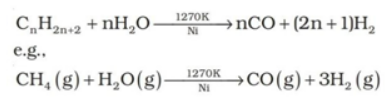
 The mixture of $CO$ and $H_2$ is called water Gas. As this mixture of $CO$ and $H_2$ is used for The synthesis of methanol and a number of Hydrocarbons, it is also called synthesis gas Or ‘syngas’. Nowadays ‘syngas’ is produced From sewage, saw-dust, scrap wood, Newspapers etc. The process of producing ‘syngas’ from coal is called ‘coal gasification’. The production of dihydrogen can be Increased by reacting carbon monoxide of Syngas mixtures with steam in the presence of Iron chromate as catalyst. This is called water-gas shift reaction. Carbon dioxide is removed by scrubbing with Sodium arsenite solution. Presently ~77% of the industrial Dihydrogen is produced from petro-chemicals, 18% from coal, 4% from electrolysis of aqueous Solutions and 1% from other sources. Physical Properties Dihydrogen is a colourless, odourless, Tasteless, combustible gas. It is lighter than Air and insoluble in water. Its other physical Properties are alongwith those of deuterium. The chemical behaviour of dihydrogen (and for That matter any molecule) is determined, to a Large extent, by bond dissociation enthalpy. The H–H bond dissociation enthalpy is the Highest for a single bond between two atoms Of any element. What inferences would you Draw from this fact ? It is because of this factor That the dissociation of dihydrogen into its Atoms is only~0.081% around 2000K which Increases to 95.5% at 5000K. Also, it is Relatively inert at room temperature due to the high H–H bond enthalpy. Thus, the atomic Hydrogen is produced at a high temperature In an electric arc or under ultraviolet Radiations. Since its orbital is incomplete with 1s1 Electronic configuration, it does combine With almost all the elements. It accomplishes Reactions by
i) loss of the only electron to Give H+, ii) gain of an electron to form H–, and iii) Sharing electrons to form a single covalent bond. The chemistry of dihydrogen can be Illustrated by the following reactions: Reaction with halogens: It reacts with Halogens, $X_2$ to give hydrogen halides, $\text{H}_2(\text{g})+\text{x}_2(\text{g})\rightarrow2\text{HX}(\text{g})(\text{x}=\text{F.CI.Br.I})$ While the reaction with fluorine occurs even in The dark, with iodine it requires a catalyst. Reaction with dioxygen: It reacts with Dioxygen to form water. The reaction is highly Exothermic. $2\text{H}_2(\text{g})+\text{O}_2(\text{g})\xrightarrow{\text{catalyst or beading}}2\text{H}_2\text{O}(\text{l}):$ $\triangle\text{H}^-=-285.9\text{kj}\text{mol}^-1$ This is the method for the manufacture of Ammonia by the Haber process. Reactions with metals: With many metals it Combines at a high temperature to yield the Corresponding hydrides $H_2$ (g) + 2M (g) → 2 MH (s); Where M is an alkali metal Reactions with metal ions and metal Oxides: It reduces some metal ions in aqueous Solution and oxides of metals (less active than Iron) into corresponding metals. $\text{H}_2(\text{g})+\text{Pd}^{2+}\text{(aq)}\rightarrow\text{Pd}(\text{s})+2\text{H}^+(\text{aq})$ $\text{y}\text{H}_2(\text{g})+\text{M}_\text{x}\text{O}_\text{y}(\text{S})\rightarrow\text{xM}(\text{s})+\text{y}\text{H}_2\text{O}\text{(l)}$ Reactions with organic compounds: It Reacts with many organic compounds in the Presence of catalysts to give useful Hydrogenated products of commercial Importance. For example: Hydrogenation of vegetable oils using Nickel as catalyst gives edible fats (margarine and vanaspati ghee) Hydroformylation of olefins yields Aldehydes which further undergo Reduction to give alcohols. $\text{H}_2+\text{CO}+\text{RCH}=\text{CH}_2\rightarrow\text{RCH}_2\text{CH}_2\text{CHO}$ $\text{H}_2+\text{RCH}_2\text{CH}_2\text{CHO}\rightarrow\text{RCH}_2\text{CH}_2\text{CH}_2\text{OH}$
  1. The mixture of CO and H2 is called …
  1. water Gas
  2. Dry ice
  3. Dry carbon
  4. Dry hydrogen
  1. Which of the following is not physical property of Dihydrogen.
  1. colourless
  2. Highest dissociation enthalpy
  3. odourless
  4. Tasteless
  1. Dihydrogen is reacts with dioxygen to get ….
  1. $H_2O_2$
  2. $2H_2O_2$
  3. $2H_2O$
  4. $H_2O$
  1. High purity dihydrogen is obtained by electrolysing warm aqueous barium hydroxide solution between… electrodes.
  1. Chromium
  2. Copper
  3. Platinum
  4. Nickel
Answer
  1. (a) water gas
  2. (b) Highest dissociation enthalpy
  3. (c) $2H_2O$
  4. (d) Nickel
View full question & answer
Question 24 Marks
Read the passage given below and answer the following questions from 1 to 5.
The unusual properties of water in the Condensed phase (liquid and solid states) are Due to the presence of extensive hydrogen Bonding between water molecules. This leads To high freezing point, high boiling point, high Heat of vaporisation and high heat of fusion in Comparison to $H_2S$ and $H_2Se$. In comparison To other liquids, water has a higher specific Heat, thermal conductivity, surface tension, Dipole moment and dielectric constant, etc. these properties allow water to play a key role In the biosphere. In the gas phase water is a bent molecule with a bond angle of $104.5^\circ$ , and O–H bond length Of 95.7 pm
It is a highly polar molecule. Its orbital overlap. In the liquid Phase water molecules are associated together By hydrogen bonds. The crystalline form of water is ice. At Atmospheric pressure ice crystallises in the Hexagonal form, but at very low temperatures It condenses to cubic form.
Density of ice is Less than that of water. Therefore, an ice cube Floats on water. In winter season ice formed On the surface of a lake provides thermal Insulation which ensures the survival of the Aquatic life. This fact is of great ecological Significance. Structure of Ice Ice has a highly ordered three dimensional Hydrogen bonded structure. Examination of ice crystals with X-rays shows that each oxygen atom is Surrounded tetrahedrally by four other oxygen Atoms at a distance of 276 pm.
Hydrogen bonding gives ice a rather open Type structure with wide holes. These holes can Hold some other molecules of appropriate size Interstitially.
Water reacts with a large number of Substances. Some of the important reactions Are given below.
Amphoteric Nature: It has the ability to act as an acid as well as a base i.e., it behaves As an amphoteric substance. In the Brönsted Sense it acts as an acid with $NH_3$ and a base with $H_2S.$
$\text{H}_2\text{O}(\text{l})+\text{NH}_3(\text{aq})\rightleftharpoons\text{OH}^-(\text{aq})+\text{NH}^+_4\text{aq}$
$\text{H}_2\text{O}(\text{l})+\text{H}_2\text{S}(\text{aq})\rightleftharpoons\text{H}_3\text{O}^+(\text{aq})+\text{HS}^-\text{(aq)}$
The auto protolysis (self-ionzation) of water takes palace as follow:
$\text{H}_2\text{O}(\text{l})+\text{H}_2\text{O}(\text{l})\rightleftharpoons\text{H}_3\text{O}^+(\text{aq})+\text{OH}^-(\text{aq})$
$\text{acid-1 base-2 (acid-2) base-1}$
$\text{(acid) (base) (conjugate acid) (conjugate base)}$
Redox Reactions Involving Water: Water Can be easily reduced to dihydrogen by highly Electropositive metals.
$2\text{H}_2\text{O}(\text{l})+2\text{Na}\text{(s)}\rightarrow2\text{NaOH}\text{(aq)}+\text{H}_2\text{g}$
Thus. it is a great source of dihydrogen.
water is oxidished to $O_2$ during photosynthesis.
$6\text{CO}_2\text{g}+12\text{H}_2\text{O}(\text{l})\rightarrow\text{C}_6\text{H}_{12}\text{O}_6(\text{aq})+6\text{H}_2\text{O}{\text{l}}+6\text{O}_2\text{(g)}$
With fluorine also it is oxidised to $O_2.$
$2\text{F}_2\text{g}+2\text{H}_2\text{O}(\text{l})\rightarrow4\text{H}^+(\text{aq})+4\text{F}^-(\text{aq})+\text{O}_2\text{(G)}$
Hydrolysis Reaction: Due to high Dielectric constant, it has a very strong Hydrating tendency. It dissolves many ionic Compounds. However, certain covalent and Some ionic compounds are hydrolysed in water.
$\text{P}_4\text{O}_{10}(\text{s})+6\text{H}_2\text{O}(\text{l})\rightarrow4\text{H}_3\text{PO}_4\text{(aq)}$
$\text{SiCl}_4{\text{l}}+2\text{H}_2\text{O}(\text{l})\rightarrow\text{SiO}_2\text{(s)}+4\text{HCl}\text{(aq)}$
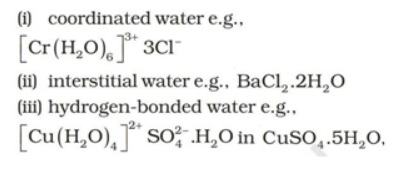
Hydrates Formation: From aqueous Solutions many salts can be crystallised as Hydrated salts. Such an association of water Is of different types viz., Coordinated water e.g.,

Hard and Soft Water- Rain water is almost pure (may contain some Dissolved gases from the atmosphere). Being a Good solvent, when it flows on the surface of The earth, it dissolves many salts. Presence of Calcium and magnesium salts in the form of Hydrogencarbonate, chloride and sulphate in Water makes water ‘hard’. Hard water does Not give lather with soap. Water free from Soluble salts of calcium and magnesium is Called Soft water. It gives lather with soap Easily. Temporary hardness is due to the presence of Magnesium and calcium hydrogen- Carbonates. It can be removed by:
Boiling: During boiling, the soluble $Mg(HCO_3)_2$ is converted into insoluble $Mg(OH)_2$ And $Ca(HCO_3)_2$ is changed to insoluble $CaCO_3$. It is because of high solubility product of $Mg(OH)_2$ as compared to that of $MgCO_3$, that $Mg(OH)_2$ is precipitated. These precipitates can Be removed by filtration. Filtrate thus obtained
Will be soft water.
$\text{Mg}(\text{HCO}_3)_2\xrightarrow{\text{Heating}}\text{Mg}(\text{OH})_2\downarrow+2\text{CO}_2\uparrow$
$\text{Ca}(\text{HCO}_3)_2\xrightarrow{\text{Heating}}\text{CaCO}_3\downarrow+\text{H}_2\text{O}+\text{CO}_2\uparrow$
Clark’s method: In this method calculated Amount of lime is added to hard water. It Precipitates out calcium carbonate and Magnesium hydroxide which can be filtered off.
Permanent Hardness is due to the presence of soluble salts of Magnesium and calcium in the form of Chlorides and sulphates in water. Permanent Hardness is not removed by boiling.
$\text{Ca}(\text{Hco}_3)_2+\text{Ca}(\text{OH)}_2\rightarrow2\text{CaCO}_3\downarrow2\text{H}_2\text{O}$
$\text{Mg}(\text{HCO)}_3+2\text{Ca}\text{(Oh)}_2\rightarrow2\text{CaCO}_3\downarrow+\text{Mg}(\text{OH)}_2\downarrow2\text{H}_2\text{O}$
Permanent Hardness is due to the presence of soluble salts of Magnesium and calcium in the form of Chlorides and sulphates in water. Permanent Hardness is not removed by boiling.
  1. In the gas phase water is a bent molecule with a bond angle of:
  1. $104.5^\circ$
  2. $94.5^\circ$
  3. $110.5^\circ$
  4. $95.5^\circ$
  1. At Atmospheric pressure ice crystallises in the … form.
  1. Cubic
  2. Hexagonal
  3. Octagonal
  4. Pentagonal
  1. Water free from Soluble salts of calcium and magnesium is called …
  1. hard water
  2. dry water
  3. soft water
  4. None of above
  1. Water has…. Nature.
  1. acidic
  2. basic
  3. neutral
  4. amphoteric
  1. Water is…. Molecule.
  1. Polar
  2. Non- Polar
  3. Ionic
  4. All the above
Answer
  1. (a) $104.5^\circ$
  2. (b) Hexagonal
  3. (c) soft water
  4. (d) amphoteric
  5. (d) All the above
View full question & answer
Question 34 Marks
Read the passage given below and answer the following questions from 1 to 5.
Hydrogen Peroxide $(H_2O_2)$ Hydrogen peroxide is an important chemical used in pollution control treatment of domestic and industrial effluents.It can be prepared by the following methods.
i) Acidifying barium peroxide and removing excess water by evaporation under reduced pressure gives hydrogen.
$\text{BaO}_2.8\text{H}_2\text{O}(\text{s})+\text{H}_2\text{SO}_4\text{(aq)}\rightarrow\text{BaSO}_4\text{(s)}+\text{H}_2\text{O}_2\text{(aq)}+8\text{H}_2\text{O}\text{l}$
ii) Peroxodisulphate, obtained by electrolytic oxidation of acidified sulphate solutions at high current density, on hydrolysis yields hydrogen.
$2\text{HSO}_\bar{4}(\text{aq})\xrightarrow{\text{Electrolysis}}\text{HO}_3\text{SOOSO}_3\text{H}(\text{aq})\xrightarrow{\text{Hydrolysis}}2\text{HSO}_\bar{4}\text{(aq)}+2\text{H}^+\text{(aq)}+\text{H}_2\text{O}_2\text{aq}$
This method is now used for the laboratory preparation of $D_2O_{2.}$
_{$\text{K}_2\text{S}_2\text{O}_8(\text{s})+2\text{D}_2\text{O}\text{(l)}\rightarrow2\text{KDSO}_4(\text{aq})+\text{D}_2\text{O}_2\text{(l)}$}
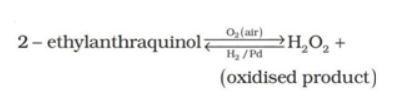
iii) Industrially it is prepared by the auto- oxidation of 2-alklylanthraquinols. 2 ethylanthraquinol H O oxidised product.

In this case 1% $H_2O_2$ is formed. It is extracted with water and concentrated to $\sim30\%$ (by mass) by distillation under reduced pressure. It can be further concentrated to $\sim85\%$ by careful distillation under low pressure. The remaining water can be frozen out to obtain pure $H_2O_2$. Physical Properties of the pure state $H_2O_2$ is an almost colourless (very pale blue) liquid. Its important physical properties. $H_2O_2$ is miscible with water in all proportions and forms a hydrate $H_2O_2.$ $H_2O$ (mp 221K). A 30% solution of $H_2O_2$ is marketed as ‘100 volume’ hydrogen peroxide. It means that one millilitre of 30% $H_2O_2$ solution will give 100 mL of oxygen at STP. Commercially marketed sample is 10 V, which means that the sample contains 3% $H_2O_2$ . Structure Hydrogen peroxide has a non-planar structure.
$H_2O_2$ decomposes slowly on exposure to light.
$2\text{H}_2\text{O}_2\text{(l)}\rightarrow2\text{H}_2\text{O}(\text{l})+\text{O}_2\text{(g)}$
In the presence of metal surfaces or traces of alkali (present in glass containers), the above reaction is catalysed. It is, therefore, stored in wax-lined glass or plastic vessels in dark. Urea can be added as a stabiliser. It is kept away from dust because dust can induce explosive decomposition of the compound.
Its wide scale use has led to tremendous increase in the industrial production of $H_2O_2$. Some of the uses are listed below:
i) In daily life it is used as a hair bleach and as a mild disinfectant. As an antiseptic it is sold in the market as
ii) It is used to manufacture chemicals like sodium perborate and per – carbonate, which are used in high quality detergents.
iii) It is used in the synthesis of hydroquinone, tartaric acid and certain food products and pharmaceuticals (cephalosporin)
iv) It is employed in the industries as a bleaching agent for textiles, paper pulp, leather, oils, fats,
v) Nowadays it is also used in Environmental (Green) Chemistry. For example, in pollution control treatment of domestic and industrial effluents, oxidation of cyanides, restoration of aerobic conditions to sewage wastes,
Heavy water, $D_2O$ It is extensively used as a moderator in nuclear reactors and in exchange reactions for the study of reaction mechanisms. It can be prepared by exhaustive electrolysis of water or as a by-product in some fertilizer industries. It is used for the preparation of other deuterium compounds, for example:
Dihydrogen can be used as a fuel .Dihydrogen releases large quantities of heat on combustion. The data on energy released by combustion of fuels like dihydrogen, methane, LPG etc. are compared in terms of the same amounts in mole, mass and volume Hydrogen Economy is an alternative. The basic principle of hydrogen economy is the transportation and storage of energy in the form of liquid or gaseous dihydrogen. Advantage of hydrogen economy is that energy is transmitted in the form of dihydrogen and not as electric power. It is for the first time in the history of India that a pilot project using dihydrogen as fuel was launched in October 2005 for running automobiles. Initially 5% dihydrogen has been mixed in CNG for use in four-wheeler vehicles. The percentage of dihydrogen would be gradually increased to reach the optimum level. Nowadays, it is also used in fuel cells for generation of electric power. It is expected that economically viable and safe sources of dihydrogen will be identified in the years to come, for its usage as a common source of energy.
  1. In India, a pilot project using dihydrogen as fuel was launched in… for running automobiles.
  1. October 2005
  2. May 2004
  3. August 2014
  4. February 2010
  1. Structure Hydrogen peroxide has a … structure.
  1. Bilateral
  2. Non-planar
  3. Planar
  4. Cubic
  1. One millilitre of 30% $H_2O_2$ solution will give … mL of oxygen at STP.
  1. 30
  2. 10
  3. 100
  4. 300
  1. …. is extensively used as a moderator in nuclear reactors and in exchange reactions for the study of reaction mechanisms.
  1. $H_2O_2$
  2. $T_2O$
  3. $H_2O$
  4. $D_2O$
  1. Colour of pure state $H_2O_2$ is ..
  1. Very Pale red
  2. Very Pale yellow
  3. Very Pale green
  4. Very Pale blue
Answer
  1. (a) October 2005
  2. (b) Non-planar
  3. (c) 100
  4. (d) $D_2O$
  5. (d) Very Pale blue
View full question & answer
Question 44 Marks
Read the passage given below and answer the following questions from 1 to 5.
Hydrogen has the simplest atomic structure among all the elements around us in Nature. In atomic form it consists of only one proton and one electron. However, in elemental form it exists as a diatomic $(H_2)$ molecule and is called dihydrogen. It forms more compounds than any other element. Do you know that the global concern related to energy can be overcome to a great extent by the use of hydrogen as a source of energy? In fact, hydrogen is of great industrial importance as you will learn in this unit. Hydrogen is the first element in the periodic table. However, its placement in the periodic table has been a subject of discussion in the past. As you know by now that the elements in the periodic table are arranged according to their electronic configurations. Hydrogen has electronic configuration $1s^1$. On one hand, its electronic configuration is similar to the outer electronic configuration $(ns^1)$ of alkali metals , which belong to the first group of the periodic table. On the other hand, like halogens (with $ns^2 np^5$ configuration belonging to the seventeenth group of the periodic table), it is short by one electron to the corresponding noble gas configuration, helium $(1s^2)$. Hydrogen, therefore, has resemblance to alkali metals, which lose one electron to form unipositive ions, as well as with halogens, which gain one electron to form uninegative ion. Like alkali metals, hydrogen forms oxides, halides and sulphides. However, unlike alkali metals, it has a very high ionization enthalpy and does not possess metallic characteristics under normal conditions. In fact, in terms of ionization enthalpy, hydrogen resembles more with halogens, $\triangle _iH$ of Li is $520\ kJ\ mol^{–1}$, F is $1680\ kJ\ mol^{–1}$and that of H is $1312\ kJ\ mol^{–1}$. Like halogens, it forms a diatomic molecule, combines with elements to form hydrides and a large number of covalent compounds. However, in terms of reactivity, it is very low as compared to halogens.
Inspite of the fact that hydrogen, to a certain extent resembles both with alkali metals and halogens, it differs from them as well. Now the pertinent question arises as where should it be placed in the periodic table? Loss of the electron from hydrogen atom results in nucleus $(H^+) of ~1.5 \times 10^{–3}\ pm$ size. This is extremely small as compared to normal atomic and ionic sizes of 50 to 200pm. As a consequence, $H^+$ does not exist freely and is always associated with other atoms or molecules. Thus, it is unique in behaviour and is, therefore, best placed separately in the periodic table. Occurrence – Dihydrogen $H^2$ is the most abundant element in the universe $(70 \%$ of the total mass of the universe) and is the principal element in the solar atmosphere. The giant planets Jupiter and Saturn consist mostly of hydrogen. However, due to its light nature, it is much less abundant (0.15% by mass) in the earth’s atmosphere. Of course, in the combined form it constitutes $15.4 \%$ of the earth’s crust and the oceans. In the combined form besides in water, it occurs in plant and animal tissues, carbohydrates, proteins, hydrides including hydrocarbons and many other compounds.
Hydrogen has three isotopes: protium, 1H, deuterium, 2H or D and tritium, 3H or T. These isotopes differ from one another in respect of the presence of neutrons. Ordinary hydrogen, protium, has no neutrons, deuterium (also known as heavy hydrogen) has one and tritium has two neutrons in the nucleus. In the year 1934, an American scientist, Harold C. Urey, got Nobel Prize for separating hydrogen isotope of mass number 2 by physical methods. The predominant form is protium. Terrestrial hydrogen contains 0.0156% of deuterium mostly in the form of HD. The tritium concentration is about one atom per 1018 atoms of protium. Of these isotopes, only tritium is radioactive and emits low energy $\beta\text{ -particles}(\text{t}\frac{1}{2}12.33\text{ years})$
  1. Hydrogen has electronic configuration ..
  1. $1s^1$
  2. $1s^2$
  3. $2s^1$
  4. $2s^2$
  1. Ionisation enthalpy of hydrogen is ..
  1. $520\ kJ\ mol^{–1}$​​​​​​​
  2. $1312\ kJ\ mol^{–1}$
  3. $1249\ kJ\ mol^{–1}$
  4. $950\ kJ\ mol^{–1}$
  1. Hydrogen has … Isotopes.
  1. 1
  2. 2
  3. 3
  4. 4
  1. got Nobel Prize for separating hydrogen isotope of mass number 2 by physical methods.
  1. Nyholm
  2. Gillespie
  3. Heitler
  4. Harold C. Urey
  1. tritium is radioactive and emits low energy…. particles.
  1. $\alpha$
  2. $\beta$
  3. $\gamma$
  4. $\sigma$
Answer
  1. a) $1s^1$
  2. b) $1312\ kJ\ mol^{–1}$
  3. c) $3$
  4. d) Harold C. Urey
  5. b)$\beta$
View full question & answer
Question 54 Marks
Read the passage given below and answer the following questions from 1 to 5. Uses of Dihydrogen:
  • The largest single use of dihydrogen is in the synthesis of ammonia which is used in the manufacture of nitric acid and nitrogenous
  • Dihydrogen is used in the manufacture of vanaspati fat by the hydrogenation of polyunsaturated vegetable oils like soyabean, cotton seeds
  • It is used in the manufacture of bulk organic chemicals, particularly
  • It is widely used for the manufacture of metal
  • It is used for the preparation of hydrogen chloride, a highly useful
  • In metallurgical processes, it is used to reduce heavy metal oxides to
  • Atomic hydrogen and oxy-hydrogen torches find use for cutting and welding purposes. Atomic hydrogen atoms (produced by dissociation of dihydrogen with the help of an electric arc) are allowed to recombine on the surface to be welded to generate the temperature of 4000
  • It is used as a rocket fuel in space
  • Dihydrogen is used in fuel cells for generating electrical energy. It has many advantages over the conventional fossil fuels and electric It does not produce any pollution and releases greater energy per unit mass of fuel in comparison to gasoline and other fuels.
Dihydrogen, under certain reaction conditions, combines with almost all elements, except noble gases, to form binary compounds, called hydrides. If ‘E’ is the symbol of an element then hydride can be expressed as EHx $($e.g., Mg $H_2)$ or EmHn $($e.g.,$B_2H_6)$. The hydrides are classified into three categories:
  • Ionic or saline or saltlike hydrides
  • Covalent or molecular hydrides
  • Metallic or non-stoichiometric hydrides
Ionic or Saline Hydrides are stoichiometric compounds of dihydrogen formed with most of the s-block elements which are highly electropositive in character. However, significant covalent character is found in the lighter metal hydrides such as LiH, $BeH_2$ and $MgH_2$. In fact Be $H_2$ and Mg $H_2$ are polymeric in structure. The ionic hydrides are crystalline, non-volatile and non- conducting in solid state. However, their melts conduct electricity and on electrolysis liberate dihydrogen gas at anode, which confirms the existence of $H^{–} ion$. Covalent or Molecular Hydride Dihydrogen forms molecular compounds with most of the p-block elements. Most familiar examples are $CH_4, NH_3, H_2O$ and $HF.$ For convenience hydrogen compounds of non- metals have also been considered as hydrides. Being covalent, they are volatile compounds. Molecular hydrides are further classified according to the relative numbers of electrons and bonds in their Lewis structure into:
  • electron-deficient,
  • electron-precise, and
  • electron-rich
An electron-deficient hydride, as the name suggests, has too few electrons for writing its conventional Lewis structure. Diborane $(B_2H_6)$ is an example. In fact all elements of group 13 will form electron-deficient compounds. They act as Lewis acids i.e., electron acceptors. Electron-precise compounds have the required number of electrons to write their conventional Lewis structures. All elements of group 14 form such compounds (e.g., $CH_4$) which are tetrahedral in geometry. Electron-rich hydrides have excess electrons which are present as lone pairs. Elements of group 15-17 form such compounds. (NH3 has 1 - lone pair, $H_2O – 2$ and $HF –3$ lone pairs). What do you expect from the behaviour of such compounds ? They will behave as Lewis bases i.e., electron donors. The presence of lone pairs on highly electronegative atoms like N, O and F in hydrides results in hydrogen bond formation between the molecules. This leads to the association of molecules. Metallic or Non-stoichiometric (or Interstitial ) Hydrides are formed by many d- block and f-block elements. However, the metals of group 7, 8 and 9 do not form hydride. Even from group 6, only chromium forms CrH. These hydrides conduct heat and electricity though not as efficiently as their parent metals do. Unlike saline hydrides, they are almost always non- stoichiometric, being deficient in hydrogen. For example, $La H_{2.87}, Yb H_{2.55}, TiH1_{.5–1.8}, ZrH_{1.3–1.75}$, etc. In such hydrides, the law of constant composition does not hold good. Earlier it was thought that in these hydrides, hydrogen occupies interstices in the metal lattice producing distortion without any change in its type. Consequently, they were termed as interstitial hydrides. However, recent studies have shown that except for hydrides of Ni, Pd, Ce and Ac, other hydrides of this class have lattice different from that of the parent metal. The property of absorption of hydrogen on transition metals is widely used in catalytic reduction / hydrogenation reactions for the preparation of large number of compounds. Some of the metals (e.g., Pd, Pt) can accommodate a very large volume of hydrogen and, therefore, can be used as its storage media. This property has high potential for hydrogen storage and as a source of energy. A major part of all living organisms is made up of water. Human body has about 65% and some plants have as much as 95% water. It is a crucial compound for the survival of all life forms. It is a solvent of great importance. The distribution of water over the earth’s surface is not uniform.​​​​​​​
  1. Dihydrogen, under certain reaction conditions, combines with almost all elements, except …
  1. Noble gases
  2. Halogens
  3. Alkali metals
  4. Alkaline earth metal
  1. Covalent or Molecular Hydride Dihydrogen forms molecular compounds with most of the p-block elements. Most familiar example is:
  1. $CH_4$
  2. $NH_3$
  3. $H_2O$
  4. All the above
  1. All elements of group 14 form such compounds have … geometry.
  1. pyramidal
  2. tetrahedral
  3. bilateral
  4. spherical
  1. From group 6, only … forms hydride.
  1. molybdenum
  2. tungsten
  3. chromium
  4. seaborgium
  1. Which of the following hydride is/ are deficient in hydrogen.
  1. $La H_2._{87}$
  2. $Yb H_2._{55}$
  3. TiH5–1.8
  4. All of above
Answer
  1. (a) noble gases
  2. (d) All the above
  3. (b) tetrahedral
  4. (c) chromium
  5. (d) All the above
View full question & answer