Questions

Assertion (A) & Reason (B) MCQ

Take a timed test

19 questions · 6 auto-graded MCQ + 13 self-marked written.

MCQ 11 Mark
For two statements are given$-$one labelled Assertion $(A)$ and the other labelled Reason $(R)$. Select the correct answer to these questions from the codes $(a), (b), (c)$ and $(d)$ as given below.
Assertion $(A):$ Charge is quantized.
Reason $(R):$ Charge which is less than $\text{IC}$ is not possible.
  • A
    Both $A$ and $R$ are true, and $R$ is the correct explanation of $A$.
  • B
    Both $A$ and $R$ are true, but $R$ is not the correct explanation of $A$
  • $A$ is true but $R$ is false.
  • D
    $A$ is false and $R$ is also false.
Answer
Correct option: C.
$A$ is true but $R$ is false.
The charge $q$ on a body is given as $q = ne$
where $n$ is any integer positive or negative.
The charge on the electron is $q = 1.6 \times 10^{-19} C$ which is less than $1C.$
View full question & answer
MCQ 21 Mark
For two statements are given-one labelled Assertion (A) and the other labelled Reason (R). Select the correct answer to these questions from the codes (a), (b), (c) and (d) as given below.
Assertion (A): The electric tines of forces diverges from a positive charge and converge at a negative charge.
​​​​​​​Reason (A): A charged particle free to move in an electric field always move along an electric line of force.
  • A
    Both A and R are true, and R is the correct explanation of A.
  • B
    Both A and R are true, but R is not the correct explanation of A.
  • A is true but R is false.
  • D
    A is false and R is also false.
Answer
Correct option: C.
A is true but R is false.
  1. A is true but R is false.
Explanation:
If the charged particle is initially at rest in an electric field, it will move along the electric line of force. But when the initial velocity of charged particle makes some angle with the line of force then the resultant path is not along the line of force. Because electric line of force may not coincide with the line of velocity of the charge.
View full question & answer
MCQ 31 Mark
For two statements are given-one labelled Assertion (A) and the other labelled Reason (R). Select the correct answer to these questions from the codes (a), (b), (c) and (d) as given below.
Assertion (A): If there exists coulomb attraction between two bodies, both of them may not be charged.
​​​​​​​Reason (R): ln coulomb attraction two bodies are oppositely charged.
  • A
    Both A and R are true, and R is the correct explanation of A.
  • Both A and R are true, but R is not the correct explanation of A.
  • C
    A is true but R is false.
  • D
    A is false and R is also false.
Answer
Correct option: B.
Both A and R are true, but R is not the correct explanation of A.
  1. Both A and R are true, but R is not the correct explanation of A.
Explanation:
Coulomb attraction exists even when one body is charged, and the other is uncharged.
View full question & answer
MCQ 41 Mark
For two statements are given-one labelled Assertion (A) and the other labelled Reason (R). Select the correct answer to these questions from the codes (a), (b), (c) and (d) as given below.
​​​​​​​Assertion (A): If a conducting medium is placed between two charges, then electric force between them becomes zero.
Reason (R): Reduction in a force due to introduced material is inversely proportional to its dielectric constant.
  • Both A and R are true, and R is the correct explanation of A.
  • B
    Both A and R are true, but R is not the correct explanation of A.
  • C
    A is true but R is false.
  • D
    A is false and R is also false.
Answer
Correct option: A.
Both A and R are true, and R is the correct explanation of A.
  1. Both A and R are true, and R is the correct explanation of A.
Explanation:
The dielectric constant of any material is $\text{K}=\frac{\text{E}_0}{\text{E}}=\frac{\frac{\text{F}_0}{\text{q}}}{\frac{\text{F}}{\text{q}}}=\frac{\text{F}_0}{\text{F}}$
$\Rightarrow \mathrm{F}=\frac{\mathrm{F}_0}{\mathrm{~K}}$, where $\mathrm{F}_0$ is force when conductor is not present between the charge. Fis a force after introduction of conductor between charges. Since dielectric constant of a conducting medium is infinity therefore $F=0$.
View full question & answer
Question 51 Mark
For two statements are given-one labelled Assertion (A) and the other labelled Reason (R). Select the correct answer to these questions from the codes (a), (b), (c) and (d) as given below.
  1. Both A and R are true, and R is the correct explanation of A.
  2. Both A and R are true, but R is not the correct explanation of A.
  3. A is true but R is false.
  4. A is false and R is also false.
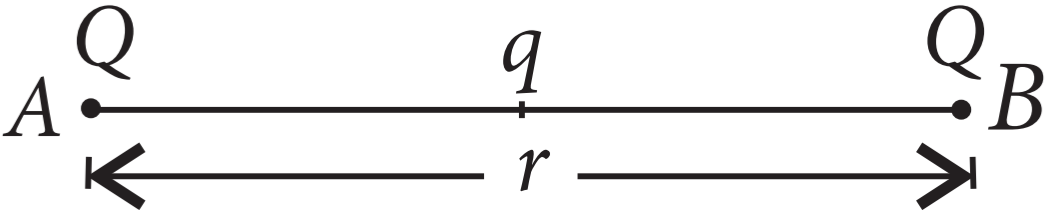
Assertion (A): For charge to be in equilibrium, sum of the forces on charge due to rest of the two charges must be zero.
Reason (R): A charge is lying at the centre of the line joining two similar charges each which are fixed. The system will be in equilibrium if that charge is one fourth of the similar charges.
Answer
  1. A is true but R is false.
Explanation:

According to Coulomb's law, $\text{F}=\text{k}\frac{\text{Q}_1\text{Q}_2}{\text{r}^2}.$

The force on q due to A,

$\text{F}_\text{A}=\frac{1}{4\pi\in_0}\cdot\frac{\text{Qq}}{(\frac{\text{r}}{2})^2}$ to the right


Due to B,

$\text{F}_\text{B}=\frac{1}{4\pi\in_0}\cdot\frac{\text{Qq}}{(\frac{\text{r}}{2})^2}$ to the right

$\therefore$ Their sum is zero whether q is $+\frac{\text{Q}}{4}$or $-\frac{\text{Q}}{4}$ or any other value.

Therefore, it is not true that the third charge has to be $\frac{\text{Q}}{4}$ only. It can be any value.
View full question & answer
Question 61 Mark
For two statements are given-one labelled Assertion (A) and the other labelled Reason (R). Select the correct answer to these questions from the codes (a), (b), (c) and (d) as given below.
  1. Both A and R are true, and R is the correct explanation of A.
  2. Both A and R are true, but R is not the correct explanation of A.
  3. A is true but R is false.
  4. A is false and R is also false.
Assertion (A): ln electrostatics, electric lines of force can never be closed loops, as a line can never start and end on the same charge.
Reason (R): The number of electric lines of force originating or terminating on a charge is proportional to the magnitude of charge.
Answer
  1. Both A and R are true, but R is not the correct explanation of A.
Explanation:

Electrostatic field lines of force can never form any closed loop. Because electric field originate from positive charge and terminates on negative charge.
View full question & answer
Question 71 Mark
For two statements are given-one labelled Assertion (A) and the other labelled Reason (R). Select the correct answer to these questions from the codes (a), (b), (c) and (d) as given below.
  1. Both A and R are true, and R is the correct explanation of A.
  2. Both A and R are true, but R is not the correct explanation of A.
  3. A is true but R is false.
  4. A is false and R is also false.
Assertion (A): If a point charge be rotated in a circle around a charge, the work done will be zero.
Reason (R): Work done is equal to dot product of force and distance.
Answer
  1. Both A and R are true, and R is the correct explanation of A.
Explanation:

Work done will be zero because in rotating the charge in a circle, force is along the radius, and direction of motion is perpendicular to it.

$\therefore$ Work done, $\text{W}=\vec{\text{F}}\cdot\vec{\text{S}}=\text{FS}\cos\theta=\text{FS}\cos90^\circ=0$
View full question & answer
Question 81 Mark
For two statements are given-one labelled Assertion (A) and the other labelled Reason (R). Select the correct answer to these questions from the codes (a), (b), (c) and (d) as given below.
  1. Both A and R are true, and R is the correct explanation of A.
  2. Both A and R are true, but R is not the correct explanation of A.
  3. A is true but R is false.
  4. A is false and R is also false.
Assertion (A): A point charge is brought in an electric field. The field at a nearby point is increase, whatever be the nature of the charge.
Reason (R): The electric field is independent of the nature of charge.
Answer
  1. A is false and R is also false.
Explanation:

Electric field at the nearby point will be resultant of existing field and field due to the charge brought. lt may increase or decrease if the charge is positive or negative depending on the position of the point with respect to the charge brought.
View full question & answer
Question 91 Mark
For two statements are given-one labelled Assertion (A) and the other labelled Reason (R). Select the correct answer to these questions from the codes (a), (b), (c) and (d) as given below.
  1. Both A and R are true, and R is the correct explanation of A.
  2. Both A and R are true, but R is not the correct explanation of A.
  3. A is true but R is false.
  4. A is false and R is also false.
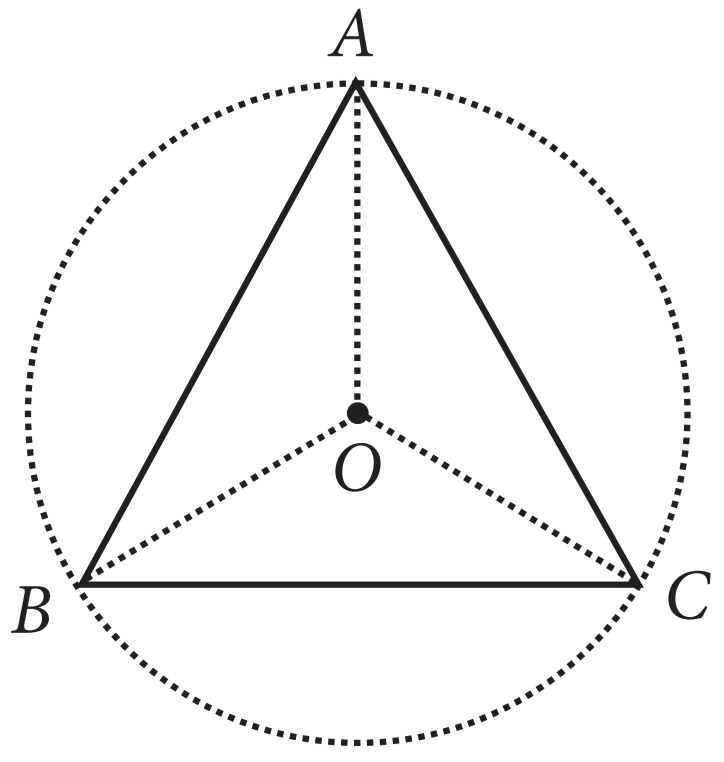
Assertion (A): Three equal charges are situated on a circle of radius r such that they form on equilateral triangle, then the electric field intensity at the centre is zero.
Reason (R): The force on unit positive charge at the centre, due to the three equal charges are represented by the three sides of a triangle taken in the same order. Therefore, electric field intensity at centre is zero.
Answer
  1. Both A and R are true, and R is the correct explanation of A.
Explanation:

Resultant of electric intensity at O due to B and C is equal and opposite to that due to A.

​​​​​​​​​​​​​​
View full question & answer
MCQ 101 Mark
For two statements are given-one labelled Assertion (A) and the other labelled Reason (R). Select the correct answer to these questions from the codes (a), (b), (c) and (d) as given below.
Assertion (A): As force is a vector quantity, hence electric field intensity is also a vector quantity.
​​​​​​​Reason (R): 'Tile unit of electric field intensity is newton per coulomb.
  • A
    Both A and R are true, and R is the correct explanation of A.
  • Both A and R are true, but R is not the correct explanation of A.
  • C
    A is true but R is false.
  • D
    A is false and R is also false.
Answer
Correct option: B.
Both A and R are true, but R is not the correct explanation of A.
  1. Both A and R are true, but R is not the correct explanation of A.
Explanation:
The electric field intensity is equal to force experienced by unit positive test charge $\mathrm{q}_0$ placed at that point i.e.
$\vec{\text{E}}=\frac{\vec{\text{F}}}{\text{q}_0}$ thus $\vec{\text{E}}$ is also a vector quality,
As, $\text{E}=\frac{\text{F}}{\text{q}}=\frac{\text{newton}}{\text{coulomb}}.$
View full question & answer
Question 111 Mark
For two statements are given-one labelled Assertion (A) and the other labelled Reason (R). Select the correct answer to these questions from the codes (a), (b), (c) and (d) as given below.
  1. Both A and R are true, and R is the correct explanation of A.
  2. Both A and R are true, but R is not the correct explanation of A.
  3. A is true but R is false.
  4. A is false and R is also false.
Assertion (A): Charging is due to transfer of electrons.
Reason (R): Mass of a body decreases slightly when it is negatively charged.
Answer
  1. A is true but R is false.
Explanation:

A body becomes negatively charged only when some electrons are transferred to the body i.e. the body gains some electrons. Hence its mass increases slightly. Mass of a body decreases only when body gives some electrons to some other body.
View full question & answer
Question 121 Mark
For two statements are given-one labelled Assertion (A) and the other labelled Reason (R). Select the correct answer to these questions from the codes (a), (b), (c) and (d) as given below.
  1. Both A and R are true, and R is the correct explanation of A.
  2. Both A and R are true, but R is not the correct explanation of A.
  3. A is true but R is false.
  4. A is false and R is also false.
Assertion (A): Sharper is the curvature of spot on a charged body lesser will be the surface charge density at that point.
Reason (R): Electric field is non-zero inside a charged conductor.
Answer
  1. A is false and R is also false.
Explanation:

Surface of a charged conductor is always an equipotential surface, whatever may be its shape. Hence, $\sigma\text{R}=$ constant, at every point on the surface of charged conductor i.e. at the sharpest point (R → 0) of the surface, charge density will be maximum. A uniformly charged conductor exerts no electrostatic force on a point charge located anywhere inside the conductor or electric field is zero.
View full question & answer
Question 131 Mark
For two statements are given-one labelled Assertion (A) and the other labelled Reason (R). Select the correct answer to these questions from the codes (a), (b), (c) and (d) as given below.
  1. Both A and R are true, and R is the correct explanation of A.
  2. Both A and R are true, but R is not the correct explanation of A.
  3. A is true but R is false.
  4. A is false and R is also false.
Assertion (A): Electric force acting on a proton and an electron, moving in a uniform electric field is the same, where as acceleration of electron is 1836 times that of a proton.
Reason (R): Electron is lighter than proton.
Answer
  1. Both A and R are true, and R is the correct explanation of A.
Explanation:

As F = qE, and charge (q) on an electron and on a proton has the same magnitude, therefore force (F) on each is same. Now, acceleration $\text{a}=\frac{\text{F}}{\text{m}}.$

Mass of electron $=\frac{1}{1836}$ mass of a proton. Therefore, acceleration of electron is 1836 times that of a proton.
View full question & answer
Question 141 Mark
For two statements are given-one labelled Assertion (A) and the other labelled Reason (R). Select the correct answer to these questions from the codes (a), (b), (c) and (d) as given below.
  1. Both A and R are true, and R is the correct explanation of A.
  2. Both A and R are true, but R is not the correct explanation of A.
  3. A is true but R is false.
  4. A is false and R is also false.
Assertion (A): No two electric lines of force can intersect each other.
Reason (R): Tangent at any point of electric line of force gives the direction of electric field.
Answer
  1. Both A and R are true, and R is the correct explanation of A.
Explanation:

If the two electric tines of force can intersect each other then at the point of intersection, we can draw two tangents to the two lines of force. This would mean two directions of electric field intensity at the point of intersection, which is not possible.
View full question & answer
MCQ 151 Mark
For two statements are given-one labelled Assertion (A) and the other labelled Reason (R). Select the correct answer to these questions from the codes (a), (b), (c) and (d) as given below.
Assertion (A): The electric flux emanating out and entering a closed surface are $8 \times 10^3$ and $2 \times 10^3 \mathrm{Vm}$ respectively. The charge enclosed by the surface is $0.053\mu\text{C}.$
Reason (R): Gauss's theorem in electrostatics may be applied to verify.
  • A
    Both A and R are true, and R is the correct explanation of A.
     
  • B
    Both A and R are true, but R is not the correct explanation of A.
     
  • C
    A is true but R is false.
     
  • D
    A is false and R is also false.
Answer
  1. Both A and R are true, and R is the correct explanation of A.
Explanation:

According to Gauss's theorem in electrostatics,$\phi=\frac{\text{q}}{\in_0}$

$\phi=\frac{\text{q}}{\in_0}=8.85\times10^{-12}[8\times10^3-2\times10^3]$

$=53.10\times10^{-9}\text{C}=0.053\mu\text{C}.$
View full question & answer
Question 161 Mark
For two statements are given-one labelled Assertion (A) and the other labelled Reason (R). Select the correct answer to these questions from the codes (a), (b), (c) and (d) as given below.
  1. Both A and R are true, and R is the correct explanation of A.
  2. Both A and R are true, but R is not the correct explanation of A.
  3. A is true but R is false.
  4. A is false and R is also false.
Assertion (A): A point charge is lying at the centre of a cube of each side. The electric flux emanating from each surface of the cube is $\frac{1^\text{th}}{6}$ of total flux.
Reason (R): According to Gauss theorem, total electric flux through a closed surface enclosing a charge is equal to $\frac{1}{\in_0}$ times the magnitude of the charge enclosed.
Answer
  1. Both A and R are true, but R is not the correct explanation of A.
Explanation:

The electric flux through the cube, $\phi=\frac{\text{q}}{\in_0}.$ A cube has six faces of equal area. Therefore, electric flux through each face $=\frac{1}{6}\phi=\frac{1}{6}(\frac{\text{q}}{\in_0}).$
View full question & answer
Question 171 Mark
For two statements are given-one labelled Assertion (A) and the other labelled Reason (R). Select the correct answer to these questions from the codes (a), (b), (c) and (d) as given below.
  1. Both A and R are true, and R is the correct explanation of A.
  2. Both A and R are true, but R is not the correct explanation of A.
  3. A is true but R is false.
  4. A is false and R is also false.
Assertion (A): A small metal ball is suspended in a uniform electric field with an insulated thread. If high-energy X-ray beam falls on the ball, the ball will be deflected in the electric field.
Reason (R): X-rays emits photoelectron and metal becomes negatively charged.
Answer
  1. A is true but R is false.
Explanation:

When high energy X-ray beam falls on the ball, the metal will emit photoelectrons, thus leaving the positive charge on the ball. As a result of this, ball is deflected in the direction of the electric field.
View full question & answer
Question 181 Mark
For two statements are given-one labelled Assertion (A) and the other labelled Reason (R). Select the correct answer to these questions from the codes (a), (b), (c) and (d) as given below.
  1. Both A and R are true, and R is the correct explanation of A.
  2. Both A and R are true, but R is not the correct explanation of A.
  3. A is true but R is false.
  4. A is false and R is also false.
Assertion (A): Range of Coulomb force is infinite.
Reason (R): Coulomb force acts between two charged particles.
Answer
  1. Both A and R are true, but R is not the correct explanation of A.
Explanation:

Coulomb's force or electric force given by Coulomb's law is valid over nuclear distances $(\cong10^{-15}\text{m})$ as well as over very large distances.

From Coulomb's law, $\text{F}=\frac{\text{k }\mid\text{ q}_1 \parallel\text{ q}_2 \mid}{\text{r}^2}.$ This generally holds only for charged objects whose size are much smaller than the distance between them.
View full question & answer
MCQ 191 Mark
For two statements are given-one labelled Assertion (A) and the other labelled Reason (R). Select the correct answer to these questions from the codes (a), (b), (c) and (d) as given below.
Assertion (A): The surface densities of two spherical conductors of different radii are equal. Then the electric field intensities near their surface are also equal.
Reason (R): Surface density is equal to charge per unit area.
  • A
    Both A and R are true, and R is the correct explanation of A.
  • Both A and R are true, but R is not the correct explanation of A.
  • C
    A is true but R is false.
  • D
    A is false and R is also false.
Answer
Correct option: B.
Both A and R are true, but R is not the correct explanation of A.
  1. Both A and R are true, but R is not the correct explanation of A.
Explanation:
As, $\sigma_1=\sigma_2$ (Given)
$\therefore\frac{\text{q}_1}{4\pi\text{r}_1^2}=\frac{\text{q}_2}{4\pi\text{r}_2^2},$
Or $\frac{\text{q}_1}{\text{q}_2}=\frac{\text{r}_1^2}{\text{r}^2_2}$
[Let $\mathrm{r}_1$ and $\mathrm{r}_2$ be two different radii) Then the ratio of electric field intensities near the surface of spherical conductors,
$\frac{\text{E}_1}{\text{E}_2}=\frac{\text{q}_1}{4\pi\in_0\text{r}^2_1}\times\frac{4\pi\in_0\text{r}^2_2}{\text{q}_2}$
$=\frac{\text{q}_1}{\text{q}_2}\times\frac{\text{r}^2_2}{\text{r}^2_1}=\frac{\text{q}_1}{\text{q}_2}\times\frac{\text{q}_2}{\text{q}_1}=1$
i.e. $\mathrm{E}_1=\mathrm{E}_2$.
View full question & answer