Questions

1 Marks Question

Take a timed test

49 questions · self-marked practice — reveal the answer and mark yourself.

Question 11 Mark
Answer carefully:Two large conducting spheres carrying charges $Q_1$ and $Q_2$ are brought close to each other. Is the magnitude of electrostatic force between them exactly given by $\frac{\text{Q}_1\text{Q}_2}{{4}\pi\in_{0}\text{r}^{2}}$, where r is the distance between their centres?
Answer
The force between two conducting spheres is not exactly given by the expression, $\frac{\text{Q}_1\text{Q}_2}{{4}\pi\in_{0}\text{r}^{2}}$, because there is a non-uniform charge distribution on the spheres.
View full question & answer
Question 21 Mark
Answer the following:
What are the forms of energy into which the electrical energy of the atmosphere is dissipated during a lightning?
(Hint: The earth has an electric field of about $100 \mathrm{Vm}^{-1}$ at its surface in the downward direction, corresponding to a surface charge density $=-10^{-9} \mathrm{Cm}^{-2}$. Due to the slight conductivity of the atmosphere up to about 50 km (beyond which it is good conductor), about +1800 C is pumped every second into the earth as a whole. The earth, however, does not get discharged since thunderstorms and lightning occurring continually all over the globe pump an equal amount of negative charge on the earth.)
Answer
During lightning and thunderstorm, light enerqv, heat energy, and sound energy are dissipated in the atmosphere.
View full question & answer
Question 31 Mark
Answer carefully:
What meaning would you give to the capacitance of a single conductor?
Answer
The capacitance of a single conductor is considered as a parallel plate capacitor with one of its two plates at infinity.
View full question & answer
Question 41 Mark
Answer carefully:
A small test charge is released at rest at a point in an electrostatic field configuration. Will it travel along the field line passing through that point?
Answer
Yes,
If a small test charge is released at rest at a point in an electrostatic field conflquration, then it will travel along the field lines passing through the point, only if the field lines are straight. This is because the field lines give the direction of acceleration and not of velocity.
View full question & answer
Question 51 Mark
Answer the following:
The top of the atmosphere is at about 400 kV with respect to the surface of the earth, corresponding to an electric field that decreases with altitude. Near the surface of the earth, the field is about $100 \mathrm{Vm}^{-1}$. Why then do we not get an electric shock as we step out of our house into the open? (Assume the house to be a steel cage so there is no field inside!)
Answer
We do not get an electric shock as we step out of our house because the original equipotential surfaces of open air changes, keeping our body and the ground at the same potential.
View full question & answer
Question 61 Mark
Answer carefully:
What is the work done by the field of a nucleus in a complete circular orbit of the electron? What if the orbit is elliptical?
Answer
Whenever the electron completes an orbit, either circular or elliptical, the work done by the field of a nucleus is zero.
View full question & answer
Question 71 Mark
Answer carefully:
Guess a possible reason why water has a much greater dielectric constant (= 80) than say, mica (= 6).
Answer
Water has an unsvrnrnetrlcal space as compared to mica. Since it has a permanent dipole moment, it has a greater dielectric constant than mica.
View full question & answer
Question 81 Mark
Answer carefully:
If Coulomb’s law involved $\frac{1}{\text{r}^{3}}$ dependence $(\text{instead of}\ \frac{1}{\text{r}^{2}})$, would Gauss’s law be still true?
Answer
Gauss's law will not be true, if Coulomb's law involved $\frac{1}{\text{r}^{3}}$ dependence, instead of $\frac{1}{\text{r}^{2}}$, on r.
View full question & answer
Question 91 Mark
Answer carefully:
We know that electric field is discontinuous across the surface of a charged conductor. Is electric potential also discontinuous there?
Answer
No,
Electric field is discontinuous across the surface of a charqed conductor. However, electric potential is continuous.
View full question & answer
Question 101 Mark
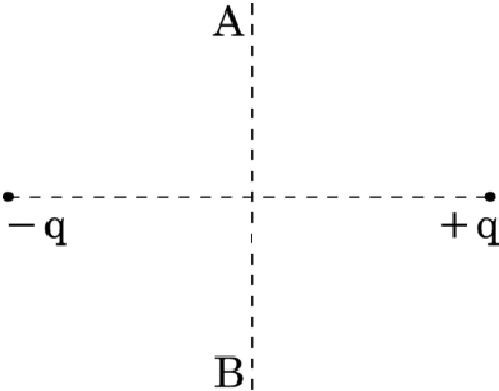
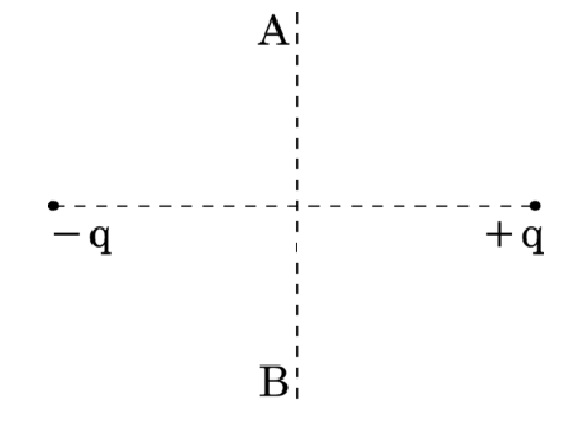
A charge 'q' is moved from a point A above a dipole of dipole moment 'p' to a point B below the dipole in equatorial plane without acceleration. Find the work done in the process.
Answer
No work is done $/
W=\mathrm{qV}_{\mathrm{AB}}=\mathrm{q} \times 0=0$.
View full question & answer
Question 111 Mark
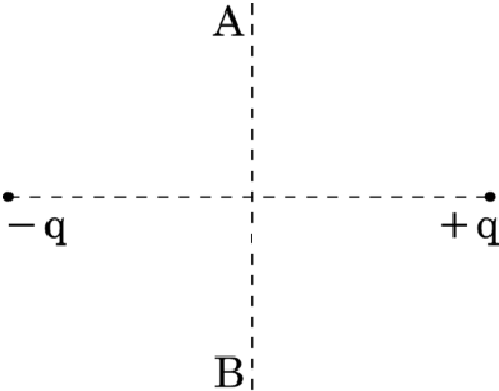
A charge 'q' is moved from a point A above a dipole of dipole moment 'p' to a point B below the dipole in equatorial plane without acceleration. Find the work done in the process.
Answer
No work is done $/
W=\mathrm{qV}_{\mathrm{AB}}=\mathrm{q} \times 0=0$.
View full question & answer
Question 121 Mark
A charge 'q' is moved from a point A above a dipole of dipole moment 'p' to a point B below the dipole in equatorial plane without acceleration. Find the work done in the process.
Answer
No work is done/
$\mathrm{W}=\mathrm{qV}_{\mathrm{AB}}=\mathrm{q} \times 0=0$.
View full question & answer
Question 131 Mark
A hollow metal sphere of radius 5 cm is charged such that the potential on its surface is 10 V. What is the potential at the centre of the sphere?
Answer
10 V.
View full question & answer
Question 141 Mark
Name the physical quantity whose S.I. unit is $\mathrm{JC}^{-1}$. Is it a scalar or a vector quantity?
Answer
Electric potential, scalar.
View full question & answer
Question 161 Mark
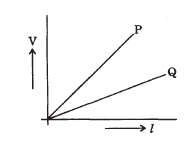
The variation of potential difference V with lengthlin case of two potentiometers P and Q is as shown. Which one of these two will you prefer for comparing emfs of two primary cells?
Answer
Potentiometer Q.
View full question & answer
Question 171 Mark
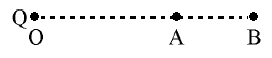
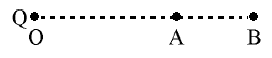
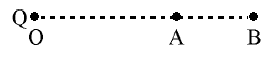
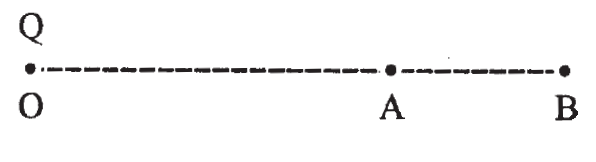
A point charge $Q$ is placed at point ' $O$ ' as shown in the figure. Is the potential at point $A$, i.e. $V_A$, greater, smaller or equal to potential, $\mathrm{V}_{\mathrm{B}}$, at point B , when Q is (i) positive, and (ii) negative charge?
Answer
  1. $V_A>V_B$
  2. $V_A<V_B$
View full question & answer
Question 181 Mark
A point charge $Q$ is placed at point $O$ as shown in the figure. The potential difference $V_A-V_B$ positive. Is the charge $Q$ negative or positive?
Answer
$V_A-V_B>0$
View full question & answer
Question 191 Mark
The charging current for a capacitor is 0.25 A. What is the displacement current across its plates?
Answer
$I_D=0.25 A$
View full question & answer
Question 201 Mark
A point charge Q is placed at point ' O ' as shown in the figure. Is the potential at point A , i.e. $\mathrm{V}_{\mathrm{A}}$, greater, smaller or equal to potential, $\mathrm{V}_{\mathrm{B}}$, at point B , when Q is (i) positive, and (ii) negative charge?
Answer
  1. $V_A>V_B$
  2. $V_A<V_B$
View full question & answer
Question 211 Mark
A point charge $Q$ is placed at point $O$ as shown in the figure. The potential difference $V_A-V_B$ positive. Is the charge Q negative or positive?
Answer
$V_A-V_B>0$.
View full question & answer
Question 221 Mark
A point charge Q is placed at point ' O ' as shown in the figure. Is the potential at point A , i.e. $\mathrm{V}_{\mathrm{A}}$, greater, smaller or equal to potential, $\mathrm{V}_{\mathrm{B}}$, at point B , when Q is (i) positive, and (ii) negative charge?
Answer
  1. $V_A>V_B$
  2. $V_A<V_B$
View full question & answer
Question 231 Mark
A point charge $Q$ is placed at point $O$ as shown in the figure. The potential difference $V_A-V_B$ positive. Is the charge $Q$ negative or positive?
Answer
$V_A-V_B>0$.
View full question & answer
Question 241 Mark
How does the electric flux due to a point charge enclosed by a spherical Gaussian surface get affected when its radius is increased?
Answer
Electric flux remains unaffected.
View full question & answer
Question 251 Mark
A point charge $+Q$ is placed at point $O$ as shown in the figure. Is the potential difference $V_A-V_B$ positive, negative or zero?
Answer
Positive.
View full question & answer
Question 261 Mark
A point charge $+Q$ is placed at point $O$ as shown in the figure. Is the potential difference $V_A-V_B$ positive, negative or zero?
Answer
Positive.
View full question & answer
Question 271 Mark
A point charge $+Q$ is placed at point $O$ as shown in the figure. Is the potential difference $V_A-V_B$ positive, negative or zero?
Answer
Positive.
View full question & answer
Question 281 Mark
"For any charge configuration, equipotential surface through a point is normal to the electric field." Justify.
Answer
If Electric field is not normal, it will have non-zero component along the surface. In that case, work would be done in moving a charge on an equipotential surface.
View full question & answer
Question 291 Mark
When electrons drift in a metal from lower to higher potential, does it mean that all the free electrons of the metal are moving in the same direction?
Answer
No.
View full question & answer
Question 301 Mark
A point charge $Q$ is placed at point $O$ as shown in the figure. Is the potential difference $V_A-V_B$ positive, negative or zero, if $Q$ is (i) positive (ii) negative?
Answer
  1. Positive.
  2. Negative.
View full question & answer
Question 311 Mark
A 500 µC charge is at the centre of a square of side 10 cm. Find the work done in moving a charge of 10 µC between two diagonally opposite points on the square.
Answer
(HOTS)ZeroAlternate Answer
W = q x pot. difference between the two points.
= q x 0 = 0
Alternate Answer
The work done is zero as the two points are at the same potential.
View full question & answer
Question 321 Mark
How is displacement current produced between the plates of a parallel plate capacitor during charging?
Answer
Conduction current is established by actual movement of free electrons through a metallic conductor while displacement current is established by polarization of molecules of a dielectric under the influence of an external electric field. Displacement current is produced by time varying electric flux and electric field across the dielectric medium between capacitor plates that leads to polarization and displacement of charges.
View full question & answer
Question 331 Mark
How does the mobility of electrons in a conductor change, if the potential difference applied across the conductor is doubled, keeping the length and temperature of the conductor constant?
Answer
The mobility of electrons in a conductor is given by the expression,
$\mu=\frac{\text{eT}}{\text{m}}$
As it's independent of the applied potential difference, so it will not change if the applied potential difference will be doubled.
View full question & answer
Question 341 Mark
A capacitor has capacitance C. Is this information sufficient to know what maximum charge the capacitor can contain? If yes, what is this charges? If no, what other information is needed?
Answer
No, This information is not sufficient. Since the charge is proportional to the potential difference across the capacitor, we need to know the potential difference applied across the capacitor.
$\text{q}\propto\text{V}$
$\Rightarrow\text{q}=\text{CV}$
Here, q is the charge, V is the potential difference applied and C is the proportionality constant, i.e. capacitance.
View full question & answer
Question 351 Mark
The dielectric constant decreases if the temperature is increased. Explain this in terms of polarization of the material.
Answer
The amount of polarisation can be understood as the extent of perfect alignment of the molecules of a dielectric with an external electric field. The more aligned the molecules are with the external magnetic field, the more is the polarisation and the more will be the dielectric constant.
But with increase in temperature, the thermal agitation of the molecules or the randomness in their alignment with the field increases.
Thus, we can say that increase in temperature results in reduced polarisation and reduced dielectric constant.
View full question & answer
Question 361 Mark
A parallel plate capacitor is filled by a dielectric whose relative permittivity varies with the applied voltage (U) as $\in=\alpha\text{U}$ where $\alpha=2\text{V}^{-1}$. A similar capacitor with no dielectric is charged to $U_0= 78V.$ It is then connected to the uncharged capacitor with the dielectric. Find the final voltage on the capacitors.
Answer
Both capacitors will be connected in parallel, hence the potential difference across both capacitors should be same. Assuming the required final voltage. be U. If C is the capacitance of the capacitor without the dielectric, then the charge on the capacitor is given by $Q_1= CU$.As the capacitor with the dielectric has a capacitance $\in\text{C}$. Hence, the charge on the capacitor is given by
$\text{Q}_2=\in\text{CU}=(\alpha\text{U})\text{CU}=\alpha\text{CU}$
The initial charge on the capacitor is given by
$\text{Q}_0=\text{CU}_0$
From the conservation of charges,
$\text{Q}_0=\text{Q}_1+\text{Q}_2\Rightarrow\ \text{CU}_0=\text{CU}+\alpha\text{CU}^2$
$\Rightarrow\ \alpha\text{U}_2+\text{U}-\text{U}_0=0$
$\therefore \text{U} = \frac{-1\pm\sqrt{1+4\alpha\text{U}_0}}{2\alpha}$
On solving for $U_0= 78V$ and $\alpha=2\text{V}^{-1}$
$\text{U}=\frac{-1\pm\sqrt{1+4\times2\times78}}{2\times2}=\frac{-1\pm\sqrt{1+624}}{4}$
$=\frac{-1\pm\sqrt{625}}{4}=\frac{-1\pm25}{4}=-\frac{26}{4}\text{V and }6\text{V}$
Hence final voltage,. U = 6V.
View full question & answer
Question 371 Mark
Name the dielectric whose molecules have:
  1. Non-zero,
  2. Zero dipole moment.
Answer
  1. The dielectric having non-zero dipole moment is water or HCl.
  2. The dipole having zero dipole moment is $\mathrm{CH}_4$ or $\mathrm{H}_2$.
View full question & answer
Question 381 Mark
What is the function of a dielectric in a capacitor?
Answer
Dielectric reduces the effective potential on plates and hence increases the capacitance.
View full question & answer
Question 391 Mark
A capacitor with stored energy 4.0J is connected with an identical capacitor with no electric field in between. Find the total energy stored in the two capacitors.
Answer
Stored energy of capacitor $C_1= 4.0J$
$=\frac{1}{2}\frac{\text{q}^2}{\text{c}^2}=4.0\text{J}$
When then connected, the charge shared
$=\frac{1}{2}\frac{\text{q}^2_1}{\text{c}^2}=\frac{1}{2}\frac{\text{q}^2_2}{\text{c}^2}$
$\Rightarrow\text{q}_1=\text{q}_2$
So, that the energy should divided.
$\therefore$ The total energy stored in the two capacitors each is 2J.
View full question & answer
Question 401 Mark
Can electric field at a point be zero, while electric potential is not zero?
Answer
Yes, inside a hollow charged metallic conductor, the electric field is zero, but electric potential is finite.
View full question & answer
Question 411 Mark
The capacitance of a charged capacitor is C and the energy stored in it is U. What is the value of charge on the capacitor?
Answer
Energy stored $\text{U}=\frac{\text{Q}^2}{2\text{C}}$ where Q is charge on capacitor.
$\Rightarrow\text{Q}^2=2\text{CU}\Rightarrow\text{Charge,}\text{ Q}=\sqrt{2\text{CU}}$
View full question & answer
Question 421 Mark
Do free electrons travel to region of higher potential or lower potential?
Answer
Free electrons would travel to regions of higher potentials as they are negatively charged.
View full question & answer
Question 431 Mark
A hollow metal sphere and a solid metal sphere of equal radii are given equal charges. Which of the two will have higher potential?
Answer
The potential of a metal sphere is directly proportional to the charge q given to it and inversely proportional to its radius r.
i.e. $\text{V}=\frac{\text{q}}{4\pi\in_0\text{r}}$
Since both the spheres are conductors with the same radius and charge, the charge given to them appears on the surface evenly. Thus, the potential on the surface or within the sphere will be the same, no matter the sphere is hollow or solid.
View full question & answer
Question 441 Mark
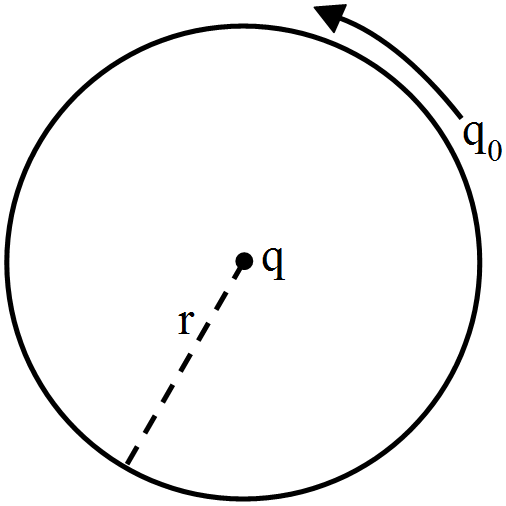
If a point charge is rotated in an arc of radius r around a charge q, what will be the work done? Explain.
Answer
All points of circle of radius r are at same potential, hence work done is zero.
View full question & answer
Question 451 Mark
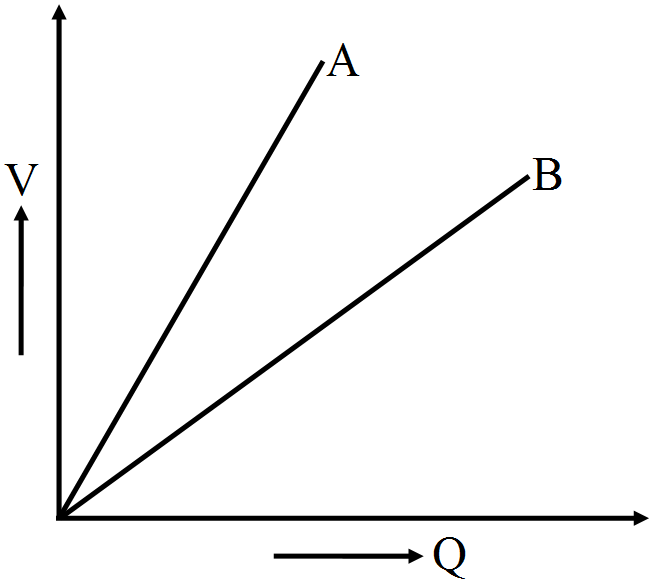
The graph shows the variation of voltage ‘V’ across the plates of two capacitors A and B versus increase of charge ‘Q’ stored on them. Which of the two capacitors has higher capacitance? Give reason for your answer.
Answer
$\text{C}=\frac{\text{Q}}{\text{V}}=\frac{1}{\text{Slope of line}}$
As slope of A is smaller, capacitance of A is higher.
View full question & answer
Question 461 Mark
Can electric potential at a point be zero, while the electric field is not zero?
Answer
Yes, electric potential is zero at all points on equatorial line of electric dipole, while electric field strength is not zero.
View full question & answer
Question 471 Mark
When a dielectric slab is gradually inserted between the plates of an isolated parallel-plate capacitor, the energy of the system decreases. What can you conclude about the force on the slab exerted by the electric field?
Answer
As the energy of the system decreases, the change in the energy is negative.
Force is defined as a negative rate of change of energy with respect to distance.
$\text{F}=-\frac{\delta\text{U}}{\delta\text{x}}$
So, as the energy decreases, the force due to the electric field of the capacitor increases when the dielectric is dragged into the capacitor.
View full question & answer
Question 481 Mark
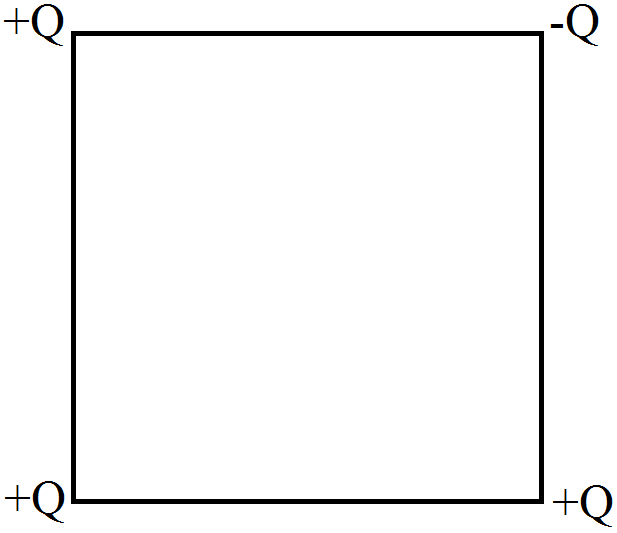
Show diagrammatically the arrangement of four point electric charges of equal magnitude placed at four corners of a square such that the electric field as well as the electric potential at the centre of the square is non-zero.
Answer
For the following arrangement of four point electric charges of equal magnitude, the electric field as well as electric potential at the centre of the square will be non-zero.
View full question & answer
Question 491 Mark
As $\text{C}=\Big(\frac{1}{\text{V}}\Big)\text{Q},$ can you say that the capacitance C is proportional to the charge Q?
Answer
No, Since capacitance is a proportionality constant, it depends neither on the charge on the plates nor on the potential. It only depends upon the size and shape of the capacitor and on the dielectric used between the plates.
The formula that shows its dependence on the size and shape of the capacitor is as follows:
$\text{C}=\frac{\in_0\text{A}}{\text{d}}$
Here, A is the area of the plates of the capacitor and d is the distance between the plates of the capacitor.
View full question & answer