Questions · Page 1 of 2

2 Marks Questions

Take a timed test

50 questions · self-marked practice — reveal the answer and mark yourself.

Question 12 Marks
Define the magnifying power of a compound microscope when the final image is formed at infinity. Why must both the objective and the eyepiece of a compound microscope has short focal lengths? Explain.
Answer
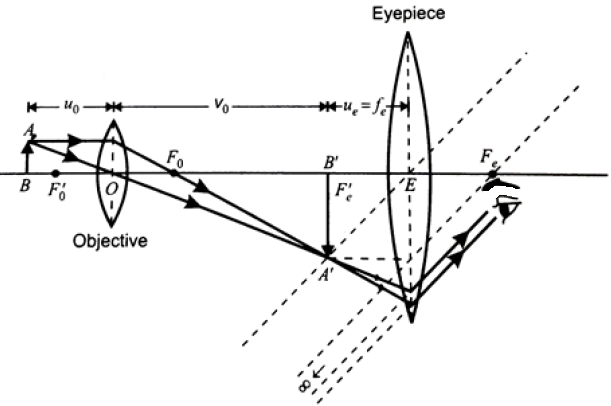
When the final image is formed at infinity.
When the final image is formed at infinity, the angular magnification due to the eyepiece is
$\text{m}_e=D/\text{f}_e$
Thus, the total magnification when the image is formed at infinity can be defined as the product of magnification of objective lens and eyepiece. i.e
$m=m_0 m_e=\left(L / f_0\right)\left(D / f_e\right)$
From the above the equation, we can see that to achieve a large magnification of a small object, the objective and eyepiece should have small focal lengths.
View full question & answer
Question 22 Marks
Answer the following question:
Magnifying power of a simple microscope is inversely proportional to the focal length of the lens. What then stops us from using a convex lens of smaller and smaller focal length and achieving greater and greater magnifying power?
Answer
The focal length of a convex lens cannot be decreased by a greater amount. This is because making lenses having very small focal lengths is not easy. Spherical and chromatic aberrations are produced by a convex lens having a very small focal length.
View full question & answer
Question 32 Marks
Does short-sightedness (myopia) or long-sightedness (hypermetropia) imply necessarily that the eye has partially lost its ability of accommodation? If not, what might cause these defects of vision?
Answer
No, a person may have normal ability of accommodation yet, he may be myopic or hypermetropic.
In fact, myopia arises when length of eye ball (from front to back) gets elongated and hypermetropia arises when length of eye ball gets shortened.
However, when eye ball has normal length, but the eye-lens losses partially its power of accommodation, this defect is called presbiopia.
View full question & answer
Question 42 Marks
A small pin fixed on a table top is viewed from above from a distance of 50cm. By what distance would the pin appear to be raised if it is viewed from the same point through a 15 cm thick glass slab held parallel to the table? Refractive index of glass = 1.5. Does the answer depend on the location of the slab?
Answer
Actual depth of the pin, d= 15 cm
Apparent dept of the pin = d'
Refractive index of glass, µ = 1.5
Ratio of actual depth to the apparent depth is equal to the refractive index of glass, i.e.
$\mu=\frac{\text{d}}{\text{d}'}$
$\therefore \ \text{d}'=\frac{\text{d}}{\mu}$
$=\frac{15}{1.5}=10 \ \text{cm}$
The distance at which the pin appears to be raised = d'− d
= 15 - 10 = 5 cm
For a small angle of incidence, this distance does not depend upon the location of the slab.
View full question & answer
Question 52 Marks
A screen is placed 90 cm from an object. The image of the object on the screen is formed by a convex lens at two different locations separated by 20 cm. Determine the focal length of the lens.
Answer
Distance between the image (screen) and the object, D = 90 cm
Distance between two locations of the convex lens, d = 20 cm
Focal length of the lens = f
Focal length is related to d and D as:
$\text{f}=\frac{\text{D}^2-\text{d}^2}{4\text{D}}$
$=\frac{(90)^2-(20)^2}{4\times90}=\frac{7700}{360}=\frac{700}{36}=21.39 \ \text{cm}$
View full question & answer
Question 62 Marks
Answer the following question:
The refractive index of diamond is much greater than that of ordinary glass. Is this fact of some use to a diamond cutter?
Answer
Yes
The refractive index of diamond (2.42) is more than that of ordinary glass (1.5). The critical angle for diamond is less than that for glass. A diamond cutter uses a large angle of incidence to ensure that the light entering the diamond is totally reflected from its faces. This is the reason for the sparkling effect of a diamond.
View full question & answer
Question 72 Marks
Answer the following question:
virtual image, we always say, cannot be caught on a screen.
Yet when we 'see' a virtual image, we are obviously bringing it on to the 'screen' (i.e., the retina) of our eye. Is there a contradiction?
Answer
No
A virtual image is formed when light rays diverge. The convex lens of the eye causes these divergent rays to converge at the retina. In this case, the virtual image serves as an object for the lens to produce a real image.
View full question & answer
Question 82 Marks
Answer the following question:
When viewing through a compound microscope, our eyes should be positioned not on the eyepiece but a short distance away from it for best viewing. Why? How much should be that short distance between the eye and eyepiece?
Answer
When we place our eyes too close to the eyepiece of a compound microscope, we are unable to collect much refracted light. As a result, the field of view decreases substantially. Hence, the clarity of the image gets blurred.
The best position of the eye for viewing through a compound microscope is at the eye-ring attached to the eyepiece. The precise location of the eye depends on the separation between the objective lens and the eyepiece.
View full question & answer
Question 92 Marks
The image of a small electric bulb fixed on the wall of a room is to be obtained on the opposite wall 3 m away by means of a large convex lens. What is the maximum possible focal length of the lens required for the purpose?
Answer
Distance between the object and the image, $d = 3\ m$
Maximum focal length of the convex lens $= f_{max}$
For real images, the maximum focal length is given as:
$\text{f}_\text{max}=\frac{\text{d}}{4}$
$=\frac{3}{4}=0.75\text{m}$
Hence, for the required purpose, the maximum possible focal length of the convex lens is 0.75 m.
View full question & answer
Question 102 Marks
Answer the following question:
The angle subtended at the eye by an object is equal to the angle subtended at the eye by the virtual image produced by a magnifying glass. In what sense then does a magnifying glass provide angular magnification?
Answer
Though the image size is bigger than the object, the angular size of the image is equal to the angular size of the object. A magnifying glass helps one see the objects placed closer than the least distance of distinct vision (i.e., 25 cm). A closer object causes a larger angular size. A magnifying glass provides angular magnification. Without magnification, the object cannot be placed closer to the eye. With magnification, the object can be placed much closer to the eye.
View full question & answer
Question 112 Marks
Answer the following question:
You have learnt that plane and convex mirrors produce virtual images of objects. Can they produce real images under some circumstances? Explain.
Answer
Yes, Plane and convex mirrors can produce real images as well. If the object is virtual, i.e., if the light rays converging at a point behind a plane mirror (or a convex mirror) are reflected to a point on a screen placed in front of the mirror, then a real image will be formed.
View full question & answer
Question 122 Marks
Answer the following question:
Does the apparent depth of a tank of water change if viewed obliquely? If so, does the apparent depth increase or decrease?
Answer
Yes;
Decrease The apparent depth of a tank of water changes when viewed obliquely. This is because light bends on travelling from one medium to another. The apparent depth of the tank when viewed obliquely is less than the near-normal viewing.
View full question & answer
Question 132 Marks
Answer the following question:
A diver under water, looks obliquely at a fisherman standing on the bank of a lake. Would the fisherman look taller or shorter to the diver than what he actually is?
Answer
The diver is in the water and the fisherman is on land (i.e., in air). Water is a denser medium than air. It is given that the diver is viewing the fisherman. This indicates that the light rays are travelling from a denser medium to a rarer medium. Hence, the refracted rays will move away from the normal. As a result, the fisherman will appear to be taller.
View full question & answer
Question 142 Marks
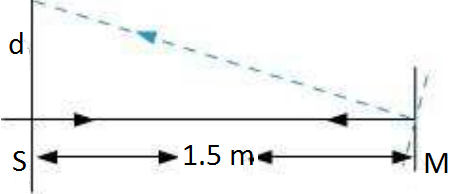
Light incident normally on a plane mirror attached to a galvanometer coil retraces backwards. A current in the coil produces a deflection of 3.5° of the mirror. What is the displacement of the reflected spot of light on a screen placed 1.5 m away?
Answer
Angle of deflection, θ = 3.5°
Distance of the screen from the mirror, D = 1.5 m
The reflected rays get deflected by an amount twice the angle of deflection i.e., 2θ = 7.0°
The displacement (d) of the reflected spot of light on the screen is given as:
$\tan2\theta=\frac{\text{d}}{1.5}$
$\therefore \ \text{d}=1.5\times\tan7^\circ=0.814 \ \text{m}=18.4 \ \text{cm}$
Hence, the displacement of the reflected spot of light is 18.4 cm.
View full question & answer
Question 152 Marks
Answer the following question:
In viewing through a magnifying glass, one usually positions one’s eyes very close to the lens. Does angular magnification change if the eye is moved back?
Answer
Yes, the angular magnification changes. When the distance between the eye and a magnifying glass is increased, the angular magnification decreases a little. This is because the angle subtended at the eye is slightly less than the angle subtended at the lens. Image distance does not have any effect on angular magnification.
View full question & answer
Question 162 Marks
Is the magnification equal to the magnifying power in this case? Explain.
Answer
Near point, D = 25 cm
Distance where the object is kept, u = 7.14 cm
Magnifying power of the lens, $\text{m}=\frac{\text{D}}{\text{u}}$
$=\frac{25}{7.14}$
= 3.5
Here, in this case since the image is formed at the least distance of distinct vision, the magnifying power is equal to the magnitude of magnification.
View full question & answer
Question 172 Marks
A person looking at a person wearing a shirt with a pattern comprising vertical and horizontal lines is able to see the vertical lines more distinctly than the horizontal ones. What is this defect due to? How is such a defect of vision corrected?
Answer
The defect is called Astigmatism. When the curvature of the cornea plus eye-lens refracting system is not the same in different planes, this defect arises. As vertical lines are seen distinctly, the curvature in the vertical plane is enough, but the curvature of the lens system is insufficient in the horizontal plane and, the lines cannot be seen distinctly.
This defect is removed by using a cylindrical lens with its axis along the vertical plane.
View full question & answer
Question 182 Marks
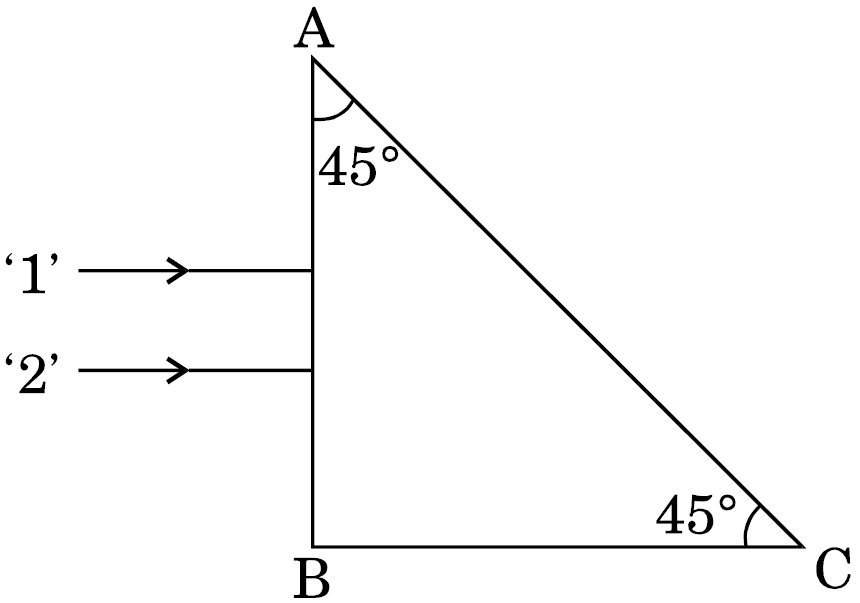
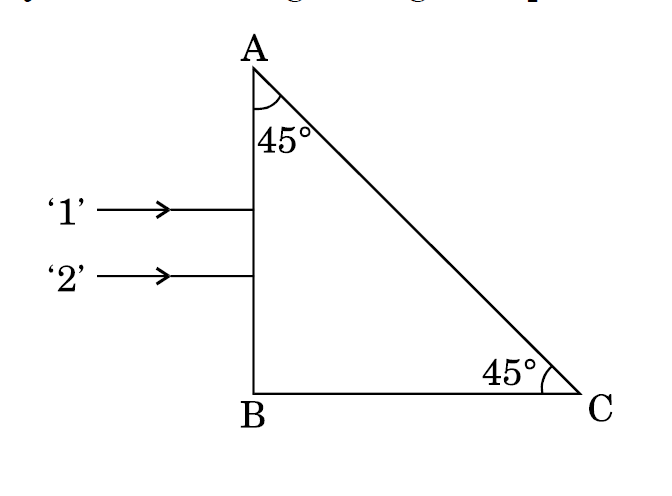
Two monochromatic rays of light are incident normally on the face AB of an isosceles right-angled prism ABC. The refractive indices of the glass prism for the two rays ‘1’ and ‘2’ are respectively 1.38 and 1.52. Trace the path of these rays after entering through the prism.
View full question & answer
Question 192 Marks
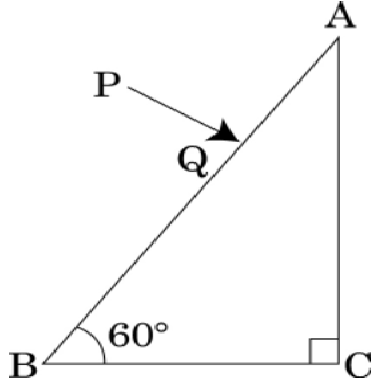
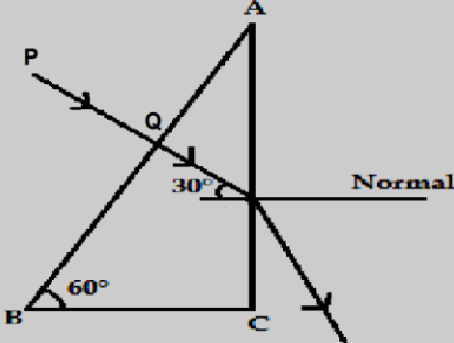
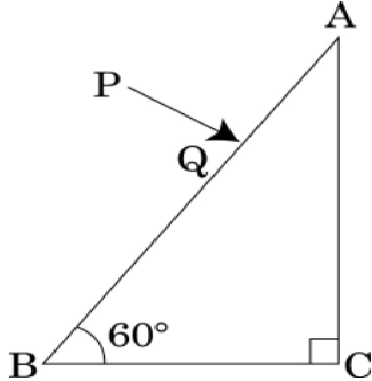
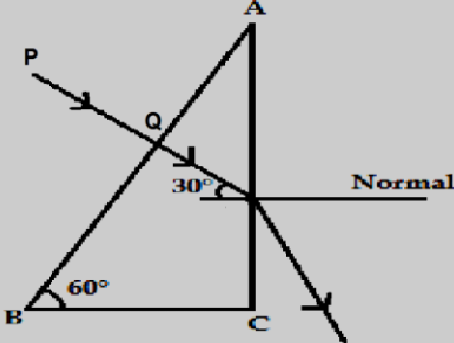
A ray PQ incident normally on the refracting face BA is refracting in the prism BAC made of material of refractive index 1.5. Complete the path of ray through the prism. From which face will the ray emerge? Justify your answer.
Answer

Face-AC
Here $\text{i}_{c} =\sin^{-1}(\frac{2}{3})$
$ = \sin^{-1}(0.6)$
$\angle\text{i}$ on face AC is 30º which is less than $\angle\text{i}_{c}$ Hence the ray get replaced here.
View full question & answer
Question 202 Marks
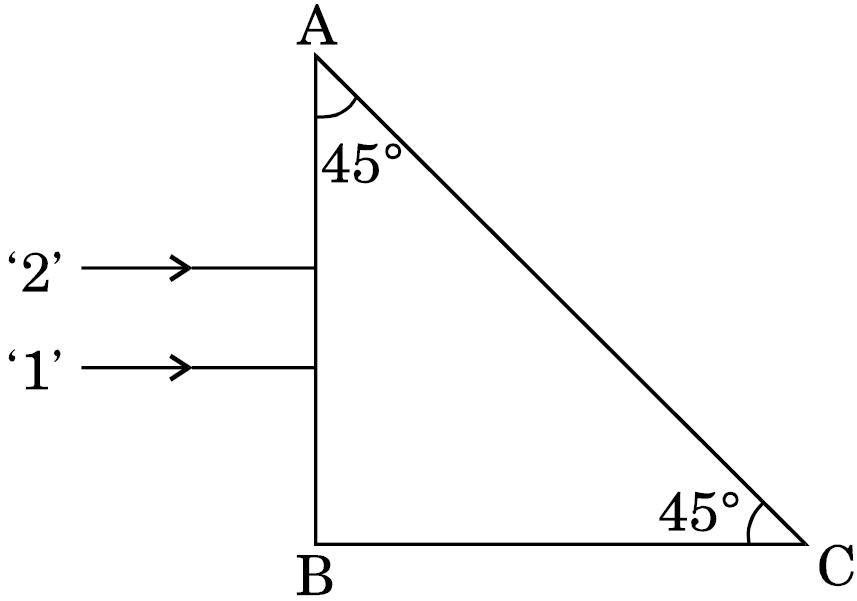
Two monochromatic rays of light are incident normally on the face AB of an isosceles right-angled prism ABC. The refractive indices of the glass prism for the two rays ‘1’ and ‘2’ are respectively 1.3 and 1.5 Trace the path of these rays after entering through the prism.
View full question & answer
Question 212 Marks
A ray PQ incident normally on the refracting face BA is refracting in the prism BAC made of material of refractive index1.5. Complete the path of ray through the prism. From which face will the ray emerge? Justify your answer.
Answer

Face-AC
Here $\text{i}_{c} =\sin^{-1}(\frac{2}{3})$
$ = \sin^{-1}(0.6)$
$\angle\text{i}$ on face AC is 30º which is less than $\angle\text{i}_{c}$ Hence the ray get replaced here.
View full question & answer
Question 222 Marks
Two monochromatic rays of light are incident normally on the face AB of an isosceles right-angled prism ABC. The refractive indices of the glass prism for the two rays ‘1’ and ‘2’ are respectively 1.35 and 1.45. Trace the path of these rays after entering through the prism.
View full question & answer
Question 232 Marks
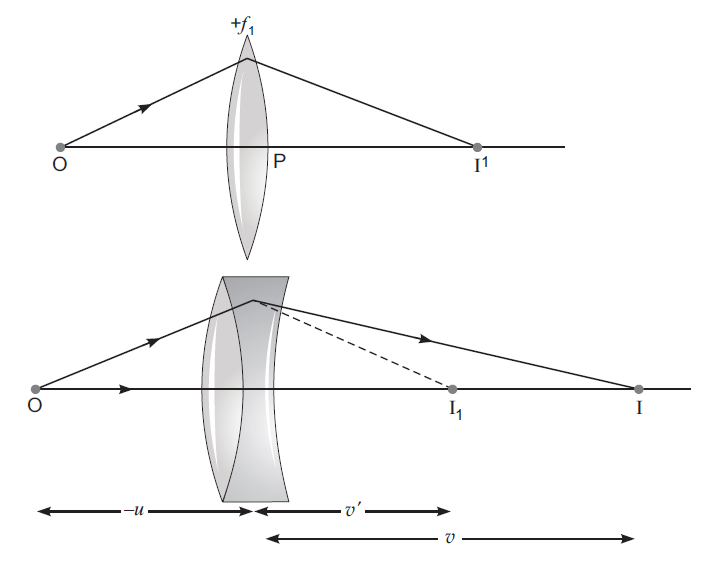
A convex lens of focal length $f_1$ is kept in contact with a concave lens of focal length $f_2$. Find the focal length of the combination.
Answer

For convex lens of focal length $(+ f_1)$
$ + \frac{1}{\text{f}_{1}} = \frac{1}{\text{v}'} - \frac{1}{\text{u}}$ - - - - - - - -(1)
For concave lens of focal length $(– f_2)$
$-\frac{1}{\text{f}_{2}} = \frac{1}{\text{v}} - \frac{1}{\text{v}'}$ - - - - - - - - (2)
Adding equation (1) and (2)
$\frac{1}{\text{f}_{1}} - \frac{1}{\text{f}_{2}} = \frac{1}{\text{v}} - \frac{1}{\text{u}}$ - - - - - - - - - -(3)
For an equivalent lens (using lens formula)
$\frac{1}{\text{f}} = \frac{1}{v} - \frac{1}{u}$ where f is the focal length of combination. - - - - - - - - - (4)
From equation (3) and (4),
$\frac{1}{\text{f}} =\frac{1}{\text{f}_{1}} - \frac{1}{\text{f}_{2}}.$
View full question & answer
Question 242 Marks
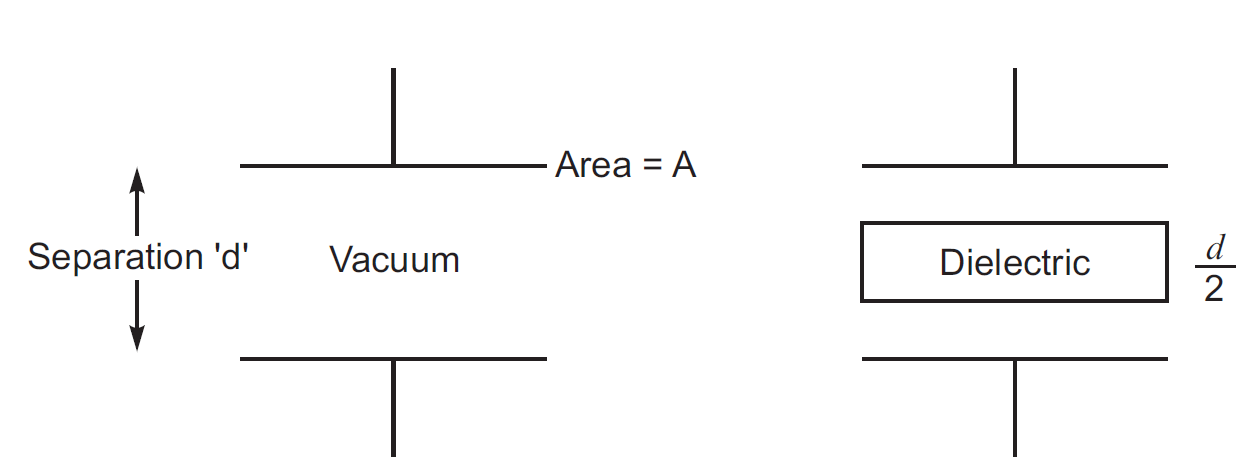
A slab of material of dielectric constant K has the same area as that of the plates of a parallel plate capacitor but has the thickness d/2, where d is the separation between the plates. Find out the expression for its capacitance when the slab is inserted between the plates of the capacitor.
Answer


Capacitance with dielectric of thickness ‘t’
$\text{C} = \frac{\varepsilon_{0}\text{A}}{\text{d - t} + \frac{\text{t}}{\text{K}}}$
Put $\text{t} = \frac{\text{d}}{2}$
$\text{C} = \frac{\varepsilon_{0}\text{A}}{\text{d} - \frac{\text{d}}{2} + \frac{\text{d}}{2\text{K}}}$
$ = \frac{\varepsilon_{0}\text{A}}{\frac{\text{d}}{2} + \frac{\text{d}}{2\text{K}}}$
$ = \frac{\varepsilon_{0}\text{A}}{\frac{\text{d}}{2}\bigg(1+\frac{1}{\text{K}}\bigg)}$
$ = \frac{2\varepsilon_{0}\text{AK}}{\text{d}\text{(K} + 1)}.$
View full question & answer
Question 252 Marks
Describe briefly with the help of a circuit diagram, how the flow of current carriers in a p-n-p transistor is regulated with emitter-base junction forward biased and base-collector junction reverse biased.
View full question & answer
Question 262 Marks
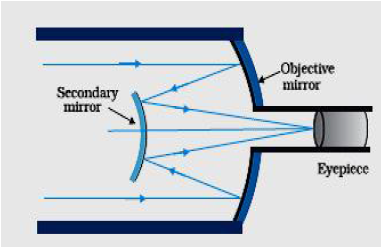
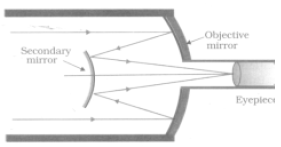
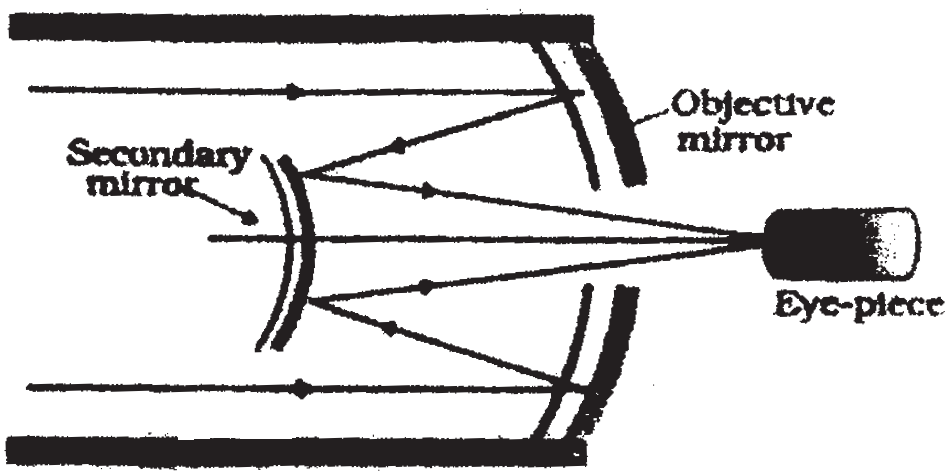
Draw a labelled ray diagram of a reflecting telescope. Mention its two advantages over the refracting telescope.
Answer

Newtonion telescope in lieu of Cassegranian telescope:
  1. Image formed is brighter.
  2. Image is free from chromatic aberration.
  3. Image is free from spherical aberration.
  4. Higher resolving power.
  5. Mechanical advantage in mounting.
View full question & answer
Question 272 Marks
Define refractive index of a transparent medium.
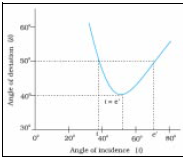
A ray of light passes through a triangular prism. Plot a graph showing the variation of the angle of deviation with the angle of incidence.
Answer
Refractive index: It is the ratio of speed of light in vacuum to the speed of light in medium.
Alternate Answer
$\mu= \frac{\sin\text{i}}{\sin\text{r}}$
View full question & answer
Question 282 Marks
Answer the following questions:
  1. Optical and radio telescopes are built on the ground while X-ray astronomy is possible only from satellites orbiting the Earth. Why?
  2. The small ozone layer on top of the stratosphere is crucial for human survival. Why ?
Answer
  1. Atmosphere absorbs X rays, while visible and $\frac{\phi}{\text{I}} = \frac{\text{NAB}}{\text{k}}$ radiowaves can penetrate it.
  2. Ozone layer absorbs ultraviolet radiations (harmful radiations) from sun and prevents it from reaching the earth’s surface and causing damage to life.
View full question & answer
Question 292 Marks
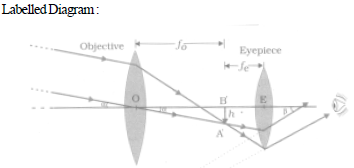
Draw a labelled ray diagram of an astronomical telescope in the near point position.
Write the expression for its magnifying power.
Answer

Magnifying Power:
$\text{m} = \frac{\text{f}_{0}}{\text{f}_{e}}\bigg(1 + \frac{\text{f}_{e}}{\text{D}}\bigg)\text{ or }\text{m} = \frac{\text{f}_{0}}{\text{f}_{e}}.$
View full question & answer
Question 302 Marks
Define resolving power of a compound microscope. How does the resolving power of a compound microscope change when.
  1. refractive index of the medium between the object and objective lens increases?
  2. wavelength of the radiation used is increased?
Answer
R.P. of microscope is reciprocal of the minimum separation of two near points, seen as distinct.
or
R.P. of microscope is reciprocal of the smallest distance between two point object, which are just resolved by the microscope.
  1. increases, (with increase of $\mu$)
  2. decreases, (with increase of $\lambda$).
View full question & answer
Question 312 Marks
Draw a labelled ray diagram to show the image formation in a refracting type astronomical telescope. Why should the diameter of the objective of a telescope be large?
Answer
Alternate Answer
High resolving power/Large light gathering power/Intensity of image more.
View full question & answer
Question 322 Marks
  1. State the condition under which a large magnification can be achieved in an astronomical telescope.
  2. Give two reasons to explain why a reflecting telescope is preferred over a refracting telescope.
Answer
  1. $m=-\frac{f_0}{f_e}$
By increasing $?_0$ / decreasing $?_?$
  1.  
  1. No chromatic aberration.
  2. No spherical aberration.
  3. Mechanical advantage – low weight, easier to support.
  4. Mirrors are easy to prepare.
  5. More economical.
View full question & answer
Question 332 Marks
Use the mirror equation to show that an object placed between f and 2f of a concave mirror forms an image beyond 2f.
Answer
$\frac{1}{v}+\frac{1}{u}=\frac{1}{f}\text{ }\text{ }\text{ }\text{ }\text{ }(f\text{ }\text{ } \text{is negative})$
$\text{U}=-\text{f}\Longrightarrow\frac{1}{v}=0\Longrightarrow v=\infty$
$\text{U}=-\text{2f}\Longrightarrow\frac{1}{v}=\frac{-1}{2f}\Longrightarrow v=-2f$
$\text{Hence if}\text{ }\text{ }\text{ }-\text{2f}<\text{u}<-\text{f}\Longrightarrow-2f
Alternate Answer
$2f>u>f$
$-\frac{1}{2f}>-\frac{1}{u}>-\frac{1}{f}$
$\frac{1}{f}-\frac{1}{2f}>\frac{1}{f}-\frac{1}{u}>\frac{1}{f}-\frac{1}{f}$
$\frac{1}{2f}<\frac{1}{V}<0$
$2\text{f}<\text{V}<\propto]$
View full question & answer
Question 342 Marks
Use the mirror equation to show that an object placed between f and 2f of a concave mirror produces a real image beyond 2f.
Answer
$\frac{1}{\text{f}} = \frac{1}{\text{v}}+ \frac{1}{\text{u}}$
For concave mirror f < 0 and u < 0 As object lies between f and 2f.
At u = – f
$\frac{1}{\text{v}} = - \frac{1}{\text{f}} +\frac{1}{\text{f}}$
$= > \text{v} = \propto$
At u = – 2f
$= > \frac{\text{1}}{\text{v}} = - \frac{\text{1}}{\text{f}} + \frac{\text{1}}{2\text{f}} = - \frac{\text{1}}{2\text{f}}$
$= > \text{v} =- 2\text{f}$
= > Hence, image distance v > – 2f
Since v is negative, therefore, the image is real.
Alternate Answer
$\frac{1}{\text{f}} =\frac{1}{\text{v}} +\frac{1}{\text{u}}$
For concave mirror
f < 0, u < 0
$\because2 \text{f}< \text{u}< \text{f}$
$\Rightarrow\frac{1}{2\text{f}}> \frac{1}{\text{u}}> \frac{1}{\text{f}}$
$\frac{1}{2\text{f}} -\frac{1}{\text{f}}>\frac{1}{\text{u}} -\frac{1}{\text{f}}> \frac{1}{\text{f}} - \frac{1}{\text{f}}$
$\Rightarrow - \frac{1}{2\text{f}} =\frac{1}{\text{v}}> 0 $ $\because\frac{1}{\text{u}} -\frac{1}{\text{f}} - \frac{1}{\text{-v}}$
$\Rightarrow\frac{1}{2\text{f}}<\frac{1}{\text{v}}< 0$
$\Rightarrow\text{v}< 0$
$\because$ Image is real
Also v > 2f image is formed beyond 2f.
View full question & answer
Question 352 Marks
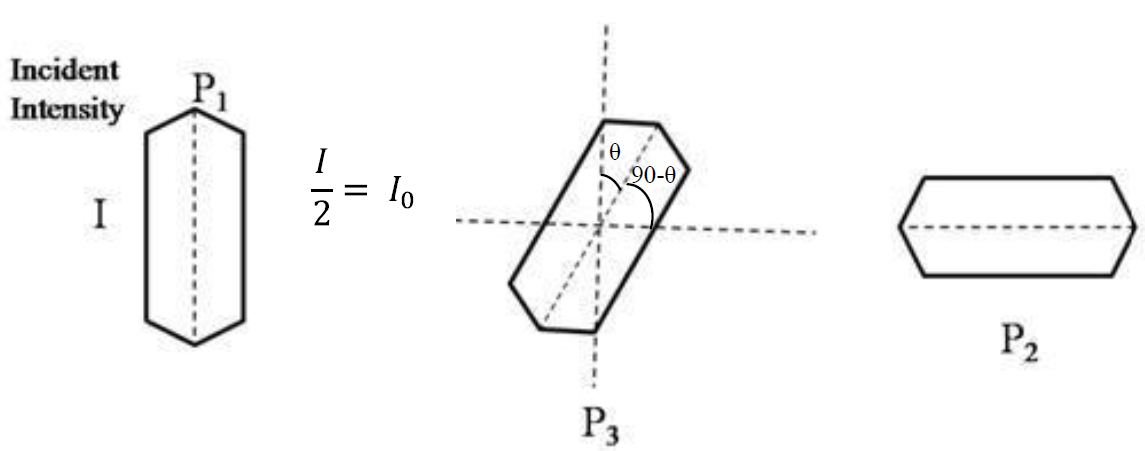
Find an expression for intensity of transmitted light when a polaroid sheet is rotated between two crossed polaroids. In which position of the polaroid sheet will the transmitted intensity be maximum?
Answer
Let the rotating polaroid sheet makes an angle $\theta$with the first polaroid $\therefore$ Angle with the other polaroid will be $(90 - \theta)$
Applying Malus's law between $P_1$ and $P_3 $ $\text{I}' = \text{I}_{0}\cos^{2}\theta$ Between $P_3$ and $P_2$ $\text{I}'' = (\text{I}_{0}\cos^{2}\theta)\cos^{2}(90 - \theta)$ $\text{I}'' = \frac{I_{0}}{4}.\sin^{2}2\theta$ $\therefore$ Transmitted intensity will be maximum when $\theta = \frac{\pi}{4}$.
View full question & answer
Question 362 Marks
Why should the objective of a telescope have large focal length and large aperture? Justify your answer.
Answer
Large focal length: To increase magnifying power.
$\bigg(\because{m}=\frac{f_0}{f_e}\bigg)$
Large aperature: To increase resolving power.
$\bigg(\because{\text{RP}}=\frac{\text2a}{1.22\lambda}\bigg)$
View full question & answer
Question 372 Marks
A convex lens of focal length 25 cm is placed coaxially in contact with a concave lens of focal length 20 cm. Determine the power of the combination. Will the system be converging or diverging in nature?
Answer
Power of convex lens,
Power of concave lens,
Power of the combination $P=P_1+P_2=-1 D$
Nature: Diverging.
View full question & answer
Question 382 Marks
  1. Write the necessary conditions for the phenomenon of total internal reflection to occur.
  2. Write the relation between the refractive index and critical angle for a given pair of optical media.
Answer
    1. Ray of light should travel from denser to rarer medium.
    2. Angle of incidence shoud be more than the critical angle.
  1. $\mu = \frac{1}{\sin\text{i}_{c}}$ where $i_c$ is the critical angle.
View full question & answer
Question 392 Marks
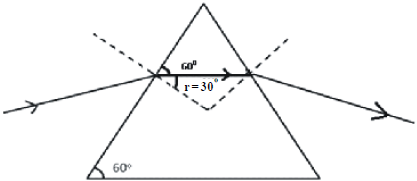
A ray of light, incident on an equilateral glass prism$(\mu_{g} = \sqrt{3})$ moves parallel to the base line of the prism inside it. Find the angle of incidence for this ray.
Answer


Fromthe diagram, $r = 30^\circ$
Also $\text{n}_{21} = \frac{\sin\text{i}}{\sin\text{r}}$
$\Rightarrow\sqrt{3} = \frac{\sin\text{i}}{\sin30}$
$\Rightarrow\sin\text{i} = \sqrt{3}\times\frac{1}{2}$
$\Rightarrow \text{i} = 60^{o}.$
View full question & answer
Question 402 Marks
Two convex lenses of same focal length but of aperture $A_1$ and $A_2\left(A_2<A_1\right)$, are used as the objective lenses in two astronomical telescopes having identical eyepieces. What is the ratio of their resolving power? Which telescope will you prefer and why? Give reason.
Answer
Ratio of resolving power $ = \frac{\text{A}_{1}}{\text{A}_{2}}$
Telescope of aperture $A_1$ is preferred.
Reason:
Higher resolving power/More light gathering power.
View full question & answer
Question 412 Marks
  1. The bluish colour predominates in clear sky.
  2. Violet colour is seen at the bottom of the spectrum when white light is dispersed by a prism.
State reasons to explain these observations.
Answer
  1. As per Rayleigh’s law (scattering α 1/λ4), lights of shorter wavelengths scattered more by the atmospheric particles. This results in a dominance of bluish colour in the scattered light.
  2. In the visible spectrum, violet light having its shortest wavelength, has the highest refractive index. Hence it is deviated the most.
View full question & answer
Question 422 Marks
The radii of curvature of the faces of a double convex lens are 10 cm and 15 cm. If focal length of the lens is 12 cm, find the refractive index of the material of the lens.
Answer
$\frac{1}{\text{f}} = (\mu - 1 )\bigg(\frac{1}{\text{R}_{1}} - \frac{1}{\text{R}_{2}}\bigg)$
$\frac{1}{12} = (\mu - 1 ) \bigg(\frac{1}{10} - \frac{1}{-15}\bigg)\Rightarrow\mu =1.5.$
View full question & answer
Question 432 Marks
A ray of light passing through an equilateral triangular glass prism from air undergoes minimum deviation when angle of incidence is 3/4th of the angle of the prism. Calculate the speed of light in the prism.
Answer
(HOST)$\text{D}_{m} = 2i - \text{A}; \text{D}_{m} = 2 \times \frac{3}{4}\text{A} - \text{A} = \text{A}/2$
$\therefore \text{D}_{m} = \frac{60^\circ}{2} = 30^{\circ}$
$\text{n} = \frac{c_1}{c_2} = \frac{\text{sin}\bigg(\frac{\text{A+D}_m}{2}\bigg)}{\text{sing}\frac{A}{2}}$
$\therefore \text{n} = \frac{c_1}{c_2} = \frac{\text{sin}45^\circ}{\text{sin}30^{\circ}} = \sqrt{2}$
$\text{c}_{2} = \frac{c_1}{\sqrt{2}} = \frac{3\times10^{8}}{\sqrt{}2} \text{ms}^{-1} = 1.5 \sqrt{2}\text{ms}^{-1}$
$\approx2 .12\times10^{8} \text{ms}^{-1}$
Alternate Answer
$\text{r}_{1} + \text{r}_{2} = \text{A}$
At minimum deviation,
$2\text{r} = \text{A}$
or $\text{r} = \frac{A}{2}$

$=30^{\circ}$
Also $\text{i} = \frac{3}{4}\times\text{A} = 45^{\circ}$
$\therefore \text{n} = \frac{c}{c_\circ} = \frac{sin\text{i}}{sin\text{r}}$
$\frac{sin45^\circ}{sin30^\circ} =\sqrt{2}$
$\text{c}_{2} = \frac{\text{c}_{1}}{\sqrt{2}} = \frac{3\times10^{8}\text{ms}^{-1}}{\sqrt{2}}$
$ = 1.5\sqrt{2}\times10^{8}\text{ms}^{-1}$
$\cong2.12 \times10^{8}\text{ms}^{-1}$
View full question & answer
Question 442 Marks
Draw a ray diagram of a reflecting type telescope. State two advantages of this telescope over a refracting telescope.
Answer
  1.  
  1. Advantages:
  1. No chromatic aberration.
  2. No spherical aberration.
View full question & answer
Question 452 Marks
A convex lens of refractive index 1.5 has a focal length of 18cm in air. Calculate the change in its focal length when it is immersed in water of refractive index $\frac{4}{3}$
Answer
$\frac{1}{\text{f}} = \big(\mu - 1\big)\bigg(\frac{1}{\text{R}_{1}} - \frac{1}{\text{R}_{2}}\bigg)$for air
$\frac{1}{\text{f}}_{a} = \big(^{a}\mu_{g} - 1\big)\bigg(\frac{1}{\text{R}_{1}} - \frac{1}{\text{R}_{2}}\bigg) = \bigg(\frac{1}{2}\bigg)\bigg(\frac{1}{\text{R}_{1}} - \frac{1}{\text{R}_{2}}\bigg)$
For water
$\frac{1}{\text{f}}_{w} = \big(^{w}\mu_{g} - 1\big)\bigg(\frac{1}{\text{R}_{1}} - \frac{1}{\text{R}_{2}}\bigg) = \bigg(\frac{1}{8}\bigg)\bigg(\frac{1}{\text{R}_{1}} - \frac{1}{\text{R}_{2}}\bigg)$
$\text{f}_{w} = 4 \text{f}_{a}$
Change in focal length $= 3 \text{f}_{a} = 54 \text{cm}$
View full question & answer
Question 462 Marks
Draw a labelled ray diagram of a reflecting type telescope. Write its any one advantage over refracting type telescope.
Answer

Advantage:No chromatic aberration/More light gathering power/Large size mirror can be more easily obtained than the lens.
View full question & answer
Question 472 Marks
Using lens maker’s formula, derive the thin lens formula $\frac{1}{\text{f}}=\frac{1}{\text{v}}-\frac{1}{\text{u}}$ for a biconvex lens.
Answer
Ace to lens maker's formula,
$\frac{1}{\text{v}}-\frac{1}{\text{u}}=(\text{n}_{21}-1)\Big(\frac{1}{\text{R}_1}-\frac{1}{\text{R}_2}\Big)\ ...(1)$
When object is at placed at infinity,
$\text{u}=\infty$
Image is obtained at focus,
$\text{v}=\text{f}$
Using these values in Eq (1),
$\frac{1}{\text{f}}-\frac{1}{\infty}={(\text{n}_{21}-1)}\Big(\frac{1}{\text{R}_1}-\frac{1}{\text{R}_2}\Big)$
$\Rightarrow\frac{1}{\text{f}}=(\text{n}_{21}-1)\Big(\frac{1}{\text{R}_1}-\frac{1}{\text{R}_2}\Big)\ ...(2)$
$\therefore$ By Eq (1) and (2),
$\Rightarrow\frac{1}{\text{f}}=\frac{1}{\text{v}}-\frac{1}{\text{u}}$
View full question & answer
Question 482 Marks
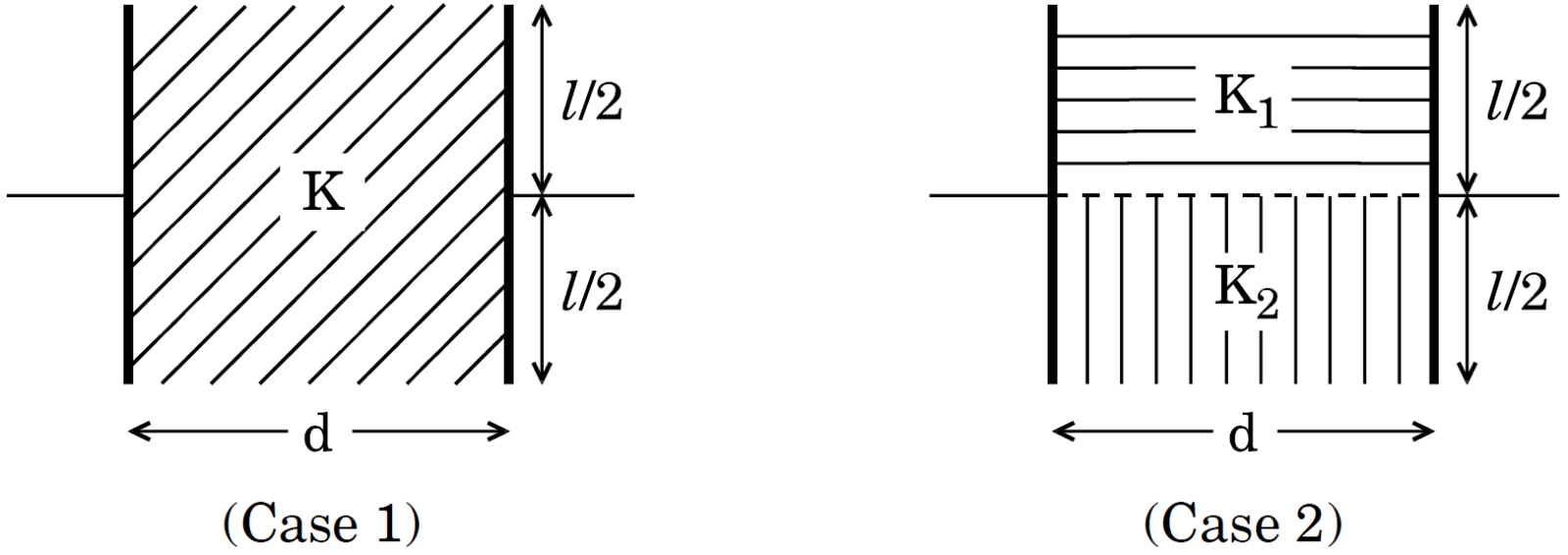
The space between the plates of a parallel plate capacitor is completely filled in two ways. In the first case, it is filled with a slab of dielectric constant K. In the second case, it is filled with two slabs of equal thickness and dielectric constants $\mathrm{K}_1$ and $\mathrm{K}_2$ respectively as shown in the figure. The capacitance of the capacitor is same in the two cases. Obtain the relationship between $\mathrm{K}, \mathrm{K}_1$ and $\mathrm{K}_2$.
Answer
$\text{C}_1=\frac{\text{K}\varepsilon_0\text{A}}{\text{d}}$
$C_2=$ parallel combination of two capacitors,
$=\frac{\text{K}_1\varepsilon_0\big(\frac{\text{A}}{2}\big)}{\text{d}}+\frac{\text{K}_2\varepsilon_0\big(\frac{\text{A}}{2}\big)}{\text{d}}$
$\frac{\varepsilon_0\text{A}}{2\text{d}}\big(\text{K}_1+\text{K}_2\big)$
$\because\text{C}_1=\text{C}_2$
$\Rightarrow\text{K}=\frac{\text{K}_1+\text{K}_2}{2}$
View full question & answer
Question 492 Marks
N small conducting liquid droplets, each of radius r, are charged to a potential V each. These droplets coalesce to form a single large drop without any charge leakage. Find the potential of the large drop.
Answer
$\text{q}_{\text{new}}=\text{Nq};$ q = charge on each small droplet,
$\frac{4}{3}\pi\text{R}^3=\text{N}\Big(\frac{4}{3}\pi\text{R}^3\Big)$
$\Rightarrow\text{R}=\text{N}^{\frac{1}{3}}\text{r}$
R = radius of larger drop,
$\because\text{V}=\frac{\text{kq}}{\text{r}}=$ potential on each small dropper.
$\therefore$ V '= Potential on large drop,
$=\frac{\text{kq}_{\text{new}}}{\text{R}}=\frac{\text{K}(\text{Nq})}{\text{N}^{\frac{1}{3}}\text{r}}=\text{N}^\frac{2}{3}\Big(\frac{\text{kq}}{\text{r}}\Big)$
$\Rightarrow\text{V}'=\text{N}^{\frac{2}{3}}\text{V}$
View full question & answer
Question 502 Marks
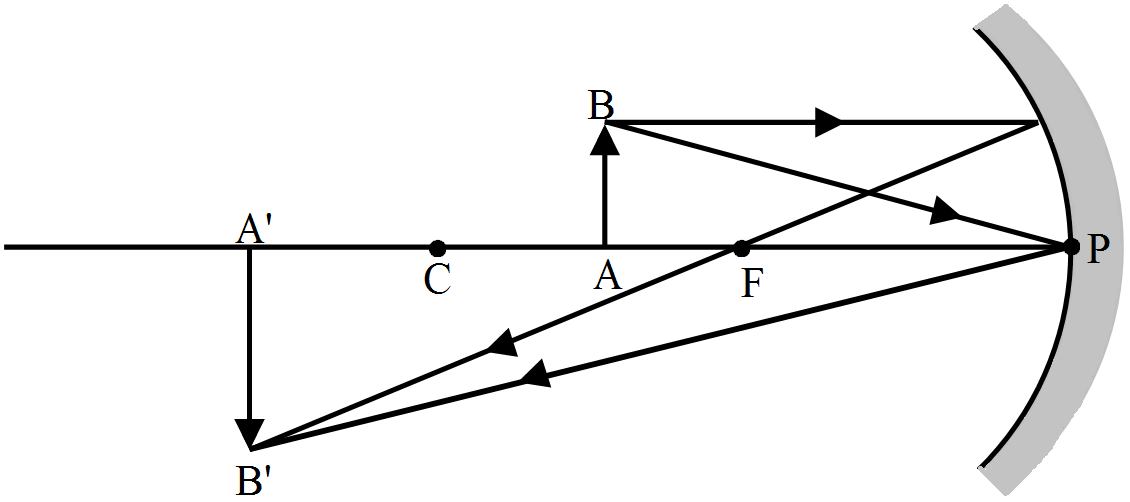
Redraw the diagram given below and mark the position of the centre of curvature of the spherical mirror used in the given set up.
Answer
If the object is in between focus 'F' and centre of curvature 'C', image would be beyond the centre of curvature, inverted real and magnified.
View full question & answer