Question types

Ray Optics and Optical Instruments question types

573 questions across 7 question groups — pick any mix to generate a Physics paper with step-by-step answer keys.

573
Questions
7
Question groups
5
Question types
Sample Questions

Ray Optics and Optical Instruments questions

One sample from each question group in this chapter. Select any group above to see the full set with answer keys.

Two unequal resistors are connected in series across a battery. Then the:
  • A
    Potential difference across each resistor is the same.
  • B
    Current in the smaller resistor is larger.
  • Potential difference across the bigger resistor is greater.
  • D
    Power dissipated in both resistors is the same.

Answer: C.

View full solution
The focal length of the objective of a compound microscope is:
  • A
    Greater than the focal length of eyepiece.
  • Lesser than the focal length of eyepiece.
  • C
    Equal to the focal length of eyepiece.
  • D
    Equal to the length of its tube.

Answer: B.

View full solution
A biconvex lens of glass having refractive index $1.47$ is immersed in a liquid. It becomes invisible and behaves as a plane glass plate. The refractive index of the liquid is:
  • $1.47$
  • B
    $1.62$
  • C
    $1.33$
  • D
    $1.51$

Answer: A.

View full solution
For a glass prism, the angle of minimum deviation will be smallest for the light of:
  • Red colour.
  • B
    Blue colour.
  • C
    Yellow colour.
  • D
    Green colour.

Answer: A.

View full solution
The resistance of a metal wire increases with increasing temperature on account of:
  • A
    Decrease in free electron density.
  • Decrease in relaxation time.
  • C
    Increase in mean free path.
  • D
    Increase in the mass of electron.

Answer: B.

View full solution
Two statements are given-one labelled Assertion (A) and the other labelled Reason (R). Select the correct answer to these questions from the codes (a), (b), (c) and (d) as given below.
  1. Both A and R are true and R is the correct explanation of A.
  2. Both A and R are true but R is not the correct explanation of A.
  3. A is true but R is false.
  4. A is false and R is also false.
Assertion: Endoscopy involves use of optical fibres to study intemal organs.
Reason: Optical fibres are based on phenomena of total internal reflection.
View full solution
Two statements are given$-$one labelled Assertion $(A)$ and the other labelled Reason $(R)$. Select the correct answer to these questions from the codes $(a), (b), (c)$ and $(d)$ as given below.
Assertion: The focal length of an equiconvex lens placed in air is equal to radius of curvature of either face. Lens is made up of material of refractive index of $1.5.$
Reason: For an equiconvex lens, radius of curvature of both the faces is same.
  • A
    Both $A$ and $R$ are true and $R$ is the correct explanation of $A.$
  • Both $A$ and $R$ are true but $R$ is not the correct explanation of $A.$
  • C
    $A$ is true but $R$ is false.
  • D
    $A$ is false and $R$ is also false.

Answer: B.

View full solution
Two statements are given-one labelled Assertion (A) and the other labelled Reason (R). Select the correct answer to these questions from the codes (a), (b), (c) and (d) as given below.
  1. Both A and R are true and R is the correct explanation of A.
  2. Both A and R are true but R is not the correct explanation of A.
  3. A is true but R is false.
  4. A is false and R is also false.
Assertion: The minimum distance between an object and its real image formed by a convex lens is 2f.
Reason: The distance between an object and its real image is minimum when its magnification is two.
View full solution
Two statements are given-one labelled Assertion (A) and the other labelled Reason (R). Select the correct answer to these questions from the codes (a), (b), (c) and (d) as given below.
  1. Both A and R are true and R is the correct explanation of A.
  2. Both A and R are true but R is not the correct explanation of A.
  3. A is true but R is false.
  4. A is false and R is also false.
Assertion: The light travelling from air to glass can not suffer total internal reflection.
Reason: Air is rarer than glass.
View full solution
Two statements are given-one labelled Assertion (A) and the other labelled Reason (R). Select the correct answer to these questions from the codes (a), (b), (c) and (d) as given below.
  1. Both A and R are true and R is the correct explanation of A.
  2. Both A and R are true but R is not the correct explanation of A.
  3. A is true but R is false.
  4. A is false and R is also false.
Assertion: The images formed by total intemal reflections are brighter than those formed by mirrors or lenses.
Reason: There is no loss of intensity in total internal reflection.
View full solution
A biconcave lens made of a transparent material of refractive index 1.25 is immersed in water of refractive index 1.33. Will the lens behave as a converging or a diverging lens? Give reason.
View full solution
Define the magnifying power of a compound microscope when the final image is formed at infinity. Why must both the objective and the eyepiece of a compound microscope has short focal lengths? Explain.
View full solution
Answer the following question:
Magnifying power of a simple microscope is inversely proportional to the focal length of the lens. What then stops us from using a convex lens of smaller and smaller focal length and achieving greater and greater magnifying power?
View full solution
Does short-sightedness (myopia) or long-sightedness (hypermetropia) imply necessarily that the eye has partially lost its ability of accommodation? If not, what might cause these defects of vision?
View full solution
A small pin fixed on a table top is viewed from above from a distance of 50cm. By what distance would the pin appear to be raised if it is viewed from the same point through a 15 cm thick glass slab held parallel to the table? Refractive index of glass = 1.5. Does the answer depend on the location of the slab?
View full solution
A screen is placed 90 cm from an object. The image of the object on the screen is formed by a convex lens at two different locations separated by 20 cm. Determine the focal length of the lens.
View full solution
Q 213 Marks Question3 Marks
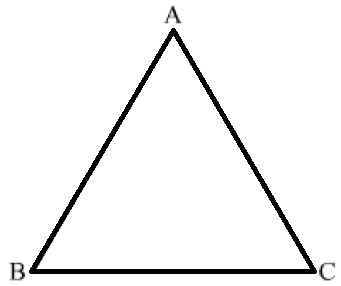
  1. A ray of light incident on face AB of an equilateral glass prism, shows minimum deviation of 30°. Calculate the speed of light through the prism.
  1. Find the angle of incidence at face AB so that the emergent ray grazes along the face AC.
View full solution
Q 233 Marks Question3 Marks
What should be the distance between the object in Exercise 9.30 and the magnifying glass if the virtual image of each square in the figure is to have an area of $6.25\ mm^2$. Would you be able to see the squares distinctly with your eyes very close to the magnifier?
View full solution
Q 243 Marks Question3 Marks
  1. At what distance should the lens be held from the figure in Exercise 9.29 in order to view the squares distinctly with the maximum possible magnifying power?
  2. What is the magnification in this case?What is the magnification in this case?
  3. Is the magnification equal to the magnifying power in this case? Explain.
View full solution
Q 253 Marks Question3 Marks
A small telescope has an objective lens of focal length 140 cm and an eyepiece of focal length 5.0 cm. What is the magnifying power of the telescope for viewing distant objects when,
  1. the telescope is in normal adjustment (i.e., when the final image is at infinity)?
  2. the final image is formed at the least distance of distinct vision (25 cm)?
View full solution
What is the focal length of a convex lens of focal length 30cm in contact with a concave lens of focal length 20 cm? Is the system a converging or a diverging lens? Ignore thickness of the lenses.
View full solution
Determine the ‘effective focal length’ of the combination of the two lenses in if they are placed 8.0 cm apart with their principal axes coincident. Does the answer depend on which side of the combination a beam of parallel light is incident? Is the notion of effective focal length of this system useful at all.
View full solution
A Cassegrain telescope uses two mirrors. Such a telescope is built with the mirrors 20 mm apart. If the radius of curvature of the large mirror is 220 mm and the small mirror is 140 mm, where will the final image of an object at infinity be?
View full solution
An angular magnification (magnifying power) of 30X is desired using an objective of focal length 1.25 cm and an eyepiece of focal length 5 cm. How will you set up the compound microscope?
View full solution
Use the mirror equation to deduce that:
  1. an object placed between f and 2f of a concave mirror produces a real image beyond 2f.
  2. a convex mirror always produces a virtual image independent of the location of the object.
  3. the virtual image produced by a convex mirror is always diminished in size and is located between the focus and the pole.
View full solution
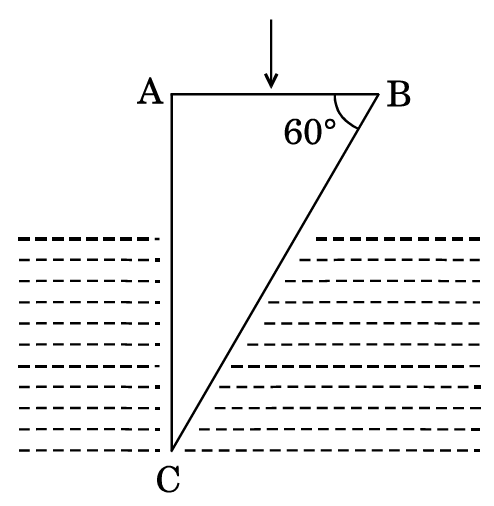
  1. A ray of light is incident normally on the face AB of a right-angled glass prism of refractive index $_{a}\mu_{g} =1.5$The prism is partly immersed in a liquid of unknown refractive index. Find the value of refractive index of the liquid so that the ray grazes along the face BC after refraction through the prism.
  1. Trace the path of the rays if it were incident normally on the face AC.
View full solution
  1. A point-object is placed on the principal axis of a convex spherical surface of radius of curvature R, which separates the two media of refractive indices $n_1$ and $n_2 (n_2 > n_1).$ Draw the ray diagram and deduce the relation between the distance of the object (u),distance of the image (v) and the radius of curvature (R) for refraction to take place at the convex spherical surface from rarer to denser medium.
  2. Use the above relation to obtain the condition on the position of the object and the radius of curvature in terms of $n_1$ and $n_2$ when the real image is formed.
View full solution
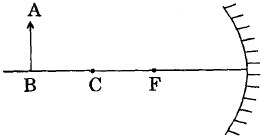
An object AB is kept in front of a concave mirror as shown in the figure.
  1. Complete the ray diagram showing the image formation of the object.
  2. How will the position and intensity of the image be affected if the lower half of the mirror's reflecting surface is painted black?
View full solution
  1. A mobile phone lies along the principal axis of a concave mirror. Show, with the help of a suitable diagram, the formation of its image. Explain why magnification is not uniform.
  2. Suppose the lower half of the concave mirror's reflecting surface is covered with an opaque material. What effect this will have on the image of the object? Explain.
View full solution
Total internal reflection is the phenomenon of reflection of light into denser medium at the interface of denser medium with a rarer medium. For this phenomenon to occur necessary condition is that light must travel from denser to rarer and angle of incidence in denser medium must be greater than critical angle (C) for the pair of media in contact. Critical angle depends on nature of medium and wavelength of tight. We can show that $\mu=\frac{1}{\sin\text{C}}.$
  1. Critical angle for glass air interface, where ft of glass is $\frac{3}{2}$ is,
  1. 41.8
  2. 60º
  3. 30º
  4. 15º
  1. Critical angle for water air interface is 48.6º. What is the refractive index of water?
  1. $1$
  2. $\frac{3}{2}$
  3. $\frac{4}{3}$
  4. $\frac{3}{4}$
  1. Critical angle for air water interface for violet colour is 49º. Its value for red colour would be:
  1. 49º
  2. 50º
  3. 48º
  4. Cannot say.
  1. Which of the following is not due to total internal reflection?
  1. Working of optical fibre.
  2. Difference between apparent and real depth of a pond.
  3. Mirage on hot summer days.
  4. Brilliance of diamond.
  1. Critical angle of glass is $\theta_1$ and that of water is $\theta_2$The critical angle for water and glass surface would be $(\mu_\text{g}=\frac{3}{2},\ \mu_\text{w}=\frac{4}{3})$
  1. Less than $\theta_2$
  2. Between $\theta_1$ and $\theta_2$
  3. Greater than $\theta_2$
  4. Less than $\theta_1$
View full solution

Generate a Ray Optics and Optical Instruments paper free

Pick question groups from the list above, set marks and difficulty, and export a branded PDF with step-by-step answer keys. First 3 chapters free — no signup.

Download App