Question 15 Marks
The product of three consecutive numbers is always divisible by $6.$ Verify this statement with the help of some examples.
AnswerLet the three consecutive numbers be n, $(n + 1), ( n + 2).$
The product of these numbers be $n(n + 1)(n + 2).$
We know that the product of three consecutive numbers is always divisible by $3.$
Out of the three consecutive numbers, one will be even. Which means the product is also divisible by $2.$
Hence the product of three consecutive numbers is divisible by $3$ and $2.$
Therefore the product of three consecutive numbers is also divisible by $6.$
$Ex.1:$ Take three consecutive number $21, 22$ and $23.$
$21$ is divisible by $3.$
$22$ is divisible by $2.$
$ \therefore 21 \times 22$ is divisible by $3 \times 2 (= 6)$
$ \therefore 21 \times 22 \times 23$ is divisible by $6.$
$Ex.2:$ Take three consecutive numbers $47, 48$ and $49.$
$48$ is divisible by $2$ and $3$ both.
$\therefore 48$ is divisible by $2 \times 3 = 6$
$ \therefore 47 \times 48 \times 49$ is divisible by $6.$
View full question & answer→Question 25 Marks
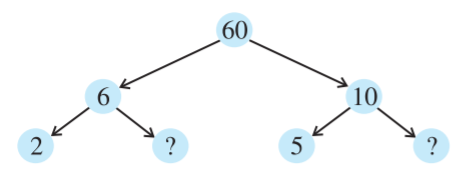
Here are two different factor trees for $60$. Write the missing numbers.
Answer
Here, we have to divide the given set of numbers by the other set of given numbers to see whether each one of them is divisible or not.
To check this, we follow the divisibility rules as given below:
$i.\ $For divisible by $2$: Any number that has $0$,$2$,$4$,$6$, or $8$ in its one's place is divisible by $2$.
$ii.\ $For divisible by $3$: If the sum of all the digits of the number is multiple of $3$, then it is divisible by $3$.
$iii.\ $For divisible by $4$: Any number whose last two digits $($i.e. one's and ten's place digits$)$ are divisible by $4$ then, the number is divisible by $4$.
$iv.\ $For divisible by $5$: Any number that has $0$ or $5$ in its one's place is divisible by $5$.
$v.\ $For divisible by $6$: If a number a divisible by both $2$ and $3$, then it is divisible by $6$.
$vi.\ $For divisible by $8$: Any number whose last three digits are divisible by $8$ then, the number is divisible by $8$.
$vii.\ $For divisible by $9$: If the sum of all the digits of the number is multiple of $9$, then it is divisible by $9$.
$viii.\ $For divisible by $10$: Any number that has $0$ in its one's place is divisible by $10$.
So, after following these rules, we can see the results as are given below:
| Number |
Divisible by |
| $2$ |
$3$ |
$4$ |
$5$ |
$6$ |
$8$ |
$9$ |
$1$0 |
$11$ |
| $9 9 0$ |
Yes |
Yes |
No |
Yes |
Yes |
No |
Yes |
Yes |
Yes |
| $15 8 6$ |
Yes |
No |
No |
No |
No |
No |
No |
No |
No |
| $2 7 5$ |
No |
No |
No |
Yes |
No |
No |
No |
No |
Yes |
| $6 6 8 9$ |
Yes |
No |
No |
No |
No |
No |
No |
No |
No |
| $6 3 9 2 10$ |
Yes |
Yes |
No |
Yes |
Yes |
No |
No |
Yes |
Yes |
| $4 2 9 714$ |
Yes |
Yes |
No |
No |
Yes |
No |
Yes |
No |
No |
| $2 8 5 6$ |
Yes |
Yes |
Yes |
No |
Yes |
Yes |
No |
No |
No |
| $3 0 6 0$ |
Yes |
Yes |
Yes |
Yes |
Yes |
No |
Yes |
Yes |
No |
| $4 0 6 8 3 9$ |
No |
Yes |
No |
No |
No |
No |
No |
No |
No |
View full question & answer→Question 35 Marks
Using divisibility tests, determine which of the following numbers are divisible by $2;$ by $3;$ by $4;$ by $5;$ by $6;$ by $8;$ by $9;$ by $10;$ by $11 ($say, yes or no$):$
| Number |
Divisible by |
| $2$ |
$3$ |
$4$ |
$5$ |
$6$ |
$8$ |
$9$ |
$10$ |
$11$ |
| $128$ |
|
|
|
|
|
|
|
|
|
| $990$ |
|
|
|
|
|
|
|
|
|
| $1586$ |
|
|
|
|
|
|
|
|
|
| $275$ |
|
|
|
|
|
|
|
|
|
| $6686$ |
|
|
|
|
|
|
|
|
|
| $639210$ |
|
|
|
|
|
|
|
|
|
| $429714$ |
|
|
|
|
|
|
|
|
|
| $2856$ |
|
|
|
|
|
|
|
|
|
| $3060$ |
|
|
|
|
|
|
|
|
|
| $406839$ |
|
|
|
|
|
|
|
|
|
Answer
Here, we have to divide the given set of numbers by the other set of given numbers to see whether each one of them is divisible or not.
To check this, we follow the divisibility rules as given below:
$i.\ $For divisible by $2$: Any number that has $0$,$2$,$4$,$6$, or $8$ in its one's place is divisible by $2$.
$ii.\ $For divisible by $3$: If the sum of all the digits of the number is multiple of $3$, then it is divisible by $3$.
$iii.\ $For divisible by $4$: Any number whose last two digits $($i.e. one's and ten's place digits$)$ are divisible by $4$ then, the number is divisible by $4$.
$iv.\ $For divisible by $5$: Any number that has $0$ or $5$ in its one's place is divisible by $5$.
$v.\ $For divisible by $6$: If a number a divisible by both $2$ and $3$, then it is divisible by $6$.
$vi.\ $For divisible by $8$: Any number whose last three digits are divisible by $8$ then, the number is divisible by $8$.
$vii.\ $For divisible by $9$: If the sum of all the digits of the number is multiple of $9$, then it is divisible by $9$.
$viii.\ $For divisible by $10$: Any number that has $0$ in its one's place is divisible by $10$.
So, after following these rules, we can see the results as are given below:
| Number |
Divisible by |
| $2$ |
$3$ |
$4$ |
$5$ |
$6$ |
$8$ |
$9$ |
$10$ |
$11$ |
| $990$ |
Yes |
Yes |
No |
Yes |
Yes |
No |
Yes |
Yes |
Yes |
| $1586$ |
Yes |
No |
No |
No |
No |
No |
No |
No |
No |
| $275$ |
No |
No |
No |
Yes |
No |
No |
No |
No |
Yes |
| $6689$ |
Yes |
No |
No |
No |
No |
No |
No |
No |
No |
| $639210$ |
Yes |
Yes |
No |
Yes |
Yes |
No |
No |
Yes |
Yes |
| $429714$ |
Yes |
Yes |
No |
No |
Yes |
No |
Yes |
No |
No |
| $2856$ |
Yes |
Yes |
Yes |
No |
Yes |
Yes |
No |
No |
No |
| $3060$ |
Yes |
Yes |
Yes |
Yes |
Yes |
No |
Yes |
Yes |
No |
| $406839$ |
No |
Yes |
No |
No |
No |
No |
No |
No |
No |
View full question & answer→Question 45 Marks
Find the $LCM$ of $12$ and $18.$
AnswerClearly, we can see that common multiples of $12$ and $18$ are: $36, 72, 108$ etc
The lowest of these is $36.$
Now, Let us see another method to find $LCM$ of these two numbers.
The prime factorization of $12$ and $18$ are :
$12 = 2 \times 2 \times 3;$
$18 = 2 \times 3 \times 3$
In these prime factorizations, the maximum number of times the prime factor $2$ occurs is two; this happens for $12.$ Similarly, the maximum number of times the factor $3$ occurs is two; this happens for $18.$ The $LCM$ of the two numbers is the product of the prime factors counted the maximum number of times they occur in any of the numbers.
Thus, in this case: $LCM = 2 \times 2 \times 3 \times 3 = 36.$
View full question & answer→Question 55 Marks
Find the least number which when divided by $12, 16, 24$ and $36$ leaves a remainder $7$ in each case.
AnswerWe first find the $LCM$ of $12, 16, 24$ and $36$ as follows :
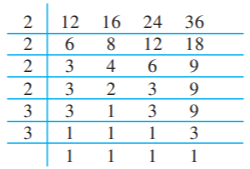
Therefore, $LCM = 2 \times 2 \times 2 \times 2 \times 3 \times 3 = 144$
$144$ is the least number which when divided by the given numbers will leave remainder $0$ in each case.
But we need the least number that leaves remainder $7.$
So, the required number is $7$ units more than $144.$
Hence, the required least number $= 144 + 7 = 151.$ View full question & answer→Question 65 Marks
Two tankers contain $850$ litres and $680$ litres of kerosene oil respectively. Find the maximum capacity of a container which can measure the kerosene oil of both the tankers when used an exact number of times.
AnswerThe required container has to measure both the tankers in a way that the count is an exact number of times.
So, its capacity must be an exact divisor of the capacities of both the tankers.
Moreover, this capacity should be maximum. Thus, the maximum capacity of such a container will be the $HCF$ of $850$ and $680.$
We can find it as follows :
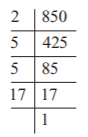
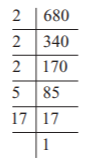
Therefore, the factorised form of the numbers is:
$850 = 2 \times 5 \times 5 \times 17 = 2 \times 5 \times 17 \times 5$ and
$680 = 2 \times 2 \times 2 \times 5 \times 17 = 2 \times 5 \times 17 \times 2 \times 2$
The common factors of the given numbers $850$ and $680$ are $2, 5$ and $17.$
And thus, the $HCF$ of $850$ and $680$ is $2 \times 5 \times 17 = 170.$
Hence, the maximum capacity of the required container is $170$ litres.
It will fill the first container in $5$ refills and the second in $4$ refills. View full question & answer→Question 75 Marks
Determine the number nearest to $100000$ but greater than $100000$ which is exactly divisible by each of $8, 15$ and $21.$
AnswerFirst, we have to find the $L.C.M$ of $8, 15$ and $21.$
Prime factorization of $8 = 2 \times 2 \times 2$
Prime factorization of $15 = 3 \times 5$
Prime factorization of $21 = 3 \times 7$
Therefore, required $LCM = 2 \times 2 \times 2 \times 3 \times 5 \times 7 = 840$
The number nearest to $1, 00,000$ and exactly divisible by each $8, 15$ and $21$ should also be divisible by their $LCM$ (i.e. $840)$
We have to divide $1, 00,000$ by $840.$
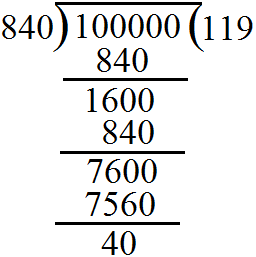
Remainder $= 40$
Therefore, Number greater than $1, 00, 000$ and
exactly divisible by $840 = 1, 00, 000 + (840 - 40) = 1, 00, 000 + 800 = 1, 00, 800$
Therefore, Required number $= 1, 00, 800.$ View full question & answer→Question 85 Marks
Find the $HCF$ of the numbers in the following using the division method:$754, 1508, 1972$
AnswerThe given numbers are $754, 1508$ and $1972.$
First we will find the $HCF$ of $754$ and $1508.$
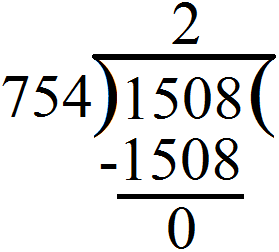
So, the $HCF$ of $754$ and $1508$ is $754.$
Now, we will find the $HCF$ of $754$ and $1972.$
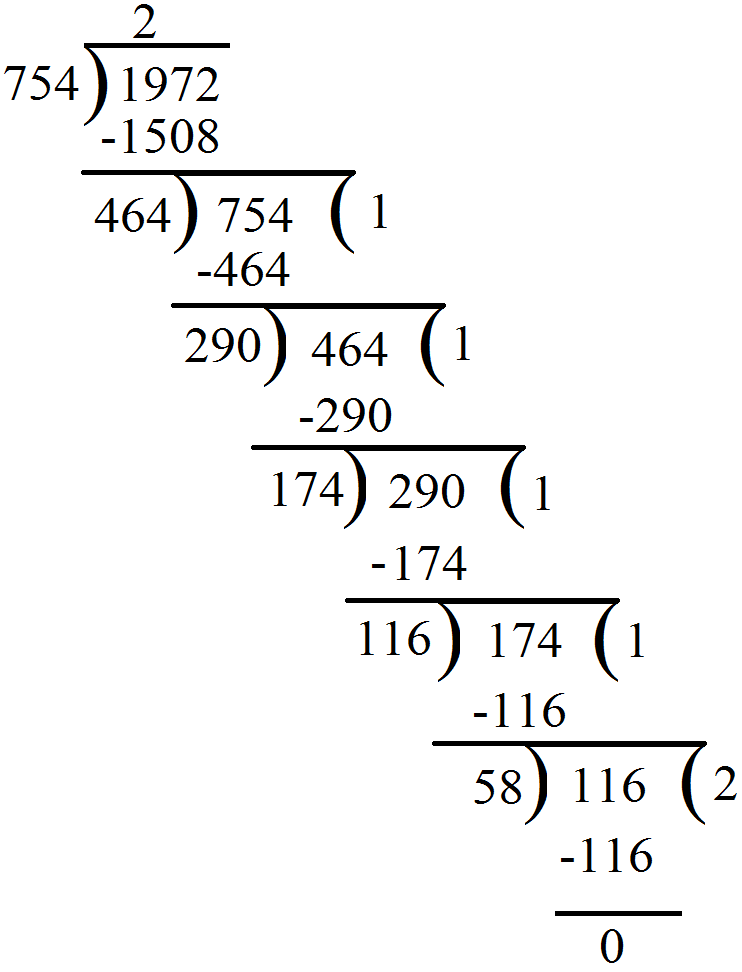
So, the $HCF$ of $754$ and $1972$ is $58.$
$\therefore$ The $HCF$ of $754, 1058$ and $1972$ is $58.$ View full question & answer→Question 95 Marks
Find the greatest number of five digits exactly divisble by $9, 12, 15, 18$ and $24.$
AnswerFirst, we will find the $LCM$ Of $9, 12, 15, 18$ and $24.$
$\begin{array}{c|c}2&9,12,15,18,24\\\hline2&9,6,15,9,12\\\hline2&9,3,15,9,6\\\hline3&9,3,15,9,3\\\hline3&3,1,5,3,1\\\hline5&1,1,5,1,1\\\hline&1,1,1,1,1\end{array}$
$\therefore LCM$ of the numbers $= 2^3× 3^2× 5 = 360$
The least six-digit number $= 100000$
The greatest five-digit number divisible by $360.$
Weill be the quatient of $\frac{100000}{360}$ multiplied by $360.$
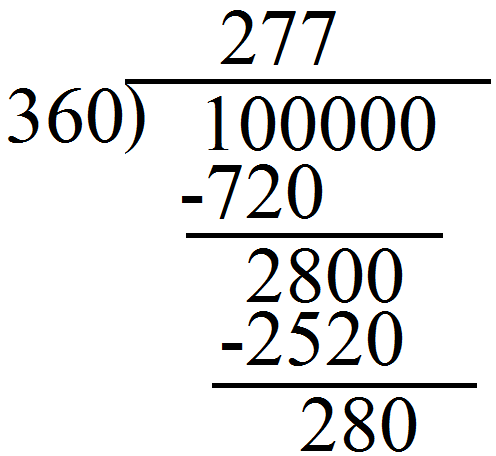
So, the greatest five-digit number exactly divisible by the given numbers will be
$360 \times 277 = 99720.$ View full question & answer→Question 105 Marks
Find the greatest number that will divide $445, 572$ and $699$, leaving remainders $4, 5, 6$ respectively.
AnswerSince the respective remainders of $445, 572$ and $699$ are $4, 5$ and $6$, we have to find the number which exactly devides $(445 - 4), (572 - 5)$ and $(696 - 6).$
So, the required number is the $HCF$ of $441, 567$ and $693.$
Firstly, we will find the $HCF$ of $441$ and $567.$
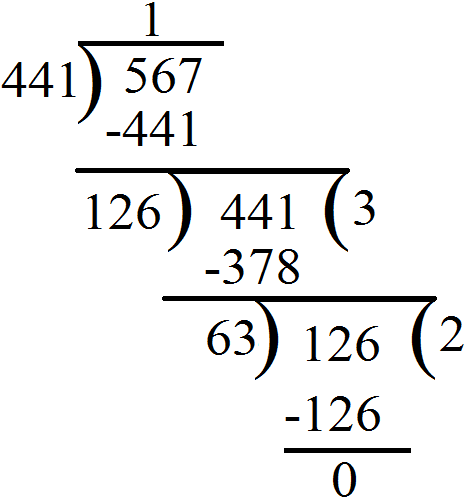
$\therefore$ $HCF = 63$
Now, we will find the $HCF$ of $63$ and $693.$
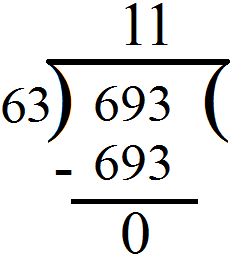
$\therefore HCF = 63$
Hence, the required numbers is $63.$ View full question & answer→Question 115 Marks
Three different containers contain $403L, 434L$ and $465L$ of milk respectively. Find the capacity of a container which can measure the milk of all containers in an exact number of times.
AnswerThree different containers contain $403L, 434L$ and $465L$ of milk.
The capacity of the comntainer that can measure the milk in an exact number of times will be given by the $HCF$ of $403, 434$ and $465.$
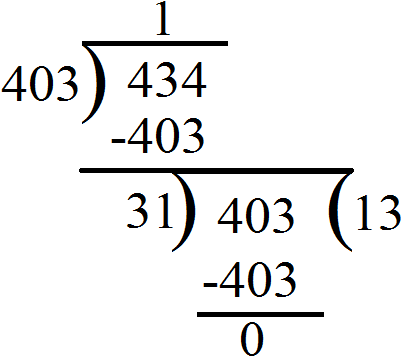
$\therefore HCF = 31$
Now, we will find the $HCF$ of $31$ and $465.$
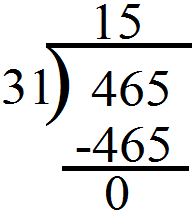
$\therefore HCF = 31.$
Hence, the capacity of the required container is $31L.$ View full question & answer→Question 125 Marks
The circumferences of four wheels are $50\ cm, 60\ cm, 75\ cm$ and $100\ cm$. They start moving simultaneously. what least distance should they cover so that each wheel makes a complete number of revolutions?
AnswerDistance covered by a wheel for one complete revolution = circumference of the wheel.
All the wheels will make complete numbers of revolutions when the distances covered by them equal to their $LCM.$
$\begin{array}{c|c}5&50,60,75,100\\\hline5&10,12,15,20\\\hline2&2,12,3,4\\\hline2&1,6,3,2\\\hline3&1,3,3,1\\\hline&1,1,1,1\end{array}$
Required least distance $= 5 \times 5 \times 2 \times 2 \times 3 = 25 \times 4 \times 3 = 300\ cm = 3m$
So each wheel will make a complete number of revolutions after travelling $3m.$
View full question & answer→Question 135 Marks
Show that the following pairs are co-primes:$512, 945$
AnswerGiven numbers are $512$ and $945$.$\begin{array}{c|c}2&512\\\hline2&256\\\hline2&128\\\hline2&64\\\hline2&32\\\hline2&16\\\hline2&8\\\hline2&4\\\hline2&2\\\hline&1\end{array}$
$\begin{array}{c|c}3&315\\\hline3&105\\\hline5&35\\\hline7&7\\\hline&1\end{array}$
Now, $512=2\times2\times2\times2\times2\times2\times2\times2\times2=2^9$
$945=3\times3\times3\times5\times7=3^3\times5\times7$
Thus, the $HCF$ of $512$ and $945$ is $1.$
$\therefore$ $512$ and $945$ are co-primes.
View full question & answer→Question 145 Marks
There are $527$ apples, $646$ pears and $748$ oranges. These are to be arranged in heaps containing the same number of fruits. Find the greatest number of fruits. Find the greatest number of fruits possible in each heap. How many heaps are formed?
AnswerNumber of apples $= 527$
Number of pears $= 646$
Number of oranges $= 748$
The fruits are to be arranged in heaps containing the same number of fruits.
The greatest number of fruits posible in each heaps will be given by the $HCF$ of $527, 646$ and $748.$
Firstly, we will find the $HCF$ of $527$ and $646.$
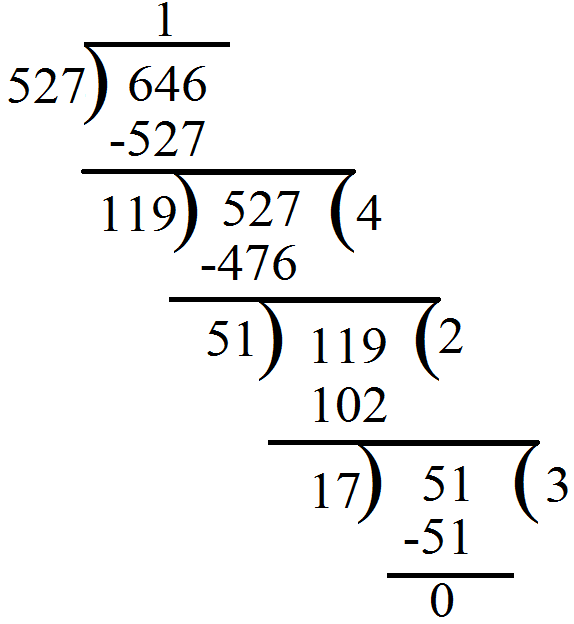
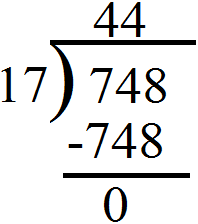
$\therefore$ $HCF$ of $527, 646$ and $748 = 17$
So, the greatest number of fruits in each heaps will be $17.$ View full question & answer→Question 155 Marks
Find the least number of five digits that is exactly divisible by $16, 18, 24$ and $30.$
Answer$LCM$ of $16, 18, 24$ and $30.$
$\begin{array}{c|c}2&16,18,24,30\\\hline2&8,9,12,15\\\hline2&4,9,6,15\\\hline2&2,9,3,15\\\hline3&1,9,3,15\\\hline3&1,3,1,5\\\hline5&1,1,1,5\\\hline&1,1,1,1\end{array}$
LCM $= 2^4× 3^2× 5 = 720$
We have to find the least five-digit number that is exactly divisible by $16, 18,$ and $30.$
But $LCM = 720$ is a three digit number.
The least five digit number $= 10000.$
Dividing $10000$ by $720$, we get:
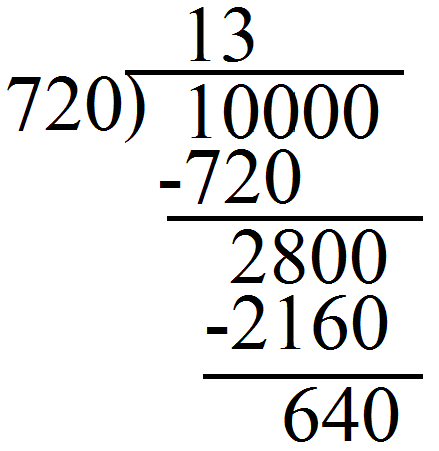
The greatest fout- digits number exactly divisible by $720 = 10000 - 640 = 9360$
So, the least five-digit number exactly divisible by $720 = 9360 + 720 = 10080$ View full question & answer→Question 165 Marks
A rectangular courtyard is $18m, 72\ cm$ long and $13m, 20\ cm$ board. It is to be paved with square tiles of the same size. Find the least possibele number of such tiles.
AnswerLength of the courtyard $= 18m, 72\ cm = 1872\ cm$ Breadth of the courtyard $= 13m, 20\ cm = 1320\ cm$
Now, maximum edge of the square tile is given by the $HCF$ of $1872\ cm$ and $1320\ cm.$
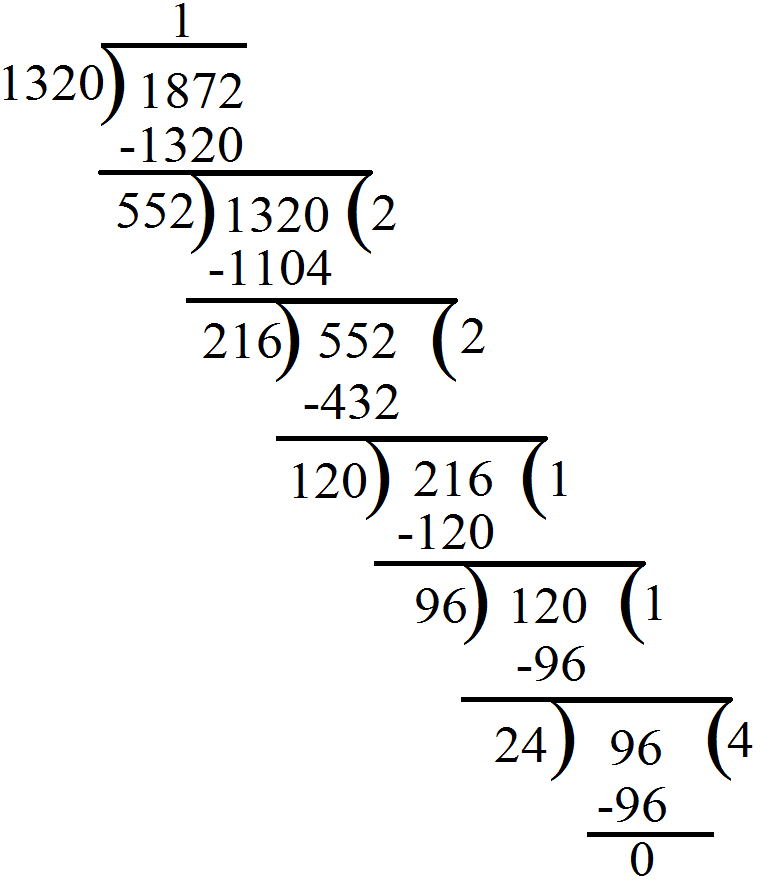
$HCF$ of $1872$ and $1320 = 24$
$\therefore$ maximum edge of the squre tile $= 24\ cm$
Required number of tiles $=\frac{\text{area of courtyard}}{\text{area of each square tile}}$
$=\frac{1872\times1320}{24\times24}$
$=4290$ View full question & answer→Question 175 Marks
Find the $HCF$ of the numbers in the following using the division method:$1794, 2346, 4761$
AnswerThe given numbers are $1794, 2346$ and $4761.$
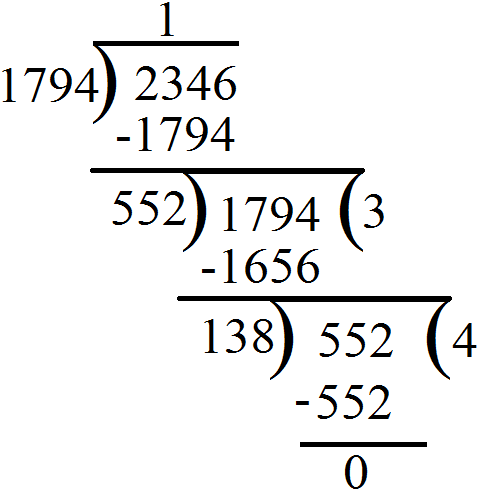
First we will find the $HCF$ of $1794$ and $2346.$
So, the $HCF$ of $1794$ and $2346$ is $138.$
Now, we will find the $HCF$ of $138$ and $4761.$
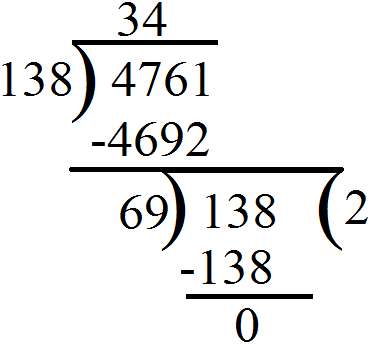
So, the $HCF$ of $138$ and $4761$ is $69.$
$\therefore$ The $HCF$ of $1794, 2346$ and $4761$ is $69.$ View full question & answer→Question 185 Marks
Find the $HCF$ of the numbers in the following using the division method:$391, 425, 527$
AnswerThe given numbers are $391, 425$ and $527$
First we will find the $HCF$ of $391$ and $425.$
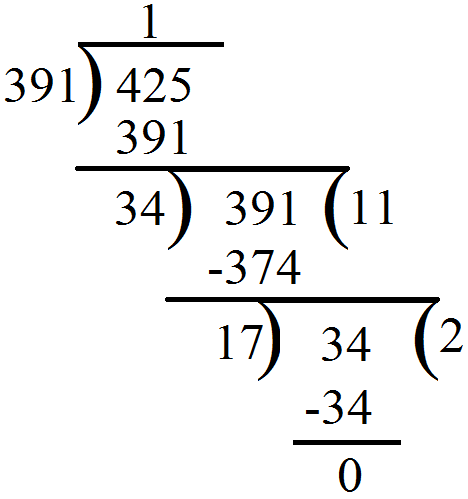
So, the $HCF$ of $391$ and $425$ is $17.$
Now, we will find the $HCF$ of $17$ and $527.$
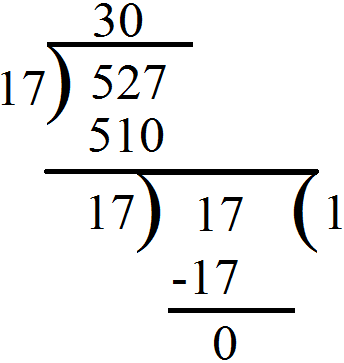
So, the $HCF$ of $17$ and $527$ is $17.$
$\therefore$ The $HCF$ of $391,$ $425$ and $527$ is $17.$ View full question & answer→Question 195 Marks
Find the $HCF$ of the numbers in the following using the division method:$658, 940, 1128$
AnswerThe given numbers are $658, 940$ and $1128.$
First we will find the $HCF$ of $658$ and $940$.
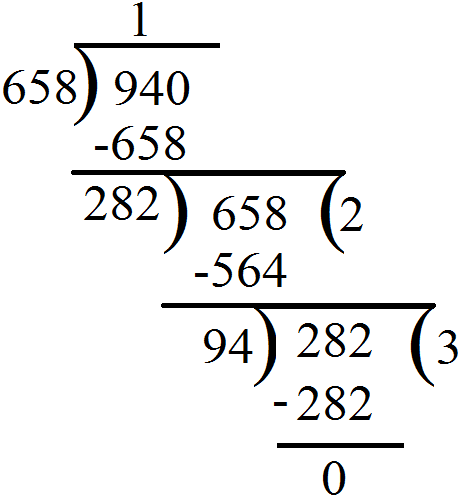
Thus, the $HCF$ of $658$ and $940$ is $94$.
Now, we will find the $HCF$ of $94$ and $1128.$
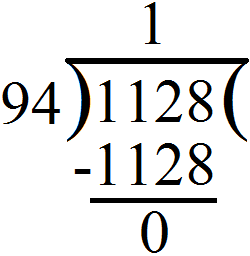
Thus, the $HCF$ of $94$ and $1128$ is $94$.
$\therefore$ The $HCF$ of 658, $94$02 and $1128$ is $94$. View full question & answer→Question 205 Marks
Find the largest number which divides $630$ and $940$ leaving remainders $6$ and $4$ respectively.
AnswerSince $6$ and $4$ are the remainders, the number must exactly divide the following:
$630 - 6 = 624$ and $940 - 4 = 936$
$\begin{array}{c|c}3&642\\\hline2&204\\\hline2&104\\\hline2&52\\\hline2&26\\\hline13&13\\\hline&1\end{array}$
$\begin{array}{c|c}3&936\\\hline2&312\\\hline2&156\\\hline2&78\\\hline3&39\\\hline13&13\\\hline&1\end{array}$
$624 = 2 \times 2 \times 2 \times 2 \times 3 \times 13$
$936 = 2 \times 2 \times 2 \times 3 \times 3 \times 13$
$HCF$ of $624$ and $936 = 8 \times 3 \times 13$
$= 312$
So, $312$ is the greatest number that divides $630$ and $940$, leaving $6$ and $4$ as the respective remainders.
View full question & answer→Question 215 Marks
Define $(i) FACTOR, (ii) MULTIPLE$. Give five example of each.
AnswerFactor: A factor of a number is an exact divisor of that number. Multiple: A multiple of a number is a number obtained by multiplying it by a natural number.
Example 1: We know that $15 = 1 \times 15$ and $15 = 3 \times 5$
$\therefore 1, 3, 5$ and $15$ are the factors of $15$. In other words, we can say that $15$ is a multiple of $1, 3, 5$ and $15.$
Example 2: We know that $8 = 8 \times 1, 8 = 2 \times 4$ and $8 = 4 \times 2$
$\therefore 1, 2, 4$ and $8$ are the factors of $8$. In other words, we can say that $8$ is a multiple of $1, 2, 4$ and $8.$
Example 3: We know that $30 = 30 \times 1, 30 = 5 \times 6$ and $30 = 6 \times 5$
$\therefore 1, 5, 6$ and $30$ are factors of $30.$ In other words, we can say that $30$ is a multiple of $1, 5, 6$ and $30.$
Example 4: We know that $20 = 20 \times 1, 20 = 4 \times 5$ and $20 = 5 \times 4$
$\therefore 1, 4, 5$ and $20$ are factors of $20.$ In other words, we can say that $20$ is a multiple of $1, 4, 5 $and $20.$
Example 5: We know that $10 = 10 \times 1, 10 = 2 \times 5$ and $10 = 5 \times 2$
$\therefore 1, 2, 5$ and $10$ are factors of $10$. In other words, we can say that $10$ is a multiple of $1, 2, 5$ and $10.$
View full question & answer→Question 225 Marks
Draw a rectangle whose two adjacent sides are $5\ cm$ and $3.5\ cm$. Make use of a pair of compasses and a ruler only.
Answer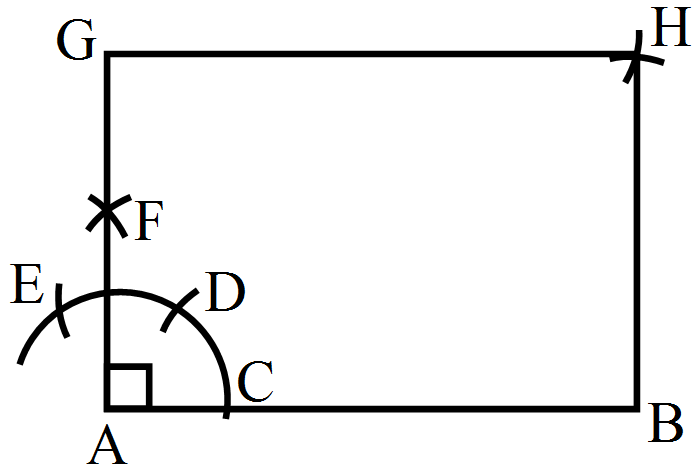
Steps of Construction:
$1.$Draw a line-segment $AB = 5\ cm$ with the help of a rular.
$2.$With Aas centre and suitable radius draw an arc cutting $AB$ at $C.$
$3.$With C as centre and same radius cut the previous arc at $D$ and then with $D$ as centre and same radius cut the arc at $E.$
$4.$With $D$ as centre and radius more than half $DE$ draw an arc.
$5.$With $E$ as centre and same radius draw another arc to cut the previous arc at $F.$
$6.$Join $AF$ and produce it to $G$ such that $AG = 3.5\ cm$. Then $\angle\text{BAG}=90^\circ.$
$7.$With $G$ as centre and radius equal to $AB$ draw an arc. With $B$ as centre and radius equal to $AG$ draw another arc to cut the previous arc at $H.$
$8.$Join $GH$ and $BH$. Then, $AB HG$ is the required rectangle. View full question & answer→