Question 12 Marks
Evaluate: $\sqrt[3]{4096}$
Answer$\sqrt[3]{4096}$ By prime factorisation, we have$4096=\underline{2\times2\times2}\times\underline{2\times2\times2}\times\underline{2\times2\times2}$
$= (2\times2\times2)^3$ $=8^3$ $\therefore\sqrt[3]{4096}=8$
View full question & answer→Question 22 Marks
Evaluate: $\sqrt[3]{-216}$
AnswerWe know that $\sqrt[3]{-216}=-\sqrt[3]{216}$
Resolving $216$ into prime factors,
We get, $216= \underline{2\times2\times 2}\times\underline{3\times3\times3}$
$= (2\times 3)^3$
$=(6)^3$
$\therefore\sqrt[3]{216}=6 $
$\therefore\sqrt[3]{-216}=-(\sqrt[3]{216})=-6 $
View full question & answer→Question 32 Marks
Evaluate: $\sqrt[3]{\frac{729}{1000}}$
Answer$\sqrt[3]{\frac{729}{1000}}$$=\frac{\sqrt[3]{729}}{\sqrt[3]{1000}}$
$=\frac{\sqrt[3]{9\times9\times9}}{\sqrt[3]{10\times10\times10}}$
$=\frac{9}{10}$
View full question & answer→Question 42 Marks
Evaluate:$\Big(\frac{1}{15}\Big)^3$
Answer$\Big(\frac{1}{15}\Big)^3$$=\Big(\frac{1}{15}\times\frac{1}{15}\times\frac{1}{15}\Big)$
$=\Big(\frac{1}{3375}\Big)$
Thus, the cube of $\Big(\frac{1}{15}\Big)$ is $\Big(\frac{1}{3375}\Big)$
View full question & answer→Question 52 Marks
Evaluate: $\sqrt[3]{9261}$
Answer$\sqrt[3]{9261}$ By prime factorisation, we have$9261=\underline{3\times3\times3}\times\underline{7\times7\times7}$
$= (3\times7)^3$ $= (21)^3$ $\therefore\sqrt[3]{9261}=21$
View full question & answer→Question 62 Marks
Evaluate: $\sqrt[3]{-1331}$
AnswerWe know that $\sqrt[3]{-1331}=-\sqrt[3]{1331}$ Resolving 1000 into prime factors, We get, $1331= 11\times11\times 11$ $= (11)^3$ $\therefore\sqrt[3]{1331}=11$ $\therefore\sqrt[3]{-1331}=-\big(\sqrt[3]{1331}\big)=-11$
View full question & answer→Question 72 Marks
Find the smallest number by which $1323$ must be multiplied so that the product is a perfect cube.
Answer$\begin{array}{c|c}3&1323\\\hline3&441\\\hline3&147\\\hline7&49\\\hline7&7\\\hline&1\end{array}$
$1323 = 3 \times 3 \times 3 \times 7 \times 7$
To make it a perfect cube, it has to be multiplied by $7.$
View full question & answer→Question 82 Marks
Which of the following numbers are perfect cubes$?$ In case of perfect cube, find the number whose cube is the given number. $3375$
Answer$3375$
Resolving $3375$ into prime factors:
$3375 = 3 \times 3 \times 3 \times 5 \times 5 \times 5$
Here, two triplet are formed, which are $3^3$ and $5^3$.
Hence, $3375$ can be expressed as the product of the triplets of $3$ and $5,$
$i.e. 3^3\times 5^3= 15^3$.
Therefore, $3375$ is a perfect cube.
View full question & answer→Question 92 Marks
Evaluate: $\sqrt[3]{\frac{-512}{343}}$
Answer$\sqrt[3]{\frac{-512}{343}}$$=\frac{\sqrt[3]{-512}}{\sqrt[3]{343}}$
$=\frac{\sqrt[3]{(-8)\times(-8)\times(-8)}}{\sqrt[3]{7\times7\times7}}$
$=\frac{-8}{7}$
View full question & answer→Question 102 Marks
Evaluate: $\sqrt[3]{729}$
Answer$\sqrt[3]{729}$ By prime factorisation, we have$729=\underline{3\times3\times3}\times\underline{3\times3\times3}$
$= (3\times3)^3$ $= 9^3$ $\therefore\sqrt[3]{729}=9$
View full question & answer→Question 112 Marks
Which of the following numbers are perfect cubes? In case of perfect cube, find the number whose cube is the given number. $9261$
Answer$9261$
Resolving $9261$ into prime factors: $9261 = 3 × 3 × 3 × 7 × 7 × 7$
Here,two triplet are formed, which are $3^3$ and $7^3$.
Hence, $9261$ can be expressed as the product of the triplets of 3 and 7, $i.e. 3^3× 7^3= 21^3$.
Therefore, $9261$ is a perfect cube.
View full question & answer→Question 122 Marks
Evaluate: $\sqrt[3]{343}$
Answer$\sqrt[3]{343}$ By prime factorisation, we have$343 = 7\times7\times7$
$= 7^3$ $\therefore\sqrt[3]{343}=7$
View full question & answer→Question 132 Marks
Evaluate: $\sqrt[3]{8000}$
Answer$\sqrt[3]{8000}$ By prime factorisation, we have$8000=\underline{2\times2\times2}\times\underline{2\times2\times2}\times\underline{5\times5\times5}$
$= (2\times2\times5)^3$ $=(20)^3$ $\therefore\sqrt[3]{8000}=20$
View full question & answer→Question 142 Marks
Evaluate: $\sqrt[3]{64}$
Answer$\sqrt[3]{64}$ By prime factorisation: $64 = \underline{2\times2\times 2}\times\underline{2\times2\times2}$ $= (2\times 2)^3$$= 4^3$
$\therefore\sqrt[3]{64}=4$
View full question & answer→Question 152 Marks
Evaluate: $\sqrt[3]{64\times729}$
Answer$\sqrt[3]{64\times729}$$=\sqrt[3]{64}\times\sqrt[3]{729}$
$=\sqrt[3]{4\times4\times4}\times\sqrt[3]{9\times9\times9}$
$=(4\times9)$
$=36$
View full question & answer→Question 162 Marks
Evaluate: $\sqrt[3]{1728}$
Answer$\sqrt[3]{1728}$ By prime factorisation, we have$1728=\underline{2\times2\times2}\times\underline{2\times2\times2}\times\underline{3\times3\times3}$
$= (2\times2\times3)^3$ $= (12)^3$ $\therefore\sqrt[3]{1728}=12$
View full question & answer→Question 172 Marks
Evaluate: $\sqrt[3]{3375}$
Answer$\sqrt[3]{3375}$ By prime factorisation, we have$3375=\underline{3\times3\times3}\times\underline{5\times5\times5}$
$= (3\times5)^3$ $=(15)^3$ $\therefore\sqrt[3]{3375}=15$
View full question & answer→Question 182 Marks
Evaluate: $\sqrt[3]{\frac{125}{216}}$
Answer$\sqrt[3]{\frac{125}{216}}$ $=\frac{\sqrt[3]{125}}{\sqrt[3]{216}}$ $=\frac{\sqrt[3]{5\times5\times5}}{\sqrt[3]{2\times2\times2\times3\times3\times3}}$ $=\frac{5}{2\times3}$ $=\frac{5}{6}$
View full question & answer→Question 192 Marks
Which of the following numbers are perfect cubes? In case of perfect cube, find the number whose cube is the given number. $8000$
Answer$8000$ Resolving $8000$ into prime factors:
$8000 = 2 \times 2 \times 2 \times 2 \times 2 \times 2 \times 5 \times 5 \times 5$
Here, three triplet are formed, which are $2^3, 2^3$ and $5^3$.
Hence, $8000$ can be expressed as the product of the triplets of $2, 2$ and $5,$i.e. $2^3\times 2^3\times 5^3= 20^3$.
Therefore, $8000$ is a perfect cube.
View full question & answer→Question 202 Marks
Evaluate: $\sqrt[3]{\frac{-27}{125}}$
Answer$\sqrt[3]{\frac{-27}{125}}$ $=\frac{\sqrt[3]{-27}}{\sqrt[3]{125}}$ $=\frac{\sqrt[3]{(-3)\times(-3)\times(-3)}}{\sqrt[3]{5\times5\times5}}$ $=\frac{-3}{5}$
View full question & answer→Question 212 Marks
Evaluate:$\Big(\frac{4}{7}\Big)^3$
Answer$\Big(\frac{4}{7}\Big)^3$$=\Big(\frac{4}{7}\times\frac{4}{7}\times\frac{4}{7}\Big)$
$=\Big(\frac{64}{343}\Big)$
Thus, the cube of $\Big(\frac{4}{7}\Big)$ is $\Big(\frac{64}{343}\Big)$
View full question & answer→Question 222 Marks
Which of the following numbers are perfect cubes? In case of perfect cube, find the number whose cube is the given number. $343$
Answer$343$
Resolving $343$ into prime factors:
$343 = 7 \times 7 \times 7$
Here, one triplet is formed, which is $7^3$.
Hence, $343$ can be expressed as the product of the triplets of $7.$
Therefore, $343$ is a perfect cube.
View full question & answer→Question 232 Marks
Evaluate:
$\sqrt[3]{\frac{-64}{343}}$
Answer $\sqrt[3]{\frac{-64}{343}}$
$=\frac{\sqrt[3]{-64}}{\sqrt[3]{343}}$
$=\frac{\sqrt[3]{(-4)\times(-4)\times(-4)}}{\sqrt[3]{7\times7\times7}}$
$=\frac{-4}{7}$
View full question & answer→Question 242 Marks
Which of the following numbers are perfect cubes? In case of perfect cube, find the number whose cube is the given number. $125$
Answer$125$
Resolving $125$ into prime factors:$125 = 5 \times 5 \times 5$
Here, one triplet is formed, which is $5^3$.
Hence, $125$ can be expressed as the product of the triplets of $5.$
Therefore, $125$ is a perfect cube.
View full question & answer→Question 252 Marks
Evaluate:$\Big(1\frac{3}{10}\Big)^3$
Answer$\Big(1\frac{3}{10}\Big)^3$$=\Big(\frac{13}{10}\Big)^3$
$=\Big(\frac{13}{10}\times\frac{13}{10}\times\frac{13}{10}\Big)$
$=\Big(\frac{2197}{1000}\Big)$
Thus, the cube of $\Big(1\frac{3}{10}\Big)$ is $\Big(\frac{2197}{1000}\Big)$
View full question & answer→Question 262 Marks
Evaluate: $\sqrt[3]{\frac{27}{64}}$
Answer$\sqrt[3]{\frac{27}{64}}$ $=\frac{\sqrt[3]{27}}{\sqrt[3]{64}}$ $=\frac{\sqrt[3]{3\times3\times3}}{\sqrt[3]{4\times4\times4}}$ $=\frac{3}{4}$
View full question & answer→Question 272 Marks
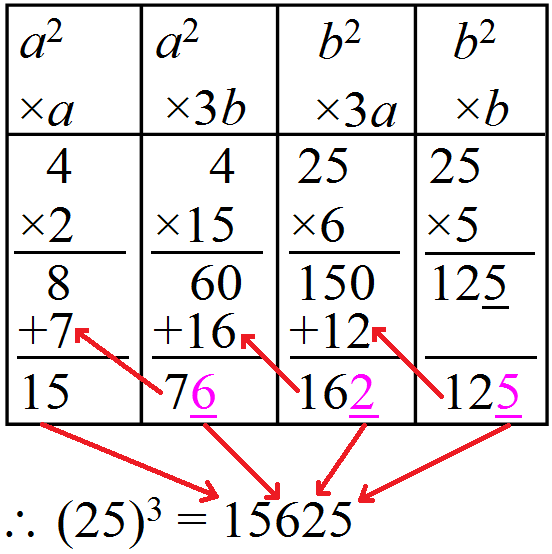
Find the value of using the short-cut method:
$ (25)^3$
Answer$(25)^3$
We know that short-cut method for finding the cube of any two digit numbers is as given.
$ (a+b)^3=a^3+3 a^2 b+3 a b^2+b^3$
$ =a^2 \times a+a^2 \times 3 b+b^2 \times 3 a+b^2 \times bn$
Here,
$a = 2$
$b = 5$
View full question & answer→Question 282 Marks
Evaluate: $\sqrt[3]{-512}$
AnswerWe know that $\sqrt[3]{-512}=-\sqrt[3]{512}$ Resolving $512$ into prime factors, We get, $512= \underline{2\times2\times 2}\times\underline{2\times2\times2}\times\underline{2\times2\times2}$
$= (2\times2\times2)^3$
$=(8)^3$
$\therefore\sqrt[3]{512}=8$
$\therefore\sqrt[3]{-512}=-\big(\sqrt[3]{512}\big)=-8$
View full question & answer→Question 292 Marks
Evaluate:$\Big(\frac{10}{11}\Big)^3$
Answer$\Big(\frac{10}{11}\Big)^3$$=\Big(\frac{10}{11}\times\frac{10}{11}\times\frac{10}{11}\Big)$
$=\Big(\frac{1000}{1331}\Big)$
Thus, the cube of $\Big(\frac{10}{11}\Big)$ is $\Big(\frac{1000}{1331}\Big)$
View full question & answer→