MCQ 11 Mark
How many sides does a regular polygon have if the measure of an exterior angle is $24^\circ ?$
AnswerNumber of sides $\frac{360^\circ}{24^\circ}=15$
View full question & answer→MCQ 21 Mark
$PQRS$ is a trapezium in which $PQ || SR$ and $\angle\text{P}=130^\circ, \angle\text{Q}= 110^\circ.$ Then $\angle\text{R}$ is equal to:
- ✓
$70^\circ$
- B
$50^\circ$
- C
$65^\circ$
- D
$55^\circ$
AnswerCorrect option: A. $70^\circ$
Since, $PQRS$ is a trapezium and $PQ \ || \ SR$
$\therefore\angle\text{Q}+\angle\text{R}=180^\circ$
$\Rightarrow\angle\text{R}= 180^\circ − 110^\circ= 70^\circ$
View full question & answer→MCQ 31 Mark
If $AB$ and $CD$ are two parallel sides of a parallelogram, then:
- ✓
$AB = CD$
- B
$AB > CD$
- C
$AB < CD$
- D
AnswerCorrect option: A. $AB = CD$
$AB = CD$
View full question & answer→MCQ 41 Mark
In the quadrilateral $ABCD,$ the diagonals $AC$ and $BD$ are equal and perpendicular to each other. What type of a quadrilateral is $ABCD?$
View full question & answer→MCQ 51 Mark
Tick the correct answer in the following$?$
The measure of each exterior angle of a regular polygon is $40^\circ .$ How many sides does it have$?$
AnswerEach exterior angle of a regular n-sided polygon $=\frac{160}{\text{n}}=40$
$\Rightarrow\text{n}=\frac{360}{\text{40}}=9$
View full question & answer→MCQ 61 Mark
The number of sides of a regular polygon whose each interior angle is of $135^\circ $ is:
AnswerWe know that, the measures of each exterior angle of a polygon having n sides is given by $\frac{360^\circ}{\text{n}}$
$\therefore$ The number of sides, $\text{n}=\frac{360^\circ}{\text{Exterior angle}}=\frac{360^\circ}{180^\circ}=\frac{360^\circ}{45^\circ}=8$
View full question & answer→MCQ 71 Mark
A simple closed curve made up of only line segments is called a $..............$
View full question & answer→MCQ 81 Mark
How many diagonals does a triangle have?
MCQ 91 Mark
Which of the following statement is true?
- A
All the rectangles are squares.
- B
All the parallelograms are rhombuses.
- ✓
All the squares are rhombuses.
- D
Each parallelogram is a trapezium.
AnswerCorrect option: C. All the squares are rhombuses.
All the squares are rhombuses.
View full question & answer→MCQ 101 Mark
The four angles of a pentagon are $40^\circ , 75^\circ , 125^\circ and 135^\circ .$ The measure of the fifth angle is:
- ✓
$165^\circ$
- B
$170^\circ $
- C
$160^\circ$
- D
$175^\circ$
AnswerCorrect option: A. $165^\circ$
$ n= 5, (n - 2) 180^\circ = (5 - 2) 180^\circ = 540^\circ $
Fifth angle
$= 540^\circ - (40^\circ + 75^\circ + 125^\circ + 135^\circ )$
$= 540^\circ - 375^\circ = 165^\circ $
View full question & answer→MCQ 111 Mark
How many non-overlapping triangles can we make in a $n-$gon (polygon having n sides), by joining the vertices$?$
- A
$n - 1$
- ✓
$n - 2$
- C
$n - 3$
- D
$n - 4$
AnswerCorrect option: B. $n - 2$
The number of non-overlapping triangles in a $n-$gon $= n - 2,$ i.e., $2$ less than the number of sides.
View full question & answer→MCQ 121 Mark
$\text{ABCD}$ is a quadrilateral. If $\text{AC}$ and $\text{BD}$ bisect each other, what is $\text{ABCD}?$
View full question & answer→MCQ 131 Mark
The perimeter of a parallelogram is $180\ cm.$ One side exceeds another by $10\ cm.$ The sides of the parallelogram are:
- ✓
$40\ cm, 50\ cm$
- B
$50\ cm$ each
- C
$45\ cm$ each
- D
AnswerCorrect option: A. $40\ cm, 50\ cm$
$40\ cm, 50\ cm$
View full question & answer→MCQ 141 Mark
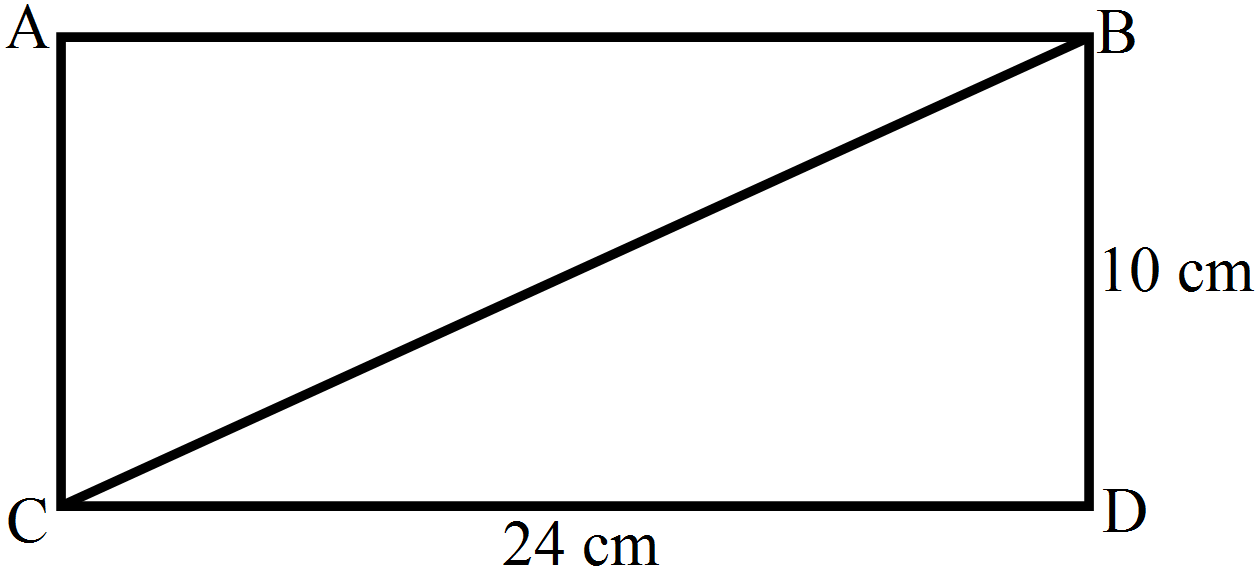
Length of one of the diagonals of a rectangle whose sides are $10\ cm$ and $24\ cm$ is.
- A
$25\ cm$
- B
$20\ cm$
- ✓
$26\ cm$
- D
$3.5\ cm$
AnswerCorrect option: C. $26\ cm$
In $\triangle\text{BDC}=90^\circ$
Using Pythagoras Theorem, We have,
$\text{BC}^2=\text{BD}^2+\text{CD}^2$
$\Rightarrow\text{BC}^2=10^2+24^2=100+576$
$\Rightarrow\text{BC}^2=676$
$\Rightarrow\text{BC}=\sqrt{676}$
$\Rightarrow\text{BC}=256\text{cm}$
View full question & answer→MCQ 151 Mark
A quadrialateral whose opposite sides and all the angles are equal is a.
AnswerWe know that, in a rectangle, opposite sides and all the angles are equal.
View full question & answer→MCQ 161 Mark
Out of the three equal angles of a quadrilateral, each measures $70^\circ .$ The measure of the fourth angle is:
- A
$90^\circ$
- B
$140^\circ$
- ✓
$150^\circ$
- D
$70^\circ$
AnswerCorrect option: C. $150^\circ$
Fourth angle $= 360^\circ - (70^\circ + 70^\circ + 70^\circ )$
$= 150^\circ .$
View full question & answer→MCQ 171 Mark
If a quadrilateral has two adjacent sides equal and the other two sides equal, it is called:
MCQ 181 Mark
Which of the following quadrilaterals is a regular quadrilateral?
AnswerA rhombus is a quadrilateral with all the sides equal and its diagonals bisect each other, but all of its angles are not equal.
We already know that only the parallel sides or the opposite sides of a parallelogram are equal.
In a trapezium no side is equal to another.
A rectangle has only its opposite sides as equal. Therefore, square is the only regular quadrilateral.
So, the correct answer is “square”.
Note: Do not confuse that rectangle is also a regular quadrilateral.
It is not because all the sides are not equal in a rectangle whereas all the angles are equal and diagonals bisect each other.
For a quadrilateral to be regular it should have all the sides equal.
So the rectangle is not.
When all the sides are equal in a rectangle, then it can be considered as a square.
View full question & answer→MCQ 191 Mark
The sum of angles of a concave quadrilateral is:
- A
more than $360^\circ$
- B
less than $360^\circ$
- ✓
equal to $360^\circ$
- D
twice of $360^\circ$
AnswerCorrect option: C. equal to $360^\circ$
C. equal to $360^\circ$
Solution:
We know that, the sum of interior angles of any polygon (convex or concave) having n sides is $(n − 2) \times 180^\circ$
$\therefore$ The sum of angles of a concave quadrilateral is $(4 – 2) \times 180^\circ$, i.e. $360^\circ$
View full question & answer→MCQ 201 Mark
The diagonals of a rectangle are $2x + 1$ and $3x - 1,$ respectively. Find the value of $x.$
Answer The diagonals of a rectangle are equal in length.
$2x + 1 = 3x - 1$
$1 + 1 = 3x - 2x$
$2 = x$
Thus, the value of $x$ is $2.$
View full question & answer→MCQ 211 Mark
Tick the correct answer in the following$?$ How many diagonals are there in a polygon having $12$ sides$?$
Answer For an n-sided polygon:
Number of diagonals $=\frac{\text{n}(\text{n}-3)}{2}$
$\therefore\text{n}=12$
$\Rightarrow\frac{12(12-3)}{2}=54$
View full question & answer→MCQ 221 Mark
$ABCD$ is a rectangle and $AC$ & $BD$ are its diagonals. If $AC = 10\ cm,$ then $BD$ is:
- A
$20\ cm$
- ✓
$10\ cm$
- C
$5\ cm$
- D
$15\ cm$
AnswerCorrect option: B. $10\ cm$
The diagonals of a rectangle are always equal.
View full question & answer→MCQ 231 Mark
The closed curve which is also a polygon is:
Answer
is polygon as no two line segments intersect each other.
View full question & answer→MCQ 241 Mark
The measures of the three angles of a quadrilateral are $65^\circ , 75^\circ $ and $85^\circ $. The measure of the fourth angle is:
- A
$65^\circ$
- B
$75^\circ$
- C
$85^\circ$
- ✓
$135^\circ$
AnswerCorrect option: D. $135^\circ$
$135^\circ$
View full question & answer→MCQ 251 Mark
Two adjacent angles of a quadrilateral measure $130^\circ $ and $40^\circ .$ The sum of the remaining two angles is:
- ✓
$190^\circ$
- B
$180^\circ$
- C
$360^\circ$
- D
$90^\circ$
AnswerCorrect option: A. $190^\circ$
$190^\circ$
View full question & answer→MCQ 261 Mark
The angle sum of a convex polygon with number of sides $8$ is:
- A
$720^\circ$
- B
$900^\circ$
- ✓
$1080^\circ $
- D
$1440^\circ$
AnswerCorrect option: C. $1080^\circ $
$n = 8$
$(n - 2) 180^\circ = 1080^\circ .$
View full question & answer→MCQ 271 Mark
The sides of a pentagon are produced in order. Which of the following is the sum of its exterior angles?
- A
$540^\circ$
- B
$180^\circ$
- C
$720^\circ$
- ✓
$360^\circ $
AnswerCorrect option: D. $360^\circ $
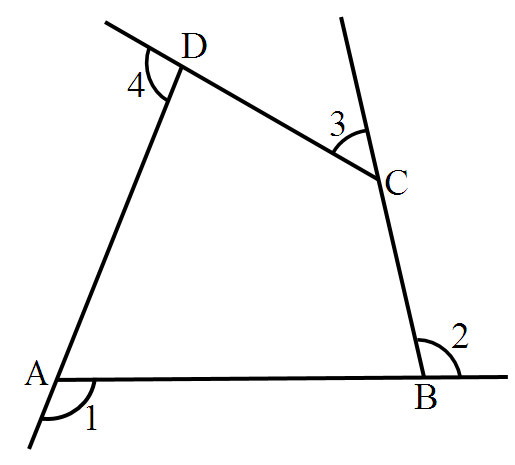
$\because ABCD$ is a Quadrilateral
To Proof $\angle\text{1}+ \angle\text{2}+\angle\text{3}+\angle\text{4}=360^\circ$
$\angle\text{A}+ \angle\text{B}+\angle\text{C}+\angle\text{D}=360^\circ$
$\angle\text{A}+ \angle\text{1}=180^\circ$
$\angle\text{B}+ \angle\text{2}=180^\circ$
$\angle\text{C}+ \angle\text{3}=180^\circ$
$\angle\text{D}+ \angle\text{4}=180^\circ$
$\angle\text{A}+ \angle\text{B}+\angle\text{C}+\angle\text{D}+ \angle\text{1}+ \angle\text{2}+\angle\text{3}+\angle\text{4}$
$= 180^\circ+180^\circ+180^\circ+180^\circ$
$=720^\circ$
$360^\circ+\angle1+\angle2+\angle3+\angle4=720^\circ$
$\angle1+\angle2+\angle3+\angle4=360^\circ$
Each polygon have $360^\circ $ as it's exterior angel but it's Interior angle is depend on it's sides, so the answer is $D.$
View full question & answer→MCQ 281 Mark
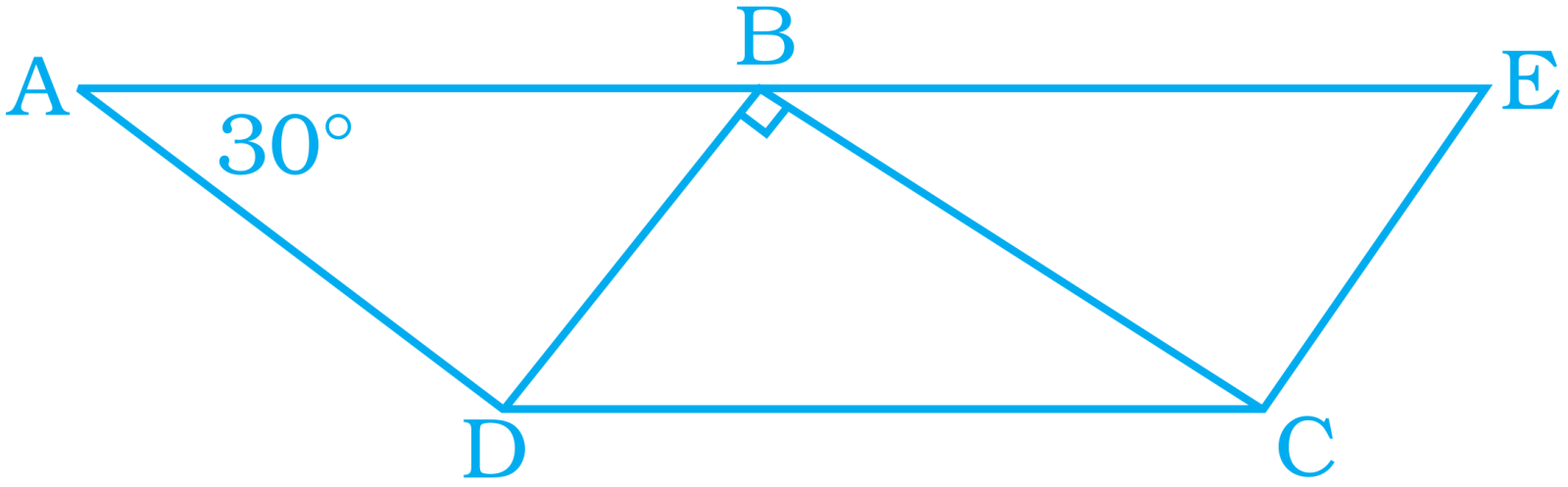
In the given figure, $ABCD$ and $BDCE$ are parallelograms with common base $DC.$ If $BC ⊥ BD,$ then $\angle\text{BEC}=$
- ✓
$60^\circ$
- B
$30^\circ$
- C
$150^\circ$
- D
$120^\circ$
AnswerCorrect option: A. $60^\circ$
$\angle\text{BCD}=30^\circ$
$\therefore\angle\text{BCD}=30^\circ$,
in $\triangle\text{CBD}$ by angle sum property of a triangle, we have
$\Rightarrow\angle\text{DBC}+\angle\text{BCD}+\angle\text{CDB}=180^\circ$
$\Rightarrow90^\circ+30^\circ+\angle\text{CDB}=180^\circ$
$\Rightarrow\angle\text{CDB}=180^\circ-120^\circ=60^\circ$
$\Rightarrow\angle\text{BEC}=60^\circ$
View full question & answer→MCQ 291 Mark
If two adjacent angles of a parallelogram are $(5x – 5)^\circ$ and $(10x + 35)^\circ$, then the ratio of these angles is:
- ✓
$1 : 3$
- B
$2 : 3$
- C
$1 : 4$
- D
$1 : 2$
AnswerCorrect option: A. $1 : 3$
A. $1 : 3$
Solution:
We know that, adjacent angles of a parallelogram are supplementary, i.e., their sum equals $180^{\circ}$
$\therefore(5-5)+(10 x+35)=180^{\circ} $
$\Rightarrow 15 x+30^{\circ} .=180^{\circ} . \Rightarrow 15 x=180^{\circ}$
$\Rightarrow x=10^{\circ}$. Thus, the angles are $(5 \times 10-5)$ and $(10 \times 10+35)$ i.e., $45^{\circ}$ and $135^{\circ}$. Hence, the required ratio is $45^{\circ}: 135^{\circ}$ i.e., $1: 3$.
View full question & answer→MCQ 301 Mark
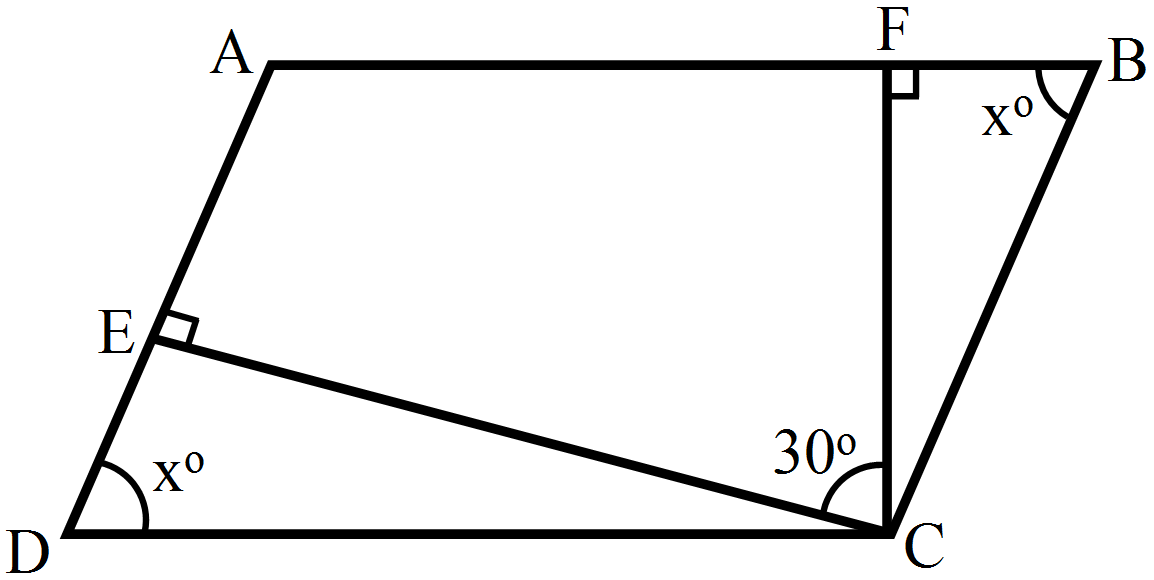
The angle between the two altitudes of a parallelogram through the same vertex of an obtuse angle of the parallelogram is $30^\circ$. The measure of the obtuse angle is.
- A
$100^\circ$
- ✓
$150^\circ$
- C
$105^\circ$
- D
$120^\circ$
AnswerCorrect option: B. $150^\circ$
B. $150^\circ$
Solution:
Let EC and FC be altitudes and $\angle\text{EBC}=30^\circ$
let $\angle\text{EDC}=\text{x}=\angle\text{FBC}$
so, $\angle\text{EDC}=90-\text{x}\ \text{and}\ \angle\text{BCF}=90-\text{x}$
So, by property of the parallelogram,
$\Rightarrow\angle\text{ADC}+\angle\text{DCB}+180^\circ$
$\Rightarrow\angle\text{ADC}+(\angle\text{ECD}+\angle\text{ECF})=180^\circ$
$\Rightarrow\text{x}+90^\circ-\text{x}+30^\circ+90^\circ-\text{x}=180^\circ$
$\Rightarrow-\text{x}=180^\circ-210^\circ=-30^\circ$
$\Rightarrow\text{x}=30^\circ$
Hence, $\angle\text{DCB}=30^\circ+60^\circ+60^\circ=150^\circ$
View full question & answer→MCQ 311 Mark
What is the maximum exterior angle possible for a regular polygon$?$
- A
$60^\circ$
- B
$80^\circ$
- ✓
$120^\circ$
- D
$160^\circ$
AnswerCorrect option: C. $120^\circ$
Since of increasing size of regular polygon $\Rightarrow $ its exterior angle decreases.
$\therefore$ Mass exterior angle is for a regular triangle (equilateral triangle) and $= 180 -$ interior angle
$= 180^\circ - 60^\circ = 120^\circ $
View full question & answer→MCQ 321 Mark
The length and breadth of a rectangle is $4\ cm$ and $2\ cm$ respectively. Find the perimeter of the rectangle.
- A
$8\ cm$
- B
$16\ cm$
- ✓
$12\ cm$
- D
$6\ cm$
AnswerCorrect option: C. $12\ cm$
Given, length of rectangle is $4\ cm$
Breadth of rectangle $= 2\ cm$
By the formula of perimeter of rectangle, we know that;
Perimeter $= 2 ($Length $+$ Breadth$)$
$P = 2(4 + 2)$
$P = 2 × 6$
$P = 12\ cm.$
View full question & answer→MCQ 331 Mark
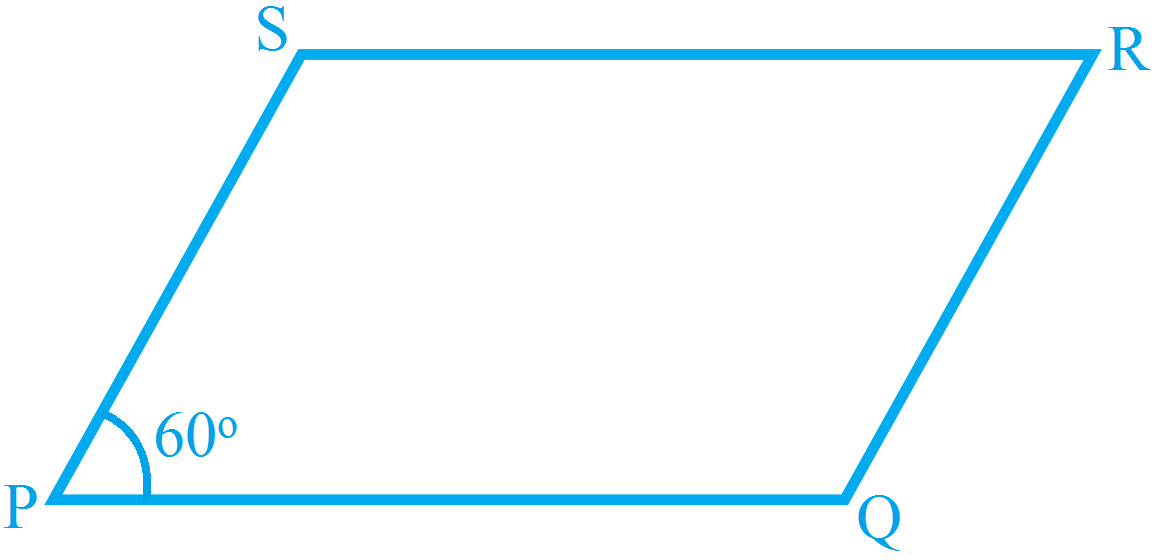
In a parallelogram $PQRS,$ if $\angle\text{P}=60^\circ$, then other three angles are:
- A
$45^\circ, 135^\circ, 120^\circ$
- ✓
$60^\circ, 120^\circ, 120^\circ$
- C
$60^\circ, 135^\circ, 135^\circ$
- D
$45^\circ, 135^\circ, 135^\circ$
AnswerCorrect option: B. $60^\circ, 120^\circ, 120^\circ$
B. $ 60^\circ, 120^\circ, 120^\circ$
Solution:
Given,$\angle\text{P}=60^\circ$ Since, in a parallelogram, adjacent angles are supplementary,
$\Rightarrow\angle\text{P}+\angle\text{Q}=180^\circ$
$\Rightarrow60^\circ+\angle\text{Q}=180^\circ$
$\Rightarrow\angle\text{Q}=120^\circ$
Also, opposite angles are equal in a parallelogram Therefore, $\angle\text{R}=\angle\text{P}=60^\circ,\angle\text{S}=\angle\text{Q}=120^\circ$
Hence, other three angles are $60^\circ, 120^\circ, 120^\circ.$
View full question & answer→MCQ 341 Mark
What is the number of vertices of a quadrilateral?
MCQ 351 Mark
A diagonal of a rectangle is inclined to one side of the rectangle at $25^\circ .$ The acute angle between the diagonals is:
- A
$25^\circ$
- ✓
$50^\circ$
- C
$40^\circ$
- D
$55^\circ$
AnswerCorrect option: B. $50^\circ$
$50^\circ$
View full question & answer→MCQ 361 Mark
Tick the correct answer in the following? In a regular polygon, each interior angle is thrice the exterior angle. The number os sides of the polygon is:
Answer For a regular polygon with $n$ sides:
Each exterior angle $=\frac{ 360}{ \text{n}}$
Each interior angle $=180-\frac{360}{\text{n}}$
$\therefore180-\frac{360}{\text{n}}=3\Big(\frac{360}{\text{n}}\Big)$
$\Rightarrow180=4\Big(\frac{360}{\text{n}}\Big)$
$\Rightarrow\text{n}=\frac{4\times360}{180}=8$
View full question & answer→MCQ 371 Mark
The sum of the measures of the three angles of a triangle is ________.
- A
$360^\circ$
- B
$210^\circ$
- ✓
$180^\circ$
- D
AnswerCorrect option: C. $180^\circ$
$180^\circ$
View full question & answer→MCQ 381 Mark
Which of the following is not true for an exterior angle of a regular polygon with $n$ sides?
- A
Each exterior angle$=\frac{360^\circ}{\text{n}}$
- B
Exterior angle $=180^{\circ}$ – interior angle
- C
$n =\frac{360^\circ}{\text{exterior angle}}$
- ✓
Each exterior angle $= \frac{(\text{n}-2)\times180^\circ}{\text{n}}$
AnswerCorrect option: D. Each exterior angle $= \frac{(\text{n}-2)\times180^\circ}{\text{n}}$
Each exterior angle $= \frac{(\text{n}-2)\times180^\circ}{\text{n}}$
View full question & answer→MCQ 391 Mark
If the two diagonals of a rhombus are $8\ cm\ \& \ 6\ cm,$ its area is?
- A
$28\ cm^2$
- B
$48\ cm^2$
- C
$14\ cm^2$
- ✓
$24\ cm^2$
AnswerCorrect option: D. $24\ cm^2$
D. $24\ cm^2$
View full question & answer→MCQ 401 Mark
A parallelogram which has equal diagonals is a:
MCQ 411 Mark
The lengths of the diagonals of a rhombus are $16\ cm$ and $12\ cm$. The length of each side of the rhombus is:
- A
$8\ cm$
- B
$9\ cm$
- ✓
$10\ cm$
- D
$12\ cm$
AnswerCorrect option: C. $10\ cm$
$\text{AO}=\frac{1}{2}\text{AC}=\Big(\frac{1}{2}\times16\Big)=8\text{cm}$
$\text{BO}=\frac{1}{2}\text{BD}=\Big(\frac{1}{2}\times12\Big)=6\text{cm}$
From the right $\triangle\text{AOB},$ we have,
$\therefore\text{AB}^2=\text{AO}^2+\text{BO}^2$
$\Rightarrow\text{AB}^2=\big\{(8)^2+(6)^2\big\}\text{cm}^2$
$\Rightarrow\text{AB}=\sqrt{100}=10\text{cm}$
View full question & answer→MCQ 421 Mark
The number of sides of a regular polygon, whose each exterior angle has a measure of $45^\circ $, is:
View full question & answer→MCQ 431 Mark
The two diagonals are not necessarily equal in a:
AnswerAll sides of Rhombus are equal in length but in case of angle it is not necessary to be equal.
If all the angles are equal then it will become a square.
That’s why diagonals of rhombus are not necessary to be equal in length.
View full question & answer→MCQ 441 Mark
If an angle of a parallelogram is two-thirds of its adjacent angle, the smallest angle of the parallelogram is:
- A
$54^\circ$
- ✓
$72^\circ $
- C
$81^\circ $
- D
$108^\circ $
AnswerCorrect option: B. $72^\circ $
Let the measure of the angle be $x^\circ .$
$\therefore\text{x}+\Big(\frac{2}{3}\times\text{x}\Big)=180$
$\Rightarrow\frac{3\text{x}+2\text{x}}{3}=180$
$\Rightarrow5\text{x}=3\times180$
$\Rightarrow\text{x}=\frac{3\times180}{5}=180$
Hence the anlge is $180^\circ .$
Its adjacent $= (180 - 108^\circ ) = 72^\circ .$
Therefore, the smallest angle is $72^\circ .$
View full question & answer→MCQ 451 Mark
What is the name of a regular polygon of $6$ sides?
View full question & answer→MCQ 461 Mark
Two adjacent angles of a parallelogram are of equal measure. The measure of each angle of the parallelogram is:
- A
$45^\circ $
- B
$30^\circ $
- C
$60^\circ $
- ✓
$90^\circ $
AnswerCorrect option: D. $90^\circ $
$x^\circ + x^\circ = 180^\circ$
$\Rightarrow x^\circ = 90^\circ .$
View full question & answer→MCQ 471 Mark
The quadrilateral whose diagonals are perpendicular to each other is:
MCQ 481 Mark
The length and breadth of a rectangle are in the ratio $4 : 3.$ If the diagonal measures $25\ cm$ then the perimeter of the rectangle is:
- A
$56\ cm$
- B
$60\ cm$
- ✓
$70\ cm$
- D
$80\ cm$
AnswerCorrect option: C. $70\ cm$
C. $70\ cm$
Solution:
Let the length $A B$ be $4 x$ and Breadth $B C$ be $3 x$.
Each angle of a rectangle is a right angle. We have,
$\therefore \angle ABC =90^{\circ}$
From the right $\triangle ABC$ :
$A C 2=A B 2+B C 2$
$\Rightarrow(25)^2=(4 x)^2+(3 x)^2$
$\Rightarrow 16 x^2+9 x^2=625$
$\Rightarrow 25 x^2=625$
$\Rightarrow x^2=25$
$\Rightarrow x=5$
Therefore, lenght $=4 \times 5=2\ cm$ and breadth $=3 \times 5=15\ cm$.
View full question & answer→MCQ 491 Mark
If the two adjacent angles of a parallelogram are equal, then each of its angle is?
- A
$70^\circ $
- B
$80^\circ$
- ✓
$90^\circ$
- D
$100^\circ$
AnswerCorrect option: C. $90^\circ$
$90^\circ $
View full question & answer→MCQ 501 Mark
What is the number of sides of a quadrilateral?
MCQ 511 Mark
For which of the following figures, diagonals are equal?
AnswerBy the property of a rectangle, we know that its diagonals are equal.
View full question & answer→MCQ 521 Mark
$ABCD$ is a rhombus. If $\angle\text{ACB}=40^\circ$ then, $\angle\text{ADB}$ is:
- A
$45^\circ$
- B
$60^\circ$
- ✓
$50^\circ$
- D
$40^\circ$
AnswerCorrect option: C. $50^\circ$
$50^\circ$
View full question & answer→MCQ 531 Mark
Which of the following is a property of a parallelogram?
- ✓
Opposite sides are parallel.
- B
The diagonals bisect each other at right angles.
- C
The diagonals are perpendicular to each other.
- D
AnswerCorrect option: A. Opposite sides are parallel.
We, know that, in a parallelogram, opposite sides are parallel.
View full question & answer→MCQ 541 Mark
A quadrilateral whose all sides are equal, opposite angles are equal and the diagonals bisect each other at right angles is a $..........$
AnswerWe know that, in rhombus, all sides are equal, opposite angles are equal and diagonals bisect each other at right angles.
View full question & answer→MCQ 551 Mark
The perimeter of a parallelogram whose parallel sides have lengths equal to $12\ cm$ and $7\ cm$ is:
- A
$19\ cm$
- ✓
$38\ cm$
- C
$21\ cm$
- D
$42\ cm$
AnswerCorrect option: B. $38\ cm$
Perimeter of parallelogram $= 2$ (Sum of Parallel sides)
$P = 2 (12 + 7)$
$P = 2 (19)$
$P = 38\ cm$
View full question & answer→MCQ 561 Mark
If the sides of a triangle are produced in order, What is the sum of the exterior angles so formed?
- A
$540^\circ$
- B
$180^\circ$
- C
$720^\circ$
- ✓
$360^\circ$
AnswerCorrect option: D. $360^\circ$
$360^\circ$
View full question & answer→MCQ 571 Mark
Which of the following quadrilaterals has two pairs of adjacent sides equal and diagonals intersecting at right angles?
Answer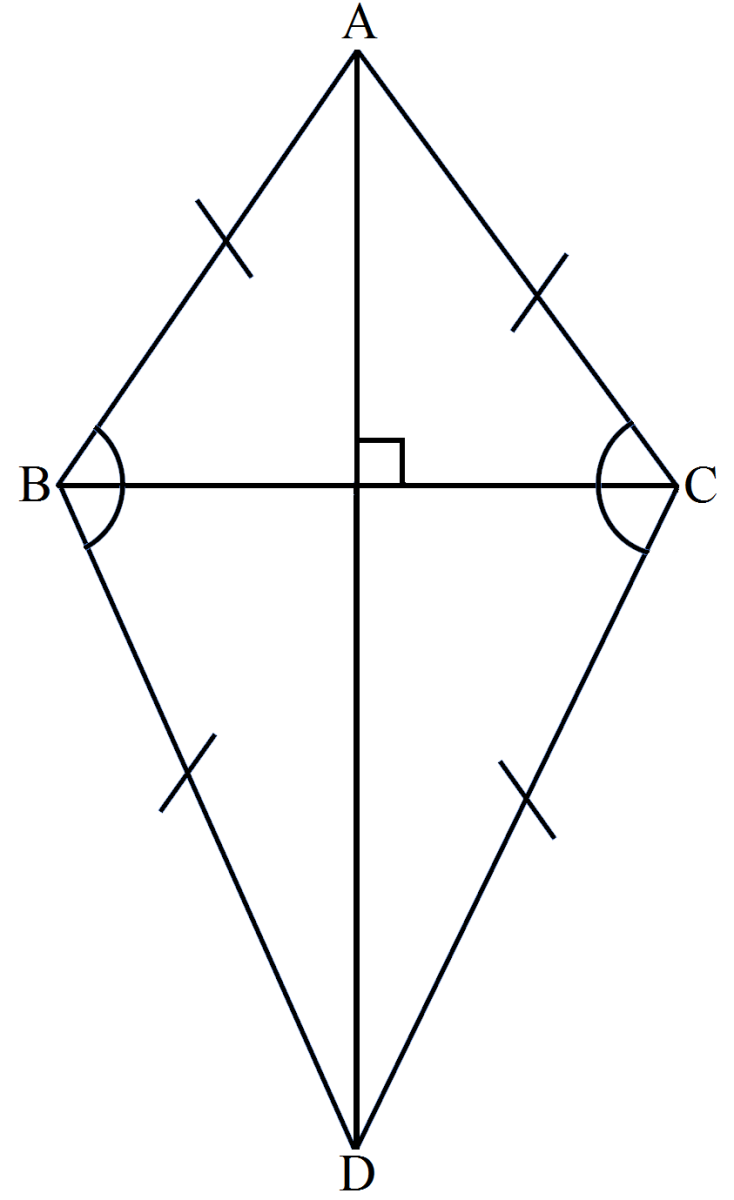
$\Rightarrow $ In given quadrilateral $ABCD$ is a kite
$\Rightarrow $ We know the properties of kite.
$\Rightarrow $ Kite has two pairs of adjacent sides equal.
$\Rightarrow AB = AC$ and $BD = CD$
$\Rightarrow $ In kite it's opposite sides are unequal.
$\Rightarrow $ So, If a quadrilateral has exactly two pairs of equal adjacent sides and the unequal opposite sides, then it is called kite. View full question & answer→MCQ 581 Mark
The measure of each exterior angle of a regular polygon of $15$ sides is:
- A
$30^\circ$
- B
$45^\circ$
- C
$60^\circ$
- ✓
$24^\circ$
AnswerCorrect option: D. $24^\circ$
$24^\circ $
View full question & answer→MCQ 591 Mark
A quadrilateral whose all sides, diagonals and angles are equal is a.
AnswerThese are the properties of a square, i.e. in a square, all sides, diagonals and angles are equal.
View full question & answer→MCQ 601 Mark
Which of the following is true for the adjacent angles of a parallelogram?
- A
They are equal to each other
- B
They are complementary angles
- ✓
They are supplementary angles
- D
AnswerCorrect option: C. They are supplementary angles
Parallelogram: A parallelogram is a quadrilateral in which each pair of opposite sides is parallel. The two diagonals bisect each other. The pair of opposite sides is equal and the pair of opposite angles is equal.
Sum of the adjacent angles of a parallelogram is $180^\circ $.
i.e supplementary, $\angle{\text{A}}+\angle{\text{D}}=180^\circ$
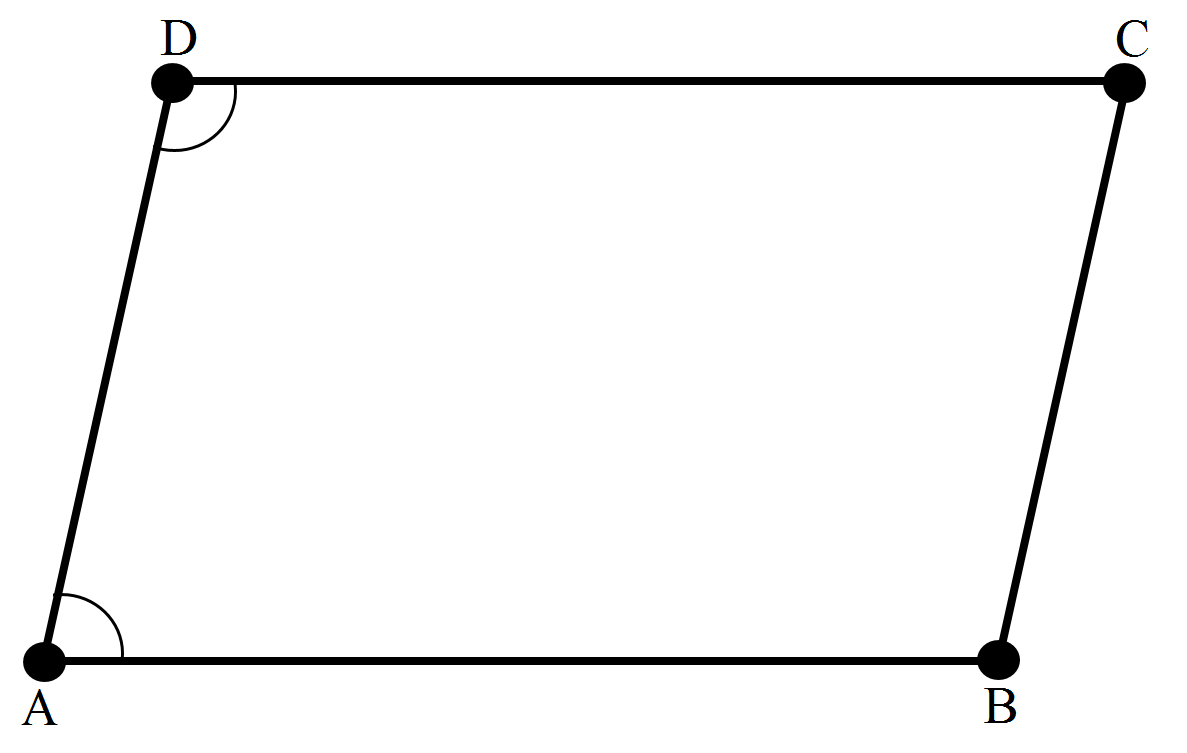
Since, the adjacent angles of a parallelogram are supplementary angles. View full question & answer→MCQ 611 Mark
Which of the following figures satisfy the following property? $-$ Has two pairs of congruent adjacent sides.
AnswerWe know that, a kite has two pairs of congruent adjacent sides and we can observe that figure $R$ resembles a kite.
View full question & answer→MCQ 621 Mark
The sum of the internal angles of a polygon is $10$ right angles. Then the number of sides is:
Answer$(n - 2) 180^\circ = 10 \times 90^\circ $
$\Rightarrow n = 7.$
View full question & answer→MCQ 631 Mark
The diameter of circumcircle of a rectangle is $10\ cm$ and breath of the rectangle is $6\ cm$. Its length is:
- ✓
$8\ cm$
- B
$6\ cm$
- C
$5\ cm$
- D
AnswerCorrect option: A. $8\ cm$
$8\ cm$
View full question & answer→MCQ 641 Mark
In an isosceles parallelogram, we have:
AnswerCorrect option: B. Pair of non$-$parallel sides as equal
In Euclidean geometry, an isosceles trapezoid $($isosceles trapezium in British English$)$ is a convex quadrilateral with a line of symmetry bisecting one pair of opposite sides. Note that a non$-$rectangular parallelogram is not an isosceles trapezoid because of the second condition, or because it has no line of symmetry.
View full question & answer→MCQ 651 Mark
Tick the correct answer in the following? How many diagonals are there in a pentagon?
AnswerFor a pentagon:
$n = 5$
Number of diagonals $=\frac{\text{n}(\text{n}-3)}{2}=\frac{5(5-3)}{2}=5$
View full question & answer→MCQ 661 Mark
Tick the correct answer in the following? Each interior angle of a polygon is $135^\circ $. How many sides does it have?
AnswerEach interior angle for a regular polygon withn-sided $=180-\Big(\frac{360}{\text{n}}\Big)$
$180-\Big(\frac{360}{\text{n}}\Big)=135$
$\Rightarrow\Big(\frac{360}{\text{n}}\Big )=45$
$\Rightarrow\text{n}=8$
View full question & answer→MCQ 671 Mark
What is the sum of all the angles of a pentagon?
- A
$180^\circ$
- B
$360^\circ$
- ✓
$540^\circ$
- D
$720^\circ$
AnswerCorrect option: C. $540^\circ$
We know that, the sum of angles of a polygon is $(n - 2) \times 180^\circ ,$ where n is the number of sides of the polygon.
In pentagon, $n = 5$ Sum of the angles $= (n - 2) \times 180^\circ = (5 - 2) \times 180^\circ = 3 \times 180^\circ = 540^\circ .$
View full question & answer→MCQ 681 Mark
Which of the following figures satisfy the following properties? All sides are congruent. All angles are right angles. Opposite sides are parallel.
AnswerWe know that all the properties mentioned above are related to square and we can observe that figure $R$ resembles a square.
View full question & answer→MCQ 691 Mark
In the quadrilateral $ABCD$, the diagonals $AC$ and $BD$ are equal and perpendicular to each other. Then $ABCD$ is a:
View full question & answer→MCQ 701 Mark
The angle sum of a convex polygon with number of sides $7$ is:
- ✓
$900^\circ$
- B
$1080^\circ$
- C
$1440^\circ$
- D
$720^\circ$
AnswerCorrect option: A. $900^\circ$
$n = 7$
$(n - 2) 180^\circ = 900^\circ$
View full question & answer→MCQ 711 Mark
A $.............$ is both ‘equiangular’ and ‘equilateral’.
View full question & answer→MCQ 721 Mark
The measures of each of the four angles of a quadrilateral are equal. Find the measure of each angle.
- A
$45^\circ$
- B
$30^\circ$
- C
$60^\circ$
- ✓
$90^\circ$
AnswerCorrect option: D. $90^\circ$
Measure of each angle
$= \frac{360^\circ}{4}=90^\circ$
View full question & answer→MCQ 731 Mark
Tick the correct answer in the following?
Each interior angle of a regular decagon is:
- A
$60^\circ$
- B
$120^\circ$
- ✓
$144^\circ$
- D
$180^\circ$
AnswerCorrect option: C. $144^\circ$
Each interior angle of a regular decagon $=180-\frac{360}{10}=180-36=144^\circ$
View full question & answer→MCQ 741 Mark
- A
Does not bisect each other
- B
- ✓
Are perpendicular to each other
- D
AnswerCorrect option: C. Are perpendicular to each other
The diagonals of a kite are perpendicular to each other. They intersect at $90$ degrees but does not bisect.
View full question & answer→MCQ 751 Mark
How many diagonals does a convex quadrilateral has?
AnswerA convex quadrilateral is a four sided figure with interior angles of less than $180$ degrees each and both of its diagonals contained within the shape. It has got two Diagonals.
View full question & answer→MCQ 761 Mark
The angle sum of a convex polygon with number of sides n is:
- ✓
$(n - 2) 180^\circ$
- B
$(n + 2) 180^\circ$
- C
$(2n - 4) 180^\circ $
- D
$(2n + 4) 180^\circ$
AnswerCorrect option: A. $(n - 2) 180^\circ$
$(n - 2) 180^\circ $
View full question & answer→MCQ 771 Mark
The measure of each exterior angle of a regular polygon of $9$ sides is:
- A
$30^\circ$
- ✓
$40^\circ$
- C
$60^\circ$
- D
$45^\circ$
AnswerCorrect option: B. $40^\circ$
Required measure $= \frac{360^\circ}{9}=40^\circ$
View full question & answer→MCQ 781 Mark
Which of the following figures do not satisfy any of the following properties? All sides are equal. All angles are right angles. Opposite sides are parallel.
AnswerOn observing the above figures, we conclude that the figure $P$ does not satisfy any of the given properties.
View full question & answer→MCQ 791 Mark
How many diagonals does a regular hexagon have?
MCQ 801 Mark
Which of the quadrilaterals has all angles as right angles, opposite sides equal and diagonals bisect$-$each other?
AnswerA rectangle is a quadrilateral in which all angles are right angles.
A rectangle is a parallelogram,
so its opposite sides are equal.
The diagonals of a rectangle are equal and bisect each other.
View full question & answer→MCQ 811 Mark
The sum of all exterior angles of a triangle is.
- A
$180^\circ$
- ✓
$360^\circ$
- C
$540^\circ$
- D
$720^\circ$
AnswerCorrect option: B. $360^\circ$
We know that the sum of exterior angles, taken in order of any polygon is $360^\circ $ and triangle is also a polygon. Hence, the sum of all exterior angles of a triangle is $360^\circ .$
View full question & answer→MCQ 821 Mark
How many sides does a regular polygon has if each of it's interior angle is $120^\circ ?$
AnswerLet assume polygon is regular polygon.
The measure of an interior angle, A, of a regular polygon of n sides is given by:
$\text{A}=\frac{\text{(n}-2)180^\circ} {\text{n}}$
$\Rightarrow120^\circ=\frac{\text{(n}-2)} {\text{n}}\times180^\circ.$
$\Rightarrow\frac{120^\circ\text{n}} {180^\circ}=\text{n}-2$
$\Rightarrow\frac{2} {\text{n}}=\text{n}-2$
$\Rightarrow\text{2n}=\text{3n}-6$
$\Rightarrow\text{n}=6$
$\therefore$ The regular polygon has 6 equal sides and is called a hexagon.
View full question & answer→MCQ 831 Mark
Which of the following statement is false?
- A
A square is a rectangle whose adjacent sides are equal.
- B
A square is a rhombus whose one angle is a right angle.
- C
The diagonals of a square bisect each other at right angles.
- ✓
The diagonals of a square do not divide the whole square into four equal parts.
AnswerCorrect option: D. The diagonals of a square do not divide the whole square into four equal parts.
The diagonals of a square do not divide the whole square into four equal parts.
View full question & answer→MCQ 841 Mark
Which of the following is true for the adjacent angles of a parallelogram?
- A
They are equal to each other
- B
They are complementary angles
- ✓
They are supplementary angles
- D
AnswerCorrect option: C. They are supplementary angles
They are supplementary angles
View full question & answer→MCQ 851 Mark
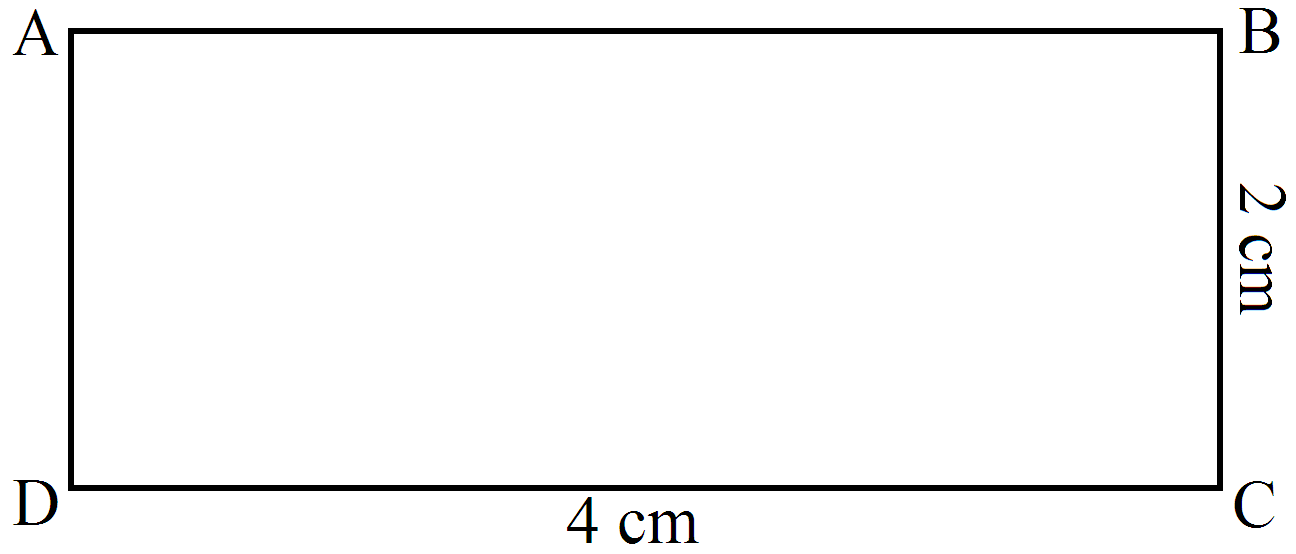
Find the perimeter of the rectangle $ABCD.$
- A
$6\ cm$
- ✓
$12\ cm$
- C
$3\ cm$
- D
$24\ cm$
AnswerCorrect option: B. $12\ cm$
Perimeter $= 2 (4 + 2)cm = 12cm.$
View full question & answer→MCQ 861 Mark
What is the minimum interior angle possible for a regular polygon?
- ✓
$60^\circ$
- B
$80^\circ$
- C
$120^\circ $
- D
$160^\circ$
AnswerCorrect option: A. $60^\circ$
Since on increasing the size of regular polygon $\Rightarrow $ its angle increase.
Minimum interior angle for regular triangle. i.e. equilateral triangle and Minimum interior angle $= 60^\circ $
View full question & answer→MCQ 871 Mark
What is the maximum number of obtuse angles that a quadrilateral can have?
AnswerWe know that, the sum of all the angles of a quadrilateral is $360^\circ $. Also, an obtuse angle is more than 90^\circ and less than $180^\circ $.
View full question & answer→MCQ 881 Mark
If two adjacent angles of a parallelogram are in the ratio $3 : 2$, then the measure of the angles are:
- A
$100^\circ , 80^\circ $
- B
$72^\circ , 36^\circ$
- ✓
$108^\circ , 72^\circ$
- D
$144^\circ , 36^\circ$
AnswerCorrect option: C. $108^\circ , 72^\circ$
$108^\circ , 72^\circ$
View full question & answer→MCQ 891 Mark
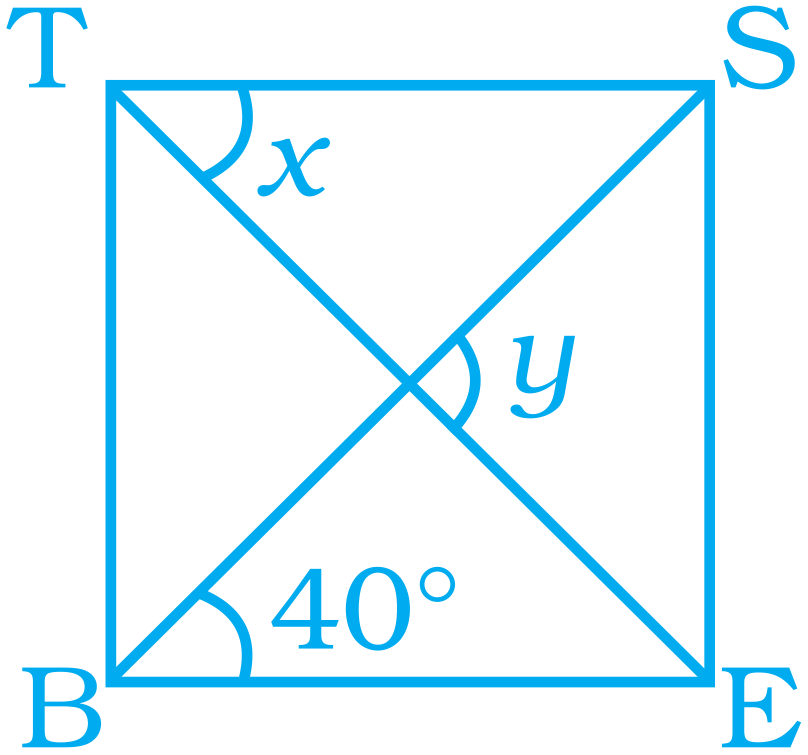
In the figure, $BEST$ is a rhombus, Then the value of $y – x$ is:
- ✓
$40^\circ$
- B
$50^\circ$
- C
$20^\circ$
- D
$10^\circ$
AnswerCorrect option: A. $40^\circ$
Given, a rhombus BEST ??|| ?? and ?? is transversal.
$\therefore\angle\text{SBE}=\angle\text{TSB}=40^\circ$
Also, y = $90^\circ$
In $\triangle\text{TSO}, \angle\text{STO}+\angle\text{TOS}=\angle\text{SOE}$
$\Rightarrow \text{x}+40^\circ+90^\circ $
$\Rightarrow\text{x}=50^\circ$
$\Rightarrow\text{y}-\text{x}=90^\circ-50^\circ=40^\circ$
View full question & answer→MCQ 901 Mark
Two adjacent angles of a parallelogram are $(2x + 25)^\circ $ and $(3x - 5)^\circ $. The value of $x$ is:
Answer$\therefore (2x + 25) + (3x - 5) = 180$
$\Rightarrow 2x + 25 + 3x - 5 = 180$
$\Rightarrow 5x = 180 - 20$
$\Rightarrow 5x = 160$
$\Rightarrow x = 32$
View full question & answer→MCQ 911 Mark
If the length of a side of a rhombus is $6\ cm$, then the perimeter of the rhombus is:
- A
$6\ cm$
- B
$12\ cm$
- ✓
$24\ cm$
- D
$3\ cm$
AnswerCorrect option: C. $24\ cm$
Perimeter $= 4$ side
$= 4 \times 6 = 24cm$
View full question & answer→MCQ 921 Mark
If two adjacent angles of a parallelogram are in the ratio $2 : 3,$ then the measure of angles are:
- ✓
$72^\circ, 108^\circ$
- B
$36^\circ, 54^\circ$
- C
$80^\circ, 120^\circ$
- D
$96^\circ, 144^\circ$
AnswerCorrect option: A. $72^\circ, 108^\circ$
A. $72^\circ, 108^\circ$
Solution:
Let the angles be $2x$ and $3x.$ Then, $2x + 3x = 180^\circ$ [adjacent angles of a parallelogram are supplementary]
$\Rightarrow 5x = 180^\circ$
$\Rightarrow x = 36^\circ$
Hence, the measures of angles are $2x = 2 \times 36^\circ = 72^\circ$ and $3x = 3 \times 36^\circ = 108^\circ$
View full question & answer→MCQ 931 Mark
If angles $P, Q, R$ and $S$ of the quadrilateral $PQRS$, taken in order, are in the ratio $3:7:6:4$ then $PQRS$ is a:
View full question & answer→MCQ 941 Mark
Tick the correct answer in the following? A polygon has $27$ diagonals. How many sides does it have?
Answer$\frac{\text{n}(\text{n}-3)}{2}=27$
$\Rightarrow(\text{n}-3)=54$
$\Rightarrow\text{n}^2-3\text{n}-54=0$
$\Rightarrow\text{n}^2-9\text{n}+6\text{n}-54=0$
$\Rightarrow\text{n}(\text{n}-9)+6(\text{n}-9)=0$
$\Rightarrow\text{n}=-6\ \text{or}\ \text{n}=9$
Number of sides cannot be negative.
$\therefore\text{n}=9$
View full question & answer→MCQ 951 Mark
The diagonals do not necessarily bisect the interior angles at the vertices in a:
AnswerIn rectangle, only opposite sides are equal which makes diagonals are not to be perpendicular to each other. As diagonals are not perpendicular to each other, they will not bisect the interior angles.
View full question & answer→MCQ 961 Mark
The measure of each exterior angle of a regular polygon of $15$ sides is:
- A
$30^\circ$
- B
$45^\circ$
- C
$60^\circ$
- ✓
$24^\circ$
AnswerCorrect option: D. $24^\circ$
Required measure $= \frac{360^\circ}{15}=24^\circ$
View full question & answer→MCQ 971 Mark
A quadrilateral has three acute angles. If each measures $80^\circ $, then the measure of the fourth angle is.
- A
$150^\circ$
- ✓
$120^\circ$
- C
$105^\circ$
- D
$140^\circ$
AnswerCorrect option: B. $120^\circ$
Let the fourth angle be $x.$
$80^\circ+80^\circ+80^\circ\ \text{x}^\circ=360^\circ$
$\Rightarrow240^\circ+\text{x}=360^\circ$
$\Rightarrow\text{x}=360^\circ-240^\circ$
$\Rightarrow\text{x}=120^\circ$
View full question & answer→MCQ 981 Mark
Which of the following statement is false?
- A
All the rectangles are parallelograms.
- B
All the squares are rectangles.
- ✓
All the parallelograms are rectangles.
- D
All the rhombuses are parallelograms.
AnswerCorrect option: C. All the parallelograms are rectangles.
All the parallelograms are rectangles.
View full question & answer→MCQ 991 Mark
Two adjacent sides of a rectangle are equal. The name of the quadrilateral is:
MCQ 1001 Mark
Tick the correct answer in the following? How many diagonals are there in a hexagon?
AnswerNumber of diagonals in an n-sided polygon $=\frac{\text{n}(\text{n}-3)}{2}$
$\text{n}=6$
$\therefore\frac{\text{n}(\text{n}-3)}{2}=\frac{6(6-3}{2}$
$=\frac{18}{9}=9$
View full question & answer→MCQ 1011 Mark
The sum of the angles of a quadrilateral is:
- A
$180^\circ$
- B
$270^\circ$
- ✓
$360^\circ$
- D
Depends on the quadrilateral
AnswerCorrect option: C. $360^\circ$
$360^\circ$
View full question & answer→MCQ 1021 Mark
$ABCD$ is a rectangle. Its diagonals meet at $O.$
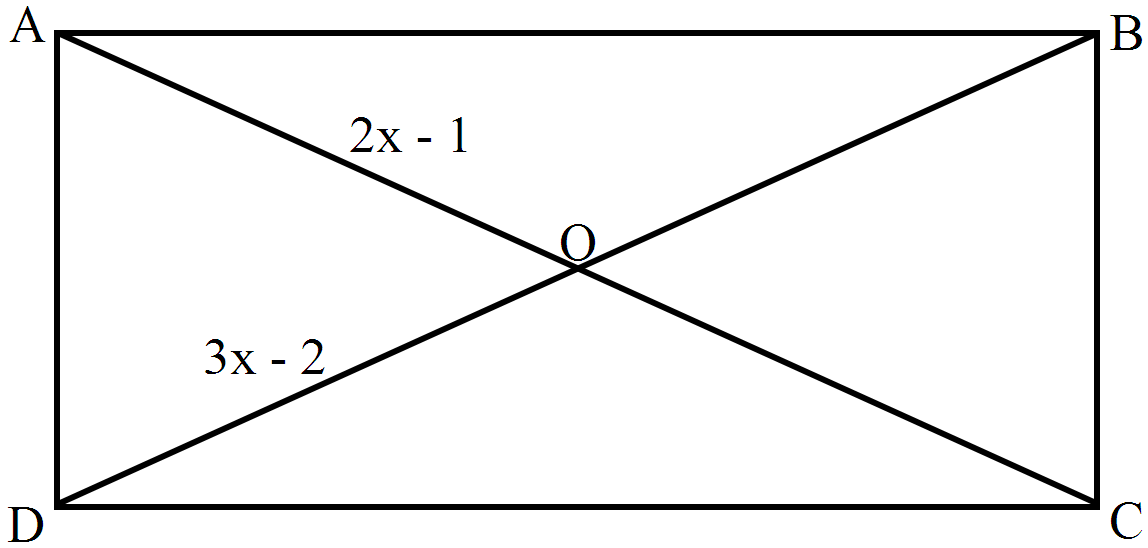
$OA = 2x - 1, OD = 3x - 2.$ Find $x$ Answer$3x - 2 = 2x - 1$
$\Rightarrow x = 1.$
View full question & answer→MCQ 1031 Mark
Find the perimeter of a rectangle whose two adjacent sides are: $5x^2 + 2xy - 13, 2x^2 - 6xy + 11$
- ✓
$14 x^2-8 x y-4$
- B
$x^2 - 8xy - 3$
- C
$4x^2- 8xy - 3$
- D
$12 x^2-8 x y-4$
AnswerCorrect option: A. $14 x^2-8 x y-4$
A. $14 x^2-8 x y-4$
Solution:
Perimeter of a rectangle is $2(L+B)$
Given, two adjacent side are $5 x^2+2 x y-13,2 x^2-6 x y+11$
Therefore,
$2(L+B) $
$=2\left(5 x^2+2 x y-13,2 x^2-6 x y+11\right) $
$=2\left(7 x^2-4 x y-2\right) $
$=14 x^2-8 x y-4$
View full question & answer→MCQ 1041 Mark
$ABCD$ is a parallelogram. If angle A is equal to $45^\circ $, then find the measure of its adjacent angle.
- A
$115^\circ$
- B
$180^\circ$
- ✓
$135^\circ$
- D
$120^\circ$
AnswerCorrect option: C. $135^\circ$
The adjacent angles of a parallelogram sums up to $180^\circ .$
Thus,$45^\circ + x = 180^\circ$
$x = 180^\circ - 45^\circ$
$x = 135^\circ$
View full question & answer→MCQ 1051 Mark
The bisectors of any two adjacent angles of a parallelogram intersect at:
- A
$30^\circ$
- B
$45^\circ$
- C
$60^\circ$
- ✓
$90^\circ$
AnswerCorrect option: D. $90^\circ$
Let $ABCD$ is a parallelogram.
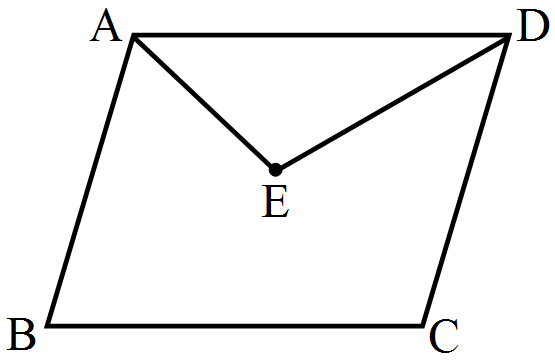
$AE$ and $AD$ is the bisector angles of adjacent angles of $\angle\text{A}$ and $\angle\text{D}.$
As we know that,
$\angle\text{A}+\angle\text{D}=180^\circ$ (Sum of interior angles on the same side of traversal is $180^\circ )$
$\frac{1}{2}\angle\text{A}+\frac{1}{2}\angle\text{D}=\frac{1}{2}\times180^\circ$
$=90^\circ\ ...(\text{i})$
Now, in triangle $AOD,$
$\angle\text{AED}+\frac{1}{2}\angle\text{A}+\frac{1}{2}\angle\text{D}=180^\circ$
$($AE and $AD$ is the angle bisector of $\angle\text{A}$ and $\angle\text{D}).$
$\angle\text{AED}+90^\circ=180^\circ$ (From eq $(i))$
$\angle\text{AED}=180^\circ-90^\circ=90^\circ$
So, the bisectors of any two adjacent angles of a parallelogram intersect at $90^\circ .$
View full question & answer→MCQ 1061 Mark
Which of the parallelograms has all sides equal and diagonals bisect each other at right angle?
AnswerA square is a parallelogram in which adjacent sides are equal and one angle is of $90^\circ $. In a parallelogram, opposite sides are equal, opposite angles are equal and diagonals bisect each other. In a rhombus diagonal intersect at right angles.
View full question & answer→MCQ 1071 Mark
The number of sides of a regular polygon, whose each exterior angle has a measure of $45^\circ $, is:
AnswerNumber of sides $= \frac{360^\circ}{45^\circ}=8.$
View full question & answer→MCQ 1081 Mark
What is the name of a regular polygon of $3$ sides?
View full question & answer→MCQ 1091 Mark
Tick the correct answer in the following? Each interior angle of a polygon is $108^\circ $. How many sides does it have?
AnswerEach interior angle for a regular n-sided polygon $=180-\Big(\frac{360}{\text{n}}\Big)$
$180-\Big(\frac{360}{\text{n}}\Big)=108$
$\Rightarrow\Big(\frac{360}{\text{n}}\Big )=72$
$\Rightarrow\text{n}=\frac{360}{\text{n}}=5$
View full question & answer→MCQ 1101 Mark
Which one of the following is a regular quadrilateral?
AnswerA square has all its sides equal and angles equal to $90$ degrees.
View full question & answer→MCQ 1111 Mark
The angle sum of a convex polygon with number of sides $7$ is:
- ✓
$900^\circ$
- B
$1080^\circ$
- C
$1440^\circ$
- D
$720^\circ$
AnswerCorrect option: A. $900^\circ$
$900^\circ$
View full question & answer→MCQ 1121 Mark
How many sides does a-regular polygon have if each of its interior angles is $165^\circ ?$
AnswerExterior angle $= 180^\circ - 165^\circ = 15^\circ $
$\therefore$ Number of sides $\frac{360^\circ}{15^\circ}=24$
View full question & answer→MCQ 1131 Mark
The angles of a quadrilateral are in the ratio $1 : 2 : 3 : 4.$ The smallest angle is.
- A
$72^\circ$
- B
$144^\circ$
- ✓
$36^\circ$
- D
$18^\circ$
AnswerCorrect option: C. $36^\circ$
C. $36^\circ$
Solution:
Let the angles of the given quadrilaterals be $x^\circ , 2x^\circ , 3x^\circ$ and $4x^\circ$
$\therefore $ $x^\circ + 2x^\circ + 3x^\circ + 4x^\circ= 360^\circ$
$\Rightarrow 10x = 360^\circ$
$\Rightarrow x = 360^\circ 10^\circ = 36^\circ$
Hence, the smallest angle $= 36^\circ.$
View full question & answer→MCQ 1141 Mark
How many diagonals does a rectangle have?
MCQ 1151 Mark
Which of the following is an equiangular and equilateral polygon?
AnswerIn a square, all the sides and all the angles are equal.
Hence, square is an equiangular and equilateral polygon.
View full question & answer→MCQ 1161 Mark
Which of the following statement is true?
- A
All the rhombuses are squares.
- ✓
Each square is a parallelogram.
- C
Each parallelogram is a square.
- D
Each trapezium is a parallelogram.
AnswerCorrect option: B. Each square is a parallelogram.
Each square is a parallelogram.
View full question & answer→MCQ 1171 Mark
Choose the correct statement:
- A
Every quadrilateral is either a trapezium or a parallelogram or a kite.
- B
The diagonals of a rectangle are perpendicular to each other.
- C
The diagonals of a parallelogram are equal.
- ✓
If the diagonals of a quadrilateral intersect at right angles, it is not necessary a rhombus.
AnswerCorrect option: D. If the diagonals of a quadrilateral intersect at right angles, it is not necessary a rhombus.
If the diagonals of a quadrilateral intersect at right angles, it is not necessary a rhombus.
View full question & answer→MCQ 1181 Mark
The diagonal of a rectangle is 10cm and its breadth is $6\ cm$. What is its length?
- A
$6\ cm.$
- B
$5\ cm.$
- ✓
$8\ cm.$
- D
$4\ cm.$
AnswerCorrect option: C. $8\ cm.$
$8\ cm.$
View full question & answer→MCQ 1191 Mark
Which of the following is not a regular polygon?
AnswerA regular polygon is both equiangular and equilateral.
But all four sides of a rectangle are not equal,
thus it is not a regular polygon.
View full question & answer→MCQ 1201 Mark
The four angles of a quadrilateral are in the ratio $1 : 2 : 3 : 4$. The measure of its smallest angle is:
- A
$120^\circ$
- ✓
$36^\circ$
- C
$18^\circ$
- D
$10^\circ$
AnswerCorrect option: B. $36^\circ$
Sum of the ratios $= 1 + 2 + 3 + 4 = 10$
$\therefore$ Smallest angle $=\frac{1}{10}\times360^\circ=36^\circ$
View full question & answer→MCQ 1211 Mark
To construct a unique rectangle, the minimum number of measurements required is:
AnswerSince, in a rectangle, opposite sides are equal and parallel, so we need the measurement of only two adjacent sides, i.e. length and breadth.
View full question & answer→MCQ 1221 Mark
What is the number of sides of a triangle?
MCQ 1231 Mark
If $\text{PQ}$ and $\text{RS}$ are two perpendicular diameters of a circle, then $\text{PQRS}$ is a:
View full question & answer→MCQ 1241 Mark
The angles of a quadrilateral are in ratio $1 : 2 : 3 : 4$. Which angle has the largest measure?
- A
$98^\circ$
- B
$36^\circ$
- C
$120^\circ$
- ✓
$144^\circ$
AnswerCorrect option: D. $144^\circ$
Suppose, $A B C D$ is a quadrilateral.
Let angle $A$ is $x$
Then, $x+2 x+3 x+4 x=360^{\circ}$ [Angle sum property of quadrilateral] $10 x=360^{\circ}$ $x=36^{\circ}$
Hence, the greatest angle is $4 x=4 \times 36=144^{\circ}$
View full question & answer→MCQ 1251 Mark
Which of the following statement is false?
- ✓
All the four sides of a parallelogram are equal.
- B
The opposite angles of a parallelogram are equal.
- C
The diagonals of a parallelogram bisect each other.
- D
All the four sides of a rhombus are equal.
AnswerCorrect option: A. All the four sides of a parallelogram are equal.
All the four sides of a parallelogram are equal.
View full question & answer→MCQ 1261 Mark
Which of the following is a formula to find the sum of interior angles of a quadrilateral of $n-$sides?
- A
$\frac{\text{n}}{2}\times180^\circ$
- B
$\Big(\frac{\text{n}+1} {2}\Big)\times180^\circ$
- C
$\Big(\frac{\text{n}-1} {2}\Big)\times180^\circ$
- ✓
$(\text{n} – 2)\times180^\circ$
AnswerCorrect option: D. $(\text{n} – 2)\times180^\circ$
The sum of the interior angles, in degrees, of a regular polygon is given by the formula $(n - 2) \times 180$, where n is the number of sides. The problem concerns a polygon with twelve sides, so we will let $n = 12$. The sum of the interior angles in this polygon would be $180(12 - 2) = 180(10) = 1800.$
View full question & answer→MCQ 1271 Mark
Which of the following figures satisfy the following property? $-$ Only one pair of sides are parallel.
AnswerWe know that, in a trapezium, only one pair of sides are parallel and we can observe that figure $P$ resembles a trapezium.
View full question & answer→MCQ 1281 Mark
Which of the following statement is false?
- ✓
All the four angles of a rhombus are equal.
- B
The diagonals of a rhombus bisect each other at right angles.
- C
A rectangle is a parallelogram.
- D
All squares are rectangles.
AnswerCorrect option: A. All the four angles of a rhombus are equal.
All the four angles of a rhombus are equal.
View full question & answer→MCQ 1291 Mark
$AB$ and $CD$ are diameters. Then $ACBD$ is:
View full question & answer→MCQ 1301 Mark
Which one has all the properties of a kite and a parallelogram?
AnswerIn a kite Two pairs of equal sides. Diagonals bisect at $90^\circ.$
One pair of opposite angles are equal. In a parallelogram Opposite sides are equal.
Opposite angles are equal.
Diagonals bisect each other.
So, from the given options, all these properties are satisfied by rhombus.
View full question & answer→MCQ 1311 Mark
State the name of a regular polygon of $6$ sides.
View full question & answer→MCQ 1321 Mark
The angle sum of a convex polygon with number of sides n is:
- ✓
$(n - 2) 180^\circ$
- B
$(n + 2) 180^\circ$
- C
$(2n - 4) 180^\circ$
- D
$(2n + 4) 180^\circ$
AnswerCorrect option: A. $(n - 2) 180^\circ$
$(n - 2) 180^\circ$
View full question & answer→MCQ 1331 Mark
How many diagonals does a quadrilateral have?
MCQ 1341 Mark
$ABCD$ is a square $E, F, G, H$ are the mid-mid-points of the four sides. Then the figure $EFGH$ is:
View full question & answer→MCQ 1351 Mark
In a parallelogram $ABCD$, if $AB = 2x + 5, CD = y + 1, AD = y + 5$ and $BC = 3x - 4$ then ratio of $AB : BC:$
- ✓
$31 : 35$
- B
$71 : 21$
- C
$12 : 11$
- D
$4 : 7$
AnswerCorrect option: A. $31 : 35$
$31 : 35$
View full question & answer→MCQ 1361 Mark
If the diagonals of a quadrilateral are equal and bisect each other, then the quadrilateral is a.
AnswerSince, diagonals are equal and bisect each other, therefore it will be a rectangle.
View full question & answer→MCQ 1371 Mark
Which of the following quadrilaterals has two pairs of adjacent sides equal and its diagonals intersect at $90$ degrees?
View full question & answer→MCQ 1381 Mark
The measures of two angles of a quadrilateral are $110^\circ $ and $100^\circ $. The remaining two angles are equal. The measure of each of the remaining two angles is:
- A
$30^\circ$
- B
$60^\circ$
- ✓
$75^\circ$
- D
$45^\circ$
AnswerCorrect option: C. $75^\circ$
Required measure
$= \frac{360^\circ-(110^\circ+100^\circ)}{2}=75^\circ$
View full question & answer→MCQ 1391 Mark
The diagonals do not necessarily intersect at right angles in a:
AnswerThe diagonals do not necessarily intersect at right angles in a parallelogram. Only opposite sides, opposite angles are equal and diagonal bisects each other in parallelogram. If diagonals intersect each other at right angle then it would be square or rhombus.
View full question & answer→MCQ 1401 Mark
The angle sum of a convex polygon with number of sides $10$ is:
- A
$720^\circ$
- B
$900^\circ$
- C
$1080^\circ$
- ✓
$1440^\circ$
AnswerCorrect option: D. $1440^\circ$
$n = 10$
$(n – 2) 180^\circ = 1440^\circ .$
View full question & answer→MCQ 1411 Mark
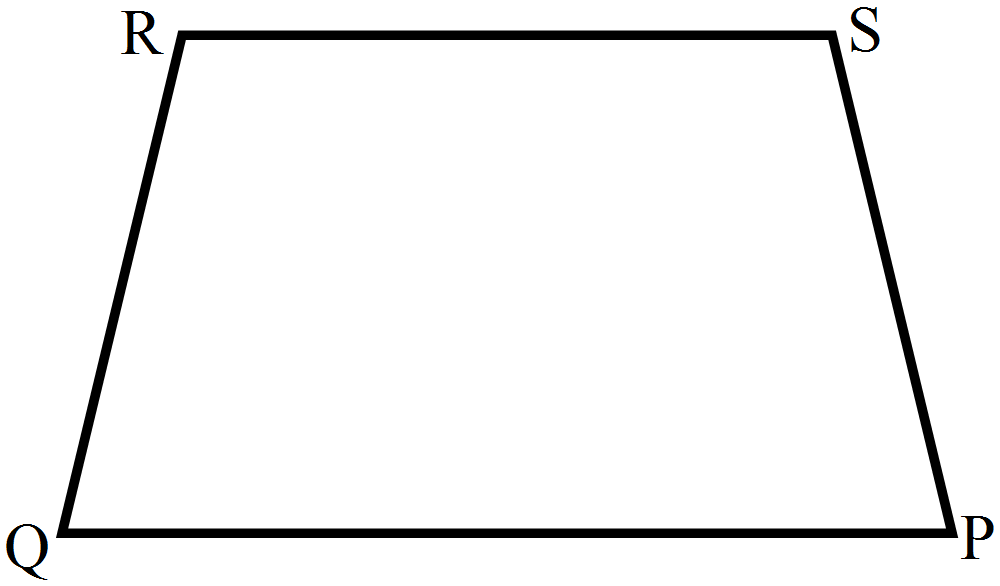
The angles $P, Q, R$ and $S$ of a quadrilateral are in the ratio $1:3:7:9.$ Then $PQRS$ is a:
AnswerCorrect option: B. trapezium with $P Q\ \| \ R S$
B. trapezium with $P Q\ \| \ R S$
Solution:
Let the angles be $x, 3 x, 7 x$ and $9 x$, then
$\Rightarrow x+3 x+7 x+9 x=360^{\circ}$
$\Rightarrow 20 x=360^{\circ}$
$\Rightarrow x=360^{\circ}/ 20$
$\Rightarrow x=18^{\circ}$ Then, the angles $P, Q, R$ and $S$ are $18^{\circ}, 54^{\circ}, 126^{\circ}$ and $162^{\circ}$ respectively Since, $\angle P +\angle S =18^{\circ}+162^{\circ}=180^{\circ}$ and $\angle Q +\angle R =54^{\circ}+126^{\circ}=180^{\circ}$
The quadrilateral $P Q R S$ is a trapezium with $P Q\ \| \ R S$
View full question & answer→MCQ 1421 Mark
If three angles of a quadrilateral are each equal to $75^{\circ}$, the fourth angle is.
- A
$150^{\circ}$.
- ✓
$135^{\circ}$.
- C
$45^{\circ}$.
- D
$75^{\circ}$.
AnswerCorrect option: B. $135^{\circ}$.
B. $135^{\circ}$
Solution:
Given, three angles of quadrilaterals $=75^{\circ}$
Let the fourth angle be $x^{\circ}$ Then, according to the property, $75^{\circ}+75^{\circ}+75^{\circ}+x^{\circ}=360^{\circ}$, since sum of the angles of a quadrilateral is $360^{\circ}$.
So, $225^{\circ}+x^{\circ}=360^{\circ}$ or $x^{\circ}=360^{\circ}-225^{\circ}=135^{\circ}$
Hence, the fourth angle is $135^{\circ}$.
View full question & answer→MCQ 1431 Mark
Tick the correct answer in the following? Sum of all the interior angles of a hexagon is:
- A
$6\ \text{right}\ \angle\text{s}$
- ✓
$8\ \text{right}\ \angle\text{s}$
- C
$9\ \text{right}\ \angle\text{s}$
- D
$12\ \text{right}\ \angle\text{s}$
AnswerCorrect option: B. $8\ \text{right}\ \angle\text{s}$
Sum of all the interior angles of a hexagon is $(2n - 4)$ right angles.
For a hexagon:
$\text{n}=6$
$\Rightarrow(2\text{n}-4)\ \text{Right}\ \angle\text{s}=(12- 4)\ \text{right}\ \angle\text{s}=8\ \text{right}\ \angle\text{s}$
View full question & answer→MCQ 1441 Mark
The sum of the measures of all the three angles of a triangle is:
- A
$90^\circ$
- ✓
$180^\circ$
- C
$360^\circ$
- D
$720^\circ$
AnswerCorrect option: B. $180^\circ$
$180^\circ$
View full question & answer→MCQ 1451 Mark
Which of the following can be four interior angles of a quadrilateral?
- ✓
$140^\circ, 40^\circ, 20^\circ, 160^\circ$
- B
$270^\circ, 150^\circ, 30^\circ, 20^\circ$
- C
$40^\circ, 70^\circ, 90^\circ, 60^\circ$
- D
$110^\circ, 40^\circ, 30^\circ, 180^\circ$
AnswerCorrect option: A. $140^\circ, 40^\circ, 20^\circ, 160^\circ$
A. $140^\circ, 40^\circ, 20^\circ, 160^\circ$
Solution:
We know that, the sum of interior angles of a quadrilateral is $360^\circ.$ Thus, the angles in option (a) can be four interior angles of a quadrilateral as their sum is $360^\circ.$
View full question & answer→MCQ 1461 Mark
Which of the following is not a quadrilateral?
AnswerA quadrilateral is a four$-$sided polygon but triangle is a three$-$sided polygon.
View full question & answer→MCQ 1471 Mark
In the trapezium $ABCD$, the measure of $\angle\text{D}$ is.
- A
$55^\circ$
- B
$115^\circ $
- C
$135^\circ$
- ✓
$125^\circ $
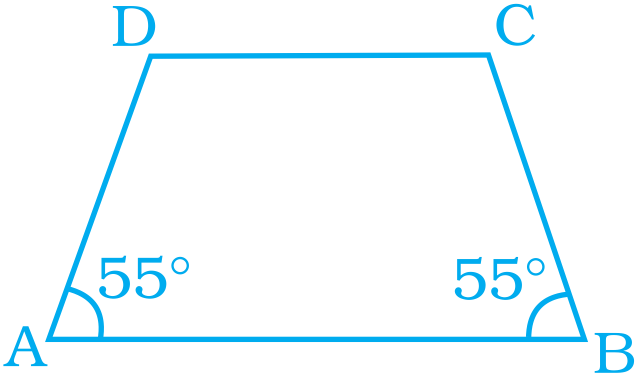
AnswerCorrect option: D. $125^\circ $
We know that, in a trapezium, the angles on either sides of base are supplementary angle. In trapezium $ABCD,$
$\therefore\angle\text{A}+\angle\text{D}=180^\circ$
$\Rightarrow55^\circ+\angle\text{D}=180^\circ$
$\Rightarrow\angle\text{D}=180^\circ-50^\circ$
$\Rightarrow\angle\text{D}=120^\circ$
View full question & answer→MCQ 1481 Mark
Which of the following properties describe a trapezium?
- ✓
A pair of opposite sides is parallel.
- B
The diagonals bisect each other.
- C
The diagonals are perpendicular to each other.
- D
AnswerCorrect option: A. A pair of opposite sides is parallel.
We know that, in a trapezium, a pair of opposite sides are parallel.
View full question & answer→MCQ 1491 Mark
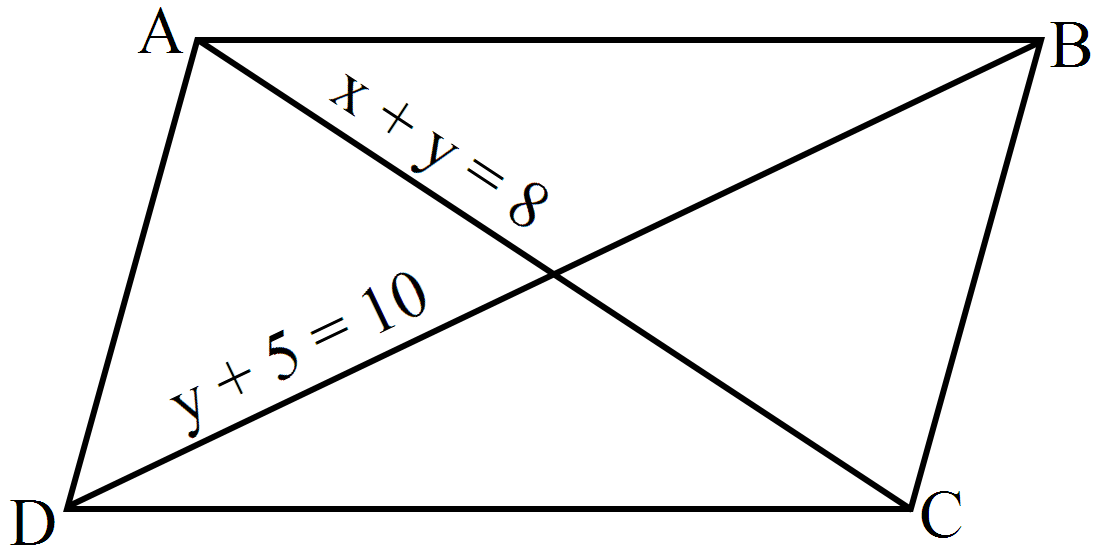
$ABCD$ is a parallelogram as shown. Find $x$ and $y.$
- A
$1, 7$
- B
$2, 6$
- ✓
$3, 5$
- D
$4, 4$
AnswerCorrect option: C. $3, 5$
$x + y = 8$
$y + 5 = 10$
$\Rightarrow y = 5$
$\therefore x + 5 = 8$
$\Rightarrow x = 3.$
View full question & answer→MCQ 1501 Mark
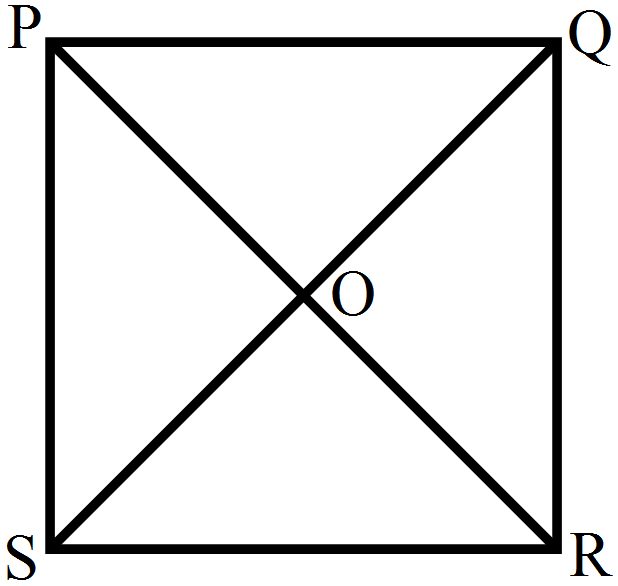
$PQRS$ is a square. $PR$ and $SQ$ intersect at $O.$ Then $\angle\text{POQ}$ is a:
AnswerA. Right angle
Solution:
We know that, the diagonals of a square intersect each other at right angle. Hence, $\angle\text{POQ}$ $= 90^\circ $ , i.e, right angle.
View full question & answer→MCQ 1511 Mark
Tick the correct answer in the following?
How many diagonals are there in an actagon?
AnswerFor a regular n-sided polygon:
Number of diagonals $=\frac{\text{n}(\text{n}-3)}{2}$
For an actagon:
$\text{n}=8$
$\frac{8(8-3)}{2}=\frac{40}{2}=20$
View full question & answer→MCQ 1521 Mark
Which of the following quadrilaterals has a pair of opposite sides parallel?
AnswerWe know that, a rectangle is a quadrilateral having both pair of opposite sides equal and parallel.
Also, all its angles are right angles.
Also, a square is a quadrilateral having all sides equal and both pairs of opposite sides parallel. All its angles are right angles.
And, a parallelogram is a quadrilateral having both pairs of opposite sides equal and parallel.
Hence, a parallelogram, square and rectangle has both pairs of opposite sides equal and parallel.
However, a trapezium is a quadrilateral having one pair of opposite sides parallel.
View full question & answer→MCQ 1531 Mark
What is the sum of all angles of a hexagon?
- A
$180^\circ$
- B
$360^\circ$
- C
$540^\circ$
- ✓
$720^\circ$
AnswerCorrect option: D. $720^\circ$
D. $720^\circ$
Solution:
Sum of all angles of a n-gon is $(n - 2) \times 180^\circ.$
In hexagon, $n = 6,$ therefore the required sum $= (6 - 2) \times 180^\circ = 4 \times 180^\circ = 720^\circ.$
View full question & answer→MCQ 1541 Mark
Which of the following can never be the measure of exterior angle of a regular polygon?
- ✓
$22^\circ$
- B
$36^\circ$
- C
$45^\circ$
- D
$30^\circ$
AnswerCorrect option: A. $22^\circ$
A. $22^\circ$
Solution:
Since, we know that, the sum of measures of exterior angles of a polygon is $360^\circ$, i.e. measure of each exterior angle $ = 360^\circ$ n ,where n is the number of sides/ angles.
Thus, measure of each exterior angle will always divide $360^\circ$ completely.
Hence, $22^\circ$ can never be the measure of exterior angle of a regular polygon.
View full question & answer→MCQ 1551 Mark
If all the four sides of a parallelogram are equal and the adjacent angles are of $120^\circ $ and $60^\circ $, then the name of the quadrilateral is:
View full question & answer→MCQ 1561 Mark
What is the number of vertices of a triangle?
MCQ 1571 Mark
For which of the following figures, all angles are equal?
AnswerIn a rectangle, all angles are equal, i.e. all equal to $90^\circ .$
View full question & answer→MCQ 1581 Mark
Diagonals of which of the following quadrilaterals do not bisect it into two congruent triangles?
AnswerThe bases of the trapezium are parallel to each other No sides, angles and diagonals are congruent therefore the diagonals do not bisect each other in a trapezium.
View full question & answer→MCQ 1591 Mark
Tick the correct answer in the following? The interior angle of a regular polygon exceeds its exterior angle by $108^\circ $. How many sides does the polygon have?
AnswerEach exterior angle of a regular polygon $=\frac{360}{\text{n}}$
Each interior angle of a regular polygon $=180-\frac{360}{\text{n}}$
$180-\frac{360}{\text{n}}-108=\frac{360}{\text{n}}$
$\frac{720}{\text{n}}=180-108=72$
$\text{n}=\frac{720}{72}=10$
View full question & answer→MCQ 1601 Mark
To construct a unique parallelogram, the minimum number of measurements required is:
AnswerWe know that, in a parallelogram, opposite sides are equal and parallel. Also, opposite angles are equal. So, to construct a parallelogram uniquely, we require the measure of any two nonparallel sides and the measure of an angle. Hence, the minimum number of measurements required to draw a unique parallelogram is $3.$
View full question & answer→MCQ 1611 Mark
If $\angle\text{A}$ of a parallelogram $ABCD$ is of $60^\circ $, then the measure of the opposite angle $\angle\text{C}$ is:
- ✓
$60^\circ$
- B
$120^\circ$
- C
$30^\circ$
- D
AnswerCorrect option: A. $60^\circ$
$\angle{\text{C}} = \angle{\text{A}}= 60^\circ$
View full question & answer→MCQ 1621 Mark
In a kite, what is false?
- A
The diagonals are perpendicular to each other.
- B
The diagonals bisect each other.
- C
Only one pair of opposite angles is equal.
- ✓
All the four sides are equal.
AnswerCorrect option: D. All the four sides are equal.
All the four sides are equal.
View full question & answer→MCQ 1631 Mark
If the adjacent sides of a parallelogram are equal then parallelogram is a.
AnswerWe know that, in a parallelogram, opposite sides are equal.
But according to the question, adjacent sides are also equal.
Thus, the parallelogram in which all the sides are equal is known as rhombus.
View full question & answer→MCQ 1641 Mark
The number of sides of a regular polygon where each exterior angle has a measure of $45^\circ $ is.
AnswerWe know that, the sum of exterior angles taken in an order of a polygon is $360^\circ $ Since, each exterior angle measures $45^\circ $, therefore the number of sides = Sum of exterior angles/ Measure of an exterior angle.
$=\frac{360^\circ}{45^\circ}=8$
View full question & answer→MCQ 1651 Mark
How many diagonals does a hexagon have?
AnswerWe know that, the number of diagonals in a polygon of n sides is $n(n−3) 2 $, In hexagon, $n = 6$
Number of diagonals in a hexagon $= 6(6−3) 2 = 6\times 3 2 = 3 \times 3 = 9.$
View full question & answer→MCQ 1661 Mark
Each of the angles of a square is:
AnswerAll the angles of square is at right angle.
View full question & answer→MCQ 1671 Mark
If one angle of a parallelogram is of $65^\circ ,$ then the measure of the adjacent angle is:
- A
$65^\circ$
- ✓
$115^\circ$
- C
$25^\circ$
- D
$90^\circ$
AnswerCorrect option: B. $115^\circ$
Measure of the adjacent angle$= 180^\circ - 65^\circ = 115^\circ .$
View full question & answer→MCQ 1681 Mark
The angle sum of a convex polygon with number of sides $10$ is:
- A
$720^\circ $
- B
$900^\circ $
- C
$1080^\circ$
- ✓
$1440^\circ$
AnswerCorrect option: D. $1440^\circ$
$1440^\circ$
View full question & answer→MCQ 1691 Mark
If $\angle\text{A}$ and $\angle\text{B}$ are two adjacent angles of a parallelogram. If $\angle\text{A}=70^\circ,$, then $\angle\text{B}=$?
- ✓
$110^\circ$
- B
$180^\circ$
- C
$70^\circ$
- D
$90^\circ$
AnswerCorrect option: A. $110^\circ$
The adjacent angles of parallelogram are supplementary.
$\angle\text{B}+ \angle\text{B}=180^\circ$
$70^\circ+\angle\text{B}=180^\circ$
$\angle\text{B}=180^\circ-70^\circ=110^\circ$
View full question & answer→MCQ 1701 Mark
Two adjacent angles of a parallelogram are in the ratio $1:5.$ Then all the angles of the parallelogram are:
- ✓
$30^\circ, 150^\circ, 30^\circ, 150^\circ$
- B
$85^\circ, 95^\circ, 85^\circ, 95^\circ$
- C
$45^\circ, 135^\circ, 45^\circ, 135^\circ$
- D
$30^\circ, 180^\circ, 30^\circ, 180^\circ$
AnswerCorrect option: A. $30^\circ, 150^\circ, 30^\circ, 150^\circ$
A. $30^\circ, 150^\circ, 30^\circ, 150^\circ$
Solution:
Let the adjacent angles of a parallelogram be $x$ and $5x,$ respectively.
Then, $x + 5x = 180^\circ$ [adjacent angles of a parallelogram are supplementary]
$\Rightarrow 6x = 180^\circ$
$\Rightarrow x = 30^\circ$
View full question & answer→MCQ 1711 Mark
Find the measure of each exterior angle of a regular polygon of $9$ sides.
- A
$30^\circ$
- B
$90^\circ$
- ✓
$40^\circ$
- D
$60^\circ$
AnswerCorrect option: C. $40^\circ$
$40^\circ$
View full question & answer→MCQ 1721 Mark
The sum of the measures of all the four angles of a quadrilateral is:
- A
$90^\circ$
- B
$180^\circ$
- ✓
$360^\circ$
- D
$720^\circ$
AnswerCorrect option: C. $360^\circ$
$360^\circ$
View full question & answer→MCQ 1731 Mark
Tick the correct answer in the following? The sum of all interior angles of a regular polygon is $1080^\circ $. What is the measure of each of its interior angles?
- ✓
$135^\circ$
- B
$120^\circ$
- C
$156^\circ$
- D
$144^\circ$
AnswerCorrect option: A. $135^\circ$
$(2n - 4) \times 90 = 1080$
$(2n - 4) = 12$
$2n = 16$
Or $n = 8$
Each interior angle $=180-\frac{360}{\text{n}}=180-\frac{360}{8}=180-45=135^\circ$
View full question & answer→MCQ 1741 Mark
The measures of the three angles of a quadrilateral are $65^\circ , 75^\circ $ and $85^\circ $. The measure of the fourth angle is:
- A
$65^\circ$
- B
$75^\circ$
- C
$85^\circ$
- ✓
$135^\circ$
AnswerCorrect option: D. $135^\circ$
Fourth angle $= 360^\circ - (65^\circ + 75^\circ + 85^\circ )$
$= 135^\circ$
View full question & answer→MCQ 1751 Mark
One angle of a parallelogram is a right angle. The name of the quadrilateral is:
MCQ 1761 Mark
What is the sum of all exterior angles of a pentagon?
- A
$180^\circ$
- ✓
$360^\circ$
- C
$540^\circ$
- D
$720^\circ$
AnswerCorrect option: B. $360^\circ$
We know that the sum of all exterior angles of a polygon is $360$ degrees.
View full question & answer→MCQ 1771 Mark
$ABCD$ is a quadrilateral. If $AC$ and $BD$ bisect each other then $ABCD$ must be:
View full question & answer→MCQ 1781 Mark
In a regular polygon of n sides, the measure of each internal angle is:
AnswerCorrect option: B. $(\frac{\text{2n - 4}}{\text{n}})90^\circ$
$(\frac{\text{2n - 4}}{\text{n}})90^\circ$
View full question & answer→MCQ 1791 Mark
For which of the following figures, diagonals are perpendicular to each other?
AnswerThe diagonals of a kite are perpendicular to each other.
View full question & answer→MCQ 1801 Mark
If one angle of a parallelogram is $24^\circ $ less than twice the smallest angle then the largest angle of the parallelogram is:
- A
$68^\circ$
- B
$102^\circ$
- ✓
$112^\circ$
- D
$176^\circ$
AnswerCorrect option: C. $112^\circ$
Let the measure of smallest anlge be $x^\circ $ and other is $(2x - 24)^\circ .$
$\therefore x + (2x - 24) = 180$
$\Rightarrow x + 2x = 180 + 24$
$\Rightarrow 3x = 204$
$\Rightarrow x = 68$
Hence, the samllest angle is $68^\circ .$
Ite adjacent is $= (180 - 68)^\circ = 112^\circ .$
Therefore, the largest angle is $112^\circ .$
View full question & answer→MCQ 1811 Mark
In a parallelogram $ABCD$, angle $A$ and angle $B$ are in the ratio $1 : 2$. Find the angle $A$.
- ✓
$60^\circ$
- B
$90^\circ$
- C
$30^\circ$
- D
$45^\circ$
AnswerCorrect option: A. $60^\circ$
As we know, the sum of adjacent angles of a parallelogram is equal to $180^\circ $ and opposite angles are equal to each other.
Thus, in parallelogram $ABCD$ angle $A$ and angle $B$ are adjacent to each other
Let angle $A = x$ and angle $B = 2x.$
So, $x + 2x = 180^\circ $
$3x = 180^\circ $
$x = 60^\circ $
View full question & answer→MCQ 1821 Mark
The measures of two angles of a quadrilateral are $110^\circ $ and $100^\circ .$ The remaining two angles are equal. The measure of each of the remaining two angles is:
- A
$30^\circ$
- B
$60^\circ$
- ✓
$75^\circ$
- D
$45^\circ$
AnswerCorrect option: C. $75^\circ$
$75^\circ$
View full question & answer→MCQ 1831 Mark
Two adjacent angles of a quadrilateral measure $130^\circ $ and $40^\circ $. The sum of the remaining two angles is:
- ✓
$190^\circ$
- B
$180^\circ$
- C
$360^\circ$
- D
$90^\circ$
AnswerCorrect option: A. $190^\circ$
Sum $= 360^\circ - (130^\circ + 40^\circ ) = 190^\circ .$
View full question & answer→MCQ 1841 Mark
If the adjacent angles of a parallelogram are equal, then the parallelogram is a:
AnswerA. rectangle
Solution:
We know that, the adjacent angles of a parallelogram are supplementary, i.e. their sum equals $180^\circ$& given that both the angles are same. Therefore, each angle will be of measure $90^\circ.$ Hence, the parallelogram is a rectangle.
View full question & answer→MCQ 1851 Mark
State the name of a regular polygon of $5$ sides.
View full question & answer→MCQ 1861 Mark
Tick the correct answer in the following? The angles of a pentagon are $x^\circ , (x + 20)^\circ , (x + 40)^\circ , (x + 60)^\circ $ and $(x + 80)^\circ $. The smallest angle of the pentagon is:
- A
$75^\circ$
- ✓
$68^\circ$
- C
$78^\circ$
- D
$85^\circ$
AnswerCorrect option: B. $68^\circ$
$\therefore (5 - 2) \times 180^\circ - x + x + 20 + x + 40 + x + 60 + x + 80$
$\Rightarrow 540 - 5x + 200$
$\Rightarrow 5x - 340$
$\Rightarrow x - 68^\circ $
View full question & answer→MCQ 1871 Mark
What is the area of the rectangle whose perimeter is $16\ cm$ & length $5\ cm\ ?$
- A
$3.2\ cm^2$
- B
$80\ cm^2$
- ✓
$15\ cm^2$
- D
$16\ cm^2$
AnswerCorrect option: C. $15\ cm^2$
C. $15\ cm^2$
View full question & answer→MCQ 1881 Mark
For which of the following, diagonals bisect each other?
AnswerWe know that, the diagonals of a square bisect each other but the diagonals of kite, trapezium and quadrilateral do not bisect each other.
View full question & answer→MCQ 1891 Mark
If the two angles of a triangle are $80^\circ $ and $50^\circ $, respectively. Find the measure of the third angle.
- A
$70^\circ$
- B
$80^\circ$
- ✓
$50^\circ$
- D
$60^\circ$
AnswerCorrect option: C. $50^\circ$
By the angle sum property of triangle, we know that;
Sum of all the angles of a triangle $= 180^\circ $
Let the unknown angle be $x$
$80^\circ + 50^\circ + x = 180^\circ $
$x = 180^\circ - 130^\circ $
$x = 50^\circ $
View full question & answer→MCQ 1901 Mark
If $\angle\text{A}$ and $\angle\text{C}$ are two opposite angles of a parallelogram, then:
- ✓
$\angle\text{A}= \angle\text{C}$
- B
$\angle\text{A}<\angle\text{C}$
- C
$\angle\text{A}>\angle\text{C}$
- D
AnswerCorrect option: A. $\angle\text{A}= \angle\text{C}$
Opposite angles of a parallelogram are always equal.
View full question & answer→MCQ 1911 Mark
The sum of adjacent angles of a parallelogram is.
- ✓
$180^\circ$
- B
$120^\circ$
- C
$360^\circ$
- D
$90^\circ$
AnswerCorrect option: A. $180^\circ$
A. $180^\circ$
Solution:
By property of the parallelogram, we know that, the sum of adjacent angles of a parallelogram is $180^\circ.$
View full question & answer→MCQ 1921 Mark
If PQRS is a parallelogram, then $\angle\text{P}-\angle\text{R}$ is equal to.
- A
$60^\circ$
- B
$90^\circ$
- C
$80^\circ$
- ✓
$0^\circ$
AnswerCorrect option: D. $0^\circ$
D. $0^\circ$
Solution:
Since, in a parallelogram, opposite angles are equal. Therefore, $\angle\text{P}-\angle{R=0}$ , as, $\angle\text{P}\ \text{and}\ \angle\text{R}$ are opposite angles.
View full question & answer→MCQ 1931 Mark
A parallelogram PQRS is constructed with sides $Q R=6 \ cm, PQ =4\ cm$ and $\angle P Q R=90^{\circ}$. Then PQRS is a:
AnswerB. rectangle
Solution:
We know that, if in a parallelogram one angle is of $90^\circ,$ then all angles will be of $90^\circ$ and a parallelogram with all angles equal to $90^\circ$ is called a rectangle.
View full question & answer→MCQ 1941 Mark
The sum of the measures of the exterior angles of any polygon is:
- A
$90^\circ$
- B
$180^\circ$
- ✓
$360^\circ$
- D
$720^\circ$
AnswerCorrect option: C. $360^\circ$
$360^\circ $
View full question & answer→MCQ 1951 Mark
Out of the three equal angles of a quadrilateral, each measures $70^\circ $. The measure of the fourth angle is:
- A
$90^\circ$
- B
$140^\circ$
- ✓
$150^\circ$
- D
$70^\circ$
AnswerCorrect option: C. $150^\circ$
$150^\circ$
View full question & answer→MCQ 1961 Mark
A rhombus has a side length equal to $5\ cm$. Find its perimeter.
AnswerA rhombus is a parallelogram that has all its four sides equal. Thus, the perimeter of rhombus,
$P = 4 \times $ side-length
$P = 4 \times 5$
$P = 20cm$
View full question & answer→MCQ 1971 Mark
If a diagonal of a quadrilateral bisects both the angles, then it is a:
AnswerIf a diagonal of a quadrilateral bisects both the angles, then it is a rhombus.
View full question & answer→MCQ 1981 Mark
In a parallelogram $\angle{\text{A}}:\angle{\text{B}}=1:2$ Then, $\angle\text{A}=$
- A
$30^\circ$
- ✓
$60^\circ$
- C
$45^\circ$
- D
$90^\circ$
AnswerCorrect option: B. $60^\circ$
$\angle{\text{A}}+\angle{\text{B}}=180^\circ$
$\angle{\text{A}}:\angle{\text{B}}=1:2$
Stun of the ratios $= 1 + 2 = 3$
$\therefore\angle\text{A}=\frac{1}{3}\times180^\circ=60^\circ$
View full question & answer→MCQ 1991 Mark
The diagonals of a parallelogram $ABCD$, intersect at $O$. If $\angle\text{BOC}-90^\circ$ and $\angle\text{BDC}=50^\circ$then, $\angle\text{AOB}$ is:
- A
$10^\circ$
- B
$50^\circ$
- ✓
$40^\circ$
- D
$90^\circ$
AnswerCorrect option: C. $40^\circ$
$40^\circ$
View full question & answer→MCQ 2001 Mark
In a square $ABCD, AB = (2x + 3)\ cm$ and $BC = (3x - 5)\ cm$. Then, the value of $x$ is:
AnswerWe know, all sides are equal of a square. Then,
$\therefore AB = BC$
$\Rightarrow 2x + 3 = 3x - 5$
$\Rightarrow 3x - 2x = 3 + 5$
$\Rightarrow x = 8$
View full question & answer→MCQ 2011 Mark
One of the diagonals of a rhombus is equal to a side of the rhombus. The angles of the rhombus are:
- ✓
$60^\circ $ and $120^\circ $
- B
$100^\circ $ and $120^\circ $
- C
$60^\circ $ and $80^\circ $
- D
$120^\circ $ and $240^\circ $
AnswerCorrect option: A. $60^\circ $ and $120^\circ $
$60^\circ $ and $120^\circ $
View full question & answer→MCQ 2021 Mark
Which of the following statements is false?
- A
All the angles of a rectangle are equal.
- B
No angle of a rectangle can be obtuse.
- C
The diagonals of a rectangle bisect each other.
- ✓
The opposite sides of a rectangle are not equal
AnswerCorrect option: D. The opposite sides of a rectangle are not equal
The opposite sides of a rectangle are not equal.
View full question & answer→MCQ 2031 Mark
The quadrilateral formed by joining the mid-points of the sides of a quadrilateral $PQRS$, taken in order, is a rectangle if:
- ✓
Diagonals of $PQRS$ are perpendicular
- B
$PQRS$ is a rectangle
- C
$PQRS$ is a parallelogram
- D
Diagonals of $PQRS$ is equal
AnswerCorrect option: A. Diagonals of $PQRS$ are perpendicular
Diagonals of $PQRS$ are perpendicular
View full question & answer→MCQ 2041 Mark
What is the name of a regular polygon of $4$ sides?
View full question & answer→