Questions

M.C.Q

Take a timed test

31 questions · auto-graded multiple-choice test.

MCQ 11 Mark
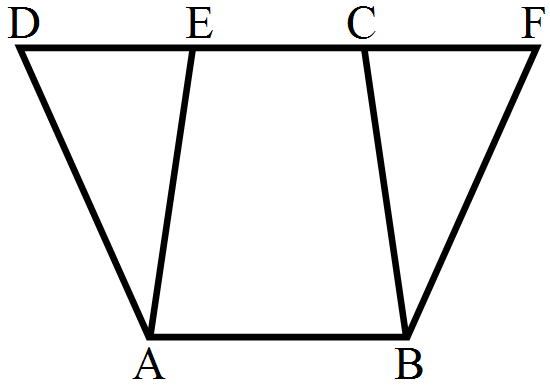
Look at the statements given below:
$i.$ A parallelogram and a rectangle on the same base and between the same parallels are equal in area.
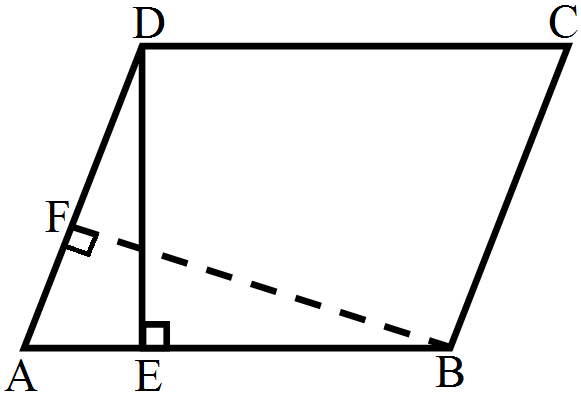
$ii.$ In a $\| gm \text{ABCD},$ it is given that $AB = 10\ cm.$
The altitudes $DE$ on $AB$ and $BF$ on $AD$ being $6\ cm$ and $8\ cm$ respectively, then $AD = 7.5\ cm.$
$iii.$ Area of a $\| gm =\frac{1}{2}\times\text{base}\times\text{altitude}.$
Which is true?
  • A
    $I$ only
     
  • B
    $II$ only
     
  • $I$ and $II$
     
  • D
    $II$ and $III$
Answer
Correct option: C.
$I$ and $II$
 
Since the parallelogram and the rectangle are on the same base and between the same parallels, they are equal in area.
So, the statement $(I)$ is true.
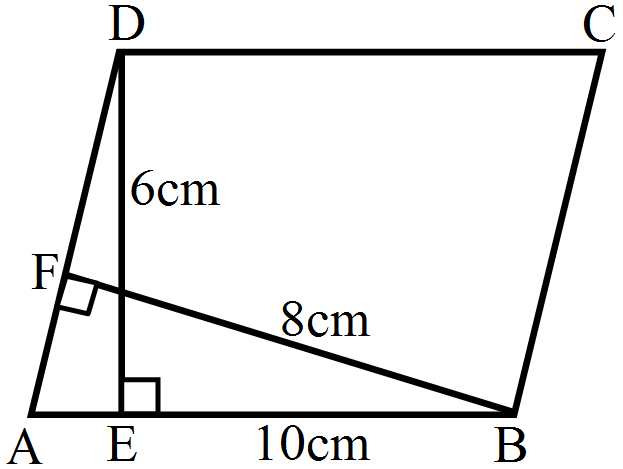
$\operatorname{ar}(\| g m \text{ABCD})=A B \times D E=10 \times 6 \mathrm{\sim cm}^2$
Similarly,
$\operatorname{ar}(\| g m \mathrm{ABCD})=\mathrm{AD} \times \mathrm{BF}=\mathrm{AD} \times 8$
$\Rightarrow \mathrm{AD} \times 8=60$
$\Rightarrow \mathrm{AD}=7.5 \mathrm{\sim cm}$
So, $(II)$ is true.
$\operatorname{ar}(\| g m)=$ base $\times$ altitude
So, $(III)$ is false.
View full question & answer
MCQ 21 Mark
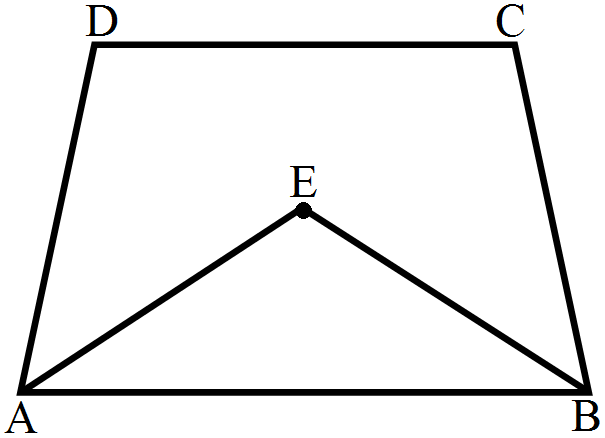
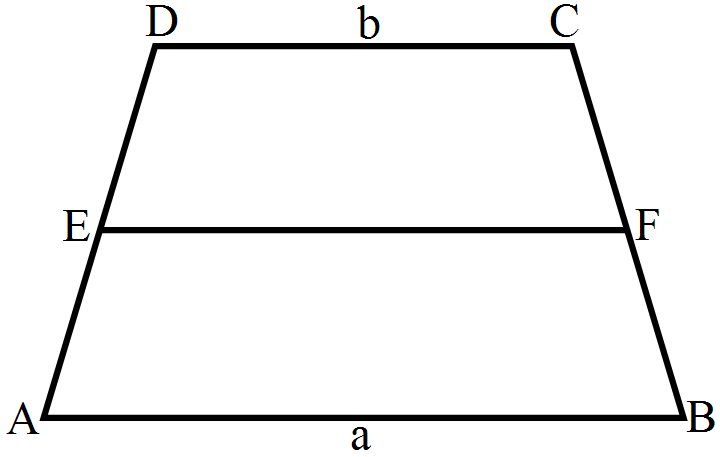
In the given figure $ABCD$ is a trapezium in which $AB || DC$ such that $AB = a\ cm$ and $DC = b\ cm.$ If $E$ and $F$ are the midpoints of $AD$ and $BC$ respectively. Then, $ar(ABFE) : ar(EFCD) = ?$
  • A
    $a : b$
  • B
    $(a + 3b) : (3a + b)$
  • $(3a + b) : (a + 3b)$
  • D
    $(2a + b) : (3a + b)$
Answer
Correct option: C.
$(3a + b) : (a + 3b)$
Since $E$ and $F$ are the midpoints of $AD$ and $BC$ respectively.
$\text{EF}=\frac{1}{2}(\text{AB}+\text{CD})$
$\Rightarrow\ \text{EF}=\frac{1}{2}(\text{a}+\text{b})$
Let $d$ be the distance between $AB$ and $EF.$
Then, $d$ is the distance between $EF$ and $DC.$
$ar($trapezium $ABFE)=\frac{1}{2}\text{(sum of the parallel sides)}\times\text{d}$
$=\frac{1}{2}\times(\text{AB}+\text{EF})\times\text{d}$
$=\frac{1}{2}\Big(\text{a}+\frac{1}{2}(\text{a}+\text{b})\Big)\times\text{d}$
$=\frac{(3\text{a}+\text{b})\times\text{d}}{4}$
$ar($trapezium $EFCD) =\frac{1}{2}\text{(sum of the parallel sides)}\times\text{d}$
$=\frac{1}{2}\times(\text{EF}+\text{CD})\times\text{d}$
$=\frac{1}{2}\Big(\frac{1}{2}(\text{a}+\text{b})\Big)\times\text{d}$
$=\frac{(\text{a}+3\text{b})\times\text{d}}{4}$
So,
$\frac{\text{ar}{(\text{trapezium ABFE}})}{\text{ar}{(\text{trapezium ABFE}})}=\frac{\frac{(3\text{a}+\text{b})\times\text{d}}{4}}{\frac{(\text{a}+3\text{b})\times\text{d}}{4}}$
$=\frac{3\text{a}+\text{b}}{\text{a}+3\text{b}}$
Hence, the required ratio is $(3a + b) : (a + 3b).$
View full question & answer
MCQ 31 Mark
If a triangle and a parallelogram are on the same base and between the same parallels, then the ratio of the area of the triangle to the area of the parallelogram is:
  • $1 : 2$
  • B
    $1 : 3$
  • C
    $1 : 4$
  • D
    $3 : 4$
Answer
Correct option: A.
$1 : 2$
Since the triangle and the parallelogram are on the same base and between the same parallel line the base and the height of the triangle and the parallelogram are the same.
$⇒$ area of the triangle $=\frac{1}{2}\text{area of ||gm}$
Hence, the ratio $1 : 2.$
View full question & answer
MCQ 41 Mark
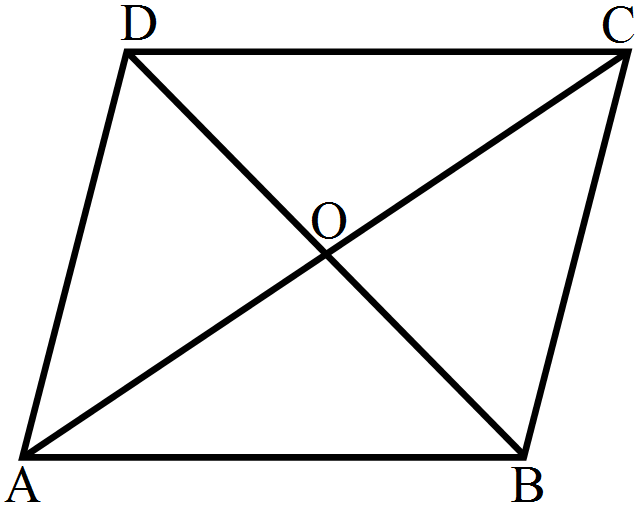
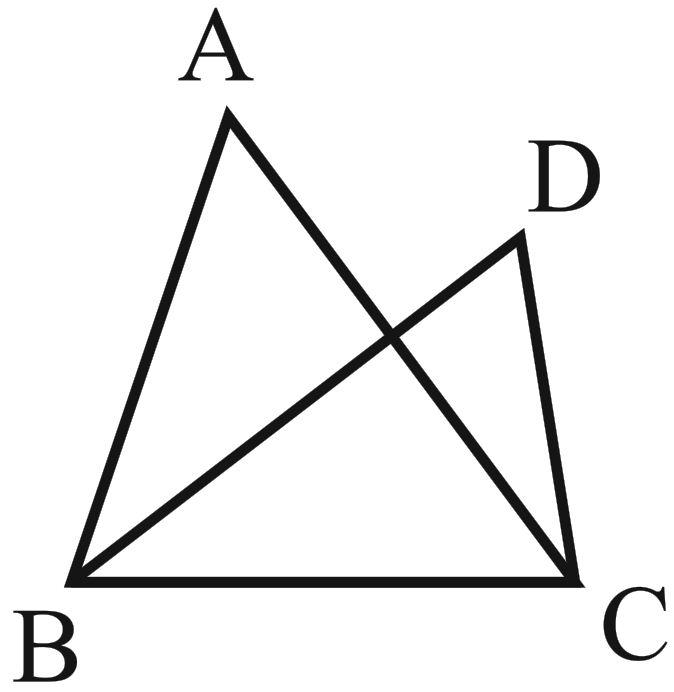
In the given figure, $A B C D$ is a $\| g m$ in which diagonals $A C$ and $B D$ intersect at $O$. If ar $(\| g m A B C D)$ is $52 \mathrm{~cm}^2$, then the $\operatorname{ar}(\triangle \mathrm{AOB})=$ ?
  • A
    $26 \mathrm{~cm}^2$
  • B
    $18.5 \mathrm{~cm}^2$
  • C
    $39 \mathrm{~cm}^2$
  • $13 \mathrm{~cm}^2$
Answer
Correct option: D.
$13 \mathrm{~cm}^2$

$ABCD$ is a $||\ gm$ and $AC$ and $BD$ are the diagonals.
So, $\text{ar}(\triangle\text{ABD})=\frac{1}{2}\text{ar}(||\text{gm ABCD})$
We know that, the diagonals of a parallelogram bisect each other.
So, $O$ is the mid-point of $AC$ and $BD.$
In $\triangle\text{ABD},$
$AO$ is the median on $BD.$
So, $\text{ar}(\triangle\text{OAB})=\frac{1}{2}\text{ar}(\triangle{\text{ABD}})$
$=\frac{1}{2}\times\frac{1}{2}\text{ar}(|| \text{gm ABCD})$
$=\frac{1}{2}\times\frac{1}{2}\times52$
$=13\text{cm}^2$

View full question & answer
MCQ 51 Mark
Which of the following is a false statement$?$
 
  • A
    A median of a triangle divides it into two triangles of equal area.
  • B
    The diagonals of a ||gm divide it into four triangles of equal area.
  • C
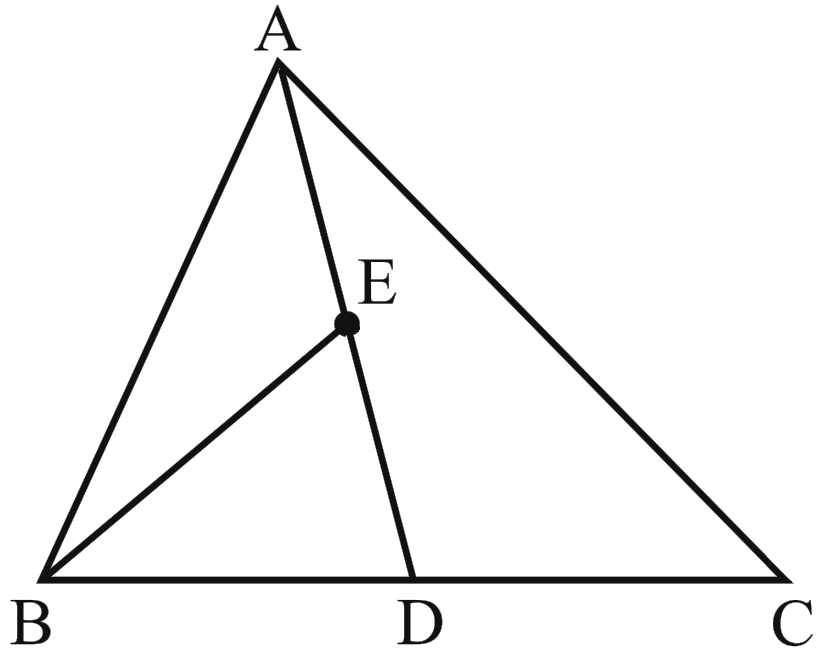
    In a $\triangle\text{ABC},$ if $E$ is the midpoint of median $AD$, then $\text{ar}(\triangle\text{BED})=\frac{1}{4}\text{ar}(\triangle\text{ABC}).$
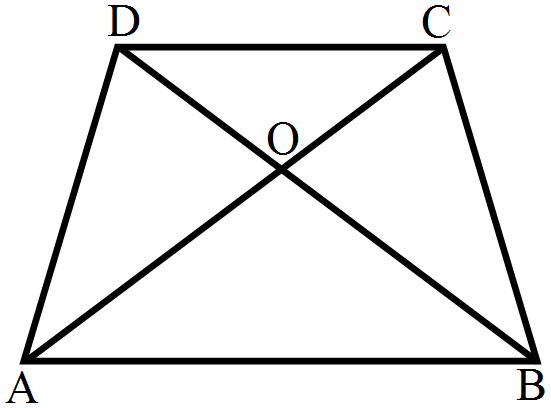
  • In a trapezium $ABCD,$ it is given that $AB || DC$ and the diagonals $AC$ and $BD$ intersect at $O.$ Then, $\text{ar}(\triangle\text{AOB})=\text{ar}(\triangle\text{ABC}).$

Answer
Correct option: D.
In a trapezium $ABCD,$ it is given that $AB || DC$ and the diagonals $AC$ and $BD$ intersect at $O.$ Then, $\text{ar}(\triangle\text{AOB})=\text{ar}(\triangle\text{ABC}).$

Clearly, options $(a)$ and $(b)$ are true.
Since $AD$ is the median,
$\text{ar}(\triangle\text{ADB})=\frac{1}{2}\text{ar}(\triangle\text{ABC})$
Since $E$ is the mid-point of $AD, BE$ is the median on $AD.$
$\Rightarrow\ \text{ar}(\triangle\text{BED})=\frac{1}{2}\text{ar}(\triangle\text{ADB})$
$=\frac{1}{2}\Big(\frac{1}{2}\text{ar}(\triangle\text{ABC})\Big)$
$=\frac{1}{4}\text{ar}(\triangle\text{ABC})$
So, the statement is true.
View full question & answer
MCQ 61 Mark
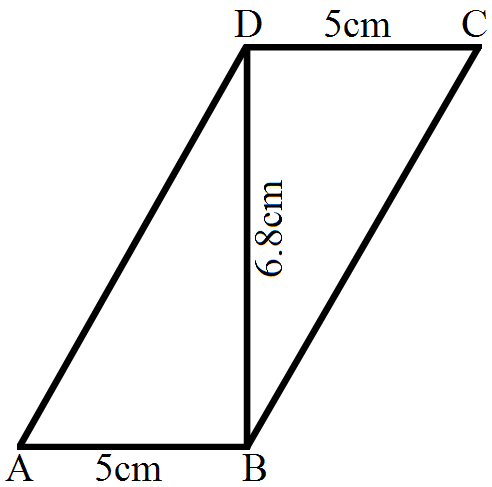
In the given figure, $\text{ABCD}$ is a $\|  \mathrm{gm}$ in which $A B=C D=5 \mathrm{\sim cm}$ and $B D \perp D C$ such that $B D=6.8 \mathrm{\sim cm}$. Then, the area of $\mathrm{ABCD}=$ ?
  • A
    $17 \mathrm{\sim cm}^2$
  • B
    $25 \mathrm{\sim cm}^2$
  • $34 \mathrm{\sim cm}^2$
  • D
    $68 \mathrm{\sim cm}^2$
Answer
Correct option: C.
$34 \mathrm{\sim cm}^2$
Since $\text{ABCD}$ is a $\|\mathrm{gm}, A B\| C D$.
$\operatorname{ar}(\| g m \mathrm{ABCD})=$ base $\times$ height
$=A B \times B D$
$=5 \times 6.8$
$=34 \mathrm{\sim cm}^2$
View full question & answer
MCQ 71 Mark
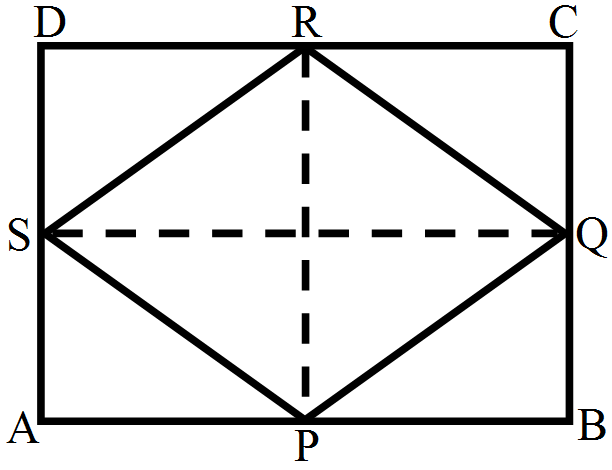
The figure formed by joining the midpoints of the adjacent sides of a rectangle of sides $8\ cm$ and $6\ cm$ is a:
  • A
    Rectangle of area $24 \mathrm{~cm}^2$
  • B
    Square of area $24 \mathrm{~cm}^2$
  • C
    Trapezium of area $24 \mathrm{~cm}^2$
  • Rhombus of area $24 \mathrm{~cm}^2$
Answer
Correct option: D.
Rhombus of area $24 \mathrm{~cm}^2$

Clearly, $PQRS$ is a rhombus whose area $=\frac{1}{2}\times\text{PR}\times\text{SQ}$
$=\frac{1}{2}\times6\times8$
$=24\text{cm}^2$

View full question & answer
MCQ 81 Mark
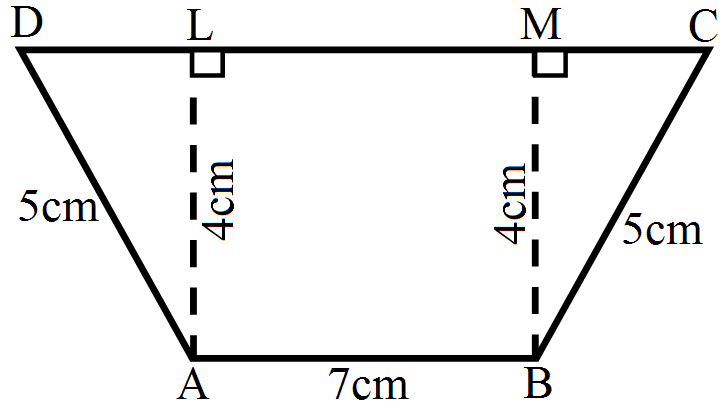
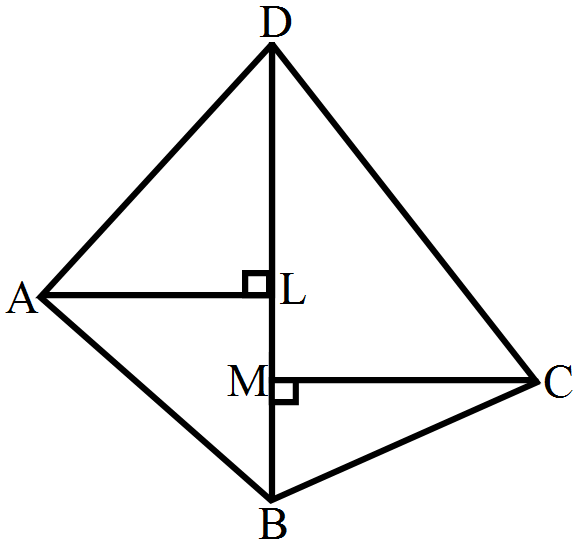
In the given figure $A B C D$ is a trapezium such that $A L \perp D C$ and $B M \perp D C$. If $A B=7 \mathrm{~cm}, B C=A D=5 \mathrm{~cm}$ and $A L=$ $B M=4 \mathrm{~cm}$, then $\operatorname{ar}($ trapezium $ABCD)=?$
  • A
    $24 \mathrm{~cm}^2$
  • $40 \mathrm{~cm}^2$
  • C
    $55 \mathrm{~cm}^2$
  • D
    $27.5 \mathrm{~cm}^2$
Answer
Correct option: B.
$40 \mathrm{~cm}^2$

In right $\triangle \mathrm{BMC}$,
By pythagoras theorem,
$\mathrm{BC}^2=\mathrm{BM}^2+C M^2$
$\Rightarrow \mathrm{CM}^2=\mathrm{BC}^2-\mathrm{BM}^2$
$\Rightarrow \mathrm{CM}^2=5^2-4^2$
$\Rightarrow \mathrm{CM}^2=25-16$
$\Rightarrow C M^2=9$
$\Rightarrow \mathrm{CM}=3 \mathrm{~cm}$
In right $\triangle \mathrm{ALD}$
By pythagoras theorem,
$A D^2=A L^2+D L^2$
$\Rightarrow D L^2=A D^2-A L^2$
$\Rightarrow D L^2=5^2-4^2$
$\Rightarrow D L^2=25-16$
$\Rightarrow D L^2=9$
$\Rightarrow D L=3 \mathrm{~cm}$
Since $AMML$ forms a rectangle, the opposite sides are equal.
So, $\mathrm{AB}=\mathrm{LM}=7 \mathrm{~cm}$
Area of a trapezium $=\frac{1}{2} \times$ (Sum of the parallel sides) $\times$ Distance between the parallel sides
$=\frac{1}{2} \times(\mathrm{AB} \times \mathrm{CD}) \times \mathrm{AL}$
$=\frac{1}{2} \times(3+7+3) \times 4$
$=40 \mathrm{~cm}^2$

View full question & answer
MCQ 91 Mark
The lengths of the diagonals of a rhombus are $12\ cm$ and $16\ cm.$ The area of the rhombus is:
  • A
    $192 \mathrm{\sim cm}^2$
  • $96 \mathrm{\sim cm}^2$
  • C
    $64 \mathrm{~cm}^2$
  • D
    $80 \mathrm{\sim cm}^2$
Answer
Correct option: B.
$96 \mathrm{\sim cm}^2$
Area of a rhombus $=\frac{1}{2}\times$ product of the diagonals
$=\frac{1}{2}\times12\times16$
$=96\text{ cm}^2$
View full question & answer
MCQ 101 Mark
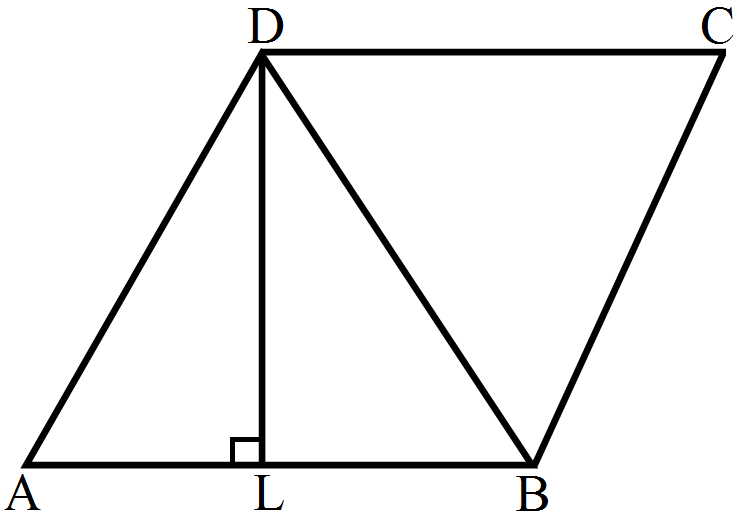
In the given figure, $ABCD$ is a $\| \mathrm{gm}$ in which $\mathrm{DL} \perp \mathrm{AB}$. If $\mathrm{AB}=10 \mathrm{~cm}$ and $\mathrm{DL}=4 \mathrm{~cm}$, then the ar $(\| \mathrm{gm} A B C D)=$ ?
  • $40 \mathrm{~cm}^2$
  • B
    $80 \mathrm{~cm}^2$
  • C
    $20 \mathrm{~cm}^2$
  • D
    $196 \mathrm{~cm}^2$
Answer
Correct option: A.
$40 \mathrm{~cm}^2$

$ABCD$ is a $\| \mathrm{gm}$ and $\mathrm{DL} \perp \mathrm{AB}$.
So, $D L$ is the height of the $\| \mathrm{gm} A B C D$.
$\operatorname{ar}(\| \mathrm{gm} \mathrm{ABCD})=\text { base } \times \text { height }$
$=\mathrm{AB} \times \mathrm{DL}$
$=10 \times 4$
$=40 \mathrm{~cm}^2$

View full question & answer
MCQ 111 Mark
Two parallelograms are on equal bases and between the same parallels. The ratio of their areas is:
  • A
    $1 : 2$
  • $1 : 1$
  • C
    $2 : 1$
  • D
    $3 : 1$
Answer
Correct option: B.
$1 : 1$
Parallelograms on equal bases and between the same parallels are equal in area.
View full question & answer
MCQ 121 Mark
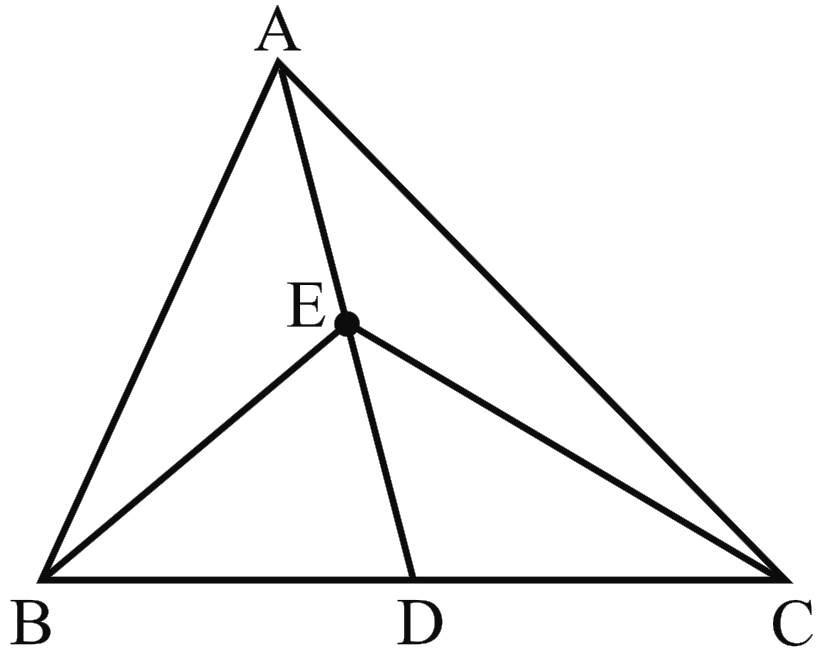
The vertex $A$ of $\triangle\text{ABC}$ is joined to a point $D$ on $BC.$ If E is the midpoint of $AD,$ then $\text{ar}(\triangle\text{BEC})=?$
  • $\frac{1}{2}\text{ar}(\triangle\text{ABC})$
  • B
    $\frac{1}{3}\text{ar}(\triangle\text{ABC})$
  • C
    $\frac{1}{4}\text{ar}(\triangle\text{ABC})$
  • D
    $\frac{1}{6}\text{ar}(\triangle\text{ABC})$
Answer
Correct option: A.
$\frac{1}{2}\text{ar}(\triangle\text{ABC})$
In $\triangle\text{ABD},$ median $BE$ divides $\triangle\text{ABD}$ into two triangles of equal area.
$\Rightarrow\ \text{ar}(\triangle\text{BED})=\frac{1}{2}\text{ar}(\triangle\text{ABD})\dots(1)$
In $\triangle\text{ACD},$ median $CE$ divides $\triangle\text{ACD}$ into two triangles of equal area.
$\Rightarrow\ \text{ar}(\triangle\text{CED})=\frac{1}{2}\text{ar}(\triangle\text{ACD})\dots(2)$
From $(1)$ and $(2)$, we get:
$\Rightarrow\ \text{ar}(\triangle\text{BED})+ \text{ar}(\triangle\text{CED})=\frac{1}{2}\text{ar}(\triangle\text{ABD})+\frac{1}{2}\text{ar}(\triangle\text{ACD})$
$\Rightarrow\ \text{ar}(\triangle\text{BED})+ \text{ar}(\triangle\text{CED})=\frac{1}{2}[\text{ar}(\triangle\text{ABD})+\text{ar}(\triangle\text{ACD})]$
$\Rightarrow\ \text{ar}(\triangle\text{BEC})=\frac{1}{2}\text{ar}(\triangle\text{ABC})$
View full question & answer
MCQ 131 Mark
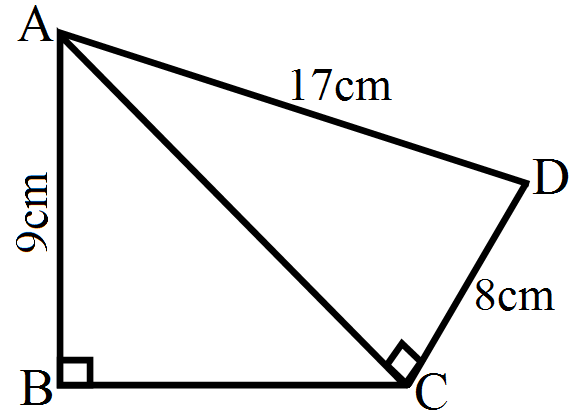
The area of quadrilateral $\text{ABCD}$ in the given figure is:
  • A
    $57 \mathrm{\sim cm}^2$
  • B
    $108 \mathrm{\sim cm}^2$
  • $114 \mathrm{\sim cm}^2$
  • D
    $195 \mathrm{\sim cm}^2$
Answer
Correct option: C.
$114 \mathrm{\sim cm}^2$
In right $\triangle \mathrm{ACD}$,
By Pythagoras theoram,
$A D^2=A C^2+C D^2$
$\Rightarrow A C^2=A D^2-C D^2$
$\Rightarrow A C^2=17^2-8^2$
$\Rightarrow A C^2=289-64$
$\Rightarrow A C^2=225$
$\Rightarrow A C^2=15 \mathrm{\sim cm}$
In right $\triangle \mathrm{ABC}$,
By Pythagoras theoram,
$A C^2=A B^2+B C^2$
$\Rightarrow B C^2=A C^2-A B^2$
$\Rightarrow B C^2=15^2-9^2$
$\Rightarrow B C^2=225-81$
$\Rightarrow B C^2=144$
$\Rightarrow B C^2=12 \mathrm{\sim cm}$
$\text { ar }($quadrilateral $\text{ABCD})=\operatorname{ar}(\triangle \mathrm{ABC})+\operatorname{ar}(\triangle \mathrm{ACD})$
$=\left(\frac{1}{2} \times \mathrm{AB} \times \mathrm{BC}\right)+\left(\frac{1}{2} \times \mathrm{AC} \times \mathrm{CD}\right)$
$=\left(\frac{1}{2} \times 9 \times 12\right)+\left(\frac{1}{2} \times 15 \times 8\right)$
$=54+60$
$=114 \mathrm{\sim cm}^2$
View full question & answer
MCQ 141 Mark
In the given figure $A B C D$ and $A B F E$ are parallelograms such that ar(quadrilateral $E A B C)=17 \mathrm{~cm}^2$ and $\operatorname{ar}(\| \mathrm{gm} A B C D)=$ $25 \mathrm{~cm}^2$. Then, $\operatorname{ar}(\triangle \mathrm{BCF})=$ ?
  • A
    $4 \mathrm{~cm}^2$
  • B
    $4.8 \mathrm{~cm}^2$
  • C
    $6 \mathrm{~cm}^2$
  • $8 \mathrm{~cm}^2$
Answer
Correct option: D.
$8 \mathrm{~cm}^2$

From the given figure, we have $||\ gm\ ABCD$ and $||\ gm\ ABFE$ are lying on the same base and between the same parallels.
$\Rightarrow\ \text{ar}(||\text{gm ABCD})=\text{ar}(||\text{gm ABFE})=25\text{cm}^2$
$\Rightarrow\ \text{ar}(\triangle\text{BCF})=\text{ar}(||\text{gm ABFE})-\text{ar(quadrilateral EABC)}$
$=25-17$
$=8\text{cm}^2$

View full question & answer
MCQ 151 Mark
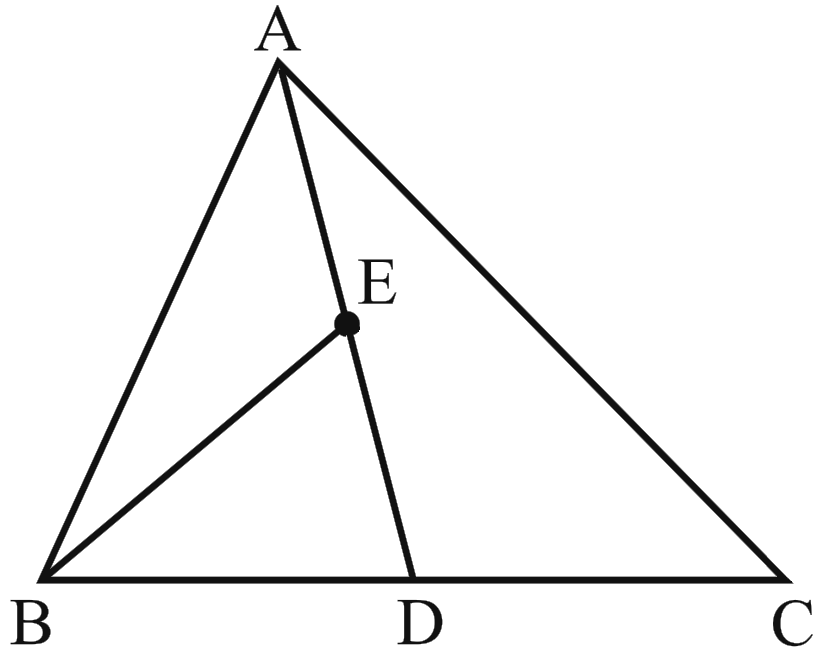
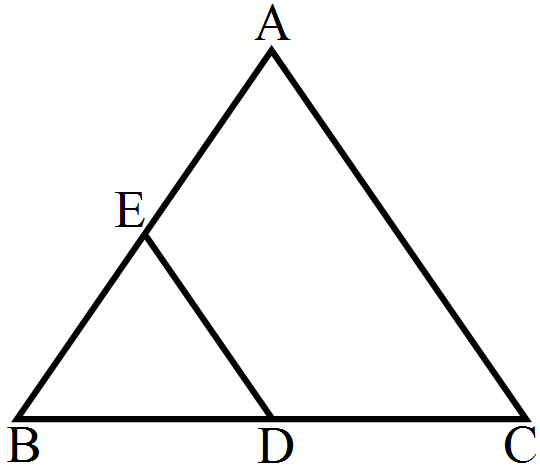
In $\triangle\text{ABC},$ if $D$ is the midpoint of $BC$ and $E$ is the midpoint of $AD,$ then $\text{ar}(\triangle\text{BED})=?$
  • A
    $\frac{1}{2}\text{ar}(\triangle\text{ABC})$
  • B
    $\frac{1}{3}\text{ar}(\triangle\text{ABC})$
  • $\frac{1}{4}\text{ar}(\triangle\text{ABC})$
  • D
    $\frac{2}{3}\text{ar}(\triangle\text{ABC})$
Answer
Correct option: C.
$\frac{1}{4}\text{ar}(\triangle\text{ABC})$
In $\triangle\text{ABC},$ median $AD$ divides $\triangle\text{ABC}$ into two triangles of equal area.
$\Rightarrow\ \text{ar}(\triangle\text{ABD})=\text{ar}(\triangle\text{ADC})=\frac{1}{2}\text{ar}(\triangle\text{ABC})\dots(1)$
In $\triangle\text{ABD},$ median $BE$ divides $\triangle\text{ABD}$ into two triangles of equal area.
$\Rightarrow\ \text{ar}(\triangle\text{BED})=\text{ar}(\triangle\text{ABE})=\frac{1}{2}\text{ar}(\triangle\text{ABD})\dots(2)$
From $(1)$ and $(2),$ we get:
$\text{ar}(\triangle\text{BED})=\frac{1}{4}\text{ar}(\triangle\text{ABC})$
View full question & answer
MCQ 161 Mark
$\triangle\text{ABC}$ and $\triangle\text{BDE}$ are two equilateral triangles such that $D$ is the mid-point of $BC.$ Then, $\text{ar}(\triangle\text{BDE}):\text{ar}(\triangle\text{ABC})=?$
  • A
    $1:2$
  • $1:4$
  • C
    $\sqrt{3}:2$
  • D
    $3:4$
Answer
Correct option: B.
$1:4$
Since $D$ is the mid-point of $BC, \text{BD}=\frac{\text{BC}}{2}.$
Area of an equilateral triangle $=\frac{\sqrt{3}}{4}(\text{side})^2$
$\frac{\text{ar}(\triangle\text{BDE})}{\text{ar}(\triangle\text{ABC})}=\frac{\frac{\sqrt{3}}{4}\text{BD}^2}{\frac{\sqrt{3}}{4}\text{BC}^2}$
$=\frac{\frac{\sqrt{3}}{4}\Big(\frac{\text{BC}}{2}\Big)^2}{\frac{\sqrt{3}}{4}\text{BC}^2}$
$=\frac{\frac{\text{BC}^2}{4}}{\text{BC}^2}$
$=\frac{1}{4}$
Hence, the $\text{ar}(\triangle\text{BDE}):\text{ar}(\triangle\text{ABC})$ is $1 : 4.$
View full question & answer
MCQ 171 Mark
Two parallel sides of a trapezium are $12\ cm$ and $8\ cm$ long and the distance between them is $6.5\ cm.$ The area of the trapezium is:
  • A
    $74 \mathrm{~cm}^2$
  • $32.5 \mathrm{~cm}^2$
  • C
    $65 \mathrm{~cm}^2$
  • D
    $130 \mathrm{~cm}^2$
Answer
Correct option: B.
$32.5 \mathrm{~cm}^2$

Area of a trapezium $=\frac{1}{2}\times ($Sum of the parallel sides$)\ ×$ Distance between the parallel sides
$=\frac{1}{2}\times(12+8)\times6.5$
$=65\text{cm}^2$

View full question & answer
MCQ 181 Mark
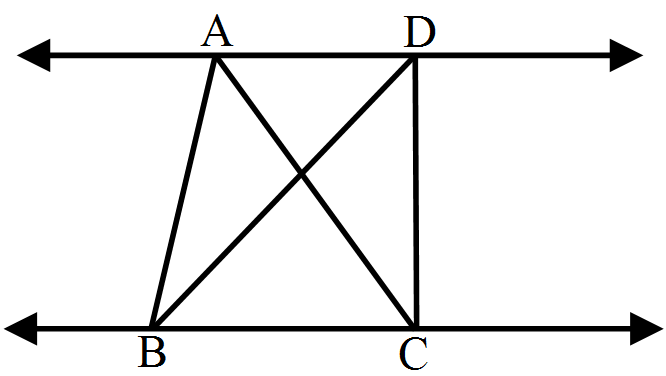
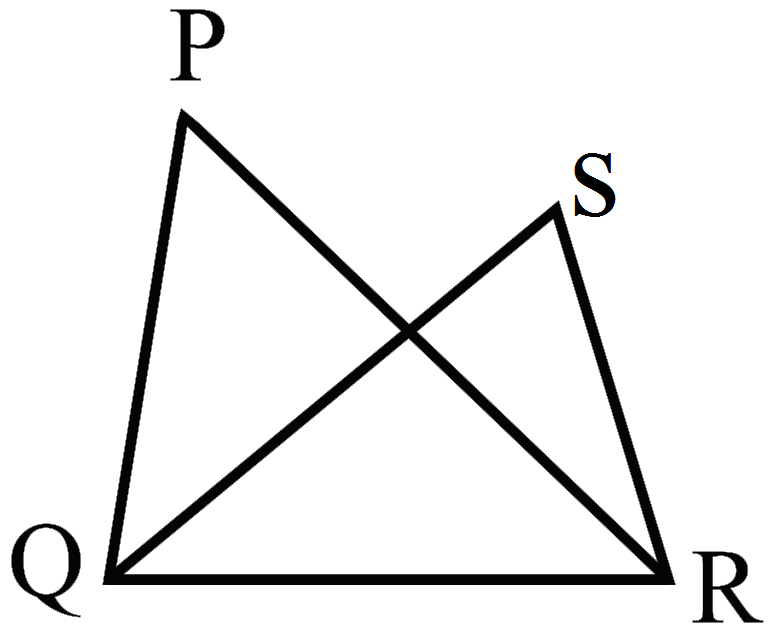
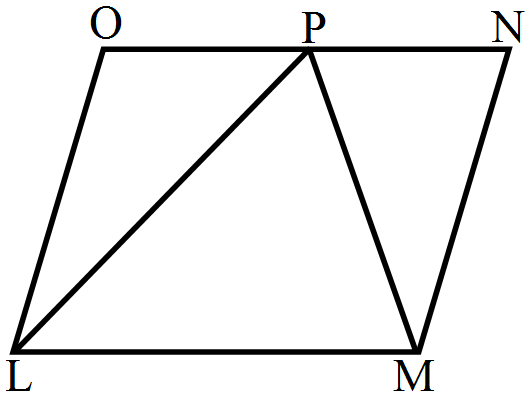
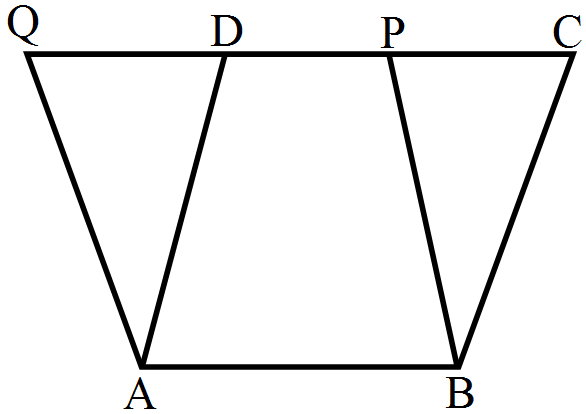
Out of the following given figures which are on the same base but not between the same parallels?
 
  • A
  • C
  • D
Answer
Correct option: B.
$a.$ The $\triangle\text{ABC}$ and $\triangle\text{DCB}$ are between the same parallel lines, $AD$ and $BC$ and on the same base $BC.$
$b.$ The $\triangle\text{PLM}$ and $\| gm \text{OLMN}$ are between the same parallel lines, $ON$ and $LM$ and on the same base $LM.$
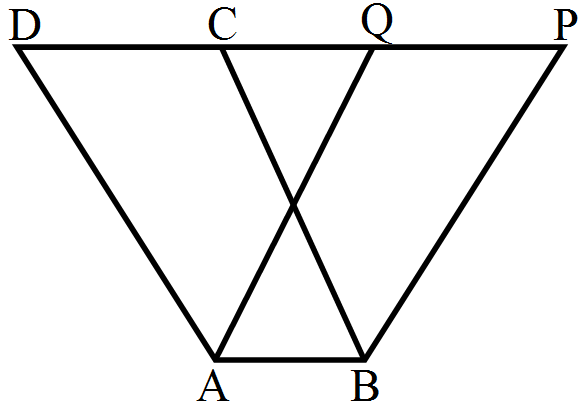
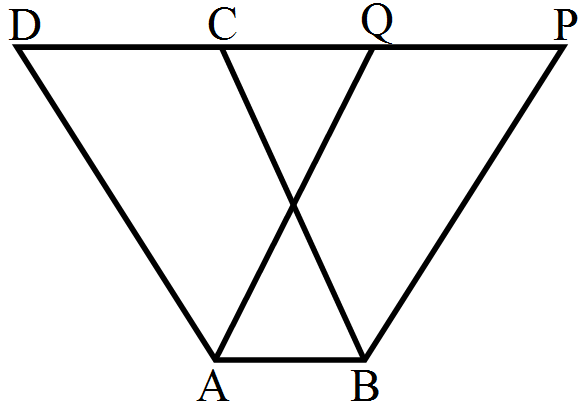
$c.$ The $\|\ gm\ \text{ABCD}$ and $\|\ gm\ \text{ABPQ}$ are between the same parallel lines, $QC$ and $AB$ and on the same base $AB.$
$d.$ The $\triangle\text{PQR}$ and $\triangle\text{SRQ}$ are on the same base $QR.$
But not between the same parallel.
View full question & answer
MCQ 191 Mark
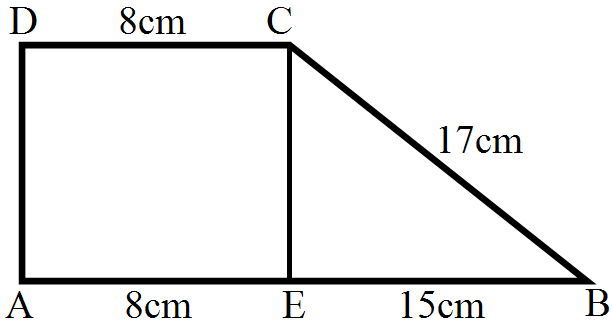
The area of trapezium $ABCD$ in the given figure is:
  • A
    $62 \mathrm{~cm}^2$
  • B
    $93 \mathrm{~cm}^2$
  • $124 \mathrm{~cm}^2$
  • D
    $155 \mathrm{~cm}^2$
Answer
Correct option: C.
$124 \mathrm{~cm}^2$

Since $A B C D$ is a trapezium, $A B \| C D$, that is $A E \| C D$.
Also, $A E=C D=8 \mathrm{~cm}$
So, $A E C D$ is a square.
In right $\triangle \mathrm{CEB}$,
By Pythagoras theoram,
$\mathrm{BC}^2=\mathrm{EC}^2+E \mathrm{~EB}^2$
$\Rightarrow \mathrm{EC}^2=\mathrm{BC}^2-\mathrm{EB}^2$
$\Rightarrow \mathrm{EC}^2=17^2-15^2$
$\Rightarrow \mathrm{EC}^2=289-225$
$\Rightarrow E C^2=64$
$\Rightarrow E C^2=8 \mathrm{~cm}$
Which is the required height of trapezium $A B C D$.
$\operatorname{ar}($ trapezium $ABCD )$
$=\frac{1}{2} \times$ (Sum of the parallel sides) $\times$ height
$=\frac{1}{2} \times(\mathrm{AB}+\mathrm{CD}) \times \mathrm{EC}$
$=\frac{1}{2} \times(8+15+8) \times 8$
$=124 \mathrm{~cm}^2$

View full question & answer
MCQ 201 Mark
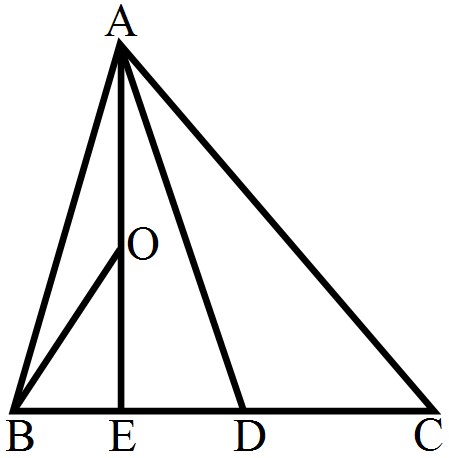
In $\triangle\text{ABC},$ it is given that $D$ is the midpoint of $BC; E$ is the midpoint of $BD$ and $O$ is the midpoint of $AE.$ Then, $\text{ar}(\triangle\text{BOE})=?$
  • A
    $\frac{1}{3}\text{ar}(\triangle\text{ABC})$
  • B
    $\frac{1}{4}\text{ar}(\triangle\text{ABC})$
  • C
    $\frac{1}{6}\text{ar}(\triangle\text{ABC})$
  • $\frac{1}{8}\text{ar}(\triangle\text{ABC})$
Answer
Correct option: D.
$\frac{1}{8}\text{ar}(\triangle\text{ABC})$
We know that the median of a triangle divides the triangle into two triangles with equal areas.
Since $D$ is the mid-point of $BC, AD$ is the median on $BC.$
$\Rightarrow\ \text{ar}(\triangle\text{ABD})=\frac{1}{2}\text{ar}(\triangle\text{ABC})$
Since $E$ is the mid-point of $BD, AE$ is the median on $BD.$
$\Rightarrow\ \text{ar}(\triangle\text{ABE})=\frac{1}{2}\text{ar}(\triangle\text{ABD})$
$=\frac{1}{2}\Big[\frac{1}{2}\text{ar}(\triangle\text{ABC})\Big]=\frac{1}{4}\text{ar}(\triangle\text{ABC})$
Since $O$ is the mid-point of $AE, BO$ is the median on $AE.$
$\Rightarrow\ \text{ar}(\triangle\text{BOE})=\frac{1}{2}\text{ar}(\triangle\text{ABE})$
$=\frac{1}{2}\Big[\frac{1}{4}\text{ar}(\triangle\text{ABC})\Big]=\frac{1}{8}\text{ar}(\triangle\text{ABC})$
Thus,
$\text{ar}(\triangle\text{BOE})=\frac{1}{8}\text{ar}(\triangle\text{ABC})$
View full question & answer
MCQ 211 Mark
In a quadrilateral $A B C D$, it is given that $B D=16 \mathrm{~cm}$. If $\mathrm{AL} \perp \mathrm{BD}$ and $\mathrm{CM} \perp \mathrm{BD}$ such that $\mathrm{AL}=9 \mathrm{~cm}$ and $\mathrm{CM}=7 \mathrm{~cm}$, then ar(quadrilateral $A B C D)=$ ?
  • A
    $256 \mathrm{~cm}^2$
  • $128 \mathrm{~cm}^2$
  • C
    $64 \mathrm{~cm}^2$
  • D
    $96 \mathrm{~cm}^2$
Answer
Correct option: B.
$128 \mathrm{~cm}^2$

Area of quadrilateral $ABCD =\text{ar}(\triangle\text{ABD})+\text{ar}(\triangle\text{BCD})$
$=\frac{1}{2}\times\text{BD}\times\text{AL}+\frac{1}{2}\text{BD}\times\text{CM}$
$=\frac{1}{2}\times16\times9+\frac{1}{2}\times16\times7$
$=72+56$
$=128\text{cm}^2$

View full question & answer
MCQ 221 Mark
In which of the following figures, you find polynomials on the same base and between the same parallels$?$
 
  • A
  • B
  • D
Answer
Correct option: C.

Only in option $(c), ||\ gm\ ABPQ $ and $||\ gm\ ABCD$ are between the same base, $AB$ and between the same parallel lines, $AB$ and $DP.$
View full question & answer
MCQ 231 Mark
$ABCD$ is a quadrilateral whose diagonal $AC$ divides it into two parts, equal in area, then $ABCD$ is:
  • A
    A rectangle
  • B
    a ||gm
  • C
    A rhombus
  • All of these
Answer
Correct option: D.
All of these
The diagonals of a parallelogram divide the parallelogram into two triangles with equal areas.
Since a rectangle and a rhombus is a $||\ gm, ABCD $ could be a rectangle, or $||\ gm$ or a rhombus.
View full question & answer
MCQ 241 Mark
Which of the following is a false statement$?$
  • A
    If the diagonals of a rhombus are $18\ cm$ and $14\ cm ,$ then its area is $126 \mathrm{~cm}^2$.
  • Area of a $\| g m=\frac{1}{2} \times$ base $\times$ corresponding height.
  • C
    A parallelogram and a rectangle on the same base and between the same parallels are equal in area.
  • D
    If the area of a $\| \mathrm{gm}$ with one side $24\ cm$ and corresponding height $h\ cm$ is $192 \mathrm{~cm}^2$, then $\mathrm{h}=8 \mathrm{~cm}$.
Answer
Correct option: B.
Area of a $\| g m=\frac{1}{2} \times$ base $\times$ corresponding height.

$a.$ The area of the rhombus $=\frac{1}{2} \times$ product of the diagonals
$=\frac{1}{2} \times 18 \times 14$
$=126 \mathrm{~cm}^2$
So, the statement is true.
$b.$ area of a $\| g m=$ base $\times$ height
So, the statement is false.
$c.$ Since parallelograms between the same parallel lines and on the same base are equal in area, and a rectangle is a $ll\ gm,$ the statement is true.
$d.$ area of a $\| g m=$ base $\times$ height
$\Rightarrow 192=24 \times h$
$\Rightarrow h=8 \mathrm{~cm}$
So, the statement is true.

View full question & answer
MCQ 251 Mark
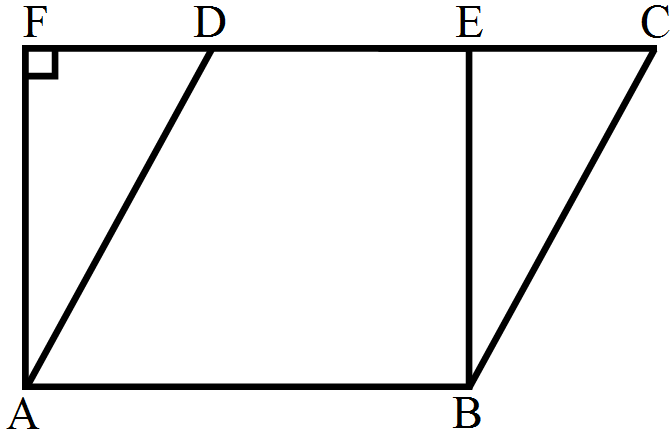
In the given figure, a ||gm $ABCD$ and a rectangle $ABEF$ are of equal area. Then,
  • A
    Perimeter of $ABCD =$ perimeter of $ABEF$
  • B
    Perimeter of $ABCD < $ perimeter of $ABEF$
  • Perimeter of $ABCD > $ perimeter of $ABEF$
  • D
    Perimeter of $ABCD =\frac{1}{2}($perimeter of $ABEF)$
Answer
Correct option: C.
Perimeter of $ABCD > $ perimeter of $ABEF$
Since the perpendicular is the shortest distance in a right triangle.
$AB > AF$ and $BC > BE$
Clearly, perimeter of $ABCD > $ perimeter if $ABEF.$
View full question & answer
MCQ 261 Mark
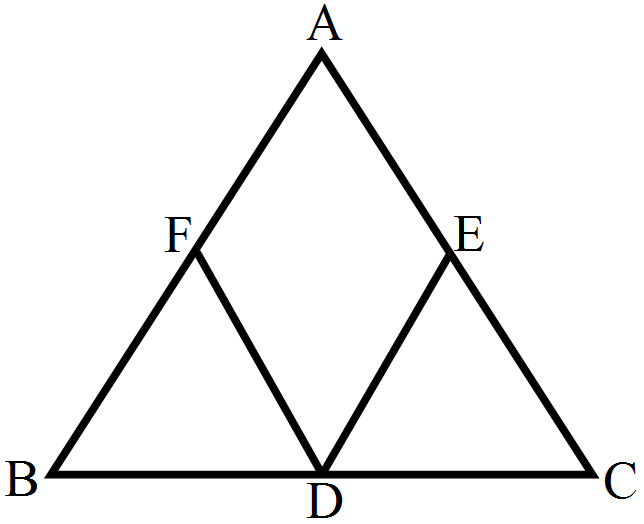
The midpoints of the sides of a triangle along with any of the vertices as the fourth point makes a parallelogram of area equal to
  • $\frac{1}{2}(\text{ar}\triangle\text{ABC})$
  • B
    $\frac{1}{3}(\text{ar}\triangle\text{ABC})$
  • C
    $\frac{1}{4}(\text{ar}\triangle\text{ABC})$
  • D
    $(\text{ar}\triangle\text{ABC})$
Answer
Correct option: A.
$\frac{1}{2}(\text{ar}\triangle\text{ABC})$
$\triangle\text{ABC}$ is divided into four triangles of equal area.
$ar($parallelogram $AFDE) =\text{ar}(\triangle\text{AFE})+\text{ar}(\triangle\text{DFE})$
$=2\text{ar}(\triangle\text{AFE})$
$=2\times\frac{1}{4}\text{ar}(\triangle\text{ABC})$
$=\frac{1}{2}\text{ar}(\triangle\text{ABC})$
View full question & answer
MCQ 271 Mark
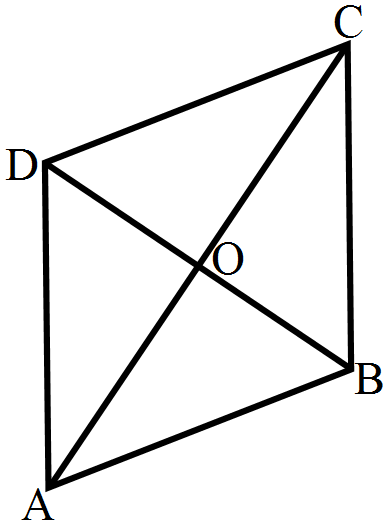
$ABCD$ is a rhombus in which $\angle\text{C}=60^\circ.$ Then, $AC : BD = ?$
​​​​​​​
  • $\sqrt{3}:1$
  • B
    $\sqrt{3}:\sqrt{2}$
  • C
    $3:1$
  • D
    $3:2$
Answer
Correct option: A.
$\sqrt{3}:1$

Given that $ABCD$ is a rhombus.
$BC = CD [$Since all the sides of a rhombus are equal$]$
$\Rightarrow\ \angle\text{BDC}=\angle\text{BCD} [$Angles opposite equal sides are equal$]$
In $\triangle\text{BCD},$
$\angle\text{BDC}+\angle\text{BCD}+\angle\text{CBD}=180^\circ[ $Angle sum property$]$
$\Rightarrow\ \angle\text{BDC}+60^\circ+\angle\text{BDC}=180^\circ$
$\Rightarrow\ 2\angle\text{BDC}=120^\circ$
$\Rightarrow\ \angle\text{BDC}=60^\circ$
$\Rightarrow\ \angle\text{BDC}=\angle\text{BCD}=60^\circ$
So, $\triangle\text{BCD},$ is an equilateral triangle.
$\therefore B D=B C=C D=x \text { (say) }$
We know that the diagonals of a rhombus are perpendicular bisectors of each other.
In right $\triangle \mathrm{AOB}$,
$A B^2=A O^2+O B^2[B y$ Pythagoras theoram $]$
$\Rightarrow A O^2=A B^2-O B^2$
$\Rightarrow\ \text{AO}^2=\text{x}^2-\Big(\frac{\text{x}}{2}\Big)^2$
$\Rightarrow\ \text{AO}^2=\text{x}^2-\Big(\frac{\text{x}^2}{4}\Big)$
$\Rightarrow\ \text{AO}^2=\frac{3\text{x}^2}{4}$
$\Rightarrow\ \text{AO}=\frac{\sqrt{3}\text{x}}{2}$
So, $\text{AC}=\sqrt{3}\text{x}$
Thus,
$\frac{\text{AC}}{\text{BD}}=\frac{\sqrt{3}\text{x}}{\text{x}}=\frac{\sqrt{3}}{1}$
Hence,
$\text{AC}:\text{BD}=\sqrt{3}:1.$

View full question & answer
MCQ 281 Mark
The median of a triangle divides it into two:
  • Triangles of equal areas
  • B
    Congruent triangles
  • C
    Isosceles triangles
  • D
    Right triangles.
Answer
Correct option: A.
Triangles of equal areas
The median of a triangle divides it into two triangles of equal area.
View full question & answer
MCQ 291 Mark
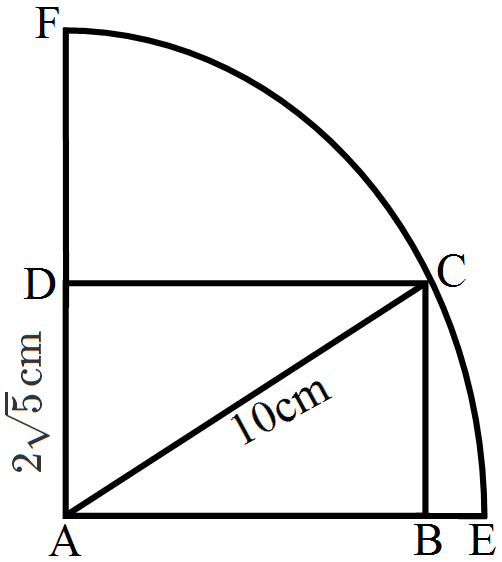
In the given figure, $ABCD$ is a rectangle inscribed in a quadrant of a circle of radius $10\ cm.$ If $\text{AD}=2\sqrt{5}\text{cm}$ then area of the rectangle is:
  • A
    $32 \mathrm{~cm}^2$
  • $40 \mathrm{~cm}^2$
  • C
    $44 \mathrm{~cm}^2$
  • D
    $48 \mathrm{~cm}^2$
Answer
Correct option: B.
$40 \mathrm{~cm}^2$

Since $ABCD$ is a rectangle, $\text{AD}=\text{BC}=2\sqrt{5}\text{cm}$
In right $\triangle\text{ABC},$
$\text{AC}^2=\text{AB}^2+\text{BC}^2$
$\Rightarrow\ \text{AB}^2=\text{AC}^2-\text{BC}^2$
$\Rightarrow\ \text{AB}^2=10^2-(2\sqrt{5})^2$
$\Rightarrow\ \text{AB}^2=100-20$
$\Rightarrow\ \text{AB}=4\sqrt{5}\text{cm}$
$\therefore\ \text{ar(rectangle ABCD)}=\text{lenght}\times\text{breadth}$
$=\text{AB}\times\text{AD}$
$=4\sqrt{5}\times2\sqrt{5}$
$=40\text{cm}^2$

View full question & answer
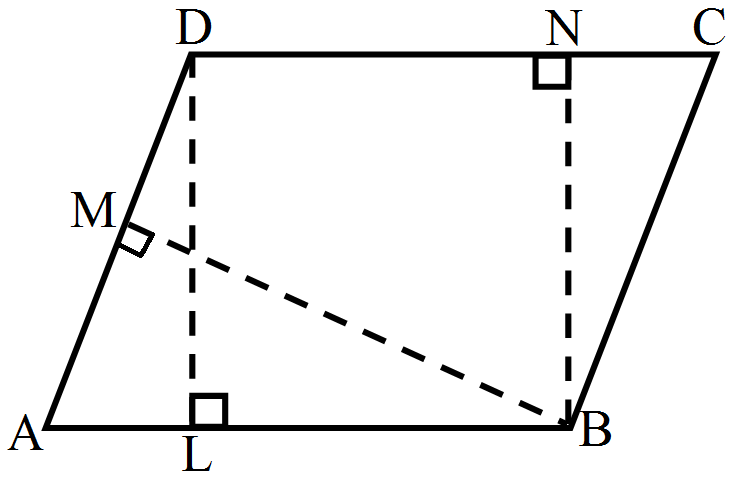
MCQ 301 Mark
The area of $||\ gm\ ABCD$ is:
  • A
    $AB × BM$
  • B
    $BC × BN$
  • $DC × DL$
  • D
    $AD × DL$
Answer
Correct option: C.
$DC × DL$
Area of $||\ gm ABCD =$ Base $×$ Height $= DC × DL$
View full question & answer
MCQ 311 Mark
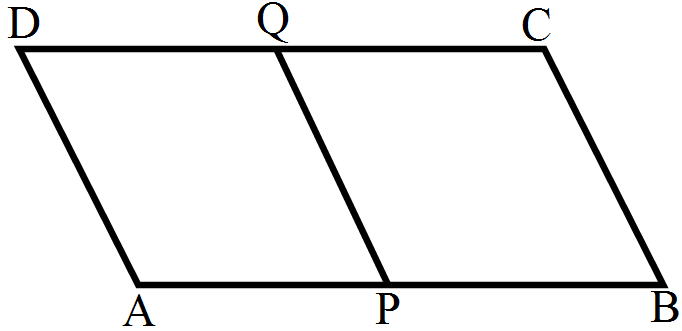
In a $\| g m A B C D$, if $P$ and $Q$ are midpoints of $A B$ and $C D$ respectively and $\operatorname{ar}(\| g m A B C D)=16 \mathrm{~cm}^2$, then ar$(\| g m \mathrm{~APQD})$ = ?
  • $8 \mathrm{~cm}^2$
  • B
    $12 \mathrm{~cm}^2$
  • C
    $6 \mathrm{~cm}^2$
  • D
    $9 \mathrm{~cm}^2$
Answer
Correct option: A.
$8 \mathrm{~cm}^2$
Let $h$ be the distance between $AB$ and $CD.$
$ar(||\ gm\ APQD) =$ base $×$ height
$= AP × h ...(i)$
$ar(||\ gm\ APQD) AB × h$
$\Rightarrow\ \text{AB}=\frac{\text{ar}(||\text{gm APQD})}{\text{h}}$
Since $P$ is the mid-point of $AB, \text{AP}=\frac{1}{2}\text{AB }$
So, $(i)$ becomes
$\text{ar(||gm APQD)}=\frac{1}{2}\text{AB}\times\text{h}$
$\Rightarrow\ \text{ar(||gm APQD)}=\frac{1}{2}\times\frac{\text{ar(||gm APQD)}}{\text{h}}\times\text{h}$
$=\frac{\text{ar(||gm APQD)}}{2}$
$=\frac{16}{2}$
$=8\text{cm}^2$
View full question & answer