Question 14 Marks
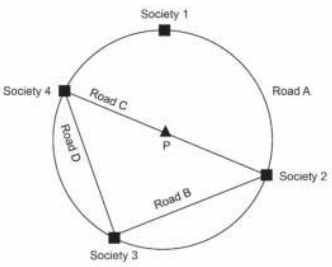
Two new roads, Road $E$ and Road $F$ were constructed between society $4$ and $1$ and society $1$ and $2.$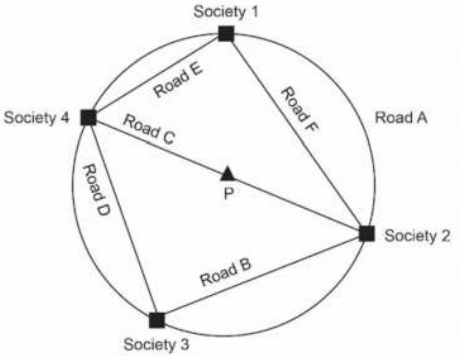
$5.$ What would be the measure of the sum of angles formed by the straight roads at society $1$ and society $3?$
$A. 60^\circ $
$B. 90^\circ $
$C. 180^\circ $
$D. 360^\circ $
$6.$ Krish says, “The distance to go from society $4$ to society $2$ using Road $D$ will be longer that the distance using Road $E”$
Is Krish correct$?$ Justify your answer with examples.
$7.$ Road $G,$ perpendicular to Road $F$ was constructed to connect the park and Road $F.$
Which of the following is true for Road $G$ and Road $F?$
$A.$ Road $G$ and road $F$ are of same length.
$B$. Road $F$ divides Road $G$ into two equal parts.
$C.$ Road $G$ divides Road $F$ into two equal parts.
$D.$ The length of road $G$ is one-fourth of the length of Road $F.$
$8.$ Priya said, “Minor arc corresponding to Road $B$ is congruent to minor arc corresponding to Road $D.”$
Do you agree with Priya$?$ Give reason to support your answer.
$5.$ What would be the measure of the sum of angles formed by the straight roads at society $1$ and society $3?$
$A. 60^\circ $
$B. 90^\circ $
$C. 180^\circ $
$D. 360^\circ $
$6.$ Krish says, “The distance to go from society $4$ to society $2$ using Road $D$ will be longer that the distance using Road $E”$
Is Krish correct$?$ Justify your answer with examples.
$7.$ Road $G,$ perpendicular to Road $F$ was constructed to connect the park and Road $F.$
Which of the following is true for Road $G$ and Road $F?$
$A.$ Road $G$ and road $F$ are of same length.
$B$. Road $F$ divides Road $G$ into two equal parts.
$C.$ Road $G$ divides Road $F$ into two equal parts.
$D.$ The length of road $G$ is one-fourth of the length of Road $F.$
$8.$ Priya said, “Minor arc corresponding to Road $B$ is congruent to minor arc corresponding to Road $D.”$
Do you agree with Priya$?$ Give reason to support your answer.
Answer
View full question & answer→$5. C. 180°$
$6.$ Examples to show that in a right triangle the sum of legs is longest for an isosceles right triangle when hypotenuse remains same.
● Take for example the length of diameter $($hypotenuse$) = 5$ units.
Road $D$ and Road $B$ are equal hence $($Road $D = 3.53$ units$).$
Let Road $E$ be $= 1$ Chapter, Road $F = 4.89$ units.
Therefore, length of Road $B\ +$ Road $D$ is greater than Road $E\ +$ Road $F.$
$7. C.$ Road G divides Road F into two equal parts.
$8.$ Yes, Priya is correct with valid reasoning.
● Yes, Priya is correct because arc corresponding to two equal roads (chords) are congruent.
$6.$ Examples to show that in a right triangle the sum of legs is longest for an isosceles right triangle when hypotenuse remains same.
● Take for example the length of diameter $($hypotenuse$) = 5$ units.
Road $D$ and Road $B$ are equal hence $($Road $D = 3.53$ units$).$
Let Road $E$ be $= 1$ Chapter, Road $F = 4.89$ units.
Therefore, length of Road $B\ +$ Road $D$ is greater than Road $E\ +$ Road $F.$
$7. C.$ Road G divides Road F into two equal parts.
$8.$ Yes, Priya is correct with valid reasoning.
● Yes, Priya is correct because arc corresponding to two equal roads (chords) are congruent.