Sample QuestionsCoordinate Geometry questions
One sample from each question group in this chapter. Select any group above to see the full set with answer keys.
A point of the form $(a, 0)$ lies on:
- A
Quadrant $IV$
- B
Quadrant $I$
- C
$y-$axis
- ✓
$x-$axis
Answer: D.
View full solution →If $a > 0$ and $b > 0$ then the point $(a, b)$ lies in quadrant.
Answer: B.
View full solution →Write the correct answer in the following: If $P (5,1), Q (8,0), R (0,4), S (0,5)$ and $O (0,0)$ are plotted on the graph paper, then the point(s) on the $x$-axis are:
- A
$P$ and $R$
- B
$R$ and $S$
- C
Only $Q$
- ✓
$Q$ and $O$
Answer: D.
View full solution →The points $(-5, 2)$ and $(2, -5)$ lie in the:
- ✓
$II$ and $IV$ quadrants, respectively.
- B
- C
$IV$ and $II$ quadrants, respectively.
- D
$II$ and $III$ quadrants, respectively.
Answer: A.
View full solution →If $10 x-4 x^2-3$, then the value of $p(0) + p(1)$ is:
Answer: B.
View full solution →Directions: In the following questions, the Assertions $(A)$ and Reason(s) $(R)$ have been put forward. Read both the statements carefully and choose the correct alternative from the following:
Assertion: The point $(x, 0), x < 0$ lies on $ox’$
Reason: $(0, 14)$,$ \big(0,\frac{-28}{3}\big)$ are the points on the $y$ - axis whose distance from the line $3x + 4y = 1$ is $8$ unit.
- A
Both Assertion and Reason are correct and Reason is the correct explanation for Assertion.
- ✓
Both Assertion and Reason are correct and Reason is not the correct explanation for Assertion.
- C
Assertion is true but the reason is false.
- D
Both assertion and reason are false.
Answer: B.
View full solution →Directions: In the following questions, the Assertions $(A)$ and Reason(s) $(R)$ have been put forward. Read both the statements carefully and choose the correct alternative from the following:
Assertion: If the points $P(1, 2), B(0, 0)$ and $C(a, b)$ are collinear, then $2a = b$.
Reason: If the distance between the points $(x, -1)$ and $(3, 2)$ is $5$, then the value of $x$ ib $7$.
- A
Both Assertion and Reason are correct and Reason is the correct explanation for Assertion.
- ✓
Both Assertion and Reason are correct and Reason is not the correct explanation for Assertion.
- C
Assertion is true but the reason is false.
- D
Both assertion and reason are false.
Answer: B.
View full solution →Directions: In the following questions, the Assertions $(A)$ and Reason(s) $(R)$ have been put forward. Read both the statements carefully and choose the correct alternative from the following:
Assertion: A Cartesian plane consists of two mutually perpendicular lines intersecting at their zeros.
Reason: The Cartesian plane consists of two perpendicular and directed lines whose intersection point is the zero point for both the lines.
- ✓
Both Assertion and Reason are correct and Reason is the correct explanation for Assertion.
- B
Both Assertion and Reason are correct and Reason is not the correct explanation for Assertion.
- C
Assertion is true but the reason is false.
- D
Both assertion and reason are false.
Answer: A.
View full solution →Directions: In the following questions, the Assertions $(A)$ and Reason(s) $(R)$ have been put forward. Read both the statements carefully and choose the correct alternative from the following:
Assertion: The point $(+4, +5)$ is lies in $2$nd quadrant.
Reason: The point $(0, -5)$ lies in $x$ - axis.
- A
Both Assertion and Reason are correct and Reason is the correct explanation for Assertion.
- B
Both Assertion and Reason are correct and Reason is not the correct explanation for Assertion.
- C
Assertion is true but the reason is false.
- ✓
Both assertion and reason are false.
Answer: D.
View full solution →Directions: In the following questions, the Assertions $(A)$ and Reason(s) $(R)$ have been put forward. Read both the statements carefully and choose the correct alternative from the following:
Assertion: $x$ - co - ordinate is also called as abscissa.
Reason: $y$ - cordinate is also called as ordinate.
- A
Both Assertion and Reason are correct and Reason is the correct explanation for Assertion.
- ✓
Both Assertion and Reason are correct and Reason is not the correct explanation for Assertion.
- C
Assertion is true but the reason is false.
- D
Both assertion and reason are false.
Answer: B.
View full solution →Write whether the following statements are True or False$?$ Justify your answer. $(-1, 7)$ is a point in the II quadrant.
View full solution →Write whether the following statements are True or False$?$ Justify your answer. Point $(3, 0)$ lies in the first quadrant.
View full solution →Write whether the following statements are True or False$?$ Justify your answer. A point lies on $y-$axis at a distance of $2$ units from the $x-$axis. Its coordinates are $(2, 0).$
View full solution →Write whether the following statements are True or False$?$ Justify your answer. Points $(1, -1)$ and $(-1, 1)$ lie in the same quadrant.
View full solution →Write whether the following statements are True or False$?$ Justify your answer. The coordinates of a point whose ordinate is $-\frac{1}{2}$ and and abscissa is $1$ are $-\frac{1}{2},\ 1$
View full solution →See Fig. and complete the statements: The x-coordinate and the y-coordinate of the point S are ________ and ________, respectively. Hence, the coordinates of S are (________, ________).
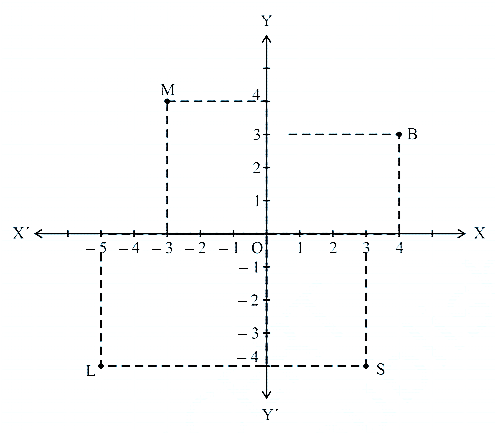
See Fig. and complete the statements: The $x-$coordinate and the y-coordinate of the point $L$ are ________ and ________, respectively. Hence, the coordinates of $L$ are (________, ________).
View full solution →See Fig. and complete the statements: The $x-$coordinate and the $y-$coordinate of the point $M$ are ________ and ________, respectively. Hence, the coordinates of $M$ are (________, ________).
View full solution →See Fig. and complete the statements: The abscissa and the ordinate of the point $B$ are ________ and ________, respectively.
View full solution →See Fig. and write the coordinates of the point $M.$
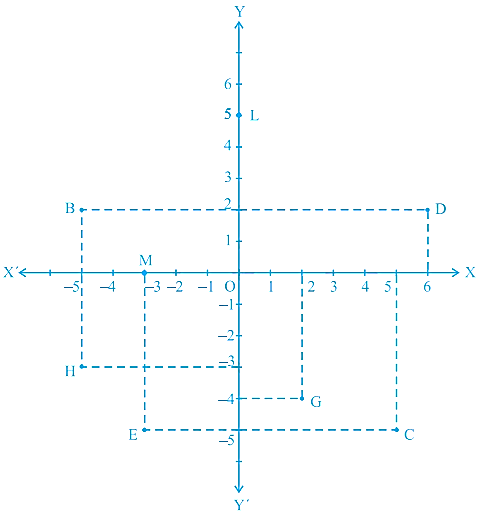
View full solution →See Fig. and write the coordinates of the point $L.$
View full solution →See Fig. and write the ordinate of the point $H.$
View full solution →See Fig. and write the abscissa of the point $D.$
View full solution →See Fig. and write the point identified by the coordinates $(2, – 4)$
View full solution →What is the name of each part of the plane formed by the two lines?
Plot the ordered pairs $(x, y)$ of numbers as points in the Cartesian plane. Use the scale $1cm = 1$ unit on the axes
| $x$ |
$-3$ |
$0$ |
$-1$ |
$4$ |
$2$ |
| $y$ |
$7$ |
$-3.5$ |
$-3$ |
$4$ |
$-3$ |
View full solution →Locate the points $(5, 0), (0, 5), (2, 5), (5, 2), (-3, 5), (-3, -5)$ and $(6, 1)$ in the Cartesian plane.
View full solution →(Street Plan): A city has two main roads which cross each other at the centre of the city. These two roads are along the North-South direction and East-West direction. All the other streets of the city run parallel to these roads and are $200 \ m$ apart. There are $5$ streets in each direction. Using $1\ cm = 200 \ m$, draw a model of the city on your notebook. Represent the roads/streets by single lines. There are many cross- streets in your model. A particular cross-street is made by two streets, one running in the North-South direction and another in the East-West direction. Cross street is referred to in this manner: If the 2nd street running in the North-South direction and 5th in the East-West direction meet at some crossing, then we will call this cross-street $(2, 5)$. Using this convention, find: how many cross - streets can be referred to as $(3, 4).$
View full solution →(Street Plan): A city has two main roads which cross each other at the centre of the city. These two roads are along the North-South direction and East-West direction. All the other streets of the city run parallel to these roads and are $200 m$ apart. There are 5 streets in each direction. Using $1\ cm = 200 \ m$, draw a model of the city on your notebook. Represent the roads/streets by single lines. There are many cross- streets in your model. A particular cross-street is made by two streets, one running in the North-South direction and another in the East-West direction. Cross street is referred to in this manner: If the 2nd street running in the North-South direction and $5th$ in the East-West direction meet at some crossing, then we will call this cross-street $(2, 5)$. Using this convention, find: how many cross - streets can be referred to as $(4, 3).$
View full solution →How will you describe the position of a table lamp on your study table to another person?
A forest ranger keeps track of bears in his area. He plotted their location on a graph. The origin
represents the ranger's control room’s location. To access and maintain equipment, Road $x$ and
Road yhave been laid and paved inside the forest. They pass through the control room.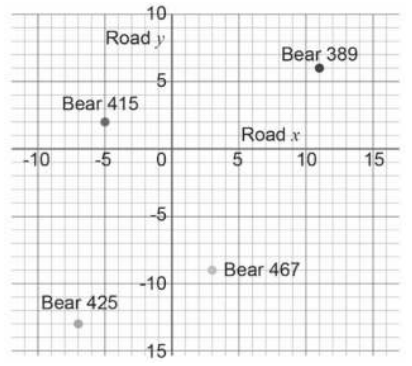
One unit on the graph paper represents $1\ km.$
$1.$ Which bear is nearest to a paved road$?$
$A$. Bear 389
$B.$ Bear $415$
$C.$ Bear $425$
$D.$ Bear $467$
$2.$ Bear $467$ has been injured. The forest rescue team starts from the control room and decides to use the paved road as much as possible. Which road should they take$?$
$3.$ How far is Bear $425$ from Road $x?$
$4. A$ tiger is at $(11, 4)$. How far from it is the nearest bear$?$
$A. 2\ km$
$B. 4\ km$
$C. 5 \ km$
$D. 7\ km$
$5.$ In the forest, rain shelters are at an interval of $2\ km$ along paved roads. $A$ forest ranger is travelling on Road $x.$ He crosses a rain shelter located at $(3, 0).$
What is likely to be the location of the next shelter$?$
$6.$ The control room receives a message about trespassers located at $(–9, –8).$ The trespassers were seen moving towards Road $x$ on foot. The ranger immediately dispatches a team of guards in a jeep towards them. The guards encounter the trespassers before crossing Road $x.$
Which of the following is most likely to be the location of the encounter$?$
$A. (–9, –14)$
$B. (–9, –5)$
$C. (–9, 4)$
$D. (9, 5)$
$7.$ Ravi planted a red maple tree sapling. The height of the sapling is $0.25 m.$ The average growth rate of the height of a red maple tree is $0.27 m$ per year.
The average life of a red maple tree is $80–100$ years. Ravi estimated that his tree will grow up to $27 m.$
What is the likely reason behind his estimation?
$8.$ Which of the following equations represents the height $(h)$ of the red maple tree after $‘t’$ years of planting?
$A. h=0.25+0.27$
$B. h=0.25t+0.27$
$C. h=0.25+0.27t$
$D. h=0.25+0.27t$
$9.$ Which of the following is true for the line with equation: $1.x+0.y-4=0?$
$A.$ The distance of the line from the $x-$axis is $1.$
$B.$ The distance of the line from the $Y-$axis is $4$.
$C.$ The distance of the line from the $Y-$axis is $–1.$
$D.$ The distance of the line from the $x-$axis changes from $1$ to $–4.$
$10.$ The equation of a line is $ax+by+c=0.$
What conditions ensure that the distance of the line from an axis is constant?
$A. c = 0$ and $a, b ≠ 0$
$B. c < 0$ and a, b ≠ 0
$C. c, b ≠ 0$ and $a =1$
$D. c, b ≠ 0$ and $a = 0$ View full solution →Read the Source/ Text given below and answer these questions:
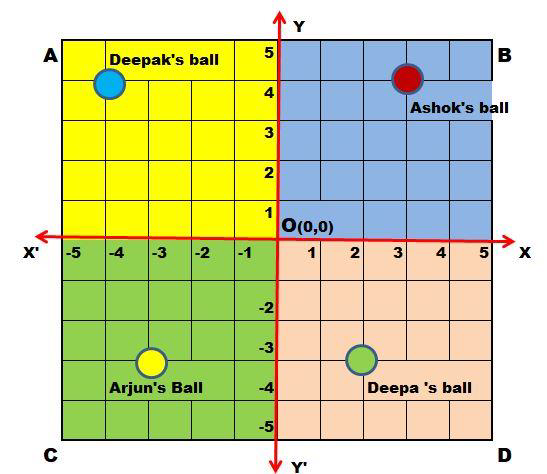
There is a square park $\text{ABCD}$ in the middle of Saket colony in Delhi.Four children Deepak, Ashok, Arjun and Deepa went to play with their balls. The colour of the ball of Ashok, Deepak, Arjun and Deepa are red, blue, yellow and green respectively. All four children roll their ball from centre point $O$ in the direction of $XOY, X'OY, X'OY'$ and $XOY'.$ Their balls stopped as shown in the above image. Answer the following questions:
$i.$ What are the coordinates of the ball of Ashok$?$
$a. (4, 3)$
$b. (3, 4)$
$c. (4, 4)$
$d. (3, 3)$
$ii.$ What are the coordinates of the ball of Deepa$?$
$a. (2, -3)$
$b. (3, 2)$
$c. (2, 3)$
$d. (2, 2)$
$iii.$ What the line $\text{XOX'}$ is called$?$
$a. y-$axis.
$b.$ ordinate.
$c. x-$axis.
$d.$ origin.
$iv.$ What the point $O(0, 0)$ is called$?$
$y-$axis.
ordinate.
$x-$axis.
origin.
$v.$ What is the ordinate of the ball of Arjun$?$
$a. -3$
$b. 3$
$c. 4$
$d. 2$ View full solution →Read the Source/ Text given below and answer these questions: 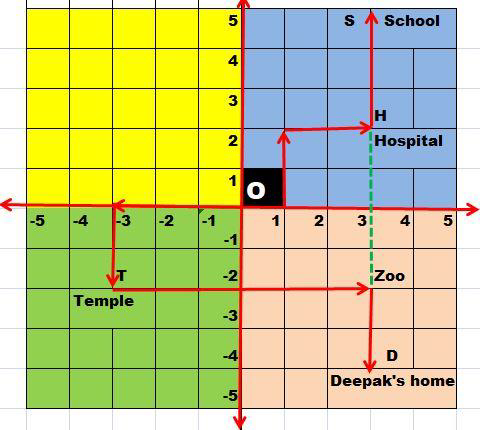
In the above picture, one small square is of size $1\ km \times 1\ km.$ From the starting point $O(0, 0)$ Deepak started to drive towards his home. He first drives $3\ km$ in left then he turned to his left and drove $2\ km,$ there he found a temple. He worshipped there and drove $6\ km$ in the left direction, there is a zoo and from the zoo, he drives $2\ km$ on the right side, then he reached his home. From $O$ Sanjay drove for his school, he drove $1\ km$ to his right then took a left turn and drives $2\ km$ then again took a right turn and drives $2\ km$. He found a hospital in the way. From Hospital he drove $3\ km$ and finally reached his school.
$i.$ What are the coordinates of the Hospital?
$a. (3, 2)$
$b. (2, 3)$
$c. (3, 3)$
$d. (5, 5)$
$ii.$ What is common abscissa of school, Hospital, Zoo and Deepak's home$?$
$a. 3$
$b. 5$
$c. -3$
$d. -5$
$iii.$ What is the common ordinate of temple and Zoo$?$
$a. 3$
$b. 5$
$c. -3$
$d. -2$
$iv.$ Deepak Drove in which quadrants$?$
$a. I$ and $II$
$b. II$ and $III$
$c. III$ and $IV$
$d. IV$ and $I$
$v.$ Sanjay Drove in which quadrants$?$
$a. I$ only
$b. II$ and $III$
$c. III$ and $IV$
$d. II$ and $I$ View full solution →Read the Source/ Text given below and answer any four questions:
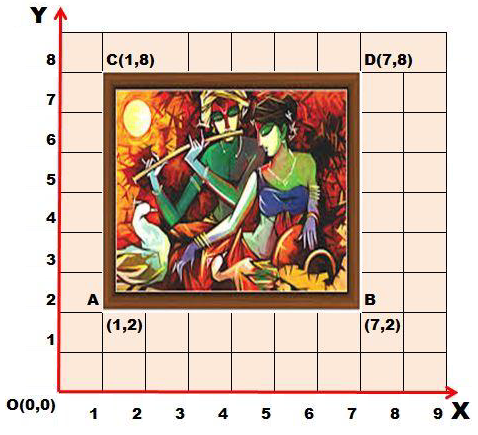
Rohit was putting up one of his paintings in his living room. Before this Rohit had put a grid on the wall where each unit measured equal to a foot. The upper$-$left corner of the frame is at point $C(1, 8)$ and the upper$-$right corner at $D(7, 8).$ The bottom$-$left corner is at $A(1, 2)$ and the bottom$-$right corner at $B(7, 2).$ Please answer the following questions:
$i.$ What is the width of the painting plus frame$?$
$a. 5$ feet
$b. 8$ feet
$c. 9$ feet
$d. 6$ feet
$ii.$ What is the length of the painting plus frame$?$
$a. 9$ feet
$b. 8$ feet
$c. 6$ feet
$d. 5$ feet
$iii.$ Which sides of the painting are parallel to $x-$axis$?$
$a. AB$ and $CD$
$c. AC$ and $BD$
$c.$ Diagonals $AD$ and $BC$
$d.$ No one
$iv.$ Which sides of the painting are parallel to $y-$axis$?$
$a. AB$ and $CD$
$b.AC$ and $BD$
$c.$ Diagonals $AC$ and $BD$
$d.$ No one
$v.$ Point $A, B, C$ and $D$ lie in which quadrant$?$
$a. I$
$b. II$
$c. III$
$d. IV$ View full solution →Read the Source/ Text given below and answer these questions: 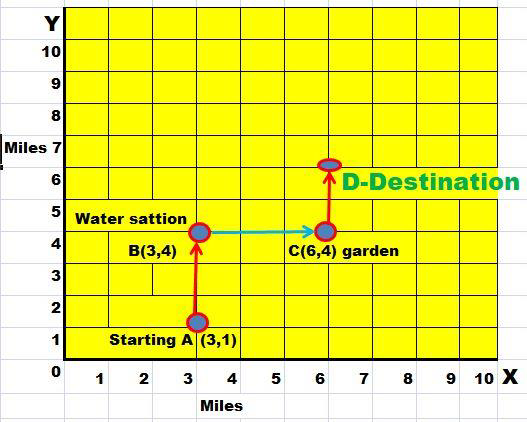
Arun is participating in an $8$ miles walk. The organizers used a square coordinate grid to plot the course. The starting point is at $A (3, 1).$ At $B (3, 4),$ there's a water station to make sure the walkers stay hydrated. From water station, the walkway turns right and at $C (6,4)$ a garden is situated to keep walkers fresh. From the garden, the walkway turns left and finally, Arun reaches at destination $D$ to complete $8$ miles.
$i.$ How far is the water station $B$ from the starting point $A?$
$a. 4$ miles
$b. 3$ miles
$c. 1$ mile
$d. 5$ miles
$ii.$ How far is the water station $B$ from garden $C?$
$a. 3$ miles
$b. 4$ miles
$c. 1$ mile
$d. 5$ miles
$iii.$ What is the abscissa of destination point $D:$
$a. 3$
$b. 5$
$c. 3$
$d. 6$
$iv$. What is the ordinate of destination point $D?$
$a. 3$
$b. 2$
$c. 6$
$d. 5$
$v.$ What are the coordinates of destination point $D?$
$a. (5, 6)$
$b. (6, 5)$
$c. (3, 9)$
$d. (6, 6)$ View full solution →