MCQ 11 Mark
A point of the form $(a, 0)$ lies on:
- A
Quadrant $IV$
- B
Quadrant $I$
- C
$y-$axis
- ✓
$x-$axis
AnswerCorrect option: D. $x-$axis
The given point of the form $= (a, 0)$
Here, x-co-ordinate $= a$ and y-co-ordinate $= 0$
$\therefore$ The point of the form $(a, 0)$ always lies on x-axis.
Thus, the point of the form $(a, 0)$ always lies on x-axis.
View full question & answer→MCQ 21 Mark
If $a > 0$ and $b > 0$ then the point $(a, b)$ lies in quadrant.
AnswerSince, $x$ co-ordinate is negative and $y$ co-ordinate is positive, the given point lies in Quadrant $II.$
View full question & answer→MCQ 31 Mark
Write the correct answer in the following: If $P (5,1), Q (8,0), R (0,4), S (0,5)$ and $O (0,0)$ are plotted on the graph paper, then the point(s) on the $x$-axis are:
- A
$P$ and $R$
- B
$R$ and $S$
- C
Only $Q$
- ✓
$Q$ and $O$
AnswerCorrect option: D. $Q$ and $O$
We now that, a point lies on $X-$axis, if its $y-$coordinate is zero.So, the points on the axis are $Q(8, 0)$ and $O(0, 0).$
View full question & answer→MCQ 41 Mark
The points $(-5, 2)$ and $(2, -5)$ lie in the:
- ✓
$II$ and $IV$ quadrants, respectively.
- B
- C
$IV$ and $II$ quadrants, respectively.
- D
$II$ and $III$ quadrants, respectively.
AnswerCorrect option: A. $II$ and $IV$ quadrants, respectively.
In point $(-5,2), x$-coordinate is negative and $y$-coordinate is positive, so it lies in $II$ quadrant and in point $(2,-5)$, $x$-coordinate is positive and $y$-coordinate is negative, so it lies in $IV$ quadrant.
View full question & answer→MCQ 51 Mark
If $10 x-4 x^2-3$, then the value of $p(0) + p(1)$ is:
Answer$10 x-4 x^2-3$$p(x)=-4 x^2+10 x-3$
$p(0)+p(1)=\left[-4(0)^2+10(0)-3\right]+\left[-4(1)^2+10(1)-3\right]$
$p(0)+p(1)=[0+0-3]+[-4+10-3]$
$p(0)+p(1)=[-3]+[3]$
$p(0)+p(1)=0$
View full question & answer→MCQ 61 Mark
Which of the following are the signs of abscissa and ordinate of a point in quadrant?
- A
$(-, +)$
- B
$(-, -)$
- ✓
$(+, +)$
- D
$(+, -)$
AnswerCorrect option: C. $(+, +)$
The signs of abscissa and ordinate of a point in quadrant I are both +ve i.e. $(+, +)$
View full question & answer→MCQ 71 Mark
Abscissa of all the points on the y-axis is:
AnswerOn y-axis, x-coordinate i.e. abscissa is$ 0.$
Thus, abscissa of all the points on y-axis is$ 0.$
View full question & answer→MCQ 81 Mark
If $P(3, 9)$ and $Q(-3, -4)$, then (abscissa of $P$) - (ordinate of $Q$) is:
AnswerFrom the given data we have,
The abscissa of $P = 3$ and ordinate of $Q = -4,$
So, according to question,
(abscissa of P) - (ordinate of$ Q)$
$= 3 - (-4)$
$= 7$
View full question & answer→MCQ 91 Mark
The area of the triangle formed by the points $A (2,0), B (6,0)$ and $C (4,6)$ is:
- A
$24$sq. unit
- ✓
$12$sq. unit
- C
$10$sq. unit
- D
AnswerCorrect option: B. $12$sq. unit
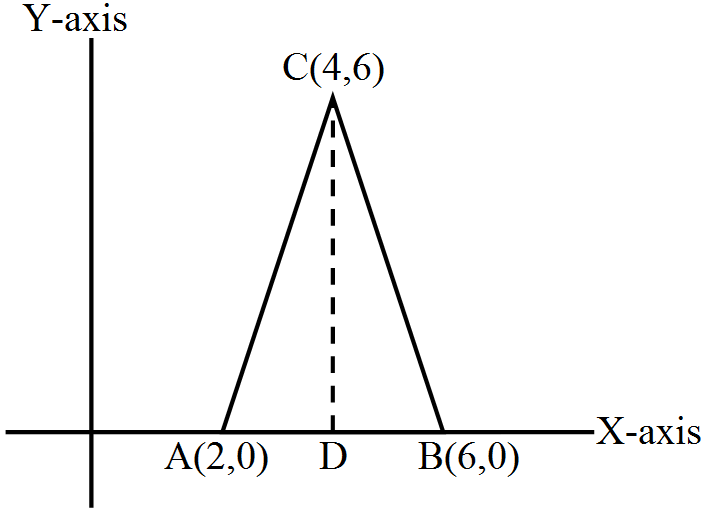
Let $CD$ be perpendicular drawn from $C$ to $AB.$
The length of the perpendicular will be equal to the ordinate of point $C.$
$\Rightarrow CD = 6$ unit
$AB = 4$ unit
Now, area of $\triangle\text{ABC}=\frac{1}{2}\times\text{Base}\times\text{height}$
$\triangle\text{ABC}=\frac{1}{2}\times\text{5}\times\text{6}$
$12\text{sq. units}$ View full question & answer→MCQ 101 Mark
The co-ordinates of two points $A$ and $B$ are $(4, 3)$ and $(-5, 3)$ respectively. The co-ordinates of the point at which the line segment $AB$ meets the y-axis are:
- A
$(0, 4)$
- ✓
$(0, 3)$
- C
$(3, 0)$
- D
$(-5, 0)$
AnswerCorrect option: B. $(0, 3)$
Since it meets at y-axis, so, abscissa will be zero and we have ordinate $= 3$ in common so,point will be $(0, 3)$
View full question & answer→MCQ 111 Mark
Which point does not lie in any quadrant?
- A
$(3, -4)$
- B
$(5, 9)$
- C
$(-3, 6)$
- ✓
$(0, 3)$
AnswerCorrect option: D. $(0, 3)$
Since here value of x-coordinate $= 0$ so point lies on $y-$axis not in any quadrant.
View full question & answer→MCQ 121 Mark
If the perpendicular distance of a point $P$ from the $x-$axis is $5$ units and the foot of the perpendicular lies on the negative direction of $x-$axis, then the point $P$ has.
- ✓
$y$ coordinate $= 5$ or $-5$
- B
$x$ coordinate $= -5$
- C
$y$ coordinate $= 5$ only
- D
$y$ coordinate $= -5$ only
AnswerCorrect option: A. $y$ coordinate $= 5$ or $-5$
We know that, the perpendicular distance of a point from the $X$-axis gives $y$-coordinate of that point. Here, foot of perpendicular lies on the negative direction of $X$ -axis, so perpendicular distance can be measure in $II$ quadrant or $III $ quadrant. Hence, the point $P$ has $y$-coordinate $=5$ or $-5 .$
View full question & answer→MCQ 131 Mark
Write the correct answer in the following: Point $(0, -7)$ lies:
- A
On the $x-$axis.
- B
- C
On the $y-$axis.
- ✓
AnswerIn Point $(0, -7)$ co-ordinate of $x$ axis is zero so it lies on $y$ axis.
View full question & answer→MCQ 141 Mark
The ordinate of every point on the $x-$axis is:
AnswerThe ordinate ($y$ co-ordinate) of every point on the x-axis is $0.$
View full question & answer→MCQ 151 Mark
Points $(2, -3), (4, -5), (5, -9)$ and $(-2, -5).$
- A
- B
- ✓
Does not lie in same quadrant.
- D
AnswerCorrect option: C. Does not lie in same quadrant.
Point $(2,-3),(4,-5),(5,-9)$ lies in 4th quadrant, because sign of abscissa and ordinate in 4th quadrant is $(+,-)$. But point $(-2,-5)$ lies in 3rd quadrant since, sign of abscissa and ordinate in 3rd quadrant is $(-,-)$.
View full question & answer→MCQ 161 Mark
Write the correct answer in the following:
The points $(-5, 2)$ and $(2, -5)$ lie in the:
- A
- B
$II$ and $III$ quadrants, respectively.
- ✓
$II$ and $IV$ quadrants, respectively.
- D
$IV$ and $II$ quadrants, respectively.
AnswerCorrect option: C. $II$ and $IV$ quadrants, respectively.
In point $(-5,2), x$-coordinate is negative and $y$-coordinate is positive, so it lies in $II$ quadrant and in point $(2,-5), x$ coordinate is positive and $y-$coordinate is negative, so it lies in $IV$ quadrant.
View full question & answer→MCQ 171 Mark
Abscissa of all points on the $x-$axis is:
AnswerAbscissa of point in $x$ axis is can be any number but ordinate will always be zero, because for any point to lie on x-axis its $y-$ordinate must be equal to zero.
View full question & answer→MCQ 181 Mark
The point $(0, 9)$ lies:
AnswerCorrect option: D. On the positive direction of $y-$axis
Any point $P$ in co-ordinate plane is written as $P(x, y)$ When the value of $x$-coordinate is equal to zero then the point $P$ lies on $y$ axis
Since, here $x=0$ so, point lies on $y$-axis
And the value of $y$ is positive so,
Points lies in the positive direction of $y$-axis
View full question & answer→MCQ 191 Mark
The area of the triangle formed by the points $A(2,0), B(6,0)$ and $C(4,6)$ is:
- ✓
$12 $sq. units
- B
- C
$10$ sq. units
- D
$24$ sq. units
AnswerCorrect option: A. $12 $sq. units
The correct option is $D12$ sq. units
Point $A$ and $B$ lie on the $x$-axis, therefore, $A B=4$ units i.e. the base of the triangle and the height of the triangle is $6$ units from point $C(4,6)$.
Area of triangle $=\frac{1}{2} \times$ Base $\times$ Height $=\frac{1}{2} \times 4 \times 6=12$ sq. units
View full question & answer→MCQ 201 Mark
The point $O(0, 0)$ lies on:
AnswerCorrect option: C. both $x-$axis and $y-$axis
Point $(0, 0)$ is the co-ordinate of origin and origin is the point of intersection of $x$ and $y-$axis.
So, point $O(0, 0)$ lies on both axis.
View full question & answer→MCQ 211 Mark
A point both of whose coordinates are negative lies in quadrant.
Answer
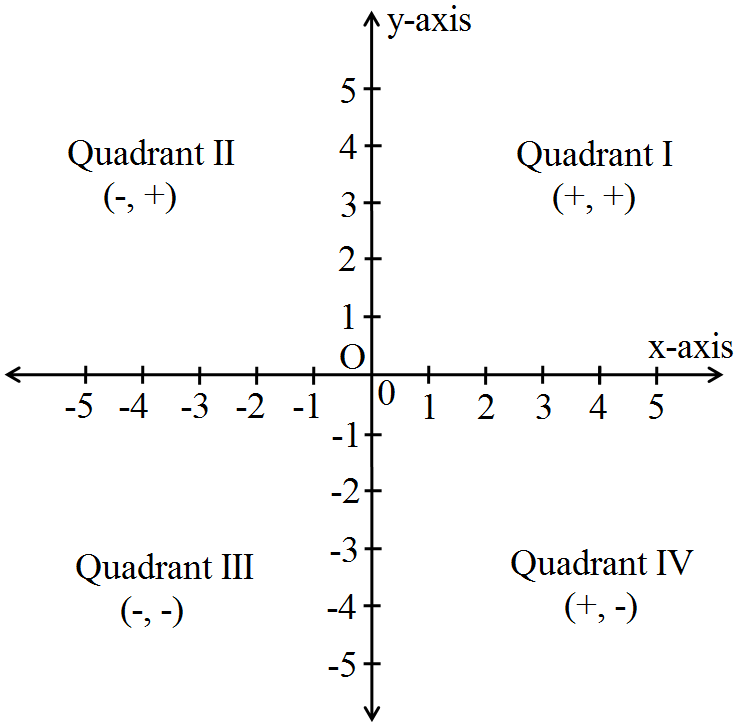
A point both of whose coordinates are negative, that is, of the from $(-, -)$ lies in quadrant $III.$ View full question & answer→MCQ 221 Mark
The points in which the abscissa and the ordinate have different signs will lie in.
- A
Quadrant $II$ only
- B
Quadrant $IV$ only
- ✓
Quadrants $II$ and $IV$
- D
Quadrants $I$ and $III$
AnswerCorrect option: C. Quadrants $II$ and $IV$
In $2nd$ quadrant and 4th quadrant sign of abscissa and ordinate both is opposite i.e, one is negative and the other is positive.
In $2nd$ quadrant sign of co-ordinate are $(-, +).$
And in 4th quadrant sign of co-ordinate are $(+, -).$
View full question & answer→MCQ 231 Mark
Write the correct answer in the following: Which of the points $P (0,3), Q (1,0), R (0,-1), S (-5,0), T (1,2)$ do not lie on the $x$-axis?
- A
$P$ and $R$ only.
- B
$Q$ and $S$ only.
- ✓
$P, R$ and $T$.
- D
$Q, S$ and $T$.
AnswerCorrect option: C. $P, R$ and $T$.
We know that, if a point is of the form ( $x , 0$ ) i.e., its y -coordinate is zero, then it will lie on $X$ -axis otherwise not. Here, $y$-coordinates of points $P(0,3), R(0,-1)$ and $T(1,2)$ are not zero, so these points do not lie on the $X$-axis.
View full question & answer→MCQ 241 Mark
The point $(7, 0)$ lies:
AnswerCorrect option: B. On the positive direction of $x-$axis
Since value of $y$-ordinate is zero so, point lies on $x$-axis.
But value of $x$ is + ve so it lies on + ve direction of $x$-axis.
View full question & answer→MCQ 251 Mark
If $x>0$ and $y<0$, then the point $(x, y)$ lies in:
- ✓
$IV$ Quadrant.
- B
$III$ Quadrant.
- C
$I$ Quadrant.
- D
$II$ Quadrant.
AnswerCorrect option: A. $IV$ Quadrant.
Since, $x>0$ i.e, $x$ is $+v e$,
$y<0$ i.e, $y$ is $-v e$,
Recall that $(+,+)$ lies in $I$ quadrant, $(-,+)$ lies in $II$ quadrant, $(-,-)$ lies in $III$ quadrant, $(+,-)$ lies in $IV$ quadrant.
So, $(x, y)$ lies in $IV$ quadrant.
View full question & answer→MCQ 261 Mark
The zero of the polynomial $(x-2)^2-(x+2)^2$ is:
Answer$(x-2)^2-(x+2)^2$$=(x-2+x+2)(x-2-x-2)[\text { Using identity] }$
$a^2-b^2=(a+b)(a-b)$
$=(2 x)(-4)$
$=-8 x$
Then the zero is,
$-8 x=0$
$\Rightarrow x=0$
View full question & answer→MCQ 271 Mark
The abscissa and ordinate of the point with Co-ordinates $(8, 12)$ is:
- A
Abscissa $12$ and ordinate $8$
- B
Abscissa $4$ and ordinate $20$
- ✓
Abscissa $8$ and ordinate $12$
- D
Abscissa $0$ and ordinate $20$
AnswerCorrect option: C. Abscissa $8$ and ordinate $12$
In the Cartesian plane, any point $P$ is written as $p(x, y)$, where $X$ co-ordinate is called the abscissa of point $p$ and $Y$ coordinate is called ordinate of point $p$.
So, here abscissa will be equal to $8$ and ordinate $=12$
View full question & answer→MCQ 281 Mark
A point whose abscissa is $-3$ and ordinate $2$ lies in:
AnswerIf absciss $= -3$ Intercept on $Y$ axis is $= 2$
$Y > 0$
So, Point is in Second Quadrant.
View full question & answer→MCQ 291 Mark
The area of $\triangle\text{AOB}$ having vertices $A(0, 6), 0(0, 0)$ and $B(6, 0)$ is:
- A
$36$ sq units
- ✓
$18$ sq units
- C
$24$ sq units
- D
$12$ sq units
AnswerCorrect option: B. $18$ sq units
When we plot the given points in the graph paper then,
is the right angle triangle, where
$OB =$ Base $= 6$ units
Height of triangle $= OA = 6$ units
$\therefore$ Area of $\triangle\text{AOB}=\frac{1}{2}\times\text{OA}\times\text{OB}$
$\Rightarrow$ Area of $\triangle\text{AOB}=\frac{1}{2}\times\text{6}\times\text{6}$
$\Rightarrow$ Area of $\triangle\text{AOB}=\frac{1}{2}\times\text{36}$
$\Rightarrow$ Area of $\triangle\text{AOB}=18\text{ square units}$
View full question & answer→MCQ 301 Mark
Write the correct answer in the following: If y coordinate of a point is zero, then this point always lies:
- A
In $I$ quadrant.
- B
In $II$ quadrant
- ✓
On $x-$axis.
- D
On $y-$axis.
AnswerCorrect option: C. On $x-$axis.
We know that if $y-$coordinate of a point, i.e., ordinate is zero, then this point always lies on $x-$axis.
View full question & answer→MCQ 311 Mark
Write the correct answer in the following: The points whose abscissa and ordinate have different signs will lie in:
AnswerCorrect option: D. $II$ and $IV$ quadrants.
The points whose abscissa and ordinate have different sings will be of the from $(-x, y)$ or $(x,-y)$ and these points will lie in $II$ and $IV$ quadrants.
View full question & answer→MCQ 321 Mark
The point $(3, 0)$ lies on:
- A
Negative $x-$axis
- B
Negative $y$ axis
- C
Positive $y$ axis
- ✓
Positive $x-$axis
AnswerCorrect option: D. Positive $x-$axis
Any point in co-ordinate is written as $P ( x , y )$ So, when the value of $y$ becomes zero. i.e, $y=0$ then the point $p$ lies on the $x$-axis.
So, here the point will lie on +ve direction of the $x -$axis.
View full question & answer→MCQ 331 Mark
The name of the horizontal line drawn to determine the position of any point in the Cartesian plane is:
AnswerCorrect option: A. $x-$axis
In co-ordinate, we have two axis, one is a horizontal line called $x-$axis and the other is vertical line called $y-$axis.
Used to determine the position of any point in Cartesian plane.
View full question & answer→MCQ 341 Mark
The point at which the two coordinate axes meet is called the:
AnswerThe point at which the two coordinate axes meet is called the origin.
View full question & answer→MCQ 351 Mark
Abcissa of a point is positive in:
- A
$I$ and $II$ quadrant.
- ✓
$I$ and $IV$ quadrant.
- C
$I$ quadrant only.
- D
$II$ quadrant only.
AnswerCorrect option: B. $I$ and $IV$ quadrant.
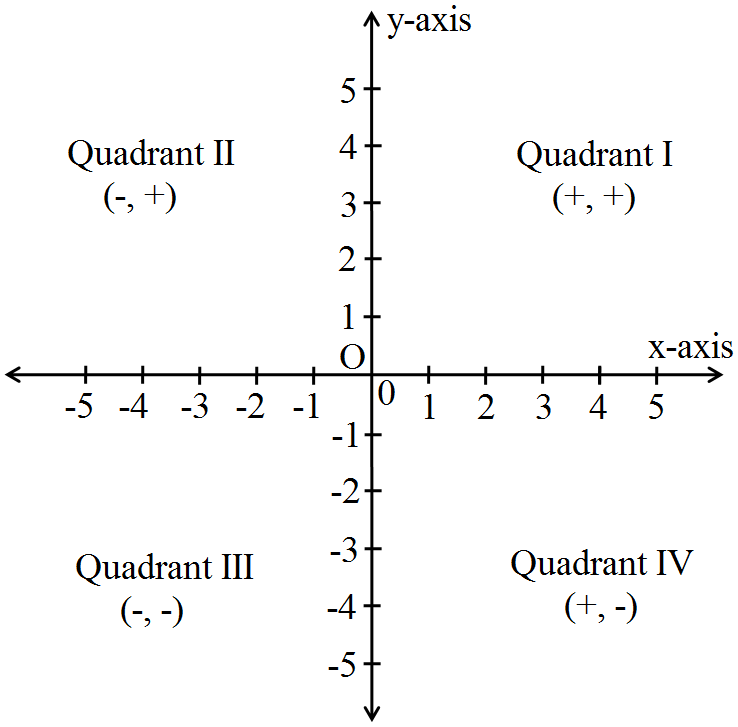
Absissa of a point is positive when the points are of the form $(+, +)$ and $(+, -).$
So, the absissa of the point is positive in quadrant $I$ and $IV.$ View full question & answer→MCQ 361 Mark
The ordinate of every point on the $x-$axis is:
AnswerEvery point on the x-axis is of the form $(a, 0)$. This means abscissa can be any real number but ordinate is always $0.$
View full question & answer→MCQ 371 Mark
Write the correct answer in the following: Ordinate of all points on the $x-$axis is:
AnswerOrdinate of all the points on the x-axis is $0$.Because ordinate (or $y-$coordinate) of a point is perpendicular distance of this point from the $x-$axis measured along the $y–$axis.
View full question & answer→MCQ 381 Mark
If $A(2, 3)$ and $B(-3, 4)$, then (abscissa of $A$) - (abscissa of $B$) is:
AnswerHere we have, the abscissa of $A = 2$ and abscissa of $B = -3.$
So, according to question,
$($abscissa of $A) - ($abscissa of $B)$
$= 2 - (-3)$
$= 5$
View full question & answer→MCQ 391 Mark
Write the correct answer in the following: If the perpendicular distance of a point $P$ from the $x-$axis is $5$ units and the foot of the perpendicular lies on the negative direction of $x-$axis, then the point $P$ has:
- A
$x$ coordinate $= -5$
- B
$y$ coordinate $= 5$ only
- C
$y$ coordinate $= –5$ only
- ✓
$y$ coordinate $= 5$ or $-5$
AnswerCorrect option: D. $y$ coordinate $= 5$ or $-5$
We do know that perpendicular distance of a point from the $X$ -axis $Y$ -coordinate of that point. Here foot of perpendicular lies on the negative direction of $X$ -axis, so perpendicular distance can be measure in $II$ quadrant or $III$ quadrant. Hence, the point $P$ has $y$ coordinate $=5$ or $-5$
View full question & answer→MCQ 401 Mark
The point whose ordinate is $6$ and which point lies on the $y-$axis?
- A
$(6, 0)$
- B
$(6, 6)$
- ✓
$(0, 6)$
- D
AnswerCorrect option: C. $(0, 6)$
Since the ordinate or $y-$coordinate of a point is $6$ and this point lies on $y-$axis.
And the abscissa or $x-$coordinate of a point lying on $y-$axis is $0.$
Therefore, the coordinate of the point is $(0, 6).$
The point whose abscissa is $4$ and this point lies on the $x-$axis is:
View full question & answer→MCQ 411 Mark
If $x^2+k x-3=(x-3)(x+1)$, then the value of $'k'$ is:
Answer$x^2+k x-3=(x-3)(x+1)$$\Rightarrow x^2+k x-3=x^2+(-3+1) x+(-3) x 1$
$\Rightarrow x^2+k x-3=x^2-2 x-3$
On comparing the term, we get $\mathrm{k}=-2$
View full question & answer→MCQ 421 Mark
The point $(-2, 5)$ lies in:
- A
$4$th quadrant
- B
$1$st quadrant
- ✓
$2$nd quadrant
- D
$3$rd quadrant
AnswerCorrect option: C. $2$nd quadrant
For any point to lie in the second quadrant, Abscissa and ordinate must be $(-, +)$. So the given point $(-2, 5)$ lies in $2$nd quadrant.
View full question & answer→MCQ 431 Mark
The distance of the point $(-3, -2)$ from $x-$axis is:
- A
$\sqrt{13}\text{ units}$
- B
$5$ units
- C
$3$ units
- ✓
$2$ units
AnswerCorrect option: D. $2$ units
Distance from $x-$axis is they, co-ordinate of other point So ,here distance $= 2,$
View full question & answer→MCQ 441 Mark
The distance of the point $(-3, -2)$ from $x-$axis is:
- ✓
$2$ units
- B
$3$ units
- C
$5$ units
- D
$13$ units
AnswerCorrect option: A. $2$ units
Distance from the $x$-axis is equal to the $y$-coordinate of a given point $(-3,-2)$, and distance is taken as positive, so the distance from $x$-axis $=2$ units.
View full question & answer→MCQ 451 Mark
Ordinate of a point is negative in:
- A
Quadrant $III$ only
- ✓
Quadrant $III$ and $IV$
- C
Quadrant $I$ and $II$
- D
Quadrant $IV$ only
AnswerCorrect option: B. Quadrant $III$ and $IV$
Since, sign of point in 3rd quadrant is $(-, -)$.And in 4th quadrant, it is $(+, -).$
So, Ordinate of a point is -ve only in 3rd and 4th quadrant.
View full question & answer→MCQ 461 Mark
If $x < 0$ and $y > 0$, then the point $(x, y)$ lies in.
- A
$I$ Quadrant.
- B
$III$ Quadrant.
- ✓
$II$ Quadrant.
- D
$IV$ Quadrant.
AnswerCorrect option: C. $II$ Quadrant.
Here, $x<0$ (i.e -ve) and $y>0$, (i.e, +ve)
So in $2$ nd quadrant value of $(x, y)$ is $(-,+)$.
So the given point will lie in $2$ nd quadrant.
View full question & answer→MCQ 471 Mark
If $O(0, 0), A(3, 0), B(3, 4), C(0, 4)$ are four given points then the figure $OABC$ is a:
AnswerBy plotting the given points, we find that figure $OABC$ is a rectangle.
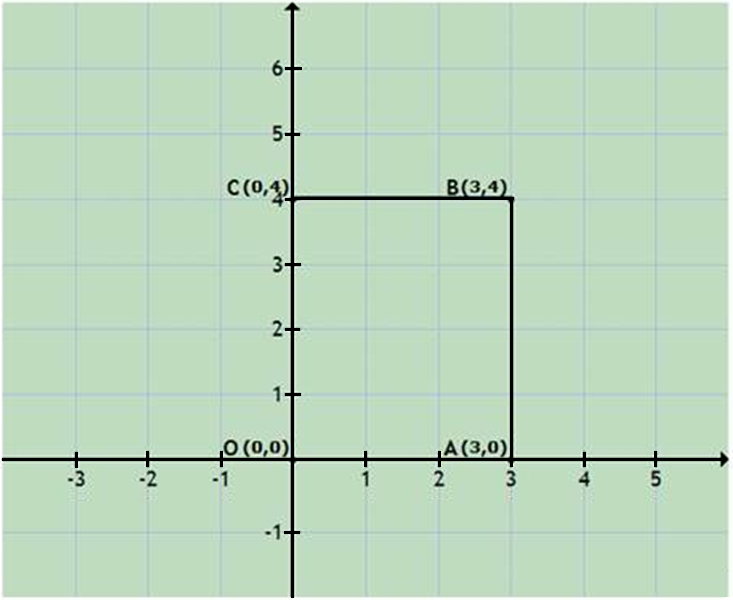
View full question & answer→MCQ 481 Mark
The point $(-3, 0)$ lies:
AnswerCorrect option: C. On the negative direction of $x$-axis
Since value of $y$-ordinate is zero, so point lies on $x$-axis.
But value of $x$ is -ve so, it lies on negative direction of $x$-axis.
View full question & answer→MCQ 491 Mark
The perpendicular distance of the point $P(-2, -3)$ from the $y$-axis is:
- A
$3$ units
- ✓
$2$ units
- C
$-3$
- D
$-2$
AnswerCorrect option: B. $2$ units
Perpendicular distance of any point from y-axis is the given x-coordinate of point,
So distance $= 2$ units
View full question & answer→MCQ 501 Mark
The perpendicular distance of the point $P(-3, -6)$ from the $x$-axis is:
- A
$3$ units
- B
$-3$
- ✓
$6$ units
- D
$-2$
AnswerCorrect option: C. $6$ units
Perpendicular distance of a point from $x$-axis is $y$-ordinate of the given point is $(-3,-6)$.Distance $=6$ unit
View full question & answer→MCQ 511 Mark
The area of a triangle whose vertices are $(0, 0), (4, 0)$ and $(0, 6)$ is:
- A
$36$ sq. units
- B
$6$ sq. units
- ✓
$12$ sq. units
- D
$24$ sq. units
AnswerCorrect option: C. $12$ sq. units
We have a point $(0,0)$ i.e; origin.
A point $(4,0)$ whose $y$-coordinate is zero.
So, this point is having 4 units in $x$-axis = base (let) A point $(0,6)$ i.e. 6 units in $y$-axis = height of a triangle so, these point forms a right angle triangle.
So, Area of a triangle $=\frac{1}{2}\times\text{Base}\times\text{Height}$
Area of a triangle $=\frac{1}{2}\times6\times4=12\text{ sq.}\text{units.}$
View full question & answer→MCQ 521 Mark
The points $A(-2,3), B(-2,-4)$ and $C(5,-4)$ are the vertices of the square $A B C D$, then the co-ordinates of the vertex $D$ are:
- ✓
$(5, 3)$
- B
$(3, 3)$
- C
$(0, 0)$
- D
$(3, -4)$
AnswerCorrect option: A. $(5, 3)$
Let $A(-2,3), B(-2,4), C(5,-4)$ be the three vertices of the square $A B C D$. Clearly, abscissa of $D=$ abscissa of $C=5$
And,ordinate of $D =$ ordinate of $A =3$
So, the coordinates of the 4 th vertex of $A B C D$ i.e. $D$ are $(5,3)$.
View full question & answer→MCQ 531 Mark
Which of the following points lie on the line $y = 3x – 4?$
- A
$(4, 12)$
- B
$(5, 15)$
- ✓
$(2, 2)$
- D
$(3, 9)$
AnswerCorrect option: C. $(2, 2)$
When we put $x=2$ in the given equation, Then, $y=(3 \times 2)-4$ $y=6-4=2$, so point is $(2,2)$ satisfied the given equation, Hence point $(2,2)$ will lie on the line $y=3 x-4$
View full question & answer→MCQ 541 Mark
The abscissa of any point on $y-$axis is:
AnswerThe abscissa of any point on y-axis is always zero. This means that this point hasn't covered any distance on x-axis.
View full question & answer→MCQ 551 Mark
Write the correct answer in the following: Abscissa of all the points on the $x-$axis is:
AnswerAbscissa of all the points on the $X-$axis is any number because $X-$axis is a number line which contains many real numbers on it.
View full question & answer→MCQ 561 Mark
The point at which the two co-ordinate axes meet is called the:
AnswerIn co-ordinate system, there are two axes; x-axis and y-axis, point of intersection of $x-$axis and $y-$axis is called the origin.
View full question & answer→MCQ 571 Mark
Point $(-10, 0)$ lies.
AnswerCorrect option: D. On the negative direction of the $X-$axis.
In point $(-10,0) y$-coordinate is zero, so it lies on $X$-axis and its $x$-coordinate is negative, so the point $(-10,0)$ lies on the $X -$axis in the negative direction.
View full question & answer→MCQ 581 Mark
The point whose abscissa is $4$ and this point lies on the $x-$axis is:
- A
$(0, 4)$
- B
$(4, 4)$
- ✓
$(4, 0)$
- D
AnswerCorrect option: C. $(4, 0)$
Since the abscissa or $x$-coordinate of a point is $4$ and this point lies on the $x$-axis. And the ordinate or $y$-coordinate of a point lying on the $x$-axis is $0 .$
Therefore the coordinate of the point is $(4,0)$.
View full question & answer→MCQ 591 Mark
The equation of $x-$axis is:
- A
$x = 0$
- B
- C
$y = x$
- ✓
$y = 0$
AnswerCorrect option: D. $y = 0$
In co-ordinate, any point $P$ is written as $p(x, y)$. When $Y=0$ then the point $P$ lies on $x$-axis. So, $Y=0$ is the equation of the $x$-axis.
View full question & answer→MCQ 601 Mark
If $P (-1,1), Q (3,-4), R (1,-1), S (-2,-3)$ and $T (-4,4)$ are plotted on the graph paper, then the point(s) in the fourth quadrant are:
- ✓
$Q$ and $R$
- B
Only $S$
- C
$P$ and $T$
- D
$P$ and $R$
AnswerCorrect option: A. $Q$ and $R$
In point $P(-1,1)$, $x$-coordinate is -1 unit and $y$-coordinate is 1 unit, so it lies in II nd quadrant. Similarly, we can plot all the points $Q(3$, $-4), R(1,-1), S(-2,-3)$ and $T(-4,4)$, It is clear from the graph that points $R$ and $Q$ lie in fourth quadrant.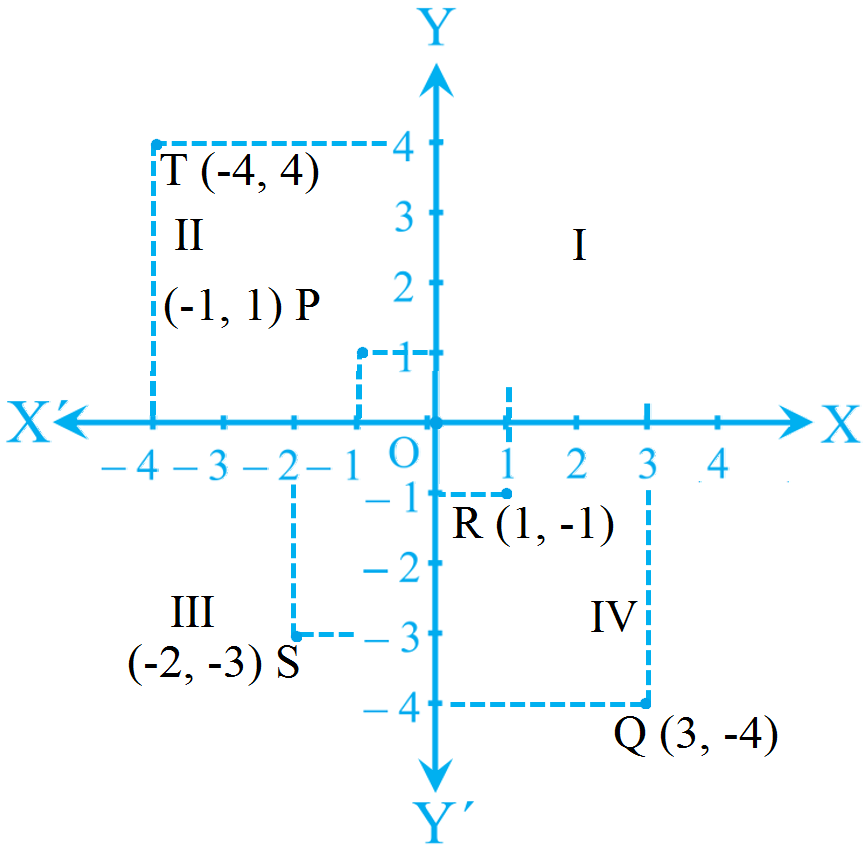
View full question & answer→MCQ 611 Mark
Write the correct answer in the following: The point whose ordinate is $4$ and which lies on $y-$axis is:
- A
$(4, 0)$
- ✓
$(0, 4)$
- C
$(1, 4)$
- D
$(4, 2)$
AnswerCorrect option: B. $(0, 4)$
Given ordinate of the point is $4$ arid the point lies on $Y-$axis, so its abscissa is zero. Hence, the required point is $(0, 4).$
View full question & answer→MCQ 621 Mark
$A(-6, 3)$ be a point on the graph. Draw $AL$ $\perp$ $x-$axis. The co-ordinates of $L$ are:
- A
$(0, -6)$
- ✓
$(-6, 0)$
- C
$(0, 0)$
- D
$(-6, 3)$
AnswerCorrect option: B. $(-6, 0)$
Since AL perpendicular to $x-$axis,
So, point L lies on $x-$axis, and we know that for any point on $x-$axis $y-$ordinate is zero.
So, we have $L = (-6, 0)$
View full question & answer→MCQ 631 Mark
The abscissa of a point is positive in the:
- ✓
Fourth and first quadrant.
- B
Third and fourth quadrant.
- C
First and second quadrant.
- D
Second and third quadrant.
AnswerCorrect option: A. Fourth and first quadrant.
We know that abscissa is always positive in first and fourth coordinate and ordinate is always positive in first and second coordinate:
View full question & answer→MCQ 641 Mark
Directions: In the following questions, the Assertions $(A)$ and Reason$(s)$ $(R)$ have been put forward. Read both the statements carefully and choose the correct alternative from the following:
Assertion: By using graph we can locate $(0, 4)$ on the $y - $axis.
Reason: A point whose $y - $coordinate is zero lies on the $x - $axis.
- A
Both Assertion and Reason are correct and Reason is the correct explanation for Assertion.
- ✓
Both Assertion and Reason are correct but Reason is not the correct explanation for Assertion.
- C
Assertion is correct but Reason is incorrect.
- D
Both Assertion and Reason are incorrect.
AnswerCorrect option: B. Both Assertion and Reason are correct but Reason is not the correct explanation for Assertion.
Obviously, by using graph, we can easily locate $(0, 4)$ on the $y -$ axis,
as any point on the $y -$ axis has the form $(0, a)$, where a is any number. Hence, it is correct.
Also, a point whose $y -$ coordinate is zero lies on the $x -$ axis,
as any point on the $x -$ axis has the form $(a,0)$, where a is any number. Hence, it is correct.
But clearly, the reason is not the correct explanation for the assertion.
View full question & answer→MCQ 651 Mark
The point $(-3, 0)$ lies.
AnswerCorrect option: D. On the negative direction of $x-$axis.
Since value of $y$-ordinate is zero, so point lies on $x$-axis, $B$ ut value of $x$ is -ve so, it lies on negative direction of $x$-axis.
View full question & answer→MCQ 661 Mark
Which of the following points does not lie in any quadrant?
- A
$(1, 7)$
- B
$(2, 10)$
- C
$(-1, 1)$
- ✓
$(4, 12)$
AnswerCorrect option: D. $(4, 12)$
For the point to lie on the line $y=3 x+4$, it has to satisfy the equation of the line.
Putting $x=1$, in $y=3 x+4$, we get $y=3(1)+4 \Rightarrow y=7$
So, the point satisfies the equation and hence lies on the given line.
Putting $x=2$, in $y=3 x+4$, we get $y=3(2)+4 \Rightarrow y=10$
So, the point satisfies the equation and hence lies on the given line.
Putting $x=1$, in $y=3 x+4$, we get $y=3(-1)+4 \Rightarrow y=1$
So, the point satisfies the equation and hence lies on the given line.
Putting $x=4$, in $y=3 x+4$, we get $y=3(4)+4 \Rightarrow y=16$
But $y=12$.
So, the point not satisfy the equation and hence lies on the given line.
View full question & answer→MCQ 671 Mark
The point whose ordinate is $3$ and which lies on the $y-$axis is:
- A
$(3, 3)$
- B
$(1, 3)$
- C
$(3, 0)$
- ✓
$(0, 3)$
AnswerCorrect option: D. $(0, 3)$
Since the point lies on y-axis, so, $x = 0.$
Hence, the required point is: $(0, 3)$
View full question & answer→MCQ 681 Mark
The point of intersection of $X$ and $Y$ axes is called:
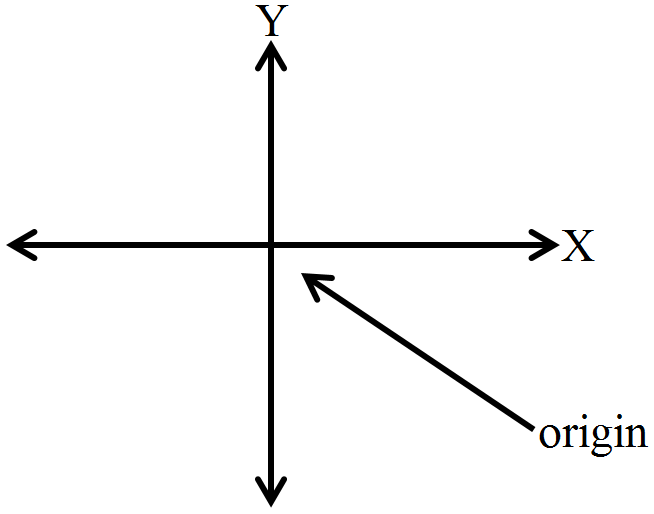
AnswerIn two dimensions, On the flat coordinate plane, there are two axes,
The vertical y-axis and the horizontal x-axis.
The origin is the point where they intersect.
This point has the coordinates (0, 0) and is usually labelled with the letter $O$.
View full question & answer→MCQ 691 Mark
Write the correct answer in the following: The perpendicular distance of the point $P(3, 4)$ from the $y-$axis is:
AnswerThe perpendicular distance of the point $P(3, 4)$ from the y-axis is abscissa (x-coordinate) of the point $(3, 4)$, which is $3.$
View full question & answer→MCQ 701 Mark
Point $(-7, 0)$ lies.
AnswerCorrect option: A. On the negative direction of $x-$axis.
Point $(-7, 0)$ lies on negative direction of the $x-$axis as its $x$ co-ordinate is negative and y co-ordinate is zero.
View full question & answer→MCQ 711 Mark
If $O(0,0), A(3,0), B(3,4)$ and $C(0,4)$ are the vertices of a quadrilateral $O A B C$, then $O A B C$ is:
AnswerAs $O(0,0)$ and $A(3,0)$
So, Length of side $O A=3$ units
As $A(3,0)$ and $B(3,4)$
So, Length of side $A B=4$ units
As $O(0,0)$ and $C(0,4)$
So, Length of side $O C=4$ units
As $B(3,4)$ and $C(0,4)$
So, Length of side $B C=3$ units
As $O(0,0)$ and $B(3,4)$
So, Length of diagonal $O B=5$ units
As $A(3,0)$ and $C(0,4)$
So, Length of diagonal $A C=5$ units
In a quadrilateral opposite sides are equal and diagonals are also equal then it is a rectangle.
Therefore, $O A B C$ is a rectangle.
View full question & answer→MCQ 721 Mark
If $A (-2, 3)$ and $B(-3, 5)$ are two given points then (abscissa of $A) - ($abscissa of $B) = ?$
AnswerAbscissa of $A -$ Abscissa of $B$
$= -2 - (-3)$
$= -2 + 3$
$= 1$
View full question & answer→MCQ 731 Mark
The point which lies on $x-$axis at a distance of $3$ units in the positive direction of $x-$axis is:
- A
$(0, -3)$
- B
$(-3, 0)$
- C
$(0, 3)$
- ✓
$(3, 0)$
AnswerCorrect option: D. $(3, 0)$
Since it lies on $x-$axis so ordinate will be zero because the value of the $y-$coordinate in the x-axis is equal to zero.
Thus point will be $(3, 0).$
View full question & answer→MCQ 741 Mark
The ordinate of any point on $x-$axis is:
AnswerOn X-axis, all points have their $Y$-intercept $=0$ So their ordinate $=0$
View full question & answer→MCQ 751 Mark
The area of $\triangle\text{AOB}$ having vertices $A(0, 6), O(0, 0)$ and $B(6, 0)$ is:
- A
$12$sq units.
- B
$36$sq units.
- ✓
$18$sq units.
- D
$24$sq units.
AnswerCorrect option: C. $18$sq units.
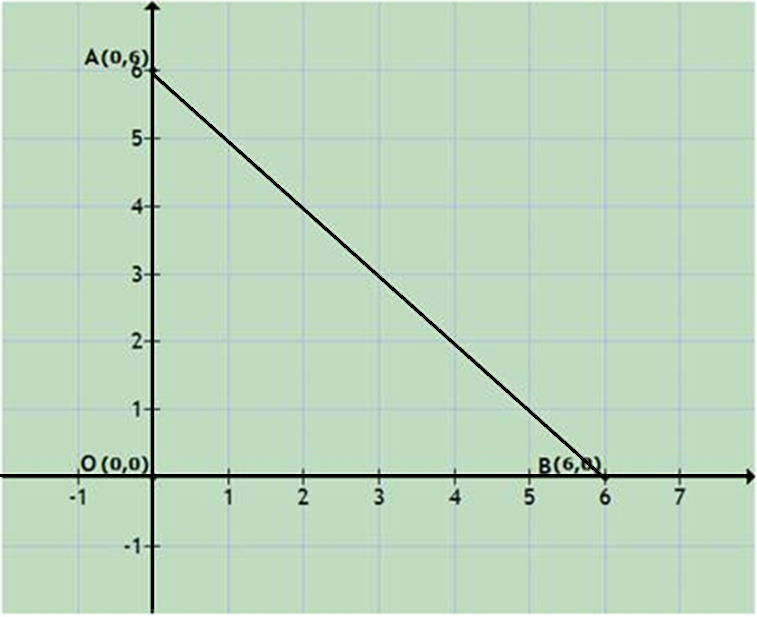
Clearly, $\triangle\text{AOB}$ is a right-angled triangle.
$\therefore$ Area of $\triangle\text{AOB}=\frac{1}{2}\times\text{Base}\times\text{Height}$
$=\frac{1}{2}\times\text{OB}\times\text{OA}$
$=\frac{1}{2}\times6\times6$
$= 18$ square units. View full question & answer→MCQ 761 Mark
Point $(0, -8)$ lies.
- A
In the $IV$ quadrant.
- B
In the $II$ quadrant.
- C
On the $x-$axis
- ✓
On the $y-$axis
AnswerCorrect option: D. On the $y-$axis
Every point on the y-axis is of the form $(0, a)$Since x-coordinate is $0$, so, the point lies on $y-$axis.
View full question & answer→MCQ 771 Mark
Ordinate of all points on the $x-$axis is:
AnswerIn cartesian plane any point $P$ is written as $P(x, y)$ when the value of $Y$ co-ordinate is equal to zero then the point $P$ lies on $x$-axis.
So, for any point on x-axis, ordinate $= 0$
View full question & answer→MCQ 781 Mark
Points $(1, -1), (2, -2), (-3, -4), (4, -5)$
- ✓
All lie in the $II$ quadrant.
- B
All in the $III$ quadrant.
- C
All lie in the $IV$ quadrant.
- D
Do not lie in the same quadrant.
AnswerCorrect option: A. All lie in the $II$ quadrant.
Points $(1,-1),(2,-2)$ and $(4,-5)$ lie in Quadrant $IV,$ but point $(-3,-4)$ lies in Quadrant $III$. Hence, all the given points do not lie in the same quadrant.
View full question & answer→MCQ 791 Mark
In the which quadrant does the point $(-7, -4)$ lie?
AnswerSince, both the coordinates of given point are negative, it lies in Quadrant $III.$
View full question & answer→MCQ 801 Mark
Which of the points $P(0, 3), Q(1, 0), R(0, -1), S(-5, 0), T(1, 2)$ do not lie on the $x-$axis?
- ✓
$P, R$ and $T$
- B
$Q, S$ and $T$
- C
$Q$ and $S$ only
- D
$P$ and $R$ only
AnswerCorrect option: A. $P, R$ and $T$
We know that, if a point is of the form $(x, 0)$ i.e., its $y$-coordinate is zero, then it will lie on $X-$axis otherwise not.Here, $y$-coordinates of points $P(0,3), R(0,-1)$ and $T(1,2)$ are not zero, so these points do not lie on the $X$-axis.
View full question & answer→MCQ 811 Mark
Signs of the abscissa and ordinate of a point in the second quadrant are respectively.
- A
$(+, +)$
- B
$(+, -)$
- C
$(-, -)$
- ✓
$(-, +)$
AnswerCorrect option: D. $(-, +)$
Abscissa means just the horizontal axis i.e. $x$ axis. Ordinate means just the vertical axis i.e. $y$ axis. $x$-corrdinate and $y$-corrdinate make a point.
The signs of abscissa and ordinate of a point in quadrant II are $(-,+)$.
View full question & answer→MCQ 821 Mark
The signs of abscissa and ordinate of a point in quadrant $IV$ are:
- A
$(-, +)$
- B
$(+, +)$
- C
$(-, -)$
- ✓
$(+, -)$
AnswerCorrect option: D. $(+, -)$
In the Cartesian plane, if co-ordinate of any point P is $P(x, y)$, then $x-$coordinate is called the abscissa of the point and, $y-$coordinate is called ordinate of the point.
The signs of abscissa and ordinate of a point in quadrant $IV$ is $(+, -)$
View full question & answer→MCQ 831 Mark
The points in which the abscissa and the ordinate have different signs will lie in.
- A
Quadrant $IV$ only
- B
Quadrants $I$ and $III$
- ✓
Quadrants $II$ and $IV$
- D
Quadrant $II$ only
AnswerCorrect option: C. Quadrants $II$ and $IV$
In 2nd quadrant and 4th quadrant sign of abscissa and ordinate both is opposite i.e, one is negative and other is positive.
In 2nd quadrant sign of co-ordinate are$(-, +),$
And in 4th quadrant sign of co-ordinate are $(+, -)$
View full question & answer→MCQ 841 Mark
A point whose abscissa is $-3 $and ordinate $2$ lies in:
AnswerAs we know that abscissa is negative in second and third coordinate and ordinate is positive in first and second coordinate. Therefore the given point $(-3, 2)$ lies in second coordinate.
View full question & answer→MCQ 851 Mark
In Figure, the point identified by the coordinates $(-5, 3)$ is:
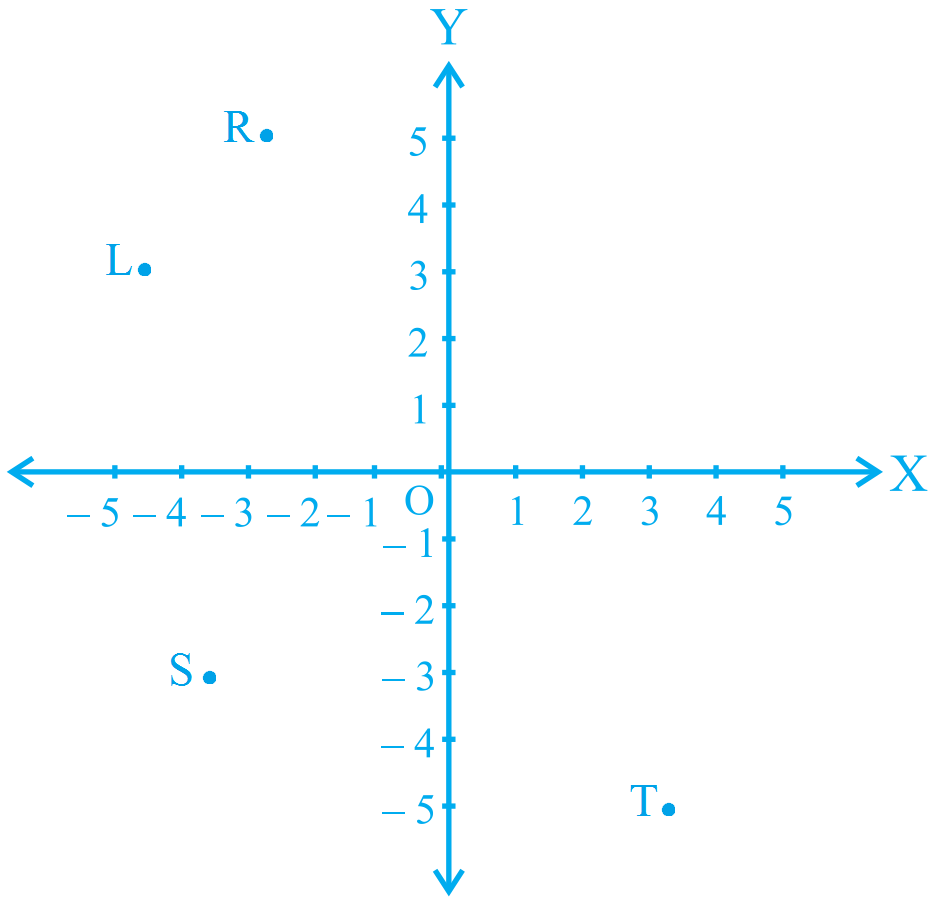
AnswerIn point $(-5,3), x$-coordinate is negative and $y$-coordinate is positive, so it will lie in II quadrant. Now, we see that perpendicular distance of $L$ from $V$ -axis is 5 and from $X$ -axis is $3 .$
So, the required point is $L$.
View full question & answer→MCQ 861 Mark
A symbol having a fixed value is called a ______.
AnswerA symbol having a fixed value is called a constant.Any natural number, whole number, integers, rational number. A symbol having the variable values is called variable.
View full question & answer→MCQ 871 Mark
The abscissa of a point is positive in the:
- A
First and Second quadrant.
- B
Second and Third quadrant.
- C
Third and Fourth quadrant.
- ✓
Fourth and First quadrant.
AnswerCorrect option: D. Fourth and First quadrant.
Abscissa = Intercept on $X-$axisIf intercept on $X-$axis is positive, means First and Fourth quadrant
View full question & answer→MCQ 881 Mark
The radius of a circle whose radius is $5$ units and whose centre lies on the origin. The co-ordinates of any point lies on the circle and on the $y-$axis are:
- A
$(5, 0)$ only
- B
$(0, 5)$ only
- C
$(5, 0)$ or $(-5, 0)$
- ✓
$(0, 5)$ or $(0, -5)$
AnswerCorrect option: D. $(0, 5)$ or $(0, -5)$
Since point lies on the y-axis so it can lie in two-point one in positive direction and another is negative direction of y-axis.So point will be $(0, 5)$ or $(0, -5)$
View full question & answer→MCQ 891 Mark
A point both of whose co-ordinates are positive lies in:
- A
Quadrant $I$ and $III$
- B
Quadrant $III$ only
- ✓
Quadrant $I$ only
- D
Quadrant $II$ and $IV$
AnswerCorrect option: C. Quadrant $I$ only
In 1st quadrant only the sign of $x$ and $y$ coordinate is $+$ve. i.e,$ (+, +)$
View full question & answer→MCQ 901 Mark
Ordinate of all points on the $y-$axis is.
AnswerIn the cartesian plane any point $P$ is written as $p(x, y)$ when the value of $x$ co-ordinate is equal to zero then the point P lies on y axis,So, Ordinate of any point on $y$-axis can be any number but abscissa will be zero.
View full question & answer→MCQ 911 Mark
If $O(0, 0), A(4, 0)$ and $B(0, 5)$ are the vertices of a triangle, then a triangle $OAB$ is:
AnswerSince we have a point $O(0,0)$ i.e. origin.
Point $A(4,0)$ whose $y$-coordinate is zero. So, this point is on $x$-axis.
Point $B(0,5)$ whose $x$-coordinate is zero. So, this point is on $y$-axis.
Angle between $x$-axis $(O A)$ and $y$-axis $(O B)$ is 90 degrees. Thus, it forms a right triangle.
View full question & answer→MCQ 921 Mark
Write the correct answer in the following: On plotting the points $O(0, 0), A(3, 0), B(3, 4), C(0, 4)$ and joining $OA, AB, BC$ and $CO$ which of the following figure is obtained?
AnswerHere, point $O(0,0)$ is the origin. $A(3,0)$ lies on positive direction of $X$-axis, $B(3,4)$ lies in $1^{\text {st }}$ quadrant and $C(0,4)$ lines on positive direction of $Y$ -axis. On joining $OA AB , BC$ and CO the figure obtained is a rectangle.
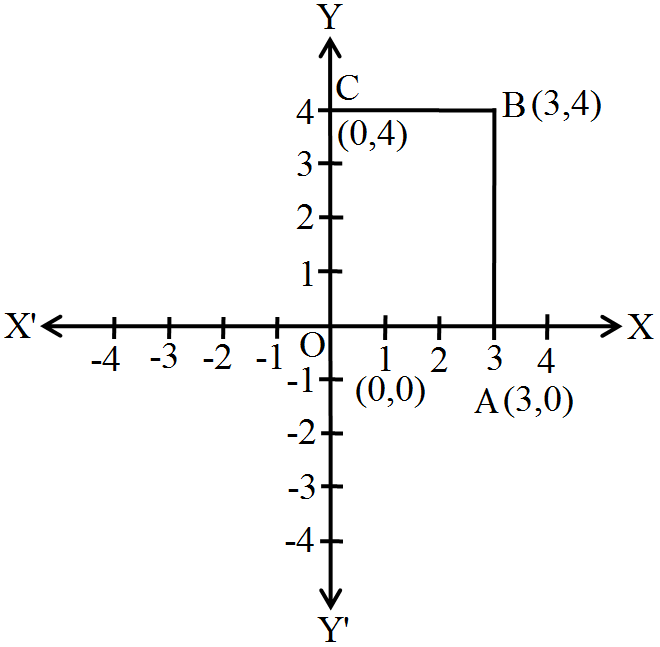
View full question & answer→MCQ 931 Mark
Abscissa of a point is positive in:
- A
Quadrant $I$ and $IV$
- B
Quadrant $I$ only
- ✓
Quadrant $IV$ only
- D
Quadrant $II$ and $III$
AnswerCorrect option: C. Quadrant $IV$ only
Abscissa means $x-$corrdinate.
In quadrant $I$ and $IV$, the value of $x$ is positive.
Thus, the abscissa of a point is positive in quadrant $I$ and $IV.$
View full question & answer→MCQ 941 Mark
Which of the following point does not lie on the line $y = 2x + 3?$
- A
$(-5, -7)$
- ✓
$(3, 7)$
- C
$(-1, 1)$
- D
$(3, 9)$
AnswerCorrect option: B. $(3, 7)$
Let us put $x=3$ in the give equation, Then, $y=2(3)+3$
$y=6+3=9$
So, the point will be $(3,9)$
For $x=3, y=9$. But in the given option, $y=7$
So, the given point $(3,7)$ will not lie on the line $y=2 x+3$.
View full question & answer→MCQ 951 Mark
The name of the vertical line drawn to determine the position of any point in the Cartesian plane is:
AnswerCorrect option: B. $y-$axis
In the Cartesian plane, there are two axes. One is a horizontal line, that is called the x-axis and other is a vertical line, that is called y-axis.
View full question & answer→MCQ 961 Mark
$x$ co-ordinate is known as:
Answer Any point p in cartesian plane is written as $p(x, y).x$ coordinate of point $p$ is called abscissa and $Y$ co-ordinate of point $p $is called ordinate.
View full question & answer→MCQ 971 Mark
The area of the triangle formed by the points $P(0,1), Q(0,5)$ and $R(3,4)$ is:
- A
$16$sq. units
- ✓
$6$sq. units
- C
$4$sq. units
- D
$6$sq. units
AnswerCorrect option: B. $6$sq. units
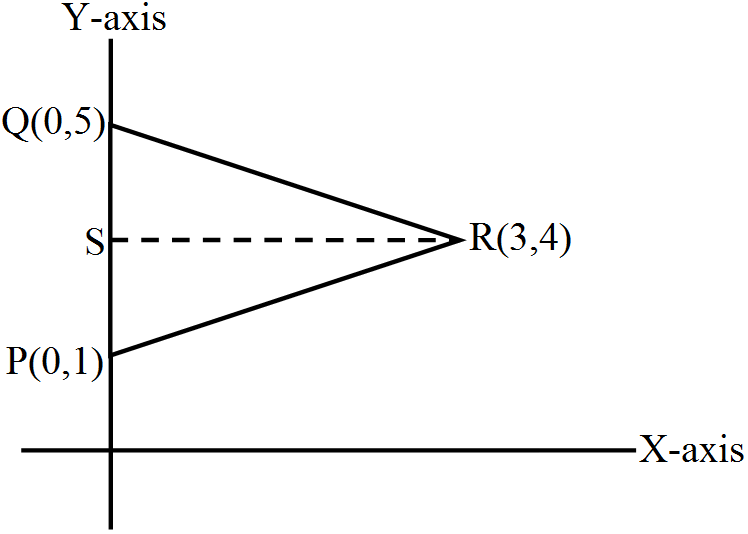
$PQ = 4$ units
Let $RS$ be perpendicular drawn from $R$ to $PQ.$
Lenght of $RS =$ abscissa of $(3, 4)$
$\Rightarrow RS = 3$ units
Area of $\triangle\text{RQP}=\frac{1}{2}\times\text{PQ}\times\text{RS}$
$=\frac{1}{2}\times\text{4}\times\text{3}$
$=6\text{sq. units}.$ View full question & answer→MCQ 981 Mark
The point (other than origin) for which abscissa is equal to the ordinate will lie in quadrant.
- A
$I$ only
- B
$I$ or $II$
- ✓
$I$ or $III$
- D
$II$ or $IV$
AnswerCorrect option: C. $I$ or $III$
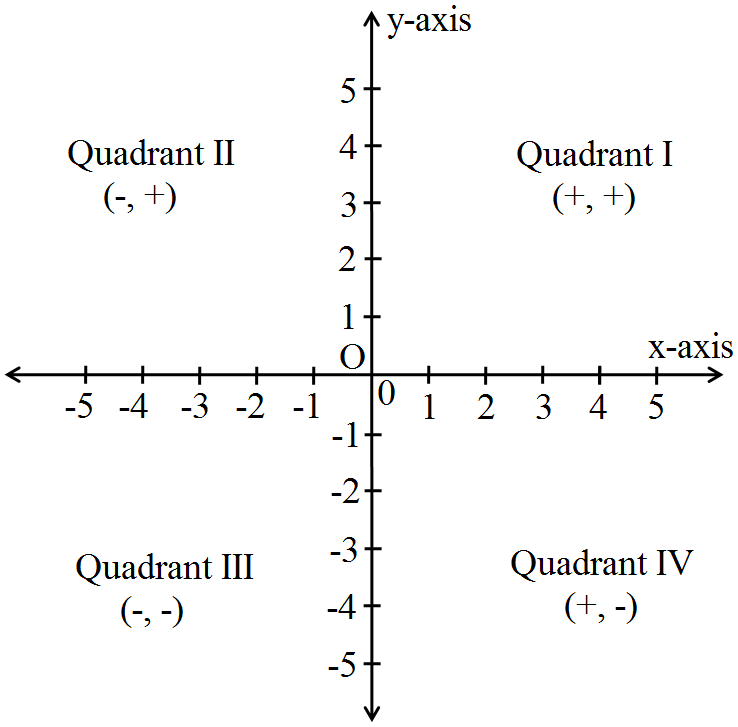
The points are same when they are of the form $(m, m)$ or $(-n,-n)$.
This happens only in quadrant $I$ and quadrant $III.$
So, the points (other than the origin) for which the abscissa is equal to the ordinate lie in quadrant $I$ and quadrant $III.$ View full question & answer→MCQ 991 Mark
The point which lies on the $y-$ axis at a distance of $5$ units in the negative direction of the $y-$axis is:
- A
$(-5, 0)$
- ✓
$(0, -5)$
- C
$(5, 0)$
- D
$(0, 5)$
AnswerCorrect option: B. $(0, -5)$
The point which lies on the y-axis at a distance of 5 units in the negative direction of the $y-$axis is $(0, -5).$
View full question & answer→MCQ 1001 Mark
Point $(-3, 5)$ lies in the:
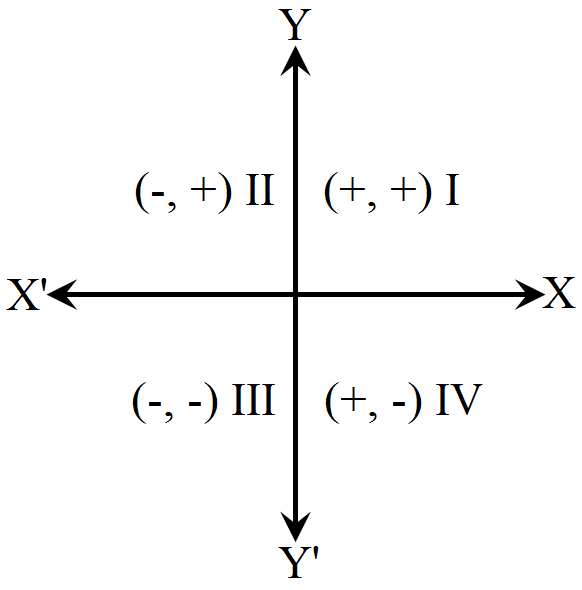
AnswerIn point $(-3, 5), x-$ coordinate is negative and $y-$coordinate is positive. So, the point lies in the second quadrant.
View full question & answer→MCQ 1011 Mark
The distance of the point $P(4, 3)$ from the origin is:
Answer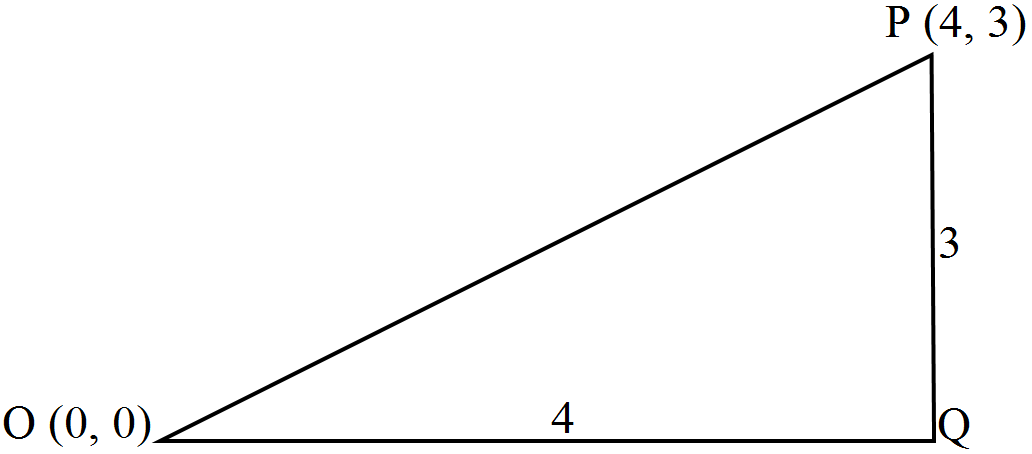
Using pythagorous theorem: $\text{OP}^2=\text{OQ}^2=\text{QP}^2$
$\text{OP}^2-4^2+3^2$
$\text{OP}^2=\sqrt{16+9}=5$
View full question & answer→MCQ 1021 Mark
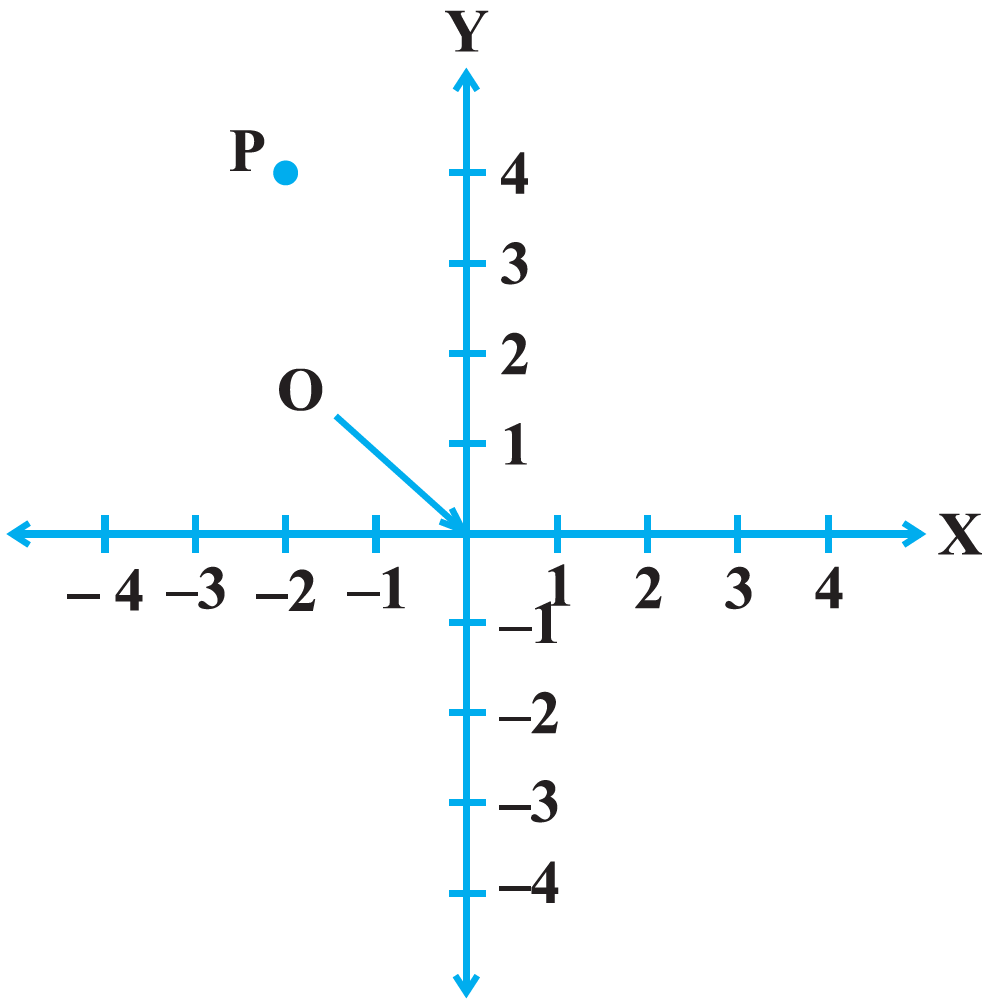
Write the correct answer in the following: In coordinates of $P$ are:
- A
$(-4, 2)$
- ✓
$(-2, 4)$
- C
$(4, -2)$
- D
$(2, -4)$
AnswerCorrect option: B. $(-2, 4)$
Here, given point $P$ lies in II quadrant, so its abscissa will be negative and ordinate will be positive. Also its perpendicular distance from $X-$axis is $4 y-$coordinate of $P$ is $4$ and its perpendicular distance from $Y-$axis is $2$. So, $x–$coordinate is $-2$. Hence, coordinate of $P$ are $(-2, 4).$
View full question & answer→MCQ 1031 Mark
Two point having same abscissae but different ordinates lie on:
AnswerCorrect option: C. A line parallel to $y-$axis
Let two points be $(a, b)$ and $(a, c).$
If abscissa is same $= a$
and ordinate is different then all such points will lie on a line parallel to $Y$
axis because value of $X-$intercept
i.e. abscissa is fixed.
View full question & answer→MCQ 1041 Mark
Write the correct answer in the following: If the coordinates of the two points are $P(-2, 3)$ and $Q(-3, 5)$, then (abscissa of $P) –$ (abscissa of $Q$) is:
AnswerWe have, points $P(-2,3)$ and $Q(-3,5)$
Here, abscissa of $P$ i.e., $x$-coordinate of $P$ is $-2$ and abscissa of $Q$ i.e., $x$-coordinate of $Q$ is $-3 .$
So, (Abscissa of $P) - ($Abscissa of $Q)$
$=-2-(-3)=-2+3=1$
View full question & answer→MCQ 1051 Mark
The point of intersect of the coordinate axes is:
AnswerThe point where coordinate axes intersect is known as origin $O(0, 0).$
View full question & answer→MCQ 1061 Mark
Write the correct answer in the following: The point at which the two coordinate axes meet is called the:
AnswerThe points at which the two coordinate axes meet is called the origin.
View full question & answer→MCQ 1071 Mark
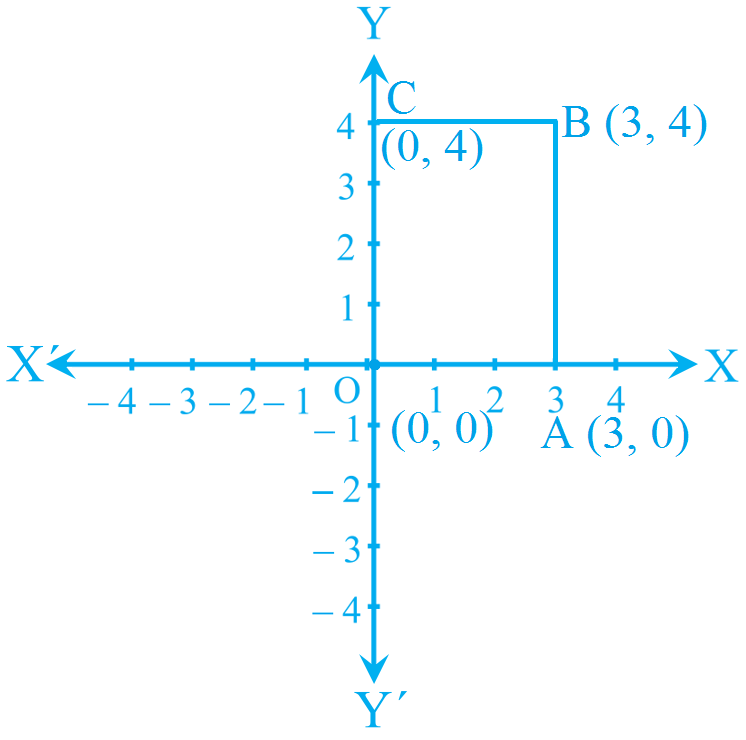
On plotting points $O(0, 0), A(3, 0), B(3, 4), C(0, 4)$ and joining $OA, AB, BC$, and $CO$ Which of the following figure is obtained?
AnswerHere, point $O(0,0)$ is the origin. $A(3,0)$ lies on positive direction of $X$-axis, $B(3,4)$ lies in 1st quadrant and $C(0,4)$ lines on positive direction of $Y -$ axis. On joining $OA , AB , BC$ and $CO$ the figure obtained is a rectangle.
View full question & answer→MCQ 1081 Mark
Which of the following points lies on the line $y = 2x + 3?$
- A
$(2, 8)$
- ✓
$(3, 9)$
- C
$(4, 12)$
- D
$(5, 15)$
AnswerCorrect option: B. $(3, 9)$
For the point to lie on the line $y=2 x+3$, it has to satisfy the equation of the line.
Putting $x=2$, in $y=2 x+3$, we get $y=2(2)+3 \Rightarrow y=7$
But $y=8$.
So, the point does not satisfy the equation and hence does not lie on the given line.
Putting $x=3$, in $y=2 x+3$, we get $y=2(3)+3 \Rightarrow y=9$
So, the point satisfies the equation and hence lies on the given line.
Putting $x=4$, in $y=2 x+3$, we get $y=2(4)+3 \Rightarrow y=11$
But $y=12$.
So, the point does not satisfy the equation and hence does not lie on the given line.
Putting $x=5$, in $y=2 x+3$, we get $y=2(5)+3 \Rightarrow y=13$
But $y =15$.
So, the point does not satisfy the equation and hence does not lie on the given line.
View full question & answer→MCQ 1091 Mark
If $x > 0$ and $y < 0$ then the point $(x, y)$ lies in quadrant.
Answer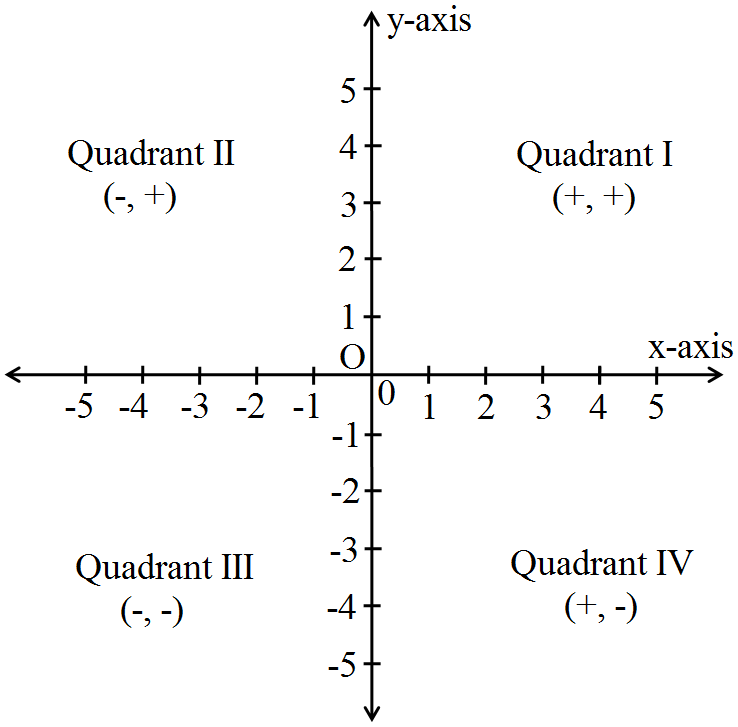
Points of the type $(+,-)$ lie in the 4th quadrant.
Since $x>0$ and $y<0$, the point ( $x, y$ ) lies in quadrant $IV.$ View full question & answer→MCQ 1101 Mark
Abscissa of a point is negative in:
- A
Quadrant $IV$ only
- B
Quadrant $I$ and $IV$
- C
Quadrant $I$ only
- ✓
Quadrant $II$ and $III$
AnswerCorrect option: D. Quadrant $II$ and $III$
The abscissa ( $x$-axis) is -ve in $2$nd and $3$rd quadrant only because, Sign of point in 2nd quadrant is $(-,+)$, and in 3rd quadrant, it is $(-,-)$.
View full question & answer→MCQ 1111 Mark
If $x > 0$ and $y > 0$, then the point $(x, y)$ lies in which quadrant?
- A
$III$ Quadrant.
- ✓
$I$ Quadrant.
- C
$II$ Quadrant.
- D
$IV$ Quadrant.
AnswerCorrect option: B. $I$ Quadrant.
Since, $x > 0$ and $y >$ 0So, both $x$ and $y$ co-ordinate are +ve,
And we know that in 1st quadrant value of both Abscissa and Ordinate is +ve so, the point will lie in 1st quadrant.
View full question & answer→MCQ 1121 Mark
In which quadrant does the point $(-7, -4)$ lie?
AnswerRecall that $(+, +)$ lies in I quadrant, $(-, +)$ lies in II quadrant, $(-, -)$ lies in III quadrant, $(+, -)$ lies in $IV$ quadrant.
Since, both the coordinates of given point are negative, it lies in Quadrant III.
View full question & answer→MCQ 1131 Mark
Write the correct answer in the following: Point $(-3, 5)$ lies in the:
AnswerIn the point $(-3, 5)$ abscissa is negative and ordinate is positive. So, it lies in the second quadrant.
View full question & answer→MCQ 1141 Mark
The abscissa and ordinate of the origin are:
- ✓
$(0, 0)$
- B
$(1, 0)$
- C
$(0, 1)$
- D
$(1, 1)$
AnswerCorrect option: A. $(0, 0)$
Absciss = intercept pon $X -$ axis$ = 0$
Ordinate = intercept on $Y -$ axis $= 0$
$\Rightarrow (0, 0)$ is the answer.
View full question & answer→MCQ 1151 Mark
If $(x, y) = (y, x)$, then.
- A
$x + y = 0$
- ✓
$x - y = 0$
- C
$x ÷ y = 0$
- D
$xy = 0$
AnswerCorrect option: B. $x - y = 0$
If $(x, y) = (y, x),$
It means abscissa =ordinate or, $x = y$
So, $X - Y = 0$ {since $x = y}$
View full question & answer→MCQ 1161 Mark
The co-ordinates of the origin are.
- ✓
$(0, 0)$
- B
$(2, 2)$
- C
$(0, 2)$
- D
$(2, 0)$
AnswerCorrect option: A. $(0, 0)$
In co-ordinate, there are two Axis one is $x-$axis and other is $y-$axis, the point of intersection of both $x-$axis and $y-$axis is origin.
Coordinate of origin is always $(0, 0).$
View full question & answer→MCQ 1171 Mark
If the $y-$ coordinate of a point is zero then this point always lies.
- A
On the $y-$axis.
- ✓
On the $x-$axis.
- C
In the $I$ quadrant.
- D
In the $IV$ quadrant.
AnswerCorrect option: B. On the $x-$axis.
If the $y-$coordinate of a point is zero then this point always lies on the $x-$axis.
View full question & answer→MCQ 1181 Mark
The points $(-5, 3)$ and $(3, -5)$ lie in the.
- A
- B
$II$ and $III$ quadrants respectively.
- ✓
$II$ and $IV$ quadrants respectively.
- D
$IV$ and $II$ quadrants respectively.
AnswerCorrect option: C. $II$ and $IV$ quadrants respectively.
For point $(-5,3)$, the $x$ co-ordinate is negative and the $y$ co-ordinate is positive. Hence, it lies in Quadrant $II$. For point $(3,-5)$, the $x$ co-ordinate is positive and the $y$ co-ordinate is negative. Hence, it lies in Quadrant $IV$.
View full question & answer→MCQ 1191 Mark
The equation $x = 7$ in two variables can be written as
- A
$0.x + 0.y = 7$
- B
$1.x + 1.y = 7$
- C
$0.x + 1.y = 7$
- ✓
$1.x + 0.y = 7$
AnswerCorrect option: D. $1.x + 0.y = 7$
The equation $x = 7$ in two variables can be written as exactly $1.x + 0.y = 7$.
because it contain two variable $x$ and $y$ and coefficient of $y$ is zero as there is no term containing $y$ in equation $x = 7.$
View full question & answer→MCQ 1201 Mark
Write the correct answer in the following: In the point identified by the coordinates $(-5, 3)$ is: 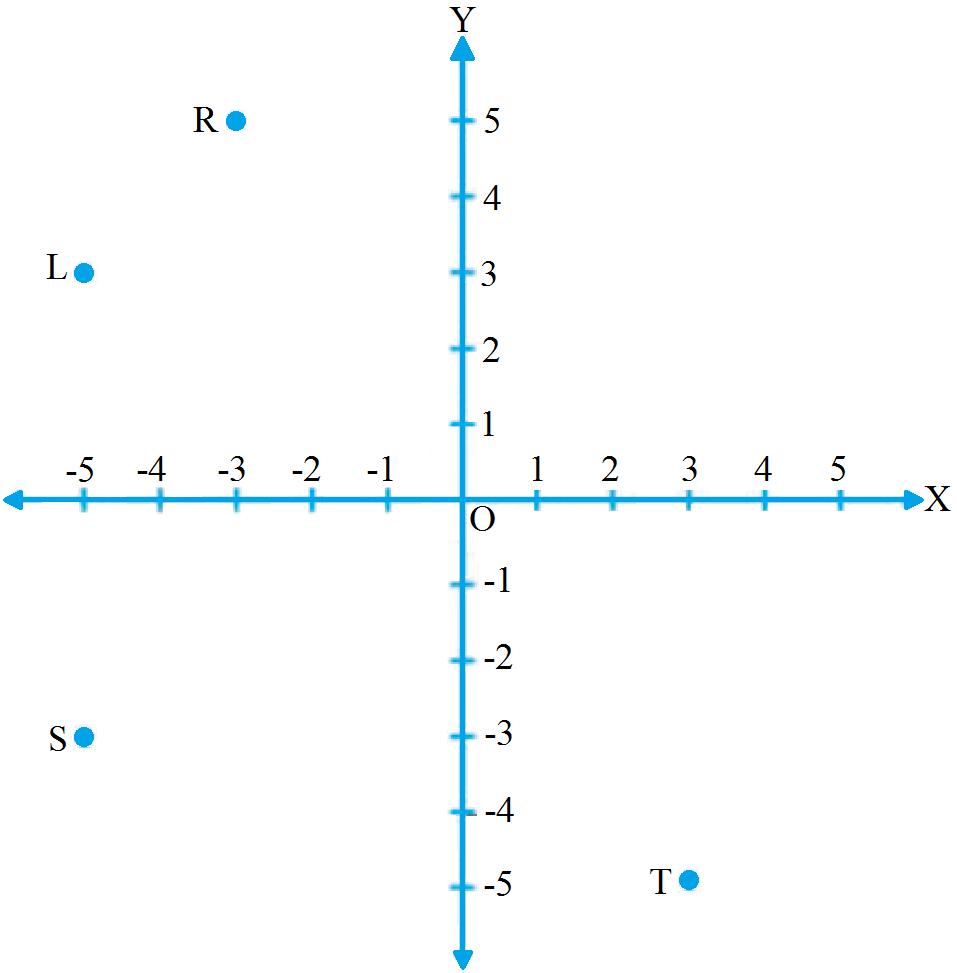
AnswerClearly, point $T$ lies in the fourth quadrant. The distance of $T$ from $y-$axis is $3$ unit and from $x-$axis is $-5$ units. So, the points identified by the coordinate $(-5, 3)$ is $T.$
View full question & answer→MCQ 1211 Mark
A point is at a distance of $3$ units from the $x-$axis and $7$ units from the $y-$axis. Which of the following may be the co-ordinates of the point?
- A
$(0, 0)$
- B
$(4, 5)$
- C
$(3, 7)$
- ✓
$(7, 3)$
AnswerCorrect option: D. $(7, 3)$
We know that distance of any point from $x-$axis is the $y-$ordinate, so here $y-$coordinate $= 3$.
Now, distance of any point from $y-$axis is the $x$ coordinate of the point.
So, here $x$ co-ordinate is $= 7$
Thus, point will be $(7, 3)$
View full question & answer→MCQ 1221 Mark
The equation of $y-$axis is:
- A
$y = x$
- B
$y = 0$
- ✓
$x = 0$
- D
AnswerCorrect option: C. $x = 0$
The value of abscissa or $x-$corrdinate is always zero at any point on $y-$axis.
So, $x = 0$ is the equation of $y-$axis.
View full question & answer→MCQ 1231 Mark
Which of the following points does not lie on the line $y = 3x + 4?$
- A
$(1, 7)$
- B
$(2, 10)$
- ✓
$(4, 12)$
- D
$(-1, 1)$
AnswerCorrect option: C. $(4, 12)$
$y = 3x + 4$
for $x = 4$, we have
$= 3 \times 4 + 4$
$= 12 + 4$
$= 16 \neq 12$
Hence, $(4, 12)$ doesn't lie on the given line.
View full question & answer→MCQ 1241 Mark
The perpendicular distance of the point $P(4, 3)$ from $x-$axis is:
AnswerIf perpendicular drawn from $P$ to $X-$axis, then the perpendicular is equal to measure of ordinate of point $P.$
So, perpendicular distance of point $P$ form $X-$axis $= 3$
View full question & answer→MCQ 1251 Mark
The points $($other than the origin$)$ for which the abscissa is equal to the ordinate lie in.
- ✓
Quadrants $I$ and $III$
- B
Quadrants $II$ and $IV$
- C
Quadrant $III$ only
- D
Quadrant $I$ only
AnswerCorrect option: A. Quadrants $I$ and $III$
We have to take those points where abscissa and ordinate are equal.
Two cases arise,
$i.(2, 2) =$ since both values are $+$ve so it will lie in $1^{st}$ quadrant.
$ii.(-2, -2) =$ since both values are $-$ve so it will lie in $3^{rd}$ quadrant.
View full question & answer→MCQ 1261 Mark
The point $(-2, -1)$ lies in:
- ✓
$3$rd quadrant
- B
$1$st quadrant
- C
$2$nd quadrant
- D
$4$th quadrant
AnswerCorrect option: A. $3$rd quadrant
$3$rd quadrant because co-ordinate of point in $3$rd quadrant is $(-x, -y).$
View full question & answer→MCQ 1271 Mark
Write the correct answer in the following: Points $(1, -1), (2, -2), (4, -5)$ and $(-3, -4):$
- A
lie in $II$ quadrant.
- B
lie in $III$ quadrant.
- C
lie in $IV$ quadrant.
- ✓
Do not lie in the same quadrant.
AnswerCorrect option: D. Do not lie in the same quadrant.
In points $(1,-1),(2,-2)$ and $(4,-5) x$-coordinate is positive and $y$-coordinate is negative, So, they all lie in $IV$ quadrant. In point $(-3,-4) x$-coordinate is negative and $y$-coordinate is negative. So, it lies in $III$ quadrant. So, given points do not lie in the same quadrant.
View full question & answer→MCQ 1281 Mark
The measure of the angle between the coordinate axes is:
- A
$0^\circ $
- ✓
$90^\circ$
- C
$180^\circ $
- D
$360^\circ $
AnswerCorrect option: B. $90^\circ$
The angle between the co-ordinate axes is $90^\circ$ because $\text{X}-\text{axis}\perp\text{Y}-\text{axis}.$
View full question & answer→MCQ 1291 Mark
Ordinate of a point is positive in:
- A
Quadrant $II$ only
- ✓
Quadrant $I$ and $II$
- C
Quadrant $IV$ and $III$
- D
Quadrant $I$ only
AnswerCorrect option: B. Quadrant $I$ and $II$
Since.sign of point in 1st quadrant is $(+, +),$
And in second quadrant it is $(-, +)$
So, Ordinat of a point is +ve only in $1$st and 2nd quadrant.
View full question & answer→MCQ 1301 Mark
The distance of the point $(3, 5)$ from $x-$ axis is:
- A
$3$ units
- B
$4$ units
- ✓
$5$ units
- D
$6$ units
AnswerCorrect option: C. $5$ units
Distance of any point from $x-$axis is $y-$coordinate of that given point:
View full question & answer→MCQ 1311 Mark
Points $(-4, 0)$ and $(7, 0)$ lie:
- ✓
On $x-$axis.
- B
$Y-$axis.
- C
- D
AnswerCorrect option: A. On $x-$axis.
In $(-4,0)$ and $(7,0)$
measure of ordinate $=0$
That means, intercept on $Y$-axis $=0$
So, points lies on $X-$axis.
View full question & answer→MCQ 1321 Mark
A point of the form $(0, b)$ lies on:
- A
Quadrant $I$
- B
$x- $axis
- ✓
$y- $axis
- D
Quadrant $III$
AnswerCorrect option: C. $y- $axis
Let $P$ be any point whose co-ordinate be $P(0, b)$ Then, if the value of $x$-coordinate or abscissa is zero then the point $P$ lies in $y$-axis.
View full question & answer→MCQ 1331 Mark
The co-ordinates of a point below the $x-$axis lying on $y-$axis at a distance of $4$ units are.
- A
$(0, 4)$
- B
$(4, 0)$
- C
$(-4, 0)$
- ✓
$(0, -4)$
AnswerCorrect option: D. $(0, -4)$
Since, it lies on the $y$-axis so abscissa $=0$ And since it lies 4 unit below $x$-axis so the value of ordinate $=-4$.
Thus, point will be $(0,-4)$
View full question & answer→MCQ 1341 Mark
$x$ co-ordinate is known as:
AnswerAny point $p$ in cartesian plane is written as $p(x, y), x$ co-ordinate of point pis called abscissa and $Y$ co-ordinate of point pis called ordinate.
View full question & answer→MCQ 1351 Mark
The ordinate of any point on $x-$axis is:
AnswerThe ordinate of any point on $x-$axis is always zero. This means that this point hasn't covered any distance on $y-$axis.
View full question & answer→MCQ 1361 Mark
The point $(0, 9)$ lies.
AnswerCorrect option: A. On the positive direction of $y-$axis
Any point Pin co-ordinate plane is written as $P(x, y)$ When the value of $x$-coordinate is equal to zero then the point Plies on $y$ axis.
Since, here $x=0$ so,point lies on $y$-axis
And the value of $y$ is positive so,
Points lies in the positive direction of $y$-axis
View full question & answer→MCQ 1371 Mark
$y$ co-ordinate is known as:
AnswerAny point p in cartesian plane is written as $p(x, y).$
$x$ coordinate of point p is called abscissa and $Y$ co-ordinate of point p is called ordinate.
View full question & answer→MCQ 1381 Mark
Point $(0, -8)$ lies.
- A
In the $II$ quadrant.
- B
In the $IV$ quadrant.
- C
On the $x-$axis.
- ✓
On the $y-$axis.
AnswerCorrect option: D. On the $y-$axis.
Point $(0, -8)$ lies on $y$-axis as its $x$ co-ordinate is $0.$
View full question & answer→MCQ 1391 Mark
Write the correct answer in the following: The point which lies on $y-$axis at a distance of $5$ units in the negative direction of $y-$axis is:
- A
$(0, 5)$
- B
$(5, 0)$
- ✓
$(0, -5)$
- D
$(-5, 0)$
AnswerCorrect option: C. $(0, -5)$
Given the point lies on $Y-$axis this shows that this $x-$coordinate is zero. Also it is at a distance of $5$ units in negative direction of $Y-$ axis, so its $y–$coordinate is negative. Hence, the required point is $(0, -5).$
View full question & answer→MCQ 1401 Mark
A point both of whose coordinates are negative will lie in:
- A
$IV$ quadrant.
- B
$II$ quadrant.
- ✓
$III$ quadrant.
- D
$I$ quadrant.
AnswerCorrect option: C. $III$ quadrant.
In $3$rd quadrant sign of both $x$ and $y-$coordinate are negative, i.e, $(-x, -y)$
View full question & answer→MCQ 1411 Mark
The distance of the point $(2, 3)$ from the $y-$axis:
- A
$5$ units
- B
$13$ units
- C
$3$ units
- ✓
$2$ units
AnswerCorrect option: D. $2$ units
The distance from $y-$axis is equal to the $x-$coordinate, so distance $= 2$ units
View full question & answer→MCQ 1421 Mark
If $P(5, 1), Q(8, 0), R(0, 4), S(0, 5)$ and $O(0, 0)$ are plotted on the graph paper, then the points on the $x-$axis are.
- A
$P$ and $Q$
- ✓
$Q$ and $O$
- C
$R$ and $S$
- D
$Q$ only
AnswerCorrect option: B. $Q$ and $O$
Co-ordinate of any point on $x$-axis is ( $x, 0$ )
And, we have point $O$ and point $Q$ with such co-ordinate so point $O$ and $Q$ will lie on $x$-axis.
View full question & answer→MCQ 1431 Mark
Write the correct answer in the following: Point $(-10, 0)$ lies:
AnswerCorrect option: A. On the negative direction of the $x-$axis.
In point $(-10,0) y$-coordinate is zero, so it lies on $X$-axis and its $x$-coordinate is negative, so the point $(-10,0)$ lies on the $X -$axis in the negative direction.
View full question & answer→MCQ 1441 Mark
The co-ordinate of origin is:
- A
- ✓
$(0, 0)$
- C
$(0, y)$
- D
$(X, 0)$
AnswerCorrect option: B. $(0, 0)$
The center of the coordinate system (where the lines intersect) is called the origin.The axes intersect when both $x$ and $y$ are zero.
The coordinates of the origin are $(0, 0).$
View full question & answer→MCQ 1451 Mark
The perpendicular distance of the point $P(4, 3)$ from $y-$axis is:
AnswerThe perpendicular distance of any point from $y$-axis is always equal to the value of abscissa.
View full question & answer→MCQ 1461 Mark
Write the correct answer in the following: A point both of whose coordinates are negative will lie in:
- A
$I$ quadrant.
- B
$II$ quadrant.
- ✓
$III$ quadrant.
- D
$IV$ quadrant.
AnswerCorrect option: C. $III$ quadrant.
A point both of whose coordinates are negative will lie in $III$ quadrant because, in $III$ quadrant $x$-coordinate and $y$-coordinate both are negative.
View full question & answer→MCQ 1471 Mark
The abscissa of any point on $y-$axis is:
AnswerEvery point on $Y$-axis have $X$-intercept $= 0$Thus, their abscissa $= 0$
View full question & answer→MCQ 1481 Mark
Two points having same abscissa but different ordinates lie on:
AnswerCorrect option: A. A line parallel to $y-$axis
Two points having same abscissa but different ordinate always make a line which is parallel to the $y-$axis as abscissa is fixed and the only ordinate keeps changing.
View full question & answer→MCQ 1491 Mark
The point $A(3, 4)$ lies in.
- A
$III$ Quadrant.
- B
$IV$ Quadrant.
- C
$II$ Quadrant.
- ✓
$I$ Quadrant.
AnswerCorrect option: D. $I$ Quadrant.
In $1$st quadrant sign of both coordinates is positive Le,$(+, +)$So, $(3, 4)$ will lie in quadrant $1$
View full question & answer→MCQ 1501 Mark
The distance of the point $(0, 3)$ from $x-$axis is:
- A
$0$ units
- ✓
$3$ units
- C
- D
$9$ units
AnswerCorrect option: B. $3$ units
The y-coordinate of given point is the distance of any point from $x-$axis.
So, distance $= 3$ unit
View full question & answer→MCQ 1511 Mark
Point $(-7, 0)$ lies.
AnswerCorrect option: A. On the negative direction of the $x-$axis
On the negative direction of the $x$-axis $(-a, 0)$ lies on the $x$-axis to the left (Negative direction of $x$-axis) of origin at a distance of ' $a$ ' units.
View full question & answer→MCQ 1521 Mark
Points $(-4, 0)$ and $(7, 0)$ lie.
- A
- B
- ✓
On $x-$axis.
- D
$y-$axis.
AnswerCorrect option: C. On $x-$axis.
Since the ordinate of both the given points is $0$, therefore both the points lie on $x-$ axis.
View full question & answer→MCQ 1531 Mark
A point whose abscissa and ordinate are $2$ and $-5$ respectively, lies in:
AnswerAs we know in the fourth coordinate abscissa is positive and ordinate is negative.
View full question & answer→MCQ 1541 Mark
The signs of abscissa and ordinate of a point in quadrant $III$ are:
- ✓
$(-, -)$
- B
$(+, -)$
- C
$(-, +)$
- D
$(+, +)$
AnswerCorrect option: A. $(-, -)$
The signs of abscissa and ordinate of a point in quadrant $III$ are both -ve,
i.e, in quadrant $III$ co-ordinates Of point is $(-, -).$
View full question & answer→MCQ 1551 Mark
The point $R(0, -3)$ lies in:
- ✓
On $y-$axis.
- B
In $III$ Quadrant.
- C
In $II$ Quadrant.
- D
In $I$ Quadrant.
AnswerCorrect option: A. On $y-$axis.
In co-ordinate, any point p is written as $p(x, y).$
If value of $x-$coordinate is zero then the point p will lie on $y-$axis.
So, given point $R(0, -3)$ will lie on negative y-axis.
View full question & answer→MCQ 1561 Mark
The perpendicular distance of the point $P(3, 4)$ from the $y-$axis is:
AnswerWe know that abscissa or the $x-$coordinate of a point is its perpendicular distance from the $Y-$axis.
So, perpendicular distance of the point $P(3, 4)$ from $Y-$axis is $3$
View full question & answer→MCQ 1571 Mark
The perpendicular distance of a point $Q(4, 7)$ from $y-$axis is:
- A
$7$ units
- ✓
$4$ units
- C
$11$ units
- D
$3$ units
AnswerCorrect option: B. $4$ units
Distance of point from y-axis is $x -$coordinate of given point,
So, since, value of $x-$coordinate is $4$
So, distance $= 4$ units
View full question & answer→MCQ 1581 Mark
The name of each part of the plane formed by the two lines in the Cartesian plane is:
AnswerIn the Cartesian plane, there are two Axis one is $x$ axis and other is $y$ axis.
When the both Axis cut one another it forms four quadrant( quadrant $1, 2, 3$ and $4)$
View full question & answer→MCQ 1591 Mark
The perpendicular distance of the point $P (4, 3)$ from $x-$axis is:
AnswerThe perpendicular distance of any point from $x-$axis is always equal to the value of ordinate.
View full question & answer→MCQ 1601 Mark
The perpendicular distance of a point $P(3, 8)$ from $x-$axis is:
- A
$5$ units
- B
$11$ units
- ✓
$8$ units
- D
$3$ units
AnswerCorrect option: C. $8$ units
The distance of any point from $x-$axis is the $y-$coordinate of a given point,
Here, the value of $y-$coordinate is $8$
Hence, distance $= 8$ units
View full question & answer→MCQ 1611 Mark
Which of the following points does not lie in any quadrant?
- A
$(3, -6)$
- B
$(-3, 4)$
- C
$(5, 7)$
- ✓
$(0, 3)$
AnswerCorrect option: D. $(0, 3)$
The abscissa of point $(0, 3)$ is $0.$ Hence, it lies on $y-$axis.
View full question & answer→MCQ 1621 Mark
The point $O(0, 0)$ lies on:
AnswerCorrect option: B. Both $x-$axis and $y-$axis.
Point $(0, 0)$ is the co-ordinate of origin and origin is the point of intersection of $x$ and $y-$axis. So, point $O(0, 0)$ lies on both axis.
View full question & answer→MCQ 1631 Mark
The perpendicular distance of the point $A(3, 4)$ from the $y-$axis is:
AnswerThe perpendicular distance of the point $A(3, 4)$ from the $y-$axis is $3$ units.
View full question & answer→MCQ 1641 Mark
Write the correct answer in the following: If $P(-1, 1), Q(3, -4), R(1, -1), S(-2, -3)$ and $T(-4, 4)$ are plotted on the graph paper, then the point$(s)$ in the fourth quadrant are:
- A
$P$ and $T$
- ✓
$Q$ and $R$
- C
Only $S$
- D
$P$ and $R$
AnswerCorrect option: B. $Q$ and $R$
We know that quadrant $IV$ consists of the all points $(x, y)$ for which $x$ is positive and $y$ negative. So, the points in the fourth quadrants are $Q(3, -4)$ and $R(1, -1).$
View full question & answer→MCQ 1651 Mark
The equation of $y-$axis is:
- ✓
$x = 0$
- B
$y = x$
- C
$y = 0$
- D
AnswerCorrect option: A. $x = 0$
The value of abscissa or $x-$corrdinate is always zero at any point on $y-$axis.
So, $x = 0$ is the equation of $y-$axis.
View full question & answer→MCQ 1661 Mark
The point $(0, -4)$ lies:
AnswerCorrect option: B. On the negative direction of $y-$axis
Since $x = 0$ so point lies on $y-$axis, but value of $y$ is -ve.
So, point lies on -ve direction of $y-$axis.
View full question & answer→MCQ 1671 Mark
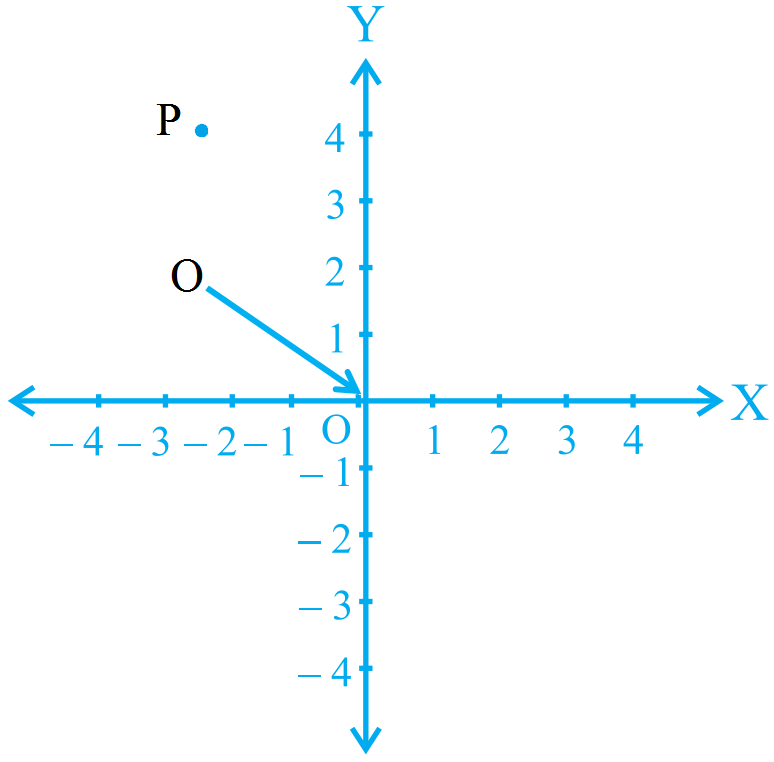
In Figure, coordinates of $P$ are.
- A
$(-4, 2)$
- ✓
$(-2, 4)$
- C
$(4, -2)$
- D
$(2, -4)$
AnswerCorrect option: B. $(-2, 4)$
Here, given point $P$ lies in II quadrant, so its abscissa will be negative and ordinate wilt be positive. Also, its perpendicular distance from $X-$axis is $4$, so $y-$coordinate of $P$ is $4$ and its perpendicular distance from $Y-$axis is $2$, so $x-$coordinate is $-2$. Hence, coordinates of $P$ are $(-2, 4).$
View full question & answer→MCQ 1681 Mark
$P(5, -7)$ be a point on the graph. Draw the $PM$ $\perp$ $y-$axis. The coordinates of $M$ are
- A
$(-7, 0)$
- ✓
$(0, -7)$
- C
$(-7, 5)$
- D
$(0, 0)$
AnswerCorrect option: B. $(0, -7)$
Here, $PM$ Perpendicular to $y-$axis.
So point $M$ lies on the $y-$axis, and for any point on $y-$axis always the value of $x = 0.$
So, Co-ordinate of $M = (0, -7).$
View full question & answer→MCQ 1691 Mark
The point of intersect of the coordinate axes is:
AnswerThe point of intersection of co-ordinate axes i.e. $X-$axis and $Y-$axis is $(0, 0),$ which is called origin.
View full question & answer→MCQ 1701 Mark
The perpendicular distance of the point $P(-2, -3)$ from the $y-$axis is:
- A
$3$ units
- B
$-2$
- ✓
$2$ units
- D
$-3$
AnswerCorrect option: C. $2$ units
Perpendicular distance of any point from $y-$axis is the given $x-$coordinate of point,
So distance $= 2$ units
View full question & answer→MCQ 1711 Mark
The area of the triangle formed by the points $P(0,1), Q(0, 5)$ and $R(3, 4)$ is:
- A
$4$ sq. units
- B
$8$ sq. units
- ✓
$6$ sq. units
- D
$16$ sq. units
AnswerCorrect option: C. $6$ sq. units
Given that the points$P(0, 1), Q(0, 5)$ and $R(3, 4)$ form a triangle.
We are asked to find the area of the triangle $\triangle\text{PQR}$ which is shown in the figure.
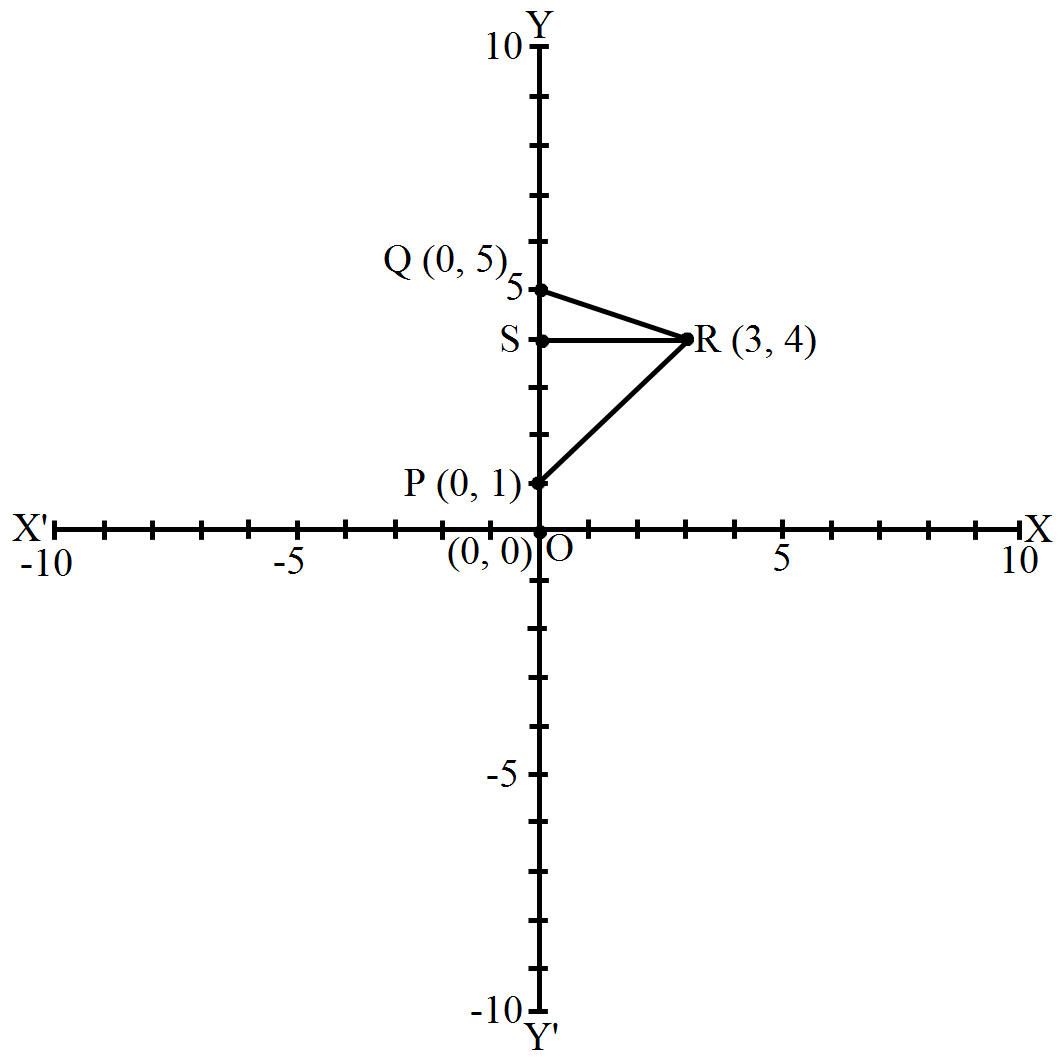
Given that
$OP = 1$ and $OQ = 5$
Hence,
$PQ = OQ - OP = 5 - 1 = 4$ and $RS = 3$
By using formula,
$PQR = 12 \times PQ \times RS$
$= 12 \times 4 \times 3$
$= 6$ sq. units
View full question & answer→MCQ 1721 Mark
Write the correct answer in the following: Abscissa of a point is positive in:
- A
$I$ and $II$ quadrants.
- ✓
$I$ and $IV$ quadrants.
- C
$I$ quadrant only.
- D
$II$ quadrant only.
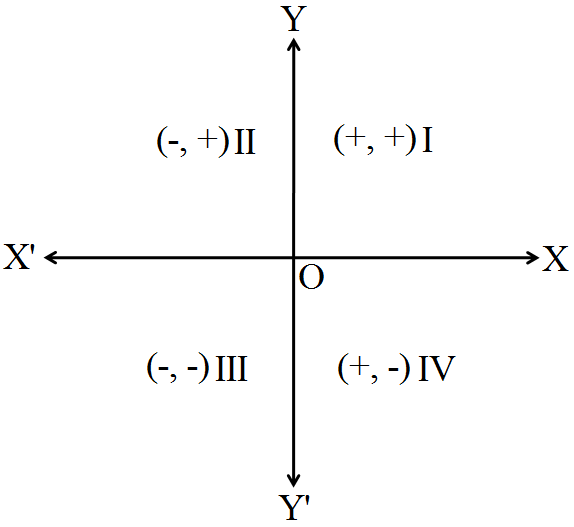
AnswerCorrect option: B. $I$ and $IV$ quadrants.
Abscissa of a point is positive in $I$ and $IV$ quadrants.
View full question & answer→MCQ 1731 Mark
The distance of the point $(-6, -2)$ from $y-$axis is:
- A
$2$ units
- ✓
$6$ units
- C
$38$ units
- D
$8$ units
AnswerCorrect option: B. $6$ units
Distance from $y-$axis is the $x$ co-ordinate of another given point,So, distance $= 6$, (since distance cannot be negative)
View full question & answer→MCQ 1741 Mark
The point whose ordinate is $6$ and which point lies on the $y-$axis?
- ✓
On $y-$axis
- B
On $x-$axis
- C
In quadrant $IV$
- D
In quadrant $III$
AnswerCorrect option: A. On $y-$axis
If the $x$ co-ordinate of a point is zero, then this point always lies on $y-$axis.
View full question & answer→MCQ 1751 Mark
Write the correct answer in the following:
Signs of the abscissa and ordinate of a point in the second quadrant are respectively:
- A
$+, +$
- B
$-, -$
- ✓
$-, +$
- D
$+, -$
AnswerCorrect option: C. $-, +$
Signs of the abscissa and ordinate of a point in the second in the second quadrant a$-, +$
View full question & answer→MCQ 1761 Mark
If $x-1$ if the factor of $p(x)= x^3-23 x^2+k x-120$, then the value of $'k'$ is:
AnswerIf $x-1$ is a factor of $p(x)$, then$\mathrm{p}(1)=0$
$(1)^3-23(1)^2+\mathrm{k}(1)-120=0$
$1-23+\mathrm{k}-120=0$
$1-143+\mathrm{k}=0$
$-142+\mathrm{k}=0$
$\mathrm{k}=142$
View full question & answer→MCQ 1771 Mark
Points $(1, -1), (2, -2), (4, -5), (-3, -4).$
- A
Lie in $IV$ quadrant.
- ✓
Do not lie in the same quadrant.
- C
Lie in $III$ quadrant.
- D
Lie in $II$ quadrant.
AnswerCorrect option: B. Do not lie in the same quadrant.
In points $(1,-1),(2,-2)$ and $(4,-5) x$-coordinate is positive and $y$-coordinate is negative, So, they all lie in $IV$ quadrant. In point $(-3,-4) x$-coordinate is negative and $y$-coordinate is negative. So, it lies in $III$ quadrant.
So, given points do not lie in the same quadrant.
View full question & answer→MCQ 1781 Mark
If $x < 0$ and $y > 0$, then the point $(x, y)$ lies in.
- A
$I$ Quadrant
- ✓
$II$ Quadrant
- C
$IV$ Quadrant
- D
$III$ Quadrant
AnswerCorrect option: B. $II$ Quadrant
Here, $x<0$ (i.e -ve) and $y>0$, (i.e, +ve)
So in 2nd quadrant value of ( $x, y$ ) is
$(-,+)$ so the given point will lie in $2$ nd quadrant.
View full question & answer→MCQ 1791 Mark
The points $(-5,3)$ and $(3, -5)$ lie in the.
- A
- B
$II$ and $III$ quadrants respectively.
- C
$IV$ and $II$ quadrants respectively.
- ✓
$II$ and $IV$ quadrants respectively.
AnswerCorrect option: D. $II$ and $IV$ quadrants respectively.
$II$ and $IV$ quadrants respectively, as in $II$ quadrant abscissa is negative and ordinate in positive, on the other hand in $IV$ quadrant abscissa is positive and ordinate is negative.
View full question & answer→MCQ 1801 Mark
The distance of the point $P(4, 3)$ from the origin is:
AnswerPoint $P(4, 3)$ and Origin $O(0, 0)$
Required distance $=\text{OP}=\sqrt{(0-4)^2+(0-3)^2}$ (by distance formula)
$=\sqrt{16+9}$
$=\sqrt{25}$
$=5$
View full question & answer→MCQ 1811 Mark
If the $y$ co-ordinate of a point is zero, then this point always lies:
- A
In quadrant $I$
- B
In quadrant $II$
- C
On $y-$axis
- ✓
On $x-$axis
AnswerCorrect option: D. On $x-$axis
Every point on the $x-$axis is of the form $(a, 0)$. This means abscissa can be any real number but ordinate is always $0$.
View full question & answer→