Questions

3 Marks Question

Take a timed test

10 questions · self-marked practice — reveal the answer and mark yourself.

Question 13 Marks
Draw a histogram for the daily earning of 30 drug stores in the following table:
Daily earning (in ₹): $450-500$ $500-550$ $550-600$ $600-650$ $650-700$
Number of stores: $16$ $10$ $7$ $3$ $1$
View full question & answer
Question 23 Marks
Read the following bar graph and answer the following questions:
$i.$  What is the information given by the bar graph?
$ii.$ State each of the following whether true or false.
$a.$ The number of government companies in $1957$ is that of $1982$ is $1 : 9$.
$b.$ The number of government companies has decreased over the year $1957$ to $1983$.
Answer
$i.$ The bar graph represents the number of government companies in India during some years.
$a.$ The number of companies in $1957$ was $50$ and the number of companies in $1982$ was $375$.
Their ratio in that order is $50 : 375 = 2 : 15$
Hence, the statement is false.
$b.$ The height of the bar graphs increases over the years $1957$ to $1983$.
Hence, the statement is false.
$2 : 15$
View full question & answer
Question 33 Marks
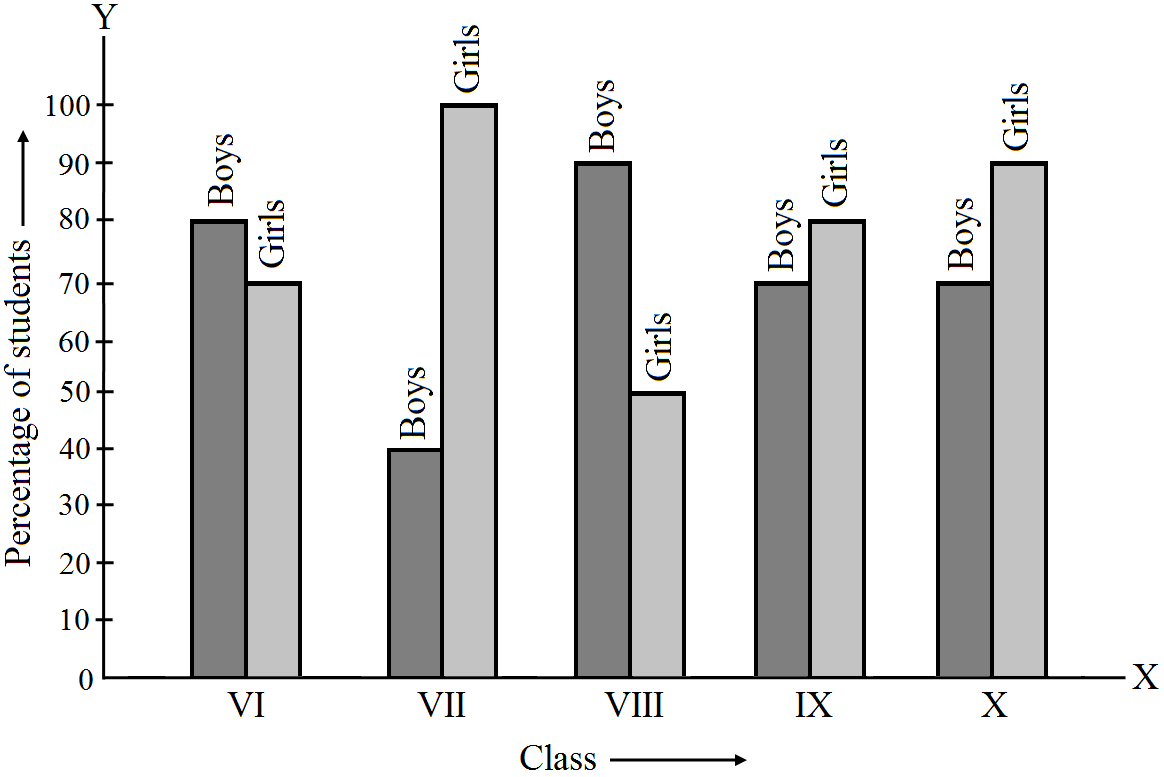
The following bar graph shows the results of an annual examination in a secondary school. Read the bar graph and choose the correct alternative in each of the following:

$i.$ The pair of classes in which the results of boys and girls are inversely proportional are:
$a. VI, VIII$
$b. VI, IX$
$c. VII, IX$
$d. VIII, X$
$ii.$ The class having the lowest failure rate of girls is:
$a. VI$
$b. X$
$c. IX$
$d. VIII$
$iii.$ The class having the lowest pass rate of students is:
$a. VI$
$b. VII$
$c. VIII$
$d. IX$
Answer
$i.$ The pair of classes in which the results of boys and girls are inversely proportional are $VI$ and $IX$.
$ii.$ The lowest failure rate of girls is same to the highest pass rate.
Hence, the class having the lowest failure rate of girls is $VII ($the height of the bar corresponding to girls for this class is maximum$)$.
$iii.$ The sum of the heights of the bars for boys and girls in class $VII$ is minimum, which is $95 + 40 = 135$.
Hence, the class having the lowest pass rate is $VII$.
Hence, the correct choice is $(b)$.
View full question & answer
Question 43 Marks
Construct a histogram for the following data:
Monthly School fee (in ₹): $30-60$ $60-90$ $90-120$ $120-150$ $150-180$ $180-210$ $210-240$
No of schools $5$ $12$ $14$ $18$ $10$ $9$ $4$
View full question & answer
Question 53 Marks
The following is the distribution of total household expenditure (in ₹) of manual worker in a city:
Expenditure (in ₹): $100-150$ $150-200$ $200-250$ $250-300$ $300-350$ $350-400$ $400-450$ $450-500$
No. of manual workers: $25$ $40$ $33$ $28$ $30$ $22$ $16$ $8$
Draw a histogram and a frequency polygon representing the above data.
View full question & answer
Question 63 Marks
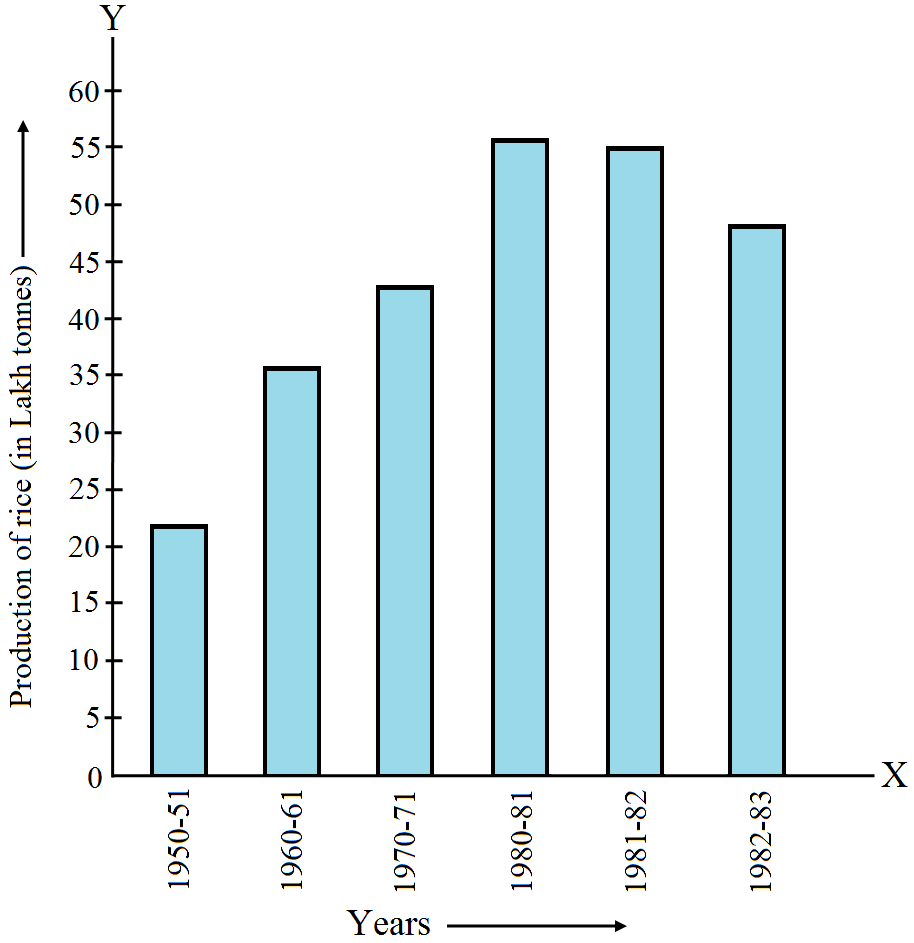
Read the bar graph given in and answer the following questions:
$i.$ What information is given by the bar graph?
$ii.$ What was the crop$-$production of rice in $1970–71?$
$iii.$ What is the difference between the maximum and minimum production of rice?

Answer
$ i.$ The bar graph represents the production of the rice crop in India in different years.
$ii.$  According to the height of the $3^{\text {rd }}$ bar from the left, the crop$-$production of rice in $1970-71$ is $42.5$ lakh tones.
$ iii.$  The maximum product of rice is $55$ lakh tones $($height of the $4^{\text {th }}$ bar from the left$)$ in the year $1980-81$ and the minimum product of rice is $22$ lakh tones $($height of the $1^{\text {st }}$ bar from the left$)$ in the year $1950-51$.
Hence, the difference between maximum and minimum production of rice $($in lakh tones$)$ is $55-22=33$
View full question & answer
Question 73 Marks
The monthly profits (in ₹) of $100$ shops are distributed as follows:
Profits per shop:
$0-50$
$50-100$
$100-150$
$150-200$
$200-250$
$250-300$
No. of shops:
$12$
$18$
$27$
$20$
$17$
$6$
Draw a histogram for the data and show the frequency polygon for it.
View full question & answer
Question 83 Marks
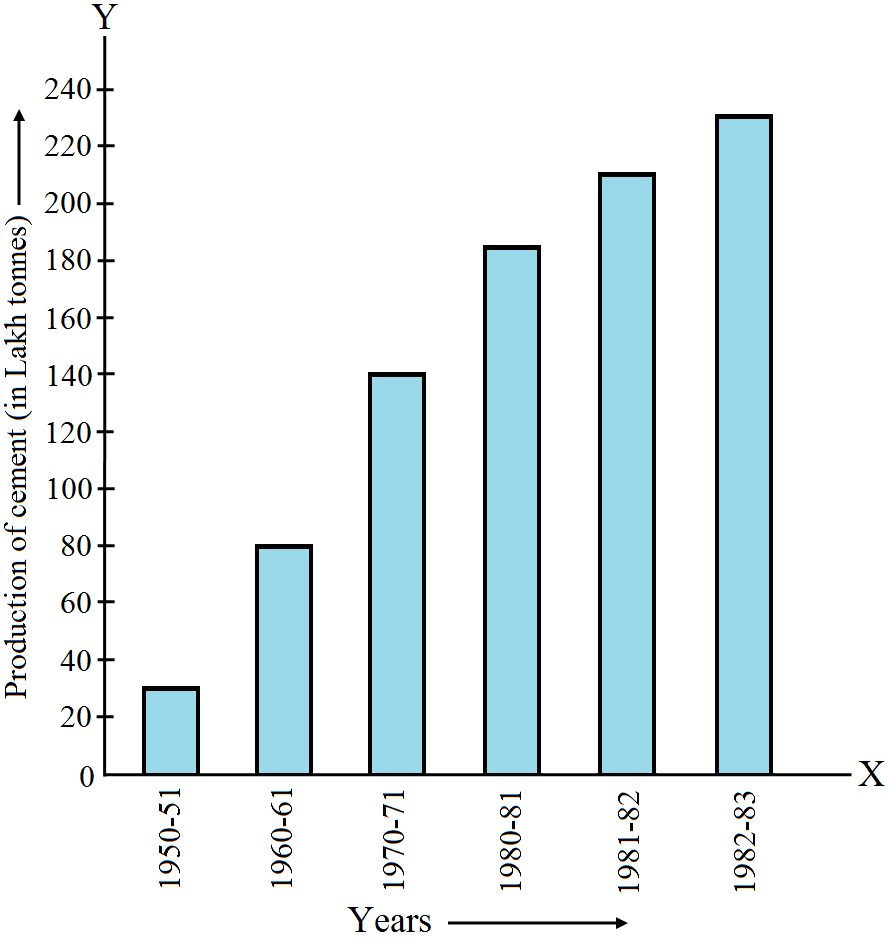
Read the following bar graph and answer the following questions:
$i.$ What information is given by the bar graph?
$ii.$ What was the production of cement in the year $1980–81$?
$iii.$ What are the minimum and maximum production of cement and corresponding years?

Answer
$i.$ The bar graph represents the industrial production of cement in different years in India.
$ii.$ According to the height of the $6^{th}$ bar from the left.
the production of cement in the year $1980–81$ was $186$ lakh tonnes.
$iii.$ According to the heights of the bars.
The minimum production of cement is $30$ lakh tonnes in the year $1950–51$ and the maximum production of cement is $232$ lakh tonnes in the year $1982–83$.
View full question & answer
Question 93 Marks
The distribution of height (in cm) of 96 children is given below. Construct a histogram and a frequency polygon on the same axes.
Height (in cm): $124$ to $128$ $128$ to $132$ $132$ to $136$ $136$ to $140$ $140$ to $144$ $144$ to $148$ $148$ to $152$ $152$ to $156$ $156$ to $160$ $160$ to $164$
No. of children: $5$ $8$ $17$ $24$ $16$ $12$ $6$ $4$ $3$ $1$
View full question & answer
Question 103 Marks
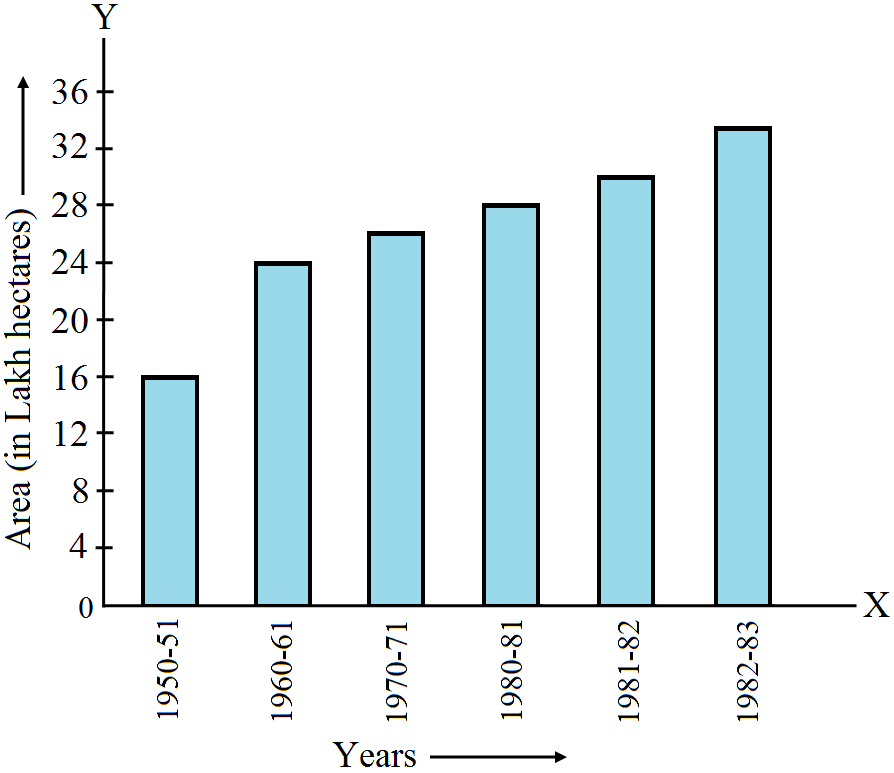
Read the graph given in figure and answer the following question:
$i.$ What information is given by the bar given?

$ii.$ In which years the areas under the sugarcane crop were the maximum and the minimum?
$iii.$ State whether true or false:
The area under sugarcane crop in the year $1982–83$ is three times that of the year $1950–51$.
Answer
$i.$ The bar graph represents the areas $($in lakh hectares$)$ under sugarcane crop during different years in India.
$ii.$ It is seen from the bar graph that the area under the sugarcane crop is maximum in the year $1982–83$ and minimum in the year $1950–51$.
$iii.$ The area under the sugarcane crop in the years $1982–83$ and $1950-51$ are $34$ lakh hectares and $18$ lakh hectares respectively.
Clearly, $34$ is not equal to $3$ multiplied by $18$.
Hence, the statement is false.
View full question & answer