Question 13 Marks
Show that the line segments joining the mid-points of opposite sides of a quadrilateral bisect each other.
Answer
View full question & answer→Given: $A$ quadrilateral $ABCD$ in which $EG$ and $FH$ are the line-segments joining the mid-points of opposite sides of a quadrilateral.
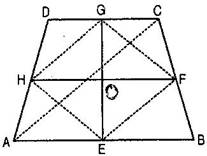
To prove: $EG$ and $FH$ bisect each other.
Construction: Join $AC, EF, FG, GH$ and $HE.$
Proof: $\ln A B C, E$ and $F$ are the mid-points of respective sides $A B$ and $B C$.
$\therefore E F \| A C$ and $E F=\frac{1}{2} A C..........(i)$
Similarly, in $ADC,$
$G$ and $H$ are the mid-points of respective sides $C D$ and $A D$.
$\therefore HG \| AC$ and $HG =\frac{1}{2} AC$.
From eq. $(i)$ and $(ii),$ we get,
$EF \| HG$ and $EF = HG$
$\therefore EFGH$ is a parallelogram.
Since the diagonals of a parallelogram bisect each other, therefore line segments (i.e. diagonals) $EG$ and $FH$ (of parallelogram $EFGH$) bisect each other.
Hence Proved.
To prove: $EG$ and $FH$ bisect each other.
Construction: Join $AC, EF, FG, GH$ and $HE.$
Proof: $\ln A B C, E$ and $F$ are the mid-points of respective sides $A B$ and $B C$.
$\therefore E F \| A C$ and $E F=\frac{1}{2} A C..........(i)$
Similarly, in $ADC,$
$G$ and $H$ are the mid-points of respective sides $C D$ and $A D$.
$\therefore HG \| AC$ and $HG =\frac{1}{2} AC$.
From eq. $(i)$ and $(ii),$ we get,
$EF \| HG$ and $EF = HG$
$\therefore EFGH$ is a parallelogram.
Since the diagonals of a parallelogram bisect each other, therefore line segments (i.e. diagonals) $EG$ and $FH$ (of parallelogram $EFGH$) bisect each other.
Hence Proved.