Sample QuestionsQuadrilaterals questions
One sample from each question group in this chapter. Select any group above to see the full set with answer keys.
If the diagonals of a quadrilateral bisect each other at right angles then the figure is a:
Answer: B.
View full solution →What is the length of $PQ$ in a trapezium $ABCD$ in which $\text{AB || DC}$ and P and Q are mid-points on $AD$ and $BC$ respectively?
Answer: B.
View full solution →Write the correct answer in the following: $ABCD$ is a rhombus such that $\angle\text{ACB}=40^\circ.$ then $\angle\text{ADB}$ is:
- A
$40^\circ$
- B
$45^\circ$
- ✓
$50^\circ$
- D
$60^\circ$
Answer: C.
View full solution →Three angles of a quadrilateral are in the ratio $3 : 4 : 5 : 6.$ The smallest of these angles is:
- ✓
$60^\circ$
- B
$80^\circ$
- C
$45^\circ$
- D
$48^\circ$
Answer: A.
View full solution →Three statements are given below:
$i.$ In a rectangle $\text{ABCD}$, the diagonal $AC$ bisects $\angle\text{A}$ as well as $\angle\text{C}.$
$ii.$ In a square $\text{ABCD}$, the diagonal $AC$ bisects $\angle\text{A}$ as well as $\angle\text{C}.$
$iii.$ In a rhombus $\text{ABCD}$, the diagonal $AC$ bisects $\angle\text{A}$ as well as $\angle\text{C}.$
Which is true?
- A
$I$ only
- ✓
$II$ and $III$
- C
$I$ and $III$
- D
$I$ and $II$
Answer: B.
View full solution →Directions: In the following questions, the Assertions $(A)$ and Reason(s) $(R)$ have been put forward. Read both the statements carefully and choose the correct alternative from the following:
Assertion: All quadrilateral are not parallelogram.
Reason: Quadrilateral that don’t have parallel side.
- ✓
Both Assertion and Reason are correct and Reason is the correct explanation for Assertion.
- B
Both Assertion and Reason are correct and Reason is not the correct explanation for Assertion.
- C
Assertion is true but the reason is false.
- D
Both assertion and reason are false.
Answer: A.
View full solution →Directions: In the following questions, the Assertions $(A)$ and Reason(s) $(R)$ have been put forward. Read both the statements carefully and choose the correct alternative from the following:
Assertion: The interior angle of a rectangle at each vertex is $90^\circ $.
Reason: The sum of all interior angles is $360^\circ$ .
- ✓
Both Assertion and Reason are correct and Reason is the correct explanation for Assertion.
- B
Both Assertion and Reason are correct and Reason is not the correct explanation for Assertion.
- C
Assertion is true but the reason is false.
- D
Both assertion and reason are false.
Answer: A.
View full solution →Directions: In the following questions, the Assertions $(A)$ and Reason(s) $(R)$ have been put forward. Read both the statements carefully and choose the correct alternative from the following:
Assertion: Every trapazoid is a parallelogram.
Reason: A trapazoid is a quadrilateral whose opposite side are parallel.
- A
Both Assertion and Reason are correct and Reason is the correct explanation for Assertion.
- B
Both Assertion and Reason are correct and Reason is not the correct explanation for Assertion.
- C
Assertion is true but the reason is false.
- ✓
Both assertion and reason are false.
Answer: D.
View full solution →Directions: In the following questions, the Assertions $(A)$ and Reason(s) $(R)$ have been put forward. Read both the statements carefully and choose the correct alternative from the following:
Assertion: Kite is not rhombus.
Reason: Because only one adjacent pair of side are equal and only one pair of opposite angle are equal.
- ✓
Both Assertion and Reason are correct and Reason is the correct explanation for Assertion.
- B
Both Assertion and Reason are correct and Reason is not the correct explanation for Assertion.
- C
Assertion is true but the reason is false.
- D
Both assertion and reason are false.
Answer: A.
View full solution →Directions: In the following questions, the Assertions $(A)$ and Reason(s) $(R)$ have been put forward. Read both the statements carefully and choose the correct alternative from the following:
Assertion: A rectangle is $12\ cm$ wide, and $5\ cm$ tall, $13\ cm$ is the length of a diagonal.
Reason: A rectangle is $12\ cm$ wide, and $5\ cm$ tall, $13\ cm$ is the length of a diagonal.
- ✓
Both Assertion and Reason are correct and Reason is the correct explanation for Assertion.
- B
Both Assertion and Reason are correct and Reason is not the correct explanation for Assertion.
- C
Assertion is true but the reason is false.
- D
Both assertion and reason are false.
Answer: A.
View full solution →If all the angles of a quadrilateral are equal, it is a parallelogram.
In a parallelogram, the diagonals intersect each other at right angles.
In any quadrilateral, if a pair of opposite sides is equal, it is a parallelogram.
In a parallelogram, the diagonals are equal.
If three sides of a quadrilateral are equal, it is a parallelogram.
If one pair of opposite sides are equal and parallel, then the figure is _____________. (parallelogram, rectangle, trapezium).
If in a quadrilateral only one pair of opposite sides are parallel, the quadrilateral is _____________. (square, rectangle, trapezium).
The figure formed by joining the mid-points of consecutive sides of a quadrilateral is ____________.
The triangle formed by joining the mid-points of the sides of an isosceles triangle is ____________.
If both pairs of opposite sides of a quadrilateral are equal, then it is necessarily a _________. (rectangle, parallelogram, rhombus).
$ABCD$ is a rhombus show that diagonal $AC$ bisects $\angle $A as well as $\angle C$ and diagonal $BD$ bisects $\angle B$ as well as $\angle D$
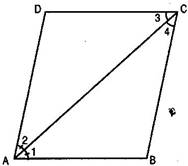
View full solution →Diagonal $AC$ of a parallelogram $\text{ABCD}$ bisects $\angle A ($See figure$).$ Show that:
$i.$ It bisects $\angle C$ also.
$ii. \text{ABCD}$ is a rhombus.
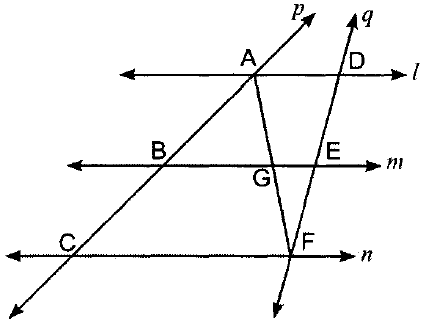
View full solution →$I, m$ and $n$ are three parallel lines intersected by transversal $p$ and $q$ such that $I, m$ and $n$ cut-off equal intercepts $A B$ and $B C$ on $p$ Show that $I, m$ and $n$ cut-off equal intercepts $D E$ and $E F$ on $q$ also.
View full solution →In $\triangle ABC, D, E$ and $F$ are respectively the mid-points of sides $AB, BC$ and $CA$. Show that $\triangle ABC$ is divided into four congruent triangles by joining $D, E$ and $F.$
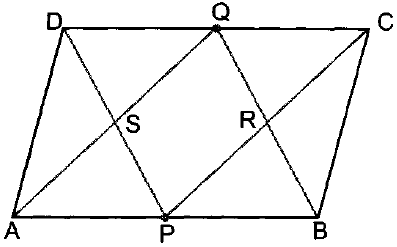
View full solution →$\text{ABCD}$ is a parallelogram in which $P$ and $Q$ are the mid$-$points of opposite sides $A B$ and $C D$. If $A Q$ intersects $D P$ at $S$ and $B Q$ intersects $C P$ at $R$, show that
$i. \text{APCQ}$ is a parallelogram
$ii. \text{DPBQ}$ is a parallelogram
$iii. \text{PSQR}$ is a parallelogram
View full solution →Show that the line segments joining the mid-points of opposite sides of a quadrilateral bisect each other.
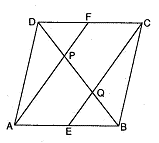
In a parallelogram $ABCD$, $E$ and $F$ are the mid-points of sides $AB$ and $CD$ respectively. Show that the line segments $AF$ and $EC$ trisect the diagonal $BD.$
View full solution →$ABCD$ is a trapezium in which $AB || DC, BD$ is a diagonal and $E$ is the mid-point of $AD$. A line is drawn through $E$ parallel to $AB$ intersecting $BC$ at $F$. Show that F is the mid-point of $BC.$
View full solution →Show that if the diagonals of a quadrilateral bisect each other at right angles, then it is a rhombus.
If the diagonals of a parallelogram are equal, then show that it is a rectangle.
$\text{ABC}$ is a triangle right angled at $C$. A line through the mid$-$point $M$ of hypotenuse $AB$ and parallels to $BC$ intersects $AC$ at $D$.Show that :
$i. D$ is the mid$-$point of $AC$
$ii. MD$ $\perp$ $AC$
$iii. CM = MA = $ $\frac{1}{2}$AB
View full solution →$ABCD$ is a rectangle and $P, Q, R$ and $S$ are mid-points of the sides $AB, BC, CD$ and $DA$ respectively. Show that quadrilateral $PQRS$ is a rhombus.
View full solution →$A B C D$ is a rhombus and $P, Q, R$ and $S$ are the mid-points of the sides $A B, B C, C D$ and $D A$ respectively. Show that the quadrilateral $PQRS$ is a rectangle.
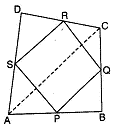
View full solution →$A B C D$ is a quadrilateral in which $P, Q, R$ and $S$ are mid-points of the sides $A B, B C, C D$ and $D A . A C$ is a diagonal. Show that
i. $S R \| A C$ and $S R=\frac{1}{2} A C$
ii. $P Q=S R$
iii. $PQRS$ is a parallelogram.
View full solution →In parallelogram $A B C D$, two points $P$ and $Q$ are taken on diagonal $B D$ such that $D P=B Q$.
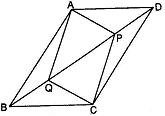
Show that
i. $\triangle APD \cong \triangle C Q B$
ii. $A P=C Q$
iii. $\triangle A Q B \cong \triangle C P D$
iv. $A Q=C P$
v. $APCQ$ is a parallelogram. View full solution →The figure below shows the side view of a shopping trolley. The metal plate is fixed on the side by the store keeper for advertisement.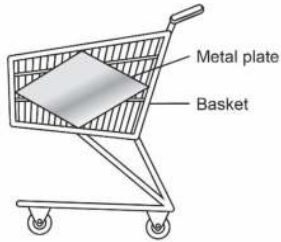
$6.$ Three angles of the basket are obtuse. Which type of angle is the fourth$?$
$A.$ Acute
$B.$ Obtuse
$C.$ Right
$D.$ Relex
$7.$ What is the shape of the metal plate$?$
$A.$ Square
$B.$ ectangle
$C.$ Rhombus
$D.$ Parallelogram View full solution →Atul likes to observe the stars with his telescope. He likes to track the movements of stars in the sky.
He took a picture of the night sky one day. On that day, Mars was equidistant from Saturn and Jupiter.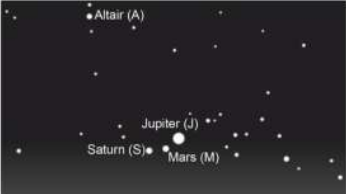
He draws a circle such that the dots showing the planets Mars $(M),$ Jupiter $(J),$ Saturn $(S)$ and a star Altair $(A)$ lies on the boundary of a circle and $\angle SMJ = 150^\circ .$
$1.$ What is the measure of $\angle SAJ?$
$A. 30^\circ $
$B. 45^\circ $
$C. 150^\circ $
$D. 210^\circ $
$2.$ Atul claims that the quadrilateral $MJAS$ is a kite.
What additional information is required to conirm his claim$?$
$A.$ Distance between Altair and Saturn is equal to the distance between Mars and Jupiter.
$B.$ Distance between Altair and Jupiter is equal to the distance between Mars and Saturn.
$C.$ Distance between Altair and Saturn is equal to the distance between Altair and Mars.
$D.$ Distance between Altair and Saturn is equal to the distance between Altair and Jupiter.
$3.$ The adjacent sides of quadrilateral $A$ are equal to corresponding sides of Quadrilateral $B.$ All angles of Quadrilateral A measure $90^\circ .$ The angles of Quadrilateral $B$ are $120^\circ , 60^\circ , 120^\circ $ and $60^\circ $ respectively.
Which quadrilateral has a greater area? Give reasons.
$4.$ Sanya has a triangular piece of land. She wants to divide it into four equal areas. Suggest a way to do so.
$5.$ Does joining four distinct points always produce a quadrilateral? Justify your answer. View full solution →Read the Source Text given below and answer any four questions:
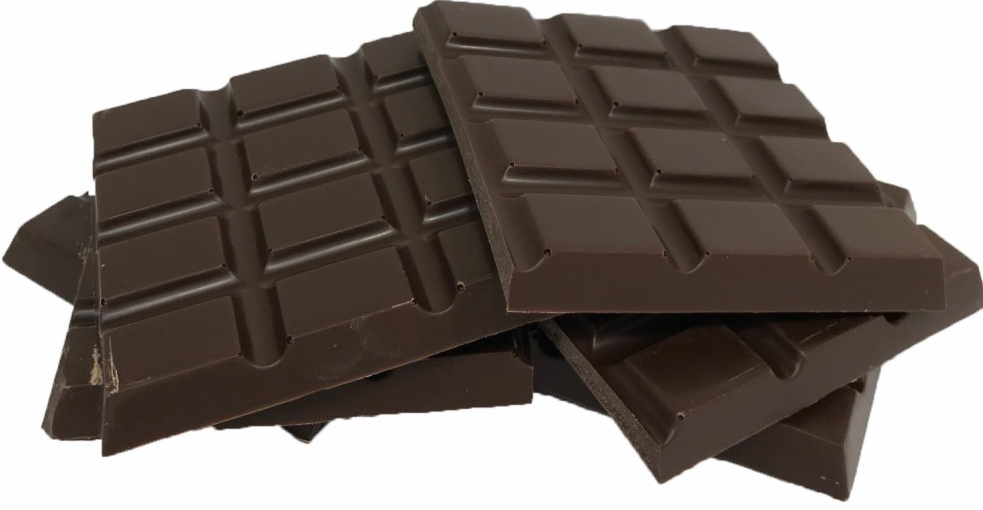
Chocolate is in the form of a quadrilateral with sides $6\ cm$ and $10\ cm, 5\ cm$ and $5\ cm($as shown in the figure$)$ is cut into two parts on one of its diagonal by a lady. Part$-I$ is given to her maid and part $II$ is equally divided among a driver and gardener.
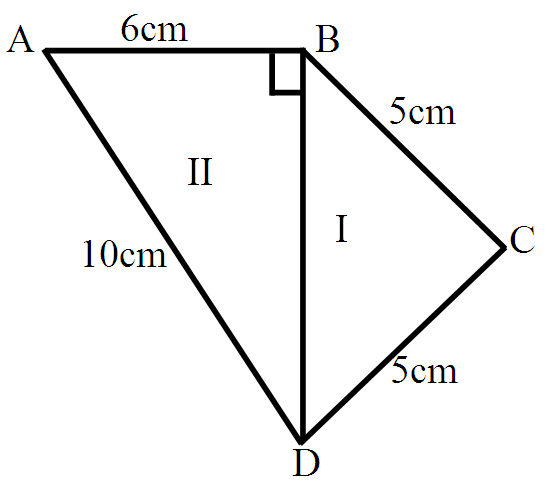
$i.$ Length of $BD:$
$a. 9\ cm$
$b. 8\ cm$
$c. 7\ cm$
$d. 6\ cm$
Area of $\triangle\text{ABC}:$
$a. 24\ cm^2$
$b. 12\ cm^2$
$c. 42\ cm^2$
$d. 21\ cm^2$
The sum of all the angles of a quadrilateral is equal to:
$a. 180^\circ$
$b. 270^\circ$
$c. 360^\circ$
$d. 90^\circ$
A diagonal of a parallelogram divides it into two congruent:
$a.$ Square.
$b.$ Parallelogram.
$c.$ Triangles.
$d.$ Rectangle.
Each angle of the rectangle is:
$a.$ More than $90^\circ$
$b.$ Less than $90^\circ$
$c.$ Equal to $90^\circ$
$d.$ Equal to $45^\circ$ View full solution →Read the Source/ Text given below and answer any four questions: During Maths Lab Activity each student was given four broomsticks of lengths $8\ cm, 8\ cm, 5\ cm, 5\ cm$ to make different types of quadrilaterals.
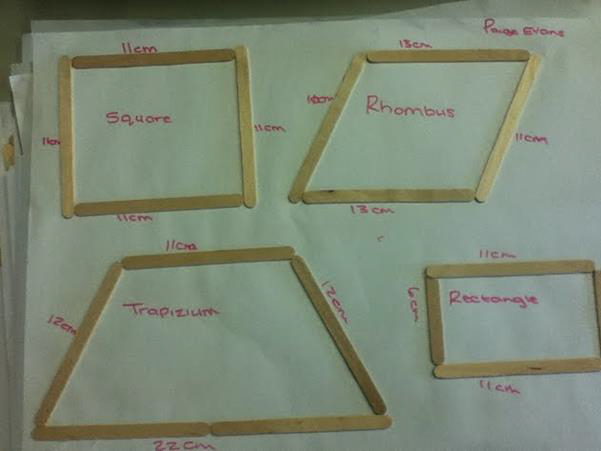
Using the above information answer the following questions:
$i.$ How many quadrilaterals can be formed using these sticks?
$a.$ Only One type of quadrilaterals can be formed.
$b.$ Two types of quadrilaterals can be formed.
$c.$ Three types of quadrilaterals can be formed.
$d.$ Four types of quadrilaterals can be formed.
$ii.$ Name the types of quadrilaterals formed:
$a.$Rectangle, parallelogram, kite.
$b.$ Rectangle, parallelogram, Trapizum.
$c.$, parallelogram, Square.
$d.$Rectangle, Square, kite.
$iii.$ In a trapezium $\text{ABCD}, DC \| AB$ and $\angle\text{A}=\angle\text{B}=45^\circ,$ the teacher asked the student to find $\angle\text{D}.$ Naresh answered it is $...........$
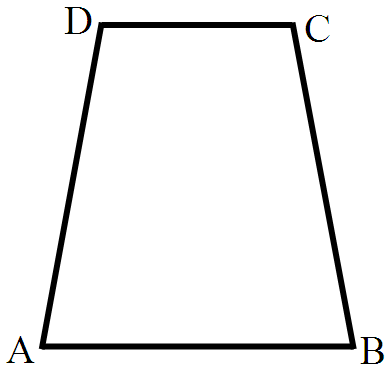
$a. 105^\circ $
$b.108^\circ $
$c.135^\circ $
$d. 125^\circ $
While discussing the properties of a parallelogram teacher asked about the relation between two angles x and y of a parallelogram as shown in fig. The teacher gave them $4$ options as $($if $BC < CD):$
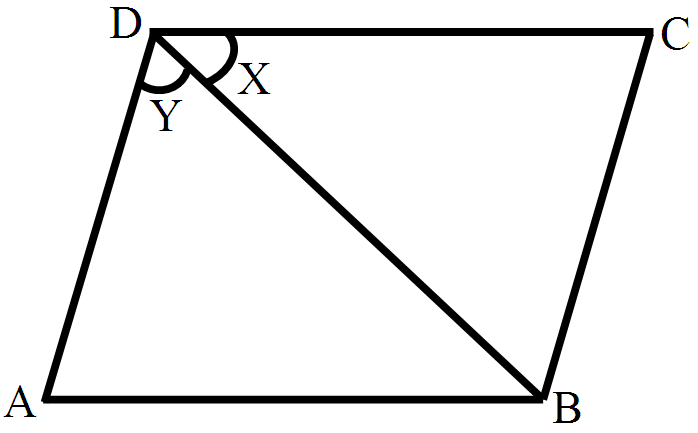
$a.x > y$
$b. x < y$
$c.x = y$
$d.$None of these.
$P, Q, R,$ and $S$ are respectively the mid-points of sides $AB, BC, CD,$ and $DA$ of quadrilateral $ABCD$ in which $AC = BD$ and $\text{AC}\bot\text{BD}, \text{PQRS},$ is a:
$a.$ Square.
$b.$ Rhombus.
$c.$Kite.
$d.$Parallelogram. View full solution →Read the Source/ Text given below and answer these questions:
There is a Diwali celebration in the $DPS$ school Janakpuri New Delhi. Girls are asked to prepare Rangoli in a triangular shape. They made a rangoli in the shape of $\triangle ABC.$ Dimensions of $\triangle\text{ABC}$ are $26\ cm, 28\ cm, 25\ cm.$
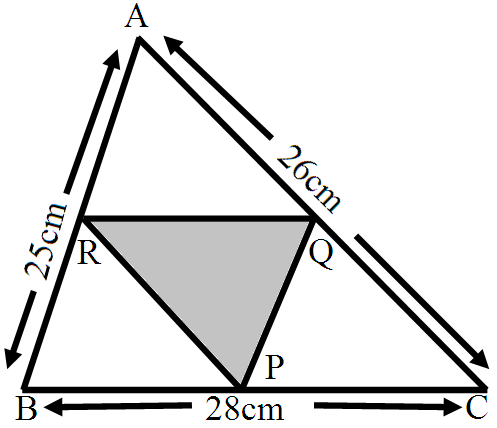
$i.$ In fig, $R$ is mid$-$point of $AB$ and $RQ \| BC$ then $AQ$ is equal to:
$a. BC$
$b. RB$
$c. QC$
$d. AD$
$ii.$ In fig $R$ and $Q$ are mid-points of $AB$ and $AC$ respectively. The length of $RQ$ is:
$a. 14$
$b. 13$
$c. 12.5$
$d.13.5$
$iii.$ If Garland is to be placed along the side of $\triangle\text{QPR}$ which is formed by joining midpoint, what is the length of garland:
$a. 79\ cm$
$b. 39.5\ cm$
$c. 35\ cm$
$d.79.5\ cm$
$iv.$ In the following figure $R, P$ and $Q$ are the mid-points of $AB, BC,$ and $AC$ respectively. Which of the following is the area of $\triangle\text{PQR}?$
$a. \frac12\text{ar (ABC)}$
$b. \frac{1}{3}\text{ar (ABC)}$
$c. \frac14\text{ar (ABC)}$
$d.\frac16\text{ar (ABC)}$
$v. R, P, Q$ are the mid-points of corresponding sides $AB, BC, CA$ in $\triangle\text{ABC}$ the figure so obtained $BPQR$ will be:
$a.$ Parallelogram.
$b.$ Trapezium.
$c.$ Quadrilateral.
$d.$ None of these. View full solution →