Questions

5 Marks Questions

Take a timed test

14 questions · self-marked practice — reveal the answer and mark yourself.

Question 15 Marks
$\text{ABC}$ is a triangle right angled at $C$. A line through the mid$-$point $M$ of hypotenuse $AB$ and parallels to $BC$ intersects $AC$ at $D$.Show that :
$i. D$ is the mid$-$point of $AC$
$ii. MD$ $\perp$ $AC$
$iii. CM = MA = $ $\frac{1}{2}$AB
Answer
Given: $\text{ABC}$ is a triangle right angled at $C$.
A line through the mid$-$point $M$ of hypotenuse $AB$ and parallels to $BC$ intersects $AC$ at $D.$
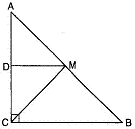
To Prove :
$i. D$ is the mid$-$point of $AC (ii) MD \perp AC$
$ii. CM = MA = \frac{1}{2} AB$
Proof:
$i.$ In $\text{ACB} ,$
As $M$ is the mid$-$point of $A B$ and $M D \| B C$
$\therefore D$ is the mid$-$point of $A C \ldots [$By converse of mid$-$point theorem$]$
$ii.$  As $MD \| B C$ and $A C$ intersects them
$\angle A D M=\angle A C B \ldots [$Corresponding angles$]$
But $\angle ACB =90^{\circ} \ldots [$Given$]$
$\therefore \angle ADM =90^{\circ} \Rightarrow MD \perp AC$
$iii.$ Now $\angle A D M+\angle C D M=180^{\circ} \ldots [$Linear pair axiom$]$
$\angle A D M=\angle C D M=90^{\circ}$
In $\triangle ADM$ and $\triangle CDM$
$A D=C D \ldots[$ As $D$ is the mid$-$point of $A C]$
$\angle A D M=\angle C D M \ldots\left[\right.$ Each $\left.90^{\circ}\right]$
$DM = DM ...[$Common$]$
$\therefore \triangle ADM \cong \triangle CDM \ldots [$By $\text{SAS}$ rule$]$
$\therefore MA = MC \ldots [\text{c.p.c.t.}]$
But $M$ is the mid$-$point of $A B$
$\therefore MA = MB = \frac{1}{2} AB$
$\therefore MA = MC = \frac{1}{2} AB$
$\therefore CM = MA = \frac{1}{2} AB$
View full question & answer
Question 25 Marks
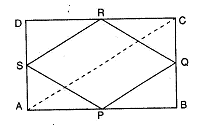
$ABCD$ is a rectangle and $P, Q, R$ and $S$ are mid-points of the sides $AB, BC, CD$ and $DA$ respectively. Show that quadrilateral $PQRS$ is a rhombus.
Answer
$A B C D$ is a rectangle. $P , Q , R$ and S are the mid-points of $AB , BC , CD$ and DA respectively. $PQ , QR , RS$ and $SP$ are joined.
To Prove : Quadrilateral $PQRS$ is a rhombus.
Construction: Join $AC.$

Proof: In $\triangle A B C$
As $P$ and $Q$ are the mid-points of $A B$ and $B C$ respectively. $P Q \| A C$ and $P Q=\frac{1}{2} A C \ldots (1)$
In $\triangle ADC$,
As $S$ and $R$ are the midpoints of $A D$ and $D C$ respectively. $S R \| A C$ and $S R=\frac{1}{2} A C \ldots(2)$
From $(1)$ and $(2)$
$P Q \| S R$ and $P Q=S R$
$\therefore$ Quadrilateral $PQRS$ is a parallelogram $... (3)$
In rectangle $A B C D$,
$A D=B C \ldots$ [Opposite sides]
$\therefore \frac{1}{2} A D=\frac{1}{2} B C \ldots$ [Halves of equals are equal]
$\therefore AS = BQ$
In $\triangle A P S$ and $\triangle B P Q$
As $P$ is the mid-point of $A B$
$A P=B P$
$A S=B Q \ldots$ [As proved above]
$\angle PAS =\angle PBQ \ldots .\left[\right.$ Each $\left.90^{\circ}\right]$
$\therefore \triangle APS \cong \triangle BPQ \ldots[$ By SAS axiom $]$
$\therefore P S=P Q \ldots \text { [c.p.c.t.] . . . (4) }$
According to $(3), (4) PQRS$ is a rhombus.
View full question & answer
Question 35 Marks
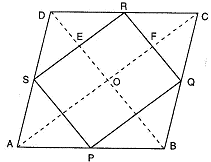
$A B C D$ is a rhombus and $P, Q, R$ and $S$ are the mid-points of the sides $A B, B C, C D$ and $D A$ respectively. Show that the quadrilateral $PQRS$ is a rectangle.
Answer
Given: $A B C D$ is a rhombus, $P, Q, R, S$ are the mid-points of $A B, B C, C D, D A$
respectively. $P Q, Q R, R S$ and $S P$ are joined.
To Prove: PQRS is a rectangle.
Construction: Join AC and BD .

Proof: In $\triangle R D S$ and $\triangle P B Q$
DS = QB . . [Halves of opp. sides of $\| gm$ are equal]
DR = PB . . [Halves of opp. sides of $\| gm$ are equal]
$\angle SDR =\angle QBP \ldots$. .Opp. $\angle s$ of $\| gm$ are equal]
$\therefore \triangle RDS \cong \triangle PBQ$ $\qquad$ [c.p.c.t.]
$\therefore SR = PQ$
In $\triangle R C Q$ and $\triangle P A S$
$R C=A P \ldots$ [Halves of opp. sides of $\| gm$ are equal]
CQ = AS . . [Halves of opp. sides of $\| gm$ are equal]
$\angle R C Q=\angle P A S \ldots$ [Opp. $\angle s$ of $\| gm$ are equal]
$\therefore \triangle R C Q \cong \triangle P A S \ldots$ [c.p.c.t.]
$\therefore RQ = SP$
$\therefore$ In PQRS,
$S R=P Q$ and $R Q=S P$
$\therefore$ PQRS is a parallelogram,
In $\triangle CDB$,
As $R$ and $Q$ are the mid-points of $D C$ and $C B$ respectively.
$\triangle R Q\|D B \therefore R F\| E O$
Similarly, RE || FO
$\therefore$ OFRE is a $\| gm$
As opp. $\angle$s of $\| gm$ are equal and diagonals of rhombus intersect at $90^o$
$\therefore$ $R = EOF = 90^o$
Thus $PQRS$ is a rectangle.
View full question & answer
Question 45 Marks
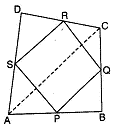
$A B C D$ is a quadrilateral in which $P, Q, R$ and $S$ are mid-points of the sides $A B, B C, C D$ and $D A . A C$ is a diagonal. Show that
i. $S R \| A C$ and $S R=\frac{1}{2} A C$
ii. $P Q=S R$
iii. $PQRS$ is a parallelogram.
Answer
Given: $A B C D$ is a quadrilateral in which $P, Q, R$ and $S$ are mid-points of the sides $A B, B C, C D$ and $D A . A C$ is a diagonal.
To Prove:
i. $S R \| A C$ and $S R=\frac{1}{2} A C$
ii. $P Q=S R$
iii. PQRS is a parallelogram
Proof:
i. In $\triangle D_{A C}$,
As $S$ is the mid-point of $D A$ and $R$ is the mid-point of $D C$
$\therefore S R \| A C$ and $S R=\frac{1}{2} A C \ldots$ [Mid point theorem]
ii. In $\triangle B A C$,
As $P$ is the mid-point of $A B$ and $Q$ is the mid-point of $B C$
$\therefore P Q \| A C$ and $P Q=\frac{1}{2} A C \ldots$ [Mid point theorem]
But from (i) $SR =\frac{1}{2} AC$
$\therefore PQ = SR$
$PQ || AC . . .$[From $(i)]$
$SR || AC . . .$[From $(i)]$
$\therefore$ $PQ || SR . . $.[Two lines parallel to the same line are parallel to each other]
Similarly, $PQ = SR . . .$[From $(ii)]$
$\therefore PQRS$ is a parallelogram . . . [A quadrilateral is a parallelogram if a pair of opposite sides is parallel and is of equal length]
View full question & answer
Question 55 Marks
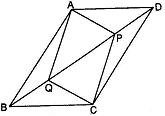
In parallelogram $A B C D$, two points $P$ and $Q$ are taken on diagonal $B D$ such that $D P=B Q$.

Show that
i. $\triangle APD \cong \triangle C Q B$
ii. $A P=C Q$
iii. $\triangle A Q B \cong \triangle C P D$
iv. $A Q=C P$
v. $APCQ$ is a parallelogram.
Answer
In parallelogram $A B C D$, two points $P$ and $Q$ are taken on diagonal $B D$ such that $D P=B Q$.
To Prove :
i. $\triangle APD \cong \triangle C Q B$
ii. $A P=C Q$
iii. $\triangle A Q B \cong \triangle C P D$
iv. $A Q=C P$
v. $APCQ$ is a parallelogram.
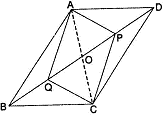
Construction: Join $AC$ to intersect $BD$ at $O .$

i. In $\triangle APD$ and $\triangle CQB$
$A D|\mid B C \ldots$ [Opp. sides of || gm ABCD]
A transversal BD intersects them
$\therefore \angle ADB=\angle CBD \ldots \text { [Alternate angles] } $
$\Rightarrow \angle ADP=\angle CBQ \ldots \text { (1) }$
$DP=BQ \ldots \text { [Given] } \ldots \text { (2) }$
$AD=CB \ldots \text { [Opp. sides of } \| \text { gm } ABCD] \ldots \text { (3) }$
$\text { According to (1), (2), (3) }$
$\triangle APD \cong \triangle CQB$
ii.$\triangle APD  \cong \triangle CQB . . . $[As proved above]
$\therefore AP = CQ . . .$ [c.p.c.t.]
iii.In $\triangle AQB$ and $\triangle CPD,$
$AB || CD . . . . . .$ [Opp. sides of $|| gm ABCD]$
A transversal $BD$ intersects them
$\therefore \angle ABD = \angle CDP . . $.[Alternate angles]
$\Rightarrow \angle ABQ = \angle CDP$
$AQ = CP . . . $.[From $(3)]$
$QB = PD . . . .$[Given]
$AB = CD . . . $.[Opp. sides of $|| gm ABCD]$
$\therefore \triangle AQB \cong \triangle CPD . . $. [By $SAS$ rule]
iv. $\triangle AQB \cong \triangle CPD . . . $[As proved above]
$\therefore AQ = CP . . . $[c.p.c.t]
As the diagonals of a parallelogram bisect each other
$\therefore OB = OD$
$ \therefore OB – BQ = OD – DP . . $.[Given : $BQ = DP]$
$ \therefore OQ = OP . . . (1)$
Also $OA = OC . . . $[As diagonals of a || gm bisect each other] $. . .(2)$
In view of $(1)$ and $(2) APCQ $is a parallelogram.
View full question & answer
Question 65 Marks
$A B C D$ is a rectangle in which diagonal $A C$ bisects $\angle A$ as well as $\angle C$. Show that:
i. $A B C D$ is a square
ii. diagonal $B D$ bisects $\angle B$ as well as $\angle D$.
Answer


Given : $ABCD$ is a rectangle,
$\angle A = \angle C$
$\frac{1}{2} \angle A=\frac{1}{2} \angle C$
To prove: $ABCD$ is a square proof:
i. $\angle DAC =\angle DCA$ ($AC$ bisects $A$ and $C)$
$C D=D A$ (Sides opposite to equal angles are also equal)
However,
$D A=B C$ and $A B=C D$ (Opposite sides of a rectangle are equal)
$AB=BC=CD=DA$
$A B C D$ is a rectangle and all of its sides are equal.
Hence, $A B C D$ is a square
ii. Let us join $BD$
In $\triangle B C D$,
$B C=C D$ (Sides of a square are equal to each other)
$\angle C D B=\angle C B D$ (Angles opposite to equal sides are equal)
However,
$\angle C D B=\angle A B D$ (Alternating interior angles for $A B \| C D$ )
$\angle C B D=\angle A B D$
$B D$ bisects $\angle B$
Also,
$\angle CDB=\angle ABD$
$BD$ bisects $\angle D$.
View full question & answer
Question 75 Marks
Show that if the diagonals of a quadrilateral are equal and bisect each other at right angles, then it is a square.
Answer
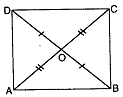
Given: The diagonals $AC$ and $BD$ of a quadrilateral $ABCD$ are equal and bisect each other at right angles.

To Prove : Quadrilateral $ABCD$ is a square.
Proof : In $\triangle OAD$ and $\triangle OCB,$
$OA = OC, OD = OB . . .$ [Given, As diagonals $AC$ and $BD$ of a quadrilateral $ABCD$ are equal and bisect each other ]
$\angle AOD =$ $\angle COB . . .$ [Vertically opposite angles]
$\therefore$ $\triangle OAD$ $\cong$ $\triangle OCB . . .$ [By $SAS$ rule]
$\triangle AD = CB . . .$ [c.p.c.t.]
$\angle ODA =  \angle OBC . . .$ [c.p.c.t.]
$\therefore AD || BC$
As $AD = CB$ and $AD || CB$
$\therefore$ Quadrilateral $ABCD$ is a $|| gm.$
In $\triangle AOB$ and $\triangle AOD,$
$AO = AO . . .$ [Common]
$OB = OD . . .$ [Given]
$\angle AOB =  \angle AOD . . . $[Given : Each $90^o$]
$\therefore \triangle AOB  \cong \triangle AOD . . . $[By $SAS$ rule]
$\therefore AB = AD$
As $A B C D$ is a parallelogram and $A B=A D$
$\therefore A B C D$ is a rhombus.
Again in $\triangle A B C$ and $\triangle B A D$
$A C=B D$
$B C=A D \ldots$ [Given]
$A B=B A \ldots$ [Common]
$\therefore \triangle ABC \cong \triangle BAD \ldots[$ [By SSS rule]
$\therefore \angle A B C=\angle B A D \ldots[\text { c.p.c.t.] }$
As $A D \| B C \ldots$ [Opp. sides of $\|$ gm $A B C D]$
and transversal $AB$ intersects them.
and transversal $A B$ intersects them.
$\angle A B C+\angle B A D=180^{\circ} \ldots$ [Sum of interior angles on the same side of transversal]
$\therefore \angle ABC =\angle BAD =90^{\circ}$
Also, $\angle B C D=\angle A D C=90^{\circ}$
$\therefore ABCD$ is a square.
View full question & answer
Question 85 Marks
Show the diagonals of a square are equal and bisect each other at right angles.
Answer
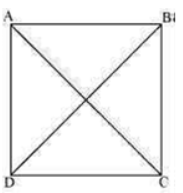
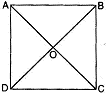
Given: A square $ABCD.$

To Prove : $(i) AC = BD$ and $(ii)$ Diagonals bisect each other at right angles.
Proof :
i. In $\triangle ADB$ and $\triangle BCA$, we have
$A D=B C \ldots[$ As sides of a square are equal]
$\angle B A D=\angle A B C$... [All interior angles are of $90^{\circ}$ ]
$A B=B A \quad . . .[C o m m o n]$
$\triangle A D B \cong \triangle B C A . . .[B y$ SAS rule]
$AC=BD . . .[\text { c.p.c.t.] }]$
ii. Now in $\triangle A O B$ and $\triangle C O D$, we have
$A B=C D$...[Sides of a square]
$\angle A O B=\angle C O D$...[Vertically opp. angles]
$\angle O B A=\angle O D C$...[Alternate interior angles are equal]
$\triangle A O B \cong \triangle C O D$...[By $ASA$ rule]
$O A=O C$ and $O B=O D \ldots[$ [c.p.c.t.] $...(1)$
Now consider $\triangle s A O D$ and $COD.$
$A D=C D$...[Sides of square]
$O A=O C \ldots$ [As proved above]
$O D=O D$...[Common]
$\triangle A O D \cong \triangle C O D \ldots[B y SSS$ rule]
$\angle A O D=\angle C O D$...[c.p.c.t.]
But $\angle A O D+\angle C O D=180^{\circ} \ldots$ [linear pair]
or $\angle A O D+\angle A O D=180^{\circ} \ldots[A s \angle A O D=\angle C O D]$
or $2 \angle AOD =180^{\circ} \therefore \angle A O D=90^{\circ} \ldots (2)$
From equation $(1)$ and $(2)$ it is clear that diagonals of a square bisect each other at right angles.
View full question & answer
Question 95 Marks
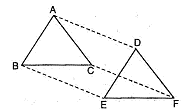
In $\triangle ABC$ and $\triangle DEF, AB = DE, AB \| DE, BC = EF$ and $BC \| EF.$ Vertices $A, B$ and $C$ are joined to vertices $D, E$ and $F$ respectively.

Show that:
$i.$ Quadrilateral $\text{ABED}$ is a parallelogram
$ii.$ Quadrilateral $\text{BECF}$ is a parallelogram
$iii.  AD \| CF$ and $AD = CF$
$iv.$ quadrilateral $\text{ACFD}$ is a parallelogram
$v. AC = DF$
$vi. \triangle ABC \cong \triangle DEF.$
Answer
Given : In $\triangle ABC$ and $\triangle DEF, AB = DE, AB \| DE, BC = EF$ and $BC \| EF. $
Vertices $A, B$ and $C$ are joined to vertices $D, E$ and $F$ respectively.
To prove:
$i.$ Quadrilateral $\text{ABED}$ is a parallelogram
$ii.$ Quadrilateral $\text{BECF}$ is a parallelogram
$iii. AD \| CF$ and $AD = CF$
$iv.$ quadrilateral $\text{ACFD}$ is a parallelogram
$v. AC = DF$
$vi. \triangle ABC \cong \triangle DEF.$
Proof :
$i.$ In quadrilateral $\text{ABED}$
$AB = DE$ and $AB \| DE . . .[$Given$]$
$\therefore$ quadrilateral $\text{ABED}$ is a parallelogram $. . .[$As a quadrilateral is a parallelogram if a pair of opposite sides is of equal length$]$
$ii.$ In quadrilateral $\text{BECF}$
$BC = EF$ and $BC \| EF . . .[$Given$]$
$ \therefore$ quadrilateral $\text{BECF}$ is a parallelogram $. . .[$As a quadrilateral is a parallelogram if a pair of opposite sides is of equal length$]$
$iii.$ As $\text{ABED}$ is a parallelogram $. . .[$As proved in $(i)]$
$\therefore AD \| BE$ and $AD = BE . . .[$As opp. sides of $\| gm$ are parallel and equal$]. . . .(1)$
As $\text{AEFC}$ is a parallelogram $. . .[$As proved in $(ii)]$
$\therefore BE \| CF$ and $BE = CF . . .[$As opp. sides of $\| gm$ are parallel and equal$]. . . .(2)$
$AD \| CF$ and $AD = CF . . . [$From $(1)$ and $(2)]$
$iv.$ In quadrilateral $\text{ACFD},$
$AD \| CF$ and $AD = CF . . .[$From $(iii)]$
$\therefore$ quadrilateral $\text{ACFD}$ is a parallelogram $. . .[$As a quadrilateral is a parallelogram if a pair of opposite sides is of equal length$]$
$v. \text{ACFD}$ is a parallelogram
$\therefore AC \| DF$ and $AC = DF . .[$In a parallelogram opposite sides are parallel and of equal length$]$
$vi.$ In $\Delta ABC$ and $\Delta DEF,$
$AB = DE . . . [$As $\text{ABED}$ is a parallelogram$]$
$BC = EF . . . [$As $\text{BEFC}$ is a parallelogram$]$
$AC = DF . . .[$As proved in $(v)]$
$\therefore \triangle ABC \cong \triangle DEF . . .[$By $\text{SSS}$ rule$]$
View full question & answer
Question 105 Marks
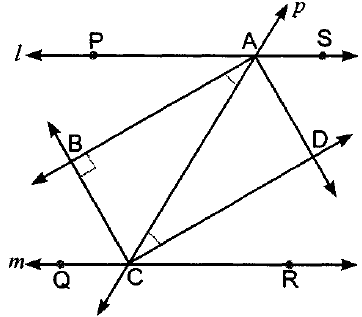
Two parallel lines l and m are intersected by a transversal p. Show that the quadrilateral formed by the bisectors of interior angles is a rectangle.
Answer


Here, it is given that $Q R \| P S$ and transversal $p$ intersects them at points $A$ and $C$ respectively.
The bisectors of $\angle A C R$ and $\angle S A C$ intersect at $D$ and the bisectors of $\angle P A C$ and $\angle A C Q$ intersect at $B$.
We have to prove that quadrilateral $A B C D$ is a rectangle.
From the given figure, we have
$\angle PAC =\angle ACR$ [Alternate angles as I $\| m$ and p is a transversal]
So, $\frac{1}{2} \angle PAC =\frac{1}{2} \angle ACR$
i.e., $\angle B A C=\angle A C D$
These form a pair of alternate angles for lines $A B$ and $D C$ with $A C$ as a transversal and they are equal also.
So, $A B \| D C$
Similarly, $B C \| A D$ [Considering $\angle A C B$ and $\angle C A D]$
Therefore, quadrilateral $A B C D$ is a parallelogram
Also, $\angle PAC +\angle CAS =180^{\circ}$ [ by the property of Linear pair ]
So, $\frac{1}{2} \angle PAC +\frac{1}{2} \angle CAS =\frac{1}{2} \times 180^{\circ}=90^{\circ}$
or, $\angle B A C+\angle C A D=90^{\circ}$
or, $\angle B A D=90^{\circ}$
So, $A B C D$ is parallelogram in which one angle ( $\angle B A D$ ) is $90^{\circ}$.
Therefore, $A B C D$ is a rectangle.
View full question & answer
Question 115 Marks
The line segment joining the mid-points of two sides of a triangle is parallel to the third side.
Answer

Image
You can prove this theorem using the following clue:
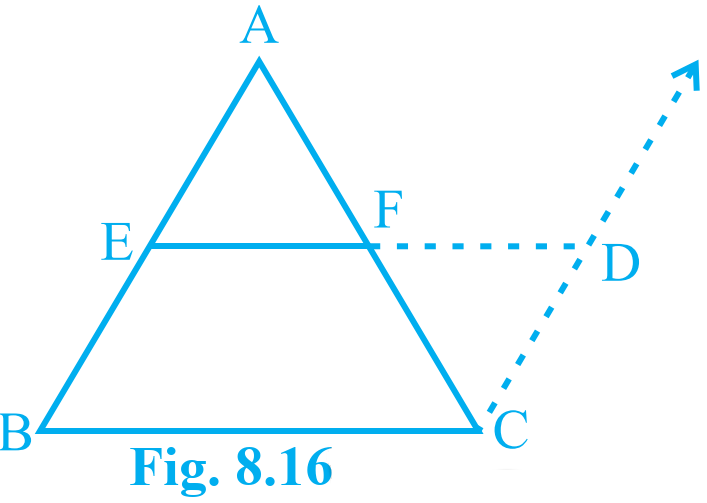
Observe Fig 8.16 in which $\mathrm{E}$ and $\mathrm{F}$ are mid-points of $\mathrm{AB}$ and $\mathrm{AC}$ respectively and $\mathrm{CD} \| \mathrm{BA}$.
$\triangle \mathrm{AEF} \cong \triangle \mathrm{CDF} \quad \text { (ASA Rule) }$
So, $\mathrm{EF}=\mathrm{DF}$ and $\mathrm{BE}=\mathrm{AE}=\mathrm{DC} \quad$ (Why?)
Therefore, BCDE is a parallelogram. (Why?)
This gives $\mathrm{EF} \| \mathrm{BC}$.
In this case, also note that $\mathrm{EF}=\frac{1}{2} \mathrm{ED}=\frac{1}{2} \mathrm{BC}$.
Can you state the converse of Theorem 8.8? Is the converse true?
You will see that converse of the above theorem is also true which is stated as below:
View full question & answer
Question 125 Marks
If each pair of opposite sides of a quadrilateral is equal, then it is a parallelogram.
View full question & answer
Question 135 Marks
In a parallelogram, opposite sides are equal.
Answer
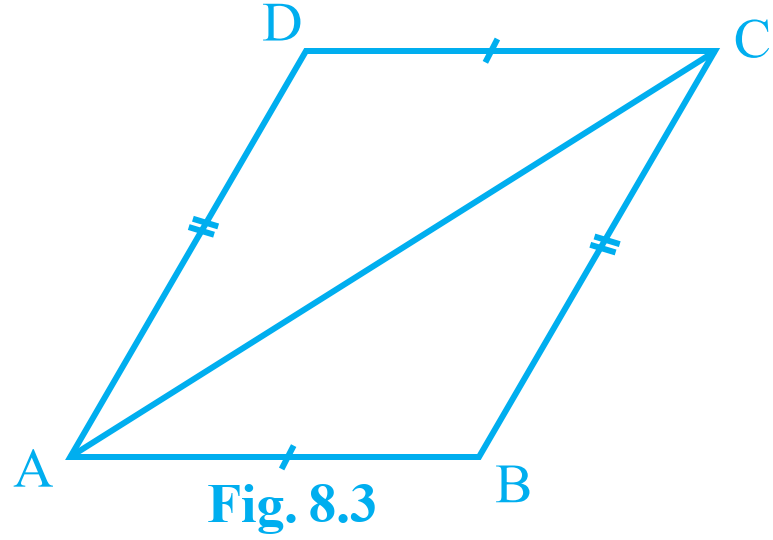
You have already proved that a diagonal divides the parallelogram into two congruent triangles; so what can you say about the corresponding sides? They are equal. gparts say, 1 the corresponding
So, AB DC and AD = BC
Now what is the converse of this result? You already know that whatever is given in a theorem, the same is to be proved in the converse and whatever is proved in the theorem it is given in the converse. Thus, Theorem 8.2 can be stated as given below:
If a quadrilateral is a parallelogram, then each pair of its opposite sides is equal. So its converse is:
View full question & answer
Question 145 Marks
A diagonal of a parallelogram divides it into two congruent triangles.
Answer
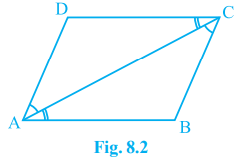
Proof : Let $\mathrm{ABCD}$ be a parallelogram and $\mathrm{AC}$ be a diagonal (see Fig. 8.2). Observe that the diagonal $\mathrm{AC}$ divides parallelogram $\mathrm{ABCD}$ into two triangles, namely, $\triangle \mathrm{ABC}$ and $\triangle \mathrm{CDA}$. We need to prove that these triangles are congruent.
Image
In $\triangle \mathrm{ABC}$ and $\triangle \mathrm{CDA}$, note that $\mathrm{BC} \| \mathrm{AD}$ and $\mathrm{AC}$ is a transversal.
So, $\quad \angle \mathrm{BCA}=\angle \mathrm{DAC}$ (Pair of alternate angles)
Also, $\mathrm{AB} \| \mathrm{DC}$ and $\mathrm{AC}$ is a transversal.
So, $\quad \angle \mathrm{BAC}=\angle \mathrm{DCA}$ (Pair of alternate angles)
and $\mathrm{AC}=\mathrm{CA} \quad$ (Common)
So, $\triangle \mathrm{ABC} \cong \triangle \mathrm{CDA} \quad$ (ASA rule)
or, diagonal $\mathrm{AC}$ divides parallelogram $\mathrm{ABCD}$ into two congruent triangles $\mathrm{ABC}$ and $\mathrm{CDA}$.
Now, measure the opposite sides of parallelogram $A B C D$. What do you observe?
You will find that $\mathrm{AB}=\mathrm{DC}$ and $\mathrm{AD}=\mathrm{BC}$.
This is another property of a parallelogram stated below:
View full question & answer