MCQ 1011 Mark
If a diagonal $AC$ and $BD$ of a quadrilateral $ABCD$ bisect each other, then $ABCD$ is a:
AnswerTwo diagonals of quadrilateral form four triangles. Out of these four triangles two triangles of opposite to each other are congruent by $SAS$. By using $CPCT$ property we can prove that both pair of opposite sides in a quadrilateral are parallel. A quadrilateral with both pair of opposite sides parallel is called parallelogram.
View full question & answer→MCQ 1021 Mark
The Diagonals $AC$ and $BD$ of a Parallelogram $ABCD$ intersect each other at point $O$. If $\angle\text{DAC}=32^\circ$ and $\angle\text{AOB}=70^\circ,$ then $\angle\text{DBC}$ is equal to:
- ✓
$38^\circ$
- B
$24^\circ$
- C
$86^\circ$
- D
$32^\circ$
AnswerCorrect option: A. $38^\circ$
$\angle\text{DAC} = \angle\text{ACB} = 32^\circ$ (alternate angles)$\angle\text{AOB} + \angle\text{COB} = 180^\circ$ (linear pair)
$\angle\text{COB} = 180 - 70^\circ = 110^\circ$
In triangle $BOC,$
$\angle\text{BOC} + \angle\text{OCB} + \angle\text{CBO} = 180^\circ$ (angle sum property)
$110^\circ + 32^\circ+ \angle\text{CBO} = 180^\circ$
$\angle\text{CBO} = 180^\circ - 142^\circ = 38^\circ$
View full question & answer→MCQ 1031 Mark
If one angle of a parallelogram is $24^\circ $ less than twice the smallest angle, then the largest angle of the parallelogram is:
- A
$68^\circ$
- B
$102^\circ$
- ✓
$112^\circ$
- D
$136^\circ$
AnswerCorrect option: C. $112^\circ$
Let the smallest angle be $x^\circ $
$\Rightarrow $ its adjacent angle $= (2x - 24)$
Since sum of the adjacent angles $= 180^\circ $
$\Rightarrow x + 2x - 24 = 180$
$\Rightarrow 3x = 204$
$\Rightarrow x = 68^\circ $
So, its adjacent angle $= 2(68) - 24 = 136 - 24 = 112^\circ .$
Hence, the largest angle of the parallelogram is $112^\circ .$
View full question & answer→MCQ 1041 Mark
Length of the line segment joining the mid-points of two sides of a triangle is ________ the third side of the Triangle.
AnswerAccording to mid point theorem, A line segment joining mid points of any two sides of a triangle is parallel to third side and length of that line segment is half of the third side.
View full question & answer→MCQ 1051 Mark
Diagonals of a quadrilateral $ABCD$ bisect each other. If $\angle\text{A} = 45^\circ,$ then $\angle\text{B} =\ ?$
- A
$115^\circ$
- B
$125^\circ$
- C
$120^\circ$
- ✓
$135^\circ$
AnswerCorrect option: D. $135^\circ$
Given,
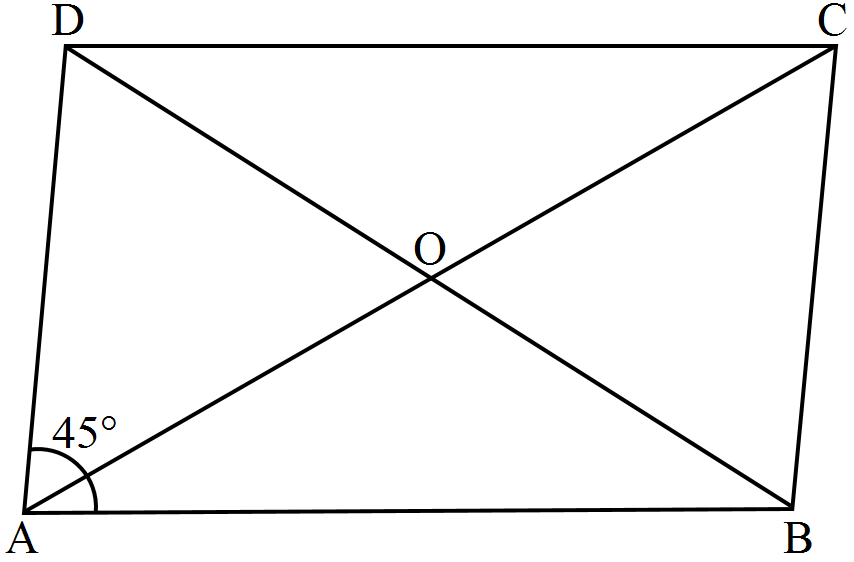
$ABCD$ is a quadrilateral,
$\angle\text{A} = 45^\circ,$
$\because $ diagonals of quadrilateral bisect each other hence $ABCD$ is a parallelogram,
$\Rightarrow \angle\text{A} + \angle\text{B} = 180^\circ$
$\Rightarrow 45^\circ + \angle\text{B} = 180^\circ$
$\Rightarrow \angle\text{B} = 180^\circ - 45^\circ = 135^\circ$ View full question & answer→MCQ 1061 Mark
The quadrilateral formed by joining the midpoints of the sides of a quadrilateral $ABCD$, taken in order, is a rectangle, if:
- A
$ABCD$ is a Parallelogram
- B
$ABCD$ is rectangle
- C
Diagonals of $ABCD$ are equal
- ✓
Diagonals of $ABCD$ are perpendicular to each other.
AnswerCorrect option: D. Diagonals of $ABCD$ are perpendicular to each other.
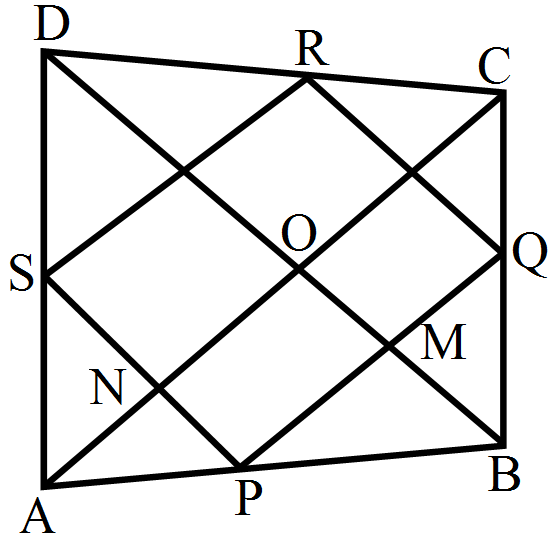
In $\triangle\text{ABC},$ P and $Q$ are the mid-point of sides $AB$ and $BC$ respectively.
$\therefore\text{PQ || AC}$ and $\text{PQ}=\frac{1}{2}\text{AC }...(\text{i})$
In $\triangle\text{ADC},$ R and $S$ are the mid-point of sides $CD$ and $AD$ respectively.
$\therefore\text{RS || AC}$ and $\text{RS}=\frac{1}{2}\text{AC }...(\text{ii})$
From $(i)$ and $(ii),$
$\text{PQ ∥ RS}$ and $\text{PQ = RS}$
Thus, in quadrilateral $PQRS$, a pair of opposite sides are equal are parallel.
So, $PQRS$ is a parallelogram.
Let the diagonals $AC$ and $BD$ intersect at $O.$
Now, in $\triangle\text{ABD},$ $P$ and S are the mid-points of sides $AB$ and $AD$ respectively.
$\therefore\text{PS || BD}$
$\Rightarrow\text{PN || MO}$
Also, from $(i)$, $\text{PQ || AC}$
$\Rightarrow\text{PM || NO}$
Thus, in quadrilateral $PMON$, $\text{PM || NO}$ and $\text{PN || MO},$
$⇒ PMON$ is a parallelogram.
$\Rightarrow\angle\text{MPN}=\angle\text{MON}$ (opposite angles of a parallelogram are equal)
$\Rightarrow\angle\text{MPN}=\angle\text{BOA}$ $(\text{Since }\angle\text{BOA}=\angle\text{MON})$
$\Rightarrow\angle\text{MPN}=90^{\circ}$ $(\text{Since }\text{AC}\perp\text{BD},\angle\text{BOA}=90^{\circ})$
$\Rightarrow\angle\text{QPS}=90^{\circ}$
Thus, $PQRS$ is a parallelogram whose one angle, i.e. $\angle\text{QPS}=90^{\circ}.$
Hence, $PQRS$ is a rectangle if $\text{AC}\perp\text{BD}.$
View full question & answer→MCQ 1071 Mark
Three angles of a quadrilateral are $75^\circ , 90^\circ $ and $75^\circ $. The fourth angle is:
- ✓
$120^\circ$
- B
$95^\circ$
- C
$105^\circ$
- D
$90^\circ$
AnswerCorrect option: A. $120^\circ$
We know that The sum of angles of quad $= 360^\circ $
$4$th angle $= 360^\circ - (75^\circ + 90^\circ + 75^\circ )$
$= 360^\circ - 240^\circ $
$= 120^\circ $
View full question & answer→MCQ 1081 Mark
Is quadrilateral $\text{ABCD}$ a rhombus?
$i.$Quadrilateral $\text{ABCD}$ is $a \| gm.$
$ii$.Diagonals $AC$ and $BD$ are perpendicular to each other.
- A
If the question can be answered by one of the given statements alone and not by the other;
- B
If the question can be answered by either statement alone;
- ✓
If the question can be answered by both the statements together but not by any one of the two;
- D
If the question cannot be answered by using both the statements together.
AnswerCorrect option: C. If the question can be answered by both the statements together but not by any one of the two;
If the quad. $\text{ABCD}$ is a $\| g m$, it could be a rectangle or square or rhombus.
So, statement I is not sufficient to answer the question.
If the diagonals $A C$ and $B D$ are perpendicular to each other, then the $\| g m$ could be a square or rhombus.
So, statement $II$ is not sufficient to answer the question.
However, if the statements are combined, then the quad. $\text{ABCD}$ is a rhombus.
View full question & answer→MCQ 1091 Mark
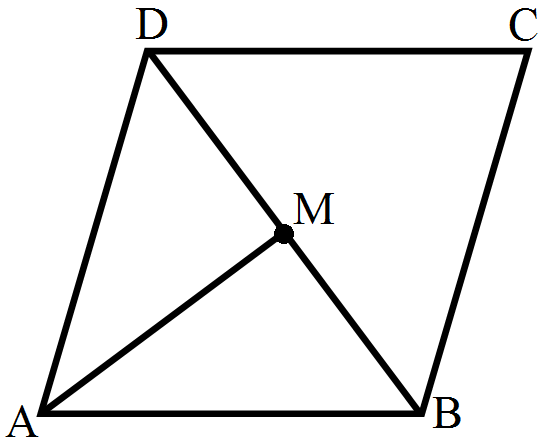
In the given figure, $ABCD$ is a parallelogram, $M$ is the mid-point of $BD$ and $BD$ bisects $\angle\text{B}$ as well as $\angle\text{D}.$ Then, $\angle\text{AMB}= ?$
- A
$45^\circ$
- B
$60^\circ$
- ✓
$90^\circ$
- D
$30^\circ$
AnswerCorrect option: C. $90^\circ$
$\angle\text{ABC}=\angle\text{ADC}$ ...(Opposite angles of a parallelogram are equal)
$\Rightarrow\frac{1}{2}\angle\text{ABC}=\frac{1}{2}\angle\text{ADC}$
$\Rightarrow\angle\text{ABD}=\angle\text{ADB}$
So, $\text{AD = AB}$ ...(Sides opposite equal angles are equal.)
$\therefore\triangle\text{ABD}$ is isosceles
Also, $M$ is the mid-point of $BD.$
$\therefore\text{AM}\perp\text{BD}$
$\therefore\angle\text{AMB}=90^{\circ}$
View full question & answer→MCQ 1101 Mark
The two diagonals are equal in a:
Answer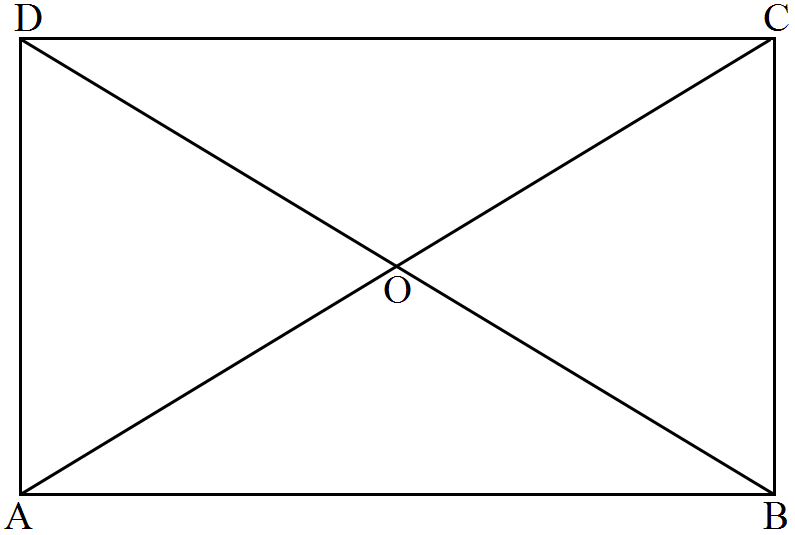
$ABCD$ is a rectangle with $AC$ and $BD$ as its diagonals.
$ABCD$ is a rectangle
$\therefore \angle\text{A} = 90^\circ, \ \text{AD = BC}$
$\text{AD || BC}$ and AB is a transversal
$\therefore \angle\text{A} + \angle\text{B} = 180^\circ$
$\Rightarrow \angle\text{B} = 90^\circ$
In $\triangle\text{ABD}$ and $\triangle\text{BAC}$
$AB = BA$
$\angle\text{A} = \angle\text{B}$
$AD = BC$
$\therefore \triangle\text{ABD}≅\triangle\text{BAC} (SAS)$
$\Rightarrow BD = AC (c.p.c.t)$
Hence, the diagonals of a rectangle are equal.
View full question & answer→MCQ 1111 Mark
A diagonal of a parallelogram divides it into:
- A
- B
Two equilateral triangles.
- C
- ✓
AnswerBy $SSS$ congruence condition, opposite sides are equal and common diagonal.
View full question & answer→MCQ 1121 Mark
Which of the following is not true for a parallelogram?
- A
Opposite sides are equal.
- B
Opposite angles are equal.
- ✓
Opposite angles are bisected by the diagonals.
- D
Diagonals bisect each other.
AnswerCorrect option: C. Opposite angles are bisected by the diagonals.
We know that, in a $\| gm$ opposite sides are equal, opposite angles are equal and also the diagonals bisect each other.
So, opposite angles are bisected by the diagonals is not true.
View full question & answer→MCQ 1131 Mark
In the given figure, $ABCD$ is a $\|$ gm and $E$ is the mid-point of $BC$. Also, $DE$ and $AB$ when produced meet at $F.$ Then:
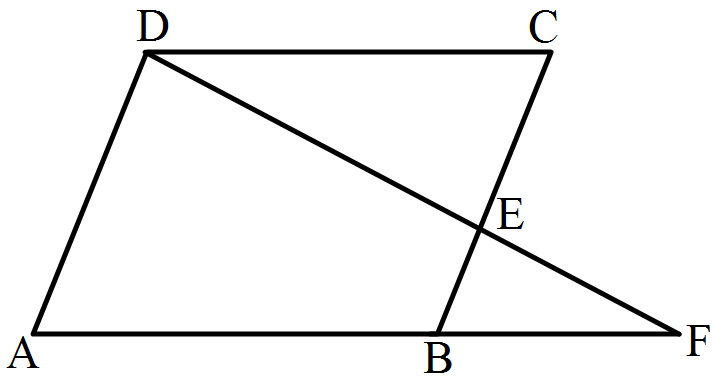
AnswerCorrect option: B. $AF = 2AB$
In $\triangle\text{CDE}$ and $\triangle\text{BFE,}$
$\angle\text{DEC}=\angle\text{FEB}$ ...(Vertically opposite angles)
$\angle\text{DCE}=\angle\text{FBE}$ ...(Alternate angles)
and $\text{CE = BE}$ ...(E is the mid-point.)
$\therefore\triangle\text{CDE}\cong\triangle\text{BFE}$ ...(By $AA$ congruence criterion)
$\therefore\text{CD = BF} ...(C.P.C.T.)$
Now,
$\text{AF = AB + BF}$
$\Rightarrow\text{AF + AB + CD}$ ...(from $(i))$
$$$\Rightarrow\text{AF = 2AB}$
View full question & answer→MCQ 1141 Mark
The figure formed by joining the mid-points of the adjacent sides of a rhombus is a:
Answer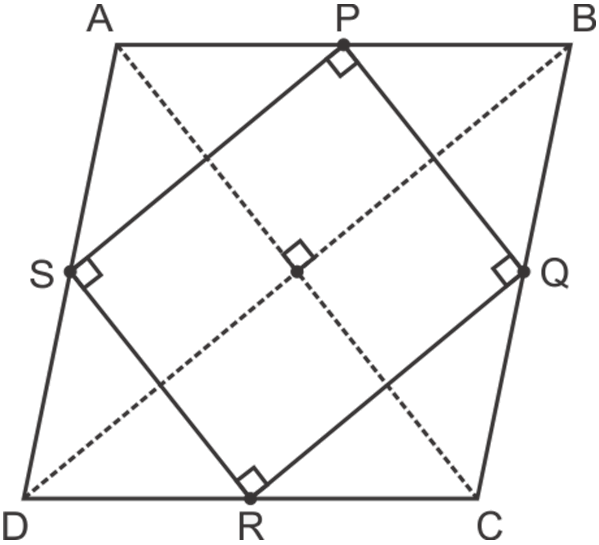
In $\triangle ABD$ and $\triangle CBD$
$P S|\mid B D$ and $Q R| \mid B D$
\{A line joining mid-points of two sides of triangle is parallel to third side}
$\Rightarrow PS \| QR$
Similiarly PQ || SR
Because $S R \| A C$ and $Q R \| B D$,
And angle between the diagonals of a Rhombus $A C$ and $B D=90^{\circ}$,
Angle between $S R$ and $Q R=90^{\circ}$
$\Rightarrow PQRS$ is a rectangle.
View full question & answer→MCQ 1151 Mark
In a trapezium $ABCD$, if $AB \| CD$, then $(AC ^2 + BD ^2 ) = ?$
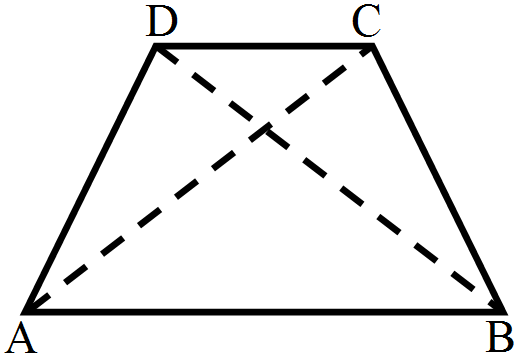
AnswerCorrect option: D. $BC^2 + AD^2 + 2AB ⋅ CD$
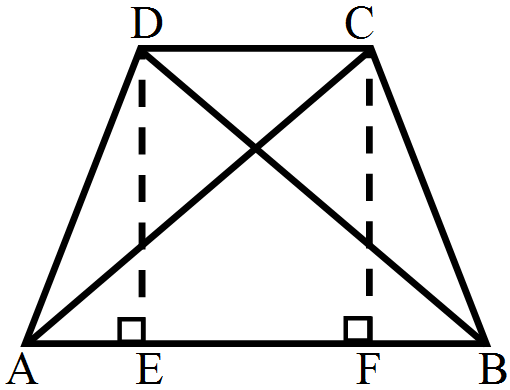
Construction: Draw perpendicular from $D$ and $C$ on $A B$ which meets $A B$ at $E$ and $F$, respectively. So, $DEFC$ is a parallelogram, since one pair of opposite sides are parallel and equal.
In $\triangle\text{ABC},$
$\angle\text{B}$ is an acute angle.
$\Rightarrow\text{AC}^2=\text{BC}^2+\text{AB}^2-2\text{AB}\times\text{AE}$
In $\triangle\text{ABD},$
$\angle\text{A}$ is an acute angle.
$\Rightarrow\text{BD}^2=\text{AD}^2+\text{AB}^2-2\text{AB}\times\text{AF}$
$\Rightarrow\text{AC}^2+\text{BD}^2=\text{BC}^2+\text{AD}^2+2\text{AB}(\text{AB}-\text{BE}-\text{AF})$
$=\text{BC}^2+\text{AD}^2+2\text{AB}\times\text{EF}$
$=\text{BC}^2+\text{AD}^2+2\text{AB}\times\text{CD}$ View full question & answer→MCQ 1161 Mark
Which of the following is not true for the Parallelogram?
- A
Opposite sides are equal.
- B
Diagonals bisect each other.
- ✓
Opposite angles are bisected by the diagonals.
- D
Opposite angles are equal.
AnswerCorrect option: C. Opposite angles are bisected by the diagonals.
If opposite angles are bisected by diagonals in parallelogram, all four bisected angles become equal which leads to equal adjacent side. That is not true in case of parallelogram.
View full question & answer→MCQ 1171 Mark
The lengths of the diagonals of a rhombus are $16\ cm$ and $12\ cm$. The length of each side of the rhombus is:
- ✓
$10\ cm$
- B
$12\ cm$
- C
$8\ cm$
- D
$9\ cm$
AnswerCorrect option: A. $10\ cm$
Let us assume a rhombus $A B C D$ where,
$A B=B C=C D=D A$
Now, in triangle $O B C$ by using Pythagoras theorem we get:
$\mathrm{BC}^2=O B^2+O C^2$
$\mathrm{BC}^2=6^2+8^2$
$\mathrm{BC}^2=36+64$
$\mathrm{BC}^2=100$
$\mathrm{BC}=\sqrt{100}$
$\mathrm{BC}=10 \mathrm{~cm}$
$\therefore A B=B C=C D=D A=10 \mathrm{~cm}$
View full question & answer→MCQ 1181 Mark
If bisector of $\angle\text{A}$ and $\angle\text{B}$ of a quadrilateral $ABCD$ intersect each other at p, $\angle\text{B}$ and $\angle\text{C}$ at Q, $\angle\text{C}$ and $\angle\text{D}$ at $R$ and, $\angle\text{D}$ and $\angle\text{A}$ at S then PQRS is a:
- A
- B
Quadrilateral whose opposite angles are supplementary.
- ✓
- D
AnswerLet's assume our quadrilateral $ABCD$ as a parallelogram:
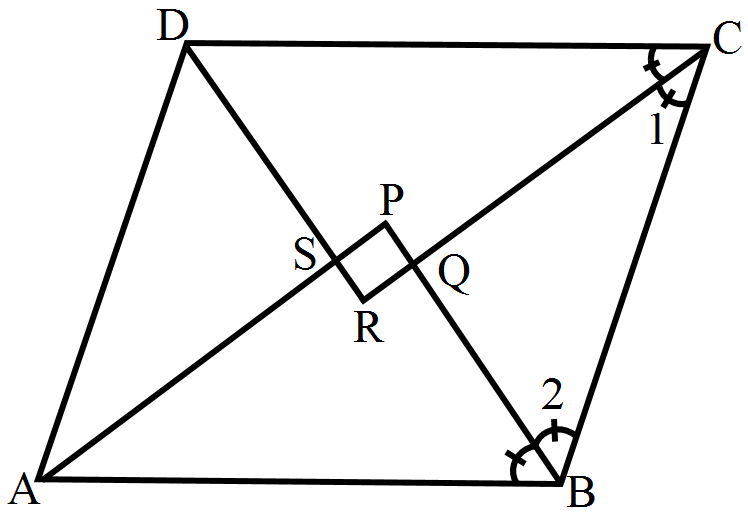
we know
$\angle\text{DCB} + \angle\text{ABC} = 180^\circ$ (Co-interior angles of parallelogram are supplementary)
$\Rightarrow \frac{1}{2}\angle\text{DCB} + \frac{1}{2}\angle\text{ABC} = 90^\circ$ (Both sides divide by $2)$
$\Rightarrow \angle\text{1} + \angle\text{2} =90^\circ... (1)$
In, $\triangle\text{CQB}$ we know
$ \Rightarrow \angle\text{1} + \angle\text{2} +\angle\text{CQB} = 180^\circ ... (2)$
From eq $(1)$ and eq $(2),$ We get
$\Rightarrow \angle\text{CQB} = 180^\circ − 90^\circ$
$\Rightarrow \angle\text{CQB} = 90^\circ$
$\Rightarrow \angle\text{PQR} = 90^\circ$ (because $\angle\text{CQB} = \angle\text{PQR},$ vertically opposite angles)
Similarly, it can be shown
$\angle\text{QPS} = \angle\text{PSR} =\angle\text{SRQ} = 90^\circ$
So, quadrilateral $PQRS$ is a rectangle. View full question & answer→MCQ 1191 Mark
In a square $ABCD$, the diagonals $AC$ and $BD$ bisects at $O$. Then $\triangle\text{AOB}$ is:
AnswerDiagonals of a square are perpendicular bisectors, hence angle $AOB = 90^\circ $. So triangle $AOB$ is right-angled.
View full question & answer→MCQ 1201 Mark
If $\angle\text{A},\angle\text{B},\angle\text{C}$ and $\angle\text{D}$ of a quadrilateral $ABCD$ taken in order, are in the ratio $3 : 7 : 6 : 4$ then $ABCD$ is a:
AnswerLet the common multiple be $x .$
$\therefore$ The angle measure $3 x, 7 x, 6 x$ and $4 x$.
Since the sum of the angles of a quadrilateral is $360^{\circ}$, we have
$3x + 7x + 6x + 4x = 360$
$⇒ 20x = 360$
$⇒ x = 18°$
$\therefore$ The angles of the quadrilateral are
$3x = 3(18) = 54°$
$7x = 7(18) = 126°$
$6x = 6(18) = 108°$ and
$4x = 4(18) = 72°$Now, $54+126=180^{\circ}$ and $108+72=180^{\circ}$
So, the angles are interior angles and hence we get one pair of parallel sides of $A B C D$. Hence, $A B C D$ is a trapezium.
View full question & answer→MCQ 1211 Mark
In which of the following figures are the diagonals equal?
AnswerThe diagonals are equal in a rectangle.
The diagonals in a parallelogram, rhombus or trapezium need not be equal.
View full question & answer→MCQ 1221 Mark
Is quad. $\text{ABCD}$ a parallelogram?
$i$.Its opposite sides are equal.
$ii$.Its opposite angles are equal.
- A
If the question can be answered by one of the given statements alone and not by the other;
- ✓
If the question can be answered by either statement alone;
- C
If the question can be answered by both the statements together but not by any one of the two;
- D
If the question cannot be answered by using both the statements together.
AnswerCorrect option: B. If the question can be answered by either statement alone;
If the opposite sides of a quad.
$\text{ABCD}$ are equal, the quadrilateral is a parallelogram.
If the opposite angles are equal, then the quad.
$\text{ABCD}$ is a parallelogram.
View full question & answer→MCQ 1231 Mark
The bisectors of the angles of a Parallelogram enclose a:
AnswerLet ABCD be a parallelogram. $\angle\text{A} + \angle\text{D} = 180$ (co-interior angles)
$\frac{1}{2}$ of $(\angle\text{A} + \angle\text{D}) = 90.$
Triangle formed by bisectors of $\angle\text{A} $ and $\angle\text{D} ,$ have sum of two angles equals to $90$ therefore, remaining angle is of $90$. similarly, we can prove that other angles formed are of $90$ each by bisectors of angles of $ABCD. $The quadrilateral formed by angle bisectors of $ABCD$ has all angles equal to $90$ (Vertically opposite angles). $A $quadrilateral with all right angles is a Rectangle.
View full question & answer→MCQ 1241 Mark
Two parallelograms stand on equal bases and between the same parallels. The ratio of their areas is:
- A
$1 : 2$
- B
$2 : 1$
- C
$1 : 3$
- ✓
$1 : 1$
AnswerCorrect option: D. $1 : 1$
Area of a parallelogram = base ⨯ height
Since two parallelogram stand on equal bases and between the same parallel lines,
their heights are same.
$\therefore$ Areas are also same.
$\therefore$ The ratio of their area is $1 : 1.$
View full question & answer→MCQ 1251 Mark
The Quadrilateral forms by joining the mid-points of the sides of a Quadrilateral $PQRS$, taken in order, is a Rhombus if:
AnswerCorrect option: A. Diagonals of $PQRS $are equal.
A quadrilateral formed by joining the mid points of the sides of the Rectangle is a rhombus. In rectangle, diagonals are equal.
View full question & answer→MCQ 1261 Mark
If the diagonals of a quadrilateral bisect each other at right angles, then the figure is a:
AnswerIf the diagonals of a quadrilateral bisect each other at right angles,
then the figure is a rhombus.
This is because in a rhombus, the diagonals are perpendicular bisectors of each other.
View full question & answer→MCQ 1271 Mark
The diagonals $AC$ and $BD$ of a parallelogram $ABCD$ intersect each other at the point $O$. If $\angle\text{DAC}=32^\circ$ and $\angle\text{AOB}=70^\circ$ then, $\angle\text{DBC}$ is equal to:
- A
$24^\circ$
- B
$86^\circ$
- ✓
$38^\circ$
- D
$40^\circ$
AnswerCorrect option: C. $38^\circ$
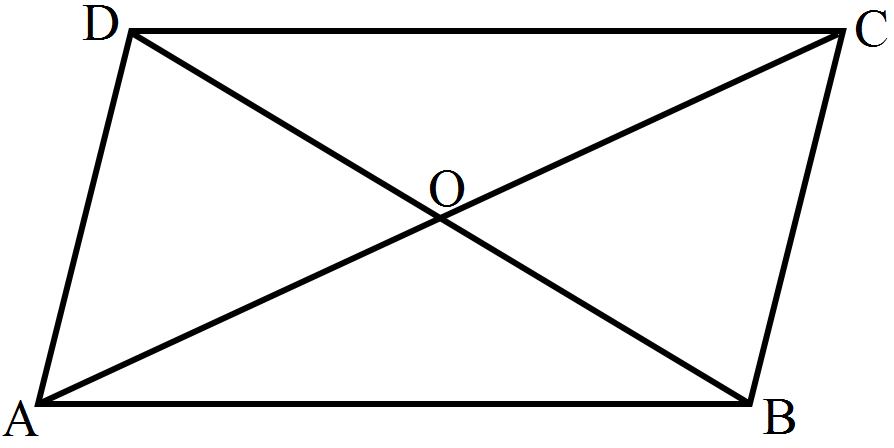
Let $ABCD$ is the parallelogram, in which $AC$ and $BD$ are diagonals that intersect at $O.$
We have, $\angle\text{DAC} = 32^\circ; \ \angle\text{AOB} = 70^\circ$ [given]
Since $ABCD$ is a ||gm, so $\text{AB || CD}$ and $\text{AD || BC}.$
Since $\text{AD || BC},$ and AC is a transversal,
Then $\angle\text{ACB} = \angle\text{DAC}$ [alternate interior angles]
So, $\angle\text{ACB} = 32^\circ \Rightarrow \angle\text{OCB} = 32^\circ$
Since, $\angle\text{AOB}$ and $\angle\text{OBC}$ form a linear pair, then $\angle\text{AOB} + \angle\text{BOC}=180^\circ$
$\Rightarrow 70^\circ+\angle\text{BOC}=180^\circ\Rightarrow \angle\text{BOC} = 180^\circ − 70^\circ \Rightarrow \angle\text{BOC}=110^\circ$
In $\angle\text{OBC},$
We have, $\angle\text{BOC} + \angle\text{OCB} + \angle\text{OBC} =180^\circ$ [angle sum property]
$\Rightarrow 110^\circ + 32^\circ + \angle\text{OBC} = 180^\circ$
$\Rightarrow 142^\circ + \angle\text{OBC}=180^\circ$
$\Rightarrow \angle\text{OBC} = 180^\circ−142^\circ$
$\Rightarrow \angle\text{OBC} = 38^\circ$
$\Rightarrow \angle\text{DBC} = 38^\circ$
View full question & answer→MCQ 1281 Mark
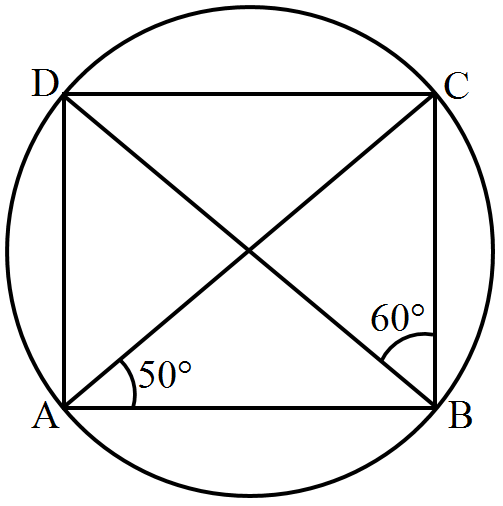
In Fig. $ABCD$ is a cyclic quadrilateral. If $\angle\text{BAC}=50^\circ$ and $\angle\text{DBC}=60^\circ$ then find $\angle\text{BCD}=\ ?$
- A
$50^\circ$
- B
$55^\circ$
- C
$60^\circ$
- ✓
$70^\circ$
AnswerCorrect option: D. $70^\circ$
Here, $\angle\text{BAC}=50^\circ$ (angles in same segment are equal)
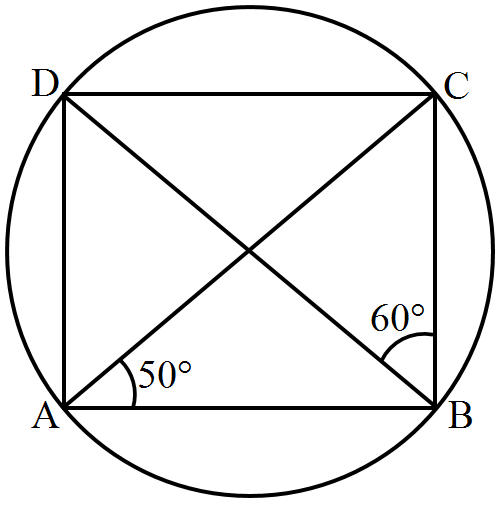
In $\triangle\text{BCD},$ we have
$\angle\text{BCD}=180^\circ−(\angle\text{BDC}+\angle\text{DBC})$
$=180^\circ−(50^\circ+60^\circ)$
$= 70^\circ$
View full question & answer→MCQ 1291 Mark
If an angle of a parallelogram is two-third of its adjacent angle, the smallest angle of the parallelogram is:
- A
$108^\circ$
- B
$54^\circ$
- ✓
$72^\circ$
- D
$81^\circ$
AnswerCorrect option: C. $72^\circ$
Let one of the angle of the || gm be $x^\circ $.
According to the given condition,
$\therefore$ the adjacent angle $=\frac{2}{3}\text{x}^{\circ}$
Now,
$\text{x}+\frac{2}{3}\text{x}=180^{\circ}$ ...(Sum of the adjacent angles of || gm is $180^\circ .)$
$\Rightarrow\frac{3\text{x}+2\text{x}}{3}=180^{\circ}$
$\Rightarrow\frac{5\text{x}}{3}=180^{\circ}$
$\Rightarrow5\text{x}=540^{\circ}$
$\Rightarrow\text{x}=108^{\circ}$
$\Rightarrow $ the adjacent angles $=\frac{2}{3}(108)=36\times2=72^{\circ}$
Hence, the smallest angle is$ 72^\circ .$
View full question & answer→MCQ 1301 Mark
In a Quadrilateral $ABCD$, $\text{AB || CD},$ then $ABCD$ is a:
AnswerA quadrilateral with only one pair of opposite sides parallel is called Trapezium.
View full question & answer→MCQ 1311 Mark
If $\angle\text{A},\ \angle\text{B},\ \angle\text{C}$ and $\angle\text{D}$ of a quadrilateral $ABCD$, taken in order, are in the ratio $3 : 7 : 6 : 4$ then $ABCD$ is a:
AnswerLet the angles be $3x, 7x, 6x, 4x$
Then $3x + 7x + 6x + 4x = 360$
$\text{x}=\frac{360}{20}=18$
View full question & answer→MCQ 1321 Mark
A diagonal of a rectangle is inclined to one side of the rectangle at $35^\circ $. The acute angle between the diagonals is:
- A
$55^\circ$
- B
$50^\circ$
- C
$45^\circ$
- ✓
$70^\circ$
AnswerCorrect option: D. $70^\circ$
$\angle\text{OAD} = 90^\circ - (\angle\text{OAB})$$= 90^\circ - 35^\circ = 55^\circ.$
Now, $\angle\text{ODA} = \angle\text{OAD} = 55^\circ$ [$∵ OA = OD$ since diagonals of a rectangles are equal and bisect each other].
$\angle\text{AOD} = 180^\circ - (\angle\text{OAD} + \angle\text{ODA})$
$= 180^\circ - (55^\circ + 55^\circ) = 70^\circ.$
View full question & answer→MCQ 1331 Mark
The bisectors of any two adjacent angles of a parallelogram intersect at:
- A
$40^\circ$
- B
$45^\circ$
- C
$60^\circ$
- ✓
$90^\circ$
AnswerCorrect option: D. $90^\circ$
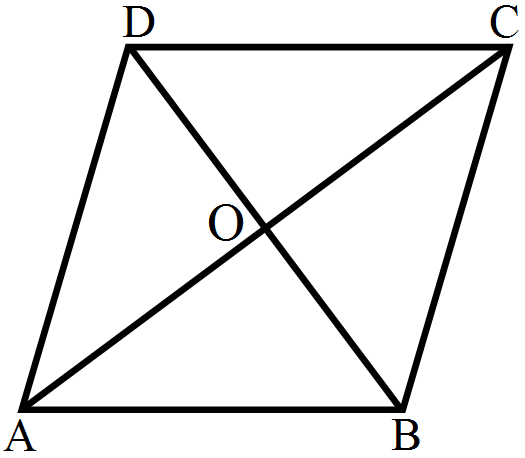
Consider parallelogram $ABCD,$
We know that, the sum if the adjacent angles of a parallelogram is $180^\circ .$
$\Rightarrow\angle\text{DAB}+\angle\text{CBA}=180^{\circ}$
$\Rightarrow\frac{1}{2}\angle\text{DAB}+\frac{1}{2}\angle\text{CBA}=\frac{1}{2}(180^{\circ})$
$\Rightarrow\angle\text{OAB}+\angle\text{OBA}=90^{\circ} ...(\text{i})$
Now,
In $\triangle\text{OAB},$
$\angle\text{OAB}+\angle\text{OBA}+\angle\text{AOB}=180^{\circ}$ ...(Angle sum property)
$\Rightarrow90^{\circ}+\angle\text{AOB}=180^{\circ}$ ...(from $(i))$
$\Rightarrow\angle\text{AOB}=90^{\circ}$
The bisectore of any adjacent angles of a parallelogram intersects at $90^\circ .$
View full question & answer→MCQ 1341 Mark
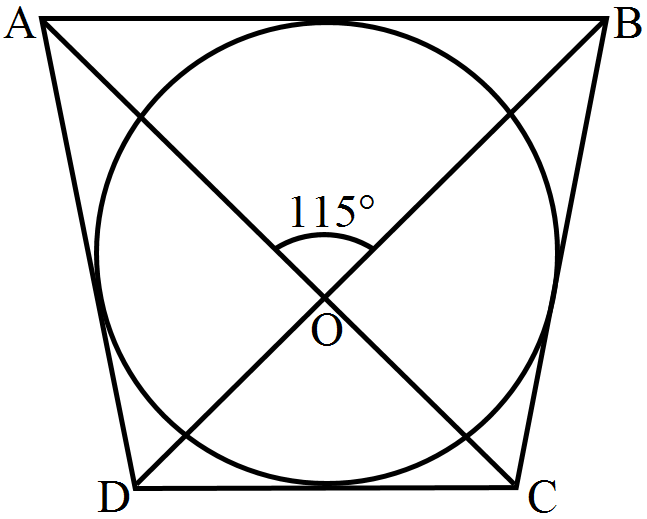
In Fig. the quadrilateral $ABCD$ circumscribes a circle with centre $O$. If $\angle\text{AOB}=115^\circ,$ then find $\angle\text{COD}=\ ?$
- A
$127^\circ$
- ✓
$115^\circ$
- C
$23^\circ$
- D
$24^\circ$
AnswerCorrect option: B. $115^\circ$
$∵\angle\text{AOB}=\angle\text{COD}$ (vertically opposite angle)
$∴\angle\text{COD}=115^\circ$
View full question & answer→MCQ 1351 Mark
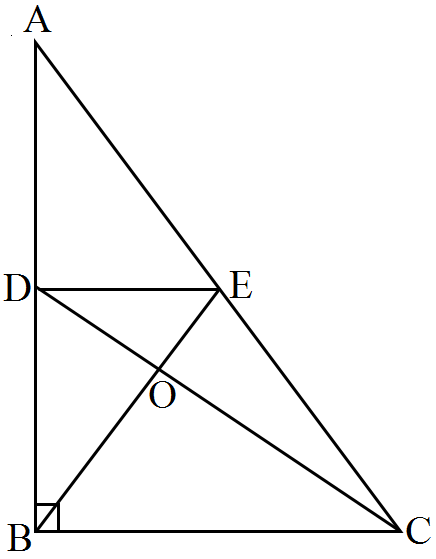
$\triangle\text{ABC}$ is right angled at $B.$ Given that $AC = 15\ cm, AB = 9\ cm$ and $E$ and $D$ are the mid-points of sides $AC$ and $AB$ res. Calculate the area of $\triangle\text{ADE}.$
- A
$12.5\ cm^2$
- B
- ✓
$13.5\ cm^2$
- D
$11.5\ cm^2$
AnswerCorrect option: C. $13.5\ cm^2$
As $D$ and $E$ are the midpoints of $AB$ and $AC.$
So, by mid-point theorem
$\text{DE} = \frac{\text{BC}}{2} = \frac{12}{2} = 6\text{cm}$
$\text{AD} = \frac{\text{AB}}{2} = \frac{9}{2} = 4.5\text{cm}$
Area of $\triangle\text{ADE} = 0.5 × \text{DE} × \text{AD}$
$= 0.5 × 6 × 4.5 = 13.5\text{cm}^2$
View full question & answer→MCQ 1361 Mark
The angles of a quadrilateral are in the ratio $3 : 4 : 5 : 6$. The smallest of these angles is:
- A
$45^\circ$
- ✓
$60^\circ$
- C
$36^\circ$
- D
$48^\circ$
AnswerCorrect option: B. $60^\circ$
Let tha common multipal be $x.$
$\therefore$ The angle measure $3x, 4x, 5x$ and $6x.$
Since the sum of the angles of a quadrilateral being $360^\circ $, we have
$3x + 4x + 5x + 6x = 360^\circ $
$\Rightarrow 18x = 360^\circ $
$\Rightarrow x = 20^\circ $
$\therefore$ The angles of the quadrilateral are
$3x = 3(20) = 60^\circ ,$
$4x = 4(20) = 80^\circ ,$
$5x = 5(20)= 100^\circ ,$
$6x = 6(20) = 120^\circ ,$
$\therefore$ The smallest angle is $60^\circ .$
View full question & answer→MCQ 1371 Mark
Write the correct answer in the following:
If bisectors of $\angle \text{A}$ and $\angle \text{B}$ of a quadrilateral $ABCD$ intersect each other at $P$, of $\angle \text{B}$ and $\angle \text{C}$ at $Q$, of $\angle \text{C}$ and $\angle \text{D}$ at $R$ and of $\angle \text{D}$ and $\angle \text{A}$ at S, then $PQRS$ is a:
- A
- B
- C
- ✓
Quadrilateral whose opposite angles are supplementary.
AnswerCorrect option: D. Quadrilateral whose opposite angles are supplementary.
$PQRS$ is a quadrilateral whose opposite angles are supplementary.
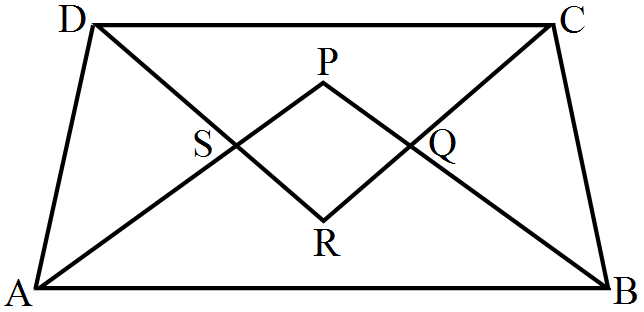
Hence, $(d)$ is the correct answer.
View full question & answer→MCQ 1381 Mark
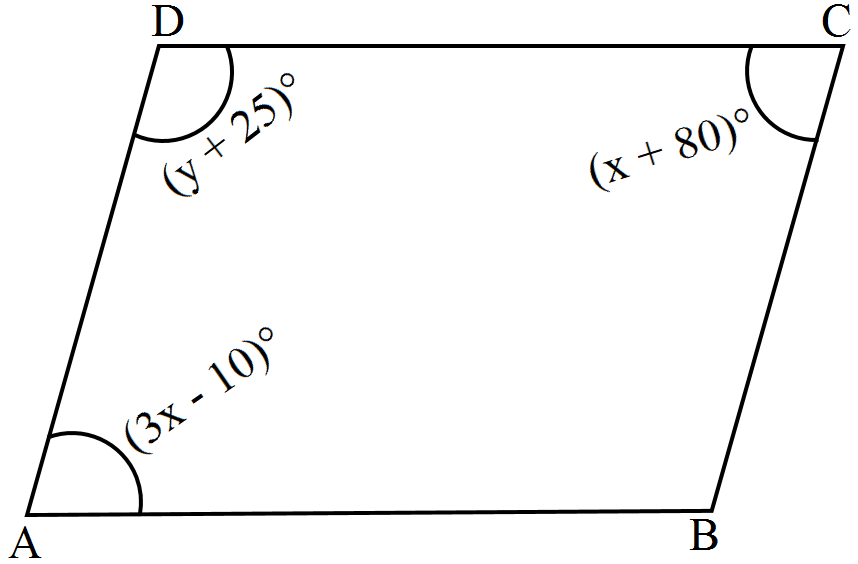
In the fig, $ABCD$ is a Parallelogram. The values of $x$ and $y$ are:
- A
$55^\circ , 35^\circ$
- B
$45^\circ , 45^\circ$
- C
$30^\circ , 35^\circ$
- ✓
$45^\circ , 30^\circ$
AnswerCorrect option: D. $45^\circ , 30^\circ$
$3x - 10^\circ = x + 80^\circ $ [opposite angles of a parallelogram are equal]
$3x - x = 80^\circ + 10^\circ $
$2x = 90^\circ $
$\text{x} = \frac{90^\circ}{2}$
$x = 45^\circ $
$3x - 10^\circ + y + 25^\circ = 180^\circ $[In a parallelogram co-interior angles are supplementary]
$3 \times 45^\circ - 10^\circ + y + 25^\circ = 180^\circ $
$135^\circ + 25^\circ - 10^\circ + y = 180^\circ $
$150^\circ + y = 180^\circ $
$y = 180^\circ - 150^\circ $
$y = 30^\circ $
View full question & answer→MCQ 1391 Mark
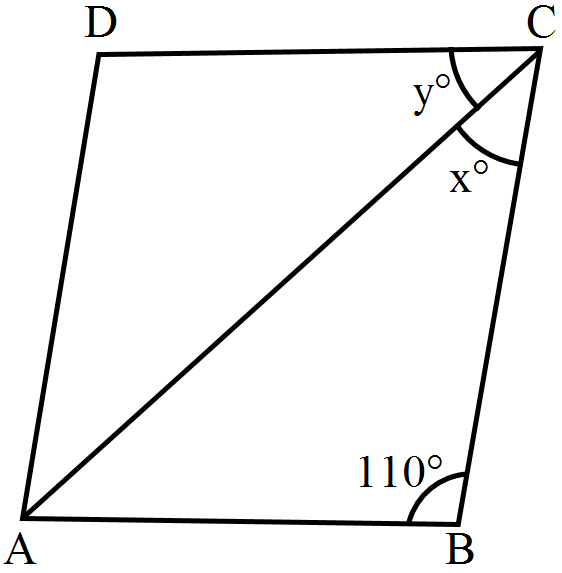
In the given figure, $ABCD$ is a Rhombus. Find the value of $x$ and $y?$
- A
$x = 35^{\circ}$ and $y = 35^{\circ}$
- B
$x = 40^{\circ}$ and $y = 40^{\circ}$
- ✓
$x = 37^{\circ}$ and $y = 37^{\circ}$
- D
$x = 45^{\circ}$ and $y = 45^{\circ}$
AnswerCorrect option: C. $x = 37^{\circ}$ and $y = 37^{\circ}$
$ABCD$ is a rhombus and a rhombus is also a parallelogram. A rhombus has four equal sides.
In $\triangle\text{ABC},\ \angle\text{BAC} = \angle\text{BCA} = \text{x}$
In $\triangle\text{ABC}$
$x + x + 110^{\circ} = 180^{\circ}$(angle sum property of triangle)
$\Rightarrow 2 x=180^{\circ}-110^{\circ}=70^{\circ}$
$\Rightarrow x=35^{\circ}$
Now, $\angle\text{B} + \angle\text{C} = 180^\circ$ (Adjacent angles are supplementary)
But, $\angle\text{C} = \text{x} + \text{y} = 70^\circ$
$\Rightarrow y=70^{\circ}-x$
$\Rightarrow y=70^{\circ}-35^{\circ}=35^{\circ}$
Hence, $x=35^{\circ}$ and $y=35^{\circ}$
View full question & answer→MCQ 1401 Mark
Write the correct answer in the following: If $APB$ and $CQD$ are two parallel lines, then the bisectors of the angles $APQ, BPQ, CQP$ and $PQD$ form:
Answer$PNQM$ is a rectangle.
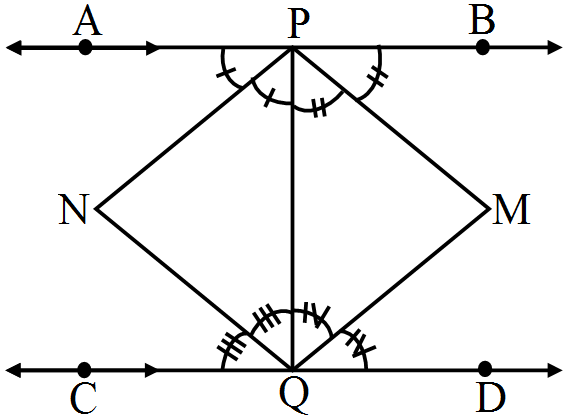
Hence, $(c)$ is the correct answer.
View full question & answer→MCQ 1411 Mark
$ABCD$ is a rhombus. If $\angle\text{ACB} = 30^\circ,$ then $\angle\text{ADB}$ is:
- A
$45^\circ$
- B
$120^\circ$
- C
$30^\circ$
- ✓
$60^\circ$
AnswerCorrect option: D. $60^\circ$
If $\angle\text{ACB} = 30^\circ$ then $\angle\text{CAD} = 30^\circ$ (The diagonals bisect the angles in a Rhombus) and in $\triangle\text{AOD}, \ \angle\text{AOB} = 90^\circ$ diagonals perpendicular to each other, so by angle sum property of a $\angle\text{ADB} = 60^\circ.$
View full question & answer→MCQ 1421 Mark
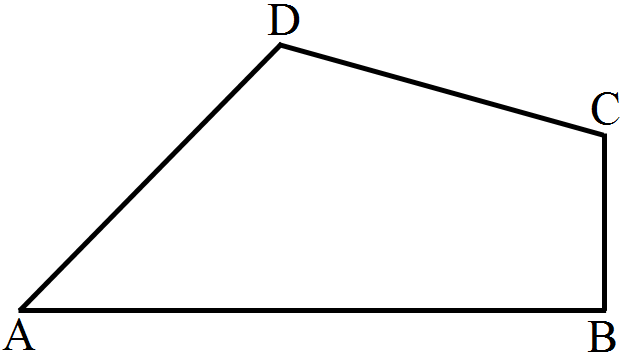
In Quadrilateral $ABCD$, $\angle\text{A}+ \angle\text{C} = 140^\circ, \ \angle\text{A} : \angle\text{C} = 1 : 3$ and $\angle\text{B} : \angle\text{D} = 5 : 6.$ Find the values of $\angle\text{A}, \ \angle\text{B},\ \angle\text{C}$ and $\angle\text{D}?$
- A
$10^\circ , 20^\circ , 100^\circ , 260^\circ $
- ✓
$35^\circ , 100^\circ , 105^\circ , 120^\circ $
- C
$100^\circ , 102^\circ , 120^\circ , 10^\circ $
- D
$90^\circ , 90^\circ , 100^\circ , 80^\circ $
AnswerCorrect option: B. $35^\circ , 100^\circ , 105^\circ , 120^\circ $
given: $\angle\text{A}+ \angle\text{C}=140^\circ$
and $\angle\text{A}:\angle\text{C} = 1:3$
and $\angle\text{B}:\angle\text{D} = 5:6$
$\Rightarrow \angle\text{A}= \frac{1}{4} \times 140^\circ - 35^\circ$
$\Rightarrow \angle\text{C}= \frac{3}{4} \times 140^\circ - 105^\circ$
Now according to angle sum property of quadrilateral
$\angle\text{A} +\angle\text{B}+ \angle\text{C}+ \angle\text{D} = 360^\circ$
$\Rightarrow 35^\circ+ \angle\text{B}+ 105^\circ +\angle\text{D} = 360^\circ$
$\Rightarrow \angle\text{B}+ \angle\text{D} = 360^\circ - 140^\circ = 220^\circ$
$\Rightarrow 5\text{x} + 6\text{x} = 220^\circ$
$\Rightarrow\text{x}=20^\circ$
So, $\angle\text{B} = 5 \times 20^\circ = 100^\circ$
and $\angle\text{D} = 6 \times 20^\circ = 120^\circ$
View full question & answer→MCQ 1431 Mark
In a triangle $A B C, P, Q$ and $R$ are the mid-points of the sides $B C, C A$ and $A B$ respectively. If $A C=21 cm, B C=29 cm$ and $A B$ $=30 cm$, find the perimeter of the quadrilateral $A R P Q$ ?
- A
$20\ cm$
- B
$80\ cm$
- ✓
$51\ cm$
- D
$52\ cm$
AnswerCorrect option: C. $51\ cm$
Given:
$A, B, C$ is a triangle .
$P, Q, R$ are the mid-points of sides $BC , CA $ and $AB .$
$AC = 21cm$
$BC = 29cm$
$AB = 30cm$
To find:
Perimeter of quadrilateral $A R Q P$ ?
$Q$ is the mid-point of $A C$
$P$ is the mid-point of $B C$
$Q P$ is parallel to $A B$
$QP =$ half of AB (according to mid point theorem)
$A B=30 cm, Q P=15 CM (Q P$ is half of $B A)$ (proved above)
$R$ is the mid-point of side $A B$.
$Q P$ is also parallel to $A R$ (half of side $A B$ )
$P R$ is parallel to $A C$
$P R=$ half of $A C$ (according to mid point theorem)
$A C=21 cm, P R=10.5 cm$ ( $P R$ is half of $A C$ ) (proved above)
$P R$ is parallel to $A Q$ ( $A Q$ is half of $A C$ )
Since, in quadrilateral $ARQP$ both the opposite sides are parallel it is a parallelogram.
Therefore, $ARQP$ is a parallelogram.
We know that
In parallelogram, opp sides are equal.
Therefore,
$PR = AQ = 10.5cm$
$QP = AR = 15cm$
$10.5cm + 10.5cm + 15cm + 15cm = 51cm.$
Therefore the perimeter of quadrilateral,
$ARQP = 51cm.$
View full question & answer→MCQ 1441 Mark
Three angles of a quadrilateral are $80^{\circ}, 95^{\circ}$ and $112^{\circ}$. Its fourth angle is:
- A
$78^{\circ}$
- ✓
$73^{\circ}$
- C
$85^{\circ}$
- D
$100^{\circ}$
AnswerCorrect option: B. $73^{\circ}$
Let the measure of the fourth angle be $x^0$.
We know that, the sum of the angles of a quadrilateral is $360^{\circ}$.
$\text { So }, 80^{\circ}+95^{\circ}+112^{\circ}+x=360^{\circ}$
$\Rightarrow 287^{\circ}+x=360^{\circ}$
$\Rightarrow x=73^{\circ}$
$\therefore$ Its fourth angle is $73^{\circ}$.
View full question & answer→MCQ 1451 Mark
Three Statements are given below:
$I$.In a, Parallelogram the angle bisectors of $2$ adjacent angles enclose a right angle.
$II$.The angle bisector of a Parallelogram form a Rectangle.
$III$.The Triangle formed by joining the mid$-$points of the sides of an isosceles triangle is not necessarily an isosceles triangle.
Which of the statement/ statements is/ are True?
- A
$II$
- B
$I$
- C
$I$ and $III$
- ✓
$I$ and $II$
AnswerCorrect option: D. $I$ and $II$
$I.$The adjacent angles of a parallelogram are supplementary.
Their halves add up to $90^\circ $.
So the angle bisectors enclose a right angle.
$II$.All the adjacent angle bisectors enclose right angles.
So we have a rectangle being enclosed by the angle bisectors of a parallelogram.
$III$.The triangle formed by joining the mid$-$points of the sides of an isosceles triangle is always an isosceles triangle, because halves of equal sides are also equal.
View full question & answer→MCQ 1461 Mark
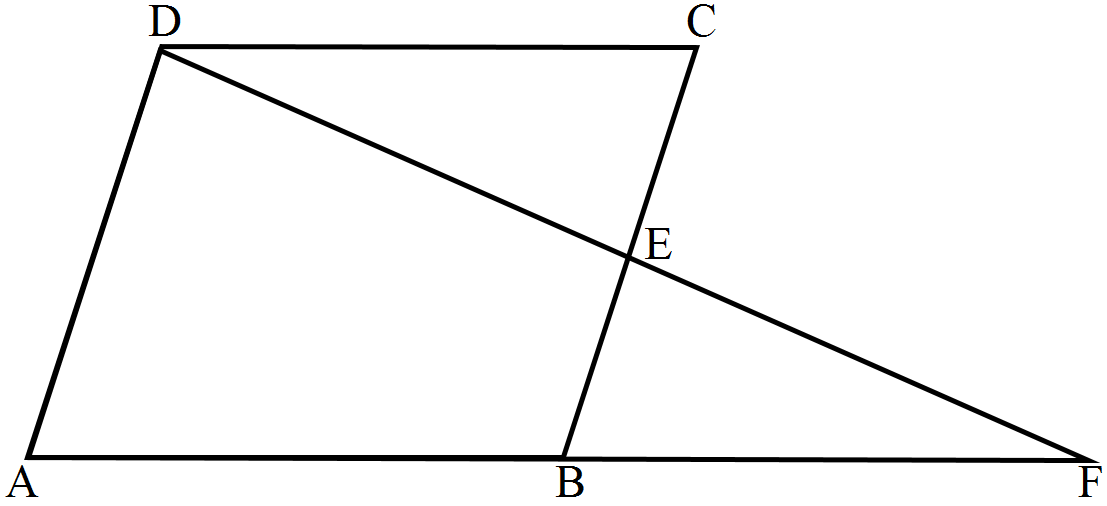
In given figure, $ABCD$ is a parallelogram and $E$ is the mid-point of $BC. DE$ and $AB$ when produced meet at F. Then, $AF = ?$
AnswerCorrect option: A. $AF = 2AB$
By the congruency of triangles,
$BEF$ and $CED$ (AAS Rule) are congruent
So, $DC = BF (CPCT) ...(1)$
But $DC = AB ...(2)$
So, $AB = BF$
but $AF = AB + BF$
So, $AF = 2AB$
View full question & answer→MCQ 1471 Mark
$ABCD$ is a Parallelogram in which $AB = 9.5\ cm$ and its perimeter is $30\ cm$. Find the length of each side of the Parallelogram?
- A
$9.5\ cm, 9.5\ cm, 5.6\ cm, 5.4\ cm$
- B
$9.5\ cm, 9.5\ cm, 5.4\ cm, 5.6\ cm$
- C
$10\ cm, 10\ cm, 11\ cm, 11\ cm$
- ✓
$9.5\ cm, 9.5\ cm, 5.5\ cm, 5.5\ cm$
AnswerCorrect option: D. $9.5\ cm, 9.5\ cm, 5.5\ cm, 5.5\ cm$
Perimeter of $ABCD = AB + BC + CD + DA = 30$
In a parallelogram, opposite sides are equal.
$AB = CD = 9.5$ and $BC = DA = x$
So, $9.5 + x + 9.5 + x = 30$
$2x = 30 - 19$
$x = 5.5$
$AB = 9.5 = CD$ and $BC = DA = 5.5$
View full question & answer→MCQ 1481 Mark
In a quadrilateral $ABCD$, $\angle\text{A}+\angle\text{C}$ is 2 times $\angle\text{B}+\angle\text{D}$ If $\angle\text{A}=140^\circ$ and $\angle\text{D}=60^\circ$ then $\angle\text{B}=$
- ✓
$60^\circ$
- B
$80^\circ$
- C
$120^\circ$
- D
AnswerCorrect option: A. $60^\circ$
$\angle\text{A}+\angle\text{B}+\angle\text{C}+\angle\text{D}=360^\circ\dots(1)$
Now, $\angle\text{A}+\angle\text{C}=2(\angle\text{B}+\angle\text{D})$ (given)$ ...(2)$
Also, $\angle\text{A}=140^\circ,\ \angle\text{D}=60^\circ$
Putting value of $(\angle\text{A}+\angle\text{C})$ from eq. $(2)$ in eq. $(1)$
$2(\angle\text{B}+\angle\text{D})+\angle\text{B}+\angle\text{D}=360^\circ$
$3(\angle\text{B}+\angle\text{D})=360^\circ$
$\Rightarrow\angle\text{B}+\angle\text{D}=120^\circ$
$\Rightarrow\angle\text{B}+60^\circ=120^\circ$
$\Rightarrow\angle\text{B}=60^\circ$
View full question & answer→MCQ 1491 Mark
The area of a quadrilateral whose diagonals measure $48\ m$ and $32\ m$ respectively and bisect each other at right angles is:
- A
$742m^2$
- B
$732m^2$
- C
$758m^2$
- ✓
$768m^2$
AnswerCorrect option: D. $768m^2$
According to the question,
$\text{Area of given quadrilateral}=\frac{1}{2}\times\text{Product of diagonals}$
$=\frac{1}{2}\times48\times32$
$=768\text{m}^2$
View full question & answer→MCQ 1501 Mark
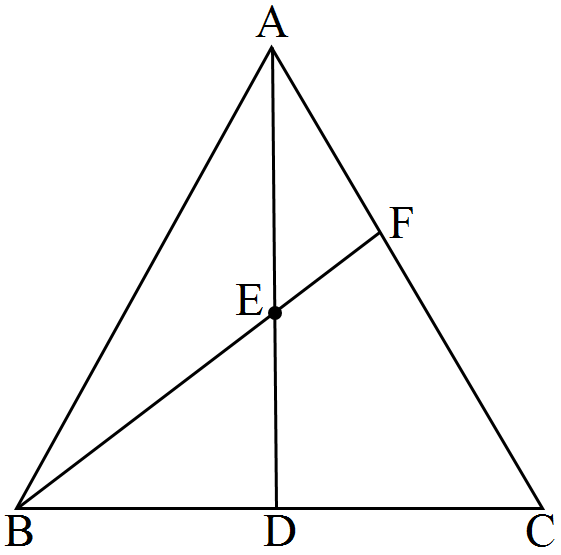
In the given figure, $AD$ is a median of $\triangle\text{ABC}$ and $E$ is the midpoint of $AD$. If $BE$ is joined and produced to meet $AC$ in F then $AF = ?$
- ✓
$\frac{1}{3}\text{AC}$
- B
$\frac{3}{4}\text{AC}$
- C
$\frac{1}{2}\text{AC}$
- D
$\frac{2}{3}\text{AC}$
AnswerCorrect option: A. $\frac{1}{3}\text{AC}$
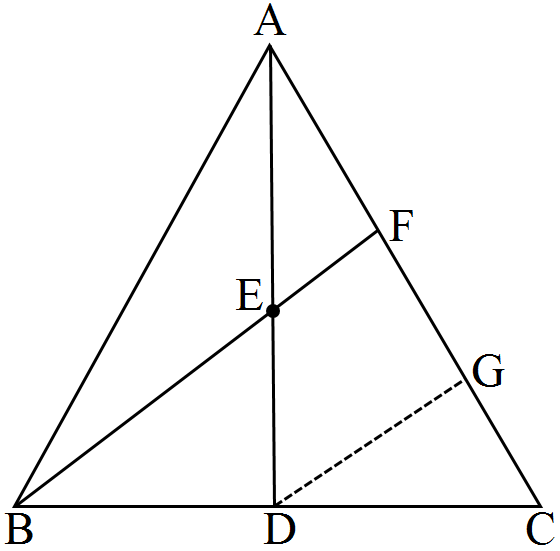
Let $G$ be the mid-point of $FC$ and join $DG.$
In $\triangle\text{BCF},$
G is the mid-point of $FC$ and $D$ is the mid-point of $BC.$
Thus, $\text{DG || BF}$
$\text{DG || EF}$
Now, In $\triangle\text{BDG},$
$E$ is the mid-point of $AD$ and $EF$ is parallel to $DG.$
Thus, $F$ is the mid-point of $AG.$
$AF = FG = GC$ [G is the mid-point of $FC]$
Hence, $\text{AF}=\frac{1}{3}\text{AC}$ View full question & answer→