MCQ 2011 Mark
If bisectors of $\angle\text{A}$ and $\angle\text{B}$ of a quadrilateral $ABCD$ intersect each other at $P,$ of $\angle\text{B}$ and $\angle\text{C}$ at $Q,$ of $\angle\text{C}$ and $\angle\text{D}$ at $R$ and of $\angle\text{D}$ and $\angle\text{A}$ at $S,$ then $PQRS$ is $a:$
- ✓
Quadrilateral whose opposite angles are supplementary.
- B
- C
- D
AnswerCorrect option: A. Quadrilateral whose opposite angles are supplementary.
Let the half of the $\angle\text{A} , \angle\text{B}, \angle\text{C}$ and $\angle\text{D}$ are denoted by $a, b, c$ and $d$ respectively.
$\text{a + b} + \angle\text{APB} = 180$ and $\text{c + d} + \angle\text{DRC} = 180($angle sum property$).$
$\angle\text{APB} = \angle\text{QPS} $ and $\angle\text{DRC} = \angle\text{QRS} ($vertically opposite angles$).$
So, $\angle\text{QPS} + \angle\text{QRS} = (180 - \text{a} - \text{b)} + (180 - \text{c} - \text{d)}$
$= 360\ -\ (\text{a + b + c + d)}$
$= 360 - \frac{1}{2} $ of $(\angle\text{ A} + \angle\text{B} + \angle\text{C} + \angle\text{D})$
$= 360 - \frac{1}{2} $ 0f $360 = 180$
Therefore, $\angle\text{QPS}$ and $\angle\text{QRS}$ are supplementary.
View full question & answer→MCQ 2021 Mark
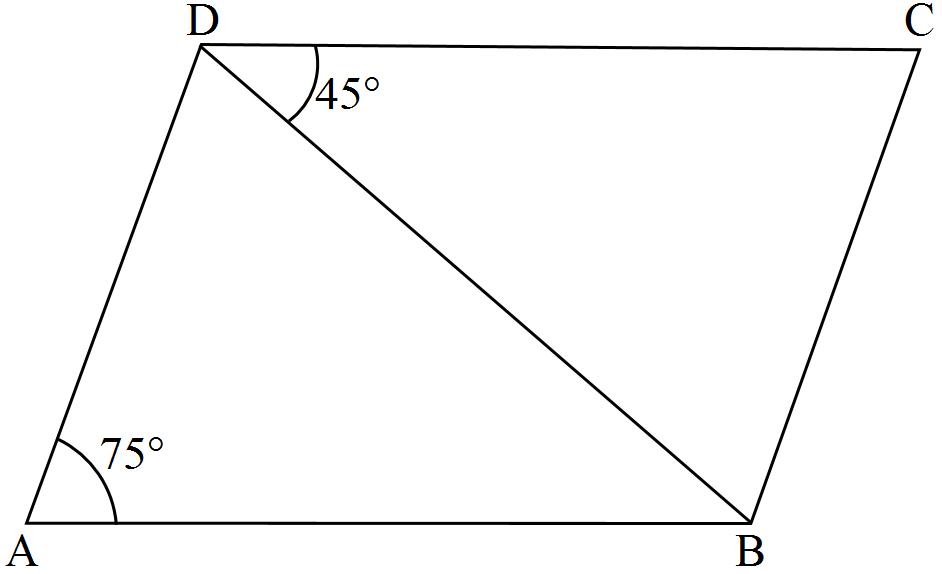
In the given figure, $ABCD$ is a parallelogram in which $\angle\text{BDC} = 45^\circ$ and $\angle\text{BAD} = 75^\circ.$ Then, $\angle\text{CBD} =\ ?$
- A
$75^\circ $
- B
$55^\circ$
- ✓
$60^\circ$
- D
$45^\circ$
AnswerCorrect option: C. $60^\circ$
As per the question
$\angle\text{BAD} = \angle\text{BCD} = 75^\circ$ (opposite angles of parallelogram)
Now, in $\triangle\text{BCD},$
$\angle\text{BCD} + \angle\text{CBD} + \angle\text{BCD} = 180^\circ$
$45^\circ + \angle\text{CBD} + 75^\circ = 180^\circ$
$\angle\text{CBD} = 60^\circ$
View full question & answer→MCQ 2031 Mark
If the degree measures of the angles of quadrilateral are $4x, 7x, 9x$ and $10,$ what is the sum of the measures of the smallest angle and largest angle$?$
- A
$140^\circ$
- B
$150^\circ$
- ✓
$168^\circ$
- D
$180^\circ$
AnswerCorrect option: C. $168^\circ$
Sum of all angles of a Quadrilateral $= 360^\circ $
$4x + 7x + 9x + 10x = 360^\circ $
$30x = 360^\circ $
$x = 12^\circ $
So, sum of smallest and largest angle,
i.e. $4x + 10x = 14x = 14 \times 12 = 168^\circ $
View full question & answer→MCQ 2041 Mark
The figure formed by joining the mid-points of the sides of a quadrilateral $ABCD,$ taken in order, is a square only if:
- A
Diagonals of $ABCD$ are equal.
- ✓
Diagonals of $ABCD$ are equal and perpendicular.
- C
$ABCD$ is a Rhombus.
- D
Diagonals of $ABCD$ are perpendicular.
AnswerCorrect option: B. Diagonals of $ABCD$ are equal and perpendicular.
A quadrilateral formed by joining the mid points of a square is a square. So, $ABCD$ is a square. In Square, diagonals are equal and perpendicular.
View full question & answer→MCQ 2051 Mark
Is $\|\ gm\ \text{ABCD}$ a square$?$
$i.$ Diagonals of $\|\ gm\ \text{ABCD}$ are equal.
$ii.$ Diagonals of $\|\ gm\ \text{ABCD}$ intersect at right angles.
- A
If the question can be answered by one of the given statements alone and not by the other;
- B
If the question can be answered by either statement alone;
- ✓
If the question can be answered by both the statements together but not by any one of the two;
- D
If the question cannot be answered by using both the statements together.
AnswerCorrect option: C. If the question can be answered by both the statements together but not by any one of the two;
If the diagonals of a $\|\ gm\ \text{ABCD}$ are equal, then $\|\ gm\ \text{ABCD}$ could either be a rectangle or a square.
If the diagonals of the $\|\ gm\ \text{ABCD}$ intersect at right angles,
then the $\|\ gm\ \text{ABCD}$ could be a square or a rhombus.
However, if both the statements are combined, then $\|\ gm\ \text{ABCD}$ will be a square.
View full question & answer→MCQ 2061 Mark
$P$ is the mid-point of side $BC$ of a parallelogram $ABCD$ such that $\angle\text{BAP} = \angle\text{DAP}.$ If $AD = 10\ cm,$ then $CD =$
- ✓
$5\ cm$
- B
$6\ cm$
- C
$8\ cm$
- D
$10\ cm$
AnswerCorrect option: A. $5\ cm$
Given,
$ABCD$ is a parallelogram
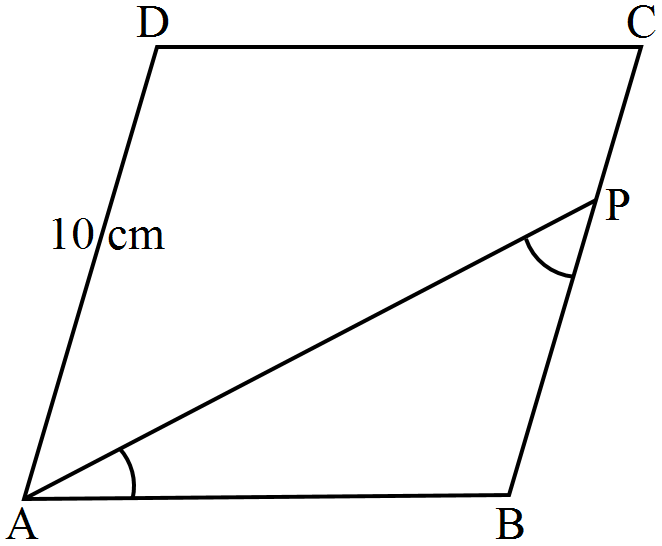
$P$ is mid-point of side $BC$
$\angle\text{BAP} = \angle\text{DAP}$
$\text{AD} = 10\text{cm}$
$∵ \text{AD || BC}$
$\angle\text{DAP} = \angle\text{APB} [$alternate angles$]$
$\angle\text{DAP} = \angle\text{BAP}$
$\text{AB = BP} ($side opposite to equal angles$)$
$\Rightarrow\ \text{BP}=\frac{1}{2}\text{BC}$
$\therefore\ \text{AB}=\frac{1}{2},\ \text{BC}=\frac{1}{2}\times10=5\text{cm}$
$\text{AB} = \text{CD} = 5\text{cm} ($sides of parallelogram$)$
Hence, $\text{CD} = 5\text{cm}.$
View full question & answer→MCQ 2071 Mark
Which of the following is not true for the Parallelogram?
- A
Opposite sides are equal.
- B
Diagonals bi.sect each other.
- ✓
Opposite angles are bisected by the diagonals.
- D
Opposite angles are equal.
AnswerCorrect option: C. Opposite angles are bisected by the diagonals.
If opposite angles are bisected by diagonals in parallelogram, all four bisected angles become equal which leads to equal adjacent side.
That is not true in case of parallelogram.
View full question & answer→MCQ 2081 Mark
$ABCD$ is a trpezium in which $AB || DC.\ M$ and $N$ are then mid-points of $AD$ and $BC$ respectively. If $AB = 12\ cm, MN = 14\ cm,$ then $CD =$
- A
$10\ cm.$
- B
$12\ cm.$
- C
$14\ cm.$
- ✓
$16\ cm.$
AnswerCorrect option: D. $16\ cm.$
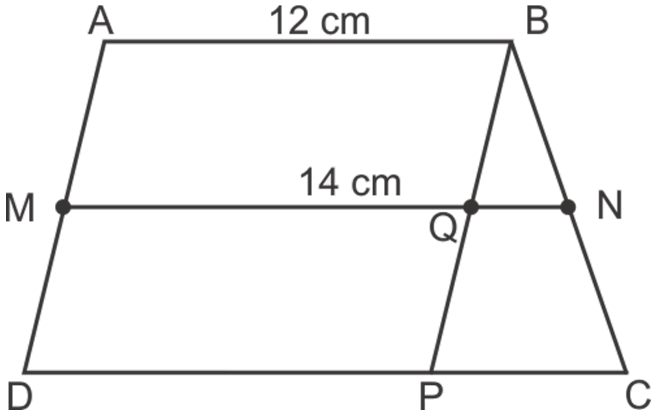
Let a line $BP$ is drawn $||$ to $AD$ to meet $DC$ at $ P.$
$ABPD$ is a parallelogram.
$AB || PD, AD || BP$
So $AB = DP$
Let $BP$ cuts $MN$ at $Q$.
$MQ$ is also $||$ to $AB || PD$
So $AB = MQ = PD = 12\ cm ...(1)$
$QN = MN - MQ = 14 - 12 = 2\ cm$
Consider $\triangle\text{BPC}.$
Q and N are the mid-points of $BP$ & $BC,$ and the line joining them $QN || PC.$
Then by property, $\frac{\text{QN}}{\text{PC}}=\frac{1}{2}$
$⇒ PC = 2QN = 2 × 2 = 4\ cm$
Now, $DC = DP + PC$
$DP = 12\ cm [$From $(1)]$
$⇒ DC = 12 + 4 = 16\ cm$
View full question & answer→MCQ 2091 Mark
$ABCD$ is a parallelogram in which diagonal $AC$ bisects $\angle\text{BAD}.$ if $\angle\text{BAC}=35^\circ,$ then $\angle\text{ABC}=$
- A
$70^\circ $
- ✓
$110^\circ$
- C
$90^\circ$
- D
$120^\circ$
AnswerCorrect option: B. $110^\circ$
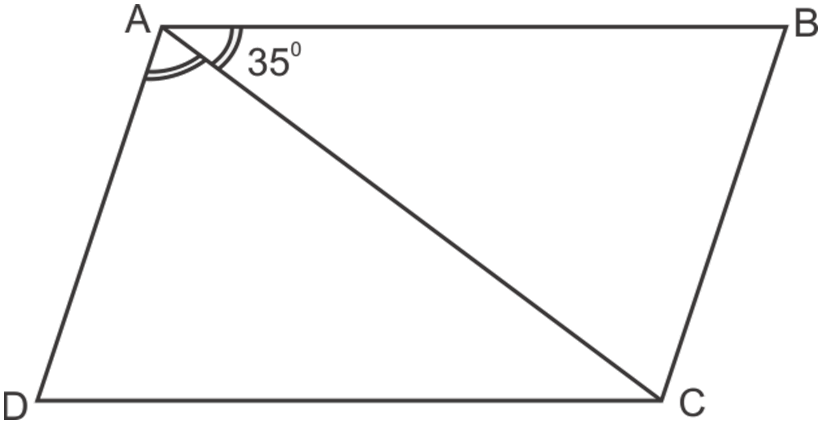
$AC$ bisects $\angle\text{DAB}.$
$\Rightarrow\angle\text{DAC}=\angle\text{BAC}=35^\circ$
$\Rightarrow\angle\text{BAD}=2\times35^\circ=70^\circ$
$\angle\text{A}+\angle\text{B}=180^\circ ($Sum of any two adjacent angles in parallelogram $=180^\circ )$
$\Rightarrow\angle\text{B}=\angle\text{ABC}=180^\circ-\angle\text{BAD}$
$=180^\circ-70^\circ=110^\circ$ View full question & answer→MCQ 2101 Mark
$PQRS$ is a quadrilateral. $PR$ and $QS$ intersect each other at $O.$ in which of the following cases, $PQRS$ is a parallelogram$?$
- ✓
$\angle\text{P}=100^\circ,\angle\text{Q}=80^\circ,\angle\text{R}=100^\circ$
- B
$\angle\text{P}=85^\circ,\angle\text{Q}=85^\circ,\angle\text{R}=95^\circ$
- C
$\text{PQ}=7\text{cm},\text{QR}=7\text{cm},\text{RS}=8\text{cm},\text{SP}=8\text{cm}$
- D
$\text{OP}=6.5\text{cm},\text{OQ}=6.5\text{cm},\text{OR}=5.2\text{cm},\text{OS}=5.2\text{cm}$
AnswerCorrect option: A. $\angle\text{P}=100^\circ,\angle\text{Q}=80^\circ,\angle\text{R}=100^\circ$
In a parallelogram, opposite corner angles are equal and sum of adjacent angles $= 108^\circ $
Hence, in quadrrilateral $PQRS,$
$\Rightarrow\angle\text{P}=\angle\text{R}$ and $\angle\text{Q}=\angle\text{S}$
Also, $\angle\text{P}+\angle\text{Q}=\angle\text{Q}+\text{R}=180^\circ$
Hence, if $\angle\text{P}=100^\circ$ and $\angle\text{Q}=80^\circ,$ then
$\angle\text{P}+\angle\text{Q}=100^\circ+80^\circ=180^\circ$
Also, if $\angle\text{Q}+=80^\circ$ and $\angle\text{R}=100^\circ$ then
$\angle\text{Q}+\angle\text{R}=80^\circ+100^\circ=180^\circ$
View full question & answer→MCQ 2111 Mark
The lengths of the diagonals of a rhombus are $16\ cm$ and $12\ cm.$ The length of each side of the rhombus is:
- ✓
$10\ cm$
- B
$12\ cm$
- C
$9\ cm$
- D
$8\ cm$
AnswerCorrect option: A. $10\ cm$
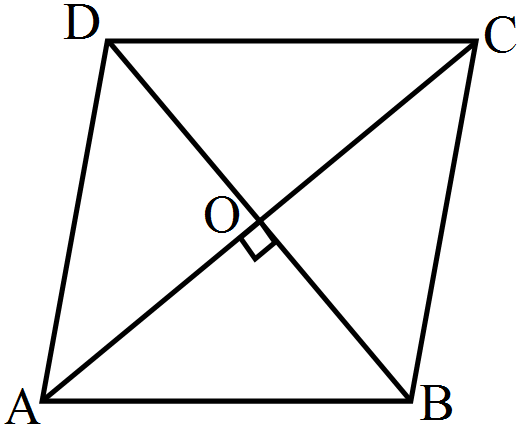
We konw that, the diagonals of a rhombus bisect each other at right angles.
So, $Ac = 16\ cm$ and $BD = 12\ cm$
$⇒ OA = 8\ cm$ and $OB = 6\ cm$
Also, $\angle\text{OAB}=90^{\circ}$
In right $\triangle\text{OAB},$
By Pythagoras theorem,
$\text{AB}^2=\text{OA}^2+\text{OB}^2$
$\Rightarrow\text{AB}^2=(8)^2+(6)^2$
$\Rightarrow\text{AB}^2=64+36$
$\Rightarrow\text{AB}^2=100$
$\Rightarrow\text{AB}=\sqrt{100}$
$\Rightarrow\text{AB}=10\text{cm}$
Hence, the length of each side of the rhombus is $10\ cm.$ View full question & answer→MCQ 2121 Mark
In $\triangle\text{ABC}, EF$ is the line segment joining the mid-points of the sides $AB$ and $AC. BC = 7.2\ cm,$ Find $EF = ?$
- A
$3.4\ cm$
- ✓
$3.6\ cm$
- C
$3.5\ cm$
- D
$2.6\ cm$
AnswerCorrect option: B. $3.6\ cm$
$ E$ and $F$ are midpoints of sides $AB$ and $AC.$ By midpoint theorem, $EF$ is parallel to $BC$ and $EF$ is $\frac{1}{2}$ of $BC.$
So, $\text{EF} = {1}{2}$ of $(7.2) = 3.6\text{cm}.$
View full question & answer→MCQ 2131 Mark
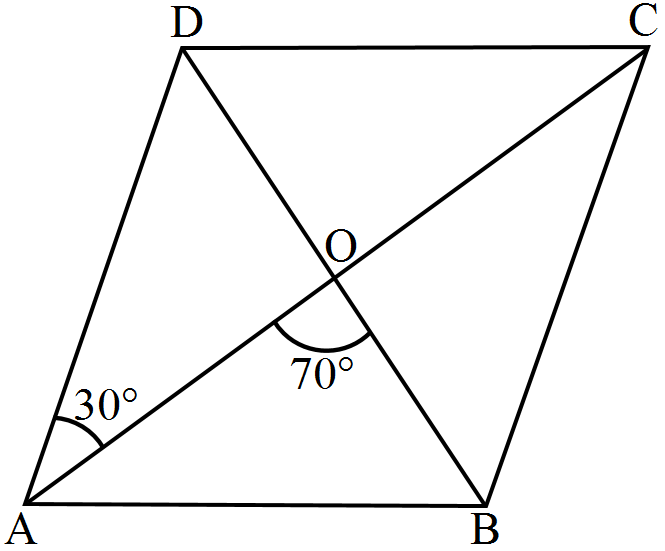
The Diagonals $AC$ and $BD$ of a Parallelogram $ABCD$ intersect each other at the point $O$ such that $\angle\text{DAC}=30^\circ$ and $\angle\text{AOB}=30^\circ.$ Then, $\angle\text{DBC}\ ?$
- A
$30^\circ $
- B
$45^\circ$
- C
$35^\circ$
- ✓
$40^\circ$
AnswerCorrect option: D. $40^\circ$
$\angle\text{DAC} = \angle\text{ACB} = 30^\circ $ (alternate angles)
$\angle\text{BOA} = \angle\text{BOC} = 180^\circ $ (linear pair)
$\angle\text{BOC} = 180^\circ - 70^\circ = 110^\circ$
In $\triangle\text{BOC},\ \angle\text{BOC} + \angle\text{OCB} + \angle\text{CBO} = 180^\circ$ (angle sum property)
$110^\circ + 30^\circ + \angle\text{CBO} = 180^\circ$
$\angle\text{CBO} = 180^\circ - 140^\circ = 40^\circ = \angle\text{DBC}$
View full question & answer→MCQ 2141 Mark
In fig $ABCD$ is a parallelogram. If $\angle\text{DAB}=60^\circ$ and $\angle\text{DBC}=80^\circ$ then $\angle\text{CDB}$ is:
- A
$80^\circ $
- B
$70^\circ $
- ✓
$40^\circ$
- D
$60^\circ$
AnswerCorrect option: C. $40^\circ$
$40^\circ\ \angle\text{C} = 60^\circ$ as opposite angles of a parallelogram are equal and $\angle\text{CDB} = 40^\circ$ angle sum property of a triangle. [In $\triangle\text{CDB},\ \angle\text{C} + \angle\text{CDB} + \angle\text{DBC} = 180^\circ$]
View full question & answer→MCQ 2151 Mark
Write the correct answer in the following: $D$ and $E$ are the mid-points of the sides $AB$ and $AC$ of $\Delta\text{ABC}$ and $O$ is any point on side $BC.\ O$ is joined to $A.$ If $P$ and $Q$ are the mid-points of $OB$ and $OC$ respectively, then $DEQP$ is:
AnswerSince the line segment joiing the mid-poients of any two sides of a triangle is parallel to third side and is half to it, so
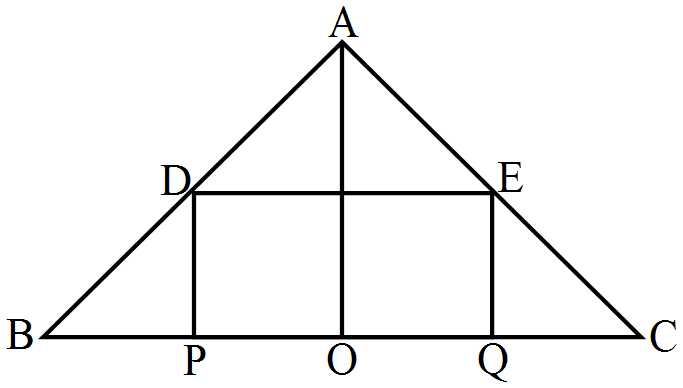
$\therefore\ \text{DE}=\frac{1}{2}\text{BC}$ and $\text{DE}||\text{BC}$
Similarly, $\text{DP}=\frac{1}{2}\text{AO}$ and $\text{DP||AO}$
And $\text{EQ}=\frac{1}{2}\text{AO}$ and $\text{EQ||AO}$
$\therefore\ \text{DP}=\text{EQ}[\therefore\text{Each}=\frac{1}{2}\text{AO}]$
And $\text{DP||EQ}[\therefore\text{Each}=\frac{1}{2}\text{AO}]$
Now, $DEQP$ is quadrilateral in which one pair of its opposite is equal and parallel.
Therefore, quadrilateral $DEQP$ is a parallelogram.
Hence, $(d)$ is the correct answer.
View full question & answer→MCQ 2161 Mark
If $ABCD$ is a parallelogram with two adjacent angles $\angle\text{A}=\angle\text{B}$ then the parallelogram is a:
Answer Given that $ABCD$ is a parallelogram.
We konw that, opposite sides of a parallelogram are parallel.
$\Rightarrow\angle\text{A}+\angle\text{B}=180^{\circ} ...($interior angles$)$
Also, $\angle\text{A}=\angle\text{B}=90^{\circ} ...($Given$)$
Since opposite angles of a parallelogram are equal,
$\angle\text{A}=\angle\text{C}$ and $\angle\text{B}=\angle\text{D}$
So, $\angle\text{A}=\angle\text{C}=\angle\text{B}=\angle\text{D}=90^{\circ}$
$\therefore ABCD$ is a rectangle.
View full question & answer→MCQ 2171 Mark
Write the correct answer in the following: The figure obtained by joining the mid-points of the sides of a rhombus, taken in order, is:
AnswerThe figure will be a rectangle.
Hence, $(b)$ is the correct answer.
View full question & answer→MCQ 2181 Mark
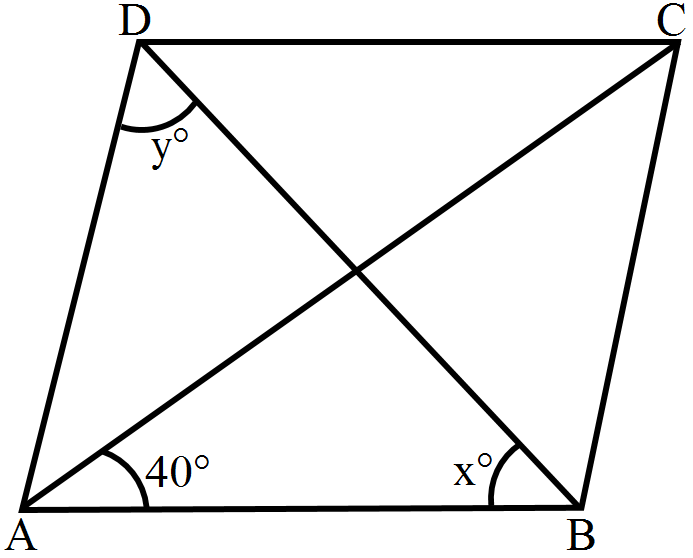
In the given figure, $ABCD$ is a Rhombus. Find the value of $x$ and $y?$
- A
$x = 55^\circ $ and $y = 65^\circ $
- ✓
$x = 50^\circ $ and $y = 50^\circ $
- C
$x = 75^\circ $ and $y = 55^\circ $
- D
$x = 80^\circ $ and $y = 80^\circ $
AnswerCorrect option: B. $x = 50^\circ $ and $y = 50^\circ $
$ABCD$ is a rhombus and a rhombus is also a parallelogram. A rhombus has four equal sides.
The diagonals of a rhombus are perpendicular bisector of each other.
So, in $\triangle\text{AOB}, \ \angle\text{OAB} = 40^\circ, \angle\text{AOB} = 90^\circ $ and $\angle\text{ABO} = 180^\circ- (40^\circ + 90^\circ) = 50^\circ$
$\therefore \text{x} = 50^\circ$
In $\triangle\text{ABD, AB = AD}$
So, $\angle\text{ABD} = \angle\text{ADB} = 50^\circ$
Hence, $x = 50^\circ $ and $y = 50^\circ $
View full question & answer→MCQ 2191 Mark
A diagonal of a Rectangle is inclined to one side of the rectangle at an angle of $25^\circ .$ The Acute Angle between the diagonals is:
- ✓
$50^\circ$
- B
$115^\circ $
- C
$40^\circ$
- D
$25^\circ$
AnswerCorrect option: A. $50^\circ$
Two diagonals of a rectangle divide it into four triangles. Out of these four triangles a pair of opposite triangles are congruent by $SSS$ in which a pair of triangles have two equal angles of $25$ each and in another pair of opposite triangles have two equal angles of $65$ each. By angle sum property we have two options of angle formed between diagonals. Either it is of $130$ or $50.$ $50$ is an acute angle. So, it is a correct option.
View full question & answer→MCQ 2201 Mark
In Quadrilateral $ABCD, \angle\text{A} = (3\text{x})^\circ, \ \angle\text{B} = (5\text{x})^\circ,\ \angle\text{C} = (20\text{x})^\circ,\ \angle\text{D} = (8\text{x})^\circ.$ Find the value of $x?$
Answer$\angle\text{A} + \angle\text{B} + \angle\text{C} + \angle\text{D} = 360 ($angle sum property$)$
$3x + 5x + 20x + 8x = 360$
$36x = 360$
$x = 10$
View full question & answer→MCQ 2211 Mark
The diagonals of a parallelogram $ABCD$ intersect at $O.$ if $\angle\text{BOC}=90^\circ$ and $\angle\text{BDC}=50^\circ,$ then $\angle\text{AOB}=$
- ✓
$40^\circ $
- B
$50^\circ $
- C
$10^\circ$
- D
$90^\circ$
AnswerCorrect option: A. $40^\circ $
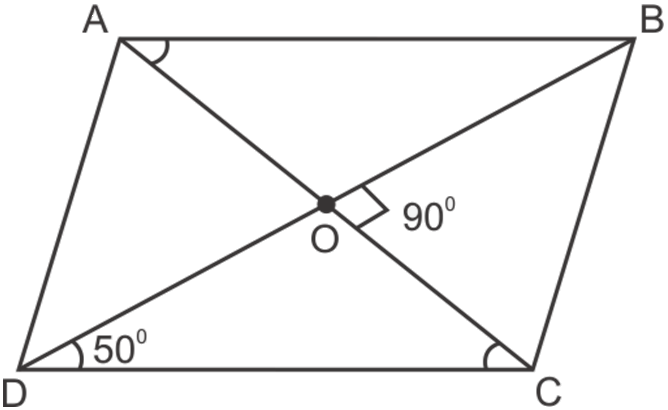
In a parallelogram $ABCD,$
$\angle\text{OAB}=\angle\text{OCB}$
In $\triangle\text{OCB}$
$\angle\text{OCD}+\angle\text{COD}+\angle\text{ODC}=180^\circ$
$\angle\text{COD}=90^\circ$
$\angle\text{ODC}=50^\circ$ (given)
$\angle\text{OCD}=180^\circ-90^\circ-50^\circ=40^\circ$
$\Rightarrow\angle\text{OAB}=\angle\text{OCD}=40^\circ$
View full question & answer→MCQ 2221 Mark
The figure formed by joining the mid$-$points of the adjacent sides of a rectangle is $a:$
AnswerThe figure formed by joining the mid points of the adjacent sides of a rectangle is a rhombus.
View full question & answer→MCQ 2231 Mark
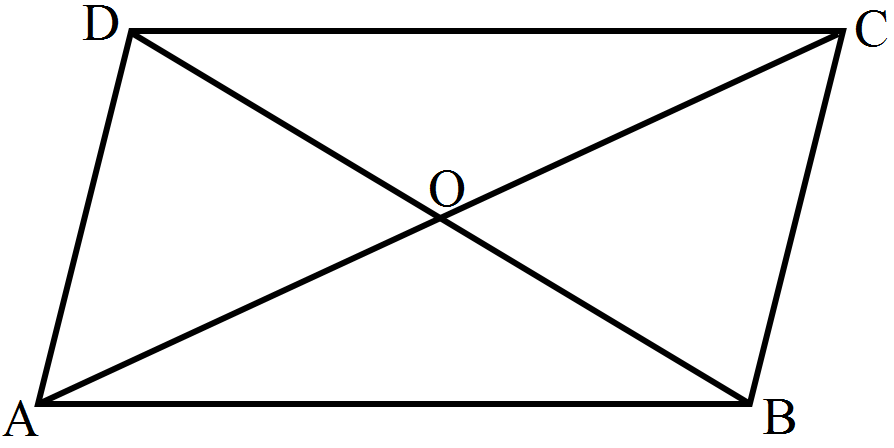
In the given figure, $ABCD$ is a Rhombus. Then,
- A
$\left(A C^2+B D^2\right)=3 A B^2$
- ✓
$\mathrm{AC}^2+\mathrm{BD}^2=4 \mathrm{AB}^2$
- C
$\mathrm{AC}^2+\mathrm{BD}^2=\mathrm{AB}^2$
- D
$\mathrm{AC}^2+\mathrm{BD}^2=2 \mathrm{AB}^2$
AnswerCorrect option: B. $\mathrm{AC}^2+\mathrm{BD}^2=4 \mathrm{AB}^2$
$ABCD$ is a rhombus. $AB = BC = CD = DA$
In Rhombus, diagonals bisect each other at right angles.
So, $AO= CO$ and $BO = DO$
In triangle $\mathrm{AOB} \times \mathrm{AO} \mathrm{F}^2+\mathrm{BO}^2=\mathrm{AB}^2$ (Pythagoras theorem)
$\Big(\frac{1}{2}\text{AC}\Big)^2 + \Big(\frac{1}{2}\text{BD}\Big)^2 = \text{AB}^2$
$\frac{\text{AC}^2}{4} + \frac{\text{BD}^2}{4} = \text{AB}^2$
$=A C^2+B D^2=4 A B^2$
View full question & answer→MCQ 2241 Mark
$ABCD$ is a Rhombus such that $\angle\text{ACB}= 40^\circ,$ then $\angle\text{ADB}$ is:
- ✓
$50^\circ $
- B
$60^\circ$
- C
$100^\circ$
- D
$40^\circ$
AnswerCorrect option: A. $50^\circ $
In Rhombus, diagonals bisect each other right angle. By using angle sum property in any of the four triangles formed by intersection of diagonals, we get $\angle\text{CBD} = 50$ and $\angle\text{CBD} = \angle\text{ADC}$ (alternate angles).
So, $\angle\text{ADC} = 50$
View full question & answer→MCQ 2251 Mark
The figure formed by joining the mid-points of the sides of a quadrilateral $ABCD,$ taken in order, is a square only if:
- A
$ABCD$ is a Rhombus.
- ✓
Diagonals of $ABCD$ are equal and perpendicular.
- C
Diagonals of $ABCD$ are perpendicular.
- D
Diagonals of $ABCD$ are equal.
AnswerCorrect option: B. Diagonals of $ABCD$ are equal and perpendicular.
A quadrilateral formed by joining the mid-points of a square is a square. So, $ABCD$ is a square. In Square, diagonals are equal and perpendicular.
View full question & answer→MCQ 2261 Mark
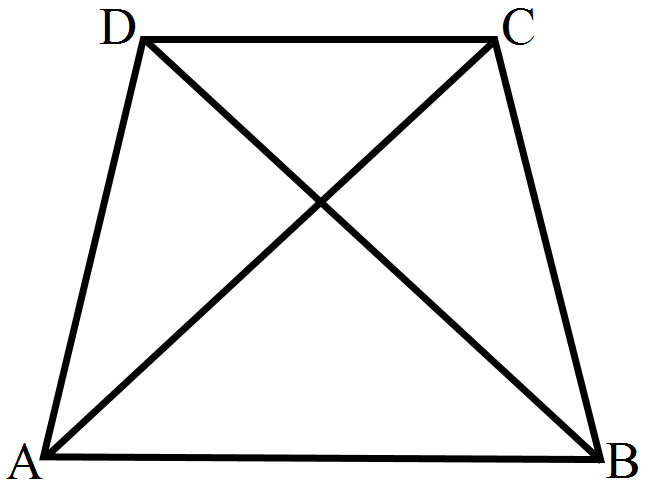
In a Trapezium $ABCD,$ if $\text{AB || CD},$ then $(A C^2+B D^2)=?$
- A
$B C^2+A D^2+2 B C \times A D$
- B
$\mathrm{AB}^2+C \mathrm{D}^2+2 \mathrm{AB} \times \mathrm{CD}$
- C
$A B^2+C D^2+2 A D \times B C$
- ✓
$\mathrm{BC}^2+\mathrm{AD}^2+2 \mathrm{AB} \times \mathrm{CD}$
AnswerCorrect option: D. $\mathrm{BC}^2+\mathrm{AD}^2+2 \mathrm{AB} \times \mathrm{CD}$
Given: $ABCD$ is a trapezium with $\text{AB || CD}$
Construction: Draw $DE$ and $CF$ $\bot$ to $AB.$
Then in $\triangle\text{ABC}$
$\angle\text{BAC}$ is acute
$\therefore B C^2=A C^2+A B^2-2 A F: A B \ldots(1)$
and in $\triangle \mathrm{BDA}$
$\angle \mathrm{DBA}$ is acute
$\therefore A D^2=B D^2+A B^2-2 B E: A B \ldots(2)$
Adding $(1)$ and $(2)$ we get
$B C^2+A D^2=A C^2+B D^2+2 A B^2-2 A F \cdot A B-2 B E \cdot A B$
$\Rightarrow A C^2+B D^2=B C^2+A D^2-2 A B[A B-A F-B E)$
$=B C^2+A D^2-2 A B[A B-(A E+E F)-(B F+E F)]$
$=B C^2+A D^2-2 A B[A B-(A E+E F+B F+E F)]$
$=B C^2+A D^2-2 A B[A B-(A B+C D)](\therefore E F=D C)$
$=B C^2+A D^2-2 A B[-(C D)]$
$=A D^2+B C^2+2 A B \times C D$
View full question & answer→MCQ 2271 Mark
In which of the following figures are the diagonals equal?
AnswerRectangle is the correct answer.
As we know that from all the quadrilaterals given in other options, diagonals of a rectangle are equal.
View full question & answer→MCQ 2281 Mark
In Parallelogram $ABCD,$ bisectors of angles $A$ and $B$ intersect each other at $O.$ The measure of $\angle\text{AOB}$ is:
- ✓
$90^\circ $
- B
$30^\circ$
- C
$60^\circ$
- D
$120^\circ$
AnswerCorrect option: A. $90^\circ $
Given: $ABCD$ is a parallelogram in which $AO$ and $BO$ are angle bisectors of $\angle\text{A}$ and $\angle\text{B}.$
Now since $ABCD$ is a parallelogram
$\therefore\text{AD || BC}$
Now $\text{AD || BC}$ and transversal $AB$ intersect them
$\therefore\angle\text{A}+ \angle\text{B} = 180^\circ ( \therefore$ sum of consecutive interior angle is $180º)$
$\Rightarrow\frac{1}{2}\angle\text{A}+\frac{1}{2}\angle\text{B}=90^\circ$
$\therefore\angle\text{1}+ \angle\text{2} = 90^\circ ( \therefore AO$ and $BO$ are angle bisectors$) ... (1)$
In $\triangle\text{AOB}$ we have
$\angle1 + \angle\text{AOB} + \angle\text{2} = 180^\circ$
$\Rightarrow90^\circ +\angle\text{AOB} = 180^\circ$ from $(1))$
$\Rightarrow \angle\text{AOB} = 180^\circ - 90^\circ = 90^\circ$
View full question & answer→MCQ 2291 Mark
$ABCD$ is a rhombus such that $\angle\text{ACB}=50^{\circ}.$ Then, $\angle\text{ADB}=?$
- ✓
$40^\circ$
- B
$25^\circ$
- C
$65^\circ$
- D
$130^\circ$
AnswerCorrect option: A. $40^\circ$
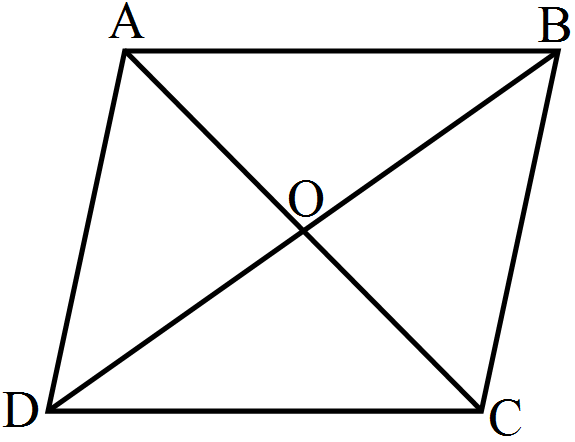
$ABCD$ is a rhombus.
$\Rightarrow\text{AD || BC}$ and $\text{AC}$ is the transversal.
$\Rightarrow\angle\text{DAC}=\angle\text{ACB}$ (alternate angles)
$\Rightarrow\angle\text{DAC}=50^{\circ}$
In $\triangle\text{AOD},$ by angle sum property,
$\angle\text{AOD}+\angle\text{DAO}+\angle\text{ADO}=180^{\circ}$
$\Rightarrow90^{\circ}+\angle\text{50}^{\circ}+\angle\text{ADO}=180^{\circ}$
$\Rightarrow\angle\text{ADO}=40^{\circ}$
$\Rightarrow\angle\text{ADB}=40^{\circ}$
View full question & answer→MCQ 2301 Mark
In a quadrilateral $ABCD, \angle\text{A} + \angle\text{C}$ is 2 times $\angle\text{B} + \angle\text{D}.$ If $\angle\text{A} = 140^\circ$ and $\angle\text{D} = 60^\circ,$ then $ZB = ?$
- ✓
$60^\circ $
- B
$120^\circ$
- C
$80^\circ$
- D
AnswerCorrect option: A. $60^\circ $
Given,
$ABCD$ is a parallelogram
$\angle\text{A} + \angle\text{C} = 2(\angle\text{B} + \angle\text{D})$
$\angle\text{A} = 40^\circ$
$∵ \angle\text{A} + \angle\text{B} + \angle\text{C} + \angle\text{D} = 360^\circ$ [angle sum property of quadrilateral]
$\Rightarrow \angle\text{A} + \angle\text{C} + \angle\text{B} + \angle\text{D} = 360^\circ$
$⇒ 2(\angle\text{B} + \angle\text{D})+ \angle\text{B} + \angle\text{D} = 360^\circ$
$⇒ 3(\angle\text{B} + \angle\text{D})= 360^\circ$
$\Rightarrow\angle\text{B}+\angle\text{D}=\frac{360^\circ}{3}=120^\circ$
$\because\ \angle\text{B}=60^\circ$ [given]
$\therefore\ \angle\text{B}=120^\circ-60^\circ=60^\circ$
View full question & answer→MCQ 2311 Mark
In a quadrilateral $ABCD,$ if $AO$ and $BO$ are the bisectors of $\angle\text{A}$ and $\angle\text{B}$ respectively, $\angle\text{C}=70^{\circ}$ and $\angle\text{D}=30^{\circ}.$ Then, $\angle\text{AOB}=?$
- A
$40^\circ $
- ✓
$50^\circ$
- C
$80^\circ$
- D
$100^\circ$
AnswerCorrect option: B. $50^\circ$
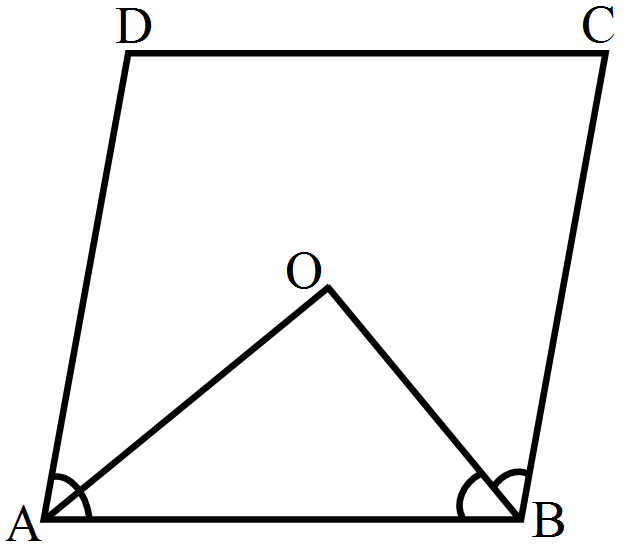
We know that, sum of the angles of a quadrilateral is $360^\circ .$
$\Rightarrow\angle\text{A}+\angle\text{B}+\angle\text{C}+\angle\text{D}=360^{\circ}$
$\Rightarrow\angle\text{A}+\angle\text{B}+70^{\circ}+30^{\circ}=360^{\circ}$
$\Rightarrow\angle\text{A}+\angle\text{B}=260^{\circ}$
$\Rightarrow\frac{1}{2}\angle\text{A}+\frac{1}{2}\angle\text{B}=\frac{1}{2}(260)^{\circ}$
$\Rightarrow\angle\text{BAO}+\angle\text{ABO}=130^{\circ}...(\text{i})$
In $\triangle\text{AOB},$
$\angle\text{BAO}+\angle\text{ABO}+\angle\text{AOB}=180^{\circ} ...($Angle sum Property$)$
$\Rightarrow130^{\circ}+\angle\text{AOB}=180^{\circ} ...($from $(i))$
$\Rightarrow\angle\text{AOB}=50^{\circ}$
View full question & answer→MCQ 2321 Mark
Is quadrilateral $\text{ABCD}$ a $\|\ gm?$
$i.$Diagonals $AC$ and $BD$ bisect each other.
$ii.AC$ and $BD$ are equal.
- ✓
If the question can be answered by one of the given statements alone and not by the other;
- B
If the question can be answered by either statement alone;
- C
If the question can be answered by both the statements together but not by any one of the two;
- D
If the question cannot be answered by using both the statements together.
AnswerCorrect option: A. If the question can be answered by one of the given statements alone and not by the other;
If the diagonals of a quad. $\text{ABCD}$ bisect each other, then the quad.
$\text{ABCD}$ is a parallelogram.
So, $I$ gives the answer.
If the diagonals are equal, then the quad.
$\text{ABCD}$ is a parallelogram.
So, $II$ gives the answer.
View full question & answer→MCQ 2331 Mark
The Quadrilateral formed by joining the mid-points of the sides of a Quadrilateral $PQRS,$ taken in order, is a rectangle if:
AnswerCorrect option: D. Diagonals of $PQRS$ are at right angles.
Diagonals of $PQRS$ are at right angles form all the internal angles as right angles. $[$according to angle property of rectangle, i.e., all the angles of a rectangle are right angle $(90^\circ )].$
View full question & answer→MCQ 2341 Mark
In Triangle $ABC$ which is right angled at $B.$ Given that $AB = 9\ cm, AC = 15\ cm$ and $D, E$ are the mid-points of the sides $AB$ and $AC$ respectively. Find the length of $BC?$
- A
$13\ cm$
- ✓
$12\ cm$
- C
$15\ cm$
- D
$13.5\ cm$
AnswerCorrect option: B. $12\ cm$
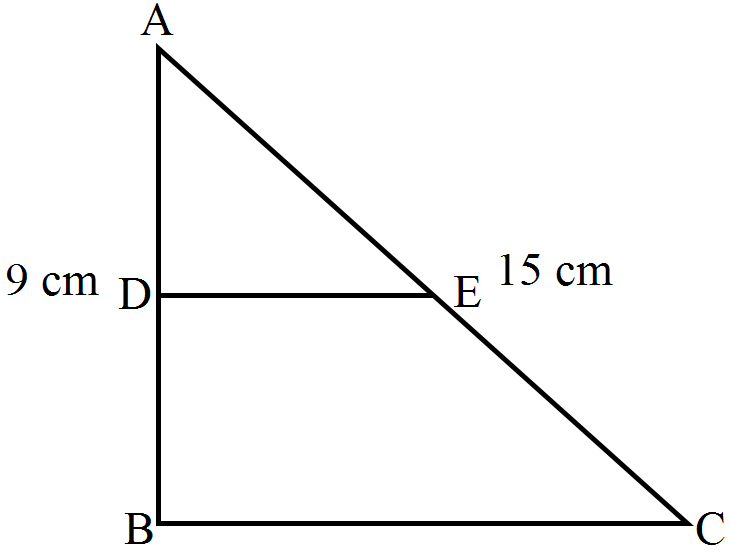
Applying Pythagoras theorem in $\triangle\text{ABC}$
$A C^2=A B^2+B C^2$
$15^2=9^2+B C^2$
$225=81+\mathrm{BC}^2$
$225-81=\mathrm{BC}^2$
$B C^2=144$
$B C=12 \mathrm{~cm}$
View full question & answer→MCQ 2351 Mark
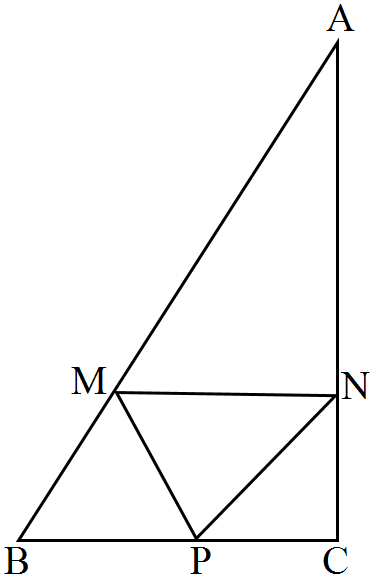
$M, N$ and $P$ are the mid-points of $AB, AC$ and $BC$ res. If $MN = 3\ cm, NP = 3.5\ cm$ and $MP = 2.5\ cm,$ calculate $BC, AB$ and $AC.$
- A
$9\ cm, 8\ cm, 11\ cm$
- B
$2\ cm, 3\ cm, 11\ cm$
- C
$5\ cm, 6\ cm, 8\ cm$
- ✓
$5\ cm, 6\ cm, 7\ cm$
AnswerCorrect option: D. $5\ cm, 6\ cm, 7\ cm$
$ AB = 7\ cm ($by mid-point theorm$)$
$AC = 5\ cm ($by mid-point theorm$)$
$BC = 6\ cm ($by mid-point theorm$)$
View full question & answer→MCQ 2361 Mark
In each of the questions one question is followed by two statements $I$ and $II.$ Choose the correct option.Is quadrilateral $\text{ABCD}$ a parallelogram$?$
$i$.Its opposite sides are equal.
$ii$.Its opposite angles are equal.
- ✓
If the question can be answered by either statement alone.
- B
If the question can be answered by one of the given statements alone and not by the other.
- C
If the question cannot be answered by using both the statements together.
- D
If the question can be answered by both the statements together but not by any one of the two.
AnswerCorrect option: A. If the question can be answered by either statement alone.
We know that a quadrilateral is a parallelogram when either $I$ or $II$ holds true.
So, the question can be answered by either statement alone.
View full question & answer→MCQ 2371 Mark
In Quadrilateral $\angle\text{A} = 38^\circ, \ \angle\text{C} = 3\angle\text{A},\ \angle\text{D} = 4\angle\text{A}.$ Find the value of $\angle\text{B}=\ ?$
- A
$57^\circ$
- ✓
$56^\circ$
- C
$55^\circ$
- D
$80^\circ$
AnswerCorrect option: B. $56^\circ$
$\angle\text{A} + \angle\text{B} + \angle\text{C} + \angle\text{D} = 360^\circ$ (angle sum property)
$\angle\text{C} = 3 ( 38) = 114^\circ$
$\angle\text{D} = 4 ( 38) = 152^\circ$
So, $38^\circ + \angle\text{B} + 114^\circ + 152^\circ = 360^\circ$
$\angle\text{B} = 360^\circ - 304^\circ = 56^\circ$
View full question & answer→MCQ 2381 Mark
The two digonals are equal in $a:$
AnswerThe two diagonals are equal in a rectangle $($property$).$
View full question & answer→MCQ 2391 Mark
The length of each side of a rhombus is $10\ cm$ and one of its diagonal is of length $16\ cm$. The Length of the other Diagonal is:
- ✓
$12\ cm$
- B
$13\ cm$
- C
$5\ cm$
- D
$6\ cm$
AnswerCorrect option: A. $12\ cm$
Use pythagoras theorem in right triangle,
$102 -\Big[\frac{16}{2}\Big]^2 = 100 - 64 = 36 = [6]^2$
Hence, the other diagonal $= 6 × 2 = 12\ cm$
View full question & answer→MCQ 2401 Mark
In Parallelogram $ABCD,$ bisectors of angles $A$ and $B$ intersect each other at $O$. The measure of $\angle\text{AOB}$ is:
- A
$120^\circ $
- ✓
$90^\circ$
- C
$30^\circ$
- D
$60^\circ$
AnswerCorrect option: B. $90^\circ$
Given: $ABCD$ is a parallelogram in which $AO$ and $BO$ are angle bisectors of $\angle\text{A}$ and $\angle\text{B}.$
Now since $ABCD$ is a parallelogram
$∴ \text{AD || BC}$
Now $\text{AD || BC}$ and transversal $AB$ intersect them
$∴\ \angle\text{A} + \angle\text{B} = 180^\circ (∴$ sum of consecutive interior angle is $180º)$
$⇒\frac{1}{2}\angle\text{A}+\frac{1}{2}\angle\text{B}=90^\circ$
$⇒ \angle1 + \angle2 = 90^\circ (∴ AO$ and $BO$ are angle bisectors$) ...(i)$
In $\triangle\text{AOB}$ we have
$\angle1 + \angle\text{AOB} + \angle2 = 180^\circ$
$⇒ 90^\circ +\angle\text{AOB} = 180^\circ ($from $(i))$
$⇒ \angle\text{AOB} = 180^\circ – 90^\circ = 90^\circ$
View full question & answer→MCQ 2411 Mark
We get a rhombus by joining the mid-points of the sides of $a:$
Answer 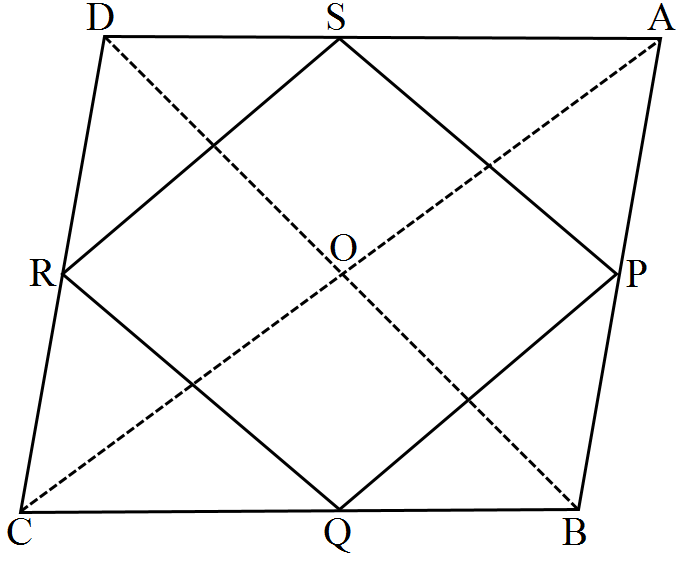
Let $ABCD$ be a rhombus and $p, q, R$ and $S$ be the mid-point.
Let $ABCD$ be a rhombus and $P, Q, R$ and $S$ be the mid-points of sides $AB, BC, CD$ and $DA$ respectively.
In $\triangle\text{ABD}$ and BDC we have
$\text{SP || BD}$ and $\text{SP}=\frac{1}{2}\text{BD}\ ...\ \text{(i)}$
$\text{RQ || BD}$ and $\text{RQ}=\frac{1}{2}\text{BD}\ ...\ \text{(ii)}$
From $(i)$ and $(ii)$ we get
$PQRS$ is a $||gm$
As diagonals of a rhombus bisect each other at right angles.
$∴\ \text{AC⊥BD}$
Since $\text{SP || BD, PQ || AC}$ and $\text{AC⊥BD}$
$∴\ \text{SP⊥ PQ}$
$∴\ \angle\text{QPS}=90^\circ ... \text{(iii)}$
From above results,
we have,
$||gm\ PQRS$ is a rectangle.
View full question & answer→MCQ 2421 Mark
In a rhombus $ABCD,$ if $\angle\text{ACB} = 40^\circ,$ then $\angle\text{ADB} =\ ?$
- A
$55^\circ $
- B
- ✓
$50^\circ$
- D
$25^\circ$
AnswerCorrect option: C. $50^\circ$
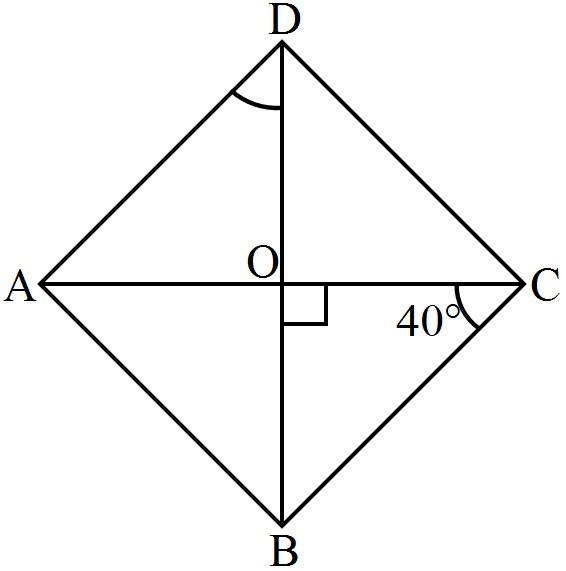
Given $ABCD$ is a rhombus. Diagonals bisect each other perpendicularly.
Hence $\angle\text{BOC} = 90^\circ$
Given $\angle\text{OCB} = 40^\circ$
$\text{AD || BC}$ and BD is the transversal
$∴ \angle\text{ADB} = \angle\text{DBC}$ (Alternate angles)
Hence in right angled $\triangle\text{BOC},$
$\angle\text{BOC} + \angle\text{OCB} + \angle\text{OBC} = 180^\circ$
$⇒ 90^\circ + 40^\circ + \angle\text{OBC} = 180^\circ$
$⇒130^\circ + \angle\text{OBC} = 180^\circ$
$⇒ \angle\text{OBC} = 180^\circ - 130^\circ = 50^\circ$
But $\angle\text{OBC} = \angle\text{DBC}$
Therefore, $\angle\text{ADB} = 50^\circ.$
View full question & answer→MCQ 2431 Mark
The diagonals $AC$ and $BD$ of a rectangle $ABCD$ intersect each other at $P.$ If $\angle\text{ABD} = 50^\circ,$ then $\angle\text{DPC} =\ ?$
- A
$70^\circ $
- B
$100^\circ$
- C
$90^\circ$
- ✓
$80^\circ$
AnswerCorrect option: D. $80^\circ$
Given,$ABCD$ is a rectangle
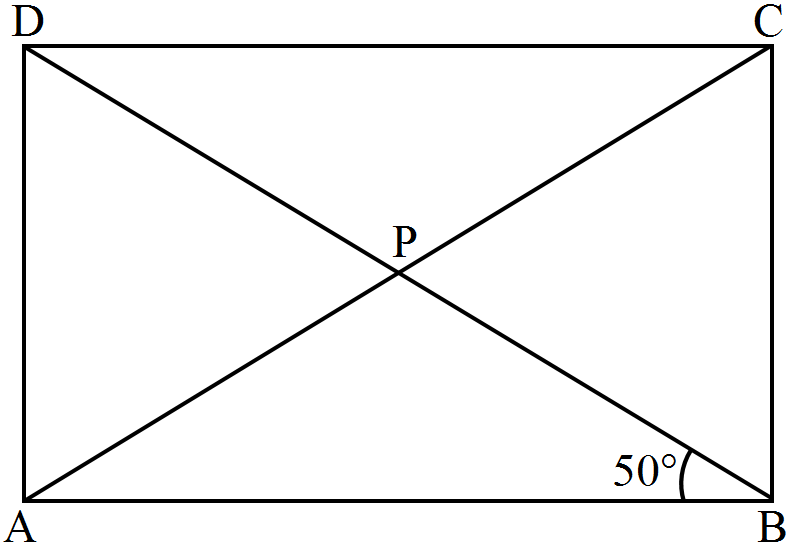
Diagonals $AC\ \&\ BD$ intersect each other at $P$
$\angle\text{ABD} = 50^\circ$
$∵$ diagonals of rectangle bisect each other and are equal in length
$⇒ \angle\text{ABD} = \angle\text{PDC}$ [alternate angles]
$⇒ \angle\text{PDC}= \angle\text{PCD} = 50^\circ$
In $\triangle\text{DPC}$
$⇒ \angle\text{DPC} + \angle\text{PCD} + \angle\text{PDC} = 180^\circ$
$⇒ \angle\text{DPC} + 50^\circ + 50^\circ= 180^\circ$
$⇒ \angle\text{DPC} = 180^\circ - 100^\circ = 80^\circ$ View full question & answer→