Questions

2 Marks Questions

Take a timed test

39 questions · self-marked practice — reveal the answer and mark yourself.

Question 12 Marks
If O is the center of the circle in the figure alongside, then complete the table from the given information.
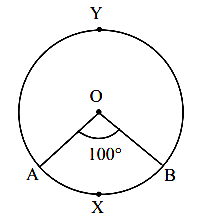
The type of arc
Type of circular arc Name of circular arc Measure of circular arc
Minor arc
Major arc
Answer
Type of arc Name of the arc Measure of the arc
Minor arc arc AXB 100°
Major arc arc AYB 260°
View full question & answer
Question 22 Marks
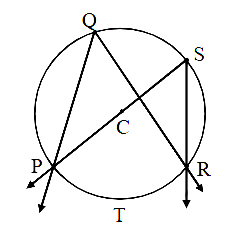
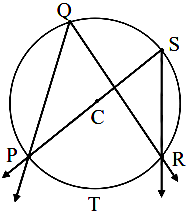
Prove that angles inscribed in the same arc are congruent.

Given: In a circle with center $C, \angle P Q R$ and $\angle P S R$ are inscribed in same arc PQR. Arc PTR is intercepted by the angles.
To prove: $\angle P Q R \cong \angle P S R$.
Proof:
$ m \angle PQR =\frac{1}{2} \times[ m (\operatorname{arc} PTR )]$
$m \angle \square=\frac{1}{2} \times[ m (\operatorname{arc} PTR )] \ldots . . . \text { (ii) } \square$
$m \angle \square= m \angle PSR \quad \ldots . . .[ By \text { (i) and (ii) }]$
$\therefore \angle PQR \cong \angle PSR $
Answer
Proof:
$ m \angle PQR =\frac{1}{2} \times[ m (\operatorname{arc} PTR )] \quad \ldots . . . \text { (i) }[\text { Inscribed angle theorem }]$
$\left. m \angle PSR =\frac{1}{2} \times[ m (\operatorname{arc} PTR )] \quad \ldots . . . \text { (ii) [Inscribed angle theorem }\right]$
$m \angle PQR = m \angle PSR \quad \ldots . . .[ By (\text { ii and (iii)] }$
$\therefore \angle PQR \cong \angle PSR $
View full question & answer
Question 32 Marks
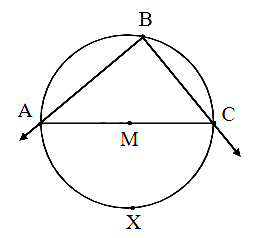
The angle inscribed in the semicircle is a right angle. Prove the result by completing the following activity.

Given: $\angle A B C$ is inscribed angle in a semicircle with center $M$
To prove: $\angle A B C$ is a right angle.
Proof: Segment AC is a diameter of the circle.
$
\therefore m(\operatorname{arc} A X C)=\square
$
Arc $A X C$ is intercepted by the inscribed angle $\angle A B C$
$\angle ABC =\square$ [Inscribed angle theorem]
$
=\frac{1}{2} \times \square
$
$\therefore m \angle ABC =\square$
$\therefore \angle ABC$ is a right angle.
Answer
Proof: Segment AC is a diameter of the circle.
$
\therefore \operatorname{m}(\operatorname{arc} AXC )=180^{\circ}
$
...(i) [Measure of semi circular arc is $180^{\circ}$ ]
Arc AXC is intercepted by the inscribed angle $\angle A B C$
$
\angle ABC =\frac{1}{2} m (\operatorname{arc} AXC )
$
[Inscribed angle theorem]
$
=\frac{1}{2} \times 180^{\circ}
$
[From (i)]
$
\therefore m \angle ABC =90^{\circ}
$
$\therefore \angle A B C$ is a right angle.
View full question & answer
Question 42 Marks
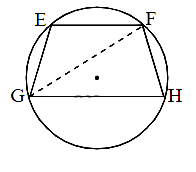
In figure, chord EF || chord GH. Prove that, chord EG ≅ chord FH. Fill in the blanks and write the proof.
Proof: Draw seg GF.

$\angle EFG =\angle FGH \quad \ldots . . . \square \quad \ldots . . .( I )$
$\angle EFG =\square \quad \ldots . .[\text { [inscribed angle theorem] (II) }$
$\angle FGH =\square \quad \ldots . .[\text { inscribed angle theorem] (III) }$
$\therefore m (\operatorname{arc} EG )=\square \quad \ldots \ldots[ By ( I ),( II ), \text { and (III)] }$
chord $EG \cong$ chord $FH \quad$.........[corresponding chords of congruent arcs]
Answer
Proof: Draw seg GF.
$\angle E F G=\angle F G H$
[Alternate angles] (I)
$\angle E F G=\frac{1}{2}(\operatorname{arc} E G)$ [Inscribed angle theorem] (II)
$\angle FGH =\frac{1}{2}(\operatorname{arc} FH )$
[Inscribed angle theorem] (III)
$\therefore m(\operatorname{arc} E G)=m(\operatorname{arc} F H)$ [By (I), (II), and (III)]
chord $E G \cong$ chord $FH$ [corresponding chords of congruent arcs]
View full question & answer
Question 52 Marks
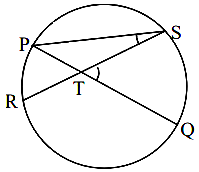
In the figure, if the chord $P Q$ and chord $R S$ intersect at point $T$, prove that: $m \angle S T Q=\frac{1}{2}[m(\operatorname{arc} P R)+$ $m (\operatorname{arc} S Q)]$ for any measure of $\angle S T Q$ by filling out the boxes

Proof: $m \angle STQ = m \angle SPQ +\square \ldots$....[Theorem of the external angle of a triangle $]$ $=\frac{1}{2} m (\operatorname{arc~SQ})+\square \quad \ldots . . .[$ Inscribed angle theorem $]$
$=\frac{1}{2}[\square+\square]$
Answer
$ m \angle STQ = m \angle SPQ + m \angle PSR \ldots . .[\text { Theorem of the external angle of a triangle }]$
$=\frac{1}{2} m (\operatorname{arc} SQ )+\frac{1}{2} m (\operatorname{arc} PR ) \ldots . .[\text { Inscribed angle theorem }]$
$=\frac{1}{2}[ m (\operatorname{arc} PR )+ m (\operatorname{arc} SQ )]$
View full question & answer
Question 62 Marks
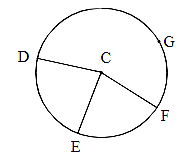
In figure, points G, D, E, F are concyclic points of a circle with centre C

$\angle E C F=70^{\circ}, m(\operatorname{arc} D G F)=200^{\circ}$
Find $m$ (arc DEF) by completing activity.
$ m(\operatorname{arc} E F)=\angle E C F \quad \ldots \ldots[\text { Definition of measure of } \operatorname{arc}]$
$\therefore m(\operatorname{arc} E F)=\square$
$B u t ; m(\operatorname{arc} D E)+m(\operatorname{arc} E F)+m(\operatorname{arc} D G F)=\square \quad \ldots \ldots[\text { Measure of a complete circle] }$
$\therefore m(\operatorname{arc} D E)=\square$
$\therefore m(\operatorname{arc} D E F)=m(\operatorname{arc} D E)+m(\operatorname{arc} E F)$
$\therefore m(\operatorname{arc} D E F)=\text { square } $
Answer
m(arc EF) = ∠ECF ...[Definition of measure of arc]∴ m(arc EF) = 70° ...(i)
But; m(arc DE)+ m(arc EF) + m(arc DGF) = 360° ...[Measure of a complete circle]
∴ m(arc DE) + 70° + 200° = 360°
m(arc DE) = 360° – 270° ...[From (i) and given]
∴ m(arc DE) = 90° ...(ii)
∴ m(arc DEF) = m(arc DE) + m(arc EF)
= 90° + 70° ...[From (i) and (ii)]
∴ m(arc DEF) = 160°
View full question & answer
Question 72 Marks
In the figure if $\angle P Q R=50^{\circ}$, then find $\angle P S R$.
Answer
In ΔABC and ΔDBE,

side AB ≅ side DB ......[Radii of the same circle]

side BC ≅ side BE .....[Radii of the same circle]

∠ABC ≅ ∠DBE ......[Measure of congruent arcs]

∴ ∆ABC ≅ ∆DBE ......[SAS test of congruency]

∴ chord AC ≅ chord DE ......[Corresponding sides of congruent triangles]

View full question & answer
Question 82 Marks
If $\sin 3A = \cos 6A,$ then $\angle A = ?$
Answer
$\sin 3 A=\cos 6 A \quad \ldots . .[\text { Given }]$
$\therefore \sin 3 A=\sin \left(90^{\circ}-6 A\right) \quad \ldots . .\left[\cos \theta=\sin \left(90^{\circ}-\theta\right)\right]$
$\therefore 3 A=90^{\circ}-6 A$
$\therefore 3 A+6 A=90^{\circ}$
$\therefore 9 A=90^{\circ}$
$\therefore A=\frac{90^{\circ}}{9}$
$\therefore A=10^{\circ}$
View full question & answer
Question 92 Marks
If $3 \sin \theta = 4 \cos \theta,$ then $sec \theta = ?$
Answer
$ 3 \sin \theta=4 \cos \theta \quad \ldots . . \text { [Given] }$
$\therefore \frac{\sin \theta}{\cos \theta}=\frac{4}{3}$
$\therefore \tan \theta=\frac{4}{3} $
We know that,
$1+\tan ^2 \theta=\sec ^2 \theta$
$\therefore 1+\left(\frac{4}{3}\right)^2=\sec ^2 \theta$
$\therefore 1+\frac{16}{9}=\sec ^2 \theta$
$\therefore \sec ^2 \theta=\frac{9+16}{9}$
$\therefore \sec ^2 \theta=\frac{25}{9}$
$\therefore \sec \theta=\frac{5}{3}$ [Taking square root of both sides]
View full question & answer
Question 102 Marks
Prove that $\cot^2\theta \times \sec^2\theta = \cot^2\theta + 1$
Answer
$\text { L.H.S }=\sec ^2 \theta+\operatorname{cosec}^2 \theta$
$=\frac{1}{\cos ^2 \theta}+\frac{1}{\sin ^2 \theta}$
$=\frac{\sin ^2 \theta+\cos ^2 \theta}{\cos ^2 \theta \cdot \sin ^2 \theta}$
$=\frac{1}{\cos ^2 \theta \cdot \sin ^2 \theta} \quad \ldots \ldots\left[\because \cdot \sin ^2 \theta+\cos ^2 \theta=1\right]$
$=\frac{1}{\cos ^2 \theta} \times \frac{1}{\sin ^2 \theta}$
$=\sec ^2 \theta \times \operatorname{cosec}^2 \theta$
$=\text { R.H.S }$
$\therefore \sec ^2 \theta+\operatorname{cosec}^2 \theta=\sec ^2 \theta \times \operatorname{cosec}^2 \theta$
View full question & answer
Question 112 Marks
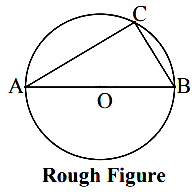
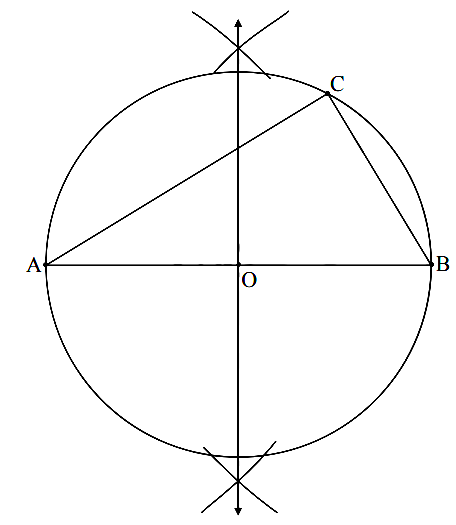
Draw seg AB = 6.8 cm. Draw a circle with diameter AB. Draw point C on the circle apart from A and B. Draw line AC and line CB. Write the measure of angle ACB
Answer

Analysis:seg AB is the diameter of the circle and the midpoint of seg AB is the centre of the circle. So we draw a

perpendicular bisector of seg AB in order to find the centre of the circle.

Step of Construction: Draw seg AB of length 6.8 cm Draw perpendicular bisector of AB. It intersects AB in point O. With O as centre and radius equal to AO, draw a circle. Take any point C on the circle and draw seg AC and seg CB. Find m∠ACB. Measures of ∠ACB = 90°
View full question & answer
Question 122 Marks
Prove that $\sec^2\theta + cosec^2\theta = \sec^2\theta \times cosec^2\theta $
Answer
$\text { L.H.S }=\sec ^2 \theta+\operatorname{cosec}^2 \theta$
$=\frac{1}{\cos ^2 \theta}+\frac{1}{\sin ^2 \theta}$
$=\frac{\sin ^2 \theta+\cos ^2 \theta}{\cos ^2 \theta \cdot \sin ^2 \theta}$
$=\frac{1}{\cos ^2 \theta \cdot \sin ^2 \theta} \quad \ldots \ldots\left[\because \cdot \sin ^2 \theta+\cos ^2 \theta=1\right]$
$=\frac{1}{\cos ^2 \theta} \times \frac{1}{\sin ^2 \theta}$
$=\sec ^2 \theta \times \operatorname{cosec}^2 \theta$
$=\text { R.H.S }$
$\therefore \sec ^2 \theta+\operatorname{cosec}^2 \theta=\sec ^2 \theta \times \operatorname{cosec}^2 \theta$
View full question & answer
Question 132 Marks
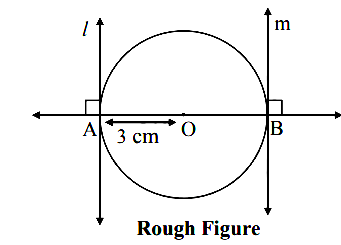
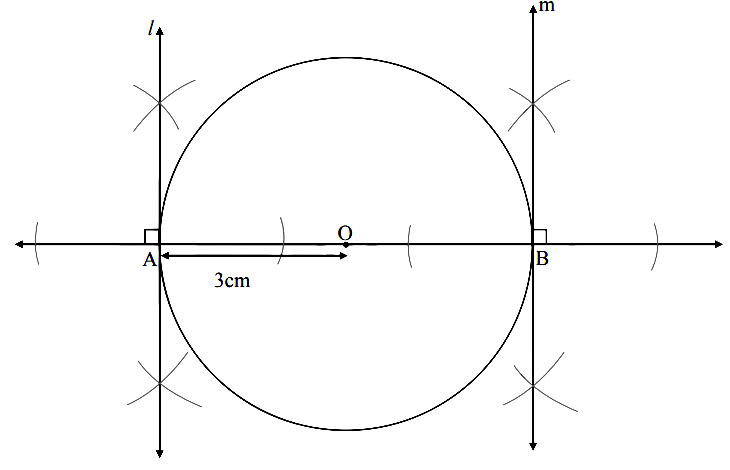
Draw a circle with a diameter $AB$ of length $6\ cm.$ Draw a tangent to the circle from the end points of the diameter.
Answer
Analysis:
Diameter $=6 \ cm$
$\therefore$ Radius $=3 \ cm$
$\left.\begin{array}{l}\operatorname{seg} OA \perp \text { line } l \\ \operatorname{seg} OB \perp \text { line } m \end{array}\right\} \ldots . . .[$ Tangent is perpendicular to radius$]$
The perpendicular to seg $O A$ and $\operatorname{seg} O B$ at points $A$ and $B$ respectively will give the required tangents


Steps of construction:
$1.$ With center $O$, draw a circle of radius $3 \ cm$.
$2.$ Draw a chord $A B$ of length $6 \ cm$.
$3.$ Draw rays $O A$ and $O B$.
$4.$ Draw line $I \perp$ ray $O A$ at point $A$.
$5.$ Draw line $m \perp$ ray $O B$ at point $B$.
Lines $I$ and $m$ are the required tangents to the circle.
View full question & answer
Question 142 Marks
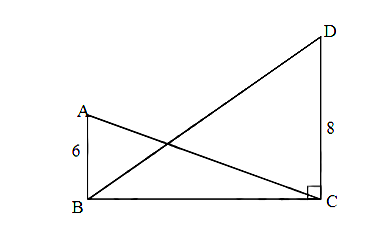
From adjoining figure, $\angle ABC =90^{\circ}, \angle DCB =90^{\circ}, AB =6, DC =8$, then $\frac{ A (\triangle ABC )}{ A (\triangle BCD )}=$ ?
Answer
$\triangle A B C$ and $\triangle B C D$ have same base $B C$.
$\therefore \frac{ A (\Delta ABC )}{ A (\Delta BCD )}=\frac{ AB }{ DC } \ldots[$ Triangles having equal base $]$
$\therefore \frac{ A (\Delta ABC )}{ A (\Delta BCD )}=\frac{6}{8}$
$\therefore \frac{ A (\Delta ABC )}{ A (\Delta BCD )}=\frac{3}{4}$
View full question & answer
Question 152 Marks
If $\tan \theta + \cot \theta = 2$, then $\tan^2\theta + \cot^2\theta = ?$
Answer
$tan θ + cot θ = 2 ....$[Given]
$\therefore (\tan \theta + \cot \theta )^2 = 4 ....$.[Squaring both sides]
$\therefore \tan^2\theta + 2tan \theta .\cot \theta + \cot^2\theta = 4 ......[\because (a + b)^2 = a^2 + 2ab + b^2]$
$\therefore \tan^2\theta + 2(1) + \cot^2\theta = 4 ......[\because \tan \theta ⋅ \cot \theta = 1]$
$\therefore \tan^2\theta + \cot^2\theta = 4 – 2$
$\therefore \tan^2\theta + \cot^2\theta = 2$
View full question & answer
Question 162 Marks
Show that the point $(11, – 2)$ is equidistant from $(4, – 3)$ and $(6, 3)$
Answer
Let $P\left(x_1, y_1\right)=P(11,-2), Q\left(x_2, y_2\right)=Q(4,-3), R\left(x_3, y_3\right)=R(6,3)$
By distance formula,
$d(P, Q)=\sqrt{\left(x_2-x_1\right)^2+\left(y_2-y_1\right)^2}$
$=\sqrt{(4-11)^2+[-3-(-2)]^2}$
$=\sqrt{(-7)^2+(-1)^2}$
$=\sqrt{49+1}$
$=\sqrt{50}$
$=5 \sqrt{2} $
And
$ d(P, R)=\sqrt{\left(x_3-x_1\right)^2+\left(y_3-y_1\right)^2}$
$=\sqrt{(6-11)^2+[3-(-2)]^2}$
$=\sqrt{(-5)^2+(5)^2}$
$=\sqrt{25+25}$
$=\sqrt{50}$
$=5 \sqrt{2}$
Here, $d(P, Q)=d(P, R)$
$\therefore$ Point $(11,-2)$ is equidistant from $(4,-3)$ and $(6,3)$.
View full question & answer
Question 172 Marks
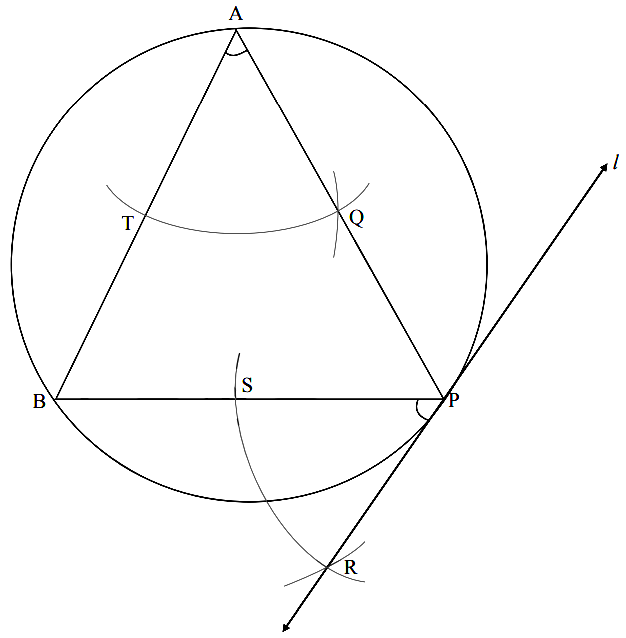
Draw a circle of radius 4.2 cm. Draw a tangent to the circle at point P on the circle without using the center of the circle
Answer


Steps of construction:
  1. Draw a circle of radius 4.2 cm and take any point P on it.
  2. Draw chord BP of any length and an inscribed ∠BAP of any measure.
  3. By taking A as a centre and any convenient distance on compass draw an arc intersecting the arms of ∠BAP in points P and Q.
  4. With P as a centre and the same distance in the compass, draw an arc intersecting the chord BP at point S.
  5. Taking radius equal to TQ and S as a centre, draw an arc intersecting the previously drawn arc. Name the point of intersection as R.
  6. Draw line RP.
    Line RP is the required tangent to the circle.
View full question & answer
Question 182 Marks
Areas of two similar triangles are $225\ cm^2$^ and $81\ cm^2$​​​​​​​^. If side of smaller triangle is $12\ cm$, find corresponding side of major triangle
Answer
Let the areas of two similar triangles be $A_1$ and $A_2$.
$
A_1=225 cm ^2 \text { and } A_2=81 cm ^2
$
Let the corresponding sides of triangles be $s_1$ and $s_2$ respectively.
$
s _1=12 cm
$
$\frac{ A _1}{ A _2}=\frac{ s _1^2}{ s _2^2} \ldots \ldots .$. Theorem of areas of similar triangles]
$
\therefore \frac{225}{81}=\frac{ s _1^2}{12^2}
$
$
\therefore s _1{ }^2=\frac{225 \times 12^2}{81}
$
$\therefore s _1=\frac{15 \times 12}{9}$ [Taking square root of both sides]
$
\therefore s _1=20 cm
$
$\therefore$ The length of the corresponding side of the bigger triangle is $20 cm$.
View full question & answer
Question 192 Marks
If cos(45° + x) = sin 30°, then x = ?
Answer
cos(45° + x) = sin 30° .....[Given]

∴ cos(45° + x) = sin(90° – 60°)

∴ cos(45° + x) = cos 60° .....[∵ sin (90° – θ) = cos θ]

∴ 45° + x = 60°

∴ x = 60° – 45°

∴ x = 15°

View full question & answer
Question 202 Marks
Find distance $CD$ where $C(– 3a, a), D(a, – 2a)$
Answer
Let $C\left(x_1, y_1\right)$ and $D\left(x_2, y_2\right)$ be the given points
$\therefore x_1=-3 a, y_1=a, x_2=a, y_2=-2 a$
By distance formula,
$ d(C, D)=\sqrt{\left(x_2-x_1\right)^2+\left(y_2-y_1\right)^2}$
$=\sqrt{[a-(-3 a)]^2+(-2 a-a)^2}$
$=\sqrt{(a+3 a)^2+(-2 a-a)^2}$
$=\sqrt{(4 a)^2+(-3 a)^2}$
$=\sqrt{16 a^2+9 a^2}$
$=\sqrt{25 a^2}$
$\therefore d(C, D)=5 a \text { units } $
View full question & answer
Question 212 Marks
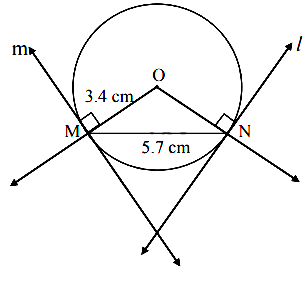
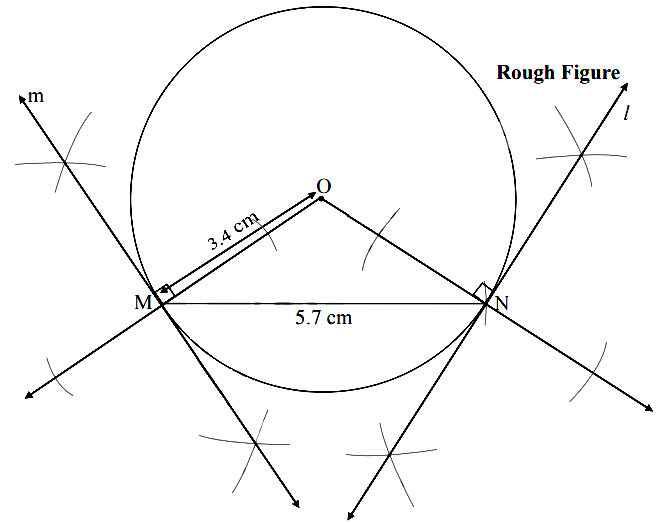
Draw a circle of radius $3.4\ cm.$ Draw a chord $MN\  5.7\ cm$ long in a circle. Draw a tangent to the circle from point $M$ and point $N$
Answer
Analysis:
$\left.\begin{array}{l}\text { seg } ON \perp \text { line } l \\ \text { seg } OM \perp \text { line } m \end{array}\right\} [$Tangent theorem$]$
The perpendicular to seg $O N$ and seg $O M$ at points $N$ and $M$ respectively will give the required tangents at $N$ and $M$.


Steps of construction:
$1.$ With center $O$, draw a circle of radius $3.4 \ cm$
$2.$ Draw chord $MN$ of length $5.7 \ cm$ in the circle.
$3.$ Draw rays $O M$ and $O N$.
$4.$ Draw line $I \perp$ ray $O N$ at point $N$.
$5.$ Draw line $M \perp$ ray $OM$ at point $M$.
View full question & answer
Question 222 Marks
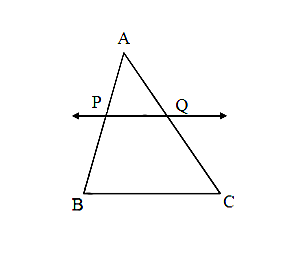
From given information, is PQ || BC?

AP = 2, PB = 4, AQ = 3, QC = 6
Answer
$\frac{ AP }{ PB }=\frac{2}{4}=\frac{1}{2}$
...(i)[Given]
$\frac{ AQ }{ QC }=\frac{3}{6}=\frac{1}{2}$
In $\triangle A B C$,
$\frac{ AP }{ PB }=\frac{ AQ }{ QC }=\frac{1}{2}$
.[From (i) and (ii)]
$\therefore$ Line $PQ \|$ side $BC$
.[Converse of basic proportionality theorem]
View full question & answer
Question 232 Marks
Prove that $\frac{1}{\operatorname{cosec} \theta-\cot \theta}=\operatorname{cosec} \theta+\cot \theta$
Answer
$\begin{array}{l}\text { L.H.S }=\frac{1}{\operatorname{cosec} \theta-\cot \theta} \\ =\frac{1}{\operatorname{cosec} \theta-\cot \theta} \times \frac{\operatorname{cosec} \theta+\cot \theta}{\operatorname{cosec} \theta+\cot \theta} \\\end{array} $
$[$On rationalising the denominator$]$
$ =\frac{\operatorname{cosec} \theta+\cot \theta}{\operatorname{cosec}^2 \theta-\cot ^2 \theta} \ldots \ldots \cdot\left[\because(a-b)(a+b)=a^2-b^2\right]  $
$ =\frac{\operatorname{cosec} \theta \cot \theta}{1} \ldots \ldots\left[\begin{array}{l}\because 1+\cot ^2 \theta=\operatorname{cosec}^2 \theta \\ \therefore \operatorname{cosec}^2 \theta-\cot ^2 \theta=1\end{array}\right] \\ $
$=\operatorname{cosec} \theta+\cot \theta  $
$ =\text { R.H.S }  $
$ \therefore \frac{1}{\operatorname{cosec} \theta-\cot \theta}$
$=\operatorname{cosec} \theta+\cot \theta $
View full question & answer
Question 242 Marks
Find the coordinates of midpoint of segment joining $(22, 20)$ and $(0, 16)$
Answer
$\text { Let } A\left(x_1, y_1\right)=A(22,20), B\left(x_2, y_2\right)=B(0,16)$
Let the co-ordinates of the midpoint be $P(x, y)$.
$\therefore$ By midpoint formula,
$ x=\frac{x_1+x_2}{2}$
$=\frac{22+0}{2}$
$=11$
$y=\frac{y_1+y_2}{2}$
$=\frac{20+16}{2}$
$=\frac{36}{2}$
$=18 $
$\therefore$ The co-ordinates of the midpoint of the segment joining $(22,20)$ and $(0,16)$ are $(11,18)$.
View full question & answer
Question 252 Marks
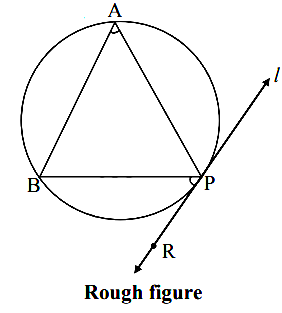
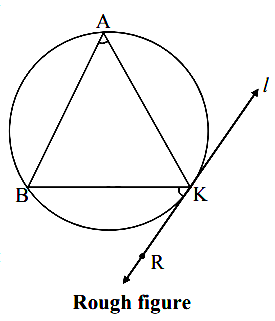
Draw a circle of radius 3 cm. Take any point K on it. Draw a tangent to the circle from point K without using center of the circle.
Answer
Analysis:As shown in the figure, line l is a tangent to the circle at point K.
seg BK is a chord of the circle and ∠BAK is an inscribed angle.
By tangent secant angle theorem,
∠BAK = ∠BKR
By converse of tangent secant angle theorem,
If we draw ∠BKR such that ∠BKR = ∠BAK, then ray KR
i.e. (line l) is a tangent at point K.

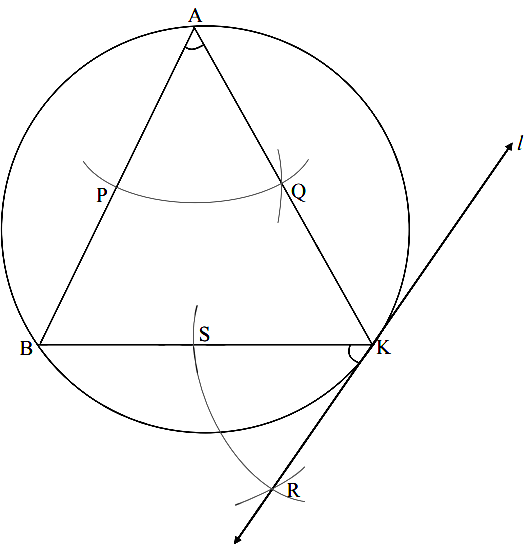
Steps of construction:
  1. Draw a circle of radius 3 cm and take any point K on it.
  2. Draw chord BK of any length and an inscribed ∠BAK of any measure.
  3. By taking A as a centre and any convenient distance on the compass draw an arc intersecting the arms of ∠BAK in points P and Q.
  4. With K as a centre and the same distance in the compass, draw an arc intersecting the chord BK at point S.
  5. Taking radius equal to PQ and S as the centre, draw an arc intersecting the previously drawn arc. Name the point of intersection as R.
  6. Draw line RK. Line RK is the required tangent to the circle.
View full question & answer
Question 262 Marks
ΔABP ~ ΔDEF and A(ΔABP) : A(ΔDEF) = 144:81, then AB : DE = ?
Answer
$\frac{ A (\Delta ABP )}{ A (\Delta DEF )}=\frac{144}{81} \quad \ldots . .$. (i) $[$ Given $]$
$\frac{ A (\triangle ABP )}{ A (\triangle DEF )}=\frac{ AB ^2}{ DE ^2} \quad \ldots \ldots . .$. (ii) $[$ Theorem of areas of similar triangles $]$
$\therefore \frac{ AB ^2}{ DE ^2}=\frac{144}{81} \quad \ldots \ldots . . .[$ From (i) and (ii)]
$\therefore \frac{ AB }{ DE }=\frac{12}{9}$ or $\frac{4}{3} \quad \ldots \ldots .$. Taking square root of both sides]
View full question & answer
Question 272 Marks
Prove that $\frac{\sin ^2 \theta}{\cos \theta}+\cos \theta=\sec \theta$
Answer
$\text { L.H.S }=\frac{\sin ^2 \theta}{\cos \theta}+\cos \theta$
$=\frac{\sin ^2 \theta+\cos ^2 \theta}{\cos \theta}$
$=\frac{1}{\cos \theta} \quad \cdots \cdots\left[\because \sin ^2 \theta+\cos ^2 \theta=1\right]$
$=\sec \theta$
$=\text { R.H.S }$
$\therefore \frac{\sin ^2 \theta}{\cos \theta}+\cos \theta=\sec \theta$
View full question & answer
Question 282 Marks
If the distance between point L(x, 7) and point M(1, 15) is 10, then find the value of x
Answer
Let $L\left(x_1, y_1\right)=L\left(x_1, 7\right)$ and $M\left(x_2, y_2\right)=M(1,15)$
$
x_1=x, y_1=7, x_2=1, y_2=15
$
By distance formula,
$
d ( L , M )=\sqrt{\left(x_2-x_1\right)^2+\left(y_2-y_1\right)^2}
$
$
\therefore d (L, M)=\sqrt{(1-x)^2+(15-7)^2}
$
$
\therefore 10=\sqrt{(1-x)^2+8^2}
$
$
\therefore 100=(1-x)^2+64
$
[Squaring both sides]
$\therefore(1-x)^2=100-64$
$
\therefore(1-x)^2=36
$
$\therefore 1- x = \pm \sqrt{36} \quad \ldots .$. [Taking square root of both sides]
$
\therefore 1-x= \pm 6
$
$\therefore 1- x =6$ or $1- x =-6$
$
\therefore x =-5 \text { or } x =7
$
$\therefore$ The value of $x$ is -5 or 7 .
View full question & answer
Question 292 Marks
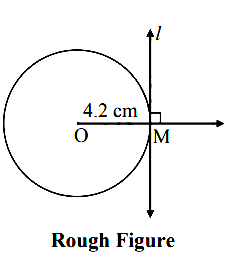
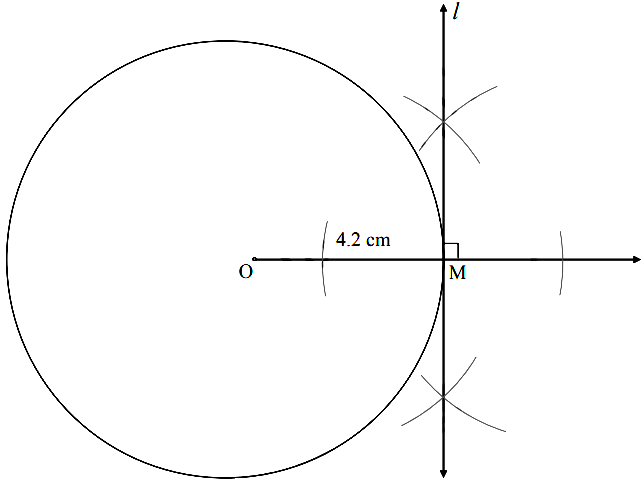
Draw a circle of radius 4.2 cm, take any point M on it. Draw tangent to the circle from point M
Answer


Steps of construction:
  1. With center O, draw a circle of radius 4.2 cm.
  2. Take any point M on the circle and draw ray OM.
  3. Draw line l ⊥ ray OM at point M.
    Line l is the required tangent to the circle at point M.
View full question & answer
Question 302 Marks
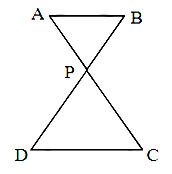
In fig., seg AC and seg BD intersect each other at point P.

$\frac{ AP }{ PC }=\frac{ BP }{ PD }$ then prove that $\triangle ABP \sim \triangle CDP$
Answer
In $\triangle ABP$ and $\triangle CDP$,
$ \frac{ AP }{ PC }=\frac{ BP }{ PD } \quad \ldots . . .[\text { Given }]$
$\angle APB \cong \angle CPD \quad \ldots . . .[\text { Vertically opposite angles }]$
$\therefore \triangle ABP \sim \triangle CDP \quad \ldots \ldots . .[ SAS \text { test of similarity] } $
View full question & answer
Question 312 Marks
Prove that $\frac{\cos \theta}{1+\sin \theta}=\frac{1-\sin \theta}{\cos \theta}$
Answer
$\text { L.H.S }=\frac{\cos \theta}{1+\sin \theta}$
$=\frac{\cos \theta}{1+\sin \theta} \times \frac{1-\sin \theta}{1-\sin \theta}......[$On rationalising the denominator$]$
$=\frac{\cos \theta(1-\sin \theta)}{1-\sin ^2 \theta}$
$=\frac{\cos \theta(1-\sin \theta)}{\cos ^2 \theta} .....[\because \sin ^2 \theta+\cos ^2 \theta=1$
$\therefore [1-\sin ^2 \theta=\cos ^2 \theta]$
$=\frac{1-\sin \theta}{\cos \theta}$
$=\text { R.H.S }$
$\therefore \frac{\cos \theta}{1+\sin \theta}=\frac{1-\sin \theta}{\cos \theta}$
View full question & answer
Question 322 Marks
Prove that $\frac{\cos ^2 \theta}{\sin \theta}+\sin \theta=\operatorname{cosec} \theta$
Answer
$\text { L.H.S }=\frac{\cos ^2 \theta}{\sin \theta}+\sin \theta$
$=\frac{\cos ^2 \theta+\sin ^2 \theta}{\sin \theta}$
$=\frac{1}{\sin \theta} \quad \ldots \ldots\left[\because \cdot \sin ^2 \theta+\cos ^2 \theta=1\right]$
$=\operatorname{cosec} \theta$
$=\text { R.H.S }$
$\therefore \frac{\cos ^2 \theta}{\sin \theta}+\sin \theta=\operatorname{cosec} \theta$
View full question & answer
Question 332 Marks
Prove that $\frac{\sin \theta+\tan \theta}{\cos \theta}=\tan \theta(1+\sec \theta)$
Answer
$\text { L.H.S }=\frac{\sin \theta+\tan \theta}{\cos \theta}$
$=\frac{\sin \theta}{\cos \theta}+\frac{\tan \theta}{\cos \theta}$
$=\tan \theta+\tan \theta \sec \theta$
$=\tan \theta(1+\sec \theta)$
$=\text { R.H.S }$
$\therefore \frac{\sin \theta+\tan \theta}{\cos \theta}=\tan \theta(1+\sec \theta)$
View full question & answer
Question 342 Marks
Prove that $\frac{\tan A }{\cot A }=\frac{\sec ^2 A }{\operatorname{cosec}^2 A }$
Answer
$\text { R.H.S }=\frac{\sec ^2 A }{\operatorname{cosec}^2 A }$
$=\frac{1+\tan ^2 A }{1+\cot ^2 A } \quad \cdots \cdot\left[\because 1+\tan ^2 A =\sec ^2 A$
$1+\cot ^2 A =\operatorname{cosec}^2 A \right]$
$=\frac{1+\frac{\sin ^2 A }{\cos ^2 A }}{1+\frac{\cos ^2 A }{\sin ^2 A }}$
$=\frac{\frac{\cos ^2 A +\sin ^2 A }{\cos ^2 A }}{\frac{\sin ^2 A +\cos ^2 A }{\sin ^2 A }}$
$=\frac{\frac{1}{\cos ^2 A }}{\frac{1}{\sin ^2 A }} \quad \ldots \ldots\left[\because \sin ^2 A +\cos ^2 A =1\right]$
$=\frac{\sin ^2 A }{\cos ^2 A }$
$=\tan ^2 A$
$=\tan A \cdot \tan A$
$=\frac{\tan A }{\cot A }$
$=\text { L.H.S }$
$\therefore \frac{\tan A }{\cot A }=\frac{\sec ^2 A }{\operatorname{cosec}^2 A }$
View full question & answer
Question 352 Marks
Prove that $\sec^2\theta − \cos^2\theta = \tan^2\theta + \sin^2\theta$
Answer
$\text { L.H.S }=\sec ^2 \theta-\cos ^2 \theta$
$=1+\tan ^2 \theta-\cos ^2 \theta \quad \ldots \ldots . .\left[\because 1+\tan ^2 \theta=\sec ^2 \theta\right]$
$=\tan ^2 \theta+\left(1-\cos ^2 \theta\right)$
$=\tan ^2 \theta+\sin ^2 \theta \quad \ldots [\because \sin ^2 \theta+\cos ^2 \theta=1\therefore 1-\cos ^2 \theta=\sin ^2 \theta]$
$=\text { R.H.S }$
$\therefore \sec ^2 \theta-\cos ^2 \theta=\tan ^2 \theta+\sin ^2 \theta$
View full question & answer
Question 362 Marks
If $\cos \theta=\frac{24}{25}$, then $\sin \theta=?$
Answer
$\cos \theta=\frac{24}{25}$
We know that,
$ \sin ^2 \theta+\cos ^2 \theta=1$
$\therefore \sin ^2 \theta+\left(\frac{24}{25}\right)^2=1$
$\therefore \sin ^2 \theta+\frac{576}{625}=1$
$\therefore \sin ^2 \theta=1-\frac{576}{625}$
$\therefore \sin ^2 \theta=\frac{625-576}{625}$
$\therefore \sin ^2 \theta=\frac{49}{625}$
$\therefore \sin ^2 \theta=\frac{7}{25} \quad \ldots . . .[\text { Taking square root of both sides] } $
View full question & answer
Question 372 Marks
The point $Q$ divides segment joining $A(3, 5)$ and $B(7, 9)$ in the ratio $2 : 3.$ Find the $X-$ coordinate of $Q$
Answer
Let the co-ordinates of point $Q$ be $\left(x_1, y\right)$ and $A\left(x_1, y_1\right), B\left(x_2, y_2\right)$ be the given points.
Here, $x_1=3, y_1=5, x_2=7, y_2=9, m=2, n=3$
$\therefore$ By section formula,
$ x =\frac{ m x_2+ n x_1}{ m + n }$
$=\frac{2(7)+3(3)}{2+3}$
$=\frac{14+9}{5}$
$=\frac{23}{5}$
$y=\frac{ m y_2+ n y_1}{ m + n }$
$=\frac{2(9)+3(5)}{2+3}$
$=\frac{18+15}{5}$
$=\frac{33}{5} $
$\therefore$ The co-ordinates of point $Q$ are $\left(\frac{23}{5}, \frac{33}{5}\right)$.
View full question & answer
Question 382 Marks
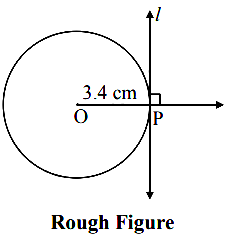
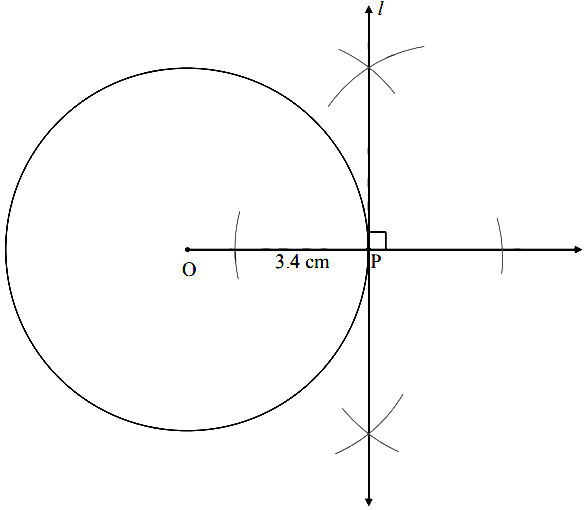
Draw a circle of radius 3.4 cm, take any point P on it. Draw tangent to the circle from point P
Answer
Analysis: seg OP ⊥ line l ......[Tangent is perpendicular to radius]
The perpendicular to seg OP at point P will give the required tangent at P.


Steps of construction:
  1. With center O, draw a circle of radius 3.4 cm.
  2. Take any point P on the circle and draw ray OP.
  3. Draw line l ⊥ ray OP at point P.
    Line l is the required tangent to the circle at point P.
View full question & answer
Question 392 Marks
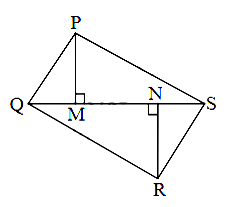
In fig., $PM = 10\ cm, A(\triangle PQS) = 100$ sq.cm, $A(\triangle QRS) = 110$ sq.cm, then $NR?$

$\triangle P Q S$ and $\triangle Q R S$ having seg $Q S$ common base.
Areas of two triangles whose base is common are in proportion of their corresponding
$ \frac{ A ( PQS )}{ A ( QRS )}=\frac{[}{ NR }$
$\frac{100}{110}=\frac{[}{ NR }$
$NR =[ $
Answer
$\triangle A B C$ and $\triangle B C D$ have same base $B C$.
$\therefore \frac{ A (\triangle ABC )}{ A (\triangle BCD )}=\frac{ AB }{ DC } \quad \ldots . .[$ Triangles having equal base $]$
$\therefore \frac{ A (\triangle ABC )}{ A (\Delta BCD )}=\frac{6}{4} \quad \ldots . .[$ Given $]$
$\therefore \frac{ A (\Delta ABC )}{ A (\Delta BCD )}=\frac{3}{2}$
View full question & answer