Questions

3 Marks Question

Take a timed test

33 questions · self-marked practice — reveal the answer and mark yourself.

Question 13 Marks
150 spherical marbles, each of diameter 14cm, are dropped in a cylindrical vessel of diameter 7cm containing some water, which are completely immersed in water. Find the rise in the level of water in the vessel.
Answer
We have,
The radius of spherical marble, $\text{r}=\frac{1.4}{2}=7\text{cm}$ and
The radius of the cylindrical vessel, $\text{R}=\frac{7}{2}\text{cm}=3.5\text{cm}$
Let the rise in the level of water in the vessel be H.
Now,
Volume of water rised in the cylindrical vessel= Volume of 150 spherical marbles
$\Rightarrow\pi\text{R}^2\text{H}=150\times\frac{4}{3}\pi\text{r}^3$
$\Rightarrow\text{R}^2\text{H}=200\text{r}^3$
$\Rightarrow3.5\times3.5\times\text{H}=200\times7\times7\times7$
$\Rightarrow\text{H}=\frac{200\times7\times7\times7}{3.5\times3.5}$
$\therefore\text{H}=5600\text{cm}$
So, the rise in the level of water in the vessel is 5.6cm.
Disclaimer: The diameter of the spherical marbles should be 1.4cm instead 14cm. The has been corrected above.
View full question & answer
Question 23 Marks
The volume of a sphere is $4851\ cm^3$​​​​​​​. Find its curved surface area.
Answer
Let the radius of the sphere be r. As, Volume of the sphere $= 4851\ cm^3$
$\Rightarrow\frac{4}{3}\pi\text{r}^3=4851$
$\Rightarrow\frac{4}{3}\times\frac{22}{7}\times\text{r}^3=4851$
$\Rightarrow\text{r}^3=4851\times\frac{3\times7}{4\times22}$
$\Rightarrow\text{r}^3=\frac{9261}{8}$
$\Rightarrow\text{r}=\sqrt[3]{\frac{9261}{8}}$
$\Rightarrow\text{r}=\frac{21}{2}\text{cm}$
Now, Curved surface area of the sphere $=4\pi\text{r}^2$ $=4\times\frac{22}{7}\times\frac{21}{2}\times\frac{21}{2}$ $=1386\text{cm}^2$
View full question & answer
Question 33 Marks
In a corner of a rectangular field with dimensions 35m × 22m, a well with 14m inside diameter is dug 8m deep. The earth dug out is spread evenly over the remaining part of the field. Find the rise in the level of the field.
Answer
We have,
Length of the fie!, l = 35m,
Width of the field, b = 22m,
Depth of the well, H = 8m and
Radius of the well, $\text{R}=\frac{14}{2}=7\text{m},$
Let the rise in the level of the field be h.
Now,
Volume of the earth on remaining part of the field= Volume of earth dug out
⇒ Area of the remaining field × h = Volume of the well
⇒ (Area of the field-Area of base of the well) $\times\text{h}\pi\text{R}^2\text{H}$
$\Rightarrow(\text{lb}-\pi\text{R}^2)\times\text{h}=\pi\text{R}^2\text{H}$
$\Rightarrow(35\times22-\frac{22}{7}\times7\times7)\times\text{h}=\frac{22}{7}\times7\times7\times8$
$=(770-154)\times\text{h}=1232$
$\Rightarrow616\times\text{h}=1232$
$\Rightarrow\text{h}=\frac{1232}{616}$
$\therefore\text{h}=2\text{m}$
So, the rise in the level of the field is 2m.
View full question & answer
Question 43 Marks
The surface areas of two spheres are in the ratio of 4 : 25. Find the ratio of their volumes.
Answer
Let the radii of the two spheres be r and R. As, $\frac{\text{Surface area of the first sphere}}{\text{Surface area of the second sphere}}=\frac{4}{25}$ $\Rightarrow\frac{4\pi\text{r}^2}{4\pi\text{R}^2}=\frac{4}{25}$ $\Rightarrow\Big(\frac{\text{r}}{\text{R}}\Big)^2=\frac{4}{25}$ $\Rightarrow\frac{\text{r}}{\text{R}}=\sqrt{\frac{4}{25}}$ $\Rightarrow\frac{\text{r}}{\text{R}}=\frac{2}{5}\ ...(\text{i})$The ratio of the volumes of the two spheres $=\frac{\text{Volume of the first sphere}}{\text{Volume of the second sphere}}$
$=\frac{\Big(\frac{4}{3}\pi\text{r}^3\Big)}{\Big(\frac{4}{3}\pi\text{R}^3\Big)}$ $=\Big(\frac{\text{r}}{\text{R}}\Big)^3$ $=\Big(\frac{2}{5}\Big)^3$ [Using (i)] $=8:25$ So, the ratio of the volumes of the given spheres is 8 : 125
View full question & answer
Question 53 Marks
A 5-m-wide cloth is used to make a conical tent of base diameter 14m and height 24m. Find th cost of cloth used at the rate of Rs. 25 per metre.
Answer
Let the length of the cloth be l m
Given radius of cone = 7m and heigth = 24m
Now,
Slant height $=\sqrt{\text{h}^2+\text{r}^2}$
$\Rightarrow\text{l}=\sqrt{\text{h}^2+\text{r}^2}$
$\Rightarrow\text{l}\sqrt{(24)^2+(7)^2}$
$\Rightarrow\sqrt{576+49}$
$\Rightarrow\text{l}=\sqrt{625}$
$\Rightarrow\text{l}=25\text{m}$
Area of the doth = curved surface area of cone
$=\pi\text{r}\text{l}$
$=\frac{22}{7}\times7\times25$
$=22\times25$
$=550\text{m}^2$
Now,
Area of the doth = length × breadth
⇒ 550 = length × 5
⇒ length $=\frac{550}{5}$
⇒ length 110m
Given cost of 1m doth = Rs. 25
⇒ cost od 110m cloth =110 × 25
= Rs. 2750
View full question & answer
Question 63 Marks
Two cubes each of volume $125\ cm^3$​​​​​​​ are joined end to end to form a solid. Find the surface area of the resulting cuboid.
Answer
Let the edge of the cube be a.
As,
Volwne of the cube $= 125\ cm^3$​​​​​​​
$\Rightarrow\text{a}^3=125$
$\Rightarrow\text{a}=\sqrt[3]{125}$
$\Rightarrow\text{a}=5\text{cm}$
So,
Length of the resulting cuboid, $l = 2 × 5 = 10\ cm$,
Breadth of the resulting cuboid, $b = 5\ cm$ and
Height of the resulting cuboid, $h = 5\ cm$
Now,
Surface area of the resulting cuboid $= 2 (lb + bh + hl)$
$= 2 \times (10 \times 5 + 5 \times 5 + 5 \times 10)$
$= 2 \times (50 + 25 + 50)$
$= 2 \times 125$
$= 250\ cm^2$​​​​​​​
So, the surface area of the resulting cuboid is $250\ cm^2​​​​​​​$​​​​​​​.
View full question & answer
Question 73 Marks
Five identical cubes, each of edge $5\ cm$, are placed adjacent to each other. Find the volume of the resulting cuboid.
Answer
We have,
Length of the resulting cuboid, $l = 5 \times 5 = 25\ cm$,
Breadth of the resulting cuboid, $b = 5\ cm$ and
Height of the resulting cuboid, $h = 5\ cm$
Now,
Volume of the resulting cuboid = lbh
$= 25 \times 5 \times 5$
$= 625\ cm^3$
View full question & answer
Question 83 Marks
A spherical cannon ball 28cm in diameter is melted and recast into a right circular conical mould, base of which is 35cm in diameter. Find the height of the cone.
Answer
Diameter of cannon ball = 28cm
Radius of the cannon ball = 14cm
Volume of ball $=\frac{4}{3}\pi\text{r}^3=\frac{4}{3}\pi\times(14)^3\text{cm}^3$
Diameter of base of cone = 35cm
Radius of base of cone $=\frac{35}{2}\text{cm}$
Let the height of the cone be h cm.
Volume of cone $=\frac{1}{3}\pi\text{r}^2\text{h}=\frac{1}{3}\pi\Big(\frac{35}{2}\Big)^2\times\text{h}\ \text{cm}^3$
From the above results and from the given conditions,
Volume of ball = Volume of cone
Or, $\frac{4}{3}\pi\times(14)^3=\frac{1}{3}\pi\times\Big(\frac{35}{2}\Big)^2\times\text{h}$
$\Rightarrow\text{h}=\frac{\frac{4}{3}\times(14)^3}{\frac{1}{3}\pi\times\Big(\frac{3\pi}{2}\Big)^2}=\frac{4\times14\times14\times14\times2\times2}{35\times35}=35.84\text{cm}$
View full question & answer
Question 93 Marks
A spherical ball of radius 3cm is melted and recast into three spherical balls. The radii of two of these balls 1.5cm and 2cm. Find t radius of the third ball
Answer
Radius of sphere = 3cm
Radius of first ball = 1.5cm
Radius of second ball = 2cm
Let radius of the third ball be rem.
Volume of third ball = Volume of original sphere - Sum of volumes of other two balls
$=\frac{4}{3}\pi\times3^3=\big(\frac{4}{3}\pi\times\frac{3}{2}^3+\frac{4}{3}\pi\times2^3\big)$
$=\frac{4}{3}\pi\times3\times3\times3-\Big(\frac{4}{3}\pi\times\frac{3}{2}\times\frac{3}{2}\times\frac{3}{2}+\frac{4}{3}\pi\times2\times2\times2\Big)$
$=4\pi\times3\times3-\Big(\pi\frac{3\times2}{2}+\frac{4}{3}\pi\times2\times2\times2\Big)$
$=36\pi-\Big(\pi\frac{9}{2}+\frac{32}{3}\pi\Big)$
$=\Big(\frac{36\times6-9\times3-32\times2}{6}\Big)\pi$
$=\Big(\frac{216-27-64}{6}\Big)\pi=\frac{125\pi}{6}$
Therefore,
$\frac{4}{3}\pi\text{r}^3=\frac{125\pi}{6}$
Or, $\text{r}=\sqrt[3]{\frac{125\times3}{4\times6}}=\sqrt[3]{\frac{125}{8}}=\frac{5}{2}=2.5\text{cm}$
View full question & answer
Question 103 Marks
The volume of a hemisphere is $2425\frac{1}{2}\text{cm}^3.$ find its curved surface area.
Answer
Let r be the radius the hemisphere.
now, volume of hemisphere $2425\frac{1}{2}\text{cm}^3$
$\Rightarrow\frac{2}{3}\pi\text{r}^3=\frac{4851}{2}$
$\Rightarrow\frac{2}{3}\times\frac{22}{7}\times\text{r}^3=\frac{4851}{2}$
$\Rightarrow\frac{44}{21}\times\text{r}^3=\frac{4851}{2}$
$\Rightarrow\text{r}^3=\frac{4851\times21}{88}$
$\Rightarrow\text{r}=\sqrt[3]{1157.625}$
$\Rightarrow\text{r}=10.5\text{cm}$
Now,
Cueved surface area $2\pi\text{r}^2$
$=2\times\frac{22}{7}\times(10.5)^2$
$=\frac{44}{7}\times110.25$
$=693\text{cm}^2$
View full question & answer
Question 113 Marks
A solid metallic sphere of diameter 21cm is melted and recast into a number of smaller cones, each of diameter 3.5cm and height 3cm Find the number of cones so formed.
Answer
Diameter of sphere = 21cm
Radius of sphere $=\frac{21}{2}\text{cm}$
Volume of sphere $=\frac{4}{3}\pi\text{r}^3=\frac{4\times21\times21\times21\pi}{3\times2\times2\times2}=\frac{21\times21\times21\pi}{3\times2}\text{cm}^3$
Diameter of the cone= 3.5cm
Radius of the cone $=\frac{3.5}{2}=\frac{7}{4}\text{cm}$
Height = 3cm
Volume of each cone $=\frac{1}{3}\pi\text{r}^2\text{h}=\frac{1}{3}\pi\times3\Big(\frac{7}{4}\Big)^2=\Big(\frac{7}{4}\Big)^2\pi\text{cm}^3$
Total number of cones $=\frac{\text{Volume of sphere}}{\text{Volume of a cone}}=\frac{\frac{21\times21\times21\times\pi}{3\times2}}{\Big(\frac{7}{4}\Big)^2\pi}=\frac{21\times21\times21\times\pi\times4\times4}{3\times2\times\pi\times7\times7}=504$
View full question & answer
Question 123 Marks
A copper sphere of diameter 18cm is drawn into a wire of diameter 4mm. Find the length of the wire.
Answer
We have, Radius of the sphere, $\text{R}=\frac{18}{2}=9\text{cm}$ and Radius of the wire, $\text{r}=\frac{4}{2}=2\text{mm}=0.2\text{cm}$ Let the length of the wire be l. Now, Volume of the wire = Volume of the copper sphere $\Rightarrow\pi\text{r}^2\text{l}=\frac{4}{3}\pi\text{R}^3$$\Rightarrow\text{l}=\frac{4\text{R}^3}{3\text{r}^2}$
$\Rightarrow\text{l}=\frac{4\times9\times9\times9}{3\times0.2\times0.2}$
$\therefore\text{l}=24300\text{cm}=243\text{m}$
So. the length of the wire is 243m.
View full question & answer
Question 133 Marks
The diameter of a sphere is 42cm. It is melted and drawn into a cylindrical wire of diameter 2.8cm. Find the length of the wire.
View full question & answer
Question 143 Marks
The radii of the circular ends of a frustum of height 6cm are 1cm and 6cm, respectively. Find the slant height of the frustum.
Answer
We have,
Height of the frustum, h = 6cm,
Radii of tbe circular ends, R = 14cm and r = 6cm
Let the slant height of the frustum be l.
Now,
$\text{l}=\sqrt{(\text{R}-\text{r})^2+\text{h}^2}$
$=\sqrt{(14-6)^2+6^2}$
$=\sqrt{8^2+6^2}$
$=\sqrt{64+36}$
$=\sqrt{100}$
$=10\text{cm}$
So, the slant heiglt of the frustum is 10cm.
View full question & answer
Question 153 Marks
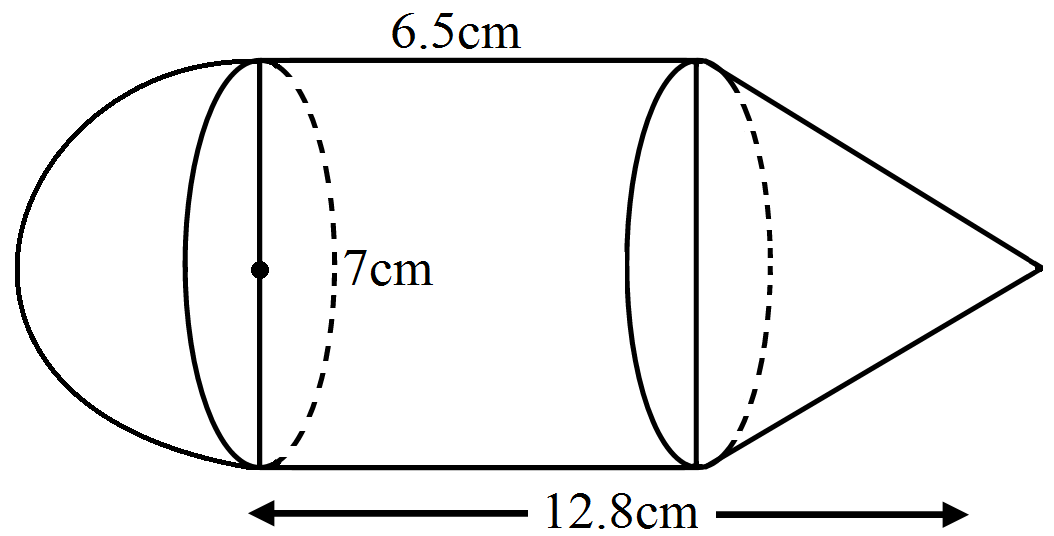
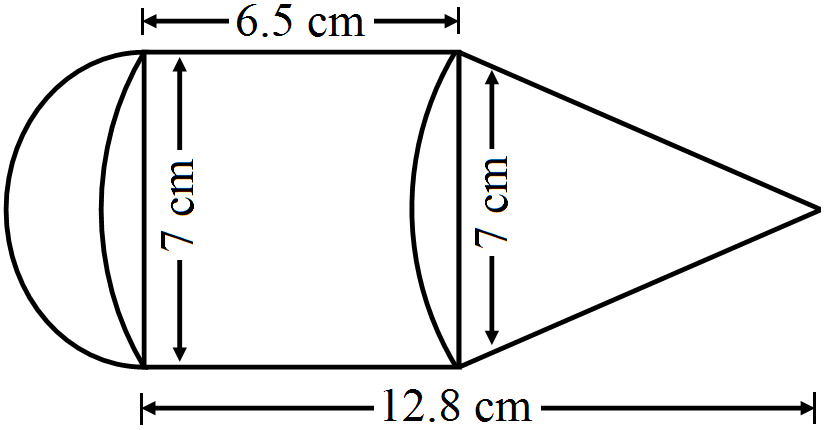
The given figure represents a solid consisting of a cylinder surmounted by a cone at one end and a hemisphere at the other. Find the volurne of the solid.
Answer


Height of cylinder $= 6.5\ cm$
height of cone $= h_2$​​​​​​​ =$ (12.8 - 6.5)cm = 6.3cm$
Radius of cylinder = radius of cone
= radius of hemisphere
$=\Big(\frac{7}{2}\Big)\text{cm}$
Volume of solid = volume of cylinder + volume of cone + volume of hemisphere
$=\pi\text{r}^2\text{h}_1+\frac{1}{3}\pi\text{r}^2\text{h}_2+\frac{2}{3}\pi\text{r}^2\Big(\text{h}_1+\frac{1}{3}\text{h}_2+\frac{2}{3}\text{r}\Big)$
$=\Big[\frac{22}{7}\times3.5\times3.5\times\Big(6.5+6.3\times\frac{1}{3}+\frac{2}{3}\times3.5\Big)\Big]$
$=[(38.5)\times(6.5+2.1+2.33)]\text{cm}^3$
$=(38.5\times10.93)\text{cm}^3=420.80\text{cm}^3$
View full question & answer
Question 163 Marks
Water running in a cylindrical pipe of inneer diameter $7\ cm$, is collected in a container at the rate of $192.5$ litres per minute. Find the rate o flow of water in the pipe in km/hr.
Answer
We have,
Radius of cylindrical pipe, $\text{r}=\frac{7}{2}\text{cm}$ and
The rate of flow of water $= 192.5\ L/min$
$=\frac{192.5\text{L}}{1\text{min}}$
$=\frac{192.5\times1000\text{cm}^3}{1\text{min}}$ (As, $1 L = 1000\ cm^3$)
$= 192500\ cm^3/min$
$\Rightarrow $ The volume of water flowing out from the cylindrical pipe in $1 min = 192500\ cm^3$​​​​​​​
Now, the rate of flow of water in the pipe $=\frac{\text{The volume or water flowing out from the cylindrical pipe}}{\pi\text{r}^2}$
$=\frac{192500}{\Big(\frac{22}{7}\times\frac{7}{2}\times\frac{7}{2}\Big)}$
$=\frac{192500}{77}$
$=5000​​\text{cm}/\text{min}$
$=\frac{5000\times60}{1\times100000}\text{km}/\text{hr}$
$=3\text{km}/\text{hr}$
So, the rate of flow of water in the pipe is $3\ km/hr$.
View full question & answer
Question 173 Marks
If the total surface area of a solid hemisphere is 462cm, find its volume.
Answer
Total surface area of solid hemisphere $=3\pi\text{r}^2$
$\Rightarrow462=3\pi\text{r}^2$
$\Rightarrow462=3\times\frac{22}{7}\times\text{r}^2$
$\Rightarrow462=\frac{66}{7}\times\text{r}^2$
$\Rightarrow\text{r}^2=\frac{3234}{66}$
$\Rightarrow\text{r}^2=49$
$\Rightarrow\text{r}=7\text{cm}$
Now,
Volume of a solid hemisphere $=\frac{2}{3}\pi\text{r}^3$
$=\frac{2}{3}\times\frac{22}{7}\times7\times7\times7$
$=\frac{2156}{3}$
$=718.67\text{cm}^3$
View full question & answer
Question 183 Marks
How many lead shots each 3mm in diameter can be made from a cuboid of dimensions 9cm × 11cm × 12cm?
Answer
We have, Radius of a lead shot, $\text{r}=\frac{3}{2}=1.5\text{mm}=0.15\text{cm}$ and Dimensions of the cuboid are 9cm × 11cm × 12cm Now,$=\frac{9\times11\times12}{\Big(\frac{4}{3}\pi\text{r}^3\Big)}$
$=\frac{9\times11\times12}{\Big(\frac{4}{3}\times\frac{22}{7}\times0.15\times0.15\times0.15\Big)}$
$=84000$
So, the number of lead shots that can be made from the cuboid is 84000.
View full question & answer
Question 193 Marks
A solid metallic sphere of radius 8cm is melted and recast into spherical balls each of radius 2cm. Find the number of spherical balls obtained.
Answer
We have, Radius of the solid metallic sphere, R = 8cm and Radius of the spherical ball, r = 2cm Now, The number spherical balls obtained $=\frac{\text{Volume of the solid metallic spher}}{\text{Volume of a spherical ball}}$$=\frac{\Big(\frac{4}{3}\pi\text{R}^3\Big)}{\Big(\frac{4}{3}\pi\text{r}^3\Big)}$
$=\Big(\frac{\text{R}}{\text{r}}\Big)^3$
$=\Big(\frac{8}{2}\Big)^3$
$=4^3$
$=64$
So, the number of spherical balls obtained is 64.
View full question & answer
Question 203 Marks
Three metallic cubes whose edges are $3\ cm, 4\ cm$ and $5\ cm$, are melted and recast into a single large cube. Find the edge of the new cube formed.
Answer
We have,
Edges of the cubes : $a_1 = 3cm, a_2 = 4cm$ nnd $a_3 = 5cm$
Let the edge of the new cube be a.
Now
Volume of the new cube $=\text{a}_1^3+\text{a}_2^3+\text{a}_3^2$
$\Rightarrow\text{a}^3=3^3+4^3+5^3$
$\Rightarrow\text{a}^3=27+64+125$
$\Rightarrow\text{a}^3={216}$
$\Rightarrow\text{a}=\sqrt[3]{216}$
$\therefore\text{a}=6\text{cm}$
so, the edge of the new cube so formed is $6\ cm$.
View full question & answer
Question 213 Marks
A cylinder with base radius 8cm and height 2cm is melted to form a cone of height 6cm. Calculate the radius of the base of the cone.
Answer
We have,
Bose radius of the cylinder, r = 8cm,
Heigbt of tbe cylinder, h = 2cm and
Height of the cone, H = 6cm
Let the base radius of the cone be R.
Now,
Volume of the coue = Volume of tbe cyliuder
$\Rightarrow\frac{1}{3}\pi\text{R}^2\text{H}=\pi\text{r}^2\text{h}$
$\Rightarrow\text{R}^2=\frac{3\text{r}^2\text{h}}{\text{H}}$
$\Rightarrow\text{R}^2=\frac{3\times8\times8\times2}{6}$
$\Rightarrow\text{R}^2=64$
$\Rightarrow\text{R}=\sqrt{64}$
$\therefore\text{R}=8\text{cm}$
so, the radius of the base of the cone is 8cm
View full question & answer
Question 223 Marks
If the area of the base of a right circular cone is $3850\ cm^2$​​​​​​​ and its height is $84\ cm$, then find the slant height of the cone.
Answer
We have,
Height $= 84\ cm$
Let the radius and the slant height of the cone be r and l, respectively.
As,
Arca of the base of the cone $= 385cm2$
$\Rightarrow\pi\text{r}^2=3850$
$\Rightarrow\frac{22}{7}\times\text{r}^2=3850$
$\Rightarrow\text{r}^2=3850\times\frac{7}{22}$
$\Rightarrow\text{r}^2=1225$
$\Rightarrow\text{r}^2=\sqrt{1225}$
$\therefore\text{r}=35\text{cm}$
Now,
$\text{l}=\sqrt{\text{h}^2+\text{r}^2}$
$=\sqrt{84^2+35^2}$
$=\sqrt{7056+1225}$
$=\sqrt{8281}$
$=91\text{cm}$
So, the slant height of the given cone is $91\ cm$.
View full question & answer
Question 233 Marks
Find the ratio of the volumes of a cylinder, a cone and a sphere, if each has the same diameter and same height?
Answer
Let the radius of the sphere be r.
We have,
The radius of the cone = The radius of the cylinder = The radius of the sphere= r and
The height of the cylinder = The height of the cone = The height of the sphere = 2r
Now,
Volume of the cylinder $=\pi\text{r}^2(2\text{r})=2\pi\text{r}^3,$
Volume of the ocne $=\frac{1}{3}\pi\text{r}^2(2\text{r})=\frac{2}{3}\pi\text{r}^3$ and
Volume of the sphere $=\frac{4}{3}\pi\text{r}^3$
So,
The ratio of the volumes of the cylinder, the cone and the sphere $=2\pi\text{r}^3:\frac{2}{3}\pi\text{r}^3:\frac{4}{3}\pi\text{r}^3$
$=1:\frac{1}{3}:\frac{2}{3}$
$=3:1:2$
So, the ratio of the volumes of the cylinder, the cone and the sphere is 3 : 1 : 2.
View full question & answer
Question 243 Marks
A solid metallic sphere of diameter 8cm is melted and drawn into a cylindrical wire of uniform width. If the length of the wire is 12m, then find its width.
Answer
We have,
Radius of the metallic sphere, $\text{R}=\frac{8}{2}=4\text{cm}$ and
Height of the cylindrical wire, h = 12m = 1200cm
Let tbe radius of the base be r.
Now,
Volume of the cylindrical wire = Volume of the metallic sphere
$\Rightarrow\pi\text{r}^2\text{h}=\frac{4}{3}\pi\text{R}^3$
$\Rightarrow\text{r}^2=\frac{4\text{R}^3}{3\text{h}}$
$\Rightarrow\text{r}^2=\frac{4\times4\times4\times4}{3\times1200}$
$\Rightarrow\text{r}^2=\frac{16}{225}$
$\Rightarrow\text{r}=\sqrt{\frac{16}{225}}$
$\therefore$ The width of the wire = 2r
$=2\times\frac{4}{15}$
$=\frac{8}{15}\text{cm}$
So. the width of the wire is $\frac{8}{15}\text{cm}$
View full question & answer
Question 253 Marks
A right cylindrical vessel is full of water. How many right cones having the same radius and height as those of the right cylinder will be needed to store that water?
Answer
Let the radius and height of the cone be r and h, respectively. Then,Radius of the cylindrical vessel = r and
Height of the cylindrical vessel = h
Now,
The number of cones $=\frac{\text{Volume of the cylindrical vessel}}{\text{Volume of a cone}}$
$=\frac{\pi\text{r}^2\text{h}}{\Big(\frac{1}{3}\pi\text{r}^2\text{h}\Big)}$
$=3$
So, the number of cones that will be needed to store the water is 3.
View full question & answer
Question 263 Marks
A vessel is in the form of a hemispherical bowl surmounted by a hollow cylinder. The diameter of the hemisphere is 21cm and the total height of the vesel is 14.5cm. find its capacity.
Answer
Radius of hemisphere = 10.5cm
Height of cylinder = (14.5 10.5)cm = 4cm
Radius of cylinder = 10.5cm
Capacity = volume of cylinder + volume of hemisphere
$=\Big(\pi\text{r}^2\text{h}+\frac{2}{3}\pi\text{r}^2\Big)\text{cm}^3=\pi\text{r}^2\Big(\text{h}+\frac{2}{3}\text{r}\Big)\text{cm}^3$
$=\Big[\frac{22}{7}\times10.5\times10.5\Big(4+\frac{2}{3}\times10.5\Big)\Big]\text{cm}^3$
$=(346.5\times11)\text{cm}^2=3811.5\text{cm}^2$
View full question & answer
Question 273 Marks
The surface area of a sphere is $2464\ cm^2$​​​​​​​ lf its radius be doubled, what will be the surface area of the new sphere?
Answer
Let the original radius be r.
⇒ original surface area $=4\pi\text{r}^2=2464\text{cm}^2\ ...(1)$
Given new radius $=2\text{r}$
⇒ New surface area $4\pi(2\text{r})^2$
$=4\times4\pi\text{r}^2$
$=4\times2464\ ...(\text{From}(1))$
$=9856\text{cm}^2$
View full question & answer
Question 283 Marks
A spherical ball of diameter $21\ cm$ is melted and recast into cubes. each of side $1\ cm$. Find the number of cubes so formed.
Answer
Diameter of the spherical ball $= 21\ cm$
Radius of the ball $\frac{21}{2}\text{cm}$
Volume of spherical ball $=\frac{4}{3}\pi\text{r}^3=\frac{4}{3}\times\frac{22}{7}\times\frac{21}{2}\times\frac{21}{2}\times\frac{21}{2}$
$=11\times21\times21=4851\text{cm}^3$
Volume of each cube $= 1^3 = 1\ cm^3$
Number of cubes $=\frac{\text{Volume of spherical ball}}{\text{Volume of each cube}}=\frac{4851}{1}=4851$
View full question & answer
Question 293 Marks
Two cubes each of volume $27cm^3$ are joined end to end to form a solid. Find the surface area of the resulting cuboid.
Answer
Let the length of each side of each cube $=5 cm$.
Now,
Volume of each cuboid $=27 cm^3$
$\Rightarrow s^3=27$
$\Rightarrow s=3 cm$
When two cubes of each side, 3 cm is joined end to end, then a cuboid is formed.
Now, length of cubiod $( l )=6 cm$,
breadth of cubiod (b) $=3 cm$ and
height of cubiod (h) $=3 cm$
$\therefore \text { Total surface area }=(lb+bh+lh)$
$=2[(6 \times 3)+(3 \times 3)(3 \times 6)]$
$=2[18+9+18]$
$=2 \times 45$
$=90 cm^2$
View full question & answer
Question 303 Marks
The slant height of a conical mountain is $2.5\ km$ and the area of its base is $1.54 km^2$. Find the height of the untain.
Answer
Let the radius of the base of the conical mountain be $r$ km.
$\Rightarrow$ Area of the base of the conical mounrain $=\pi\text{r}^2$
$\Rightarrow1.54=\frac{22}{7}\times\text{r}^2$
$\Rightarrow\text{r}^2=\frac{10.78}{22}$
$\Rightarrow\text{r}^2=0..49$
$\Rightarrow\text{r}=0.7\text{ Km}$
Slant height of the conical mountain (l) $= 2.5\ km$
Let the height of the mountain be h km.
Now,
$\Rightarrow\text{l}^2=\text{h}^2+\text{r}^2$
$\Rightarrow(2.5)^2=\text{h}^2+(0.7)^2$
$\Rightarrow\text{h}=\sqrt{(2.5)^2-(0.7)^2}$
$\Rightarrow\text{h}-\sqrt{6.25-0.49}$
$\Rightarrow\text{h}=\sqrt{5.76}$
$\Rightarrow\text{h}=2.4\text{ Km}$
Thus, the height of the moutain is $2.4\ km$.
View full question & answer
Question 313 Marks
The radius and height of a solid right-circular cone are in the ratio of $5 : 12$. If its volume is $314\ cm^3$, find its total surface area. [Take $\pi$ = $3.14$.]
Answer
Let the Radius be $5n$
And the heigth be $12n$
Volume $= 314\ cm^3$​​​​​​​
$\frac{1}{3}\pi\text{r}^2\text{h}=314$
$\frac{1}{3}\times3.14\times(5)^2\times12=314$
$\frac{1}{3}\times3.14\times300\text{n}=314$
$3.14\times100=314$
$314\text{n}=314$
$\text{n}=\frac{314}{314}$
$\text{n}=1$
$\pi\text{r}(\text{l}+\text{r})$
$\text{l}^2=\sqrt{(12)^2+(5)^2}$
$\text{l}^2=\sqrt{144+25}$
$\text{l}^2=\sqrt{169}$
$\text{l}=13$
$\pi\text{r}(1+\text{r})\Rightarrow3.14\times5(13+5)$
$\Rightarrow15.70\times18$
$\Rightarrow282.6\text{cm}^3$
View full question & answer
Question 323 Marks
The curved surface area of a sphere is $5544 cm^2$. Find its volume.
Answer
Let the radius of the sphere be $r$.
As,
Curved surface area or the sphere $= 5544 cm^2$
$\Rightarrow4\pi\text{r}^2=5544$
$\Rightarrow4\times\frac{22}{7}\times\text{r}^2=5544$
$\Rightarrow\text{r}^2=441$
$\Rightarrow\text{r}=21\text{cm}$
Now,
Volume of the sphere $=\frac{4}{3}\pi\text{r}^3$
$=\frac{4}{3}\times\frac{22}{7}\times21\times21\times21$
$= 38808cm^3$​​​​​​​
So, the volume of the spllere is $38808 cm^3​​​​​​​$​​​​​​​.
View full question & answer
Question 333 Marks
Find the ratio of the volume of a cube to that of a sphere which will fit inside it.
Answer
Let the radius of the shere be R and the edge of the cube be a. As, the sphere is fit iuside the cube. So, diameter of the sphere = edge of the cube $\Rightarrow2\text{R}=\text{a}\ ...(\text{i})$ Now, The ratio of the volume of the cube to that of the sphere $=\frac{\text{Volume of the cube}}{\text{Volume of the sphere }}$ $=\frac{\text{a}^3}{\Big(\frac{4}{3}\pi\text{R}^3\Big)}$ $=\frac{(2\text{R})^3}{\Big(\frac{4}{3}\pi\text{R}^3\Big)}$ [Using (i)] $=\frac{3\times8\text{R}^3}{4\pi\text{R}^3}$ $=\frac{6}{\pi}$ $=6:\pi$ So, the ratio of the volume of the cube to that of the sphere is 6 : $\pi$
View full question & answer