Questions

Read passage and do the activities: [10M][TEXTUAL]

Take a timed test

8 questions · self-marked practice — reveal the answer and mark yourself.

Question 110 Marks
A1. Simple Factual Activity:
State whether the following statements are Rumours or Facts:
(1) The manager told the customers to go home and come back next day.
(2) Nathu was disgusted to see the broken glass and  stonescluttering the steps.

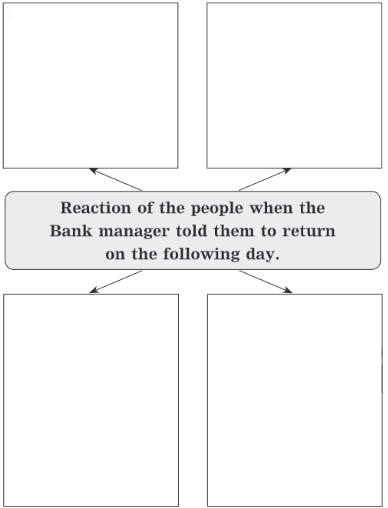
     People were turned back from the counters and told to return the following day. They did not like the sound of that. And so they gathered outside, on the steps of the bank shouting ‘Give us our money or we’ll break in!’ and ‘Fetch the Seth, we know he’s hiding in a safe deposit locker!’ Mischief makers who didn’t have a paisa in the bank, joined the crowd and aggravated their mood. The manager stood at the door and tried to placate them. He declared that the bank had plenty of money but no immediate means of collecting it; he urged them to go home and come back the next day.
    ‘We want it now!’ chanted some of the crowd.‘Now, now, now!’
     And a brick hurtled through the air and crashed through the plate glass window of the Pipalnagar Bank.
    Nathu arrived next morning to sweep the steps of the bank. He saw the refuse and the broken glass and the stones cluttering the steps. Raising his hands in a gesture of horror and disgust he cried: ‘Hooligans! Sons of donkeys! As though it isn’t bad enough to be paid late, it seems my work has also to be increased!’ He smote the steps with his broom scattering the refuse.
    Good morning, Nathu,’ said the washerman’sboy, getting down from his bicycle. ‘Are you ready to take up a new job from the first of next month? You’ll have to I suppose, now that the bank is going out of business.’
    ‘How’s that?’ said Nathu. ‘Haven’t you heard? Well you’d better wait here until half the population of Pipalnagar arrives to claim their money.’ And he waved cheerfully he did not have a bank account and sped away on his cycle.
     Nathu went back to sweeping the steps, muttering to himself. When he had finished his work, he sat down on the highest step, to await the arrival of the manager. He was determined to get his pay. ‘Who would have thought the bank would collapse!’ he said to himself, and looked thoughtfully into the distance. ‘I wonder how it could have happened …

A2. Complex Factual Activity:
Complete the web:
Image
A3. Activities based on Vocabulary:
Write one word for the following:
(1) a person who deliberately causes trouble to people.
(2) a person who washes clothes for other people.
A4. Activities based on Contextual Grammar:
Do as directed :
(1) Nathu raised his hands in a gesture of horror. He cried.
(Join the sentences beginning with the word 'Raising'.)
(2) He was determined to get his pay.
(Change the sentence into exclamatory sentence.)
A5. Personal Response:
(1) How are rumours spread? Are the rumours harmful? Why?/Why not? 
Answer
A1. Simple Factual Activity:
(1) Fact
(2) Fact
A2. Complex Factual Activity:
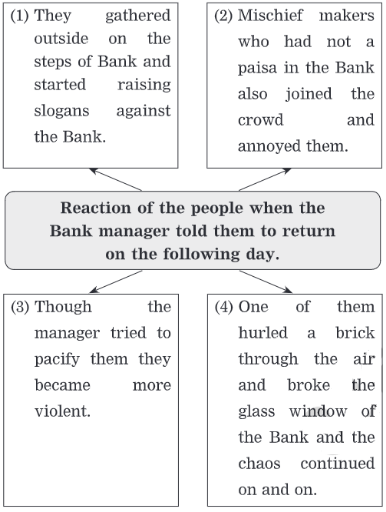
Image
A3. Activities based on Vocabulary:
(1) a mischief-maker
(2) a washerman
A4. Activities based on Contextual Grammar:
Do as directed :
(1) Raising his hand in a gesture of horror, Nathu cried.
(2) How determined he was to get his pay!
A5. Personal Response:
(1) The rumour-mongers talk to some people about a news, which is not true. They talk to others and it goes from one person to another and spreads like forest fire. They generally don't think if the news is reliable or rational or false.
     Some rumours are harmful and some are harmless. The rumours that are spread intentionally to harm the sentiments of people are harmful. These rumours depress, disturb and cause harassment to people. The rumours that are spread just for fun are harmless but they fool people.
View full question & answer
Question 210 Marks
A1. Simple Factual Activity:
Complete the following sentences with the information given in the passage:
(1) The man with crooked leg was _______________.
(2) Someone said that the Seth had hanged himself _______________.

    Old Ganpat the beggar, had a crooked leg. He had been squatting on the pavement for years, calling for alms. In the evening someone would come with a barrow and take him away. He had never been known to walk. But now, on learning that the bank was about to collapse, Ganpat astonished everyone, leaping to his feet and actually running at top speed in the direction of the bank. It soon became known that he had a thousand rupees in savings!
     Men stood in groups at street corners discussing the situation. Pipalnagar seldom had a crisis, seldom or never had floods, earthquakes or drought; and the imminent crash of the Pipalnagar Bank set everyone talking and speculating and rushing about in a frenzy. Some boasted of their farsightedness, congratulating themselves on having already taken out their money, or on never having put any in; others speculated on the reasons for the crash, putting it all down to excesses indulged in by Seth Govind Ram. The Seth had fled the State, said one. He had fled the country, said another. He was hiding in Pipalnagar, said a third. He had hanged himself from the tamarind tree, said a fourth, and had been found that morning by the sweeper-boy.
     By noon the small bank had gone through all; its ready cash, and the harassed manager was in a dilemma. Emergency funds could only be obtained from another bank some thirty miles distant, and he wasn’t sure he could persuade the crowd to wait
until then. And there was no way of contacting Seth Govind Ram on his houseboat in Kashmir. 

A2. Complex Factual Activity:
Complete the following sentences that tell you about Ganpat, the beggar:
(1) Ganpat was an old beggar who had a _______________.
(2) He had been _______________ for years.
A3. Activities based on Vocabulary:
Find the describing words for the following from the passage:
(1) fund (2) leg (3) manager (4) speed
A4. Activities based on Contextual Grammar:
(1) I must know the reason. You are late.
(Join the sentence with the word 'why'.)
(2) He was hiding in Pipalnagar.
(Rewrite the sentence using Simple Present Tense.)
A5. Personal Response:
(1) Have you ever heard a rumour that harmed people? Elaborate it.
Answer
A1. Simple Factual Activity:
(1) The man with crooked leg was old Ganpat, the beggar.
(2) Someone said that the Seth had hanged himself from the tamarind tree.
A2. Complex Factual Activity:
(1) Ganpat was an old beggar who had a crooked leg.
(2) He had been squatting on the pavement for years.
A3. Activities based on Vocabulary:
(1) emergency fund
(2) crooked leg
(3) harassed manager
(4) top speed
A4. Activities based on Contextual Grammar:

(1) I must know why you are late.
(2) He hides in Pipalnagar.
A5. Personal Response:
(1) Yes, I have not only heard but also have experienced such a rumour that has harmed people. We had been to a theatre to watch a movie. It was the first show of the movie. In the middle of the show a person shouted 'Fire! Fire!". People in the theatre left their seats in fright and ran helter-skelter to the exits for safety. Many fell and were trampled underfoot in the rush. It was an awful scene. Truth came to light that the miscreant was an agent of a producer who wanted the movie to fail.
View full question & answer
Question 310 Marks
A1. Simple Factual Activity:
Who said to whom?
(1) "The bird has flown!"
(2) "The Pipalnagar Bank is about to collapse."

     ‘What’s that?’ said Kamal Kishore, sitting up suddenly. ‘Which bank?’
     ‘Why the Pipalnagar bank of course. I hear they have stopped paying employees. Don’t tell me you have an account there, Mr. Kishore?’
     ‘No, but my neighbour has!’ he exclaimed; and he called out over the low partition to the keeper of the barber shop next door. ‘Deep Chand, have you heard the latest? The Pipalnagar Bank is about to collapse. You’d better get your money out as soon as you can!’
     Deep Chand who was cutting the hair of an elderly gentleman, was so startled that his hand shook and he nicked his customer’s right ear. The customer yelped with pain and distress: pain, because of the cut and distress because of the awful news he
had just heard. With one side of his neck still unshaven, he sped across the road to the general merchant’s store where there was a telephone. He dialled Seth Govind Ram’s number. The Seth was not at home. Where was he, then? The Seth was holidaying in Kashmir. Oh, was that so? The elderly gentleman did not believe it. He hurried back to the barber’s shop and told Deep Chand: ‘The bird has flown! Seth Govind Ram has left town. Definitely, it means a collapse.’ And then he dashed out of the shop, making a beeline for his office and chequebook.
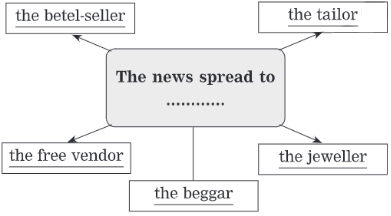
    The news spread through the bazaar with the rapidity of forest fire. From the general merchant’s it travelled to the shop, circulated amongst the customers, and then spread with them in various directions, to the betel-seller, the tailor, the free vendor, the jeweller, the beggar sitting on the pavement.   

A2. Complex Factual Activity:
Complete the web :
Image
A3. Activities based on Vocabulary:
Match the column with their meanings:

WordsMeanings
 (1) beeline (a) state of being upset
 (2) pavement (b) the direct route
 (3) nicked (c) the road for the people to walk
 (4) distress (d) cut slightly

A4. Activities based on Contextual Grammar:
Do as directed:
(1) Mr Kishore said, "Deep Chand, have you heard the latest?" (Change into indirect speech.)
(2) The bird has flown. (Rewrite the sentence using Past Perfect Tense)
A5. Personal Response:
(1) Do you think that rumour spreads faster than fire? Support your answer in two to three lines.

Answer
A1. Simple Factual Activity:
(1) The elderly gentleman said to Deep Chand the barber.
(2) Kamal Kishore said this to Deep Chand.
A2. Complex Factual Activity:
Image
A3. Activities based on Vocabulary:
(1) beeline - the direct route
(2) pavement - the road for the people to walk
(3) nicked - cut slightly
(4) distress - state of being upset
A4. Activities based on Contextual Grammar:

(1) Mr Kishore asked Deep Chand if he had heard the latest.
(2) The bird had flown.
A5. Personal Response:
(1) Forest fire, when it starts, is not under control and is made worse by winds that it causes. In the same way, people talk to others about the rumour without any thought or reasoning. And it goes from one person to another rapidly and spreads everywhere.
View full question & answer
Question 410 Marks
A1. Simple Factual Activity:
Who said to whom:
(1) "Where did you disappear?"
(2) "But you go from one shop to another."

      And Sitaram, glad that he had been of service to both a customer and his friend, hoisted his bag on his shoulders and went his way.
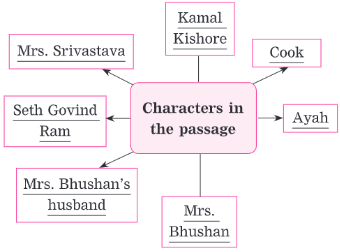
      Mrs. Srivastava had to do some shopping. She gave instructions to the ayah about looking after the baby, and told the cook not to be late with the midday meal. Then she set out for the Pipalnagar market place, to make her customary tour of the cloth shops.
      A large shady tamarind tree grew at one end of the bazaar, and it was here that Mrs. Srivastava found her friend Mrs. Bhushan sheltering from the heat. Mrs. Bhushan was fanning herself with a large handkerchief. She complained of the summer, which she affirmed, was definitely the hottest in the history of Pipalnagar. She then showed Mrs. Srivastava a sample of the cloth she was going to buy, and for five minutes they discussed its shade, texture and design. Having exhausted this topic, Mrs. Srivastava
said, ‘Do you know, my dear, that Seth Govind Ram’s bank can’t even pay its employees? Only this morning I heard a complaint from their sweeper, who hasn’t received his wages for over a month!’
     ‘Shocking!’ remarked Mrs. Bhushan. ‘If they can’t pay the sweeper they must be in a bad way. None of the others could be getting paid either.’
     She left Mrs. Srivastava at the tamarind tree and went in search of her husband, who was sitting in front of Kamal Kishore’s photography shop, talking with the owner.
    ‘So there you are!’ cried Mrs. Bhushan. ‘I’ve been looking for you for almost an hour. Where did you disappear ?’
    ‘Nowhere,’ replied Mr. Bhushan. ‘Had you remained stationary in one shop, I might have found you. But you go from one shop to another, like a bee in a flower garden.’
    ‘Don’t start grumbling. The heat is trying enough.I don’t know what’s happening to Pipalnagar. Even the bank’s about to go bankrupt.’   

A2. Complex Factual Activity:

(1) Write in your own words a few sentences about Mrs Srivastava. 
A3. Activities based on Vocabulary:
Find the words from the passage that nean the following:
(1) usual
(2) raised to higher position
(3) stable
(4) without enough money to pay what you owe
A4. Activities based on Contextual Grammar:
(1) A large shady tamarind tree grew at one end of the bazaar. Mrs Srivastava found her friend Mrs Bhushan there. (Join the sentence with 'where'.)
(2) Mrs. Srivastava had to do some shopping. (Pick out the infinitive) 
A5. Personal Response:
(1) Do you like Online Shopping? Why?
Answer
A1. Simple Factual Activity:
(1) Mrs Bhushan said this to her husband.
(2) Mr Bhushan said this to his wife.
A2. Complex Factual Activity:
(1) Mrs Srivastava was Sitaram's customer and was the lady of the house he visited. She gave some instructions to the ayah and the cook and then went the Pipalnagar market place, to make her usual tour of the cloth market. At one end of the bazaar she met her friend Mrs Bhushan. They both complained of the hot summer and they talked about a sample of cloth. Then Mrs Srivastava told Mrs Bhushan that Seth Govind Ram's bank could not pay their sweeper for over a month. She seems to be very talkative lady and was the root cause of the rumour about Pipalnagar Bank.
A3. Activities based on Vocabulary:
(1) customary
(2) hoisted
(3) stationary
(4) bankrupt
A4. Activities based on Contextual Grammar:

(1) Mrs Srivastava found her friend Mrs Bhushan where a large shady tamarind tree grew at one end of the bazaar.
(2) Mrs. Srivastava had to do some shopping.
A5. Personal Response:
Yes, I like online shopping because,
(1) it can save our time and transportation expenses.
(2) we can shop at any time we want.
(3) it is easy to search for what we want.
(4) it can avoid crowds and queues.
View full question & answer
Question 510 Marks
A1. Simple Factual Activity:
Complete the sentences using the information from the passage:
(1) According to Mrs Bhushan,  _______________.
(2) Mr Bhushan said to his wife, "You go from one shop to another, like  _______________.

      And Sitaram, glad that he had been of service to both a customer and his friend, hoisted his bag on his shoulders and went his way.
      Mrs. Srivastava had to do some shopping. She gave instructions to the ayah about looking after the baby, and told the cook not to be late with the midday meal. Then she set out for the Pipalnagar market place, to make her customary tour of the cloth shops.
      A large shady tamarind tree grew at one end of the bazaar, and it was here that Mrs. Srivastava found her friend Mrs. Bhushan sheltering from the heat. Mrs. Bhushan was fanning herself with a large handkerchief. She complained of the summer, which she affirmed, was definitely the hottest in the history of Pipalnagar. She then showed Mrs. Srivastava a sample of the cloth she was going to buy, and for five minutes they discussed its shade, texture and design. Having exhausted this topic, Mrs. Srivastava
said, ‘Do you know, my dear, that Seth Govind Ram’s bank can’t even pay its employees? Only this morning I heard a complaint from their sweeper, who hasn’t received his wages for over a month!’
     ‘Shocking!’ remarked Mrs. Bhushan. ‘If they can’t pay the sweeper they must be in a bad way. None of the others could be getting paid either.’
     She left Mrs. Srivastava at the tamarind tree and went in search of her husband, who was sitting in front of Kamal Kishore’s photography shop, talking with the owner.
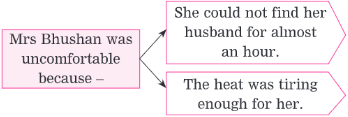
    ‘So there you are!’ cried Mrs. Bhushan. ‘I’ve been looking for you for almost an hour. Where did you disappear ?’
    ‘Nowhere,’ replied Mr. Bhushan. ‘Had you remained stationary in one shop, I might have found you. But you go from one shop to another, like a bee in a flower garden.’
    ‘Don’t start grumbling. The heat is trying enough.I don’t know what’s happening to Pipalnagar. Even the bank’s about to go bankrupt.’   

A2. Complex Factual Activity:
Complete the following web:
Image
A3. Activities based on Vocabulary:
Complete the followinig sentences by using the correct form of the phrases from the bracket:
[to complain of, at the end of, to set out for]
(1) There is an old Shiva's temple at the end of the village.
(2) The travellers set out early in the morning for the tour.
A4. Activities based on Contextual Grammar:
(1) That summer was the hottest in the history of Pipalnagar.
(Change the sentence into Positive Degree.)
(2) I heard a complaint.
(Begin the sentence with 'A complaint.....')
A5. Personal Response:
(1) Do you think, Mr Bhushan was right to compare his wife with a bee in a flower garden? Give your reason.
View full question & answer
Question 610 Marks
A1. Simple Factual Activity:
Complete the sentences using the information from the passage:
(1) Mr Srivastava was talking to Kamal Kishore the owner of the photography shop.
(2) Sitaram was glad that he had been of service to both a customer and his friend.

      And Sitaram, glad that he had been of service to both a customer and his friend, hoisted his bag on his shoulders and went his way.
      Mrs. Srivastava had to do some shopping. She gave instructions to the ayah about looking after the baby, and told the cook not to be late with the midday meal. Then she set out for the Pipalnagar market place, to make her customary tour of the cloth shops.
      A large shady tamarind tree grew at one end of the bazaar, and it was here that Mrs. Srivastava found her friend Mrs. Bhushan sheltering from the heat. Mrs. Bhushan was fanning herself with a large handkerchief. She complained of the summer, which she affirmed, was definitely the hottest in the history of Pipalnagar. She then showed Mrs. Srivastava a sample of the cloth she was going to buy, and for five minutes they discussed its shade, texture and design. Having exhausted this topic, Mrs. Srivastava
said, ‘Do you know, my dear, that Seth Govind Ram’s bank can’t even pay its employees? Only this morning I heard a complaint from their sweeper, who hasn’t received his wages for over a month!’
     ‘Shocking!’ remarked Mrs. Bhushan. ‘If they can’t pay the sweeper they must be in a bad way. None of the others could be getting paid either.’
     She left Mrs. Srivastava at the tamarind tree and went in search of her husband, who was sitting in front of Kamal Kishore’s photography shop, talking with the owner.
    ‘So there you are!’ cried Mrs. Bhushan. ‘I’ve been looking for you for almost an hour. Where did you disappear ?’
    ‘Nowhere,’ replied Mr. Bhushan. ‘Had you remained stationary in one shop, I might have found you. But you go from one shop to another, like a bee in a flower garden.’
    ‘Don’t start grumbling. The heat is trying enough.I don’t know what’s happening to Pipalnagar. Even the bank’s about to go bankrupt.’   

A2. Complex Factual Activity:
Complete the following web:
Image
A3. Activities based on Vocabulary:
Find describing words for the following from the passage:
(1) shop (2) meal (3) tour (4) tamarind tree
A4. Activities based on Contextual Grammar:
(1) Mrs Bhushan went in search of her husband. He was sitting in front of Kamal Kishore's photography shop.
(Rewrite the sentence joining it with 'who'.)
(2) That summer was the hottest in the history of Pipalnagar.
(Change the sentence into Positive Degree.)
A5. Personal Response:
(1) Do you think, Mr Bhushan was right to compare his wife with a bee in a flower garden? Give your reason.
View full question & answer
Question 710 Marks
A1. Simple Factual Activity:
Complete the sentences using the information from the passage:
(1) Sitaram was looking out for any job _______________ .
(2) The lady of the house was _______________.

    Nathu grumbled to himself as he swept the steps of the Pipalnagar Bank, owned by Seth Govind Ram. He used the small broom hurriedly and carelessly, and the dust, after rising in a cloud above his head settled down again on the steps. As Nathu was
banging his pan against a dustbin, Sitaram, the washerman’s son, passed by.
    Sitaram was on his delivery round. He had a bundle of freshly pressed clothes balanced on his head.
    ‘Don’t raise such dust!’ he called out to Nathu. ‘Are you annoyed because they are still refusing to pay you an extra two rupees a month?’
    ‘I don’t wish to talk about it,’ complained the sweeper-boy. ‘I haven’t even received my regular pay. And this is the twentieth of the month. Who would think a bank would hold up a poor man’s salary? As soon as I get my money, I’m off! Not another week I work in this place.’ And Nathu banged the pan against the dustbin several times, just
to emphasize his point and giving himself confidence.
    ‘Well, I wish you luck,’ said Sitaram. ‘I’ll keep a lookout for any jobs that might suit you.’ And he plodded barefoot along the road, the big bundle ofclothes hiding most of his head and shoulders.
     At the fourth home he visited, Sitaram heard the lady of the house mention that she was in need of a sweeper. Tying his bundle together, he said; ‘I know of a sweeper boy who’s looking for work. He can start from next month. He’s with the bank just now but they aren’t giving him his pay, and he wants to leave.’
    ‘Is that so?’ said Mrs. Srivastava. ‘Well, tell him to come and see me tomorrow.’ 

A2. Complex Factual Activity:
Write in your own words a few sentences about the following:
(i) Nathu
A3. Activities based on Vocabulary:

Do as directed:
(1) He called out to Nathu. (Rewrite the sentence in Past Continuous Tense.)
(2) Mrs Srivastava said, "Tell him to come and see me tomorrow." (Change into indirect speech.)
A4. Activities based on Contextual Grammar:

Column 'A'Column 'B'
 (1) small (a) man
 (2) pressed (b) pay
 (3) regular (c) clothes
 (4) poor (d) broom

A5. Personal Response:
(1) What makes you angry? What do you do then?

Answer
A1. Simple Factual Activity:
(1) Sitaram was looking out for any job that might suit Nathu.
(2) The lady of the house was in need of a sweeper.
A2. Complex Factual Activity:
(i) Nathu: Nathu was a sweeper working with the Pipalnagar Bank, owned by Seth Govind Ram. He was annoyed because the Bank had not paid his salary though they were the last daysof the month. He was sweeping hurriedly and carelessly because he was not happy with the owner. He was thinking of leaving that job.
A3. Activities based on Vocabulary:
(1) small -broom
(2) pressed -clothes
(3) regular - pay
(4) poor -man
A4. Activities based on Contextual Grammar:
(1) He was calling out to Nathu.
(2) Mrs Srivastava told (asked) him to tell him to come and see her the next day.
A5. Personal Response:
(1) Somebody's bad behaviour or arrogance makes me angry. When I get annoyed I do not react with harsh words or any violent action. I try to keep myself cool and try to bring to his/her notice, the wrong he/she is doing with me. I shall take time and prove him/her wrong.
View full question & answer
Question 810 Marks
A1. Simple Factual Activity:
Who am I? (Identify the character)
(1) I am the washerman's son. - _______________
(2) I am the sweeper. - _______________

    Nathu grumbled to himself as he swept the steps of the Pipalnagar Bank, owned by Seth Govind Ram. He used the small broom hurriedly and carelessly, and the dust, after rising in a cloud above his head settled down again on the steps. As Nathu was
banging his pan against a dustbin, Sitaram, the washerman’s son, passed by.
    Sitaram was on his delivery round. He had a bundle of freshly pressed clothes balanced on his head.
    ‘Don’t raise such dust!’ he called out to Nathu. ‘Are you annoyed because they are still refusing to pay you an extra two rupees a month?’
    ‘I don’t wish to talk about it,’ complained the sweeper-boy. ‘I haven’t even received my regular pay. And this is the twentieth of the month. Who would think a bank would hold up a poor man’s salary? As soon as I get my money, I’m off! Not another week I work in this place.’ And Nathu banged the pan against the dustbin several times, just
to emphasize his point and giving himself confidence.
    ‘Well, I wish you luck,’ said Sitaram. ‘I’ll keep a lookout for any jobs that might suit you.’ And he plodded barefoot along the road, the big bundle ofclothes hiding most of his head and shoulders.
     At the fourth home he visited, Sitaram heard the lady of the house mention that she was in need of a sweeper. Tying his bundle together, he said; ‘I know of a sweeper boy who’s looking for work. He can start from next month. He’s with the bank just now but they aren’t giving him his pay, and he wants to leave.’
    ‘Is that so?’ said Mrs. Srivastava. ‘Well, tell him to come and see me tomorrow.’ 

A2. Complex Factual Activity:
Arrange the following sentences as per their sequence occurred in the passage:
(1) Nathu complained about his irregular pay.
(2) Nathu used the small broom hurriedly.
(3) Sitaram called out to Nathu.
(4) Nathu grumbled as he swept the steps of the bank.
A3. Activities based on Vocabulary:

Cross out the odd man:
(1) sweeper, hooligan, beggar, declare, locker
(2) hurriedly, carelessly, salary, definitely, suddenly
(3) imminent, latest, pavement, awful, shocking
(4) morning, scattering, raising, collecting, shouting
A4. Activities based on Contextual Grammar:
(1) He called out to Nathu. (Rewrite the sentence in Past Continuous Tense.)
(2) Mrs Srivastava said, "Tell him to come and see me tomorrow." (Change into indirect speech.)
A5. Personal Response:
(1) What qualities do you find in Sitaram?
Answer
A1. Simple Factual Activity:
(1) Sitaram
(2) Nathu
A2. Complex Factual Activity:
(4) Nathu grumbled as he swept the steps of the bank.
(2) Nathu used the small broom hurriedly.
(3) Sitaram called out to Nathu.
(1) Nathu complained about his irregular pay.
A3. Activities based on Vocabulary:
(1) declare
(2) salary
(3) pavement
(4) morning
A4. Activities based on Contextual Grammar:
(1) He was calling out to Nathu.
(2) Mrs Srivastava told (asked) him to tell him to come and see her the next day.
A5. Personal Response:
(1) Sitaram was a hardworking young boy. He was always ready to help others and sympathetic towards suffering people. He felt happy to serve his customer and his friend.
View full question & answer