Question
A1. Simple Factual Activity:
Complete the following sentences with the information given in the passage:
(1) The man with crooked leg was _______________.
(2) Someone said that the Seth had hanged himself _______________.

    Old Ganpat the beggar, had a crooked leg. He had been squatting on the pavement for years, calling for alms. In the evening someone would come with a barrow and take him away. He had never been known to walk. But now, on learning that the bank was about to collapse, Ganpat astonished everyone, leaping to his feet and actually running at top speed in the direction of the bank. It soon became known that he had a thousand rupees in savings!
     Men stood in groups at street corners discussing the situation. Pipalnagar seldom had a crisis, seldom or never had floods, earthquakes or drought; and the imminent crash of the Pipalnagar Bank set everyone talking and speculating and rushing about in a frenzy. Some boasted of their farsightedness, congratulating themselves on having already taken out their money, or on never having put any in; others speculated on the reasons for the crash, putting it all down to excesses indulged in by Seth Govind Ram. The Seth had fled the State, said one. He had fled the country, said another. He was hiding in Pipalnagar, said a third. He had hanged himself from the tamarind tree, said a fourth, and had been found that morning by the sweeper-boy.
     By noon the small bank had gone through all; its ready cash, and the harassed manager was in a dilemma. Emergency funds could only be obtained from another bank some thirty miles distant, and he wasn’t sure he could persuade the crowd to wait
until then. And there was no way of contacting Seth Govind Ram on his houseboat in Kashmir. 

A2. Complex Factual Activity:
Complete the following sentences that tell you about Ganpat, the beggar:
(1) Ganpat was an old beggar who had a _______________.
(2) He had been _______________ for years.
A3. Activities based on Vocabulary:
Find the describing words for the following from the passage:
(1) fund (2) leg (3) manager (4) speed
A4. Activities based on Contextual Grammar:
(1) I must know the reason. You are late.
(Join the sentence with the word 'why'.)
(2) He was hiding in Pipalnagar.
(Rewrite the sentence using Simple Present Tense.)
A5. Personal Response:
(1) Have you ever heard a rumour that harmed people? Elaborate it.
Answer

A1. Simple Factual Activity:
(1) The man with crooked leg was old Ganpat, the beggar.
(2) Someone said that the Seth had hanged himself from the tamarind tree.
A2. Complex Factual Activity:
(1) Ganpat was an old beggar who had a crooked leg.
(2) He had been squatting on the pavement for years.
A3. Activities based on Vocabulary:
(1) emergency fund
(2) crooked leg
(3) harassed manager
(4) top speed
A4. Activities based on Contextual Grammar:

(1) I must know why you are late.
(2) He hides in Pipalnagar.
A5. Personal Response:
(1) Yes, I have not only heard but also have experienced such a rumour that has harmed people. We had been to a theatre to watch a movie. It was the first show of the movie. In the middle of the show a person shouted 'Fire! Fire!". People in the theatre left their seats in fright and ran helter-skelter to the exits for safety. Many fell and were trampled underfoot in the rush. It was an awful scene. Truth came to light that the miscreant was an agent of a producer who wanted the movie to fail.

Need a full question paper?

Generate a complete, print-ready paper with questions like this in minutes — across 16+ boards, with answer keys.

Start Generating Free

Similar questions

A1. Simple Factual Activities:
State whether the following statements are Right or Wrong:
(1) We should have vision for today not tomorrow.
(2) If we close our eyes and feel the child inside us, we can listen to that child.
(3) Mahatına Gandhi, Nelson Mandela and Martin Luther King are calling on us.
(4) Satyarthi's vision of tomorrow is to see that cobbler's boy sitting with him in his classroom.

     As a child, I had a vision of tomorrow. A vision of that cobbler boy sitting with me in my classroom.
     Now, that tomorrow has become TODAY.
     I am TODAY, and you are TODAY. TODAY it is time for every child to have a right to life, right to freedom, right to health, right to education, right to safety, right to dignity, right to equality, and right to peace.
     TODAY, beyond the darkness, I see the smiling faces of our children in the blinking stars. TODAY, in every wave of every ocean, I see my children are playing and dancing. TODAY, in every plant, in every tree, and mountain, I see our children growing freely with dignity.
     Friends, I want you to see and feel this TODAY inside you.
     My dear sisters and brothers, as I said many interesting things are happening today. May I please request you to put your hand close to your heart - close your eyes and feel the child inside you?
     I am sure you can - Now, listen to that child.Listen please.
     Today, I see thousands of Mahatma Gandhis, Nelson Mandelas and Martin Luther Kings calling on us.
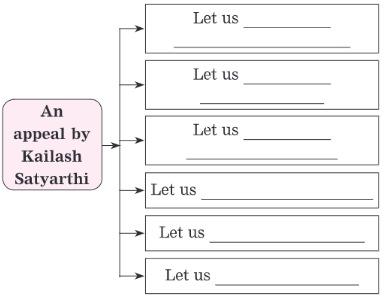
     Let us democratise knowledge. Let us universalise justice. Together, let us globalise compassion!
     I call upon you in this room, and all across the world. I call for a march from exploitation to education, I call for a march from poverty to shared prosperity, a march from slavery to liberty, and a march from violence to peace.
     Let us march from ignorance to awakening. Let us march from darkness to light. Let us march from mortality to divinity.
     Let us march!  

A2. Complex Factual Activities:
Complete the following web-chart :
Image
A3. Activities based on Vocabulary:
Write the infinitive forms of the following and use any two of them in your own sentences:
(1) dancing
(2) playing
(3) growing 
(4) happening 
A4. Activities based on Contextual Grammar:
Make nouns of the following:
(1) universal
(2) global
(3) knowledge
(4) exploitation
A5. Personal Response:
(1) What do you mean by 'Every child has a right to life'? 
A1. Simple Factual Activities:
Fill in the blanks:
(1) Ramlal had ________ sons and ________ daughters.
(2) All the children except Bholi were ________ and ________.

    Her name was Sulekha but since her childhood everyone had been calling her Bholi the simpleton.
    She was the fourth daughter of Numberdar Ramlal. When she was ten months old, she had fallen off the cot on her head and perhaps it had damaged some part of her brain. That was why she remained a backward child and came to be known
as Bholi, the simpleton.
     At birth the child was very fair and pretty. But when she was two years old, she had an attack of small pox. Only the eyes were saved. But the entire body was permanently disfigured by deep black pockmarks. Little Sulekha could not speak till she was five and when at last she learnt to speak, she stammered. The other children often made fun of
her and mimicked her. As a result, she talked very little.
     Ramlal had seven children, three sons and four daughters and the youngest of them was Bholi. It was a prosperous farmer’s household and there was plenty to eat and drink. All the children except Bholi were healthy and strong. The sons had been sent to
the city to study in schools and later in colleges. Of the daughters Radha, the eldest had already been married. The second daughter Mangla’s marriage had also been settled Ramlal would think of third Champa. They were good looking, healthy girls. And
it was not difficult to find bridegrooms for them.
     But Ramlal was worried about Bholi. She had neither good looks nor intelligence.
     Bholi was seven years old when Mangla was married. The same year a primary school for girls was opened in their village. The Tehsildar sahib came to perform its opening ceremony. He said to Ramlal, ‘‘As a revenue official you are the representative of the government in the village and so you must set an example to the villagers. You
must send your daughter to school.’’
      That night when Ramlal consulted his wife. She cried, ‘‘Are you crazy? If girls go to school, who will marry them?’’
      But Ramlal had not the courage to disobey the Tehsildar. At last his wife said, ‘‘I will tell you what to do. Send Bholi to school. As it is there is little chance of her getting married, with her ugly face and lack of sense. Let the teachers at school worry about her.’’

A2. Complex Factual Activities:
Give reasons:
(1) Little Sulekha used to talk very little because - _______________
A3. Activities based on Vocabulary:
Use the following phrases in the following sentences by making certain changes:
(to shout in terror, to pass on, to hand over)
(1) My sister _______________ a letter of apology to her class teacher.
(2) My father had the day off because he didn't want _______________ his flu to everyone in the office."
A4. Activities based on Contextual Grammar:
Do as directed:
(1) The child was very fair and pretty.
(Choose correct alternative to make it exclamatory.)
(a) What a fair and pretty the child was!
(b) How a fair and pretty the child was!
(c) How fair and pretty the child was!
(2) There was plenty to eat and drink.
(Pick out the infinitive.) 
A5. Personal Response:
(1) How do you feel on the first day of your school? 
A1. Simple Factual Activity:
Complete the following sentences with the help of the information from the passage:
(1) Dr. Stephen Hawking was born on _______________.
(2) Courage is the quality _______________.

    Exactly 300 years after the death of the great scientist Galileo, Dr Stephen Hawking was born in Oxford, London on the eighth day of January 1942. Little did his parents know that one day their little boy would be hailed as one of the greatest scientists
of this century. Neither could anybody imagine that his mind would soar up into space like light. More importantly, none could predict that he would be the very epitome of courage.
    Courage is a wonderful thing. It is that quality, which makes people not lose heart when faced with a great calamity. It would not be an exaggeration to say that Dr Stephen Hawking, a living legend of Cosmology, is the very personification of courage
and hope. Except his mind, his whole body is bound to a wheelchair, thanks to a cruel quirk of fate. Yet, he is one of the greatest scientists of this century.
     An average child, Stephen grew up to be a normal teenager, full of mischief and lots of love for music and mathematics. Even though his father wanted him to study medicine, he was bent on studying mathematics. The University of Oxford, at that time, did not have a course in mathematics so he opted to study physics instead. 

A2. Complex Factual Activity:
(1) What do you know about Dr. Stephen Hawking from this passage? 
A3. Activities based on Vocabulary:
Classify the following words into verbs, adjectives and nouns:
whole, know, little, predict, calamity, legend, mind, physics, great, imagine, wonderful, cruel, courage, faced, grew, heart, fate, course.people.
A4. Activities based on Contextual Grammar:
Make the following sentences exclamatory:
(i) Courage is truly a wonderful thing.
(ii) He was very clumsy.
A5. Personal Response:
(1) Do you think, that courage is a wonderful thing? Why do you think so?
A1. Simple Factual Activities:
State whether the following statements are True or False:
(1) Bishamber was a young bridegroom. 
(2) Ramlal had never dreamt that his fourth daughter Bholi would have such a grand wedding.
(3) When Bholi was brought near the sacred fire she was in a red silken bridal dress.
(4) Bholi felt herself lucky to get a well-to-do bridegroom like Bishamber.

    Thus the years passed.
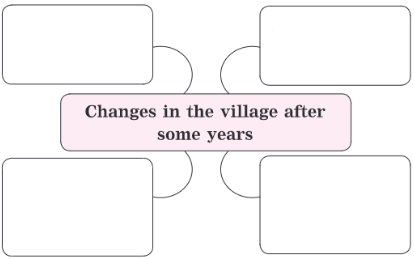
    The village became a small town. The little primary school became high school. There were now a cinema under a tin shed and a cotton ginning mill. The mail train began to stop at their railway station.
     One night, after dinner, Ramlal said to his wife, “Then, shall I accept Bishamber’s proposal?”
    “Yes, certainly” his wife said. “Bholi will be lucky to get such a well to do bridegroom. A big shop, a house of his own and I hear several thousands in the bank. Moreover, he is not asking for any dowry”.
    “That’s right, but he is not so young, you know -almost the same age as I am- and he also limps. Moreover, the children from his first wife are quite grown up”.
    “So what does it matter ?” his wife replied. “Forty five or fifty-it is no great age for a man. We are lucky that he is from another village and does not know about her pockmarks and her lack of sense. If we don’t accept this proposal, she may remain
unmarried all her life.”
    “Yes, but I wonder what Bholi will say”.
    “What will that witless one say ? She is like a dumb cow.”
    “May be you are right”, muttered Ramlal. In the other corner of the courtyard, Bholi lay awake on her cot, and listened to her parents’ whispered conversation.
     Bishamber Nath was a well - to - do grocer. He came with a big party of friends and relations with him for the wedding. A brass band playing a popular tune from an Indian film headed the procession, with the bridegroom riding a decorated horse. Ramlal was
overjoyed to see such pomp and splendour. He had never dreamt that his fourth daughter would have such a grand wedding. Bholi’s elder sisters who had come for the occasion were envious of her luck.
     When the auspicious moment came the priest said, “Bring the bride”. Bholi, clad in a red silken bridal dress, was led to bride’s place near the sacred fire.
    “Garland the bride,” one of his friends prompted Bishamber Nath.

A2. Complex Factual Activities:
Complete the following web :
Image
A3. Activities based on Vocabulary:
Complete the following sentences using the words given in the brackets:
(envious, procession, overjoyed)
(1) Most of the youngsters like to dance in marriage _______________.
(2) He was _______________ to see his friend after a long time.
A4. Activities based on Contextual Grammar:
Change the following sentences in indirect speech:
(1) "What will that witless one say? She is like a dumb cow". "May be you are right," muttered Ramlal.
(2) "Yes, certainly," his wife said, "Bholi will be lucky to get such a well-to-do bridegroom."
A5. Personal Response:
(1) What is your opinion about Bholi's bridegroom? Should she get married to him?
A1. Simple Factual Activities:
Write whether the following sentences are True or False:
(1) Writer's journey from India to Norway is a connect between the two centre of global peace.
(2) The Nobel Committee did not invite the writer to deliver a lecture.
(3) Writer represented the sound of silence and cry of innocence.
(4) Writer humbly accepted the award on behalf of all activists.

     My dear children of the world ... Your Majesties, Your Royal Highnesses, Excellencies, distinguished members of the Norwegian Nobel Committee, dear brother Tom Harkin, brothers and sisters, and my dear daughter Malala.
      From this podium of peace and humanity, I am deeply honoured to recite a mantra from the ancient texts of wisdom, Vedas. This mantra carries a prayer, an aspiration and a resolve that has the potential to liberate humanity from all man-made crises.
      Let’s walk together. In the pursuit of global progress, not a single person should be left out or left behind in any corner of the world, from East to West, from South to North. Let’s speak together, let our minds come together! Learning from the experiences of our ancestors, let us together create knowledge for all that benefits all.
      I bow to my late parents, to my motherland India, and to the mother earth.
      With a warm heart I recall how thousands of times, I have been liberated, each time I have freed a child from slavery. In the first smile of freedom on their beautiful faces, I see the Gods smiling.
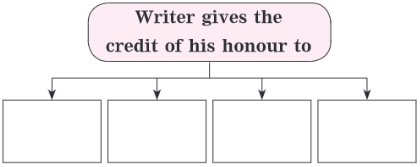
      I give the biggest credit of this honour to my movement’s Kaalu Kumar, Dhoom Das and Adarsh Kishore from India and Iqbal Masih from Pakistan who made the supreme sacrifice for protecting the freedom and dignity of children. I humbly accept this award on behalf of all such martyrs, my fellow activists across the world and my countrymen.
      My journey from the great land of Lord Buddha, Guru Nanak and Mahatma Gandhi; India to Norway is a connect between the two centres of global peace and brotherhood, ancient and modern.
      Friends, the Nobel Committee has generously invited me to present a “lecture.” Respectfully, I am unable to do that. Because, I am representing here - the sound of silence. The cry of innocence. And, the face of invisibility. I represent millions of those children who are left behind and that’s why I have kept an empty chair here as a reminder.

A2. Complex Factual Activities:
Complete the following :
Image
A3. Activities based on Vocabulary:
(1) Use the word 'credit' as a noun and a verb to make a meaningful sentence.
A4. Activities based on Contextual Grammar:
Do as directed:
(1) I humbly accept this award. (Choose the correct question tag.)
(a) do I?  (b) don't I? (c) did I? (d) didn't I?
(2) I am unable to do that.
(Make it negative without changing its meaning)
A5. Personal Response:
(1) What do you know about Kailash Satyarthi? 
A1. Simple Factual Activities:
Who said to whom?

 Sentence Who saidTo whom
 (1) "Then, what's the secret of your energy?"   
 (2) "A beggar changed my life."  

    ‘Then stay with me tonight,’ she said. ‘Let’s chat. Do you know that, old friends and memories are precious and rare ?’
     I couldn’t believe it. Was this really Meena ? I pinched myself hard to be sure it wasn’t a dream. But Meena was really standing there, right in front of me, squeezing my hand, smiling, and yes, she did look happy. In the three years she had been in Bangalore, I had never once seen her smiling like that. A few strands of grey in her hair reminded me that years had passed. There were a few wrinkles in her face, but the truth was that she looked more attractive than ever before.
     Finally, I managed to say, ‘No Meena, I can’t stay with you tonight. I have to attend a dinner. Give me your card and I’ll keep in touch with you, I promise.’
     For a moment, Meena looked disappointed, ‘Let’s go and have tea at least’, she insisted.
     ‘But Meena, it’s pouring.’
     ‘So what ? We’ll buy an umbrella and then go to the Grand Hotel,’ she said.
     ‘We won’t get a taxi in this rain’, I grumbled.
     ‘So what ? We’ll walk’.
      I was very surprised. This wasn’t the same Meena I had known. Today, she seemed ready to make any number of adjustments.
      We reached the Grand Hotel drenched. By then the only thought in my mind was to find out who or what had brought about such a change in the pessimistic Meena I had known. I was quite curious.
      ‘Tell me Meena, is there a Prince Charming who has managed to change you so ?’
       Meena was surprised by my question. ‘No, there isn’t anyone like that’, she said.
       ‘Then what’s the secret of your energy?’ I asked, like Tendulkar does in the  advertisement.
       She smiled, ‘A beggar changed my life.’ I was absolutely dumbfounded and she could see it.

A2. Complex Factual Activities:
Choose the correct alternative and complete the following sentences:
(1) The only thought in the writer's mind till they reached the Grand Hotel was _______________.
(a) why the rain was not stopping.
(b) what had brought about such a change in Meena.
(c) how the beggar had changed the entire life of Meena.
(2) The writer wanted to attend _______________.
(a) a marriage party.
(b) a dinner.
(c) a birthday party.
A3. Activities based on Vocabulary:
Find out antonyms for the following from the passage:
(1) lie ×   _____________
(2) dry ×  _____________
(3) common ×  _____________
(4) wrong ×  _____________.
A4. Activities based on Contextual Grammar:
Change into indirect speech:
(1) "We won't get a taxi in this rain," I grumbled.
(2) "So what? We'll buy an umbrella and then go to the Grand Hotel," she said.
A5. Personal Response:
(1) What, according to you, is the difference between an optimistic person and a pessimistic person?

A1. Simple Factual Activity:
Name the following:
(1) The International World Heritage Programme is administered by-
(2) The Nile valley contains many ancient-

     A World Heritage Site is a site determined by the United Nations Educational, Scientific and Cultural Organization (UNESCO) to have significant cultural or natural importance to humanity. As such the sites are protected and maintained by the
International World Heritage Programme which is administered by the UNESCO World Heritage Committee. Because World Heritage Sites are places that are significant culturally and naturally, they vary in type and include forests, lakes, monuments, buildings and cities.
    World Heritage Sites can also be a combination of both cultural and natural areas. For example, Mount Huangshan in China is a site with significance to human culture because it played a role in historical Chinese art and literature. The mountain is also
significant because of its physical landscape characteristics.
     Although the idea of protecting cultural and natural heritage sites around the world began in the early twentieth century, momentum for its actual creation was not until the 1950s. In 1954, Egypt started plans to build the Aswan High Dam to collect and control water from the Nile River. The initial plan for the dam’s construction would have flooded the valley containing the Abu Simbel Temples and scores of ancient Egyptian artefacts. To protect the temples and artifacts, UNESCO launched an international campaign in 1959 that called for the dismantling and movement of the temples to higher ground. The project cost an estimated US $80 million, $40 million of which came from 50 different countries. Because of the project’s success, UNESCO and the
International Council on Monuments and Sites initiated a draft convention to create an international organization responsible for protecting cultural heritage
 
A2. Complex Factual Activity:
(1) Why did UNESCO launch an international campaign in 1959? 
A3. Activities based on Vocabulary:
Find from the passage adjective forms for the following:
(1) culture (2) history (3) nature (4) significance
A4. Activities based on Contextual Grammar:
This does not mean that the book is filled with heavy Grammar.Rewrite the following sentences using 'not only ... but also' and 'as well as in two separate sentences:
(1) To protect the temples and artifacts, UNESCO launched an international campaign.
A5. Personal Response:
(1) What are our duties towards preservation of any historical site?
A1. Simple Factual Activity:
Complete the following sentences using information in the passage:
(1) He flapped his wings once and _______________.
(2) He turned his beak sideways and cawed _______________.

    Then he completely forgot that he had not always been able to fly, and commended himself to dive and soar and curve, shrieking shrilly.
    He was near the sea now, flying straight over it, facing straight out over the ocean. He saw a vast green sea beneath him, with little ridges moving over it and he turned his beak sideways and cawed amusedly.
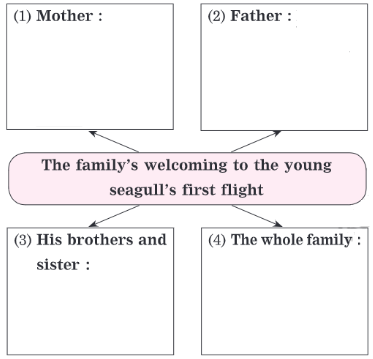
    His parents and his brothers and sister had landed on this green flooring ahead of him. They were beckoning to him, calling shrilly. He dropped his legs to stand on the green sea. His legs sank into it. He screamed with fright and attempted to rise again flapping his wings. But he was tired and weak with hunger and he could not rise, exhausted by the strange exercise. His feet sank into the green sea, and then his belly touched it and he sank no farther. He was floating on it, and around him his family was screaming, praising him and their beaks were offering him scraps of dog-fish. He had made his first flight.

A2. Complex Factual Activity:
(1) What did the young seagull forget? What did he do then? 
A3. Activities based on Vocabulary:
Read the following words and make meaningful sentences of your own by using them:*(1) beckon
(2) curveting
A4. Activities based on Contextual Grammar:
Do as directed:
(1) He was near the sea now. (Frame a Wh-question to get the underlined as an answer.)
(2) But he was tired and weak with hunger. (Use 'not only but also'.)
A5. Personal Response:
(1) How does your family help you to achieve your goal?
A1. Simple Factual Activity:
Complete the following sentences using information in the passage:
(1) The young seagull commended _______________.
(2) He completely forgot that _______________.

    Then he completely forgot that he had not always been able to fly, and commended himself to dive and soar and curve, shrieking shrilly.
    He was near the sea now, flying straight over it, facing straight out over the ocean. He saw a vast green sea beneath him, with little ridges moving over it and he turned his beak sideways and cawed amusedly.
    His parents and his brothers and sister had landed on this green flooring ahead of him. They were beckoning to him, calling shrilly. He dropped his legs to stand on the green sea. His legs sank into it. He screamed with fright and attempted to rise again flapping his wings. But he was tired and weak with hunger and he could not rise, exhausted by the strange exercise. His feet sank into the green sea, and then his belly touched it and he sank no farther. He was floating on it, and around him his family was screaming, praising him and their beaks were offering him scraps of dog-fish. He had made his first flight.

A2. Complex Factual Activity:
Complete the web :
Image
A3. Activities based on Vocabulary:

(commended, attempted, exhausted, soared)
(1) The rocket _______________ up into space.
(2) Our achievements in Science Exhibition was highly _______________ by our Principal.
(3) He was totally _______________ after the day's tedious work.
(4) The thief _______________ to give the slip, but was caught by the police.
A4. Activities based on Contextual Grammar:
Do as directed:
(1) He was near the sea now. (Frame a Wh-question to get the underlined as an answer.)
(2) He could not rise. (Add a question tag.)
A5. Personal Response:
(1) How does your family help you to achieve your goal?
A1. Simple Factual Activity:
Say whether the following statements are True or False:
(1) When the young seagull. pretended to be falling asleep, his parents took notice of him.
(2) Flying across the young seagull, the mother dropped into his beak a piece of fish.
(3) The young seagull was fed a piece of fish by his mother.
(4) The young seagull's father was preening the feathers on his white back.

     The sun was now ascending the sky, blazing on his ledge that faced the south. He felt the heat because he had not eaten since the previous nightfall.
     He stepped slowly out to the brink of the ledge, and standing on one leg with the other leg hidden under his wing, he closed one eye, then the other, and pretended to be falling asleep. Still they took no notice of him. He saw his two brothers and his sister
lying on the plateau dozing with their heads sunk into their necks. His father was preening the feathers on his white back. Only his mother was looking at him. She was standing on a little high hump on the plateau, her white breast thrust forward. Now and
again, she tore at a piece of fish that lay at her feet and then scrapped each side of her beak on the rock. The sight of the food maddened him. How he loved to tear food that way, scrapping his beak now and again to whet it.
     “Ga, ga, ga”, he cried begging her to bring him some food. “Gaw-col-ah”, she screamed back derisively. But he kept calling plaintively, and after a minute or so he uttered a joyful scream. His mother had picked up a piece of the fish and was flying across to him with it. He leaned out eagerly, tapping the rock with his feet, trying to get nearer to her as she flew across. But when she was just opposite to him, she halted, her wings motionless, the piece of fish in her beak almost within reach of his beak. He waited a moment in surprise, wondering why she did not come nearer, and then, maddened by hunger, he dived at the fish. With a loud scream he fell outwards
and downwards into space. Then a monstrous terror seized him and his heart stood still. He could hear nothing. But it only lasted a minute. The next moment he felt his wings spread outwards. The wind rushed against his breast feathers, then under his stomach, and against his wings. He could feel the tips of his wings cutting through the air. He was not falling headlong now. He was soaring gradually downwards and outwards. He was no longer afraid. He just felt a bit dizzy.

A2. Complex Factual Activity:

(1) What were the young seagull's parents doing? 
A3. Activities based on Vocabulary:
Match the words in Column 'A' with their meanings in Column 'B':

'A''B'
(1) ascending  (a) grabbed
(2) maddened (b) flying upward into the air
(3) soaring (c) made one very angry
(4) seized (d) rising up

A4. Activities based on Contextual Grammar:
Read the following sentences carefully, underline the verbs and find out the tenses in the sentences: 
(1) The sun was ascending now.
(2) Still they took no notice of him.
A5. Personal Response:
Complete the following statements:
(1) The seagull is afraid to fly because _______________ .
(2) Young birds are afraid to make their first flight because_______________.