| Measures | Pre-disaster/ Post-disaster | Structural or Non-Structural |
| (1) Community level disaster planning | (1) Post-disaster | (1) Structural |
| (2) Providing financial support | (2) Post-disaster | (2) Structural |
| (3) Rebuilding of roads and bridges | (3) Pre-disaster | (3) Non-structural |
| (4) Providing houses to affected people | (4) Pre-disaster | (4) Non-structural |
Question types
Disaster Management question types
72 questions across 12 question groups — pick any mix to generate a Geography paper with step-by-step answer keys.
72
Questions
12
Question groups
5
Question types
01
Complete the chain and rewrite in your answer paper
3 Q→02Answer the following questions in short
6 Q→03Choose the correct option by identifying the correct co-relation in the given statements.
17 Q→04identify the correct correlation
10 Q→05Give geographical reason
3 Q→06Distinguish between
2 Q→07Read the given passage and answer the following questions:
1 Q→08Answer the following question in detail
8 Q→09Draw a neat and labelled diagram.
1 Q→10Answer the following question in detail.
3 Q→11Write short note
8 Q→12identfy the incorrect factor
10 Q→Sample Questions
Disaster Management questions
One sample from each question group in this chapter. Select any group above to see the full set with answer keys.
| Measures | Pre-disaster/ Post-disaster | Structural or Non-Structural |
| (1) Public awareness | (1) Post-disaster | (1) Structural |
| (2) Preparedness of hospital | (2) Post-disaster | (2) Non-structural |
| (3) Providing food and shelter to people | (3) Pre-disaster | (3) Structural |
| (4) Construction of river embankments | (4) Post-disaster | (4) Non-structural |
| Type of disaster | Name of Disaster | Place |
| (1) Tectonic | (1) Flood | (1) Malin |
| (2) Geological | (2) Plague | (2) Kerala |
| (3) Metrological | (3) Tsunami | (3) Surat |
| (4) Biological | (4) Mudslide | (4) Indonesia |
Why is disaster management called a cycle? See the figure given below.
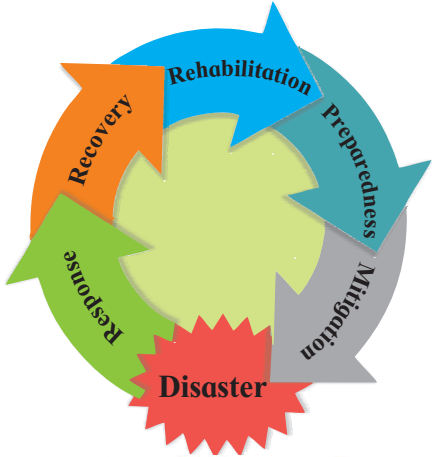
In 1988, an earthquake of magnitude 6.9 struck Armenia and took 25,000 lives. On the other hand, an earthquake in 1989 in Californ ia of magnitude 7 took only 63 lives. Can you think of the reason behind this difference?
If an earthquake occurs with a magnitude of more than 6 in Sahara Desert area which is totally uninhabited by humans and a similar one occurs in Assam, which one would you call a disaster?
Rehabilitation after Earthquakes
Preparedness for Floods
India has been successful in mitigation the effects of the following disaster.
(a) Earthquake
(b) Volcanic eruptions
(c) Floods
(d) Cyclones
(a) Earthquake
(b) Volcanic eruptions
(c) Floods
(d) Cyclones
Statement A – The cyclonic depression originating in the Bay of Bengal is marching towards Tamil Nadu at a velocity of 350 km/hr.
Statement B – The loss of life was not much but property loss occurred on a large scale.
(a) A indicates a disaster and B indicates a hazard.
(b) A indicates a hazard while B indicates a disaster.
(c) A indicates a disaster but B does not indicate a hazard.
(d) A does not indicate a disaster but B indicates a hazard.
Statement B – The loss of life was not much but property loss occurred on a large scale.
(a) A indicates a disaster and B indicates a hazard.
(b) A indicates a hazard while B indicates a disaster.
(c) A indicates a disaster but B does not indicate a hazard.
(d) A does not indicate a disaster but B indicates a hazard.
The Meteorological Department has given information that a cyclone is likely to make a landfall at Odisha in 2 days. Which of the following group shows the correct sequence of management process?
| A | B | C | D |
| Recovery | Rehabilitation | Preparedness | Response |
| Rehabilitation | Preparedness | Mitigation | Recovery |
| Preparedness | Mitigation | Response | Rehabilitation |
| Mitigation | Response | Recovery | Preparedness |
| Response | Recovery | Rehabilitation | Mitigation |
Which of the following groups shows the correct type of disaster?
| A | B | C | D |
| Tectonic | Flood | Tectonic | Tectonic |
| Geological | Geological | Geological | Human |
| Human | Human | Volcanic | Biological |
| Climate | Climate | Climate | Volcanic |
The Surat plague of 1992 is ………………….
- Ameteorological disaster
- ✓biological disaster
- Cgeological disaster
- Dtectonic disaster
Answer: B.
View full solution →A – The last phase of disaster management is rehabilitation.
R – The first stage of disaster management is mitigation.
R – The first stage of disaster management is mitigation.
- ✓Only A is correct.
- BOnly R is correct.
- CBoth A and R are correct and R is the correct explanation of A.
- DBoth A and R are correct but R is not the correct explanation of A.
Answer: A.
View full solution →A – The Malin mudslide of Maharashtra in 2014 is geological type of disaster.
R – Tsunami is tectonic type of disaster.
R – Tsunami is tectonic type of disaster.
- AOnly A is correct.
- BOnly R is correct.
- CBoth A and R are correct and R is the correct explanation of A.
- ✓Both A and R are correct but R is not the correct explanation of A.
Answer: D.
View full solution →A – Epidemics is an example of meteorological type of disaster.
R – Corona pandemic is an example of biological type of disaster.
R – Corona pandemic is an example of biological type of disaster.
- AOnly A is correct.
- ✓Only R is correct.
- CBoth A and R are correct and R is the correct explanation of A.
- DBoth A and R are correct but R is not the correct explanation of A.
Answer: B.
View full solution →A – Remote sensing is very effective in mapping disaster prone area.
R – Remote sensing satellite monitor the path of cyclone.
R – Remote sensing satellite monitor the path of cyclone.
- AOnly A is correct.
- BOnly R is correct.
- ✓Both A and R are correct and R is the correct explanation of A.
- DBoth A and R are correct but R is not the correct explanation of A.
Answer: C.
View full solution →A – Structural measures include any physical construction to reduce or avoid possible impacts of hazard.
R – Non- structural measures include the use of technology, practice to reduce disaster risks and impacts.
R – Non- structural measures include the use of technology, practice to reduce disaster risks and impacts.
- ✓Only A is correct.
- BOnly R is correct.
- CBoth A and R are correct and R is the correct explanation of A.
- DBoth A and R are correct but R is not the correct explanation of A.
Answer: A.
View full solution →Effects of many disasters can be reduced these days.
Disaster management seeks to reduce risk to damages or losses.
People living in certain areas are exposed to particular disasters.
Hazards and Disasters.
Structural Measures and Non-structural Measures.
Read about the following disasters which have occurred across the world and answer the following questions.
(1)Classify these disasters into natural and man-made disasters.
(2)Which of these disasters occurred due to climatic conditions?
(3)Which of these disasters occurred due to geological causes?
(4)Can you relate the location of a disaster with its cause?
(5)Besides the number of deaths, what other losses might be occurring after the disasters?
(6)Comparing the cyclones of 1999 and 2019, can you think of the reasons behind the reduction in the number of deaths?
(7)Which of these disasters can be predicted in advance?
(8)Of those disasters for which prediction can be made, can the people be evacuated from the area?
(9)Why do some people get affected by the disaster in specific regions?
| Major Disasters | |||
| Year | Disaster | Location | No. of deaths/loss incurred (approx.) |
| 1920 | Earthquake | China | 2,35,000 |
| 1923 | Earthquake | Japan | 1,42,000 |
| 1970 | Bhola Cyclone | India and Bangladesh | 5,00,000 |
| 1984 | Release of gas Methyl Isocyanate | Bhopal, India | 10,000; 5.5lakh affected |
| 1985 | Ruiz Volcanic Eruption | Colombia | 25,000 |
| 1994 | Land slide | Varandha Ghat, Maharashtra, India | 20; Breaching of ghat road, Konkan Coast damaged to the extent of 1 km at several places |
| 1995 | Rail accident | Firozabad, India | 400 |
| 1999 | Cyclone | Odisha, India | 10,000 |
| 2004 | Tsunami | India, Indonesia, Sri Lanka | 2,50,000 |
| 2005 | Earthquake | India and Pakistan | 80,000 |
| 2005 | Flash Floods | Mumbai, India | 1100 |
| 2014 | Hailstorm | Maharashtra, India | Affected many standing crops, 2700 farm animals dead |
| 2019 | Cyclone Fani | Odisha, India | 89 |
(2)Which of these disasters occurred due to climatic conditions?
(3)Which of these disasters occurred due to geological causes?
(4)Can you relate the location of a disaster with its cause?
(5)Besides the number of deaths, what other losses might be occurring after the disasters?
(6)Comparing the cyclones of 1999 and 2019, can you think of the reasons behind the reduction in the number of deaths?
(7)Which of these disasters can be predicted in advance?
(8)Of those disasters for which prediction can be made, can the people be evacuated from the area?
(9)Why do some people get affected by the disaster in specific regions?
Find out about the role of the military and paramilitary forces in disaster management of India.
Who is responsible for looking after disaster management in our country?
Given below are a list of measures taken for disaster. Write whether they are pre-disaster or post-disaster and structural or non-structural. Also write the name of the disaster for which they are used. Complete the table.
| Sr No. | Measures | Pre-disaster / Post- disaster | Structural / Non structural | Disaster/ (s) to which they are applicable |
| 1. | Conducting mock drills. | Pre- disaster | Non structural | Earthquake, landslides, fire |
| 2. | Discussions about disaster risks and community problems and solutions. | ……………… | ……………… | ……………… |
| 3. | Using art, documentaries, music and drama to portray the impact of disasters on communities. | ……………… | ……………… | ……………… |
| 4. | Inviting emergency services personnel to provide lectures/demonstrations. | ……………… | ……………… | ……………… |
| 5. | Making booklets on disaster related information. | ……………… | ……………… | ……………… |
| 6. | Retrofit old buildings. | ……………… | ……………… | ……………… |
| 7. | Constructing shelters and evacuation chambers. | ……………… | ……………… | ……………… |
| 8. | Making change in land use policy regarding construction of houses in low- lying areas. | ……………… | ……………… | ……………… |
| 9. | Constructing buildings and houses using disaster resistant material, design to comply with relevant BIS (Bureau of Indian Standards) codes. | ……………… | ……………… | ……………… |
| 10. | Constructing proper drains. | ……………… | ……………… | ……………… |
| 11. | Carrying out plantation activities. | ……………… | ……………… | ……………… |
| 12. | Regular disaster related activities through radio, TV newspaper, etc. | ……………… | ……………… | ……………… |
| 13. | Using satellites for early warning. | ……………… | ……………… | ……………… |
| 14. | Evacuation routes in disaster management plans should be delineated. | ……………… | ……………… | ……………… |
Classify the above components of disaster management into pre-disaster and post-disaster.
Explain with example, how will you carry out disaster management in your region or premises?
Disaster Management Cycle
Explain what is disaster management and how is it carried?
Explain what is meant by mitigation and how is it implemented?
What is meant by Disaster Preparedness?
Man-made Disasters
Hazard
Disaster
Vulnerability
Tasks in Disaster Management
Disaster preparedness include$-$
- ✓Cleaning of debris
- BPreparing plans for households
- CStrengthening the weak structures
- DAwareness campaigns
Answer: A.
View full solution →Mitigation includes$-$
- ACommunity level disaster planning
- BPreparedness of hospitals
- CInformation campaign
- ✓Providing housing
Answer: D.
View full solution →Recovery includes$-$
- ACleaning of debris
- BGiving financial assistance
- CRebuilding of roads and bridges
- ✓Public awareness
Answer: D.
View full solution →Disaster response include$-$
- ✓Preparedness of hospitals
- BProviding food and shelter
- CProviding financial support
- DRestoring normal conditions
Answer: A.
View full solution →Effects of disaster are$-$
- APrimary effects
- BSecondary effects
- ✓Quaternary effects
- DTertiary effects
Answer: C.
View full solution →Generate a Disaster Management paper free
Pick question groups from the list above, set marks and difficulty, and export a branded PDF with step-by-step answer keys. First 3 chapters free — no signup.