Questions

Solve the Following Question.(2 Marks)

🎯

Test yourself on this topic

29 questions · timed · auto-graded

Question 12 Marks
Find the equation of the locus of a point, the tangents from which to the circle $x^2+y^2=9$

are at right angles.

Answer
Given equation of the circle is $x^2+y^2=9$

Comparing this equation with $x^2+y^2=a^2$, we get

$a^2=9$

The locus of the point of intersection of perpendicular tangents is the director circle of the given circle.

The equation of the director circle of the circle $x^2+y^2=a^2$ is $x^2+y^2=2 a^2$.

the required equation is

$\begin{aligned} & x^2+y^2=2(9) \\ & x^2+y^2=18\end{aligned}$

Alternate method:

Given equation of the circle is $x^2+y^2=9$

Comparing this equation with $x^2+y^2=a^2$, we get $a^2=9$

Let $P\left(x_1, y_1\right)$ be a point on the required locus.

Equations of the tangents to the circle $x^2+y^2=a^2$ with slope $m$ are

$y=m x \pm \sqrt{a^2\left(1+m^2\right)}$

∴ Equations of the tangents are

$\begin{aligned} & y=m x \pm \sqrt{9}\left(m^2+1\right) \\ & \Rightarrow y=m x \pm 3 \sqrt{1+m^2}\end{aligned}$

Since, these tangents pass through (x1, y1).

$\begin{aligned} & \mathrm{y}_1=\mathrm{mx_{1 }} \pm 3 \sqrt{1+m^2} \\ & \Rightarrow \mathrm{y}_1-\mathrm{mx_{1 }}= \pm 3 \sqrt{1+m^2} \\ & \Rightarrow\left(\mathrm{y}_1-\mathrm{mx_{1 }}\right)^2=9\left(1+\mathrm{m}^2\right) \ldots \ldots[\text { Squaring both the sides] } \\ & \Rightarrow y_1^2-2 m x_1 y_1+m^2 x_1^2=9+9 m^2 \\ & \Rightarrow\left(x_1^2-9\right) \mathrm{m}^2-2 m x_1 y_1+\left(y_1^2-9\right)=0\end{aligned}$

This is a quadratic equation which has two roots m1 and m2.

$m_1 m_2=\frac{y_1^2-9}{x_1^2-9}$

Since, the tangents are at right angles. m1m2 = -1

$\begin{aligned} & \Rightarrow \frac{y_1^2-9}{x_1^2-9}=-1 \\ & \Rightarrow y_1^2-9=9-x_1^2 \\ & \Rightarrow x_1^2+y_1^2=18\end{aligned}$

Equation of the locus of point $P$ is $x^2+y^2=18$.
View full question & answer
Question 22 Marks
Find the equations of the tangents to the circle $x^2+y^2=4$ which are parallel to $3 x+2 y+$1 = 0.
Answer
Given equation of the circle is $x^2+y^2=4$

Comparing this equation with $x^2+y^2=a^2$, we get

$a^2=4$

Given equation of the line is $3 x+2 y+1=0$

Slope of this line $=\frac{-3}{2}$

Since, the required tangents are parallel to the given line.

Slope of required tangents $(\mathrm{m})=\frac{-3}{2}$

Equations of the tangents to the circle $x^2+y^2=a^2$ with slope $m$ are

$y=m x \pm \sqrt{a^2\left(1+m^2\right)}$

the required equations of the tangents are

$\begin{aligned} y & =\frac{-3}{2} x \pm \sqrt{4\left[1+\left(\frac{-3}{2}\right)^2\right]} \\ & =\frac{-3}{2} x \pm \sqrt{4\left(1+\frac{9}{4}\right)}\end{aligned}$

$y=\frac{-3}{2} x \pm \sqrt{13}$

$\begin{aligned} & 2 y=-3 x \pm 2 \sqrt{13} \\ & 3 x+2 y \pm 2 \sqrt{13}=0\end{aligned}$

View full question & answer
Question 32 Marks
Find the equation of tangent to circle $x^2+y^2=5$, at the point $(1,-2)$ on it.
Answer
Given equation of the circle is $x^2+y^2=5$

Comparing this equation with $x^2+y^2=r^2$, we get

$r^2=5$

The equation of a tangent to the circle $x^2+y^2=r^2$ at $\left(x_1, y_1\right)$ is $x x_1+y y_1=r^2$

the equation of the tangent at (1, -2) is

x(1) + y(-2) = 5

⇒ x – 2y = 5

View full question & answer
Question 42 Marks
Find the equation of tangent to circle $x^2+y^2-6 x-4 y=0$, at the point $(6,4)$ on it.
Answer
Given equation of the circle is $x^2+y^2-6 x-4 y=0$

Comparing this equation with $x^2+y^2+2 g x+2 f y+c=0$, we get

2g = -6, 2f = -4, c = 0

⇒ g = -3, f = -2, c = 0

The equation of a tangent to the circle $x^2+y^2+2 g x+2 f y+c=0$ at $\left(x_1, y_1\right)$ is

$x x_1+y y_1+g\left(x+x_1\right)+f\left(y+y_1\right)+c=0$

the equation of the tangent at (6, 4) is

$\begin{aligned} & x(6)+y(4)-3(x+6)-2(y+4)+0=0 \\ & \Rightarrow 6 x+4 y-3 x-18-2 y-8=0 \\ & \Rightarrow 3 x+2 y-26=0\end{aligned}$

Alternate method:

Given equation of the circle is $x^2+y^2-6 x-4 y=0$

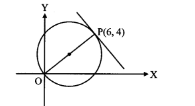
x(x – 6) + y(y – 4) = 0, which is in diameter form where (0, 0) and (6, 4) are endpoints of diameter.

Image

Slope of $O P=\frac{4-0}{6-0}=\frac{2}{3}$

Since, OP is perpendicular to the required tangent.

Slope of the required tangent $=\frac{-3}{2}$

the equation of the tangent at (6, 4) is

$\begin{aligned} & y-4=\frac{-3}{2}(x-6) \\ & \Rightarrow 2(y-4)=3(x-6) \\ & \Rightarrow 2 y-8=-3 x+18 \\ & \Rightarrow 3 x+2 y-26=0\end{aligned}$

View full question & answer
Question 52 Marks
Find the value of k, if the length of the tangent segment from the point (8, -3) to the circle

$x^2+y^2-2 x+k y-23=0$ is $\sqrt{ } 10$.

Answer
Given equation of the circle is $x^2+y^2-2 x+k y-23=0$

Here, $g=-1, f=\frac{\mathbf{k}}{2}, c=-23$

Length of the tangent segment to the circle $x^2+y^2+2 g x+2 f y+c=0$ from the point $\left(x_1\right.$,$\left.y_1\right)$ is $\sqrt{x_1^2+y_1^2+2 g x_1+2 f y_1+c}$

Length of the tangent segment from (8, -3) = √10

$\begin{aligned} & \Rightarrow \sqrt{8^2+(-3)^2-2(8)+k(-3)-23}=\sqrt{10} \\ & \Rightarrow 64+9-16-3 k-23=10 \ldots .[\text { Squaring both the sides] } \\ & \Rightarrow 34-3 k=10 \\ & \Rightarrow 3 k=24 \\ & \Rightarrow k=8\end{aligned}$

View full question & answer
Question 62 Marks
Find the equation of tangent to the circle $x^2+y^2=64$ at the point $P\left(\frac{2 \pi}{3}\right)$.
Answer
Given equation of circle is $x^2+y^2=64$

Comparina this equation with $x^2+y^2=r^2$ we aet $r=8$

The equation of a tangent to the circle $x^2+y^2=r^2$ at $P(\theta)$ is $x \cos \theta+y \sin \theta=r$

$\therefore$ the equation of the tangent at $P\left(\frac{2 \pi}{3}\right)$ is

$\begin{aligned} & \Rightarrow x \cos \frac{2 \pi}{3}+y \sin \frac{2 \pi}{3}=9 \\ & \Rightarrow x\left(\frac{-1}{2}\right)+y\left(\frac{\sqrt{3}}{2}\right)=8 \\ & \Rightarrow-x+\sqrt{3} y=16 \\ & \Rightarrow x-\sqrt{3} y+16=0\end{aligned}$

View full question & answer
Question 72 Marks
Find the centre and radius of the circle x = 3 – 4 sin θ, y = 2 – 4 cos θ.
Answer
Given, x = 3 – 4 sin θ, y = 2 – 4 cos θ

⇒ x – 3 = -4 sin θ, y – 2 = -4 cos θ

On squaring and adding, we get

$\begin{aligned} & \Rightarrow(x-3)^2+(y-2)^2=(-4 \sin \theta)^2+(-4 \cos \theta)^2 \\ & \Rightarrow(x-3)^2+(y-2)^2=16 \sin ^2 \theta+16 \cos ^2 \theta \\ & \Rightarrow(x-3)^2+(y-2)^2=16\left(\sin ^2 \theta+\cos ^2 \theta\right) \\ & \Rightarrow(x-3)^2+(y-2)^2=16(1) \\ & \Rightarrow(x-3)^2+(y-2)^2=16 \\ & \Rightarrow(x-3)^2+(y-2)^2=4^2\end{aligned}$

Comparing this equation with $(x-h)^2+(y-k)^2=r^2$, we get

h = 3, k = 2, r = 4

∴ Centre of the circle is (3, 2) and radius is 4.

View full question & answer
Question 82 Marks
Find the centre and radius of the circle $x^2+y^2-x+2 y-3=0$.
Answer
Given equation of the circle is $x^2+y^2-x+2 y-3=0$

Comparing this equation with $x^2+y^2+2 g x+2 f y+c=0$, we get

2g = -1, 2f = 2 and c = -3

$g=\frac{-1}{2}, f=1$ and $c=-3$

Centre of the circle $=(-g,-f)=\left(\frac{1}{2},-1\right)$

and radius of the circle

$\begin{aligned} & =\sqrt{g^2+\mathrm{f}^2-\mathrm{c}} \\ & =\sqrt{\left(-\frac{1}{2}\right)^2+(1)^2-(-3)}\end{aligned}$

$\begin{aligned} & =\sqrt{\frac{17}{4}} \\ & =\frac{\sqrt{17}}{2}\end{aligned}$

View full question & answer
Question 92 Marks
Find the equation of the tangent to the circle
$
x^2+y^2-4 x-6 y-12=0 \text { at }(-1,-1)
$
Answer
The equation of circle is
$
x^2+y^2-4 x-6 y-12=0
$
It is of the type $x^2+y^2+2 g x+2 f y+c=0$
$
\therefore g=-2, f=-3, c=-12
$
Let $\mathrm{P}(-1,-1)=\left(x_1, y_1\right)$
We know that the equation of a tangent to a circle
$
\begin{aligned}
& x^2+y^2+2 g x+2 f y+c=0 \text { at }\left(x_1, y_1\right) \text { is } \\
& x x_1+y y_1+g\left(x+x_1\right)+f\left(y+y_1\right)+c=0 \\
& x(-1)+y(-1)+2(x-1)-3(y-1)-12=0 \\
& -x-y-2 x+2-3 \mathrm{y}+3-12=0 \\
& 3 x+4 y+7=0
\end{aligned}
$
View full question & answer
Question 102 Marks
Find the parametric equation of the circle
$
x^2+y^2-6 x+4 y-3=0
$
Answer
We write the equation of the circle as
$
\begin{aligned}
& \left(x^2-6 x+9\right)+\left(y^2+4 y+4\right)=3+9+4 \\
& (x-3)^2+(y+2)^2=16 \\
& (x-3)^2+(y+2)^2=(4)^2
\end{aligned}
$
The parmetric equations are
$
x-3=4 \cos \theta \text { and } y+2=4 \sin \theta
$
that is, $x=3+4 \cos \theta$ and $y=-2+4 \sin \theta$
View full question & answer
Question 112 Marks
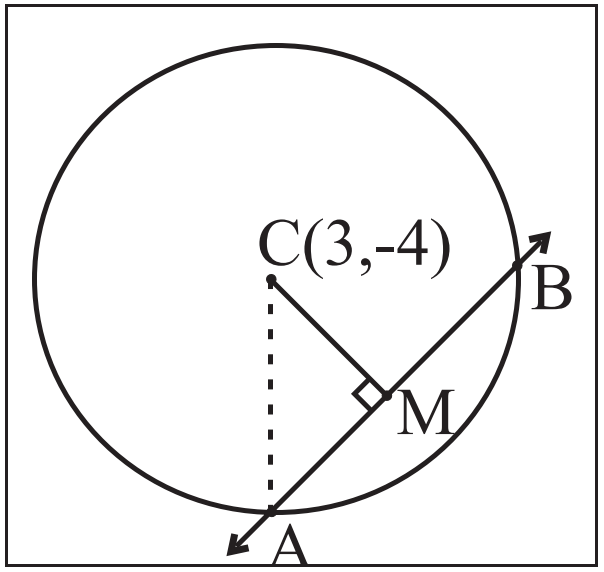
Find the equation of the circle whose centre is at $(3,-4)$ and the line $3 x-4 y-5=0$ cuts the circle at $A$ and $B$; where $l(A B)=6$.
Answer

Image

centre of the circle $\mathrm{C}(h, k)=\mathrm{C}(3,-4)$ $3 x-4 y-5=0$ cuts the circle at $\mathrm{A}$ and $\mathrm{B}$.
$
\begin{aligned}
& l(\mathrm{AB})=6 \\
& \mathrm{CM} \perp \mathrm{AB}
\end{aligned}
$
$\therefore \mathrm{AM}=\mathrm{BM}=3$
$\mathrm{CM}=$ Length of perpendicular from centre on the line
$
\begin{aligned}
& =\left|\frac{3(3)-4(-4)-5}{\sqrt{(3)^2+(-4)^2}}\right| \\
& =\left|\frac{9+16-5}{\sqrt{9+16}}\right| \\
& =\left|\frac{20}{5}\right|=4
\end{aligned}
$

View full question & answer
Question 122 Marks
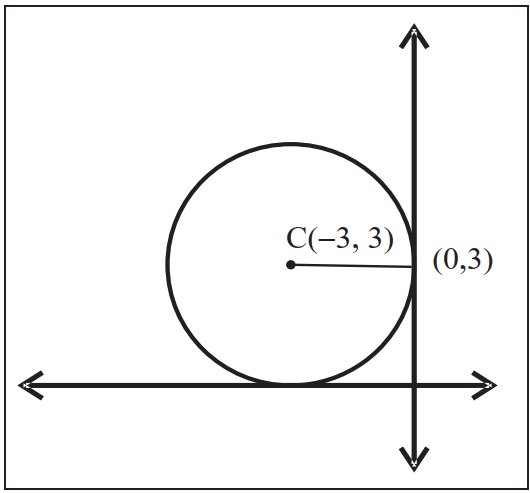
Find the equation of circle touching the $\mathrm{Y}$-axis at point $(0,3)$ and whose Centre is at $(-3,3)$.
Answer

Image

The circle touches the $\mathrm{Y}$-axis at point $(0,3)$, and the centre is $(-3,3)$ we get radius $r=3$
By using centre radius form;
$
\begin{aligned}
& (x-h)^2+(y-k)^2=r^2 \\
& (x+3)^2+(y-3)^2=9 \\
& x^2+6 x+9+y^2-6 y+9=9
\end{aligned}
$
$\therefore x^2+y^2+6 x-6 y+9=0$ is the equation of the circle.

View full question & answer
Question 132 Marks
Find the equation of the circle with $A(2,-3)$ and $B(-3,5)$ as end points of its diameter.
Answer
By using the diameter form;
$
\mathrm{A}(2,-3) \equiv\left(x_1, y_1\right) \text { and } \mathrm{B}(-3,5) \equiv\left(x_2, y_2\right) \text { are }
$
the co-ordinates of the end points of a diameter of the circle.
$\therefore$ by the diameter form, equation of the circle is
$
\begin{aligned}
& \left(x-x_1\right)\left(x-x_2\right)+\left(y-y_1\right)\left(y-y_2\right)=0 \\
& \therefore(x-2)(x+3)+(y+3)(y-5)=0 \\
& \therefore x^2+x-6+y^2-2 y-15=0 \\
& \therefore x^2+y^2+x-2 y-21=0
\end{aligned}
$
View full question & answer
Question 142 Marks
Find the equation of a circle whose centre is $(-3,1)$ and which pass through the point $(5,2)$.
Answer
Centre $\mathrm{C}=(-3,1)$,
Circle passes through the point $\mathrm{P}(5,2)$.
By distance formula,
$
\begin{aligned}
r^2=\mathrm{CP}^2 & =(5+3)^2+(2-1)^2 \\
& =8^2+1^2=64+1=65
\end{aligned}
$
$\therefore$ the equation of the circle is
$
\begin{aligned}
& (x+3)^2+(y-1)^2=65 \quad \text { (centre-radius form) } \\
& x^2+6 x+9+y^2-2 y+1=65 \\
& x^2+y^2+6 x-2 y+10-65=0 \\
& x^2+y^2+6 x-2 y-55=0
\end{aligned}
$
View full question & answer
Question 152 Marks
Write the parametric equations of the circles:
$(x-3)^2+(y+4)^2=25$
Answer
Given equation of the circle is
$(x-3)^2+(y+4)^2=25$
$\Rightarrow(x-3)^2+(y+4)^2=5^2$
Comparing this equation with $(x-h)^2+(y-k)^2=r^2$, we get
h = 3, k = -4 and r = 5
The parametric equations of the circle in terms of θ are
x = h + r cos θ and y = k + r sin θ
⇒ x = 3 + 5 cos θ and y = -4 + 5 sin θ
View full question & answer
Question 162 Marks
Write the parametric equations of the circles:
$x^2+y^2+2 x-4 y-4=0$
Answer
Given equation of the circle is
$x^2+y^2+2 x-4 y-4=0$
$\Rightarrow x^2+2 x+y^2-4 y-4=0$
$\Rightarrow x^2+2 x+1-1+y^2-4 y+4-4-4=0$
$\Rightarrow\left(x^2+2 x+1\right)+\left(y^2-4 y+4\right)-9=0$
$\Rightarrow(x+1)^2+(y-2)^2=9$
$\Rightarrow(x+1)^2+(y-2)^2=3^2$
Comparing this equation with $(x-h)^2+(y-k)^2=r^2$, we get
h = -1, k = 2 and r = 3
The parametric equations of the circle in terms of θ are
x = h + r cos θ and y = k + r sin θ
⇒ x = -1 + 3 cos θ and y = 2 + 3 sin θ
View full question & answer
Question 172 Marks
Write the parametric equations of the circles:
$x^2+y^2=9$
Answer
Given equation of the circle is
$x^2+y^2=9$
$\Rightarrow x^2+y^2=3^2$
Comparing this equation with $x^2+y^2=r^2$, we get $r=3$
The parametric equations of the circle in terms of θ are
x = r cos θ and y = r sin θ
⇒ x = 3 cos θ and y = 3 sin θ
View full question & answer
Question 182 Marks
Show that the equation $3 x^2+3 y^2+12 x+18 y-11=0$ represents a circle.
Answer
Given equation is $3 x^2+3 y^2+12 x+18 y-11=0$Dividing throughout by $3,$ we get
$x^2+y^2+4 x+6 y-\frac{11}{3}=0$
Comparing this equation with $x^2+y^2+2 g x+2 f y+c=0$, we get
$2 g=4,2 f=6, c=\frac{-11}{3}$
$\Rightarrow g=2, f=3, c=\frac{-11}{3}$
Now, $g^2+f^2-c=(2)^2+(3)^2-\left(\frac{-11}{3}\right)$
$=4+9+\frac{11}{3}$
$=\frac{50}{3}>0$
$\therefore$ The given equation represents a circle.
View full question & answer
Question 192 Marks
Find the centre and radius of each of the following circles:
$4 x^2+4 y^2-24 x-8 y-24=0$
Answer
Given equation of the circle is $4 x^2+4 y^2-24 x-8 y-24=0$
Dividing throughout by 4 , we get $x^2+y^2-6 x-2 y-6=0$
Comparing this equation with $x^2+y^2+2 g x+2 f y+c=0$, we get
2g = -6, 2f = -2 and c = -6
⇒ g = -3, f = -1 and c = -6
Centre of the circle = (-g, -f) = (3, 1)
and radius of the circle
$=\sqrt{\mathrm{g}^2+\mathrm{f}^2-\mathrm{c}}$
$=\sqrt{(-3)^2+(-1)^2-(-6)}$
$=\sqrt{9+1+6}$
$=\sqrt{16}=4$
View full question & answer
Question 202 Marks
Find the centre and radius of each of the following circles:
$x^2+y^2-6 x-8 y-24=0$
Answer
Given equation of the circle is $x^2+y^2-6 x-8 y-24=0$
Comparing this equation with $x^2+y^2+2 g x+2 f y+c=0$, we get
$2g = -6, 2f = -8$ and $c = -24$
$\Rightarrow g = -3, f = -4$ and $c = -24$
Centre of the circle $= (-g, -f) = (3, 4)$
and radius of the circle
$=\sqrt{g^2+f^2-c}$
$=\sqrt{(-3)^2+(-4)^2-(-24)}$
$=\sqrt{9+16+24}$
$=\sqrt{49}=7$
View full question & answer
Question 212 Marks
Find the centre and radius of each of the following circles:
$x^2+y^2-2 x+4 y-4=0$
Answer
Given equation of the circle is $x^2+y^2-2 x+4 y-4=0$
Comparing this equation with $x^2+y^2+2 g x+2 f y+c=0$, we get
$2g = -2, 2f = 4$ and $c = -4$
$\Rightarow g = -1, f = 2$ and $c = -4$
Centre of the circle = (-g, -f) = (1, -2)
and radius of the circle
$=\sqrt{\mathrm{g}^2+\mathrm{f}^2-\mathrm{c}}$
$=\sqrt{(-1)^2+(2)^2-(-4)}$
$=\sqrt{1+4+4}$
$=\sqrt{9}=3$
View full question & answer
Question 222 Marks
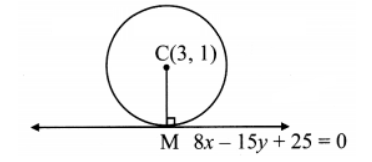
Find the equation of the circle with centre: at $(3, 1)$ and touching the line $8x – 15y + 25 = 0.$
Answer
Centre of the circle is $C (3, 1).$ Let the circle touch the line $8x – 15y + 25 = 0$ at point $M.$
Image
CM = radius (r)
CM = Length of perpendicular from centre $C(3, 1)$ on the line $8x – 15y + 25 = 0$
$=\left|\frac{8(3)-15(1)+25}{\sqrt{8^2+(-15)^2}}\right|$
$=\left|\frac{24-15+25}{\sqrt{64+225}}\right|$
$=\left|\frac{34}{\sqrt{289}}\right|$
$\mathrm{r}=\left|\frac{34}{17}\right|=2$
The equation of a circle with centre at $(h, k)$ and radius r is given by
$(x-h)^2+(y-k)^2=r^2$
Here, $h = 3, k = 1$ and $r = 2$
The required equation of the circle is
$\Rightarrow(x-3)^2+(y-1)^2=2^2$
$\Rightarrow x^2-6 x+9+y^2-2 y+1=4$
$\Rightarrow x^2+y^2-6 x-2 y+10-4=0$
$\Rightarrow x^2+y^2-6 x-2 y+6=0$
View full question & answer
Question 232 Marks
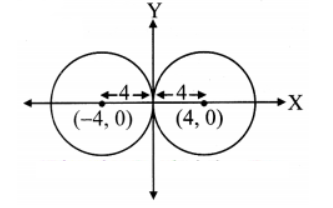
Find the equation of the circle with centre: on the X-axis and passing through the origin having radius $4.$
Answer
Let the co-ordinates of the centre of the required circle be $C (h, 0).$
Since the circle passes through the origin i.e., $O(0, 0)$
$OC =$ radius
$\Rightarrow \sqrt{(h-0)^2+(0-0)^2}=4$
$\Rightarrow \mathrm{h}^2=16$
$\Rightarrow \mathrm{h}= \pm 4$
Image
the co-ordinates of the centre are $(4, 0)$ or $(-4, 0).$
The equation of a circle with centre at $(h, k)$ and radius r is given by
$(x-h)^2+(y-k)^2=r^2$
Here, h = ± 4, k = 0, r = 4 The required equation of the circle is
$\Rightarrow(x-4)^2+(y-0)^2=4^2 \text { or }(x+4)^2+(y-0)^2=4^2$
$\Rightarrow x^2-8 x+16+y^2=16 \text { or } x^2+8 x+16+y^2=16$
$\Rightarrow x^2+y^2-8 x=0 \text { or } x^2+y^2+8 x=0$
View full question & answer
Question 242 Marks
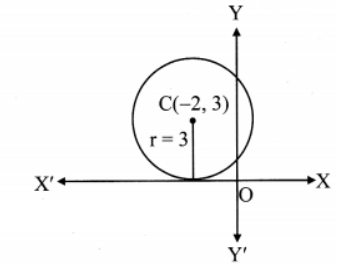
Find the equation of the circle with centre: at $(-2, 3)$ and touching the X-axis.
Answer
Since the circle is touching the X-axis, the radius of the circle is the Y co-ordinate of the centre.
Image
$\therefore r = 3$
The equation of a circle with centre at $(h, k)$ and radius $r$ is given by
$(x-h)^2+(y-k)^2=r^2$
Here, $h = -2, k = 3$
The required equation of the circle is
$\Rightarrow(x+2)^2+(y-3)^2=3^2$
$\Rightarrow x^2+4 x+4+y^2-6 y+9=9$
$\Rightarrow x^2+y^2+4 x-6 y+4=0$
View full question & answer
Question 252 Marks
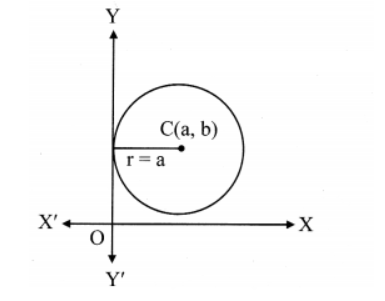
Find the equation of the circle with centre: at $(a, b)$ and touching the Y-axis.
Answer
Since the circle is touching the Y-axis, the radius of the circle is X-co-ordinate of the centre.Image
$\therefore r = a$
The equation of a circle with centre at $(h, k)$ and radius $r$ is given by
$(x-h)^2+(y-k)^2=r^2$
Here, $h = a, k = b$
The required equation of the circle is
$\Rightarrow(x-a)^2+(y-b)^2=a^2$
$\Rightarrow x^2-2 a x+a^2+y^2-2 b y+b^2=a^2$
$\Rightarrow x^2+y^2-2 a x-2 b y+b^2=0$
View full question & answer
Question 262 Marks
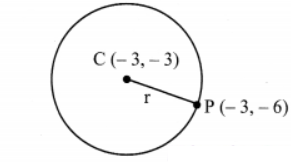
Find the equation of a circle with centre at $(-3, -3)$ passing through point $(-3, -6).$
Answer
Centre of the circle is $C (-3, -3)$ and it passes through the point $P (-3, -6).$
Image
By distance formula,
$ \operatorname{Radius}(\mathrm{r})=\mathrm{CP} =\sqrt{[-3-(-3)]^2+[-6-(-3)]^2}$
$=\sqrt{(-3+3)^2+(-6+3)^2}$
$ =\sqrt{0^2+(-3)^2}$
$ =\sqrt{9}=3$
The equation of a circle with centre at $(h, k)$ and radius ‘r’ is given by
$(x-h)^2+(y-k)^2=r^2$
$\text { Here, } h=-3, k=-3, r=3$
The required equation of the circle is
${[x-(-3)]^2+[y-(-3)]^2=3^2}$
$\Rightarrow(x+3)^2+(y+3)^2=9$
$\Rightarrow x^2+6 x+9+y^2+6 y+9-9=0$
$\Rightarrow x^2+y^2+6 x+6 y+9=0$
Check:
If the point $(-3,-6)$ satisfies $x^2+y^2+6 x+6 y+9=0$, then our answer is correct.
L.H.S. $=x^2+y^2+6 x+6 y+9$
$=(-3)^2+(-6)^2+6(-3)-6(-6)+9$
$= 9 + 36 – 18 – 36 + 9$
$= 0$
$= R.H.S.$
Thus, our answer is correct.
View full question & answer
Question 272 Marks
Find the equation of a circle with The equation of a circle with centre at $(h, k)$ and radius $‘r’$ is given by
Answer
$(x-h)^2+(y-k)^2=r^2$ Here, $h = 2, k = -3$ and $r = 5$
The required equation of the circle is
$(x-2)^2+[y-(-3)]^2=5^2$
$\Rightarrow(x-2)^2+(y+3)^2=25$
$\Rightarrow x^2-4 x+4+y^2+6 y+9-25=0$
$\Rightarrow x^2+y^2-4 x+6 y-12=0$
View full question & answer
Question 282 Marks
Find the equation of a circle with centre at $(-3, -2)$ and radius $6.$
Answer
The equation of a circle with centre at $(h, k)$ and radius $‘r’$ is given by
$(x-h)^2+(y-k)^2=r^2$
Here, $h = -3, k = -2$ and $r = 6$
$\therefore$ The required equation of the circle is
${[x-(-3)]^2+[y-(-2)]^2=6^2}$
$\Rightarrow(x+3)^2+(y+2)^2=36$
$\Rightarrow x^2+6 x+9+y^2+4 y+4-36=0$
$\Rightarrow x^2+y^2+6 x+4 y-23=0$
View full question & answer
Question 292 Marks
Find the equation of a circle with centre at origin and radius 4.
Answer
The equation of a circle with centre at origin and radius ‘r’ is given by

$x^2+y^2=r^2$

Here, r = 4

$\therefore$ The required equation of the circle is $\mathrm{x}^2+\mathrm{y}^2=4^2$ i.e., $\mathrm{x}^2+\mathrm{y}^2=16$.

View full question & answer
Solve the Following Question.(2 Marks) - Maths STD 11 Questions - Vidyadip