MCQ 11 Mark
If distance between lines $(x-2 y)^2+k(x-2 y)=0$ is 3 units, then $k=$
- A
- B
$\pm 5 \sqrt{5}$
- C
- ✓
$\pm 3 \sqrt{5}$
AnswerCorrect option: D. $\pm 3 \sqrt{5}$
$\pm 3 \sqrt{5}$$\left[\right.$ Hint: $(x-2 y)^2+k(x-2 y)=0$
$\therefore(x-2 y)(x-2 y+k)=0$
$\therefore$ equations of the lines are $x-2 y=0$ and $x-2 y+k=0$ which are parallel to each other.
$\begin{aligned} & \therefore\left|\frac{k-0}{\sqrt{1+4}}\right|=3 \\ & \therefore k= \pm 3 \sqrt{5}\end{aligned}$
View full question & answer→MCQ 21 Mark
If slope of one of the lines $a x^2+2 h x y+b y^2=0$ is 5 times the slope of the other, then $5 h^2=$________
View full question & answer→MCQ 31 Mark
If $h^2=a b$, then slope of lines $a x^2+2 h x y+b y^2=0$ are in the ratio _________
Answer 1 : 1 [Hint: If $h^2=a b$, then lines are coincident. Therefore slopes of the lines are equal.]
View full question & answer→MCQ 41 Mark
The combined equation of the co-ordinate axes is _________.
MCQ 51 Mark
The area of triangle formed by the lines $x^2+4 x y+y^2=0$ and $x-y-4=0$ is __________
- A
$\frac{4}{\sqrt{3}}$ Sq. units
- ✓
$\frac{8}{\sqrt{3}}$ Sq. units
- C
$\frac{16}{\sqrt{3}} \mathrm{Sq}$. units
- D
$\frac{15}{\sqrt{3}}$ Sq. units
AnswerCorrect option: B. $\frac{8}{\sqrt{3}}$ Sq. units
$\frac{8}{\sqrt{3}}$ Sq. units[Hint : Area $=\frac{p^2}{\sqrt{3}}$, where $p$ is the length of perpendicular from the origin to $x-y-4=0$ ]
View full question & answer→MCQ 61 Mark
If the equation $3 x^2-8 x y+q y^2+2 x+14 y+p=1$ represents a pair of perpendicular lines then the values of p and q are respectively _________.
View full question & answer→MCQ 71 Mark
If acute angle between lines $a x^2+2 h x y+b y^2=0$ is, $\frac{\pi}{4}$ then $4 h^2=$_________
- A
$a^2+4 a b+b^2$
- ✓
$a^2+6 a b+b^2$
- C
$(a+2 b)(a+3 b)$
- D
$(a-2 b)(2 a+b)$
AnswerCorrect option: B. $a^2+6 a b+b^2$
$a^2+6 a b+b^2$
View full question & answer→MCQ 81 Mark
The joint equation of the lines through the origin and perpendicular to the pair of lines$3 x^2+$ $4 x y-5 y^2=0$ is _______
- ✓
$5 x^2+4 x y-3 y^2=0$
- B
$3 x^2+4 x y-5 y^2=0$
- C
$3 x^2-4 x y+5 y^2=0$
- D
$5 x^2+4 x y+3 y^2=0$
AnswerCorrect option: A. $5 x^2+4 x y-3 y^2=0$
$5 x^2+4 x y-3 y^2=0$
View full question & answer→MCQ 91 Mark
If the slope of one of the two lines $\frac{x^2}{a}+\frac{2 x y}{h}+\frac{y^2}{h}=0$ is twice that of the other, then ab:h ${ }^2$$=\ldots$.
Answer 9 : 8 $\left[\right.$ Hint : $m_1+m_2=\frac{-2 b}{h}$ and $m_1 m_2=\frac{b}{a}$
where $m_1=2 m_2$
$\therefore 2 m_2+m_2=-\frac{2 b}{h}$ and $2 m_2 \times m_2=\frac{b}{a}$
$\therefore m_2=\frac{-2 b}{3 h}$ and $m_2^2=\frac{b}{2 a}$
$\therefore\left(\frac{-2 b}{3 h}\right)^2=\frac{b}{2 a} \quad \therefore \frac{4 b^2}{9 h^2}=\frac{b}{2 a}$
$\left.\therefore \frac{a b}{h^2}=\frac{9}{8}\right]$
View full question & answer→MCQ 101 Mark
If the two lines $a x^2+2 h x y+b y^2=0$ make angles $\alpha$ and $\beta$ with $X$-axis, then $\tan (\alpha+\beta)=$________
- A
$\frac{h}{a+b}$
- B
$\frac{h}{a-b}$
- C
$\frac{2 h}{a+b}$
- ✓
$\frac{2 h}{a-b}$
AnswerCorrect option: D. $\frac{2 h}{a-b}$
$\frac{2 h}{a-b}$$\left[\right.$ Hint : $m_1=\tan \alpha, m_2=\tan \beta$
$\therefore \tan (\alpha+\beta)=\frac{\tan \alpha+\tan \beta}{1-\tan \alpha \cdot \tan \beta}$
$\left.=\frac{m_1+m_2}{1-m_1 m_2}=\frac{(-2 h / b)}{1-(a / b)}=\frac{2 h}{a-b}\right]$
View full question & answer→MCQ 111 Mark
The difference between the slopes of the lines represented by $3 x^2-4 x y+y^2=0$ is_________
View full question & answer→MCQ 121 Mark
Auxiliary equation of $2 x^2+3 x y-9 y^2=0$ is________
- A
$2 m^2+3 m-9=0$
- B
$9 m^2-3 m-2=0$
- C
$2 m^2-3 m+9=0$
- ✓
$-9 m^2-3 m+2=0$
AnswerCorrect option: D. $-9 m^2-3 m+2=0$
$-9 m^2-3 m+2=0$
View full question & answer→MCQ 131 Mark
If the lines represented by $k x^2-3 x y+6 y^2=0$ are perpendicular to each other then________
View full question & answer→MCQ 141 Mark
If the equation $4 x^2+h x y+y^2=0$ represents two coincident lines, then $h=$__________
View full question & answer→MCQ 152 Marks
If the distance between the parallel lines given by the equation $x^2+4 x y+p y^2+3 x+q y-4=0$ is $\lambda$, then $\lambda^2=$
- A
- ✓
$\sqrt{5}$
- C
- D
$\frac{9}{5}$
AnswerCorrect option: B. $\sqrt{5}$
(b) $\sqrt{5}$
View full question & answer→MCQ 162 Marks
The centroid of the triangle formed by the lines $x+3 y=10$ and $6 x^2+x y-y^2=0$ is
- A
$\left(\frac{1}{3}, \frac{-7}{3}\right)$
- B
$\left(\frac{-1}{3}, \frac{-7}{3}\right)$
- ✓
$\left(\frac{-1}{3}, \frac{7}{3}\right)$
- D
$\left(\frac{1}{3}, \frac{7}{3}\right)$
AnswerCorrect option: C. $\left(\frac{-1}{3}, \frac{7}{3}\right)$
The equation of given lines are
$x+3 y=10...(i)$
and $6 x^2+x y-y^2=0$
Let us consider, $6 x^2+x y-y^2=0$
$\Rightarrow 6 x^2+3 x y-2 x y-y^2=0$
$\Rightarrow 3 x(2 x+y)-y(2 x+y)=0$
$\Rightarrow(3 x-y)(2 x+y)=0$
$\therefore $ The equation of other two lines are
$3 x-y=0 ...(ii)$
$2 x+y=0...(iii)$
Solving equation $(i)$ and $(ii),$ we get $x=1, y=3$
Similarly solving equation $(i)$ and $(iii),$ we get
$x=-2, y=4$
and solving equation $(ii)$ and $(iii),$ we get $x=0, y=0$
So, centroid of triangle having vertices $(1,3)(-2,4)$ and $(0,0)$ is
$=\left(\frac{1-2+0}{3}, \frac{3+4+0}{3}\right)$
$\text { i.e., }\left(\frac{-1}{3}, \frac{7}{3}\right)$
View full question & answer→MCQ 172 Marks
The perpendiculars are drawn to lines $L_1$ and $L_2$ from the origin making an angle $\frac{\pi}{4}$ and $\frac{3 \pi}{4}$ respectively with positive direction of $X$-axis. If both the lines are at unit distance from the origin, then their joint equation is
- A
$x^2-y^2+2 \sqrt{2} y+2=0$
- B
$x^2-y^2-2 \sqrt{2} y-2=0$
- ✓
$x^2-y^2+2 \sqrt{2} y-2=0$
- D
$x^2-y^2-2 \sqrt{2} y+2=0$
AnswerCorrect option: C. $x^2-y^2+2 \sqrt{2} y-2=0$
(c) : Equation of line $L_1$, which is at a unit distance from origin and have perpendicular from origin with an angle $\pi / 4$.
$
\begin{aligned}
& x \cos \frac{\pi}{4}+y \sin \frac{\pi}{4}=1 \\
\Rightarrow & x+y=\sqrt{2}...(i)
\end{aligned}
$
Similarly equation of line $L_2$ is
$
\begin{aligned}
& x \cos \frac{3 \pi}{4}+y \sin \frac{3 \pi}{4}=1 \\
\Rightarrow & -x+y=\sqrt{2}
..(ii)
\end{aligned}
$
$\therefore$ From (i) and (ii), joint equation of line is given by $(x+y-\sqrt{2}) \cdot(-x+y-\sqrt{2})=0$
$\Rightarrow-x^2+x y-x \sqrt{2}-x y+y^2-\sqrt{2} y+x \sqrt{2}-\sqrt{2} y+2=0$
$\Rightarrow-x^2+y^2-2 \sqrt{2} y+2=0$
$\Rightarrow x^2-y^2+2 \sqrt{2} y-2=0$
View full question & answer→MCQ 182 Marks
If the slopes of the lines $K x^2-4 x y+y^2=0$ differ by 2 , then $K=$
Answer(a) : Given, equation of lines is $K x^2-4 x y+y^2=0$ Let $m_1$ and $m_2$ be the slope of lines.
If $m_1$ and $m_2$ are slopes of two lines represented by $a x^2+2 h x y+b y^2=0$ then
$m_1+m_2=\frac{-2 h}{b}$ and $m_1 m_2=\frac{a}{b}$
$
\therefore m_1+m_2=\frac{4}{1}, m_1 m_2=\frac{K}{1}
$
Also, $m_1-m_2=2$
[Given]
Now, $\left(m_1-m_2\right)^2=\left(m_1+m_2\right)^2-4 m_1 m_2$
$
\begin{aligned}
& \Rightarrow(2)^2=(4)^2-4 K \\
& \Rightarrow 4 K=12 \Rightarrow K=3
\end{aligned}
$
View full question & answer→MCQ 192 Marks
If the lines $x^2-4 x y+y^2=0$ and $x+y=10$ contain the sides of an equilateral triangle, then the area of equilateral triangle is
- A
$\frac{5 \sqrt{2}}{\sqrt{3}}$ sq. units
- B
$\frac{25 \sqrt{2}}{\sqrt{3}}$ sq. units
- C
$\frac{50}{\sqrt{3}}$ sq. units
- D
$\frac{25}{\sqrt{3}}$ sq. units
View full question & answer→MCQ 202 Marks
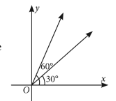
The joint equation of the lines passing through the origin and trisecting the first quadrant is
AnswerCorrect option: A. $\sqrt{3} x^2-4 x y+\sqrt{3} y^2=0$
(a): The lines trisecting the first quadrant have slopes $\sqrt{3}, \frac{1}{\sqrt{3}}$
The equation of line passing through origin and having slope $\sqrt{3}$ is;
$
\begin{aligned}
& y-0=\sqrt{3}(x-0) \\
& \Rightarrow \sqrt{3} x-y=0
\end{aligned}
$
The equation of line passing through origin and having slope $\frac{1}{\sqrt{3}}$ is;
$
\Rightarrow y-0=\frac{1}{\sqrt{3}}(x-0) \Rightarrow x-\sqrt{3} y=0
$
The joint equation of line is
$\Rightarrow(\sqrt{3} x-y)(x-\sqrt{3} y)=0$
$\Rightarrow \sqrt{3} x^2-4 x y+\sqrt{3} y^2=0$
View full question & answer→MCQ 212 Marks
If the sum of the slopes of the lines given by $x^2-2 c x y-11 y^2=0$ is six times their product, then $c$ has the value
Answer(c): We have, $x^2-2 c x y-11 y^2=0$
and $m_1+m_2=6 m_1 \times m_2$
$\therefore \quad m_1+m_2=\frac{2 c}{-11}$ and $m_1 \cdot m_2=\frac{1}{-11}$
Now, $\frac{m_1+m_2}{m_1 \cdot m_2}=\frac{\frac{2 c}{-11}}{\frac{1}{-11}} \Rightarrow \frac{m_1+m_2}{m_1 \cdot m_2}=2 c$
$\Rightarrow 6=2 c \Rightarrow c=3$
View full question & answer→MCQ 222 Marks
The equation $y^2-x^2+6 x-9=0$ represents
Answer(a) : $y^2=x^2-6 x+9$
$\Rightarrow y^2=(x-3)^2 \Rightarrow(y-x+3)(y+x-3)=0$
$\Rightarrow y-x+3=0$ and $y+x-3=0$
View full question & answer→MCQ 232 Marks
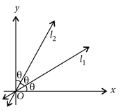
The joint equation of the lines passing through the origin and trisecting the first quadrant is
AnswerCorrect option: A. $\sqrt{3} x^2-4 x y+\sqrt{3} y^2=0$
(a) : Lines passing through origin and trisecting the first quadrant will make equal angles between each other and with the coordinate axes as shown in the figure.
$
\therefore \quad 3 \theta=90^{\circ} \Rightarrow \theta=30^{\circ}
$
$\therefore$ Slope of line $l_1=\tan 30^{\circ}=\frac{1}{\sqrt{3}}$
Slope of line $l_2=\tan 60^{\circ}=\sqrt{3}$
$\therefore l_1$ is $y=\frac{1}{\sqrt{3}} x, l_2$ is $y=\sqrt{3} x$
$\therefore$ Required joint equation is $\left(y-\frac{1}{\sqrt{3}} x\right)(y-\sqrt{3} x)=0$
$
\Rightarrow y^2-\sqrt{3} x y-\frac{x y}{\sqrt{3}}+x^2=0
$
$\begin{aligned} & \Rightarrow \sqrt{3} y^2-3 x y-x y+\sqrt{3} x^2=0 \\ & \Rightarrow \sqrt{3} x^2-4 x y+\sqrt{3} y^2=0\end{aligned}$
View full question & answer→MCQ 242 Marks
If lines represented by $\left(1+\sin ^2 \theta\right) x^2+2 h x y+2 \sin \theta$ $y^2=0, \theta \in[0,2 \pi]$ are perpendicular to each other then $\theta=$
- A
$\frac{\pi}{2}$
- B
$\pi$
- ✓
$\frac{3 \pi}{2}$
- D
$\frac{\pi}{6}$
AnswerCorrect option: C. $\frac{3 \pi}{2}$
(c) : The lines given by $\left(1+\sin ^2 \theta\right) x^2+2 h x y+$ $2 \sin \theta y^2=0$
are perpendicular if $\left(1+\sin ^2 \theta\right)+2 \sin \theta=0$
$\Rightarrow(\sin \theta+1)^2=0 \Rightarrow \sin \theta=-1$
$\Rightarrow \theta=\frac{3 \pi}{2} \quad[\because \theta \in[0,2 \pi]$
View full question & answer→MCQ 252 Marks
The joint equation of pair of straight lines passing through origin and having slopes $(1+\sqrt{2})$ and $\left(\frac{1}{1+\sqrt{2}}\right)$ is
AnswerCorrect option: A. $x^2-2 \sqrt{2} x y+y^2=0$
(a) : General equation of a line passing through origin having slope $m$ is given by $y=m x$.
$\therefore$ Equations of lines are
$
y=(1+\sqrt{2}) x, y=\frac{1}{1+\sqrt{2}} x
$
$\therefore$ Required joint equation is given by
$
\begin{aligned}
& {[y-(1+\sqrt{2}) x]\left[y-\frac{x}{1+\sqrt{2}}\right]=0 } \\
\Rightarrow & y^2-\frac{x y}{1+\sqrt{2}}-x y(1+\sqrt{2})+x^2=0 \\
\Rightarrow & y^2-x y\left(\frac{1}{1+\sqrt{2}}+1+\sqrt{2}\right)+x^2=0 \\
\Rightarrow & y^2-x y\left(\frac{\sqrt{2}-1}{2-1}+1+\sqrt{2}\right)+x^2=0 \\
\Rightarrow & x^2-2 \sqrt{2} x y+y^2=0
\end{aligned}
$
View full question & answer→MCQ 262 Marks
The point of intersection of lines represented by $x^2-y^2+x+3 y-2=0$ is
- A
$(1,0)$
- B
$(0,2)$
- ✓
$\left(-\frac{1}{2}, \frac{3}{2}\right)$
- D
$\left(\frac{1}{2}, \frac{1}{2}\right)$
AnswerCorrect option: C. $\left(-\frac{1}{2}, \frac{3}{2}\right)$
(c): We have, $x^2-y^2+x+3 y-2=0$
compare with $a x^2+b y^2+2 h x y+2 g x+2 f y+c=0$, we get $a=1, b=-1, g=\frac{1}{2}, f=\frac{3}{2}, c=-2, h=0$.
$\therefore$ Point of intersection is $\left(\frac{h f-b g}{a b-h^2}, \frac{h g-a f}{a b-h^2}\right)$.
$
=\left(\frac{0 \times \frac{3}{2}-(-1)\left(\frac{1}{2}\right)}{-1}, \frac{0\left(\frac{1}{2}\right)-(1)\left(\frac{3}{2}\right)}{-1}\right)=\left(-\frac{1}{2}, \frac{3}{2}\right) \text {. }
$
View full question & answer→MCQ 272 Marks
If the slope of one of the lines given by $a x^2+2 h x y+$ $b y^2=0$ is two times the other, then
- ✓
$8 h^2=9 a b$
- B
$8 h^2=9 a b^2$
- C
$8 h=9 a b$
- D
$8 h=9 a b^2$
AnswerCorrect option: A. $8 h^2=9 a b$
(a) : In pair of straight lines, $m_1+m_2=\frac{-2 h}{b}$ and $m_1 m_2=\frac{a}{b}$ where $m_1$ and $m_2$ are the slopes of the two lines represented by the equation $a x^2+2 h x y+b y^2=0$
Let $m_1=m$, then $m_2=2 m_1=2 m$
Now, $m+2 m=\frac{-2 h}{b} \Rightarrow 3 m=\frac{-2 h}{b} \Rightarrow m=\frac{-2 h}{3 b}$
Also $(m) \times(2 m)=\frac{a}{b} \Rightarrow 2 m^2=\frac{a}{b} \Rightarrow m^2=\frac{a}{2 b}$
From (1) and (2), we get
$
\left(\frac{-2 h}{3 b}\right)^2=\frac{a}{2 b} \Rightarrow \frac{4 h^2}{9 b^2}=\frac{a}{2 b} \Rightarrow 8 h^2=9 a b
$
View full question & answer→MCQ 282 Marks
The line $5 x+y-1=0$ coincides with one of the lines given by $5 x^2+x y-k x-2 y+2=0$, then the value of $k$ is
Answer(c) : We have, $5 x^2+x y-k x-2 y+2=0$
As $y^2$ is absent in given equation, let the equation of second line be $a x+c=0$.
$
\begin{aligned}
& \Rightarrow(5 x+y-1)(a x+c)=0 \\
& \Rightarrow 5 a x^2+5 c x+a x y+c y-a x-c=0
\end{aligned}
$
Given equation is $5 x^2+x y-k x-2 y+2=0$$\therefore \quad a=1, c=-2$ and $-k=5 c-a \Rightarrow k=11$ View full question & answer→MCQ 292 Marks
If slopes of lines represented by $K x^2+5 x y+y^2=0$ differ by 1 , then $K=$
Answer(c) : We have, $K x^2+5 x y+y^2=0$
$m_1+m_2=\frac{-2 h}{b}=-5, m_1 m_2=\frac{a}{b}=K, m_1-m_2=1$
Now, $\left(m_1-m_2\right)^2=\left(m_1+m_2\right)^2-4 m_1 m_2$
$\Rightarrow I =25-4 K \Rightarrow K=6$
View full question & answer→MCQ 302 Marks
If lines represented by equation $p x^2-q y^2=0$ are distinct, then
- ✓
$p q>0$
- B
$p q<0$
- C
$p q=0$
- D
$p+q=0$
AnswerCorrect option: A. $p q>0$
(a): We have, $p x^2-q y^2=0$
Here, $a=p, b=-q, h=0$
Lines will be real and distinct if $h^2-a b>0$
$\Rightarrow 0+p q>0 \Rightarrow p q>0$
View full question & answer→MCQ 312 Marks
$O(0,0), A(1,2), B(3,4)$ are the vertices of $\triangle O A B$. The joint equation of the altitude and median drawn from $O$ is
- A
$x^2+7 x y-y^2=0$
- B
$x^2+7 x y+y^2=0$
- C
$3 x^2-x y-2 y^2=0$
- ✓
$3 x^2+x y-2 y^2=0$
AnswerCorrect option: D. $3 x^2+x y-2 y^2=0$
(d) : Let $O P$ is the altitude and $O D$ is the median
$\therefore D$ is the mid-point of $A B$.
So, co-ordinates of $D$ are $\left(\frac{1+3}{2}, \frac{2+4}{2}\right)=(2,3)$.
Equation of median $O D$ is
$
y=\frac{3}{2} x \Rightarrow 3 x-2 y=0
$
Slope of $A B=\frac{2}{2}=1 \Rightarrow$ Slope of $O P=-1$
$\therefore$ Equation of $O P$ is $y=-x$
$\Rightarrow x+y=0$
$(1,2)$
$B$
Joint equation of $O P$ and $O D$ is $(x+y)(3 x-2 y)=0$
$\Rightarrow 3 x^2+x y-2 y^2=0$

View full question & answer→MCQ 322 Marks
Which of the following equation does not represent a pair of lines?
- A
$x^2-x=0$
- B
$x y-x=0$
- ✓
$y^2-x+1=0$
- D
$x y+x+y+1=0$
AnswerCorrect option: C. $y^2-x+1=0$
(c) : Given equation is $y^2-x+1=0$
Compare it with general equation
$
\begin{aligned}
& a x^2+2 h x y+b y^2+2 g x+2 f y+c=0 \\
& \Rightarrow a=0, h=0, b=1, g=-\frac{1}{2}, f=0, c=1
\end{aligned}
$
$
\begin{gathered}
\Rightarrow\left|\begin{array}{lll}
a & h & g \\
h & b & f \\
g & f & c
\end{array}\right|=\left|\begin{array}{ccc}
0 & 0 & -1 / 2 \\
0 & 1 & 0 \\
-1 / 2 & 0 & 1
\end{array}\right| \\
=\left(-\frac{1}{2}\right)\left[0+\frac{1}{2}\right]=-\frac{1}{4} \neq 0
\end{gathered}
$
$\therefore$ Option (c) doesn't represent a pair of lines.
View full question & answer→MCQ 332 Marks
The joint equation of bisectors of angles between lines $x=5$ and $y=3$ is
- A
$(x-5)(y-3)=0$
- ✓
$x^2-y^2-10 x+6 y+16=0$
- C
$x y=0$
- D
$x y-5 x-3 y+15=0$
AnswerCorrect option: B. $x^2-y^2-10 x+6 y+16=0$
(b) : We have, $x-5=0$ and $y-3=0$
Since, $\left|\frac{A_1 x+B_1 y+C_1}{\sqrt{A_1^2+B_1^2}}\right|=\left|\frac{A_2 x+B_2 y+C_2}{\sqrt{A_2^2+B_2^2}}\right|$
$
\begin{aligned}
& \Rightarrow \pm(x-5)=y-3 \\
& \Rightarrow y-3=x-5 \text { and } y-3=-(x-5) \\
& \Rightarrow y-x+2=0 \text { and } y+x-8=0
\end{aligned}
$
$\therefore$ Required joint equation is
$
\begin{aligned}
& (y-x+2)(y+x-8)=0 \\
\Rightarrow & y^2+x y-8 y-x y-x^2+8 x+2 y+2 x-16=0 \\
\Rightarrow & -x^2+y^2-6 y+10 x-16=0 \\
\Rightarrow & x^2-y^2-10 x+6 y+16=0
\end{aligned}
$
View full question & answer→MCQ 342 Marks
The joint equation of lines passing through the origin and trisecting the first quadrant is
MCQ 352 Marks
If $12 x^2+7 x y-p y^2-18 x+q y+6=0$ represents two straight lines at right angles to each other, then the values of $p, q$ are
- A
$-1,2$
- B
$1,-2$
- ✓
$1, \frac{-23}{2}$
- D
$-1, \frac{23}{2}$
AnswerCorrect option: C. $1, \frac{-23}{2}$
(C) Given equation of pair of lines is $12 x^2+7 x y-p y^2-18 x+q y+6=0$
$a=12, b=-p, c=6, f=\frac{q}{2}, g=-9, h=\frac{7}{2}$
The lines are be perpendicular
$\therefore \quad a+b=0$.
$\Rightarrow 12-p=0 \Rightarrow p=12$
Also, $abc +2 fgh - af ^2- bg ^2- ch ^2=0$
$\Rightarrow 12(-12) 6+2\left(\frac{ q }{2}\right)(-9)\left(\frac{7}{2}\right)-12\left(\frac{ q }{2}\right)^2$$-(-12)(-9)^2-6\left(\frac{7}{2}\right)^2=0$
$\Rightarrow-864-\frac{63 q}{2}-3 q^2+972-\frac{147}{2}=0$
$\Rightarrow 23-21 q-2 q^2=0$
$\Rightarrow(q-1)(2 q+23)=0 \Rightarrow q=1$ or $-\frac{23}{2}$
View full question & answer→MCQ 362 Marks
The line joining origin and point of intersection of curves $a x^2+2 h x y$$+ b y^2+$$2 g x=0$ and $a _1 x ^2+2 h_1 x y+ b _1 y^2+2 g_1 x=0$ will be mutually perpendicular if
- A
$a g+a_1 g_1=b g+b_1 g_1$
- B
$a+b=$$\operatorname{gg}_1\left(a_1+b_1\right)$
- ✓
$g\left(a_1+b_1\right)=$$g_1(a+b)$
- D
$g ( a + b )=$$=g_1\left(a_1+b_1\right)$
AnswerCorrect option: C. $g\left(a_1+b_1\right)=$$g_1(a+b)$
(C) Given, $a x^2+2 h x y+ b y^2=-2 g x$
$a _1 x^2+2 h_1 x y+ b _1 y^2=-2 g_1 x$
$\therefore \quad \frac{ a x^2+2 h x y+ b y^2}{ a _1 x^2+2 h_1 x y+ b _1 y^2}=\frac{ g }{ g _1}$
We have,
$\left( ag _1- a _1 g\right) x^2+2\left( hg _1- h _1 g\right) x y+\left( bg _1- b _1 g\right) y^2=0$
$\therefore \quad A=\left(ag_1-a_1 g\right), B=\left(bg_1-b_1 g\right)$
The lines are perpendicular
$\therefore \quad A+B=0$
$\begin{array}{l}\Rightarrow\left(a g_1-a_1 g\right)+\left(b g_1-b_1 g\right)=0 \\ \Rightarrow(a+b) g_1=\left(a_1+b_1\right) g\end{array}$
View full question & answer→MCQ 372 Marks
If $12 x ^2+7 xy + b y^2+ g x+7 y-1=0$ represents a pair of perpendicular lines then
- A
$b=12, g=1$
- B
$b=-12, g=1$
- ✓
$b =-12, g=-1$
- D
$b=-12, g=-\frac{1}{2}$
AnswerCorrect option: C. $b =-12, g=-1$
(C) Given equation of pair of lines is $12 x^2+7 x y+ b y^2+ g x+7 y-1=0$
$\therefore \quad A =12, B= b , C =-1, F=\frac{7}{2}, G =\frac{ g }{2}, H =\frac{7}{2}$
The lines are perpendicular
$\therefore \quad A+B=0 \Rightarrow 12+b=0 \Rightarrow b=-12$
Also, $ABC +2 FGH - AF ^2- BG ^2- CH ^2=0$
$\Rightarrow(12)(-12)(-1)+2\left(\frac{7}{2}\right)\left(\frac{ g }{2}\right)\left(\frac{7}{2}\right)$$-(12)\left(\frac{7}{2}\right)^2-(-12)\left(\frac{ g }{2}\right)^2-(-1)\left(\frac{7}{2}\right)^2=0$
$\Rightarrow 12 g^2+49 g+37=0$
$\Rightarrow( g +1)(12 g+37)=0$
$\Rightarrow g =-1$ or $-\frac{37}{12}$
View full question & answer→MCQ 382 Marks
The equation $2 x^2-4 x y- p y^2+4 x+ q y+1=0$ will represent two mutually perpendicular straight lines, if
- A
$p=1$ and $q=2$ or 6
- B
$p=2$ and $q=0$ or 6
- ✓
$p =2$ and $q =0$ or 8
- D
$p=-2$ and $q=-2$ or 8
AnswerCorrect option: C. $p =2$ and $q =0$ or 8
(C) Given equation of pair of lines is $2 x^2-4 x y- p y^2+4 x+ q y+1=0$
$a =2, b=- p , c =1, f =\frac{ q }{2}, g=2, h=-2$
The lines are perpendicular,
$\therefore \quad a+b=0$
$\Rightarrow 2-p=0 \Rightarrow p=2$
The equations represents pair of lines
$\therefore \quad 2(-2)(1)+2\left(\frac{q}{2}\right)(2)(2)-2\left(\frac{q}{2}\right)^2$ $+2(2)^2-1(2)^2=0$
$\Rightarrow q^2-8 q=0 \Rightarrow q=0$ or 8
View full question & answer→MCQ 392 Marks
The equation $\left(x^2+y^2\right)\left( h ^2+ k ^2- a ^2\right)=( hx + ky )^2$ represents a pair of perpendicular lines if
- ✓
$h^2+k^2=2 a^2$
- B
$(h+k)(h-k)=2 a^2$
- C
$h ^2+ k ^2= a ^2$
- D
$h^2+k^2=0$
AnswerCorrect option: A. $h^2+k^2=2 a^2$
(A) $\left(x^2+y^2\right)\left( h ^2+ k ^2- a ^2\right)=( h x+ k y)^2$
$\Rightarrow x^2\left(h^2+ k ^2- a ^2\right)+y^2\left(h^2+ k ^2- a ^2\right)$
$= h ^2 x^2+ k ^2 y^2+2 hk x y$
$\Rightarrow x^2\left( k ^2- a ^2\right)+y^2\left(h^2- a ^2\right)-2 hk x y=0$
$\therefore \quad A = k ^2- a ^2, B= h ^2- a ^2$
The lines are perpendicular
$\therefore \quad A+B=0$
$\Rightarrow k ^2- a ^2+ h ^2- a ^2=0 \Rightarrow h^2+ k ^2=2 a ^2$
View full question & answer→MCQ 402 Marks
$x^2+ k _1 y^2+2 k _2 y= a ^2$ represents of pair of perpendicular straight lines if
- A
$k _1=1, k _2= a$
- B
$k_1=1, k_2=-a$
- ✓
$k _1=-1, k _2= \pm a$
- D
$k_1=1, k_2= \pm a$
AnswerCorrect option: C. $k _1=-1, k _2= \pm a$
(C) Given equation of pair of lines is $x^2+ k _1 y^2+2 k _2 y= a ^2$
$a=1, b=k_1, c=-a^2, f=k_2, g=0, h=0$
The lines are perpendicular
$\therefore a + b =0 \Rightarrow k _1=-1$
Substituting value of $k_1$ in the given equation of lines, we get
$x^2-y^2+2 k _2 y- a ^2=0$
$\Rightarrow a^2-k_2^2=0 \Rightarrow k_2= \pm a$
View full question & answer→MCQ 412 Marks
The equation $a x^2+2 h x y+b y^2+2 g x+2 f y+c=0$ represents a pair of parallel straight lines if
- A
$a g^2=b f^2$
- B
$a^2 g=b^2 f$
- ✓
$bg ^2= af ^2$
- D
$b^2 f=a^2 f$
AnswerCorrect option: C. $bg ^2= af ^2$
(C) Given equation of pair of lines is $a x^2+2 h x y+b y^2+2 g x+2 f y+c=0$
$\therefore \quad A=a, B=b, H=h$
The lines are parallel
$\therefore \quad H ^2= AB$
$\Rightarrow h =\sqrt{ ab }$
Now $ABC +2 FGH - AF ^2- BG ^2- CH ^2=0$
$\Rightarrow a b c+2 f g \sqrt{ } a b-a f^2-b g^2-a b c=0$
$\Rightarrow(\sqrt{a} f-\sqrt{b} g)^2=0 \Rightarrow a f^2=b g^2$
View full question & answer→MCQ 422 Marks
Lines represented by $9 x^2+y^2+6 x y-4=0$ are
- A
- ✓
parallel but not coincident.
- C
- D
AnswerCorrect option: B. parallel but not coincident.
(B) Given equation of pair of lines is $9 x^2+y^2+6 x y-4=0$
$\therefore \quad a=9, b=1, h=3$
$h^2-a b=3^2-9(1)=0$
$\therefore \quad$ The lines are parallel
Now, $9 x^2+6 x y+y^2=4$
$\Rightarrow(3 x+y)^2=4 \Rightarrow 3 x+y= \pm 2$
Hence, the lines are parallel and not coincident.
View full question & answer→MCQ 432 Marks
The straight lines joining the origin to the points of intersection of the line $2 x+y=1$ and curve $3 x^2+4 x y-4 x+1=0$ include an angle
- ✓
$\frac{\pi}{2}$
- B
$\frac{\pi}{3}$
- C
$\frac{\pi}{4}$
- D
$\frac{\pi}{6}$
AnswerCorrect option: A. $\frac{\pi}{2}$
(A) The joint equation of the pair of straight lines joining the origin to the points of intersection of the line $l x+ m y+ n =0$ and
$a x^2+2 h x y+ b y^2+2 g x+2 f y+ c =0$ is
$a x^2+2 h x y+ b y^2+2 g\left(\frac{l x+ m y}{- n }\right) x$ $+2 f \left(\frac{l x+ m y}{- n }\right) y+ c \left(\frac{l x+ m y}{- n }\right)^2=0$
Here, $l=2, m=1, n =-1$ and $a =3, b=0, c =1, f =0, g=-2, h=2$
$\therefore \quad 3 x^2+4 x y-4 x(2 x+y)+(2 x+y)^2=0$
$\Rightarrow 3 x^2+4 x y-8 x^2-4 x y+4 x^2+y^2+4 x y=0$
$\Rightarrow x^2-4 x y-y^2-0$
$\therefore \quad A=1, B=-1, H=-2$
$\therefore \tan \theta=\frac{2 \sqrt{4+1}}{0}=\infty$
$\Rightarrow \theta=\frac{\pi}{2}$
View full question & answer→MCQ 442 Marks
If the angle between the two lines given by $a x^2+2 h x y+b y^2+2 g x+2 f y+c=0$ is $\frac{\pi}{4}$, then the constants $a , b , h , g , f , c$ are related by
AnswerCorrect option: D. $a^2+6 a b+b^2=4 h^2$
(D) Given equation of pair of lines is $a x^2+2 h x y+b y^2+2 g x+2 f y+c=0$
$0=\frac{\pi}{4} \Rightarrow \tan 0=1$
$\therefore \quad 1=\left|\frac{2 \sqrt{h^2-a b}}{a+b}\right|$
$\begin{array}{l}\Rightarrow 4\left(h^2-a b\right)=(a+b)^2 \\ \Rightarrow 4 h^2-4 a b=a^2+2 a b+b^2 \\ \Rightarrow a^2+6 a b+b^2=4 h^2\end{array}$
View full question & answer→MCQ 452 Marks
Let L be the line joining the origin to the point of intersection of the lines represented by $2 x^2-3 x y-2 y^2$$+10 x+5 y=0$. If L is perpendicular to the line $k x+y+3=0$ then $k=$
- A
$\frac{1}{2}$
- ✓
$\frac{-1}{2}$
- C
$-1$
- D
$\frac{1}{3}$
AnswerCorrect option: B. $\frac{-1}{2}$
(B) Given equation of pair of lines is $2 x^2-3 x y-2 y^2+10 x+5 y=0$
$\therefore \quad a=2, b=-2, c=0, f=\frac{5}{2}, g=5, h=\frac{-3}{2}$
∴ Point of intersection of the lines is $\left(\frac{ hf - bg }{ ab - h ^2}, \frac{ gh - af }{ ab - h ^2}\right) \equiv(-1,2)$
Slope of line joining origin and $(-1,2) m =-2$
Slope of $kx + y + 3=0$ is -k
Now, $(-k)(-2)=-1 \Rightarrow k=\frac{-1}{2}$
View full question & answer→MCQ 462 Marks
The angle between the pair of lines is $2 x^2+5 x y+2 y^2$$+3 x+3 y+1=0$ is
AnswerCorrect option: A. $\cos ^{-1}\left(\frac{4}{5}\right)$
(A) Given equation of pair of lines is $2 x^2+5 x y+2 y^2+3 x+3 y+1=0$
$a =2, b=2, c =1, f =\frac{3}{2}, g=\frac{3}{2}, h=\frac{5}{2}$
$\therefore \quad \tan \theta=\left|\frac{2 \sqrt{h^2-a b}}{a+b}\right|=\left|\frac{2 \sqrt{\left(\frac{25}{4}\right)-4}}{2+2}\right|=\frac{3}{4}$
$\therefore \quad \cos \theta=\frac{4}{5} \Rightarrow \theta=\cos ^{-1}\left(\frac{4}{5}\right)$
View full question & answer→MCQ 472 Marks
The acute angle formed between the lines joining the origin to the points of intersection of the curve $x^2+y^2-2 x-1=0$ and the line $x+y=1$ is
AnswerCorrect option: B. $\tan ^{-1} 2$
(B) Given equation of pair of lines is
$x^2+y^2-2 x-1=0$ ...(i)
$x+y=1$ intersects the above pair of lines
$\therefore$ It satisfies equation (i)
$\therefore \quad x^2+y^2-2 x(x+y)-(x+y)^2=0$
$\Rightarrow 2 x^2+4 x y=0 \Rightarrow x^2+2 x y=0$
$\therefore \quad a=1, b=0, h=1$
$\therefore \tan \theta=\frac{2 \sqrt{1^2-0}}{1}$
$\Rightarrow \theta=\tan ^{-1}(2)$
View full question & answer→MCQ 482 Marks
If the angle between the two lines represented by $2 x^2+5 x y+3 y^2+6 x+7 y+4=0$ is $\tan ^{-1} m$, then $m =$
- ✓
$\frac{1}{5}$
- B
- C
$\frac{7}{5}$
- D
AnswerCorrect option: A. $\frac{1}{5}$
(A) Given equation of pair of lines is $2 x^2+5 x y+3 y^2+6 x+7 y+4=0$
$a =2, b=3, h=\frac{5}{2}$
$\theta=\tan ^{-1} m \Rightarrow \tan \theta= m$
$\tan \theta=\left|\frac{2 \sqrt{\frac{25}{4}-6}}{2+3}\right| \Rightarrow m =\frac{1}{5}$
View full question & answer→MCQ 492 Marks
If $2 x^2-10 x y+2 \lambda y^2+5 x-16 y-3=0$ represents a pair of straight lines, then point of intersection of those lines is
- A
$(2,-3)$
- B
$(5,-16)$
- ✓
$\left(-10, \frac{-7}{2}\right)$
- D
$\left(-10, \frac{-3}{2}\right)$
AnswerCorrect option: C. $\left(-10, \frac{-7}{2}\right)$
(C) Given equation of pair of lines is $2 x^2-10 x y+2 \lambda y^2+5 x-16 y-3=0$
$\therefore \quad a =2, b=2 \lambda, c =-3, f =-8, g=\frac{5}{2}, h=-5$
Since the equation represents pair of lines,
$\therefore \quad a b c+2 f g h-a f^2-b g^2-c h^2=0$
$\Rightarrow 2(2 \lambda)(-3)+2(-8)\left(\frac{5}{2}\right)(-5)-2(64)$$-2 \lambda\left(\frac{25}{4}\right)+3(25)=0$
$\Rightarrow \frac{49 \lambda}{2}=147 \Rightarrow \lambda=6$
∴ Point of intersection of the lines is $\left(\frac{h f-b g}{a b-h^2}, \frac{g h-a f}{a b-h^2}\right)$
$\equiv\left(\frac{(-5)(-8)-2(6)\left(\frac{5}{2}\right)}{2(12)-(-5)^2}, \frac{\frac{5}{2}(-5)-2(-8)}{2(12)-(-5)^2}\right)$
$\equiv\left(-10, \frac{-7}{2}\right)$
View full question & answer→MCQ 502 Marks
Equation $3 x^2+7 x y+2 y^2+5 x+5 y+2=0$ represents
Answer(A) Given equation of pair of lines is $3 x^2+7 x y+2 y^2+5 x+5 y+2=0$
$a =3, b=2, c =2, f =\frac{5}{2}, g=\frac{5}{2}, h=\frac{7}{2}$
Consider $abc +2 fgh - af ^2- bg ^2- ch ^2$
$=(3)(2)(2)+2\left(\frac{5}{2}\right)\left(\frac{5}{2}\right)\left(\frac{7}{2}\right)$$-3\left(\frac{5}{2}\right)^2-2\left(\frac{5}{2}\right)^2-2\left(\frac{7}{2}\right)^2=0$
∴ The given equation represents a pair of straight lines.
View full question & answer→MCQ 512 Marks
If the equation $h x y+ g x+ fy + c =0$ represents a pair of straight lines, then
- A
$fh = cg$
- ✓
$fg = ch$
- C
$h^2=g f$
- D
$fgh = c$
AnswerCorrect option: B. $fg = ch$
(B) Given equation of pair of lines is $h x y+g x+f y+c=0$
$A = B =0, C = c , F =\frac{ f }{2}, G =\frac{ g }{2}, H =\frac{ h }{2}$
Now, $ABC +2 FGH - AF ^2- BG ^2- CH ^2=0$
$\Rightarrow 0+2\left(\frac{ f }{2}\right)\left(\frac{ g }{2}\right)\left(\frac{ h }{2}\right)-0-0- c \left(\frac{ h }{2}\right)^2=0$
$\Rightarrow \frac{ fgh }{4}-\frac{ ch ^2}{4}=0$
$\Rightarrow fg = ch$
View full question & answer→MCQ 522 Marks
If the equation $a x^2+b y^2+c x+c y=0$ represents a pair of straight lines, then
- A
$a(b+c)=0$
- B
$b(c+a)=0$
- ✓
$c(a+b)=0$
- D
$a+b+c=0$
AnswerCorrect option: C. $c(a+b)=0$
(C) Given equation of pair of lines is $a x^2+b y^2+c x+c y=0$
$\therefore \quad A = a , B = b , C =0, F=\frac{ c }{2}, G =\frac{ c }{2}, H =0$
Now $ABC +2 FGH - AF ^2- BG ^2- CH ^2=0$
$\Rightarrow ab (0)+2\left(\frac{ c }{2}\right)\left(\frac{ c }{2}\right)(0)- a \left(\frac{ c }{2}\right)^2$$- b \left(\frac{ c }{2}\right)^2-0(0)^2=0$
$\begin{array}{l}\Rightarrow ac ^2+ bc ^2=0 \\ \Rightarrow c ^2( a + b )=0 \\ \Rightarrow c ( a + b )=0\end{array}$
View full question & answer→MCQ 532 Marks
The equation $x^2+k x y+y^2-5 x-7 y+6=0$ represents a pair of straight lines, then k is
- A
$\frac{5}{3}$
- ✓
$\frac{10}{3}$
- C
$\frac{3}{2}$
- D
$\frac{3}{10}$
AnswerCorrect option: B. $\frac{10}{3}$
(B) Given equation of pair of lines is $x^2+k x y+y^2-5 x-7 y+6=0$
$\therefore \quad a=1, b=1, c=6, f=\frac{-7}{2}, g=\frac{-5}{2}, h=\frac{k}{2}$
Now, $abc +2 fgh - af ^2- bg ^2- ch ^2=0$
$\Rightarrow(1)(1)(6)+2\left(\frac{-7}{2}\right)\left(\frac{-5}{2}\right)\left(\frac{ k }{2}\right)-1\left(-\frac{7}{2}\right)^2$$-1\left(\frac{-5}{2}\right)^2-6\left(\frac{k}{2}\right)^2=0$
$\Rightarrow 6+\frac{35 k }{4}-\frac{49}{4}-\frac{25}{4}-\frac{6 k ^2}{4}=0$
$\begin{array}{l}\Rightarrow-6 k ^2+35 k -50=0 \\ \Rightarrow(2 k -5)(3 k -10)=0\end{array}$
$\Rightarrow k =\frac{5}{2}$ or $k =\frac{10}{3}$
View full question & answer→MCQ 542 Marks
The nature of straight lines represented by the equation $4 x^2+12 x y+9 y^2=0$ is
Answer(A) Given equation of pair of lines is $4 x^2+12 x y+9 y^2=0$
$a=4, h=6, b=9$
Here,
$h^2-a b=(6)^2-(4)(9)=36-36=0$
Hence, the lines are real and coincident.
View full question & answer→MCQ 552 Marks
The angle between the lines given by the equation $a y^2+\left(-1-\lambda^2\right) x y-a x^2=0$ is same as the angle between the lines
- A
$5 x^2+2 x y-3 y^2=0$
- B
$5 x^2+16 x y+5 y^2=0$
- ✓
$x y=0$
- D
$x^2-2 x y-3 y^2=0$
AnswerCorrect option: C. $x y=0$
(C) Given equation of pair of lines is $a y^2+\left(-1-\lambda^2\right) x y-a x^2=0$
$\therefore \quad A=-a, H=\frac{-1-\lambda^2}{2}, B=a$
$A+B=(-a)+a=0$
⇒ Angle between the given lines is $90^{\circ}$. Now, consider $x y=0$. Here, $A = B =0$
$\Rightarrow A+B=0$
$\therefore \quad$ The angle between the lines is $90^{\circ}$
$\therefore \quad$ Correct option is (C).
View full question & answer→MCQ 562 Marks
The pair of lines represented by $3 ax ^2+5 x y+\left( a ^2-2\right) y^2=0$ are perpendicular to each other for
Answer(A) Given equation of pair of lines is $3 a x^2+5 x y+\left(a^2-2\right) y^2=0$
$\therefore \quad A =3 a , H =\frac{5}{2}, B= a ^2-2$
Since the lines are perpendicular
$\therefore \quad A+B=0$
$\begin{array}{l}\Rightarrow 3 a+\left(a^2-2\right)=0 \\ \Rightarrow a^2+3 a-2=0\end{array}$
Since, the equation is a quadratic equation in ' a ' and $B ^2-4 AC >0$,
The roots of ' a ' are real and distinct.
∴ Lines are perpendicular to each other for two values of ' $a$ '.
View full question & answer→MCQ 572 Marks
If the lines $(p-q) x^2+2(p+q) x y+(q-p) y^2=0$ are mutually perpendicular, then
AnswerCorrect option: D. $p$ and q may have any value
(D) Given equation of pair of lines is
$( p - q ) x^2+2( p + q ) x y+( q - p ) y^2=0$
$\therefore \quad a=p-q, h=p+q, b=q-p$
Since, the lines are mutually perpendicular
$\therefore \quad a+b=0$
$\Rightarrow(p-q)+(q-p)=0$
The above equation is true for all values of $p$ and q .
View full question & answer→MCQ 582 Marks
The lines $a ^2 x^2+ bc y^2= a ( b + c ) x y$ will be coincident, if
- ✓
$a=0$ or $b=c$
- B
$a=b$ or $a=c$
- C
$c=0$ or $a=b$
- D
$a = b + c$
AnswerCorrect option: A. $a=0$ or $b=c$
(A) Given equation of pair of lines is $a ^2 x^2+ bc y^2= a ( b + c ) x y$
$\therefore \quad A = a ^2, H =\frac{- a ( b + c )}{2}, B= bc$
Since the lines are coincident
$\therefore \quad H^2-A B=0$
$\Rightarrow\left\{\frac{- a ( b + c )}{2}\right\}^2- a ^2( bc )=0$
$\begin{array}{l}\Rightarrow a^2(b-c)^2=0 \\ \Rightarrow a=0 \text { or } b=c\end{array}$
View full question & answer→MCQ 592 Marks
If the acute angles between the pair of lines $3 x^2-7 x y+4 y^2=0$ and $6 x^2-5 x y+y^2=0$ are $\theta_1$ and $\theta_2$ respectively, then
AnswerCorrect option: A. $\theta_1=\theta_2$
(A) Comparing the given equations with $a x^2+2 h x y+ b y^2=0$, we get,
$a _1=3, h_1=\frac{-7}{2}, b_1=4$
$a _2=6, h_2=\frac{-5}{2}, b_2=1$
If $\theta_1$ and $\theta_2$ are acute angles between the two pairs of lines, then
$\tan \theta_1=\left(\frac{2 \sqrt{\frac{49}{4}-12}}{3+4}\right)=\frac{1}{7}$
$\Rightarrow \theta_1=\tan ^{-1}\left(\frac{1}{7}\right)$
$\tan \theta_2=\left(\frac{2 \sqrt{\frac{25}{4}-6}}{6+1}\right)=\left(\frac{1}{7}\right)$
$\Rightarrow \theta_2=\tan ^{-1}\left(\frac{1}{7}\right)$
Hence, $\theta_1=\theta_2$.
View full question & answer→MCQ 602 Marks
If acute angle between lines $a x^2+2 h x y+b y^2=0$ is congruent to that lines $2 x^2-5 x y+3 y^2=0$, and $k \left( h ^2- ab \right)=( a + b )^2$, then $k =$
- A
$-(10)^2$
- ✓
$(-10)^2$
- C
$-10$
- D
AnswerCorrect option: B. $(-10)^2$
(B) Here, $a _1= a , h _1= h , b _1= b$,
$a _2=2, h_2=\frac{-5}{2}, b_2=3$
Given that $\theta_1=\theta_2$
$\Rightarrow \tan \theta_1=\tan \theta_2$
$\Rightarrow\left|\frac{2 \sqrt{h^2-a b}}{a+b}\right|=\left|\frac{2 \sqrt{\frac{25}{4}-6}}{5}\right|$
$\Rightarrow\left|\frac{2 \sqrt{h^2-a b}}{a+b}\right|=\left|\frac{1}{5}\right|$
Squaring both sides, we get
$\begin{array}{l}4 \times 25\left(h^2-a b\right)=(a+b)^2 \\ 100\left(h^2-a b\right)=(a+b)^2\end{array}$
Comparing with given condition,
$\begin{array}{l} k \left( h ^2- ab \right)=( a + b )^2, \text { we get } \\ k =100\end{array}$
View full question & answer→MCQ 612 Marks
If the angle between the lines represented by the equation $y^2+k x y-x^2 \tan ^2 A=0$ be 2 A , then $k =$
Answer(A) Given equation of pair of lines is
$\therefore a =-\tan ^2 A, h =\frac{ k }{2}, b=1$
$\therefore \quad \tan 2 A=\left|\frac{2 \sqrt{h^2-a b}}{a+b}\right|$
$\tan 2 A=\frac{2 \sqrt{\frac{ k ^2}{4}+\tan ^2 A}}{1-\tan ^2 A}$
$\Rightarrow \frac{2 \tan A}{1-\tan ^2 A}=\frac{2 \sqrt{\frac{ k ^2}{4}+\tan ^2 A}}{1-\tan ^2 A}$
$\Rightarrow \frac{ k ^2}{4}+\tan ^2 A=\tan ^2 A \Rightarrow k =0$
View full question & answer→MCQ 622 Marks
The angle between the lines represented by the equation $a x^2+x y+b y^2=0$ will be $45^{\circ}$, if
- A
$a=1, b=6$
- ✓
$a=1, b=-6$
- C
$a=6, b=1$
- D
$a=1, b=1$
AnswerCorrect option: B. $a=1, b=-6$
(B) Given equation of pair of lines is $a x^2+x y+ b y^2=0$
$\therefore \quad A = a , H =\frac{1}{2}, B= b$
Now, $\theta=45^{\circ} \Rightarrow \tan \theta=1$
$\therefore \quad \tan 45^{\circ}=\left|\frac{2 \sqrt{\frac{1}{4}- ab }}{ a + b }\right|$
$\begin{array}{l}\Rightarrow(a+b)^2=(1-4 a b) \\ \Rightarrow a^2+b^2+6 a b-1=0\end{array}$
The above equation is satisfied by $a =1$ and $b =-6$
View full question & answer→MCQ 632 Marks
The angle between the lines represented by the equation $\left(x^2+y^2\right) \sin \theta+2 x y=0$ is
AnswerCorrect option: C. $\frac{\pi}{2}-\theta$
(C) Given equation of pair of lines is $\left(x^2+y^2\right) \sin \theta+2 x y=0$
$\therefore \quad a=b=\sin \theta, h=1$
$\therefore \quad \tan \theta=\left(\frac{2 \sqrt{1-\sin ^2 \theta}}{2 \sin \theta}\right)$
$\Rightarrow \theta=\tan ^{-1}\left(\frac{\cos \theta}{\sin \theta}\right)=\tan ^{-1}(\cot \theta)$
$\Rightarrow \theta=\tan ^{-1}\left\{\tan \left(\frac{\pi}{2}-\theta\right)\right\}=\frac{\pi}{2}-\theta$
View full question & answer→MCQ 642 Marks
The angle between the lines represented by the equation $x^2-2 p x y$$+y^2=0$, is
- ✓
$\sec ^{-1} p$
- B
$\cos ^{-1} p$
- C
$\tan ^{-1} p$
- D
$\sin ^{-1} p$
AnswerCorrect option: A. $\sec ^{-1} p$
(A) Given equation of pair of lines is $x^2-2 p x y+y^2=0$
$\therefore \quad a=1, h=-p, b=1$
$\therefore \quad \tan \theta=\left|\frac{2 \sqrt{h^2-a b}}{a+b}\right|$
$\Rightarrow \tan \theta=\frac{ \pm 2 \sqrt{ p ^2-1}}{1+1}= \pm \sqrt{ p ^2-1}$
$\begin{array}{l}\Rightarrow \tan ^2 \theta= p ^2-1 \\ \Rightarrow \sec ^2 \theta-1= p ^2-1 \\ \Rightarrow \theta=\sec ^{-1} p \end{array}$
View full question & answer→MCQ 652 Marks
The equation $x-y$ $=4$ and $x^2+4 x y+y^2=0$ represent the sides of a/an
- ✓
- B
- C
- D
ordinary triangle with none of the above properties
Answer(A) Let $m_1$ and $m_2$ be the slopes of the lines given by $x^2+4 x y+y^2=0$
$\therefore m _1+ m _2=-4 \Rightarrow m_2=-4- m _1$ and $m_1 \cdot m_2=1 \Rightarrow m_1\left(-4-m_1\right)=1$
$\Rightarrow m _1^2+4 m_1+1=0$
$\therefore \quad m _1, m_2=-2 \pm \sqrt{3}$
Slope of line $x-y=4$ is
$m_3=1$
$\therefore \quad$ Angle between first two lines,
$\tan ^{-1} \theta_{12}=\left|\frac{m_1-m_2}{1+m_1 \cdot m_2}\right|=\left|\frac{(-2+\sqrt{3})-(-2-\sqrt{3})}{1+(-2+\sqrt{3})(-2-\sqrt{3})}\right|$
$\Rightarrow \theta_{12}=\tan ^{-1}(\sqrt{3})=60^{\circ}$
Angle between second and third line
$\theta_{23}=\tan ^{-1}\left(\frac{-2-\sqrt{3}-1}{1+(-2-\sqrt{3}) 1}\right)=\tan ^{-1}(\sqrt{3})=60^{\circ}$
Similarly, we have, $\theta_{31}=60^{\circ}$
$\therefore \quad$ The triangle formed by the lines is equilateral triangle.
View full question & answer→MCQ 662 Marks
The angles between the lines represented by the equation $4 x^2-24 x y+11 y^2=0$ are
- A
$\tan ^{-1} \frac{3}{4}, \tan ^{-1}\left(-\frac{3}{4}\right)$
- B
$\tan ^{-1} \frac{1}{3}, \tan ^{-1}\left(-\frac{1}{3}\right)$
- ✓
$\tan ^{-1} \frac{4}{3}, \tan ^{-1}\left(-\frac{4}{3}\right)$
- D
$\tan ^{-1} \frac{1}{2}, \tan ^{-1}\left(-\frac{1}{2}\right)$
AnswerCorrect option: C. $\tan ^{-1} \frac{4}{3}, \tan ^{-1}\left(-\frac{4}{3}\right)$
(C) Given equation of pair of lines is $4 x^2-24 x y+11 y^2=0$
$\therefore \quad a=4, h=-12, b=11$
$\therefore \tan \theta= \pm 2 \frac{\sqrt{h^2-a b}}{a+b}= \pm 2 \frac{\sqrt{144-44}}{15}= \pm \frac{4}{3}$
$\Rightarrow \theta=\tan ^{-1}\left( \pm \frac{4}{3}\right)$
View full question & answer→MCQ 672 Marks
Acute angle between the lines represented by $\left(x^2+y^2\right) \sqrt{3}=4 x y$ is
- ✓
$\frac{\pi}{6}$
- B
$\frac{\pi}{4}$
- C
$\frac{\pi}{3}$
- D
AnswerCorrect option: A. $\frac{\pi}{6}$
(A) Given equation of pair of lines is $\left(x^2+y^2\right) \sqrt{3}=4 x y$
$\therefore \quad a=\sqrt{3}, h=-2, b=\sqrt{3}$
$\therefore \quad \tan \theta=\left|\frac{2 \sqrt{4-3}}{2 \sqrt{3}}\right|=\frac{1}{\sqrt{3}}$
$\Rightarrow \theta=\tan ^{-1}\left(\frac{1}{\sqrt{3}}\right)=\frac{\pi}{6}$
View full question & answer→MCQ 682 Marks
The combined equation of two lines L and $L _1$ is $2 x^2+a x y+3 y^2=0$ and the combined equation of two lines L and $L _2$ is $2 x^2+ b x y-3 y^2=0$.
If $L_1$ and $L_2$ are perpendicular, then $a^2+b^2=$
Answer(A) Let $m , m _1$ and $m _2$ be the slopes of the lines L , $L _1$ and $L _2$ respectively.
$m + m _1=\frac{- a }{3}, m \cdot m _1=\frac{2}{3}$
and $m + m _2=\frac{ b }{3}, m \cdot m _2=-\frac{2}{3}$
$\left( m . m _1\right)\left( m . m _2\right)=\left(\frac{2}{3}\right)\left(-\frac{2}{3}\right)$
$\Rightarrow m ^2 m_1 \cdot m_2=-\frac{4}{9}$
$\Rightarrow m ^2(-1)=-\frac{4}{9}$ $\ldots\left[ m _1, m_2=-1\right]$
$\Rightarrow m^2=\frac{4}{9}$
$\Rightarrow m = \pm \frac{2}{3}$
By solving, we get
$m_1=1, m_2=-1$
Substituting the values of $m , m _1, m_2$ in $m + m _1=\frac{- a }{3}$ and $m + m _2=\frac{ b }{3}$, we get $a ^2=25$ and $b ^2=1$
$\therefore \quad a^2+b^2=26$
View full question & answer→MCQ 692 Marks
If the lines represented by the equation $2 x^2-3 x y+y^2$ make angles $\alpha$ and $\beta$ with $X$-axis, then $\cot ^2 \alpha+\cot ^2 \beta=$
- A
$0$
- B
$\frac{3}{2}$
- C
$\frac{7}{4}$
- ✓
$\frac{5}{4}$
AnswerCorrect option: D. $\frac{5}{4}$
(D) The line makes angles $\alpha$ and $\beta$ with X -axis
$\therefore m _1=\tan \alpha$ and $m _2=\tan \beta$
$\Rightarrow \cot \alpha=\frac{1}{m_1}$ and $\cot \beta=\frac{1}{m_2}$
Given equation of pair of lines is $2 x^2-3 x y+y^2=0$
$\therefore \quad a =2, h=\frac{-3}{2}, b=1$
Now, $m _1+ m _2=3$ and $m _1 m_2=2$
$\therefore \cot ^2 \alpha+\cot ^2 \beta=\frac{1}{m_1^2}+\frac{1}{m_2^2}=\frac{ m _1^2+ m _2^2}{(m_1 m_2)^2}$
$=\frac{( m _1+ m _2)^2-2 m_1 m_2}{(m_1 m_2)^2}$
$=\frac{(3)^2-2(2)}{(2)^2}=\frac{5}{4}$
View full question & answer→MCQ 702 Marks
One of the line represented by the equation $a x^2+b x y+c y^2=0$ bisects an angle between the co-ordinate axes if
- A
$a, b, c$ are in A.P
- B
$a , b , c$ are in G.P.
- C
$a , b , c$ are in H.P.
- ✓
$a+b+c=0$
AnswerCorrect option: D. $a+b+c=0$
(D) Let the equation of one of the lines be $y=x$
$\therefore \quad m _1=\tan 45^{\circ}=1$
Now, $m_1 m_2=\frac{a}{c}$
Since $m_1=1$, we get $m_2=\frac{a}{c}$
Also, $m _1+ m _2=\frac{- b }{ c }$
$\therefore \quad 1+\frac{ a }{ c }=\frac{- b }{ c }$
$\begin{array}{l}\Rightarrow \frac{ a + b + c }{ c }=0 \\ \Rightarrow a + b + c =0\end{array}$
View full question & answer→MCQ 712 Marks
If one of the lines $a x^2$$+2 h x y+b y^2=0$ bisects the angle between the positive coordinate axes, then
- A
$a+b=2 h$
- B
$a-b=2|h|$
- ✓
$(a+b)^2=4 h^2$
- D
$(a-b)^2=4 h^2$
AnswerCorrect option: C. $(a+b)^2=4 h^2$
(C) Let the equation of one of the line which bisects the angle between the co-ordinate axes be $y=x$
$\therefore \quad m_1=\tan 45^{\circ}=1$
Let $m _2$ be the slope of the other line.
Now, $m _1 m_2=\frac{ a }{ b }$
$\therefore \quad m _2=\frac{ a }{ b }$
Also, $m _1+ m _2=\frac{-2 h}{ b }$
$\begin{array}{l}\Rightarrow 1+\frac{a}{b}=\frac{-2 h}{b} \\ \Rightarrow a+b=-2 h \\ \Rightarrow(a+b)^2=4 h^2\end{array}$
View full question & answer→MCQ 722 Marks
The difference of the tangents of the angles, which the lines $\left(\tan ^2 \alpha+\cos ^2 \alpha\right) x^2-2 x y$ $\tan \alpha+\sin ^2 \alpha y^2=0$ make with the X -axis, is
Answer(B) Given equation of pair of lines
$\left(\tan ^2 \alpha+\cos ^2 \alpha\right) x^2-2 x y \tan \alpha+\sin ^2 \alpha y^2=0$ $a=\tan ^2 \alpha+\cos ^2 \alpha, h=-\tan \alpha, b=\sin ^2 \alpha$
If $\theta_1$ and $\theta_2$ are the angles made by lines with X -axis, then $\tan \theta_1= m _1$ and $\tan \theta_2= m _2$
Now, $m_1+m_2=\frac{2 \tan \alpha}{\sin ^2 \alpha}=2 \sec \alpha \operatorname{cosec} \alpha$
$m_1 m_2=\frac{\tan ^2 \alpha+\cos ^2 \alpha}{\sin ^2 \alpha}=\sec ^2 \alpha+\cot ^2 \alpha$
$\therefore \quad m_1-m_2=\sqrt{4 \sec ^2 a \operatorname{cosec}^2 a-4\left(\sec ^2 a+\cot ^2 a\right)}$
$\begin{array}{l}=\sqrt{4 \sec ^2 a \left(\operatorname{cosec}^2 a -1\right)-4 \cot ^2 a } \\ =\sqrt{4 \cot ^2 a \left(\sec ^2 a -1\right)} \\ =\sqrt{4 \cot ^2 \alpha \tan ^2 \alpha} \\ =2\end{array}$
View full question & answer→MCQ 732 Marks
Difference of slopes of the lines represented by equation $x^2\left(\sec ^2 \theta-\sin ^2 \theta\right)-2 x y$ $\tan \theta+y^2 \sin ^2$$\theta=0$ is
Answer(C) Given equation of pair of lines is $x^2\left(\sec ^2 \theta-\sin ^2 \theta\right)-2 x y \tan \theta+y^2 \sin ^2 \theta=0$
$\therefore \quad a=\sec ^2 \theta-\sin ^2 \theta, h=-\tan \theta, b=\sin ^2 \theta$
Now, $m_1+m_2=\frac{2 \tan \theta}{\sin ^2 \theta}$,
$m_1 m_2=\frac{\sec ^2 \theta-\sin ^2 \theta}{\sin ^2 \theta}$
$\therefore m_1-m_2=\sqrt{\left(m_1+m_2\right)^2-4 m_1 m_2}$
$=\sqrt{\left(\frac{2 \tan \theta}{\sin ^2 \theta}\right)^2-4\left(\frac{\sec ^2 \theta-\sin ^2 \theta}{\sin ^2 \theta}\right)}$
$=\sqrt{\frac{4 \tan ^2 \theta}{\sin ^4 \theta}-4\left(\sec ^2 \theta \operatorname{cosec}^2 \theta-1\right)}$
$=\sqrt{4 \sec ^2 \theta \operatorname{cosec}^2 \theta-4 \sec ^2 \theta \operatorname{cosec}^2 \theta+4}$
$=2$
View full question & answer→MCQ 742 Marks
If two lines $a x^2+$$2 h x y+b y^2$$=0$ are equally inclined with co-ordinate axes, then
- A
$h =0$ and $ab <0$
- ✓
$a=b$
- C
$a= \pm b$
- D
$a b>0, h=0$
Answer(B) Let the angle made by one of the lines with X -axis $=\theta$
$\begin{array}{l}\therefore \text { The angle made by other line with } Y \text { - } \text { axis }=\theta \\ \therefore m _1=\tan \theta,\end{array}$
$m_2=\tan \left(90^{\circ}-\theta\right)=\cot \theta$
$\therefore \quad m _1 m_2=\frac{ a }{ b }=1$
$\Rightarrow \frac{ a }{ b }=1 \Rightarrow a = b$
View full question & answer→MCQ 752 Marks
If $m_1, m_2$ are slopes of lines represented by $2 x^2-5 x y+3 y^2=0$ then equation of lines passing through origin with slopes $\frac{1}{m_1}, \frac{1}{m_2}$ will be
- ✓
$3 x^2-5 x y+2 y^2=0$
- B
$3 x^2+5 x y+2 y^2=0$
- C
$2 x^2+5 x y-3 y^2=0$
- D
$2 x^2-5 x y-3 y^2=0$
AnswerCorrect option: A. $3 x^2-5 x y+2 y^2=0$
(A) Given equation of pair of lines is $2 x^2-5 x y+3 y^2=0$
$\therefore \quad a =2, h=\frac{-5}{2}, b=3$
$\therefore \quad m _1+ m _2=\frac{5}{6}$ and $m _1 \cdot m_2=\frac{2}{3}$ ...(i)
Slopes of lines $=\frac{1}{m_1}$ and $\frac{1}{m_2}$
∴ Required equation of pair of lines is $y^2-\left(\frac{1}{m_1}+\frac{1}{m_2}\right) x y+\frac{1}{m_1 m_2} x^2=0$
$\Rightarrow y^2-\left(\frac{ m _1+ m _2}{m_1 m_2}\right) x y+\frac{1}{m_1 m_2} x^2=0$
$\Rightarrow y^2-\left(\frac{\frac{5}{6}}{\frac{2}{3}}\right) x y+\frac{1}{\left(\frac{2}{3}\right)} x^2=0$
$\Rightarrow 2 y^2-5 x y+3 x^2=0$
View full question & answer→MCQ 762 Marks
If the slope of one of the lines represented by $a x^2+2 h x y+b y^2=0$ be the square of the other, then
- ✓
$a^2 b+a b^2-6 a b h+8 h^3=0$
- B
$a^2 b+a b^2+6 a b h+8 h^3=0$
- C
$a^2 b+a b^2-3 a b h+8 h^3=0$
- D
$a^2 b+a b^2-6 a b h-8 h^3=0$
AnswerCorrect option: A. $a^2 b+a b^2-6 a b h+8 h^3=0$
(A) Given equation of pair of lines is $a x^2+2 h x y+b y^2=0$
Given that, $m _1= m _2^2$
$m _1 m_2= m _2^2 m_2=\frac{ a }{ b }$
$\therefore m _2=\left(\frac{ a }{ b }\right)^{\frac{1}{3}}$
Also, $m_1+m_2=m_2^2+m_2=\frac{-2 h}{b}$
$\therefore\left\{\left(\frac{ a }{ b }\right)^{\frac{1}{3}}\right\}^2+\left(\frac{ a }{ b }\right)^{\frac{1}{3}}=\frac{-2 h}{ b }$
Cubing both sides, we get
$\left(\frac{a}{b}\right)^2+\frac{a}{b}+3\left(\frac{a}{b}\right)^{\frac{2}{3}} \cdot\left(\frac{a}{b}\right)^{\frac{1}{3}} \cdot\left\{\left(\frac{a}{b}\right)^{\frac{2}{3}}+\left(\frac{a}{b}\right)^{\frac{1}{3}}\right\}=\frac{-8 h^3}{b^3}$
$\therefore \quad\left(\frac{a}{b}\right)^2+\frac{a}{b}-\frac{6 a h}{b^2}=\frac{-8 h^3}{b^3} \ldots .\left\{\because\left(\frac{a}{b}\right)^{\frac{1}{3}}+\left(\frac{a}{b}\right)^{\frac{2}{3}}=\frac{-2 h}{b}\right\}$
$\therefore a b(a+b)-6 a b h+8 h^3=0$
View full question & answer→MCQ 772 Marks
If the slope of one of the line represented by the equation $a x^2+2 h x y+b y^2=0$ be $\lambda$ times that of the other, then
- A
$4 \lambda h= ab (1+\lambda)$
- B
$\lambda h = ab (1+\lambda)^2$
- ✓
$4 \lambda h^2=a b(1+\lambda)^2$
- D
$4=\operatorname{abh}\left(1+\lambda^2\right)$
AnswerCorrect option: C. $4 \lambda h^2=a b(1+\lambda)^2$
(C) Given equation of pair of lines is $a x^2+2 h x y+ b y^2=0$
given that $m _2=\lambda m _1$
$\therefore m _1: m _2=1: \lambda$
If the slopes of the lines given by $a x^2+2 h x y+b y^2=0$ are in the ratio $m ; n$, then $( m + n )^2 ab =4 mnh ^2$.
$\frac{ h ^2}{ ab }=\frac{(1+\lambda)^2}{4 \times 1 \times \lambda}$
$\therefore \quad 4 \lambda h^2= ab (1+\lambda)^2$
View full question & answer→MCQ 782 Marks
If slope of one of the lines $a x^2+2 h x y+ b y^2=0$ is 5 times that of the other, then $5 h^2=$
Answer(D) Given equation of pair of lines is $a x^2+2 h x y+b y^2=0$
Given that $m _1=5 m_2$
$\therefore m _1: m _2=5: l$
If the slopes of the lines given by $a x^2+2 h x y+b y^2=0$ are in the ratio $m ; n$, then $( m + n )^2 ab =4 mnh ^2$.
$\frac{h^2}{a b}=\frac{(5+1)^2}{4 \times 5 \times 1}$
$\begin{array}{l}\therefore \quad 20 h^2=36 a b \\ \therefore \quad 5 h^2=9 a b\end{array}$
View full question & answer→MCQ 792 Marks
If the ratio of gradients of the lines represented by $a x^2+2 h x y+b y^2=0$ is $1: 3$, then the value of the ratio $h ^2: ab$ is
- A
$\frac{1}{3}$
- B
$\frac{3}{4}$
- ✓
$\frac{4}{3}$
- D
AnswerCorrect option: C. $\frac{4}{3}$
(C) If the slopes of the lines given by $a x^2+2 h x y+ b y^2=0$ are in the ratio $m ; n$, then $( m + n )^2 ab =4 mnh ^2$.
If the gradients of two lines are in ratio $m: n$,
then $\frac{ h ^2}{ ab }=\frac{( m + n )^2}{4 mn }=\frac{(3+1)^2}{4 \times 3}=\frac{4}{3}$
View full question & answer→MCQ 802 Marks
The gradient of one of the lines $x^2+ h x y+2 y^2=0$ is twice that of the other, then $h =$
- ✓
$\pm 3$
- B
$\pm \frac{3}{2}$
- C
$\pm 2$
- D
$\pm 1$
AnswerCorrect option: A. $\pm 3$
(A) Given equation of pair of lines is $x^2+ h x y+2 y^2=0$
$\therefore \quad A =1, H =\frac{ h }{2}, B=2$
Given that $m _1=2 m_2$
$\therefore m _1: m _2=2: 1$
If the slopes of the lines given by $a x^2+2 h x y+ b y^2=0$ are in the ratio $m : n$, then $( m + n )^2 ab =4 mnh ^2$.
$\frac{ H ^2}{ AB }=\frac{(2+1)^2}{4 \times 2 \times 1}$
$\frac{ h ^2}{8}=\frac{9}{8}$
$\therefore h = \pm 3$
View full question & answer→MCQ 812 Marks
The angle between the straight lines $x^2+4 x y+y^2=0$ is
- A
$30^{\circ}$
- B
$45^{\circ}$
- ✓
$60^{\circ}$
- D
AnswerCorrect option: C. $60^{\circ}$
(C) Given equation of pair of lines is $x^2+4 x y+y^2=0$
$\therefore \quad a=1, h=2, b=1$
$\therefore \quad \tan \theta=\left|\frac{2 \sqrt{h^2-a b}}{a+b}\right|=\left|\frac{2 \sqrt{(2)^2-(1)(1)}}{1+1}\right|=\sqrt{3}$
$\Rightarrow \theta=\tan ^{-1}(\sqrt{3})=60^{\circ}$
View full question & answer→MCQ 822 Marks
If the sum of the slopes of the lines given by $x^2-2 c x y-7 y^2=0$ is four times their product, then c has the value
Answer(C) Given equation of pair of lines is $x^2-2 c x y-7 y^2=0$
$\therefore \quad a=1, h=-c, b=-7$
$\therefore \quad m_1+m_2=\frac{-2 c}{7}$ and $m_1 m_2=\frac{-1}{7}$
Given that, $m _1+ m _2=4 m_1 m_2$
$\Rightarrow \frac{-2 c}{7}=\frac{-4}{7} \Rightarrow c=2$
View full question & answer→MCQ 832 Marks
If the pair of lines $6 x^2+x y-y^2=0$ and $3 x^2- a x y-y^2=0, a >0$ have a common line, then $a =$
AnswerCorrect option: A. $\frac{1}{2}$
(A) $6 x^2+x y-y^2=0$
$\begin{array}{l}\Rightarrow 6 x^2+3 x y-2 x y-y^2=0 \\ \Rightarrow 2 x+y=0 \text { and } 3 x-y=0\end{array}$
Consider option (A), let $a =\frac{1}{2}$
$\therefore$ equation $3 x^2-$ axy $-y^2=0$ becomes
$3 x^2-\frac{1}{2} x y-y^2=0$
$\Rightarrow 6 x^2-x y-2 y^2=0$
$\Rightarrow 3 x-2 y=0$ and $2 x+y=0$
∴ Given pair of lines have common line $2 x+y=0$
$\therefore \quad$ Option (A) is correct answer.
View full question & answer→MCQ 842 Marks
If one of the line represented by the equation $a x^2+2 h x y+b y^2=0$ is coincident with one of the line represented by $a ^{\prime} x^2+2 h^{\prime} x y+ b ^{\prime} y^2=0$, then
- ✓
$\left(a b^{\prime}-a^{\prime} b\right)^2=4\left(a h^{\prime}-a^{\prime} h\right)\left(h b^{\prime}-h^{\prime} b\right)$
- B
$\left(a b^{\prime}+a^{\prime} b\right)^2=4\left(a h^{\prime}-a^{\prime} h\right)\left(h b^{\prime}-h^{\prime} b\right)$
- C
$\left(a b^{\prime}-a^{\prime} b\right)^2=\left(a h^{\prime}-a^{\prime} h\right)\left(h b^{\prime}-h^{\prime} b\right)$
- D
$\left(a^{\prime} b^{\prime}-a b\right)^2=\left(a h-a^{\prime} h^{\prime}\right)\left(h b-h^{\prime} b^{\prime}\right)$
AnswerCorrect option: A. $\left(a b^{\prime}-a^{\prime} b\right)^2=4\left(a h^{\prime}-a^{\prime} h\right)\left(h b^{\prime}-h^{\prime} b\right)$
(A) The equation of given lines are
$a x^2+2 h x y+b y^2=0$ ...(i)
$a ^{\prime} x^2+2 h^{\prime} x y+ b ^{\prime} y^2=0$ ...(ii)
Let the line common to both be $y= m x$.
It will satisfy both the above equations.
Hence, $a +2 mh + bm ^2=0$ ...(iii)
and $a^{\prime}+2 m h^{\prime}+b^{\prime} m^2=0$ ...(iv)
Now eliminating ' $m$ ' from the equations (iii) and (iv), we get
$\frac{m^2}{2 ha ^{\prime}-2 h^{\prime} a }=\frac{-m}{ ba ^{\prime}- b ^{\prime} a }=\frac{1}{2 bh ^{\prime}-2 b^{\prime} h }$
$\Rightarrow m ^2=\frac{ ha ^{\prime}- h ^{\prime} a }{ bh ^{\prime}- b ^{\prime} h }$ ...(v)
and $m^2=\frac{\left(a b^{\prime}-b a^{\prime}\right)^2}{4\left(b h^{\prime}-b^{\prime} h\right)^2}$ ...(vi)
From (v) and (vi), we get the required condition.
View full question & answer→MCQ 852 Marks
If the pair of lines $x^2+2 x y+a y^2=0$ and $a x^2+2 x y+y^2=0$ have exactly one line in common, then the joint equation of the other two lines is given by
- A
$3 x^2+8 x y-3 y^2=0$
- ✓
$3 x^2+10 x y+3 y^2=0$
- C
$y^2+2 x y-3 x^2=0$
- D
$x^2+2 x y-3 y^2=0$
AnswerCorrect option: B. $3 x^2+10 x y+3 y^2=0$
(B) Let $y= m x$ be a line common to the given pair of lines,
It satisfies the given equations
$\therefore \quad a m^2+2 m+1=0$ and . . . (i)
$m^2+2 m+a=0$ ...(ii)
On solving (i) and (ii), we get
$\frac{m^2}{2(1-a)}=\frac{m}{a^2-1}=\frac{1}{2(1-a)}$
$\therefore m ^2=1$ and $m =-\left(\frac{ a +1}{2}\right)$
$\therefore(a+1)^2=4 \Rightarrow a=1$ or -3
But for $a =1$ the two pair have both the lines common.
So $a =-3$ and the slope m of the line common to both the pairs is 1 .
Now $x^2+2 x y+a y^2=x^2+2 x y-3 y^2$
$=(x-y)(x+3 y)$
and $a x^2+2 x y+y^2=-3 x^2+2 x y+y^2$
$=-(x-y)(3 x+y)$
Thus, required equation is $(x+3 y)(3 x+y)=0$
i.e., $3 x^2+10 x y+3 y^2=0$
View full question & answer→MCQ 862 Marks
If one of the lines represented by the equation $a x^2+2 h x y+ b y^2=0$ be $y= m x$, then
- ✓
$bm ^2+2 hm + a =0$
- B
$b m^2-2 h m+a=0$
- C
$a m^2+2 h m+b=0$
- D
$bm ^2-2 hm + a =0$
AnswerCorrect option: A. $bm ^2+2 hm + a =0$
(A) Substituting the value of $y$ in the equation $a x^2+2 h x y+ b y^2=0$.
$\begin{array}{l}\Rightarrow a x^2+2 h x(m x)+b(m x)^2=0 \\ \Rightarrow a+2 h m+b m^2=0\end{array}$
View full question & answer→MCQ 872 Marks
If one of the line is given by $k x^2-5 x y-6 y^2=0$ is $4 x+3 y=0$, then value of k is
Answer(C) Slope of the line $4 x+3 y=0$ is $m =-\frac{4}{3}$
$k x^2-5 x y-6 y^2=0$
$\Rightarrow-6 m^2-5 m+ k =0$
$\Rightarrow-6\left(-\frac{4}{3}\right)^2-5\left(-\frac{4}{3}\right)+ k =0$
$\Rightarrow k -\frac{32}{3}+\frac{20}{3}=0$
$\Rightarrow k =\frac{12}{3} \Rightarrow k =4$
View full question & answer→MCQ 882 Marks
The pair of straight lines passing through the point $(1,2)$ and perpendicular to the pair of straight lines $3 x^2-8 x y+5 y^2=0$, is
- A
$(5 x+3 y+11)(x+y+3)=0$
- ✓
$(5 x+3 y-11)(x+y-3)=0$
- C
$(3 x+5 y-11)(x+y+3)=0$
- D
$(3 x-5 y+11)(x+y-3)=0$
AnswerCorrect option: B. $(5 x+3 y-11)(x+y-3)=0$
(B) Separate equation of lines represented by $3 x^2-8 x y+5 y^2=0$ are
$x-y=0$ and $3 x-5 y=0$
Line perpendicular to $x-y=0$ i.e. $y=x$ and passing through $(1,2)$ is
$(y-2)=-1(x-1)$
i.e. $x+y-3=0$ . . .(i)
Line perpendicular to $3 x-5 y=0$
i.e. $y=\frac{3}{5} x$ and passing through $(1,2)$ is $(y-2)=\frac{-5}{3}(x-1)$
i.e. $5 x+3 y-11=0$ ...(ii)
$\therefore$ combined equation is
$(x+y-3)(5 x+3 y-11)=0$
View full question & answer→MCQ 892 Marks
Joint equation of two lines, through $(2,-3)$, perpendicular to two lines $3 x^2+x y-2 y^2=0$, is
- ✓
$2 x^2+x y-3 y^2-5 x-20 y-25=0$
- B
$-2 x^2-x y+3 y^2-5 x-20 y-25=0$
- C
$3 x^2+x y-2 y^2-5 x-20 y-25=0$
- D
$3 x^2-x y+2 y^2+5 x-20 y-25=0$
AnswerCorrect option: A. $2 x^2+x y-3 y^2-5 x-20 y-25=0$
(A) The combined equation of pair of straight lines passsing through origin and perpendicular to $3 x^2+x y-2 y^2=0$ is given by $-2 x^2-x y+3 y^2=0$
i.e. $2 x^2+x y-3 y^2=0$
Since the required lines pass through $(2,-3)$
∴ By shifting the origin to $(2,-3)$, we get
$2(x-2)^2+(x-2)(y+3)-3(y+3)^2=0$
$\Rightarrow 2 x^2+x y-3 y^2-5 x-20 y-25=0$
View full question & answer→MCQ 902 Marks
$a \left(x^2-y^2\right)+x y=0$ represents a pair of straight lines for
AnswerCorrect option: D. all real values of ' $a$ '.
(D) Given equation of pair of lines is $a x^2+x y- b y^2=0$
Comparing the equations, with
$A x^2+2 H x y+ B y^2=0$
$\therefore \quad A = a , H =\frac{1}{2}$ and $B =- a$
$\therefore \quad$ the equation represents a pair of straight lines for all real values of ' $a$ '.
View full question & answer→MCQ 912 Marks
One of the lines represented by the equation $x^2+6 x y=0$ is
Answer(D) $x^2+6 x y=0 \Rightarrow x(x+6 y)=0$
$\Rightarrow x=0$ and $x+6 y=0$ are two straight lines. $x=0$ represents Y -axis.
View full question & answer→MCQ 922 Marks
The equation of one of the lines represented by the equation $pq \left(x^2-y^2\right)+\left( p ^2- q ^2\right) x y=0$ is
- ✓
$p x-q y=0$
- B
$p x+q y=0$
- C
$p ^2 x+ q ^2 y=0$
- D
$q ^2 x- p ^2 y=0$
AnswerCorrect option: A. $p x-q y=0$
(A) $pq \left(x^2-y^2\right)+\left( p ^2- q ^2\right) x y=0$
$\begin{array}{l}\Rightarrow pq x^2- pq y^2+ p ^2 x y- q ^2 x y=0 \\ \Rightarrow p x( p y+ q x)- q y( p y+ q x)=0 \\ \Rightarrow( p x- q y)( p y+ q x)=0 \\ \Rightarrow p x- q y=0 \text { and } p y+ q x=0\end{array}$
$\therefore \quad$ Required equation of the line is $p x- q y=0$
View full question & answer→MCQ 932 Marks
The separate equations of the lines represented by the equation $a x^2+( a + b ) x y+ b y^2+x+y=0$ are
- ✓
$a x+b y+1=0, x+y=0$
- B
$a x+ b y-1=0, x+y=0$
- C
$a x+ b y+1=0, x-y=0$
- D
$a y+b x+1=0, x+y=0$
AnswerCorrect option: A. $a x+b y+1=0, x+y=0$
(A) $a x^2+( a + b ) x y+ b y^2+x+y=0$
$\begin{array}{l}\Rightarrow a x^2+ b x y+x+ a x y+ b y^2+y=0 \\ \Rightarrow x( a x+ b y+1)+y( a x+ b y+1)=0 \\ \Rightarrow(x+y)( a x+ b y+1)=0\end{array}$
View full question & answer→MCQ 942 Marks
The equation $\sqrt{(x-2)^2+y^2}+\sqrt{(x+2)^2+y^2}=4$ represents a
Answer(B) $\sqrt{(x-2)^2+y^2}+\sqrt{(x+2)^2+y^2}=4$
i.e. $\sqrt{(x-2)^2+y^2}=4-\sqrt{(x+2)^2+y^2}$
Squaring both sides, we get
$(x-2)^2+y^2=16-8 \sqrt{(x+2)^2+y^2}+(x+2)^2+y^2$
$\Rightarrow x^2-4 x+4+y^2=16+x^2+4 x+4+y^2$ $-8 \sqrt{(x+2)^2+y^2}$
$\Rightarrow x+2=\sqrt{(x+2)^2+y^2}$
Again squaring both sides, we get
$(x+2)^2=(x+2)^2+y^2$
$\Rightarrow y^2=0$
This is an equation of pair of two coincident straight lines.
View full question & answer→MCQ 952 Marks
The equation $x^2-7 x y+12 y^2=0$ represents
- A
- B
Pair of parallel straight lines
- C
Pair of perpendicular straight lines
- ✓
Pair of non-perpendicular intersecting straight lines
AnswerCorrect option: D. Pair of non-perpendicular intersecting straight lines
(D) $x^2-7 x y+12 y^2=0$
$\Rightarrow(x-3 y)(x-4 y)=0$
Hence, the lines are intersecting and non-perpendicular.
View full question & answer→MCQ 962 Marks
Let $P Q R$ be a right angled isosceles triangle, right angled at $P (2,1)$. If the equation of the line QR is $2 x+y=3$, then the equation representing the pair of lines PQ and PR is
- A
$3 x^2-3 y^2+8 x y+20 x+10 y+25=0$
- ✓
$3 x^2-3 y^2+8 x y-20 x-10 y+25=0$
- C
$3 x^2-3 y^2+8 x y+10 x+15 y+20=0$
- D
$3 x^2-3 y^2-8 x y-10 x-15 y-20=0$
AnswerCorrect option: B. $3 x^2-3 y^2+8 x y-20 x-10 y+25=0$
(B)
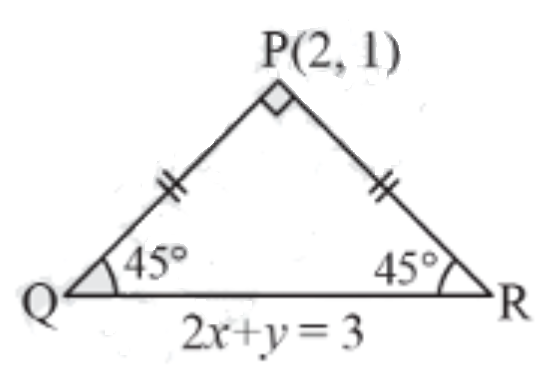
Slope of $QR =-2$.
Slope of $PQ = m _1$
$\therefore \quad \tan 45^{\circ}=\left|\frac{ m _1+2}{1+ m _1(-2)}\right|$
$\Rightarrow 1=\left|\frac{ m _1+2}{1-2 m_1}\right|$
$\Rightarrow m _1=-\frac{1}{3}$
$\therefore \quad$ Equation of PQ passing through point $P (2,1)$ and having slope $m_1$ is
$y-1=-\frac{1}{3}(x-2)$
$\Rightarrow 3(y-1)+(x-2)=0$ $\ldots$. . (i)
Slope of $PR = m _2=3$ $\ldots[\because PQ \perp PR ]$
$\therefore$ equation of PR is
$y-1=3(x-2)$
$\Rightarrow(y-1)-3(x-2)=0$ ...(ii)
$\therefore \quad$ The joint equation of the lines is
$[3(y-1)+(x-2)][(y-1)-3(x-2)]=0$
$\Rightarrow 3(y-1)^2-8(y-1)(x-2)-3(x-2)^2=0$
$\Rightarrow 3\left(x^2-4 x+4\right)+8(x y-x-2 y+2)$ $-3\left(y^2-2 y+1\right)=0$
$\Rightarrow 3 x^2-3 y^2+8 x y-20 x-10 y+25=0$ View full question & answer→MCQ 972 Marks
The combined equation of lines, through the origin forming an equilateral triangle with the line $x+y+\sqrt{3}=0$ is
- A
$x^2+4 x y-y^2=0$
- ✓
$x^2-4 x y+y^2=0$
- C
$x^2-4 x y+2 y^2=0$
- D
$x^2+4 x y+2 y^2=0$
AnswerCorrect option: B. $x^2-4 x y+y^2=0$
(B) The combined equation of pair of lines through the origin and forming an equilateral triangle with the line $ax + b y+ c =0$ is: $(a x+b y)^2-3(a y-b x)^2=0$ and area of equilateral triangle is $\frac{ c ^2}{\sqrt{3}\left( a ^2+ b ^2\right)}$.
we get that the combined equaiton of the pair of lines through the origin and forming an equailateral triangle with the line $x+y+\sqrt{3}=0$ is
$((1) x+(1) y)^2-3((1) y-(1) x)^2=0$
i.e., $x^2+2 x y+y^2-3 x^2+6 x y-3 y^2=0$
i.e., $x^2-4 x y+y^2=0$
View full question & answer→MCQ 982 Marks
The combined equation of the lines which pass through the origin and each of which makes an angle of $30^{\circ}$ with the line $2 x-y=0$ is
- A
$11 x^2+16 x y-y^2=0$
- B
$11 x^2+16 x y+y^2=0$
- C
$11 x^2-16 x y+y^2=0$
- ✓
$11 x^2-16 x y-y^2=0$
AnswerCorrect option: D. $11 x^2-16 x y-y^2=0$
(D) Given line $2 x-y=0 \Rightarrow$ Slope $=2$
Let the slope of required line be m
$\therefore \tan 30^{\circ}=\left|\frac{ m -2}{1+2 m}\right|$
$\Rightarrow \frac{1}{\sqrt{3}}=\left|\frac{ m -2}{1+2 m}\right|$
$\Rightarrow m^2+16 m-11=0$ $\ldots$. . (i)
Since, the line passes through origin, its equation is
$y= m x \Rightarrow m=\frac{y}{x}$
Substituting the value of $m$ in equation (i), we get
$\left(\frac{y}{x}\right)^2+16\left(\frac{y}{x}\right)-11=0$
$\Rightarrow 11 x^2-16 x y-y^2=0$
View full question & answer→MCQ 992 Marks
If one of the lines given by $6 x^2-x y+4 c y^2=0$ is $3 x+4 y=0$, then $c =$
Answer(D) One of the lines is $3 x+4 y=0$
i.e., $\frac{y}{x}=-\frac{3}{4}$
The given joint equation is $6 x^2-x y+4 c y^2=0$
$\Rightarrow 4 c\left(\frac{y}{x}\right)^2-\left(\frac{y}{x}\right)+6=0$ ...(i)
Substituting value of $\frac{y}{x}$ in equation (i), we get
$4 c\left(\frac{-3}{4}\right)^2-\left(-\frac{3}{4}\right)+6=0$
$\Rightarrow 4 c \times \frac{9}{16}+\frac{3}{4}+6=0$
$\Rightarrow \frac{9 c}{4}+\frac{3+24}{4}=0 \Rightarrow 9 c+27=0$
$\Rightarrow c=-3$
View full question & answer→MCQ 1002 Marks
The equation of the pair of lines through the point $(2,1)$ and perpendicular to the pair of lines $4 x y+2 x+6 y+3=0$ is
- A
$x y+x+2 y-6=0$
- B
$x y-x+2 y-2=0$
- C
$x y+x-2 y-2=0$
- ✓
$x y-x-2 y+2=0$
AnswerCorrect option: D. $x y-x-2 y+2=0$
(D) Given equation of pair of lines is $4 x y+2 x+6 y+3=0$
$\begin{array}{l}\Rightarrow 2 x(2 y+1)+3(2 y+1)=0 \\ \Rightarrow(2 y+1)(2 x+3)=0\end{array}$
$\therefore \quad$ Separate equations of lines are $2 x+3=0$ and $2 y+1=0$
i.e. $x=\frac{-3}{2}$ and $y=\frac{-1}{2}$
The equation of line passing through $(2,1)$ and perpendicular to $x=\frac{-3}{2}$ is $y=1$ i.e. $y-1=0$
The equation of line passing through $(2,1)$ and perpendicular to $y=\frac{-1}{2}$ is $x=2$ i.e. $x-2=0$
∴ Combined equation of pair of lines is $(x-2)(y-1)=0$
$\Rightarrow x y-x-2 y+2=0$
View full question & answer→MCQ 1012 Marks
If $a x^2+6 x y+b y^2-10 x+10 y-6=0$ represents two perpendicular lines, then $| a |$ equals
Answer(B) Given equation of pair of lines is $a x^2+6 x y+ b y^2-10 x+10 y-6=0$
$A=a, B=b, C=-6, F=-5, G=5, H=3$
The lines are perpendicular
$\therefore a+b=0 \Rightarrow a=-b$
Also these lines satisfy the condition
$\begin{array}{l}A B C+2 F G H-A F^2-B G^2-C H^2=0 \\ \Rightarrow 6 a^2+2(-75)-25 a+25 a+54=0 \\ \Rightarrow 6 a^2-96=0 \Rightarrow a^2-16=0 \Rightarrow a= \pm 4\end{array}$
View full question & answer→MCQ 1022 Marks
The equation of the perpendiculars drawn from the origin to the lines represented by the equation $2 x^2-10 x y+12 y^2+5 x-16 y-3=0$ is
- ✓
$6 x^2+5 x y+y^2=0$
- B
$6 y^2+5 x y+x^2=0$
- C
$6 x^2-5 x y+y^2=0$
- D
$6 x^2-x y-y^2=0$
AnswerCorrect option: A. $6 x^2+5 x y+y^2=0$
(A) Given equation of pair of lines is $2 x^2-10 x y+12 y^2+5 x-16 y-3=0$
$\therefore \quad a =2, b=12, c =-3, f =-8, g=\frac{5}{2}, h=-5$
Equation of perpendicular drawn from origin on $a x^2+2 h x y+ b y^2+2 g x+2 f y+ c =0$ is $b x^2-2 h x y+ a y^2=0$
$\begin{aligned} \therefore \quad & 12 x^2+10 x y+2 y^2=0 \\ & \text { i.e., } 6 x^2+5 x y+y^2=0\end{aligned}$
View full question & answer→MCQ 1032 Marks
If the equation $p x^2-8 x y+3 y^2+14 x+2 y+ q =0$ represents a pair of lines perpendicular to each other, then the values of $p$ and $q$ are
- A
$p=2, q=3$
- B
$p=-3, q=2$
- ✓
$p=-3, q=-8$
- D
$p=3, q=2$
AnswerCorrect option: C. $p=-3, q=-8$
(C) Given equation of pair of lines is $p x^2-8 x y+3 y^2+14 x+2 y+ q =0$
$a=p, b=3, c=q, f=1, g=7, h=-4$
This lines are perpendicular if $a+b=0$
$\Rightarrow p+3=0 \Rightarrow p=-3$
Since the equation represents a pair of lines
$\therefore \quad a b c+2 f g h-a f^2-b g^2-c h^2=0$
$\begin{array}{l}\Rightarrow-9 q-56+3-147-16 q=0 \\ \Rightarrow-25 q-200=0 \Rightarrow q=-8\end{array}$
View full question & answer→MCQ 1042 Marks
If equation $4 x^2+2 p x y+25 y^2+2 x+5 y-1=0$ represents parallel lines, then $p$ is equal to
Answer(B) Given equation of pair of lines is $4 x^2+2 p x y+25 y^2+2 x+5 y-1=0$
$\therefore \quad a =4, b=25, h= p , g =1, f =\frac{5}{2}, c =-1$
The lines are parallel
$\therefore h^2-a b=0 \Rightarrow h^2=a b$
$\begin{array}{l}\Rightarrow p ^2=4(25)=100 \\ \Rightarrow p =10\end{array}$
View full question & answer→MCQ 1052 Marks
The lines represented by the equation $x^2+2 \sqrt{3} x y+3 y^2-3 x-3 \sqrt{3} y-4=0$, are
Answer(B) Given equation of pair of lines is $x^2+2 \sqrt{3} x y+3 y^2-3 x-3 \sqrt{3} y-4=0$
$\therefore \quad a=1, h=\sqrt{3}, b=3$
Now, $h ^2- ab =(\sqrt{3})^2-(1)(3)=0$
∴ The lines are parallel.
View full question & answer→MCQ 1062 Marks
Measure of angle between the two lines $3 x y-4 y=0$ is
- A
$30^{\circ}$
- B
$60^{\circ}$
- ✓
$90^{\circ}$
- D
$120^{\circ}$
AnswerCorrect option: C. $90^{\circ}$
(C) Given equation of pair of lines is $3 x y-4 y=0$
$\therefore \quad a=b=0$
Now $a + b =0$
$\therefore \quad$ The lines are perpendicular to each other.
View full question & answer→MCQ 1072 Marks
The angle between the pair of straight lines $x^2-y^2-2 y-1=0$ is
- ✓
$90^{\circ}$
- B
$60^{\circ}$
- C
$45^{\circ}$
- D
$0^{\circ}$
AnswerCorrect option: A. $90^{\circ}$
(A) Given equation of pair of lines is $x^2-y^2-2 y-1=0$
$\therefore \quad a=1, b=-1$
Now, $a + b =1+(-1)=0$
$\therefore \quad$ The lines are perpendicular to each other.
View full question & answer→MCQ 1082 Marks
Angle between straight lines given by $3 y^2-8 x y-3 x^2-29 x$ $+3 y-18=0$ is:
- ✓
$\frac{\pi}{2}$
- B
$\frac{\pi}{3}$
- C
$\frac{\pi}{4}$
- D
$\frac{\pi}{6}$
AnswerCorrect option: A. $\frac{\pi}{2}$
(A) Given equation of pair of lines is $3 y^2-8 x y-3 x^2-29 x+3 y-18=0$
$\therefore \quad a=-3, b=3$
Now, $a + b =-3+3=0$,
$\therefore \quad$ The lines are perpendicular to each other.
View full question & answer→MCQ 1092 Marks
The equation $6 x^2-x y-12 y^2$$-8 x+29 y-14=0$ represents a pair of lines, then the angle between them is
AnswerCorrect option: A. $\tan ^{-1}\left(\frac{17}{6}\right)$
(A) Given equation of pair of lines is $6 x^2-x y-12 y^2-8 x+29 y-14=0$
$a=6, b=-12, h=\frac{-1}{2}$
$\therefore \quad \tan \theta=\left|\frac{2 \sqrt{h^2-a b}}{a+b}\right|=\frac{17}{6} \Rightarrow \theta=\tan ^{-1}\left(\frac{17}{6}\right)$
View full question & answer→MCQ 1102 Marks
The point of intersection of lines given by the equation $3 x^2+10 x y+3 y^2$$-15 x-21 y+18=0$ is
- A
$\left(\frac{13}{8}, \frac{3}{8}\right)$
- B
$\left(\frac{3}{8}, \frac{15}{8}\right)$
- ✓
$\left(\frac{15}{8}, \frac{3}{8}\right)$
- D
$\left(\frac{3}{8}, \frac{13}{8}\right)$
AnswerCorrect option: C. $\left(\frac{15}{8}, \frac{3}{8}\right)$
(C) Given equation of pair of lines is $3 x^2+10 x y+3 y^2-15 x-21 y+18=0$
$a =3, b=3, c =18, f =\frac{-21}{2}, g=\frac{-15}{2}, h=5$
The point of intersection is $\left(\frac{(5)\left(\frac{-21}{2}\right)-(3)\left(\frac{-15}{2}\right)}{(3)(3)-(5)^2}, \frac{\left(\frac{-15}{2}\right)(5)-(3)\left(\frac{-21}{2}\right)}{(3)(3)-(5)^2}\right)$
$\equiv\left(\frac{15}{8}, \frac{3}{8}\right)$
View full question & answer→MCQ 1112 Marks
The point of intersection of the lines $2 x^2-5 x y+3 y^2+8 x-9 y+6=0$ is
- A
$(-3,4)$
- B
$(3,-5)$
- ✓
$(3,4)$
- D
$(-3,-5)$
AnswerCorrect option: C. $(3,4)$
(C) Given equation of pair of lines is $2 x^2-5 x y+3 y^2+8 x-9 y+6=0$
$\therefore \quad a=2, b=3, c=6, f=-\frac{9}{2}, g=4, h=\frac{-5}{2}$
The point of intersection is given by $\left(\frac{ hf - bg }{ ab - h ^2}, \frac{ gh - af }{ ab - h ^2}\right)$
$\equiv\left(\frac{\left(\frac{-5}{2}\right)\left(\frac{-9}{2}\right)-3(4)}{2(3)-\left(\frac{5}{2}\right)^2}, \frac{4\left(\frac{-5}{2}\right)-2\left(\frac{-9}{2}\right)}{2(3)-\left(\frac{5}{2}\right)^2}\right)$
$\equiv(3,4)$
View full question & answer→MCQ 1122 Marks
The value of $\lambda$, for which the equation $x^2-y^2-x-\lambda y-2=0$ represents a pair of straight line, are
AnswerCorrect option: A. $3,-3$
(A) Given equation of pair of lines is $x^2-y^2-x-\lambda y-2=0$
$\therefore \quad a=1, b=-1, c=-2, f=\frac{-\lambda}{2}, g=\frac{-1}{2}, h=0$
Now, $abc +2 fgh - af ^2- bg ^2- ch ^2=0$
$\therefore \quad 2-\frac{\lambda^2}{4}+\frac{1}{4}=0 \Rightarrow \frac{\lambda^2}{4}=\frac{9}{4}$
$\begin{array}{l}\Rightarrow \lambda^2=9 \\ \Rightarrow \lambda= \pm 3\end{array}$
View full question & answer→MCQ 1132 Marks
If $6 x^2+11 x y-10 y^2+x+31 y+ k = 0$ represents a pair of straight lines, then $k =$
Answer(A) Given equation of pair of lines is $6 x^2+11 x y-10 y^2+x+31 y+ k =0$
$\therefore \quad a=6, b=-10, c=k, f=\frac{31}{2}, g=\frac{1}{2}, h=\frac{11}{2}$
Now, abc $+2 fgh -$$af ^2- bg ^2- ch ^2=0$
$\Rightarrow-6(10) k +2\left(\frac{31}{2}\right)\left(\frac{1}{2}\right)\left(\frac{11}{2}\right)-6\left(\frac{31}{2}\right)^2+10\left(\frac{1}{2}\right)^2$$-k\left(\frac{11}{2}\right)^2=0$
$\Rightarrow-k \frac{361}{4}=\frac{5415}{4} \Rightarrow k=-15$
View full question & answer→MCQ 1142 Marks
For which value of ' $p^{\prime}, y^2+x y+p x^2-x-2 y=0$ represents a pair of straight lines
- A
- B
$\frac{1}{3}$
- ✓
$\frac{1}{4}$
- D
$\frac{1}{2}$
AnswerCorrect option: C. $\frac{1}{4}$
(C) Given equation of pair of lines is $y^2+x y+p x^2-x-2 y=0$
$\therefore \quad a=p, b=1, c=0, f=-1, g=\frac{-1}{2}, h=\frac{1}{2}$
The given equation represents pair of straight lines if
$a b c+2 f g h-a f^2-b g^2-c h^2=0$
$\Rightarrow p (1)(0)+2(-1)\left(\frac{-1}{2}\right)\left(\frac{1}{2}\right)- p (-1)^2$$-1\left(\frac{-1}{2}\right)^2-0=0$
$\Rightarrow \frac{1}{2}- p -\frac{1}{4}=0 \Rightarrow p =\frac{1}{4}$
View full question & answer→MCQ 1152 Marks
Which of the following represents a pair of lines?
- ✓
$2 x^2+3 x y-2 y^2+5 x+5 y+3=0$
- B
$2 x^2-2 y^2+5 x+5 y+3=0$
- C
$2 x^2+5 x y-2 y^2+5 x+5 y+3=0$
- D
$2 x^2+3 x y-4 y^2+5 x+5 y+3=0$
AnswerCorrect option: A. $2 x^2+3 x y-2 y^2+5 x+5 y+3=0$
(A) Consider $2 x^2+3 x y-2 y^2+5 x+5 y+3=0$
Comparing the given equation with
$a x^2+2 h x y+b y^2+2 g x+2 f y+c=0$, we get
$a =2, b=-2, c =3, f =\frac{5}{2}, g=\frac{5}{2}, h=\frac{3}{2}$
Condition for equation to represent pair of lines is $abc +2 fgh - af ^2- bg ^2- ch ^2=0$
$\therefore \quad 2(-2)(3)+2\left(\frac{5}{2}\right)\left(\frac{5}{2}\right)\left(\frac{3}{2}\right)$ $-2\left(\frac{5}{2}\right)^2-(-2)\left(\frac{5}{2}\right)^2-3\left(\frac{3}{2}\right)^2$
$=-12+\frac{75}{4}-\frac{50}{4}+\frac{50}{4}-\frac{27}{4}=0$
∴ Condition is satisfied
∴ Option (A) is the correct answer.
View full question & answer→MCQ 1162 Marks
If $a x^2-y^2+4 x-y=0$ represents a pair of lines then $a =$
Answer(B) Given equation of pair of lines is $a x^2-y^2+4 x-y=0$
$\therefore \quad A=a, B=-1, C=0, F=\frac{-1}{2}, G=2, H=0$
The given equation represents a pair of straight lines,
$\therefore \quad ABC +2 FGH - AF ^2- BG ^2- CH ^2=0$
$\Rightarrow 0-0- a \left(\frac{1}{4}\right)-(-1)(4)=0$
$\Rightarrow-\frac{a}{4}+4=0 \Rightarrow a=16$
View full question & answer→MCQ 1172 Marks
If the lines represented by $3 y^2+9 x y+k x^2=0$ are perpendicular to each other, then $k=$
Answer(C) Given equation of pair of lines is
$3 y^2+9 x y+ k x^2=0$
i.e. $k x^2+9 x y+3 y^2=0$
$\therefore \quad a = k , b =3$
The lines are perpendicular
$\therefore a+b=0$
$\Rightarrow k+3=0 \Rightarrow k=-3$
View full question & answer→MCQ 1182 Marks
If lines $a ^2 x^2+ bcy ^2= a$ $( b + c ) x y$ are mutually perpendicular, then
- A
$c^2+a b=0$
- B
$b^2+c a=0$
- ✓
$a^2+b c=0$
- D
$a^2+b^2+c^2=0$
AnswerCorrect option: C. $a^2+b c=0$
(C) Given equation of pair of lines is
$a ^2 x^2+ bc y^2= a ( b + c ) x y$
$\therefore \quad A = a ^2, B= bc$
Since the lines are mutually perpendicular,
$A+B=0$
$\Rightarrow a ^2+ bc =0$
View full question & answer→MCQ 1192 Marks
The equation $x^2-7 x y-y^2=0$ represents
- A
- B
pair of parallel straight lines
- ✓
pair of perpendicular straight lines
- D
pair of non-perpendicular intersecting straight lines
AnswerCorrect option: C. pair of perpendicular straight lines
(C) It is a homogeneous equation of degree 2 in $x$ and $y$
Hence, it represents a pair of lines and $a+b=0$
$\therefore \quad$ lines are perpendicular
View full question & answer→MCQ 1202 Marks
pair of straight lines perpendicular to each other are represented by
- ✓
$2 x^2=2 y(2 x+y)$
- B
$x^2+y^2+3=0$
- C
$2 x^2=y(2 x+y)$
- D
$x^2=2(x-y)$
AnswerCorrect option: A. $2 x^2=2 y(2 x+y)$
(A) The condition for a pair of straight lines to be perpendicular is $a + b =0$.
Consider the equation $2 x^2=2 y(2 x+y)$
i.e. $2 x^2-4 x y-2 y^2=0$
$\therefore \quad a=2, b=-2$
$\therefore \quad a+b=2+(-2)=0$
Option (A) is the correct answer.
View full question & answer→MCQ 1212 Marks
Two lines represented by equation $x^2+x y+y^2=0$ are
Answer(D) Given equation of pair of lines is
$x^2+x y+y^2=0$
$\therefore \quad a=1, h=\frac{1}{2}, b=1$
Here, $h ^2- ab =\frac{-3}{4}<0$
Hence, the lines are imaginary
View full question & answer→MCQ 1222 Marks
If the equation $4 x^2$$+h x y+y^2=0$ represents coincident lines, then the value of $h$ is
- A
$\pm 2$
- ✓
$\pm 4$
- C
$\pm 1$
- D
$0$
AnswerCorrect option: B. $\pm 4$
(B) Given equation of pair of lines is
$4 x^2+ h x y+y^2=0$
The lines are coincident
$\therefore \quad H ^2= AB$
$\begin{array}{l}\Rightarrow \frac{ h ^2}{4}=4(1) \\ \Rightarrow h = \pm 4\end{array}$
View full question & answer→MCQ 1232 Marks
$6 x^2+h x y+12 y^2=0$ represents pair of parallel straight lines, if $h$ is
- A
$\pm 6 \sqrt{2}$
- B
$\pm \sqrt{2}$
- ✓
$\pm 12 \sqrt{2}$
- D
$\pm \sqrt{6}$
AnswerCorrect option: C. $\pm 12 \sqrt{2}$
(C) Given equation of pair of lines is
$6 x^2+h x y+12 y^2=0$
$\therefore \quad A=6, H=\frac{h}{2}, B=12$
Since lines are parallel,
$H ^2- AB =0$
$\begin{array}{l}\Rightarrow \frac{ h ^2}{4}=6(12) \Rightarrow h ^2=(24)(12) \\ \Rightarrow h = \pm 12 \sqrt{2}\end{array}$
View full question & answer→MCQ 1242 Marks
Which of the following equations represents a pair of real and coincident straight lines?
- ✓
$4 x^2-4 x y+y^2=0$
- B
$4 x^2+4 x y-y^2=11$
- C
$-x^2+x y-y^2=1$
- D
$3 x^2+3 y^2=4$
AnswerCorrect option: A. $4 x^2-4 x y+y^2=0$
(A) The condition for a pair of straight lines to be real and coincident is $h^2-a b=0$
Consider the equation $4 x^2-4 x y+y^2=0$
$\therefore \quad a=4, h=-2, b=1$
$h^2-a b=(-2)^2-(4)(1)=0$
$\therefore \quad$ Option (A) is the correct answer
View full question & answer→MCQ 1252 Marks
The straight lines represented by the equation $9 x^2-12 x y+4 y^2=0$ are
Answer(A) Given equation of pair of lines is
$9 x^2-12 x y+4 y^2=0$
$a=9, h=-6, b=4$
Now, $h^2-a b=(6)^2-9 \times 4=0$
$\therefore \quad$ The lines are coincident.
View full question & answer→MCQ 1262 Marks
The equation $3 x^2+2 h x y+y^2=0$ represents a pair of straight lines passing through the origin. Then two lines are
- A
real and distinct if $h^2>3$
- B
real and distinct if $h^2>9$
- C
real and coincident if $h ^2>3$.
- ✓
real and coincident if $h ^2 \geq 3$.
AnswerCorrect option: D. real and coincident if $h ^2 \geq 3$.
(D) Given equation of pair of lines is
$3 x^2+2 h x y+y^2=0$
$\therefore \quad a=3, h=h, b=1$
The two lines are real and coincident if
$h^2-a b=0$
$\therefore \quad h^2-a b=h^2-3$
for these lines to be real and coincident,
$h ^2-3 \geq 0 \Rightarrow h^2 \geq 3$
View full question & answer→MCQ 1272 Marks
The equation $x^2+ k y^2+4 x y=0$ represents two coincident lines, if $k=$
Answer(C) Given equation of pair of lines is
$x^2+ k y^2+4 x y=0$
$\therefore \quad a =1, h=\frac{ k }{2}, b=4$
The pair of lines are coincident if $h^2-a b=0$
$\begin{array}{l}\Rightarrow h^2=a b \Rightarrow \frac{k^2}{4}=4(1) \\ \Rightarrow k= \pm 4\end{array}$
View full question & answer→MCQ 1282 Marks
Angle between the pair of lines $x y=0$ is
- A
$30^{\circ}$
- B
$45^{\circ}$
- ✓
$90^{\circ}$
- D
$60^{\circ}$
AnswerCorrect option: C. $90^{\circ}$
(C) Given equation of pair of lines is $x y=0$
$\therefore \quad a =0, h=\frac{1}{2}, b=0$
Now, $a + b =0$
$\therefore \quad$ the lines are perpendicular to each other.
$\therefore \quad$ angle between the pair of line is $90^{\circ}$.
View full question & answer→MCQ 1292 Marks
The angle between the lines given by the equation $\lambda y^2+\left(1-\lambda^2\right) x y-\lambda x^2=0$ is
- A
$45^{\circ}$
- B
$60^{\circ}$
- ✓
$90^{\circ}$
- D
$15^{\circ}$
AnswerCorrect option: C. $90^{\circ}$
(C) Given equation of pair of lines is
$\lambda y^2+\left(1-\lambda^2\right) x y-\lambda x^2=0$
$\therefore \quad a=-\lambda, b=\lambda$
Now $a + b =0$
$\therefore \quad$ the lines are perpendicular
$\therefore \quad$ Angle between the lines is $90^{\circ}$.
View full question & answer→MCQ 1302 Marks
The angle between the pair of straight lines $3 x^2+10 x y+8 y^2=0$ is $\tan ^{-1}(p)$, where $p=$
- A
$\frac{-5}{11}$
- B
$\frac{-3}{11}$
- ✓
$\frac{2}{11}$
- D
$\frac{8}{11}$
AnswerCorrect option: C. $\frac{2}{11}$
(C) Given equation of pair of lines is
$\begin{aligned} & 3 x^2+10 x y+8 y^2=0 \\ \therefore \quad & a =3, h=5, b=8\end{aligned}$
Now $\theta=\tan ^{-1}(p) \Rightarrow \tan \theta=p$
$\begin{array}{c}\therefore \quad \tan \theta=\left|\frac{2 \sqrt{25-24}}{11}\right| \\ \quad \Rightarrow p =\left|\frac{2}{11}\right|=\frac{2}{11}\end{array}$
View full question & answer→MCQ 1312 Marks
If $3 x^2+18 x y+b y^2=0$ represents a pair of lines, making an angle $\pi$ with each other, then b =
Answer(C) Given equation of pair of lines is
$3 x^2+18 x y+b y^2=0$
$\begin{array}{ll}\therefore & a=3, h=9, b=b \\ & \text { Now } \theta=\pi \Rightarrow \tan \theta=0\end{array}$
$\begin{aligned} \therefore \quad & \tan \theta=\left|\frac{2 \sqrt{81-3 b}}{3+b}\right| \\ \Rightarrow & 0=\left|\frac{2 \sqrt{81-3 b}}{3+b}\right|\end{aligned}$
$\Rightarrow 81=3 b \Rightarrow b=27$
View full question & answer→MCQ 1322 Marks
If the acute angle between the lines $x^2-4 h x y+3 y^2=0$ is $60^{\circ}$ then $h =$
AnswerCorrect option: C. $\pm \frac{\sqrt{15}}{2}$
(C) Given equation of pair of lines is
$x^2-4 h x y+3 y^2=0$
$\therefore \quad A=1, H=-2 h, B=3$
$\begin{array}{l}\text { Now, } \theta=60^{\circ} \\ \Rightarrow \tan \theta=\sqrt{3}\end{array}$
$\therefore \quad \tan \theta=\left|\frac{2 \sqrt{ H ^2- AB }}{ A + B }\right|$
$\Rightarrow \sqrt{3}=\left|\frac{2 \sqrt{4 h^2-3}}{4}\right| \Rightarrow h = \pm \frac{\sqrt{15}}{2}$
View full question & answer→MCQ 1332 Marks
If the angle $\theta$ is acute, then the acute angle between $x^2(\cos \theta-\sin \theta)+2 x y \cos \theta+y^2(\cos \theta+\sin \theta)=0$ is
- A
$2 \theta$
- B
$\frac{\theta}{3}$
- ✓
$\theta$
- D
$\frac{\theta}{2}$
AnswerCorrect option: C. $\theta$
(C) Given equation of pair of lines is
$x^2(\cos \theta-\sin \theta)+2 x y \cos \theta$ $+y^2(\cos \theta+\sin \theta)=0$
$\therefore \quad a=\cos \theta-\sin \theta, h=\cos \theta, b=\cos \theta+\sin \theta$
The acute angle $\alpha$ between the pair of lines is given by
$\tan \alpha=\left|\frac{2 \sqrt{\cos ^2 \theta-\left(\cos ^2 \theta-\sin ^2 \theta\right)}}{2 \cos \theta}\right|$
$\Rightarrow \tan \alpha=\tan \theta \Rightarrow \alpha=\theta$
View full question & answer→MCQ 1342 Marks
Angle between the lines $2 x^2-3 x y+y^2=0$ is
AnswerCorrect option: C. $\cot ^{-1}(3)$
(C) Given equation of pair of lines is
$2 x^2-3 x y+y^2=0$
$\therefore \quad a=2, h=\frac{-3}{2}, b=1$
$\therefore \quad \tan \theta=\left|\frac{2 \sqrt{\frac{9}{4}-2}}{3}\right|=\left|\frac{\sqrt{9-8}}{3}\right|=\frac{1}{3}$
$\therefore \cot \theta=3 \Rightarrow \theta=\cot ^{-1}$ (3)
View full question & answer→MCQ 1352 Marks
The acute angle between the lines represented by the equation $11 y^2-24 x y+4 x^2=0$ are
- A
$\tan ^{-1} \frac{3}{2}$
- ✓
$\tan ^{-1} \frac{4}{3}$
- C
$\tan ^{-1} \frac{4}{5}$
- D
$\tan ^{-1} \frac{1}{3}$
AnswerCorrect option: B. $\tan ^{-1} \frac{4}{3}$
(B) Given equation of pair of lines is
$11 y^2-24 x y+4 x^2=0$
i.e. $4 x^2-24 x y+11 y^2=0$
$\begin{array}{ll}\therefore & a=4, h=-12, b=11 \\ \therefore & \tan \theta=\left|\frac{2 \sqrt{144-44}}{4+11}\right|=\frac{2(10)}{15}=\frac{4}{3}\end{array}$
$\Rightarrow \theta=\tan ^{-1}\left(\frac{4}{3}\right)$
View full question & answer→MCQ 1362 Marks
The angle between the lines represented by $\sqrt{3} x y-y^2=0$ is
- A
$30^{\circ}$
- B
$45^{\circ}$
- ✓
$60^{\circ}$
- D
$90^{\circ}$
AnswerCorrect option: C. $60^{\circ}$
(C) Given equation of pair of lines is
$\sqrt{3} x y-y^2=0$
$\therefore \quad a =0, h=\frac{\sqrt{3}}{2}, b=-1$
$\therefore \quad \tan \theta=\left|\frac{2 \sqrt{\frac{3}{4}-0}}{0-1}\right|=\left|\frac{2 \times \frac{\sqrt{3}}{2}}{-1}\right|=\sqrt{3}$
$\Rightarrow \theta=\tan ^{-1}(\sqrt{3})=60^{\circ}$
View full question & answer→MCQ 1372 Marks
The acute angle between the lines represented by $6 x^2-x y-y^2=0$ is
- ✓
$45^{\circ}$
- B
$30^{\circ}$
- C
$60^{\circ}$
- D
$90^{\circ}$
AnswerCorrect option: A. $45^{\circ}$
(A) Given equation of pair of lines is
$6 x^2-x y-y^2=0$
$\therefore \quad a =6, h=-\frac{1}{2}, b=-1$
If $\theta$ is the acute angle between the pair of lines, then
$\tan \theta=\left|\frac{2 \sqrt{h^2-a b}}{a+b}\right|$
$\begin{array}{l}\Rightarrow \tan \theta=\left|\frac{2 \sqrt{\frac{1}{4}+6}}{5}\right|=1 \\ \Rightarrow \theta=\tan ^{-1}(1)=45^{\circ}\end{array}$
View full question & answer→MCQ 1382 Marks
If the lines represented by the equation $6 x^2+41 x y-7 y^2=0$ make angles $\alpha$ and $\beta$ with X-axis, then $\tan \alpha \cdot \tan \beta=$
- ✓
$-\frac{6}{7}$
- B
$\frac{6}{7}$
- C
$\frac{7}{6}$
- D
$-\frac{7}{6}$
AnswerCorrect option: A. $-\frac{6}{7}$
(A) Given equation of pair of lines is
$6 x^2+41 x y-7 y^2=0$
$\therefore \quad a=6, h=\frac{41}{2}, b=-7$
$\alpha$ and $\beta$ are angles made by the two lines with X-axis
∴ their slopes $m _1$ and $m _2$ respectively are $m _1=\tan \alpha$ and $m _2=\tan \beta$
$\tan \alpha \cdot \tan \beta=m_1 m_2=-\frac{6}{7}$
View full question & answer→MCQ 1392 Marks
If the slope of one of the lines represented by $a x^2+(3 a+1) x y+3 y^2=0$ be reciprocal of the slope of the other, then the slope of the lines are
- A
$\frac{3}{2}, \frac{2}{3}$
- B
$\frac{1}{2}, \frac{2}{1}$
- C
$\frac{1}{3}, 3$
- ✓
$\frac{-1}{3},-3$
AnswerCorrect option: D. $\frac{-1}{3},-3$
(D) Given equation of pair of lines is
$a x^2+(3 a+1) x y+3 y^2=0$
$\therefore \quad A = a , H =\frac{3 a +1}{2}, B=3$
Given that $m _1=\frac{1}{m_2} \Rightarrow m_1 m_2=1$
Now, $m _1 m_2=\frac{ a }{3} \Rightarrow \frac{ a }{3}=1 \Rightarrow a =3$
Also, $m_1+m_2=-\left(\frac{3 a+1}{3}\right)=\frac{-10}{3}$
$\Rightarrow m _1+\frac{1}{m_1}=\frac{-10}{3} \Rightarrow 3 m_1^2+10 m_1+3=0$
$\therefore \quad m _1=\frac{-1}{3}$ or -3.
View full question & answer→MCQ 1402 Marks
If the slope of one of the lines from the pair of lines represented by $a x^2+4 x y+y^2=0$ is 3 times the slope of the other line, then ' $a$ ' is
Answer(C) Given equation of pair of lines is
$a x^2+4 x y+y^2=0$
$\therefore A=a, H=2, B=1$
$ m_1+m_2=-4 \text { and } m_1 m_2=a$
Given that $m _1=3 m_2$
$\therefore 3 m_2+ m _2=-4 \Rightarrow m_2=-1$
Hence, $m _1=-3$
$\therefore a=(-1)(-3)=3$
View full question & answer→MCQ 1412 Marks
If the slope of one line of the pair of lines represented by $a x^2+10 x y+y^2=0$ is four times the slone of the other, then a is equar to
Answer(D) Given equation of pair of lines is
$a x^2+10 x y+y^2=0$
$\therefore \quad A=a, H=5, B=1$
Let the slopes of the lines be $m _1$ and $m _2$
$m_1+m_2=\frac{-2 H}{B}$ and $m_1 m_2=\frac{A}{B}$
Given that $m _2=4 m_1$
$\therefore m_1+4 m_1=\frac{-2 H}{B}=-10 \Rightarrow m_1=-2$
and $m _1 \times 4 m_1=\frac{ A }{ B }= a \Rightarrow 4 m_1^2= a \Rightarrow a =16$
View full question & answer→MCQ 1422 Marks
If the slope of one of the lines represented by $a x^2-6 x y+y^2=0$ is twice the other, then ' $a$ ' is equal to
Answer(D) Given equation of pair of lines is
$a x^2-6 x y+y^2=0$
$\therefore \quad A=a, H=-3, B=1$
Given that, $m _1=2 m_2$
$\therefore m _1: m _2=2: 1$
If the slopes of the lines given by $a x^2+2 h x y+ b y^2=0$ are in the ratio $m ; n$, then $( m + n )^2 ab =4 mnh ^2$.
$\frac{ H ^2}{ AB }=\frac{(2+1)^2}{4 \times 2 \times 1}$
$\begin{array}{l}\therefore \quad \frac{9}{a}=\frac{9}{8} \\ \therefore \quad a=8\end{array}$
View full question & answer→MCQ 1432 Marks
Equation of the pair of straight lines through origin and perpendicular to the pair of straight lines $5 x^2-7 x y-3 y^2=0$ is
- ✓
$3 x^2-7 x y-5 y^2=0$
- B
$3 x^2+7 x y-5 y^2=0$
- C
$3 x^2-7 x y+5 y^2=0$
- D
$3 x^2+7 x y+5 y^2=0$
AnswerCorrect option: A. $3 x^2-7 x y-5 y^2=0$
(A) The of pair of lines represented by the equation $a x ^2+2 h x y+ b y^2=0$ are perpendicular to the pair of lines $b x^2-2 h x y+a y^2=0$.
we get the required equation is
$-3 x^2+7 x y+5 y^2=0 \\ \text { i.e. } 3 x^2-7 x y-5 y^2=0$
View full question & answer→MCQ 1442 Marks
Equation of pair of lines passing through $(3,4)$ and parallel to lines $x^2-y^2=0$ is
- A
$x^2-y^2-6 x+8 y-9=0$
- ✓
$x^2-y^2-6 x+8 y-7=0$
- C
$x^2-y^2-4 x+8 y-1=0$
- D
$x^2-y^2-6 x+7 y-11=0$
AnswerCorrect option: B. $x^2-y^2-6 x+8 y-7=0$
(B) $L _1=x^2-y^2=0$ represents pair of straight lines passing through the origin
Joint equation of the pair of lines passing through the point $(x_1, y_1)$ and parallel to the lines given by $a x^2+2 h x y+b y^2=0$ is:
$a (x-x_1)^2+2 h(x-x_1)(y-y_1)+ b (y-y_1)^2=0$
we get the equation of pair of straight lines parallel to $L _1$ and passing through $(3,4)$, is
$(x-3)^2-(y-4)^2=0 \\ \Rightarrow x^2-y^2-6 x+8 y-7=0$
View full question & answer→MCQ 1452 Marks
The equation $4 x^2-24 x y+11 y^2=0$ represents
- A
- B
- ✓
two lines through the origin
- D
AnswerCorrect option: C. two lines through the origin
(C) It is a homogeneous equation of degree 2 in $x$ and $y$.
∴ Option (C) is the correct answer.
View full question & answer→MCQ 1462 Marks
The separate equations of the lines represented by $3 x^2-10 x y-8 y^2=0$ are
- ✓
$3 x+2 y=0$ and $x-4 y=0$
- B
$2 x+2 y=0$ and $2 x-y=0$
- C
$-2 x+3 y=0$ and $-2 x-2 y=0$
- D
$-3 x+2 y=0$ and $x+2 y=0$
AnswerCorrect option: A. $3 x+2 y=0$ and $x-4 y=0$
(A) $3 x^2-10 x y-8 y^2=0$
$\begin{array}{l}\Rightarrow 3 x^2-12 x y+2 x y-8 y^2=0 \\ \Rightarrow 3 x(x-4 y)+2 y(x-4 y)=0 \\ \Rightarrow(3 x+2 y)(x-4 y)=0 \\ \Rightarrow 3 x+2 y=0 \text { and } x-4 y=0\end{array}$
View full question & answer→MCQ 1472 Marks
Separate equations of lines for a pair of lines whose equation is $x^2+x y-12 y^2=0$, are
AnswerCorrect option: D. $x+4 y=0$ and $x-3 y=0$
(D) $x^2+x y-12 y^2=0$
$\begin{array}{l}\Rightarrow x^2+4 x y-3 x y-12 y^2=0 \\ \Rightarrow x(x+4 y)-3 y(x+4 y)=0 \\ \Rightarrow(x-3 y)(x+4 y)=0 \\ \Rightarrow x-3 y=0 \text { and } x+4 y=0\end{array}$
View full question & answer→MCQ 1482 Marks
The equation of the lines passing through the origin and having slopes 3 and $-\frac{1}{3}$ is
- A
$3 y^2+8 x y-3 x^2=0$
- ✓
$3 x^2+8 x y-3 y^2=0$
- C
$3 y^2-8 x y+3 x^2=0$
- D
$3 x^2+8 x y+3 y^2=0$
AnswerCorrect option: B. $3 x^2+8 x y-3 y^2=0$
(B) Joint equation of pair of lines having slopes $m _1, m_2$ and passing through the origin is
$y^2-( m _1+ m _2) x y+ m _1 m_2 x^2=0$
The required equation is
$y^2-( m _1+ m _2) x y+ m _1 m_2 x^2=0$
$y^2-(\frac{8}{3}) x y-x^2=0$
$\Rightarrow 3 x^2+8 x y-3 y^2=0$
View full question & answer→MCQ 1492 Marks
The joint equation of pair of lines having slopes 1 and 3 and passing through the origin is
- A
$4 x^2-3 x y-y^2=0$
- ✓
$3 x^2-4 x y+y^2=0$
- C
$3 x^2-4 x y-y^2=0$
- D
$3 x^2=y^2$
AnswerCorrect option: B. $3 x^2-4 x y+y^2=0$
(B) we get
Joint equation of pair of lines having slopes $m _1$ and $m _2$ and passing through the origin is
$y^2-( m _1+ m _2) x y+ m _1 m_2 x^2=0$
$\Rightarrow 3 x^2-4 x y+y^2=0$
Alternate method:
Equations of the lines are $y=x$ and $y=3 x$ respectively.
i.e. $y-x=0$ and $y-3 x=0$
$\therefore \quad$ The combined equation of the pair of lines is
$(y-x)(y-3 x)=0$
$\therefore \quad y^2-3 x y-x y+3 x^2=0 \Rightarrow 3 x^2-4 x y+y^2=0$
View full question & answer→MCQ 1502 Marks
The equation of lines passing through the origin and parallel to the lines $y= m _1 x+ c _1$ and $y=m_2 x+c_2$ is
- ✓
$m_1 m_2 x^2-\left(m_1+m_2\right) x y+y^2=0$
- B
$m_1 m_2 x^2+\left(m_1+m_2\right) x y+y^2=0$
- C
$m_1 m_2 y^2-\left(m_1+m_2\right) x y+x^2=0$
- D
$m_1 m_2 y^2+\left(m_1+m_2\right) x y+x^2=0$
AnswerCorrect option: A. $m_1 m_2 x^2-\left(m_1+m_2\right) x y+y^2=0$
(A) The lines passing through origin and parallel to the given lines are $y= m _1 x$ and $y= m _2 x$.
$\therefore \quad$ The combined equation is
$\begin{array}{l}\left(y- m _1 x\right)\left(y- m _2 x\right)=0 \\ \Rightarrow m_1 m_2 x^2-\left( m _1+ m _2\right) x y+y^2=0\end{array}$
View full question & answer→