Question 12 Marks
If $\bar{a} \bar{b}$ and $\bar{c}$ are three non coplanar vectors, then$(\bar{a}+\bar{b}+\bar{c}) \cdot[(\bar{a}+\bar{b}) \times(\bar{a}+\bar{c})]=-\left[\begin{array}{lll}\bar{a} & \bar{b} & \bar{c}\end{array}\right]$.
Answer$\mathrm{LHS}=(\bar{a}+\bar{b}+\bar{c}) \cdot[(\bar{a}+\bar{b}) \times(\bar{a}+\overline{\mathrm{c}})]$$\begin{aligned}= & (\bar{a}+\bar{b}+\bar{c}) \cdot[\bar{a} \times(\bar{a}+\bar{c})+\bar{b} \times(\bar{a}+\bar{c})] \\ = & (\bar{a}+\bar{b}+\bar{c})[\bar{a} \times \bar{a}+\bar{a} \times \bar{c}+\bar{b} \times \bar{a}+\bar{b} \times \bar{c}] \\ = & \bar{a} \cdot(\bar{a} \times \bar{c})+\bar{a} \cdot(\bar{b} \times \bar{a}) \times \bar{a} \cdot(\bar{b} \times \bar{c})+ \\ & \bar{b} \cdot(\bar{a} \times \bar{c})+\bar{b} \cdot(\bar{b} \times \bar{a})+\bar{b} \cdot(\bar{b} \times \bar{c})+\end{aligned}$
$\begin{aligned} & \bar{c} \cdot(\bar{a} \times \bar{c})+\bar{c} \cdot(\bar{b} \times \bar{a}) \times \bar{c} \cdot(\bar{b} \times \bar{c}) \quad \ldots[\because \bar{a} \times \bar{a}=\overline{0}] \\ = & {[\bar{a} \bar{a} \bar{c}]+[\bar{a} \bar{b} \bar{a}]+[\bar{a} \bar{b} \bar{c}]+[\bar{b} \bar{a} \bar{c}]+[\bar{b} \bar{b} \bar{a}]+} \\ & {[\bar{b} \bar{b} \bar{c}]+[\bar{c} \bar{a} \bar{c}]+[\bar{c} \bar{b} \bar{a}]+[\bar{c} \bar{b} \bar{c}] } \\ = & 0+0+[\bar{a} \bar{b} \bar{c}]-[\bar{a} \bar{b} \bar{c}]+0+0+0-[\bar{a} \bar{b} \bar{c}]+0\end{aligned}$
$=-[\vec{a} \bar{b} c \bar{c}]=$ RHS.
View full question & answer→Question 22 Marks
Using properties of scalar triple product, prove that$\left[\begin{array}{lll}\bar{a}+\bar{b} & \bar{b}+\bar{c} & \bar{c}+\bar{a}\end{array}\right]=2\left[\begin{array}{lll}\bar{a} & \bar{b} & \bar{c}\end{array}\right]$
Answer$\begin{aligned} \text { LHS } & =[\bar{a}+\bar{b} \bar{b}+\bar{c} \bar{c}+\bar{a}] \\ & =(\bar{a}+\bar{b}) \cdot\{(\bar{b}+\bar{c}) \times(\bar{c}+\bar{a})\} \\ & =(\bar{a}+\bar{b}) \cdot\{\bar{b} \times \bar{c}+\bar{b} \times \bar{a}+\bar{c} \times \bar{c}+\bar{c} \times \bar{a}\} \\ & =(\bar{a}+\bar{b}) \cdot(\bar{b} \times \bar{c}+\bar{b} \times \bar{a}+\bar{c} \times \bar{a}) \ldots[\because \bar{c} \times \bar{c}=\overline{0}]\end{aligned}$$\begin{array}{r}=\bar{a} \cdot\{(\vec{b} \times \bar{c})+(\bar{b} \times \bar{a})+(\bar{c} \times \bar{a})\}+ \\ \quad \bar{b} \cdot\{(\bar{b} \times \bar{c})+(\bar{b} \times \bar{a})+(\bar{c} \times \bar{a})\} \\ =\bar{a} \cdot(\bar{b} \times \bar{c})+\bar{a} \cdot(\bar{b} \times \bar{a})+\bar{a} \cdot(\bar{c} \times \bar{a})+ \\ \bar{b} \cdot(\bar{b} \times \bar{c})+\bar{b} \cdot(\bar{b} \times \bar{a})+\bar{b} \cdot(\bar{c} \times \bar{a})\end{array}$
$\begin{aligned} & =[\bar{a} \bar{b} \bar{c}]+[\bar{a} \bar{b} \bar{a}]+[\bar{a} \bar{c} \bar{a}]+ \\ & {[\bar{b} \bar{b} \bar{c}]+[\bar{b} \bar{b} \bar{a}]+[\bar{b} \bar{c} \bar{a}]} \\ & \end{aligned}$
$\begin{aligned} & =[\bar{a} \bar{b} \bar{c}]+0+0+0+0+[\bar{a} \bar{b} \bar{c}] \\ & =2[\bar{a} \bar{b} \bar{c}] \\ & =\text { RHS. }\end{aligned}$
View full question & answer→Question 32 Marks
Find the volume of a parallelopiped whose coterminus edges are represented by thevector $\hat{j}+\hat{k} \cdot \hat{i}+\hat{k}$ and $\hat{i}+\hat{j}$. Also find volume of tetrahedron having these
coterminous edges.
AnswerLet $\bar{a}=\hat{j}+\hat{k}_t \bar{b}=\hat{i}+\hat{k}$ and $\bar{c}=\hat{i}+\hat{j}$ be the co-terminus edges of a parallelopiped.Then volume of the parallelopiped $=[\bar{a} \bar{b} \bar{c}]$
$=\left|\begin{array}{lll}0 & 1 & 1 \\ 1 & 0 & 1 \\ 1 & 1 & 0\end{array}\right|$
= 0(0 – 1) – 1(0 – 1) + 1(1 – 0) = 0 + 1 + 1 = 2cu units.
Also, volume of tetrahedron $=\frac{1}{6}[\bar{a} \bar{b} \bar{c}]$
$=\frac{1}{6}(2)=\frac{1}{3}$ cubic units.
View full question & answer→Question 42 Marks
Show that, for any vectors $\bar{a}, \bar{b}, \bar{c}$$(\bar{a}+\bar{b}+\bar{c}) \times \bar{c}+(\bar{a}+\bar{b}+\bar{c}) \times \bar{b}+(\bar{b}+\bar{c}) \times \bar{a}=2 \bar{a} \times \bar{c}$
Question is modified.
For any vectors $\bar{a}, \bar{b}, \bar{c}$ show that
$(\bar{a}+\bar{b}+\bar{c}) \times \bar{c}+(\bar{a}+\bar{b}+\bar{c}) \times \bar{b}+(\bar{b}-\bar{c}) \times \bar{a}$
$=2 \bar{a} \times \bar{c}$.
Answer$\begin{aligned} & \text { LHS }=(\bar{a}+\bar{b}+\bar{c}) \times \bar{c}+(\bar{a}+\bar{b}+\bar{c}) \times \bar{b}+(\bar{b}-\bar{c}) \times \bar{a} \\ & =\bar{a} \times \bar{c}+\bar{b} \times \bar{c}+\bar{c} \times \bar{c}+\bar{a} \times \bar{b}+\bar{b} \times \bar{b}+\bar{c} \times \bar{b}+\bar{b} \times \bar{a}-\bar{c} \times \bar{a} \\ & =\bar{a} \times \bar{c}+\bar{b} \times \bar{c}+\overline{0}+\bar{a} \times \bar{b}+\overline{0}-\bar{b} \times \bar{c}-\bar{a} \times \bar{b}+\bar{a} \times \bar{c}\end{aligned}$$\ldots[\because \bar{a} \times \bar{b}=-\bar{b} \times \bar{a}]$
$=2 \bar{a} \times \bar{c}=\mathrm{RHS}$
View full question & answer→Question 52 Marks
If P is orthocenter, Q is circumcenter and G is centroid of a triangle ABC, then prove that$\overline{Q P}=3 \overline{Q G}$
AnswerLet $\bar{p}$ and $\bar{g}$ be the position vectors of $\mathrm{P}$ and $\mathrm{G}$ w.r.t. the circumcentre $\mathrm{Q}$.i.e. $\overline{\mathrm{QP}}=\mathrm{p}$ and $\overline{\mathrm{QG}}=g$.
We know that Q, G, P are collinear and G divides segment QP internally in the ratio 1 : 2
∴ by section formula for internal division,
$\bar{g}=\frac{1 \cdot \bar{p}+2 \bar{q}}{1+2}=\frac{\bar{p}}{3} \quad \ldots[\because \bar{q}=0]$
$\begin{aligned} & \therefore \bar{p}=3 \bar{g} \\ & \therefore \overline{\mathrm{QP}}=3 \overline{\mathrm{QG}}\end{aligned}$
View full question & answer→Question 62 Marks
If aBC is a triangle whose orthocenter is $\mathrm{P}$ and the circumcenter is $\mathrm{Q}$, then prove that $P A$$+\overline{P C}+\overline{P B}=2 \overline{P Q}$
AnswerLet G be the centroid of the ∆ ABC.Let $\mathrm{A}, \mathrm{B}, \mathrm{C}, \mathrm{G}, \mathrm{Q}$ have position vectors $\bar{a}, \bar{b}, \bar{c}, \overline{\boldsymbol{g}}, \bar{q}$ w.r.t. P. We know that $\mathrm{Q}, \mathrm{G}, \mathrm{P}$ are
collinear and G divides segment QP internally in the ratio 1 : 2.
$\therefore \bar{g}=\frac{1 \cdot \bar{p}+2 \bar{q}}{1+2}=\frac{2 \bar{q}}{3}$
$[\because \bar{p}=\overline{0}]$
$\therefore 3 \bar{g}=2 \bar{q}$
$\therefore \frac{3(\bar{a}+\bar{b}+\bar{c})}{3}=2 \bar{q}$
$\therefore \bar{a}+\bar{b}+\bar{c}=2 \bar{q}$
$\therefore \overline{\mathrm{PA}}+\overline{\mathrm{PB}}+\overline{\mathrm{PC}}=2 \overline{\mathrm{PQ}}$
View full question & answer→Question 72 Marks
A point $P$ with position vector $\frac{-14 \hat{i}+39 \hat{j}+28 \hat{k}}{5}$ divides the line joining $A(-1,6,5)$ and $B$ in theratio 3 : 2 then find the point B.
AnswerLet $\mathrm{A}, \mathrm{B}$ and $\mathrm{P}$ have position vectors $\bar{a}, \bar{b}$ and $\bar{p}$ respectively.Then $\bar{a}=-\hat{i}+6 \hat{j}+5 \hat{k}, \bar{p}=\frac{-14 \hat{i}+39 \hat{j}+28 \hat{k}}{5}$
Now, $\mathrm{P}$ divides $\mathrm{AB}$ internally in the ratio $3: 2$
$\therefore \bar{p}=\frac{3 \bar{b}+2 \bar{a}}{5}$
$\therefore 5 \bar{p}=3 \bar{b}+2 \bar{a} \quad \therefore 3 \bar{b}=5 \bar{p}-2 \bar{a}$
$\therefore 3 \vec{b}=5\left(\frac{-14 \hat{i}+39 \hat{j}+28 \hat{k}}{5}\right)-2(-\hat{i}+6 \hat{j}+5 \hat{k})$
$\begin{aligned} & =-14 \hat{i}+39 \hat{j}+28 \hat{k}+2 \hat{i}-12 \hat{j}-10 \hat{k} \\ & =-12 \hat{i}+27 \hat{i}+18 \hat{k}\end{aligned}$
$\therefore \bar{b}=-4 \hat{i}+9 \hat{j}+6 \hat{k}$
∴ coordinates of B are (-4, 9, 6).
View full question & answer→Question 82 Marks
If $|\bar{a}|=|\bar{b}|=1 \bar{a} \cdot \bar{b}=0$ and $\bar{a}+\bar{b}+\bar{c}=0$ then find $|\bar{c}|$
Answer$\begin{aligned} & \bar{a}+\bar{b}+\bar{c}=0 \\ & \therefore-\bar{c}=\bar{a}+\bar{b}\end{aligned}$Taking dot product of both sides with itself, we get
$\begin{aligned}(-\bar{c}) \cdot( & -\bar{c})=(\bar{a}+\bar{b}) \cdot(\bar{a}+\bar{b}) \\ \therefore|\bar{c}|^2 & =\bar{a} \cdot(\bar{a}+\bar{b})+\bar{b} \cdot(\bar{a}+\bar{b}) \\ & =\bar{a} \cdot \bar{a}+\bar{a} \cdot \bar{b}+\bar{b} \cdot \bar{a}+\bar{b} \cdot \bar{b}\end{aligned}$
$=|\bar{a}|^2+0+0+|\bar{b}|^2 \quad \ldots[\bar{a} \cdot \bar{b}=\bar{b} \cdot \bar{a}=0]$
$=1+1=2 \quad \ldots[|\bar{a}|=|\bar{b}|=1]$
$\therefore|\bar{c}|=\sqrt{2}$.
View full question & answer→Question 92 Marks
In a pentagon ABCDEShow that $\overline{A B}+\overline{A E}+\overline{B C}+\overline{D C}+\overline{E D}=2 \overline{A C}$
Answer
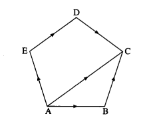
$\begin{aligned} \mathrm{LHS} & =\overline{\mathrm{AB}}+\overline{\mathrm{AE}}+\overline{\mathrm{BC}}+\overline{\mathrm{DC}}+\overline{\mathrm{ED}} \\ & =(\overline{\mathrm{AB}}+\overline{\mathrm{BC}})+(\overline{\mathrm{AE}}+\overline{\mathrm{ED}}+\overline{\mathrm{DC}})\end{aligned}$
$\begin{aligned} & =\overline{\mathrm{AC}}+\overline{\mathrm{AC}} \\ & =2 \overline{\mathrm{AC}}=\mathrm{RHS}\end{aligned}$
View full question & answer→Question 102 Marks
Prove that : $\bar{a} \times(\bar{b} \times \bar{c})+\bar{b} \times(\bar{c} \times \bar{a})+\bar{c} \times(\bar{a} \times \bar{b})=\overline{0}$
Answer$
\begin{aligned}
& \bar{a} \times(\bar{b} \times \bar{c})+\bar{b} \times(\bar{c} \times \bar{a})+\bar{c} \times(\bar{a} \times \bar{b}) \\
& {[(\bar{a} \cdot \bar{c}) \bar{b}(\bar{a} \cdot \bar{b}) \bar{c}]+[(\bar{b} \cdot \bar{a}) \bar{c}(\bar{b} \cdot \bar{c}) \bar{a}]+[(\bar{c} \cdot \bar{b}) \bar{a}(\bar{c} \cdot \bar{a}) \bar{b}]} \\
& (\bar{a} \cdot \bar{c}) \bar{b}(\bar{a} \cdot \bar{b}) \bar{c}+(\bar{a} \cdot \bar{b}) \bar{c}(\bar{b} \cdot \bar{c}) \bar{a}+(\bar{b} \cdot \bar{c}) \bar{a}(\bar{a} \cdot \bar{c}) \bar{b}=\overline{0}
\end{aligned}
$
View full question & answer→Question 112 Marks
If $\vec{a}=\hat{i}+\hat{j}+\hat{k}, \vec{a} \cdot \vec{b}=1$ and $\vec{a} \times \vec{b}=\hat{j}-\hat{k}$ then prove that $\vec{b}=\hat{i}$.
AnswerAs $(\vec{a} \times \vec{b}) \times \vec{a}=(\vec{a} \cdot \vec{a}) \vec{b}-(\vec{a} \cdot \vec{b}) \vec{a}$
$
\begin{aligned}
& \quad \vec{a} \cdot \vec{a}=|\vec{a}|^2=1+1+1=3 \text { and } \vec{a} \cdot \vec{b}=1 \\
& \therefore(\hat{j}-\hat{k}) \times(\hat{i}+\hat{j}+\hat{k})=3(\vec{b})-(\hat{i}+\hat{j}+\hat{k}) \\
& \text { i.e. }\left|\begin{array}{ccc}
\hat{i} & \hat{j} & \hat{k} \\
0 & 1 & -1 \\
1 & 1 & 1
\end{array}\right|=3(\vec{b})-(\hat{i}+\hat{j}+\hat{k}) \\
& (2 \hat{i}-\hat{j}-\hat{k})+(\hat{i}+\hat{j}+\hat{k})=3 \vec{b} \\
& \text { i.e. } \hat{i}=\bar{b}
\end{aligned}
$
View full question & answer→Question 122 Marks
Prove the Theorem : The volume of a tetrahedron with coterminus edges $\bar{a}, \bar{b}$ and $\bar{c}$ is $\frac{1}{6}\left[\begin{array}{lll}\bar{a} & \bar{b} & \bar{c}\end{array}\right]$.
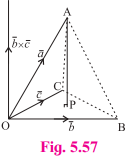
AnswerProof : Let $\overline{O A}=\bar{a}, \overline{O B}=\bar{b}$ and $\overline{O C}=\bar{c}$ be coterminus edges of tetrahedron $\mathrm{OABC}$.
Let AP be the height of tetrahedron
Volume of tetrahedron $=\frac{1}{3}($ Area of base $\triangle \mathrm{OCB})($ Height AP $)$
But AP $=$ Scalar Projection of $\bar{a}$ on $(\bar{b} \times \bar{c})=\frac{(\bar{b} \times \bar{c}) \cdot \bar{a}}{|\bar{b} \times \bar{c}|}\left(\because\right.$ scalar projection of $\bar{p}$ on $\vec{q}$ is $\left.\frac{\bar{p} \cdot \vec{q}}{\bar{q}}\right)$
Area of $\Delta \mathrm{OBC}=\frac{1}{2}|\bar{b} \times \bar{c}|$
Volume of tetrahedron
$
\begin{aligned}
& =\frac{1}{3} \times \frac{1}{2}|\bar{b} \times \bar{c}| \frac{(\bar{b} \times \bar{c}) \cdot \bar{a}}{|\bar{b} \times \bar{c}|} \\
& =\frac{1}{6}[(\bar{b} \times \bar{c}) \cdot a]=\frac{1}{6}[\bar{a} \bar{b} \bar{c}]
\end{aligned}
$
View full question & answer→Question 132 Marks
Prove the Theorem : The volume of parallelopiped with coterminus edges as $\bar{a}, \bar{b}$ and $\bar{c}$ is $\left[\begin{array}{lll}\bar{a} & \bar{b} & \bar{c}\end{array}\right]$
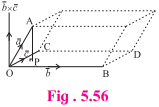
AnswerProof : Let $\overline{O A}=\bar{a}, \overline{O B}=\bar{b}$ and $\overline{O C}=\bar{c}$ be coterminus edges of parallelopiped.
Let $\mathrm{AP}$ be the height of the parallelopiped.
Volume of Parallelopiped $=($ Area of base parallelogram OBDC $)($ Height AP $)$
But AP $=$ Scalar Projection of $\bar{a}$ on $(\bar{b} \times \bar{c})=\frac{(\bar{b} \times \bar{c}) \cdot \bar{a}}{|\bar{b} \times \bar{c}|}\left(\because\right.$ scalar projection of $\bar{p}$ on $\vec{q}$ is $\left.\frac{\bar{p} \cdot \vec{q}}{\bar{q}}\right)$ and area of parallelogram OBDC $=|\bar{b} \times \bar{c}|$
$
\begin{aligned}
\text { volume of parallelopiped } & =\frac{(\bar{b} \times \bar{c}) \cdot a}{|\bar{b} \times \bar{c}|}|\bar{b} \times \bar{c}| \\
& =\bar{a} \cdot(\bar{b} \times \bar{c})=\left[\begin{array}{lll}
\bar{a} & \bar{b} & \bar{c}
\end{array}\right] \quad \text { Fig.5.56 }
\end{aligned}
$
View full question & answer→Question 142 Marks
Show that the three points with position vectors $3 \hat{j}-2 \hat{j}+4 \hat{k}, \hat{i}+\hat{j}+\hat{k}$ and $-\hat{i}+4 \hat{j}-2 \hat{k}$ respectively are collinear.
AnswerLet A, B, C be the given three points.
$\bar{a}=3 \hat{j}-2 \hat{j}+4 \hat{k}, \bar{b}=\hat{i}+\hat{j}+\hat{k}$ and $\bar{c}=-\hat{i}+4 \hat{j}-$ To show that points A, B, C are collinear.
Now $\overrightarrow{A B}=\bar{b}-\bar{a}=-2 \hat{i}+3 \hat{j}-3 \hat{k}, \overrightarrow{A C}=\bar{c}-\bar{a}=-4 \hat{i}+6 \hat{j}-6 \hat{k}$.
$
\begin{aligned}
\overline{A B} \times \overline{A C} & =\left|\begin{array}{ccc}
\hat{i} & \hat{j} & \hat{k} \\
-2 & 3 & -3 \\
-4 & 6 & -6
\end{array}\right| \\
& =(-18+18) \hat{i}-(12-12) \hat{j}+(-12+12) \hat{k} \\
& =0 \hat{i}-0 \hat{j}+0 \hat{k} \\
& =\overline{0}
\end{aligned}
$
Vectors $\overline{A B}$ and $\overline{A C}$ are collinear, but the point $\mathrm{A}$ is common, therefore points $\mathrm{A}, \mathrm{B}, \mathrm{C}$ are collinear.
View full question & answer→Question 152 Marks
Find the cross product $\bar{a} \times \bar{b}$ and verify that it is orthagonal (perpendicular) to both $\bar{a}$ and $\bar{b}$
(ii) $\quad \bar{a}=\hat{i}+3 \hat{j}-2 \hat{k} \bar{b}=-\hat{i}+5 \hat{k}$
Answer$
\begin{gathered}
\bar{a} \times \bar{b}=\left|\begin{array}{ccc}
\hat{i} & \hat{j} & \hat{k} \\
1 & 3 & -2 \\
-1 & 0 & 5
\end{array}\right|=\left|\begin{array}{cc}
3 & -2 \\
0 & 5
\end{array}\right| \hat{i}\left|\begin{array}{cc}
1 & -2 \\
-1 & 5
\end{array}\right| \hat{j}+\left|\begin{array}{cc}
1 & 3 \\
-1 & 0
\end{array}\right| \hat{k} \\
=(15-0) \hat{i}-(5-2) \hat{j}+[0-(-3)] \hat{k}=15 \hat{i}-3 \hat{j}+3 \hat{k}
\end{gathered}
$
Now $(\bar{a} \times \bar{b}) \cdot \bar{a}=(15 \hat{i}-3 \hat{j}+3 \hat{k}) \cdot(\hat{i}+3 \hat{j}-2 \hat{k})=15-9-6=0$,
and $\quad(\bar{a} \times \bar{b}) \cdot \bar{b}=(15 \hat{i}-3 \hat{j}+3 \hat{k}) \cdot(-\hat{i}+5 \hat{k})=15+0+15=0, \bar{a} \times \bar{b}$ is orthogonal to both $\bar{a}$ and $\bar{b}$
View full question & answer→Question 162 Marks
Find the cross product $\bar{a} \times \bar{b}$ and verify that it is orthagonal (perpendicular) to both $\bar{a}$ and $\bar{b}$
(i) $\bar{a}=\hat{i}+\hat{j}-\hat{k}, \bar{b}=2 \hat{i}+4 \hat{j}+6 \hat{k}$
Answer$\bar{a} \times \bar{b}=\left|\begin{array}{ccc}\hat{i} & \hat{j} & \hat{k} \\ 1 & 1 & -1 \\ 2 & 4 & 6\end{array}\right|=\left|\begin{array}{cc}1 & -1 \\ 4 & 6\end{array}\right| \hat{i}-\left|\begin{array}{cc}1 & -1 \\ 2 & 6\end{array}\right| \hat{j}+\left|\begin{array}{cc}1 & 1 \\ 2 & 4\end{array}\right| \hat{k}$
$
=[6-(-4)] \hat{i}-[6-(-2)] \hat{j}+(4-2) \hat{k}=10 \hat{i}-8 \hat{j}+2 \hat{k}
$
Now $\bar{a} \times \bar{b} \cdot \bar{a}=(10 \hat{i}-8 \hat{j}+2 \hat{k}) \cdot(\hat{i}+\hat{j}-\hat{k})=10-8-2=0$ and
$
\bar{a} \times \bar{b} \cdot \bar{b}=(10 \hat{i}-8 \hat{j}+2 \hat{k}) \cdot(2 \hat{i}+4 \hat{j}-6 \hat{k})=20-32+12=0
$
so $\bar{a} \times \bar{b}$ is orthogonal to both $\bar{a}$ and $\bar{b}$.
View full question & answer→Question 172 Marks
$\mathrm{~A}$ line makes angles of measure $45^{\circ}$ and $60^{\circ}$ with the positive direction of the $\mathrm{Y}$ and $\mathrm{Z}$ axes respectively. Find the angle made by the line with the positive directions of the $\mathrm{X}$-axis.
AnswerLet $\alpha, \beta, \gamma$ be the angles made by the line with positive direction of $\mathrm{X}, \mathrm{Y}$ and $\mathrm{Z}$ axes respectively. Given $\beta=45^{\circ}$ and $\gamma=60^{\circ}$.
Now $\cos \beta=\cos 45^{\circ}$ and $\cos \gamma=\cos 60^{\circ}=\frac{1}{2}$
$
\cos ^2 \alpha+\cos ^2 \beta+\cos ^2 \gamma=1
$
$
\begin{array}{ll}
\therefore & \cos ^2 \alpha+\frac{1}{2}+\frac{1}{4}=1 \\
\therefore & \cos ^2 \alpha=\frac{1}{4} \\
\therefore & \cos \alpha= \pm \frac{1}{2}
\end{array}
$
$\therefore \quad \alpha=60^{\circ}$ or $120^{\circ}$ There are two lines satisfying given conditions. Their direction angles are $45^{\circ}, 60^{\circ}, 60^{\circ}$ and $45^{\circ}, 60^{\circ}, 120^{\circ}$
View full question & answer→Question 182 Marks
Find the position vector of a point $\mathrm{P}$ such that $\mathrm{AB}$ is inclined to $\mathrm{X}$ axis at $45^{\circ}$ and to $\mathrm{Y}$ axis at $60^{\circ}$ and $\mathrm{OP}=12$ units.
AnswerWe have $l=\cos 45^{\circ}=\frac{1}{\sqrt{2}}, m=\cos 60^{\circ}=\frac{1}{2}, n=\cos \gamma$
Now $l^2+m^2+n^2=1$
$
\begin{aligned}
& \therefore \frac{1}{2}+\frac{1}{4}+\cos ^2 \gamma=1, \text { i.e. } \cos ^2 \gamma=\frac{1}{4} \text {, i.e. } n=\cos \gamma= \pm \frac{1}{2} \\
& \text { Now } \vec{r}=|\vec{r}| \hat{r}=|\vec{r}|(\hat{l}+m \hat{j}+n \hat{k})=12\left(\frac{1}{\sqrt{12}} \hat{i}+\frac{1}{2} \hat{j} \pm \frac{1}{2} \hat{k}\right)
\end{aligned}
$
Hence $\vec{r}=6 \sqrt{2} \hat{i}+6 \hat{j} \pm 6 \hat{k}$
View full question & answer→Question 192 Marks
Find the direction cosines of the vector $2 \hat{i}+2 \hat{i}-\hat{k}$
AnswerLet $|\vec{a}|=2 \hat{i}+2 \hat{j}-\hat{k}$
$
\begin{aligned}
& \therefore|\bar{a}|=\sqrt{(2)^2+(2)^2+(-1)^2}=\sqrt{9}=3 \\
\therefore & \hat{a}=\frac{\bar{a}}{|\bar{a}|}=\frac{2 \hat{i}+2 \hat{j}+\hat{k}}{3}=\frac{2}{3} \hat{i}+\frac{2}{3} \hat{j}-\frac{1}{3} \hat{k}
\end{aligned}
$
$\therefore \quad$ The direction cosines of $\bar{a}$ are $\frac{2}{3}, \frac{2}{3},-\frac{1}{3}$
View full question & answer→Question 202 Marks
Find the values of $\lambda$ for which the angle between the vectors $\vec{a}=2 \lambda^2 \hat{i}+4 \lambda \hat{j}+\hat{k}$ and $\vec{b}=7 \hat{i}-2 \hat{j}+\lambda \hat{k}$
AnswerIf $\theta$ is the angle between $\vec{a}$ and $\vec{b}$, then $\cos \theta=\frac{\vec{a} \cdot \vec{b}}{|\vec{a}||\vec{b}|}$
If $\theta$ is obtuse then $\cos \theta<0$
$
\begin{aligned}
& \left.\therefore \frac{\vec{a} \cdot \vec{b}}{|\vec{a}||\vec{b}|}<0 \text { i.e. } \vec{a} \cdot \vec{b}<0 \quad \quad \quad \quad \because|\vec{a}||\vec{b}|>0\right] \\
& \therefore\left(2 \lambda^2 \hat{i}+4 \lambda \hat{j}+\hat{k}\right) \cdot(7 \hat{i}-2 \hat{j}+\lambda \hat{k})<0 \\
& \therefore 14 \lambda^2-8 \lambda+\lambda<0 \text { i.e. } 14 \lambda^2-7 \lambda<0 \\
& \therefore 7 \lambda(2 \lambda-1)<0 \text { i.e. } \lambda\left(\lambda-\frac{1}{2}\right)<0 \text { i.e. } 0<\lambda<\frac{1}{2}
\end{aligned}
$
Thus the angle between $\bar{a}$ and $\bar{b}$ is abtuse if $0<\lambda<\frac{1}{2}$
View full question & answer→Question 212 Marks
Find the vector projection of $P \vec{Q}$ on $A \vec{B}$ where P, Q, A, B are the points $(-2,1,3),(3,2,5)$ $(4,-3,5)$ and $(7,-5,-1)$ respectively.
AnswerLet the position vectors of $\mathrm{P}, \mathrm{Q}, \mathrm{A}, \mathrm{B}$ are $\bar{p}, \bar{q}, \bar{a}, \bar{b}$ respectively
$
\begin{aligned}
& \bar{p}=-2 \hat{i}+\hat{j}+3 \hat{k}, \bar{q}=3 \hat{i}+2 \hat{j}+5 \hat{k} \\
& \bar{a}=4 \hat{i}-3 \hat{j}+5 \hat{k}, \bar{b}=7 \hat{i}-5 \hat{j}-\hat{k} \\
& \therefore \quad P \quad \bar{Q}=\bar{q}-\bar{p}=(3 \hat{i}+2 \hat{j}+5 \hat{k})-(-2 \hat{i}+\hat{j}+3 \hat{k})=5 \hat{i}+\hat{j}+2 \hat{k} \\
& \text { and } A \bar{B}=\bar{b}-\bar{a}=(7 \hat{i}-5 \hat{j}-\hat{k})-(4 \hat{i}-3 \hat{j}+5 \hat{k})=3 \hat{i}-2 \hat{j}-6 \hat{k}
\end{aligned}
$
$\therefore$ Vector Projection of $\overline{P Q}$ on $\overline{A B}$
$
\begin{aligned}
& =\frac{\overline{P Q} \cdot \overline{A B}}{|\overline{A B}|^2} \overline{A B}=\frac{(5)(3)+(1)(-2)+(2)(-6)}{(3)^2+(-2)^2+(-6)^2} \overline{A B} \\
= & \frac{1}{49}(3 \hat{i}-2 \hat{j}-6 \hat{k})=\frac{3}{49} \hat{i}-\frac{2}{49} \hat{j}-\frac{6}{49} \hat{k}
\end{aligned}
$
View full question & answer→Question 222 Marks
If $\vec{a}=\hat{i}+2 \hat{j}-3 \hat{k}$ and $\vec{b}=3 \hat{i}-\hat{j}+2 \hat{k}$ find the angle between the vectors $2 \vec{a}+\vec{b}$ and $\vec{a}+2 \vec{b}$.
Answer$2 \bar{a}+\bar{b}=2(\hat{i}+2 \hat{j}-3 \hat{k})+(3 \hat{i}-\hat{j}+2 \hat{k})=5 \hat{i}+3 \hat{j}-4 \hat{k}={ }^{\prime} \bar{m}^{\prime}($ say $)$
$
\begin{aligned}
\bar{a}+2 \bar{b} & =(\hat{i}+2 \hat{j}-3 \hat{k})+2(3 \hat{i}-\hat{j}+2 \hat{k})=7 \hat{i}+\hat{k}={ }^{\prime} \bar{n}^{\prime}(\text { say }) \\
\therefore \bar{m} \cdot \bar{n} & =(2 \bar{a}+\bar{b}) \cdot(\bar{a}+2 \bar{b})=(5 \hat{j}+3 \bar{j}-4 \hat{k}) \cdot(7 \hat{i}+\hat{k}) \\
& =(5)(7)+(3)(0)+(-4)(1)=31
\end{aligned}
$$
|\bar{m}|=\sqrt{(5)^2+(3)^2+(-4)^2}=\sqrt{50}
$
$
|\bar{n}|=\sqrt{(7)^2+(0)^2+(1)^2}=\sqrt{50}
$
If $\theta$ is the angle between $\bar{m}$ and $\bar{n}$ then
$
\begin{aligned}
& \cos \theta=\frac{\bar{m} \cdot \bar{n}}{|\bar{m}||\bar{n}|}=\frac{31}{\sqrt{50} \times \sqrt{50}}=\frac{31}{50} \\
& \therefore \theta=\cos ^{-1}\left(\frac{31}{50}\right)
\end{aligned}
$
View full question & answer→Question 232 Marks
Find the centroid of tetrahedron with vertices $\mathrm{A}(3,-5,7), \mathrm{B}(5,4,2), \mathrm{C}(7,-7,-3), \mathrm{D}(1,0,2)$ ?
AnswerLet $\bar{a}=3 \hat{i}-5 \hat{j}+7 \hat{k}, \bar{b}=5 \hat{i}+4 \hat{j}+2 \hat{k}, \bar{c}=7 \hat{i}-7 \hat{j}-3 \hat{k}, \bar{d}=\hat{i}+2 \hat{k}$ be position vectors of vertices A, B, C \& D.
By centroid formula, centroid $\mathrm{G}(\bar{g})$ is given by
$
\begin{aligned}
\bar{g} & =\frac{\bar{a}+\bar{b}+\bar{c}+\bar{d}}{4} \\
& =\frac{(3 \hat{i}-5 \hat{j}+7 \hat{k})+(5 \hat{i}+4 \hat{j}+2 \hat{k})+(7 \hat{i}-7 \hat{j}-3 \hat{k})+(\hat{i}+2 \hat{k})}{4} \\
& =\frac{(3+5+7+1) \hat{i}+(-5+4-7+0) \hat{j}+(7+2-3+2) \hat{k}}{4}=\frac{16 \hat{i}-8 \hat{j}+8 \hat{k}}{4} \\
& =4 \hat{i}-2 \hat{j}+2 \hat{k}
\end{aligned}
$
Therefore, centroid of tetrahedron is $G \equiv(4,-2,2)$.
View full question & answer→Question 242 Marks
If $\mathrm{G}(a, 2,-1)$ is the centroid of the triangle with vertices $\mathrm{P}(1,2,3), \mathrm{Q}(3, b,-4)$ and $\mathrm{R}(5,1, c)$ then find the values of $a, b$ and $c$.
AnswerAs $G(\bar{g})$ is centroid of $\triangle \mathrm{PQR} \bar{g}=\frac{\bar{p}+\bar{q}+\bar{r}}{3}$
$
\begin{aligned}
& a \hat{i}+2 \hat{j}-\hat{k}=\frac{(\hat{i}+3 \hat{j}+2 \hat{k})+(3 \hat{i}+b \hat{j}-4 \hat{k})+(5 \hat{i}+\hat{j}+c \hat{k})}{3}=\frac{(1+3+5) \hat{i}+(3+b+1) \hat{j}+(2-4+c) \hat{k}}{3} \\
& \text { by equality of vectors } \quad a=\frac{1+3+5}{3}=\frac{9}{3}=3 \quad \therefore a=3
\end{aligned}
$
by equality of vectors
$
a=\frac{1+3+5}{3}=\frac{9}{3}=3 \quad \therefore a=3
$
$
\begin{aligned}
& \therefore 2=\frac{3+b+1}{3} \quad \therefore 6=4+b \quad \therefore b=2 \\
& \therefore-1=\frac{2-4+c}{3} \quad \therefore-3=-2+c \quad \therefore c=-1 .
\end{aligned}
$
View full question & answer→Question 252 Marks
If $\bar{a}, \bar{b}, \bar{c}$ are the position vectors of the points $\mathrm{A}, \mathrm{B}, \mathrm{C}$ respectively and $5 \bar{a}-3 \bar{b}-2 \bar{c}=\overline{0}$, then find the ratio in which the point $\mathrm{C}$ divides the line segment BA.
$
\begin{array}{cl}
Answer\text {As } & 5 \bar{a}-3 \bar{b}-2 \bar{c}=\overline{0} \\
\therefore & 2 \bar{c}=5 \bar{a}-3 \bar{b} \\
\therefore & \bar{c}=\frac{5 \bar{a}-3 \bar{b}}{2} \\
\therefore & \bar{c}=\frac{5 \bar{a}-3 \bar{b}}{5-3}
\end{array}
$
$\therefore$ This shows that the point $\mathrm{C}$ divides BA externally in the ratio $5: 3$.
View full question & answer→Question 262 Marks
Prove the Theorem: (Section formula for external division) Let $\mathrm{A}(\bar{a})$ and $\mathrm{B}(\bar{b})$ be any two points in the space and $\mathrm{R}(\bar{r})$ be the third point on the line $\mathrm{AB}$ dividing the segment $\mathrm{AB}$ externally in the ratio $m: n$. Then $\bar{r}=\frac{m \bar{b}-n \bar{a}}{m-n}$.
View full question & answer→Question 272 Marks
Prove The Theorem : (Section formula for internal division) Let $\mathrm{A}(\bar{a})$ and $\mathrm{B}(\bar{b})$ be any two points in the space and $\mathrm{R}(\bar{r})$ be a point on the line segment $\mathrm{AB}$ dividing it internally in the ratio $m: n$.
Then $\bar{r}=\frac{m \bar{b}+n \bar{a}}{m+n}$
View full question & answer→Question 282 Marks
Show that the vectors $4 \hat{i}+13 \hat{j}-18 \hat{k}, \hat{i}-2 \hat{j}+3 \hat{k}$ and $2 \hat{i}+3 \hat{j}-4 \hat{k}$ are coplanar.
AnswerLet, $\bar{a}=4 \hat{i}+13 \hat{j}-18 \hat{k}, \bar{b}=\hat{i}-2 \hat{j}+3 \hat{k}, \bar{c}=2 \hat{i}+3 \hat{j}-4 \hat{k}$
Consider $\bar{a}=m \bar{b}+n \bar{c}$
$
\begin{aligned}
& \therefore \quad 4 \hat{i}+13 \hat{j}-18 \hat{k}=m(\hat{i}-2 \hat{j}+3 \hat{k})+n(2 \hat{i}+3 \hat{j}-4 \hat{k}) \\
& \therefore \quad 4 \hat{i}+13 \hat{j}-18 \hat{k}=(m+2 n) \hat{i}+(-2 m+3 n) \hat{j}+(3 m-4 n) \hat{k}
\end{aligned}
$
By equality of two vectors, we have
$
\begin{aligned}
& m+2 n=4 \\
& -2 m+3 n=13 \\
& 3 m-4 n=-18
\end{aligned}
$
Solving (1) and (2) we get, $\therefore m=-2, \quad n=3$
These values of $m$ and $n$ satisfy equation (3) also.
$
\therefore \bar{a}=-2 \bar{b}+3 \bar{c}
$
Therefore, $\bar{a}$ is a linear combination of $\bar{b}$ and $\bar{c}$. Hence, $\bar{a}, \bar{b}$ and $\bar{c}$ are coplanar.
View full question & answer→Question 292 Marks
Show that the three points $\mathrm{A}(1,-2,3), \mathrm{B}(2,3,-4)$ and $\mathrm{C}(0,-7,10)$ are collinear.
AnswerIf $\bar{a}, \bar{b}$ and $\bar{c}$ are the position vectors of the points $\mathrm{A}, \mathrm{B}$ and $\mathrm{C}$ respectively, then
$
\begin{aligned}
\bar{a} & =\hat{i}-2 \hat{j}+3 \hat{k} \\
\bar{b} & =2 \hat{i}+3 \hat{j}-4 \hat{k} \\
\bar{c} & =0 \hat{i}-7 \hat{j}+10 \hat{k} \\
\overline{\mathrm{AB}} & =\bar{b}-\bar{a}=\hat{i}+5 \hat{j}-7 \hat{k} \\
\overline{\mathrm{AC}} & =\bar{c}-\bar{a} \\
& =-\hat{i}-5 \hat{j}+7 \hat{k} \\
& =(-1)[\hat{i}+5 \hat{j}-7 \hat{k}] \\
\overline{\mathrm{AC}} & =(-1) \overline{\mathrm{AB}}
\end{aligned}
$
... from(1)
That is, $\overline{\mathrm{AC}}$ is a scalar multiple of $\overline{\mathrm{AB}}$. Therefore, they are parallel. But point $\mathrm{A}$ is in common. Hence, the points $\mathrm{A}, \mathrm{B}$ and $\mathrm{C}$ are collinear.
View full question & answer→Question 302 Marks
Express $-\hat{i}-3 \hat{j}+4 \hat{k}$ as the linear combination of the vectors $2 \hat{i}+\hat{j}-4 \hat{k}, 2 \hat{i}-\hat{j}+3 \hat{k}$ and $3 \hat{i}+\hat{j}-2 \hat{k}$.
AnswerLet $\bar{r}=-\hat{i}-3 \hat{j}+4 \hat{k} \quad \bar{a}=2 \hat{i}+\hat{j}-4 \hat{k}, \bar{b}=2 \hat{i}-\hat{j}+3 \hat{k}, \bar{c}=3 \hat{i}+\hat{j}-2 \hat{k}$
Consider $\quad \bar{r}=x \bar{a}+y \bar{b}+z \bar{c}$
$
\begin{aligned}
& -\hat{i}-3 \hat{j}+4 \hat{k}=x(2 \hat{i}+\hat{j}-4 \hat{k}) \hat{i}+(2 \hat{i}-\hat{j}+3 \hat{k})+z(3 \hat{i}+\hat{j}-2 \hat{k}) \\
& -\hat{i}-3 \hat{j}+4 \hat{k}=(2 x+2 y+3 z) \hat{i}+(x-y+z) \hat{j}+(-4 x+3 y-2 z) \hat{k}
\end{aligned}
$
By equality of vectors, we get $-1=2 x+2 y+3 z,-3=x-y+z, 4=-4 x+3 y-2 z$,
Using Cramer's rule we get, $x=2, y=2, z=3$. Therefore $\bar{r}=2 \bar{a}+2 \bar{b}-3 \bar{c}$
View full question & answer→Question 312 Marks
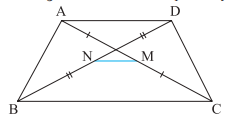
In quadrilateral $ABCD , M$ and $N$ are the mid-points of the diagonals $AC$ and $BD$ respectively.prove that
$\overline{ AB }+\overline{ AD }+\overline{ CB }+\overline{ CD }=4 \overline{ MN }$
Answer$\overline{ AB }=\overline{ AM }+\overline{ MN }+\overline{ NB }....(1)$
$\overline{ AD }=\overline{ AM }+\overline{ MN }+\overline{ ND }....(2)$
$\overline{ CB }=\overline{ CM }+\overline{ MN }+\overline{ NB }....(3)$
$\overline{ CD }=\overline{ CM }+\overline{ MN }+\overline{ ND }....(4)$
View full question & answer→Question 322 Marks
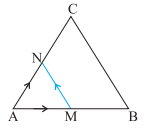
Prove that the line segment joining the midpoints of two sides of a triangle is parallel to and half of the third side.
AnswerLet the triangle be $ABC$. If $M$ and $N$ are the midpoints of $AB$ and $AC$ respectively, then $\overrightarrow{ AM }=1 / 2 \overrightarrow{ AB }$ and $\overrightarrow{ AN }=1 / 2 \overrightarrow{ AC }$.
Thus by triangle law $ \overrightarrow{ AN }=\overrightarrow{ AM }+\overrightarrow{ MN }$
$\therefore \overline{ MN }=\overrightarrow{ AN }-\overline{ AM }=\frac{\overrightarrow{ AC }-\overline{ AB }}{2}=\frac{\overrightarrow{ BC }}{2} $
Thus, $\overrightarrow{ MN }$ is parallel to and half as long as $\overline{ BC }$.
View full question & answer→Question 332 Marks
Show that $\bar{a} \times(\bar{b} \times \bar{c})+\bar{b} \times(\bar{c} \times \bar{a})+\bar{c} \times(\bar{a} \times \bar{b})=0$
Answer$\begin{array}{r}=(\bar{a} \cdot \bar{c}) \bar{b}-(\bar{a} \cdot \bar{b}) \bar{c}+(\bar{b} \cdot \bar{a}) \bar{c}-(\bar{b} \cdot \bar{c}) \bar{a}+(\bar{c} \cdot \bar{b}) \bar{a}-(\bar{c} \cdot \bar{a}) \bar{b} \\ =(\bar{c} \cdot \bar{a}) \bar{b}-(\bar{a} \cdot \bar{b}) \bar{c}+(\bar{a} \cdot \bar{b}) \bar{c}-(\bar{b} \cdot \bar{c}) \bar{a}+(\bar{b} \cdot \bar{c}) \bar{a}-(\bar{c} \cdot \bar{a}) \bar{b} \\ \ldots[\because \bar{a} \cdot \bar{b}=\bar{b} \cdot \bar{a}]\end{array}$$=\overline{0}=$ RHS.
View full question & answer→Question 342 Marks
$(\bar{a} \times \bar{b}) \times \bar{c}$ Are the results same? Justify.
Answer$\overline{\mathrm{a}} \times \overline{\mathrm{b}}=\left|\begin{array}{ccc}\hat{i} & \hat{j} & \hat{k} \\ 1 & -2 & 0 \\ 1 & 2 & 0\end{array}\right|$$\begin{aligned} & =(0-0) \hat{i}-(0-0) \hat{j}+(2-(-2)) \hat{k} \\ & =4 \hat{k}\end{aligned}$
$\therefore(\bar{a} \times \bar{b}) \times \bar{c}=\left|\begin{array}{ccc}\hat{i} & \hat{j} & \hat{k} \\ 0 & 0 & 4 \\ 2 & 1 & -2\end{array}\right|$
$=(0-4) \hat{i}-(0-8) \hat{j}+(0-0) \hat{k}$
$=-4 \hat{i}+8 \hat{j}$
$\bar{a} \times(\bar{b} \times \bar{c}) \neq(\bar{a} \times \bar{b}) \times \bar{c}$
View full question & answer→Question 352 Marks
If, $\bar{a}=\hat{i}-2 \hat{j}, \bar{b}=\hat{i}+2 \hat{j}$ and $\bar{c}=2 \hat{i}+\hat{j}-2$ then find(i) $\bar{a} \times(\bar{b} \times \bar{c})$
Answer$\bar{b} \times \bar{c}=\left|\begin{array}{ccc}\hat{i} & \hat{j} & \hat{k} \\ 1 & 2 & 0 \\ 2 & 1 & -2\end{array}\right|$$\begin{aligned} & =(-4-0) \hat{i}-(-2-0) \hat{j}+(1-4) \hat{k} \\ & =-4 \hat{i}+2 \hat{j}-3 \hat{k}\end{aligned}$
$\therefore \bar{a} \times(\bar{b} \times \bar{c})=\left|\begin{array}{ccc}\hat{i} & \hat{j} & \hat{k} \\ 1 & -2 & 0 \\ -4 & 2 & -3\end{array}\right|$
$\begin{aligned} & =(6-0) \hat{i}-(-3-0) \hat{j}+(2-8) \hat{k} \\ & =6 \hat{i}+3 \hat{j}-6 \hat{k}\end{aligned}$
View full question & answer→Question 362 Marks
$(\bar{a}-2 \bar{b}-\bar{c}) \cdot[(\bar{a}-\bar{b}) \times \bar{a}-\bar{b}-\bar{c}]=3[\bar{a}-\bar{b}-\bar{c}]$Question is modified.
$(\bar{a}-2 \bar{b}-\bar{c})[(\bar{a}-\bar{b}) \times \bar{a}-\bar{b}-\bar{c}]=3[\bar{a} \bar{b} \bar{c}]$
Answer$\begin{aligned} & (\bar{a}+2 \bar{b}-\bar{c}) \cdot[(\bar{a}-\bar{b}) \times(\bar{a}-\bar{b}-\bar{c})] \\ & =(\bar{a}+2 \bar{b}-\bar{c}) \cdot(\bar{a} \times \bar{a}-\bar{a} \times \bar{b}-\bar{a} \times \bar{c}-\bar{b} \times \bar{a}+\bar{b} \times \bar{b}+\bar{b} \times \bar{c} \\ & =(\bar{a}+2 \bar{b}-\bar{c}) \cdot(\overline{0}-\bar{a} \times \bar{b}+\bar{c} \times \bar{a}+\bar{a} \times \bar{b}+\overline{0}+\bar{b} \times \bar{c}) \\ & =(\bar{a}+2 \bar{b}-\bar{c}) \cdot(\bar{c} \times \bar{a}+\bar{b} \times \bar{c})\end{aligned}$$=\bar{a} \cdot(\bar{c} \times \bar{a})+\bar{a} \cdot(\bar{b} \times \bar{c})+2 \bar{b} \cdot(\bar{c} \times \bar{a})+2 \bar{b} \cdot(\bar{b} \times \bar{c})-$
$\bar{c} \cdot(\bar{c} \times \bar{a})-\bar{c} \cdot(\bar{b} \times \bar{c})$
$=0+\bar{a} \cdot(\bar{b} \times \bar{c})+2 \bar{b} \cdot(\bar{c} \times \bar{a})+2 \times 0-0-0$
$\begin{aligned} & =\left[\begin{array}{lll}\bar{a} & \bar{b} & \bar{c}\end{array}\right]+2\left[\begin{array}{lll}\bar{b} & \bar{c} & \bar{a}\end{array}\right] \\ & =\left[\begin{array}{lll}\bar{a} & \bar{b} & \bar{c}\end{array}\right]+2\left[\begin{array}{lll}\bar{a} & \bar{b} & \bar{c}\end{array}\right]=3\left[\begin{array}{lll}\bar{a} & \bar{b} & \bar{c}\end{array}\right]\end{aligned}$
View full question & answer→Question 372 Marks
Prove that : (i) [latex]\bar{a} \bar{b}+\bar{c} \bar{a}+\bar{b}+\bar{c}[/latex] = 0
Answer$\begin{aligned} & {[\bar{a} \bar{b}+\bar{c} \bar{a}+\bar{b}+\bar{c}]} \\ & =\bar{a} \cdot[(\bar{b}+\bar{c}) \times(\bar{a}+\bar{b}+\bar{c})] \\ & =\bar{a} \cdot(\bar{b} \times \bar{a}+\bar{b} \times \bar{b}+\bar{b} \times \bar{c}+\bar{c} \times \bar{a}+\bar{c} \times \bar{b}+\bar{c} \times \bar{c})\end{aligned}$$\begin{aligned} & =\bar{a} \cdot(\bar{b} \times \bar{a})+\bar{a} \cdot(\bar{b} \times \bar{b})+\bar{a} \cdot(\bar{b} \times \bar{c})+\bar{a} \cdot(\bar{c} \times \bar{a})+ \\ & \bar{a} \cdot(\bar{c} \times \bar{b})+\bar{a} \cdot(\bar{c} \times \bar{c}) \\ & \end{aligned}$
$=0+0+\bar{a} \cdot(\bar{b} \times \bar{c})+0-\bar{a} \cdot(\bar{b} \times \bar{c})+0$
$=0$.
View full question & answer→Question 382 Marks
If the vectors $-3 \hat{i}+4 \hat{j}-2 \hat{k}, \hat{i}+2 \hat{k}$ and $\hat{i}-p \hat{j}$ are coplanar, then find the value of $p$.
AnswerLet $\bar{a}=-3 \hat{i}+4 \hat{j}-2 \hat{k}, \bar{b}=\hat{i}+2 \hat{k}, \bar{c}=\hat{i}-p \hat{j}$Then, $\bar{a}, \bar{b}, \bar{c}$ are coplanar
$\begin{aligned} & \therefore[\bar{a} \bar{b} \bar{c}]=0 \\ & \therefore\left|\begin{array}{rrr}-3 & 4 & -2 \\ 1 & 0 & 2 \\ 1 & -p & 0\end{array}\right|=0\end{aligned}$
∴ -3(0 + 2p) – 4(0 – 2) – 2(-p – 0) = 0 ∴ -6p + 8 + 2p = 0 ∴ -4p = -8 P = 2.
View full question & answer→Question 392 Marks
If the vectors $3 \hat{i}+5 \hat{k}, 4 \hat{i}+2 \hat{j}-3 \hat{k}$ and $3 \hat{i}+\hat{j}+4 \hat{k}$ are to co-terminus edges of the parallelo piped, then find the volume of the parallelopiped.
AnswerLet $\bar{a}=3 \hat{i}+5 \hat{k}, \bar{b}=4 \hat{i}+2 \hat{j}-3 \hat{k}, \bar{c}=3 \hat{i}+\hat{j}+4 \hat{k}$$\therefore[\bar{a} \bar{b} \bar{c}]=\left|\begin{array}{rrr}3 & 0 & 5 \\ 4 & 2 & -3 \\ 3 & 1 & 4\end{array}\right|$
= 3(8 + 3) – 0(16 + 9) + 5(4 – 6) = 33 – 0 – 10 = 23
$\therefore$ volume of the parallelopiped $=[\bar{a} \bar{b} \bar{c}]$
= 23 cubic units.
View full question & answer→Question 402 Marks
Find $\bar{a} \cdot(\bar{b} \times \bar{c})$, if $\bar{a}=3 \hat{i}-\hat{j}+4 \hat{k} \bar{b}=2 \hat{i}+3 \hat{j}-\hat{k}$ and $\bar{c}=-5 \hat{i}+2 \hat{j}+3 \hat{k}$
Answer$\bar{a} \cdot(\bar{b} \times \bar{c})=\left|\begin{array}{rrr}3 & -1 & 4 \\ 2 & 3 & -1 \\ -5 & 2 & 3\end{array}\right|$= 3(9 + 2) + 1 (6 – 5) + 4(4 + 15) = 33 + 1 + 76 = 110.
View full question & answer→Question 412 Marks
View full question & answer→Question 422 Marks
If $|\bar{a} \cdot \bar{b}|=|\bar{a} \times \bar{b}|$ and $\bar{a} \cdot \bar{b}<0$, then find the angle between $\bar{a}$ and $\bar{b}$
AnswerLet $\theta$ be the anale between $\bar{a}$ and $\bar{b}$.Then $|\bar{a} \cdot \bar{b}|=|\bar{a} \times \bar{b}|$ gives
$|a b \cos \theta|=|a b \sin \theta|$
$\therefore-a b \cos \theta=a b \sin \theta \quad \ldots[\because \bar{a} \cdot \bar{b}<0]$
$\therefore-1=\tan \theta$
$\therefore \tan \theta=-\tan \frac{\pi}{4}=\tan \left(\pi-\frac{\pi}{4}\right)$
$\therefore \tan \theta=\tan \frac{3 \pi}{4} \quad \therefore \theta=\frac{3 \pi}{4}$
Hence, the angle between $\bar{a}$ and $\bar{b}$ is $\frac{3 \pi}{4}$.
View full question & answer→Question 432 Marks
Find the area of parallelogram whose diagonals are determined by the vectors $\bar{a}=$$3 i-\hat{j}-2 \hat{k}_{\text {t }}$ and $\bar{b}=-\hat{i}+3 \hat{j}-3 \hat{k}$
AnswerGiven: $\bar{a}=3 i-\hat{j}-2 \hat{k}, \bar{b}=-\hat{i}+3 \hat{j}-3 \hat{k}$$\therefore \bar{a} \times \bar{b}=\left|\begin{array}{rrr}\hat{i} & \hat{j} & \hat{k} \\ 3 & -1 & -2 \\ -1 & 3 & -3\end{array}\right|$
$=(3+6) \hat{i}-(-9-2) \hat{j}+(9-1) \hat{k}$
$=9 \hat{i}+11 \hat{j}+8 \hat{k}$
and $|\bar{a} \times \bar{b}|=\sqrt{9^2+11^2+8^2}=\sqrt{81+121+64}=\sqrt{266}$
Area of the parallelogram having diagonals $\bar{a}$ and $\bar{b}$
$=\frac{1}{2}|\bar{a} \times \bar{b}|=\frac{1}{2} \sqrt{266}$ sq units.
View full question & answer→Question 442 Marks
Find the area of the parallelogram whose adjacent sides are the vectors $\bar{a}=2 \hat{i}-2 \hat{j}+\hat{k}$and $\bar{b}=\hat{i}-3 \hat{j}-3 \hat{k}$.
AnswerGiven : $\bar{a}=2 \hat{i}-2 \hat{j}+\hat{k} \bar{b}=\hat{i}-3 \hat{j}-3 \hat{k}$$\therefore \bar{a} \times \bar{b}=\left|\begin{array}{rrr}\hat{i} & \hat{j} & \hat{k} \\ 2 & -2 & 1 \\ 1 & -3 & -3\end{array}\right|$
$\begin{aligned} & =(6+3) \hat{i}-(-6-1) \hat{j}+(-6+2) \hat{k} \\ & =9 \hat{i}+7 \hat{j}-4 \hat{k}\end{aligned}$
$|\bar{a} \times \bar{b}|=\sqrt{9^2+7^2+(-4)^2}=\sqrt{81+49+16}=\sqrt{146}$
Area of the parallelogram whose adjacent sides are $\bar{a}$ and $\bar{b}$ is $|\bar{a} \times \bar{b}|=\sqrt{146}$ sq units.
View full question & answer→Question 452 Marks
Prove that $2(\bar{a}-\bar{b}) \times 2(\bar{a}+\bar{b})=8(\bar{a} \times \bar{b})$
Answer$\begin{aligned} \text { LHS } & =2(\bar{a}-\bar{b}) \times 2(\bar{a}+\bar{b}) \\ & =4[(\bar{a}-\bar{b}) \times(\bar{a}+\bar{b})] \\ & =4[\bar{a} \times(\bar{a}+\bar{b})-\bar{b} \times(\bar{a}+\bar{b})] \\ & =4(\bar{a} \times \bar{a}+\bar{a} \times \bar{b}-\bar{b} \times \bar{a}-\bar{b} \times \bar{b}) \\ & =8(\bar{a} \times \bar{b})\end{aligned}$$\ldots[\because \bar{a} \times \bar{a}=\bar{b} \times \bar{b}=\overline{0}$ and $-(\bar{b} \times \bar{a})=\bar{a} \times \bar{b}]$
$=\mathrm{RHS}$
$\therefore 2(\bar{a}-\bar{b}) \times 2(\bar{a}+\bar{b})=8(\bar{a} \times \bar{b})$.
View full question & answer→Question 462 Marks
$|\bar{u} \times \bar{v}|$ if $|\bar{u}|=10,|\vec{v}|=2, \bar{u} \cdot \bar{v}=12$
AnswerLet $\theta$ be the angle between $\bar{u}$ and $\bar{v}$.Then $\bar{u} \cdot \bar{v}=12$ gives
$|\bar{u} \| \bar{v}| \cos \theta=12$
∴ 10 × 2 × cos θ = 12
$\therefore \cos \theta=\frac{3}{5}$, where $0 \leqslant \theta \leqslant \frac{\pi}{2}$
$\begin{aligned} \sin \theta & =\sqrt{1-\cos ^2 \theta} \\ & =\sqrt{1-\left(\frac{3}{5}\right)^2}=\sqrt{1-\frac{9}{25}}\end{aligned}$
$=\sqrt{\frac{16}{25}}=\frac{4}{5}$
Now, $|\bar{u} \times \bar{v}|=|\bar{u}||\bar{v}| \sin \theta$
$\therefore \bar{u} \times \bar{v}=10 \times 2 \times \frac{4}{5}=16$
View full question & answer→Question 472 Marks
$\bar{u} \cdot \bar{v}$ if $|\bar{u}|=2,|\vec{v}|=5,|\bar{u} \times \bar{v}|=8$
AnswerLet $\theta$ be the angle between $\bar{u}$ and $\bar{v}$.Then $|\bar{u} \times \bar{v}|=8$ gives
$|\bar{u}||\bar{v}| \sin \theta=8$
∴ 2 × 5 × sin θ = 8
$\begin{aligned} & \therefore \sin \theta=\frac{4}{5} \\ & \cos \theta= \pm \sqrt{1-\sin ^2 \theta} \quad \ldots[\because 0 \leqslant \theta \leqslant \pi]\end{aligned}$
$\begin{aligned} & = \pm \sqrt{1-\left(\frac{4}{5}\right)^2}= \pm \sqrt{1-\frac{16}{25}} \\ & = \pm \sqrt{\frac{9}{25}}= \pm \frac{3}{5}\end{aligned}$
Now, $\bar{u} \cdot \bar{v}=|\bar{u}||\bar{v}| \cos \theta$
$\therefore \overline{u \cdot v}=2 \times 5 \times\left( \pm \frac{3}{5}\right)= \pm 6$
View full question & answer→Question 482 Marks
If $\bar{a}=2 \hat{i}+\hat{j}-3 \hat{k}$ and $\bar{b}=\hat{i}-2 \hat{j}+\hat{k}$, find a vector of magnitude 5 perpendicular toboth $\bar{a}$ and $\bar{b}$.
AnswerGiven : $\bar{a}=2 \hat{i}+\hat{j}-3 \hat{k}$ and $\bar{b}=\hat{i}-2 \hat{j}+\hat{k}$$\begin{aligned} \therefore \bar{a} \times \bar{b} & =\left|\begin{array}{rrr}\hat{i} & \hat{j} & \hat{k} \\ 2 & 1 & -3 \\ 1 & -2 & 1\end{array}\right| \\ & =(1-6) \hat{i}-(2+3) \hat{j}+(-4-1) \hat{k} \\ & =-5 \hat{i}-5 \hat{j}-5 \hat{k}\end{aligned}$
$\begin{aligned} \therefore|\bar{a} \times \bar{b}| & =\sqrt{(-5)^2+(-5)^2+(-5)^2} \\ & =\sqrt{25+25+25}=\sqrt{75}=5 \sqrt{3}\end{aligned}$
$\therefore$ unit vectors perpendicular to both the vectors $\bar{a}$ and $\bar{b}$.
$=\frac{ \pm(\bar{a} \times \bar{b})}{|\vec{a} \times \bar{b}|}=\frac{ \pm(-5 \hat{i}-5 \hat{j}-5 \hat{k}}{5 \sqrt{3}}$
$=\frac{ \pm(\hat{i}+\hat{j}+\hat{k})}{\sqrt{3}}$
∴ required vectors of magnitude 5 units
$= \pm \frac{5}{\sqrt{3}}(\hat{i}+\hat{j}+\hat{k})$
View full question & answer→Question 492 Marks
If $\bar{a} \cdot \bar{b}=\sqrt{3}$ and $\bar{a} \times \bar{b}=2 \hat{i}+\hat{j}+2 \hat{k}$, find the angle between $\bar{a}$ and $\bar{b}$.
AnswerLet $\theta$ be the angle between $\bar{a}$ and $\bar{b}$$\begin{aligned} & \because \bar{a} \times \bar{b}=2 \hat{i}+\hat{j}+2 \hat{k} \\ & \therefore|\bar{a} \times \bar{b}|=\sqrt{2^2+1^2+2^2}=\sqrt{4+1+4}=3 \\ & \therefore|\bar{a}||\bar{b}| \sin \theta=3\end{aligned}$
... (1)
$\because \bar{a} \cdot \bar{b}=\sqrt{3}$
$\therefore|\bar{a}||\bar{b}| \cos \theta=\sqrt{3}$
... (2)
Dividing (1) by (2), we get
$\frac{|\bar{a}||\bar{b}| \sin \theta}{|\bar{a}||\bar{b}| \cos \theta}=\frac{3}{\sqrt{3}} \quad \therefore \tan \theta=\sqrt{3}=\tan 60^{\circ}$
∴ θ = 60°.
View full question & answer→Question 502 Marks
Find a unit vector perpendicular to the vectors $\hat{j}+2 \hat{k}$ and $\hat{i}+\hat{j}$.
AnswerLet $\bar{a}=\hat{j}+2 \hat{k}, \bar{b}=\hat{i}+\hat{j}$Then $\bar{a} \times \bar{b}=\left|\begin{array}{ccc}\hat{i} & \hat{j} & \hat{k} \\ 0 & 1 & 2 \\ 1 & 1 & 0\end{array}\right|$
$\begin{aligned} & =(0-2) \hat{i}-(0-2) \hat{j}+(0-1) \hat{k} \\ & =-2 \hat{i}+2 \hat{j}-\hat{k}\end{aligned}$
$\therefore|\vec{a} \times \bar{b}|=\sqrt{(-2)^2+2^2+(-1)^2}=\sqrt{4+4+1}=\sqrt{9}=3$
Unit vector perpendicular to both $\bar{a}$ and $\bar{b}$
$= \pm \frac{\bar{a} \times \bar{b}}{|\bar{a} \times \bar{b}|}= \pm\left(\frac{-2 \hat{i}+2 \hat{j}-\hat{k}}{3}\right)$
$= \pm\left(-\frac{2}{3} \hat{i}+\frac{2}{3} \hat{j}-\frac{1}{3} \hat{k}\right)$
View full question & answer→Question 512 Marks
If $\bar{a}=2 \hat{i}+3 \hat{j}-\hat{k}, \bar{b}=\hat{i}-4 \hat{j}+2 \hat{k}$ find $(\bar{a}+\bar{b}) \times(\bar{a}-\bar{b})$
AnswerGiven: $\bar{a}=2 \hat{i}+3 \hat{j}-\hat{k}, \bar{b}=\hat{i}-4 \hat{j}+2 \hat{k}$$\begin{aligned} & \therefore \vec{a}+\bar{b}=(2 \hat{i}+3 \hat{j}-\hat{k})+(\hat{i}-4 \hat{j}+2 \hat{k})=3 \hat{i}-\hat{j}+\hat{k} \\ & \text { and } \bar{a}-\bar{b}=(2 \hat{i}+3 \hat{j}-\hat{k})-(\hat{i}-4 \vec{j}+2 \hat{k})=\hat{i}+7 \hat{j}-3 \hat{k}\end{aligned}$
$\begin{aligned} \therefore(\bar{a}+\bar{b}) \times(\bar{a}-\bar{b}) & =\left|\begin{array}{rrr}\hat{i} & \hat{j} & \hat{k} \\ 3 & -1 & 1 \\ 1 & 7 & -3\end{array}\right| \\ & =(3-7) \hat{i}-(-9-1) \hat{j}+(21+1) \hat{k} \\ & =-4 \hat{i}+10 \hat{j}+22 \hat{k} .\end{aligned}$
View full question & answer→Question 522 Marks
If a line makes angles 90º, 135º, 45º with the X, Y and Z axes respectively, then find its direction cosines.
AnswerLet l, m, n be the direction cosines of the line.Then l = cos α, m = cos β, n = cos γ Here, α = 90°, β = 135° and γ = 45° ∴ l = cos 90° = 0
$m=\cos 135^{\circ}=\cos \left(180^{\circ}-45^{\circ}\right)=-\cos 45^{\circ}=-\frac{1}{\sqrt{2}}$ and $n=\cos 45^{\circ}=\frac{1}{\sqrt{2}}$
$\therefore$ the direction cosines of the line are $0,-\frac{1}{\sqrt{2}}, \frac{1}{\sqrt{2}}$.
View full question & answer→Question 532 Marks
Show that the sum of the length of projections of $\hat{p} \hat{i}+q \hat{j}+r \hat{k}$ on the coordinate axes,where p = 2, q = 3 and r = 4, is 9.
AnswerLet $\bar{a}=\hat{p} \hat{i}+q \hat{j}+r \hat{k}$Projection of $\bar{a}$ on $\mathrm{X}$-axis
$=\frac{\bar{a} \cdot \hat{i}}{|\hat{i}|}=\frac{(p \hat{i}+q \hat{i}+r \hat{k}) \cdot \hat{i}}{1}=p=2$
Similarly, projections of $\bar{a}$ on $Y$ - and $Z$-axes are 3 and 4 respectively.
∴ sum of these projections = 2 + 3 + 4 = 9.
View full question & answer→Question 542 Marks
If the vectors $2 \hat{i}-q \hat{j}+3 \hat{k}$ and $4 \hat{i}-5 \hat{j}+6 \hat{k}$ are collinear, then find the value of $q$.
AnswerThe vectors $2 \hat{i}-q \hat{j}+3 \hat{k}$ and $4 \hat{i}-5 \hat{j}+6 \hat{k}$ are collinear$\therefore$ the coefficients of $\hat{i}, \hat{j}, \hat{k}$ are proportional
$\begin{aligned} & \therefore \frac{2}{4}=\frac{-q}{-5}=\frac{3}{6} \\ & \therefore \frac{q}{5}=\frac{1}{2} \\ & \therefore q=\frac{5}{2} .\end{aligned}$
View full question & answer→Question 552 Marks
If $\overline{\mathrm{AB}}=2 \hat{i}-4 \hat{j}+7 \hat{k}$ and initial point $\mathrm{A} \equiv(1,5,0)$. Find the terminal point $\mathrm{B}$.
AnswerLet $\bar{a}$ and $\bar{b}$ be the position vectors of $A$ and $B$.Given: $\mathrm{A}=(1,5,0) \therefore \bar{a}=\hat{i}+5 \hat{j}$
Now, $\overline{\mathrm{AB}}=2 \hat{i}-4 \hat{j}+7 \hat{k}$
$\begin{aligned} & \therefore \bar{b}-\bar{a}=2 \hat{i}-4 \hat{j}+7 \hat{k} \\ & \therefore \bar{b}=(2 \hat{i}-4 \hat{j}+7 \hat{k})+\bar{a} \\ & =(2 \hat{i}-4 \hat{j}+7 \hat{k})+(\hat{i}+5 \hat{j}) \\ & =3 \hat{i}+\hat{j}+7 \hat{k}\end{aligned}$
Hence, the terminal point B = (3, 1, 7).
View full question & answer→Question 562 Marks
Check whether the vectors $2 \hat{i}+2 \hat{j}+3 \hat{k}_{+}+-3 \hat{i}+3 \hat{j}+2 \hat{k}_t+3 \hat{i}+4 \hat{k}$ form a triangle or not.
AnswerLet, if possible, the three vectors form a triangle ABCwith $\overline{A B}=2 \hat{i}+2 \hat{j}+3 \hat{k}_i \overline{B C}=3 \hat{i}+3 \hat{j}+2 \hat{k}, \overline{A C}=3 \hat{i}+4 \hat{k}$
Now,$\overline{A B}+\overline{B C}$
$=(2 \hat{i}+2 \hat{j}+3 \hat{k})+(-3 \hat{i}+3 \hat{j}+2 \hat{k})$
$=-\hat{i}+5 \hat{j}+5 \hat{k} \neq 3 \hat{i}+4 \hat{k}=\overline{\mathrm{AC}}$
Hence, the three vectors do not form a triangle.
View full question & answer→