MCQ 11 Mark
In a Wheatstone network, the resistances in cyclic order are $P=10 \Omega, Q=5 \Omega, S=4 \Omega$ and $R$ $=4 \Omega$ Then, for the bridge to balance,
- A
$5 \Omega$ should be connected in parallel to $Q=5 \Omega$
- B
$10 \Omega$ should be connected in series with $Q=5 \Omega$
- C
$5 \Omega$ should be connected in series with $P=10 \Omega$
- ✓
$10 \Omega$ should be connected in parallel to $P=10 \Omega$
AnswerCorrect option: D. $10 \Omega$ should be connected in parallel to $P=10 \Omega$
$10 \Omega$ should be connected in parallel to $P=10 \Omega$
View full question & answer→MCQ 21 Mark
In using a Wheatstone's bridge to accurately measure an unknown resistance, a calibrated known variable resistor is varied until
- A
the change in the galvanometer reading is zero
- B
a change in the value of the variable resistor produces no change in the galvanometer reading
- C
the potential difference across the unknown resistance is zero
- ✓
the potential difference across the galvanometer is zero.
AnswerCorrect option: D. the potential difference across the galvanometer is zero.
the potential difference across the galvanometer is zero.
View full question & answer→MCQ 31 Mark
When a metal conductor connected in the left gap of a metre bridge is heated, the null point
- ✓
will shift towards right:
- B
- C
- D
will shift towards right or left depending upon the resistivity of the metal.
AnswerCorrect option: A. will shift towards right:
View full question & answer→MCQ 41 Mark
A cell of emf $1.1 V$ and internal resistance $r$ is connected across an external resistor of resistance $R=10 r$. The potential difference across the resistor is
- A
$0.1 V$
- B
$0.9 V$
- ✓
$1.0 V$
- D
$1.1 V$.
AnswerCorrect option: C. $1.0 V$
$1.0 V$
View full question & answer→MCQ 51 Mark
The accuracy of a potentiometer wire can be increased by
- ✓
- B
- C
using a cell of higher emf
- D
using a cell of lower emf.
View full question & answer→MCQ 61 Mark
In the circuit given below the current through the 6 Ω resistor will be:
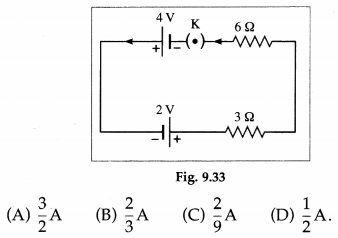
- A
$\frac{3}{2} A$
- ✓
$\frac{2}{3} A$
- C
$\frac{2}{9} A$
- D
$\frac{1}{2} A$.
AnswerCorrect option: B. $\frac{2}{3} A$
$\frac{2}{3} A$
View full question & answer→MCQ 71 Mark
When the current in a potentiometer wire decreases, the potential gradient
- ✓
- B
- C
remains the same provided the resistance and the length of the wire remain the same
- D
remains the same, irrespective of the resistance of the wire and its length.
View full question & answer→MCQ 81 Mark
The fraction of the total current passing through the galvanometer is
- ✓
$\frac{S}{S+G}$
- B
$\frac{G}{S+G}$
- C
$\frac{s+G}{G}$
- D
$\frac{s+G}{S}$.
AnswerCorrect option: A. $\frac{S}{S+G}$
$\frac{s}{s+G}$
View full question & answer→MCQ 91 Mark
View full question & answer→MCQ 101 Mark
View full question & answer→MCQ 111 Mark
A potentiometer wire is $100 cm$ long and a constant potential difference is maintained across it. Two cells are connected in series, first to support one another and then in opposite direction. The balance points are obtained at $50 cm$ and $10 cm$ from the positive end of the wire in the two cases. The ratio of emfs is
- A
$5: 4$
- B
$3: 4$
- ✓
$3: 2$
- D
$5: 1$
AnswerCorrect option: C. $3: 2$
$3: 2$
View full question & answer→MCQ 121 Mark
To convert a galvanometer into a voltmeter
- A
a high resistance is connected in parallal to the galvanometer
- ✓
a high resistance is connected in series with the galvanometer
- C
a low resistance is connected in parallel to the galvonometer
- D
a low resistance is connected in series with the galvonometer.
AnswerCorrect option: B. a high resistance is connected in series with the galvanometer
a high resistance is connected in series with the galvanometer
View full question & answer→MCQ 131 Mark
To convert a galvanometer into an ammeter
- A
a high resistance is connected in parallel to the galvanometer
- B
a high resistance is connected in series with the galvanometer
- ✓
a low resistance is connected in parallel to the galvanometer
- D
a low resistance value is connected in series with the galvanometer.
AnswerCorrect option: C. a low resistance is connected in parallel to the galvanometer
a low resistance is connected in parallel to the galvanometer
View full question & answer→MCQ 141 Mark
The open-circuit potential difference across the terminals of a cell balances on $150 cm$ of a potentiometer wire. When the cell is shunted by a $4.9 \Omega$ resistor, the balancing length reduces to $147 cm$. The internal resistance of the cell is
- A
$0.01 \Omega$
- B
$0.05 \Omega$
- ✓
$0.1 \Omega$
- D
$1 \Omega$
AnswerCorrect option: C. $0.1 \Omega$
$0.1 \Omega$
View full question & answer→MCQ 151 Mark
A load resistance $R$ is connected across a cell of emf $E$ and internal resistance $r$. If the closedcircuit p.d. across the terminals of the cell is $V$, the internal resistance of the cell is
- A
$(E-V) R$
- B
$(V-E) R$
- ✓
$\frac{E-V}{V} R$
- D
$\frac{E-V}{V}$
AnswerCorrect option: C. $\frac{E-V}{V} R$
$\frac{E-V}{V} R$
View full question & answer→MCQ 161 Mark
A potentiometer wire, having a resistance of $5 \Omega$ and length $10 m$ is connected in series a cell of emf $5 V$ and an external resistance of $495 \Omega$. A potential difference of $1.5 mV$ will balance against a length of
AnswerCorrect option: B. $30 cm$
$30 cm$
View full question & answer→MCQ 171 Mark
A potential gradient of $6 \times 10^{-3} V / mm$ is set up on a potentiometer wire which has a resistance of $2 \Omega / m$. Two emfs $2.5 V$ and $1.3 V$, once assisting and then opposing each other, are balanced on the wire. The balancing lengths in the two cases are in the ratio
- A
$19: 2$
- ✓
$19: 6$
- C
$25: 13$
- D
AnswerCorrect option: B. $19: 6$
$19: 6$
View full question & answer→MCQ 181 Mark
A $10 m$ long potentiometer wire has a resistance of $20 \Omega$. If it is connected in series with a resistance of $55 \Omega$ and a cell of emf $4 V$ and internal resistance $5 \Omega$, the potential gradient along the wire is
- ✓
$0.1 V / m$
- B
$0.08 V / m$
- C
$0.01 V / m$
- D
AnswerCorrect option: A. $0.1 V / m$
$0.1 V / m$
View full question & answer→MCQ 191 Mark
A $10 m$ long wire of resistance 2012 is connected in series with a resistance of $10 \Omega$ and a battery of emf $3 V$ and negligible internal resistance. The potential gradient, in $\mu V / mm$, along the wire is
View full question & answer→MCQ 201 Mark
An instrument which can measure terminal potential difference as well as electromotive force (emf) is
- A
Wheatstone's metre bridge
- B
- ✓
- D
View full question & answer→MCQ 211 Mark
Two resistors, $R_1$ and $R$ are connected in the left gap and the right gap of a metre bridge, and the balancing length is obtained at $20 cm$ from the left. On inter-changing the resistors in the two gaps, the balancing length shifts by
- A
$20 cm$
- B
$40 cm$
- ✓
$60 cm$
- D
$80 cm$.
AnswerCorrect option: C. $60 cm$
$60 cm$
View full question & answer→MCQ 221 Mark
For a Wheatstone network shown in the following figure, $I _{ g }=0$ when .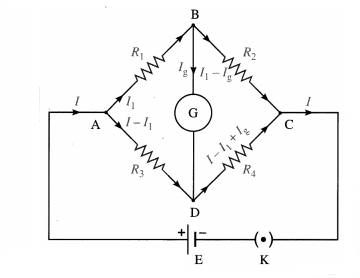
- A
$E=0$
- ✓
$V_B=V_D$
- C
$V_B>V_D$
- D
$V_B
AnswerCorrect option: B. $V_B=V_D$
$V_B=V_D$
View full question & answer→MCQ 231 Mark
To find the resistance of a gold bangle, two diametrically opposite points of the bangle are connected to the two terminals of the left gap of a metre bridge. A resistance of 4 Ω is introduced in the right gap. What is the resistance of the bangle if the null point is at 20 cm from the left end?
MCQ 241 Mark
A circular loop has a resistance of 40 Ω. Two points P and Q of the loop, which are one quarter of the circumference apart are connected to a 24 V battery, having an internal resistance of 0.5 Ω. What is the current flowing through the battery.
MCQ 251 Mark
Four resistances 10 Ω, 10 Ω, 10 Ω and 15 Ω form a Wheatstone’s network. What shunt is required across 15 Ω resistor to balance the bridge
MCQ 261 Mark
In the following circuit diagram, an infinite series of resistances is shown. Equivalent resistance between points A and B is
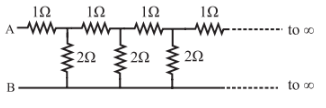
MCQ 271 Mark
When the balance point is obtained in the potentiometer, a current is drawn from
- A
both the cells and auxiliary battery
- B
- C
- ✓
neither cell nor auxiliary battery
AnswerCorrect option: D. neither cell nor auxiliary battery
neither cell nor auxiliary battery
View full question & answer→MCQ 281 Mark
Kirchhoff’s first law, i.e., ΣI = 0 at a junction, deals with the conservation of
MCQ 291 Mark
When moving coil galvanometer (MCG) is converted into a voltmeter, the series resistance is ' $n$ ' times the resistance of galvanometer. How many times that of MCG the voltmeter is now capable of measuring voltage?
- A
$n$
- B
$\frac{n+1}{n}$
- ✓
$n+1$
- D
$n=1$
Answer(c) : As the resistance connected is in series
$
R_{\text {eq }}=R+n R=(n+1) R
$
So, resistance increases by $(n+1)$ times, Similarly voltage also increases by $(n+1)$ times.
View full question & answer→MCQ 301 Mark
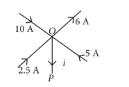
- A
$6.5 A$ from $O$ to $P$
- B
$9 A$ from $P$ to $O$
- C
$10.5 A$ from $P$ to $O$
- ✓
$11.5 A$ from $O$ to $P$
AnswerCorrect option: D. $11.5 A$ from $O$ to $P$
(d) : By Kirchhoff's law
$
10+2.5+5=6+i
$
$
17.5-6=i
$
$i=11.5$ A from $O$ to $P$.
View full question & answer→MCQ 311 Mark
A galvanometer of resistance $20 \Omega$ gives a deflection of 5 divisions when 1 mA current flows through it. The galvanometer scale has 50 divisions. To convert the galvanometer into a voltmeter of range 25 volt, we should connect a resistance of
AnswerCorrect option: B. $2480 \Omega$ in series
(b) : Here, $R_G=20 \Omega$
$
\begin{aligned}
I_g & =\frac{50}{5}=10 mA ; V=I_g\left(R_G+R\right) \\
\Rightarrow \quad 25 & =10 \times 10^{-3}(20+R) \\
\Rightarrow \quad R & =2500-20=2480 \Omega
\end{aligned}
$
View full question & answer→MCQ 321 Mark
In a meter bridge experiment null point is obtained at I cm from the left end. If the meter bridge wire is replaced by a wire of same material but twice the area of across-section, then the null point is obtained at a distance
AnswerCorrect option: B. $1 cm$ from left end
(b) : Balance point is independent of area of cross-section, so it is at $l cm$ from left.
View full question & answer→MCQ 331 Mark
A galvanometer of resistance G is shunted with a resistance of 10% of G. The part of the total current that flows through the galvanometer is
- ✓
$\frac{1}{11} I$
- B
$\frac{2}{11} I$
- C
$\frac{1}{10} I$
- D
$\frac{1}{5} I$
AnswerCorrect option: A. $\frac{1}{11} I$
(a): The shunt is given by, $S=\frac{G}{\frac{I}{I_g-1}}$
$\frac{10}{100} G=\frac{G}{\frac{I}{I_g}-1} \Rightarrow \frac{I}{I_g}-1=10 ; I_g=\frac{I}{11}$
View full question & answer→MCQ 341 Mark
In potentiometer experiment, the balancing length is $8 m$ when two cells $E_1$ and $E_2$ are joined in series. When two cells are connected in opposition the balancing length is $4 m$. The ratio of the e.m.f. of the two cells $\left(\frac{E_1}{E_2}\right)$ is
- A
$1: 2$
- B
$2: 1$
- C
$1: 3$
- ✓
$3: 1$
AnswerCorrect option: D. $3: 1$
(d) : Given, $E_1+E_2=k \times 8$...(i)
$E_1-E_2=k \times 4$...(ii)
On dividing equation (i) by equation (ii),
$
\begin{aligned}
& \frac{E_1+E_2}{E_1-E_2}=2 \\
& E_1+E_2=2 E_1-2 E_2 ; 3 E_2=E_1 ; E_1: E_2=3: 1
\end{aligned}
$
View full question & answer→MCQ 351 Mark
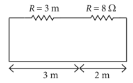
A wire of length $3 m$ connected in the left gap of a meter-bridge balances $8 \Omega$ resistance in the right gap at a point, which divides the bridge wire in the ratio $3: 2$. The length of the wire corresponding to resistance of $1 \Omega$ is
- A
$1 m$
- B
$0.75 m$
- C
$0.5 m$
- ✓
$0.25 m$
AnswerCorrect option: D. $0.25 m$
(d) : Given that, $R: S=\frac{3}{2}$ and $S=8 \Omega$
$\therefore$ So, $\frac{R}{8}=\frac{3}{2}$ or $R=12 \Omega$
$3 m$ length has
resistance $12 \Omega$,
therefore length of the wire corresponding $1 \Omega$
$
=\frac{3}{12} \times 1 m =\frac{3 \times 100}{12} cm =25 cm =0.25 m
$
View full question & answer→MCQ 361 Mark
- A
$1 A$ from $Q$ to $P$
- ✓
1 A from $P$ to $Q$
- C
$3 A$ from $P$ to $Q$
- D
$2 A$ from $Q$ to $P$
AnswerCorrect option: B. 1 A from $P$ to $Q$
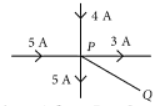
(b) : Let $i$ is current in $P Q$. According to Kirchoff's junction rule,
$
\begin{aligned}
& 5+4=3+5+i \\
& 9=8+i \\
& i=1 \text { A from } P \text { to } Q
\end{aligned}
$
View full question & answer→MCQ 371 Mark
An ammeter of resistance 'R' gives a full scale deflection when a current of 2 A passes through. it. If it is to measure maximum current of 10A, the required shunt is
- ✓
$\frac{R}{4}$
- B
$R$
- C
$2 R$
- D
$\frac{R}{2}$
AnswerCorrect option: A. $\frac{R}{4}$
(a) : As we know, for an ammeter,
$
\begin{aligned}
& I_g=\left(\frac{S}{S+R}\right) I ; \frac{I g}{I}=\frac{S}{S+R} \Rightarrow \frac{2}{10}=\frac{S}{S+R} \\
& \Rightarrow \frac{1}{5}=\frac{S}{S+R} \Rightarrow S+R=5 S \Rightarrow S=\frac{R}{4}
\end{aligned}
$
View full question & answer→MCQ 381 Mark
- ✓
$1 A$
- B
$2 A$
- C
$\frac{6}{11} A$
- D
$\frac{4}{3} A$
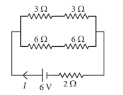
Answer(a) : Given circuit is a balanced wheatstone bridge. In balanced condition, no current flows through the galvanometer arm resistance i.e., $5 \Omega$. Thus, the given circuit can be redrawn as, shown in figure.
Now, equivalent resistance of the circuit is,
$
R_{\text {eq }}=\frac{6 \times 12}{6+12}+2=6 \Omega
$
Current drawn from the battery, $I=\frac{V}{R_{e q}}=\frac{6 V }{6 \Omega}=1 A$
View full question & answer→MCQ 391 Mark
- ✓
$10 A$
- B
$20 A$
- C
$4 A$
- D
$40 A$
AnswerCorrect option: A. $10 A$
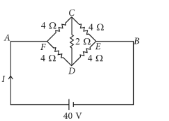
(a) : The equivalent circuit diagram of the given network is as shown in figure.
It is a balanced Wheatstone bridge, hence no current flows through arm $C D$. Therefore resistance across arm $C D$ becomes ineffective.
Now, equivalent resistance between terminals $A$ and $B$ is,
$
R=\frac{8 \times 8}{8+8}=4 \Omega
$
Current in the circuit, $I=\frac{V}{R}$
$
\therefore I=\frac{40}{4}=10 A
$
View full question & answer→MCQ 401 Mark
A current of $15 \ mA$ flows in the circuit as shown in figure. The value of potential difference between the points $A$ and $B$ will be
- A
$50 V$
- B
$75 V$
- C
$150 V$
- ✓
$275 V$
AnswerCorrect option: D. $275 V$
Let the current in $5 \ k \Omega$ is $i$ and in $10 \ k \Omega$ is $(15-i)$.
So, $i \times 5=(15-i) \times 10$
$i=10 \ mA$
Using $\ce{KVL}$ in lower loop,
$V_A=15 \times 5-10 \times 5-10 \times 15-V_B=0$
$V_A-V_B=275 V$
View full question & answer→MCQ 411 Mark
A resistance of $20 \Omega$ is connected in the left gap of a metre bridge and an unknown resistance greater than $20 \Omega$ is connected in the right gap. When these resistances are interchanged, the balance point shifts by $20 cm$. the unknown resistance is
- A
$25 \Omega$
- B
$40 \Omega$
- C
$35 \Omega$
- ✓
$30 \Omega$
AnswerCorrect option: D. $30 \Omega$
(d) : Given, $R=20 \Omega$ and let ' $x$ ' is the unknown resistance
$
\begin{aligned}
& I ^{\text {st }} \text { case }: \frac{R}{x}=\frac{l}{100-1} \\
& x=\frac{20(100-l)}{l}......(i) \\
& II ^{\text {nd }} \text { case }: \frac{x}{R}=\frac{l+20}{80-l}......(ii)
\end{aligned}
$
From equation (i) and (ii), we have
$
\begin{aligned}
& \frac{20(100-l)}{20 l}=\frac{l+20}{80-l} \\
\Rightarrow & (100-l)(80-l)=(l+20) l \\
\Rightarrow & 8000-100 l-80 l+l^2=l^2+20 l \\
& l=40 cm
\end{aligned}
$
Using value of ' $l$ ' in equation (ii), we have
$
\frac{x}{20}=\frac{(40+20)}{(80-40)} ; x=\frac{60 \times 20}{40}=30 \Omega
$
View full question & answer→MCQ 421 Mark
To determine the internal resistance of a cell by using a potentiometer the null point is at $1 m$ when the cell is shunted by $3 \Omega$ resistance and at a length $1.5 m$. When cell is shunted by $6 \Omega$ resistance, the internal resistance of the cell is
- A
$4 \Omega$
- B
$8 \Omega$
- C
$3 \Omega$
- ✓
$6 \Omega$
AnswerCorrect option: D. $6 \Omega$
(d) : When internal resistance is measured by potentiometer,
$
\frac{V_1}{V_2}=\frac{l_1}{l_2}=\frac{\varepsilon R_1 /\left(R_1+r\right)}{\varepsilon R_1 /\left(R_2+r\right)}=\frac{R_1\left(R_2+r\right)}{R_2\left(R_1+r\right)}
$
Here, $l_1=1 m , l_2=1.5 m ; R_1=3 \Omega ; R_2=6 \Omega$
$
\begin{aligned}
& \Rightarrow \quad \frac{1}{1.5}=\frac{3(6+r)}{6(3+r)} \\
& \Rightarrow 18+6 r=27+4.5 r \\
& \Rightarrow \quad 1.5 r=9 \\
& \Rightarrow r=9 / 1.5, r=6 \Omega
\end{aligned}
$
View full question & answer→MCQ 431 Mark
- ✓
$\frac{Q}{P}=\frac{R\left(S_1+S_2\right)}{S_1 S_2}$
- B
$\frac{Q}{P}=\frac{R}{S_1 S_2}$
- C
$\frac{P}{Q}=\frac{R\left(S_1+S_2\right)}{S_1 S_2}$
- D
$\frac{P}{Q}=\frac{R}{S_1+S_2}$
AnswerCorrect option: A. $\frac{Q}{P}=\frac{R\left(S_1+S_2\right)}{S_1 S_2}$
(a) : For balanced wheatstone bridge
$
\frac{Q}{P}=\frac{R}{S_1|| S_2}, S_1|| S_2=\frac{S_1 S_2}{S_1+S_2} \Rightarrow \frac{Q}{P}=\frac{R\left(S_1+S_2\right)}{S_1 S_2}
$
View full question & answer→MCQ 441 Mark
Answer(d) : Here, it is balanced Wheatstone bridge, so the circuit resolved as
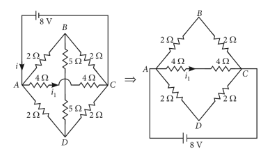
Voltage across $A C$ is 8 V. So, $i_1=\frac{8}{4+4}=1 A$ View full question & answer→MCQ 451 Mark
- A
$0.03 V / cm$
- ✓
$0.02 V / cm$
- C
$0.01 V / cm$
- D
$0.04 V / cm$
AnswerCorrect option: B. $0.02 V / cm$
(b) : Here $P Q=1 m , E_2=1.02 V$
When $S$ is open, $P J=P Q-J Q=100-49=51 cm$
Also, $E_2=k P J$
Potential gradient in the wire, $k=\frac{E_2}{P J}$
$
k=\frac{1.02 V }{51 cm }=0.02 V / cm
$
View full question & answer→MCQ 461 Mark
- ✓
$2 A , 4 A$
- B
$4 A , 2 A$
- C
$1 A , 2 A$
- D
$2 A , 3 A$
AnswerCorrect option: A. $2 A , 4 A$
(a) : Applying Kirchhoff's first law at the junction $P$, we get, $6=I_1+I_2$. . . . . .(i)
Applying Kirchhoff's second law to the closed loop PQRP, we get
$
-2 I_1-2 I_1+2 I_2=0 \text { or, } 2 I_1+2 I_1-2 I_2=0
$
or $4 I_1-2 I_2=0$. . . . . (ii)
Solving (i) and (ii), we get, $I_1=2 A , I_2=4 A$
View full question & answer→MCQ 471 Mark
- A
$100 cm$
- ✓
$120 cm$
- C
$110 cm$
- D
$140 cm$.
AnswerCorrect option: B. $120 cm$
(b) : The current in the potentiometer wire $A B$ is
$
I=\frac{6}{20+10}=0.2 A
$
The potential difference across the potentiometer wire is
$
V=\text { current } \times \text { resistance }=0.2 \times 20=4 V
$
The length of the wire is $l=200 cm$. So, the potential gradient along the wire is
$
k=\frac{V}{l}=\frac{4}{200}=0.02 V cm ^{-1}
$
The emf $2.4 V$ is balanced against a length $L$ of the potentiometer wire.
i.e., $2.4=k L$ or $L=\frac{2.4}{k}=\frac{2.4}{0.02}=120 cm$
View full question & answer→MCQ 481 Mark
- ✓
$0.25 V$
- B
$0.20 V$
- C
$0.50 V$
- D
$0.75 V$
AnswerCorrect option: A. $0.25 V$
(a) : As $r=0.01 \Omega / cm$
Resistance of the wire, $R_w=400 \times 0.01=4 \Omega$
Total resistance of the circuit
$
=0.5+0.5+4+1=6 \Omega
$
Current in the circuit, $I=\frac{1.5+1.5}{6}=0.5 A$
Reading of the voltmeter, $V=I R_{A I}=I r \times A J$
$
=0.5 A \times(0.01 \Omega / cm ) \times(50 cm )=0.25 V
$
View full question & answer→MCQ 491 Mark
The range of an ammeter of resistance 'G' can be increased from I to nl by connecting
- A
a series resistance of $\frac{G}{n-1} \Omega$
- ✓
a shunt of $\frac{G}{n-1} \Omega$
- C
a shunt of $\frac{G}{n+1} \Omega$.
- D
a series resistance of $\frac{G}{n+1} \Omega$.
AnswerCorrect option: B. a shunt of $\frac{G}{n-1} \Omega$
(b)
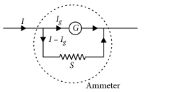
We know that, shunt resistance,
$
S=\frac{I_g R_g}{I-I_g}=\frac{I G}{n I-I}=\frac{I G}{I(n-1)} \Rightarrow S=\frac{G}{n-1} \Omega
$ View full question & answer→MCQ 501 Mark
A galvanometer has resistance of 100 Q and a current of 10 mA produces full scale deflection in it. The resistance to be connected to it in series, to get a voltmeter of range 50 volt is
- A
$3900 \Omega$
- B
$4000 \Omega$
- C
$4600 \Omega$
- ✓
$4900 \Omega$
AnswerCorrect option: D. $4900 \Omega$
(d) : Given, $G=100 \Omega, I_g=10 \times 10^{-3} A =10^{-2} A$ and $V=50 V$
Let $R$ be the resistance connected in series with the galvanometer to get a voltmeter of range 50 volt.
Then, $V=I_g(G+R)$ or $R=\frac{V}{I_g}-G$
$
\therefore R=\frac{50}{10^{-2}}-100=(5000-100) \Omega \Rightarrow R=4900 \Omega
$
View full question & answer→