Questions · Page 2 of 2

M.C.Q (1 Marks)

MCQ 511 Mark
With a resistance of X in the left gap and a resistance of 9 $\Omega$ in the right gap of a meter bridge, the balance point is obtained at 40 cm from the left end. In what way and to which resistance 3 $\Omega$ resistance to be connected to obtain the balance at 50 cm from the left end?
  • A
    in series with $9 \Omega$
  • B
    parallel to $X \Omega$
  • in series with $X \Omega$
  • D
    parallel to $9 \Omega$
Answer
Correct option: C.
in series with $X \Omega$
(c): As we know that, $\frac{X}{9}=\frac{40}{(100-40)}=\frac{40}{60}=\frac{2}{3}$
$
\Rightarrow X=\frac{2 \times 9}{3}=6 \Omega
$
Now, if we put this $3 \Omega$ resistance in series with ' $X$ ' then,
$
\begin{aligned}
& \frac{X+3}{9}=\frac{l}{100-l} \Rightarrow \frac{6+3}{9}=\frac{l}{100-l} \\
& \Rightarrow 100-l=l \Rightarrow 2 l=100 \Rightarrow l=50 cm
\end{aligned}
$
Thus, option(c) is correct.
View full question & answer
MCQ 521 Mark
  • A
    $E_2-i_2 r_2-E_1-i_1 r_1=0$
  • B
    $E_1-\left(i_1+i_2\right) R+i_1 r_1=0$
  • $E_1-\left(i_1+i_2\right) R-i_1 r_1=0$
  • D
    $-E_2-\left(i_1+i_2\right) R+i_2 r_2=0$
Answer
Correct option: C.
$E_1-\left(i_1+i_2\right) R-i_1 r_1=0$
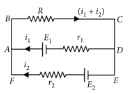
(c) : Here in this case, for the given circuit diagram, we can write for loop $A B C D A$,
$
\begin{aligned}
& -E_1+\left(i_1+i_2\right) R+i_1 r_1=0 \\
& \Rightarrow E_1-\left(i_1+i_2\right) R-i_1 r_1=0
\end{aligned}
$
For the loop $A D E F A$, applying Kirchhoff's voltage law, we get
$
-E_1+i_1 r_1-E_2+i_2 r_2=0 \Rightarrow E_1-i_1 r_1-i_2 r_2+E_2=0
$
So, the correct option is (c).
Image
View full question & answer
MCQ 531 Mark
The current in $1 \Omega$ resistor in the following circuit is
  • $1 A$
  • B
    $0.5 A$
  • C
    $1.1 A$
  • D
    $0.8 A$
Answer
Correct option: A.
$1 A$
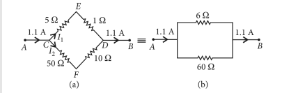
(a) : Since $\frac{5}{50}=\frac{1}{10}$, hence the given network is a balanced Wheatstone bridge. Therefore no current flows through $G$, so equivalent circuit diagram is as shown in the figure.
Image
Equivalent resistance of the network is
$
R_{\text {eq }}=\frac{6 \times 60}{6+60}=\frac{60}{11} \Omega
$
Potential across the network, $V=I R_{\text {eq }}=1.1 \times \frac{60}{11}$ $V=6 V$
Now, applying Kirchhoff's voltage law in upper arm CED.
$
5 I_1+I_1=6
$
or $6 I_1=6 \Rightarrow I_1=1 A$
Hence, current through $1 \Omega$ resistor is $I_1=1 A$
View full question & answer
MCQ 541 Mark
A galvanometer with its coil resistance $25 \Omega$ requires a current of $1 mA$ for its full deflection. In order to construct an ammeter to read up to a current of $2 A$, the approximate value of the shunt resistance should be
  • A
    $1.25 \times 10^{-3} \Omega$
  • $1.25 \times 10^{-2} \Omega$
  • C
    $2.5 \times 10^{-3} \Omega$
  • D
    $2.5 \times 10^{-2} \Omega$
Answer
Correct option: B.
$1.25 \times 10^{-2} \Omega$
(b) : $I_g R_g=\left(I-I_g\right) S$
$
S=\frac{10^{-3} \times 25}{2}
$
( $\because$ Current through galvenometer is very small).
$
S \approx 12.5 \times 10^{-3}=1.25 \times 10^{-2} \Omega
$
View full question & answer
MCQ 551 Mark
The deflection in galvanometer falls to $\left(\frac{1}{4}\right)^{\text {th }}$ when it is shunted by $3 \Omega$. If additional shunt of $2 \Omega$ is connected to earlier shunt, the deflection in galvanometer falls to
  • A
    $\frac{1}{2}$
  • B
    $\left(\frac{1}{3}\right)^{\text {rd }}$
  • C
    $\left(\frac{1}{4}\right)^{\text {th }}$
  • $\left(\frac{1}{8.5}\right)^{\text {th }}$
Answer
Correct option: D.
$\left(\frac{1}{8.5}\right)^{\text {th }}$
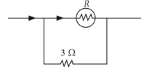
(d) : In first case, when galvanometer of resistance $R$ is shunted by $3 \Omega$ resistance.
Image
$
V^{\prime}=\left(I-\frac{I}{4}\right) \times 3=\frac{3 I}{4} \times 3 \Rightarrow \frac{R I}{4}=\frac{3 I}{4} \times 3 \Rightarrow R=9 \Omega
$
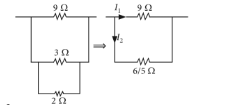
Now when additional shunt of $2 \Omega$ is connected
Image
$\begin{aligned} & I=I_1+I_2 \\ & 9 I_1=\frac{6}{5} I_2 ; I=I_1+\frac{15}{2} I_1=\frac{17}{2} I_1 \\ & I_1=\frac{2 I}{17}=\frac{I}{17 / 2}=\frac{I}{8.5}\end{aligned}$
View full question & answer
MCQ 561 Mark
  • A
    $0.8 A$
  • B
    $1.0 A$
  • $1.2 A$
  • D
    $1.4 A$
Answer
Correct option: C.
$1.2 A$
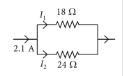
(c) : Since the network forms a wheatstone bridge
$
\frac{R_{A B}}{R_{A D}}=\frac{R_{B C}}{R_{C D}} \Rightarrow \frac{15}{20}=\frac{3}{4}
$
Hence, simplified circuit will be
$
\begin{aligned}
& I_1+I_2=2.1 A \\
& \quad 18 I_1=24 I_2 \\
& \Rightarrow \quad 3 I_1=4 I_2=4\left(2.1-I_1\right)
\end{aligned}
$
Image
$\Rightarrow \quad 7 I_1=8.4 \Rightarrow I_1=\frac{8.4}{7}=1.2 A$
View full question & answer
MCQ 571 Mark
The resistivity of potentiometer wire is $40 \times 10^{-8} \Omega m$ metre and its area of cross-section is $8 \times 10^{-6} m ^2$.If 0.2 ampere current is flowing through the wire, the potential gradient of the wire is
  • A
    $10^{-1} V / m$
  • B
    $10^{-2} V / m$
  • C
    $10^{-3} V / m$
  • D
    $10^{-4} V / m$
Answer

$\begin{gathered}
\text { (b) : Given } \rho=40 \times 10^{-8} \Omega m \\
A=8 \times 10^{-6} m ^2 \\
I=0.2 A \\
R=\frac{\rho l}{A} \therefore \quad \frac{R}{l}=\frac{\rho}{A}=\frac{40 \times 10^{-8}}{8 \times 10^{-6}}=5 \times 10^{-2}
\end{gathered}
$
Potential gradient $\frac{V}{l}=\frac{I R}{l}=0.2 \times 5 \times 10^{-2}=10^{-2} V / m$
View full question & answer
MCQ 581 Mark
Two unknown resistances are connected in two gaps of a meter$-$bridge. The null point is obtained at $40 \ cm$ from left end. A $30 \Omega$ resistance is connected in series with the smaller of the two resistances, the null point shifts by $20 \ cm$ to the right end. The value of smaller resistance in $\Omega$ is
  • A
    $12$
  • $24$
  • C
    $36$
  • D
    $48$
Answer
Correct option: B.
$24$
$l_x=40 \ cm ,$
$l_R=60 \ cm$
$\frac{x}{R}=\frac{l_x}{l_R}=\frac{40}{60}=\frac{2}{3}. . . . .(i)$
$\therefore \frac{x+30}{R}=\frac{60}{40}=\frac{3}{2} ;$
$2(x+30)=3 R$
$R=\frac{2(x+30)}{3}......(ii)$
$($From $(i)$ and $(ii))$
$\frac{3 x}{2(x+30)}=\frac{2}{3}$
$\Rightarrow 9 x=4 x+120$
$ 5 x=120$
$\Rightarrow x=24 \Omega$
View full question & answer
MCQ 591 Mark
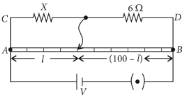
In balanced metre bridge, the resistance of bridge wire is $0.1 \Omega / cm$. Unknown resistance $X$ is connected in left gap and $6 \Omega$ in right gap, null point divides the wire in the ratio $2: 3$. Find the current drawn from the battery of $5 V$ having negligible resistance.
  • $1 A$
  • B
    $1.5 A$
  • C
    $2 A$
  • D
    $5 A$
Answer
Correct option: A.
$1 A$
(a)
Image
From the balancing condition of Wheatstone bridge, $\frac{X}{6 \Omega}=\frac{l}{(100-l)}=\frac{2}{3} \quad$ (given)
$X=\frac{2}{3} \times 6 \Omega=4 \Omega$
Resistance of bridge wire, $r=0.1 \Omega / cm \times 100 cm$
$=10 \Omega$
Resistance of $\operatorname{arm} C D=4 \Omega+6 \Omega=10 \Omega$
$\therefore$ Equivalent resistance of the circuit,
$R_{\text {eq }}=\frac{10 \times 10}{10+10}=5 \Omega$
Voltage of battery, $V=5 V$
$\therefore$ Current drawn, $I=\frac{V}{R_{\text {eq }}}=\frac{5 V }{5 \Omega}=1 A$

View full question & answer
MCQ 601 Mark
In potentiometer experiment, null point is obtained at a particular point for a cell on potentiometer wire $x cm$ long. If the length of the potentiometer wire is increased without changing the cell, the balancing length will (Driving source is not changed)
  • increase
  • B
    decrease
  • C
    not change
  • D
    becomes zero
Answer
Correct option: A.
increase
(a) : When the length of potentiometer wire is increased without changing the cell, its potential gradient decreases.
As, $E=K l$
For the same cell, if potential gradient $(K)$ decreases, balancing length $(l)$ increases.
View full question & answer
MCQ 611 Mark
A potentiometer wire of length $10 m$ is connected in series with a battery. The emf of a cell balances against $250 \ cm$ length of wire. If length of potentiometer wire is increased by $1 m$, the new balancing length of wire will be
  • A
    $2.00 m$
  • B
    $2.25 m$
  • C
    $2.50 m$
  • $2.75 m$
Answer
Correct option: D.
$2.75 m$
Here, $L_1=10 m , L_2=10+1=11 m$
$l_1=2.5 m , l_2=?$
$R_1=\sigma L_1, R_2=\sigma L_2$
$\sigma=$ Resistance of wire per unit length, $E_1=E_2=E$
$\therefore I_1 \sigma l_1=I_2 \sigma l_2$
$\frac{E_1}{R_1} l_1=\frac{E_2}{R_2} l_2$
$\Rightarrow \frac{E}{\sigma L_1} \times l_1$
$=\frac{E}{\sigma L_2} \times l_2$
$l_2=l_1 \times \frac{L_2}{L_1}$
$=2.5 \times \frac{11}{10}$
$=2.75 m $
View full question & answer
MCQ 621 Mark
The resistances in left and right gap of a meter bridge are $20 \Omega$ and $30 \Omega$ respectively. When the resistance in the left gap is reduced to half its value, the balance point shifts by
  • A
    $15 cm$ to the right
  • $15 cm$ to the left
  • C
    $20 cm$ to the right
  • D
    $20 cm$ to the left
Answer
Correct option: B.
$15 cm$ to the left
(b) : For meter bridge, $\frac{A}{R}=\frac{I_x}{\left(100-l_x\right)}$
Case (i)
$
X=20 \Omega, R=30 \Omega \Rightarrow l_x=\text { ? }
$
So, $\frac{20}{30}=\frac{l_x}{\left(100-l_x\right)} \Rightarrow 3 l_x=200-2 l_x$
$
5 l_x=200 \text { or }, l_x=40 cm
$
Case (ii)
$
X^{\prime}=\frac{X}{2}=\frac{20}{2}=10 \Omega, R=30 \Omega \Rightarrow l_x^{\prime}=\text { ? }
$
$
\begin{aligned}
\text { So, } & \frac{10}{30}=\frac{l_x^{\prime}}{\left(100-l_x^{\prime}\right)} \Rightarrow 100-l_x^{\prime}=3 l_x^{\prime} \\
& 4 l_x^{\prime}=100 \text { or } l_x^{\prime}=25 cm \\
\therefore \quad & l_x-l_x^{\prime}=40-25=15 cm
\end{aligned}
$
Hence, the balance point shifts to the left by $15 cm$.
View full question & answer
M.C.Q (1 Marks) - Page 2 - Physics STD 12 Questions - Vidyadip