Questions · Page 2 of 2

M.C.Q (1 Marks)

MCQ 511 Mark
A parallel plate air filled capacitor of capacitance ' $C$ ' has plate area ' $A$ ' and the distance between the plates ' $d$. When a metal sheet of thickness $\left(\frac{d}{2}\right)$ and of the same area ' $A$ ' is introduced between the plates, its capacitance becomes ' $C_2$ ' The ratio $C_2: C_1$ is
Answer
Correct option: A.
(a) : As $C_1=\frac{\varepsilon_0 A}{d}$. . . . . .(i)
Here $A$ area of plate $d$ is distance between the plates. For dielectric medium and thickness $t$, capacitance is, $C_2=\frac{\varepsilon_0 \cdot A}{d-t+\frac{t}{k}}$
$\begin{array}{ll}C_2=\frac{\varepsilon_0 A}{d-\frac{d}{2}+0}=\frac{2 \varepsilon_0 A}{d} & (k=\infty \text { for metal) } \\ C_2=2 C_1  .  . . . . .(From equation (i))& \\ \frac{C_2}{C_1}=\frac{2}{1} & \end{array}$
View full question & answer
MCQ 521 Mark
Answer
Correct option: A.
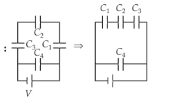
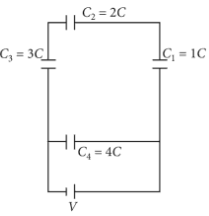
(a):
Image
As capacitor $C_1, C_2$ and $C_3$ are in series.
So equivalent capacitance is given by
$
\begin{aligned}
& \frac{1}{C_{\text {eqf }}}=\frac{1}{C_1}+\frac{1}{C_2}+\frac{1}{C_3}=\frac{C_2 C_3+C_3 C_1+C_2 C_1}{C_1 C_2 C_3} \\
& \Rightarrow C_{\text {el }}=\frac{C_1 C_2 C_3}{C_1 C_2+C_2 C_3+C_1 C_3}
\end{aligned}
$
Give, $\left(C_1=1 C_1 C_2=2 C_1 C_3=3 C\right)$
$
\Rightarrow C_{\text {eq }}=\frac{C(2 C)(3 C)}{C(2 C)+(2 C)(3 C)+C(3 C)} \Rightarrow C_{\text {eq }}=\frac{6}{11}
$
Charge on capacitors $C_1, C_2$ and $C_3=C_{\text {eq }} V=\frac{6 C}{11} V$
Charge on capacitor $C _4=4 CV$
Now, $\frac{\text { Charge on Capacitor } C_2}{\text { Charge on } C_4}=\frac{6 C}{\frac{11}{4 C V}} V=\frac{3}{22}$
View full question & answer
MCQ 531 Mark
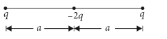
Two charges of equal magnitude $q$ are placed in air at a distance $2 a$ apart and third charge $-2 q$ is placed at midpoint. The potential energy of the system is ( $\epsilon_0=$ permittivity of free sapce)
Answer
(d) : The potential energy of the system is
$
U=\frac{1}{4 \pi \epsilon_0} \frac{(q)(-2 q)}{a}+\frac{1}{4 \pi \epsilon_0} \frac{(q)(q)}{2 a}+\frac{1}{4 \pi \epsilon_0} \frac{(q)(-2 q)}{a}
$
Image
$\begin{aligned} & =\frac{1}{4 \pi \epsilon_0}\left[\frac{-2 q^2}{a}+\frac{q^2}{2 a}+\frac{-2 q^2}{a}\right] \\ & =\frac{1}{4 \pi \epsilon_0}\left[\frac{-4 q^2+q^2-4 q^2}{2 a}\right]=-\frac{7 q^2}{8 \pi \epsilon_0 a}\end{aligned}$
View full question & answer
MCQ 541 Mark
A charged cylinder of radius $3 mm$ has surface charge density $4 \mu C / m ^2$. It is placed in a medium of dielectric constant 628 . The electric intensity at a point at a distance of $1.5 m$ from its axis is
Answer
Correct option: A.
(a) : The electric field intensity at a point outside a charged cylinder is
$
E=\frac{\sigma R}{\varepsilon_0 K r}
$
where, $\sigma=$ surface charge density,
$R=$ radius of the cylinder,
$K=$ dielectric constant,
$r=$ distance of point from axis of the cylinder
Here,
$\sigma=4 \mu C / m ^2=4 \times 10^{-6} C / m ^2$
$
\begin{aligned}
& R=3 mm =3 \times 10^{-3} m \\
& K=628, r=1.5 m
\end{aligned}
$
$
\therefore E=\frac{\left(4 \times 10^{-6} C ^{-} m ^2\right)\left(3 \times 10^{-3} m \right)}{\left(8.85 \times 10^{-12} C ^2 / N m ^2\right)(628)(1.5 m )}=1.44 V / m
$.
View full question & answer
MCQ 551 Mark
In a parallel plate air capacitor the distance between plates is reduced to one fourth and the space between them is filled with a dielectric medium of constant 2. If the initial capacity of the capacitor is $4 \mu F$, then its new capacity is
Answer
Correct option: A.
(a) : When a dielectric medium is filled between plates of a capacitor, then new capacitance
$
\begin{aligned}
& C^{\prime}=\frac{K \varepsilon_0 A}{d^{\prime}}=\frac{4 K \varepsilon_0 A}{d} \\
& {\left[\because d^{\prime}=\frac{d}{4}\right]} \\
& =4 \times K \times C \\
& =(4 \times 2 \times 4) \mu F =32 \mu F \\
& {\left[\because C=\frac{\varepsilon_0 A}{d}=4 \mu F \right]} \\
&
\end{aligned}
$
$
\left[\because C=\frac{\varepsilon_0 A}{d}=4 \mu F \right]
$
View full question & answer
MCQ 561 Mark
A series combination of $N_1$ capacitors (each of capacity $C_1$ ) is charged to potential difference ' $3 V$. Another parallel combination of $N _2$ capacitors (each of capacity $C_2$ ) is charged to potential difference ' $V$ '. The total energy stored in both combinations is same. The value of $C_1$ in terms of $C_2$ is
Answer
Correct option: A.
(a) : For series combination of $N_1$ capacitors,
$
C_{\text {eq }}=\frac{C_1}{N_1} ; V_1=3 V
$
Energy stored is, $E_1=\frac{1}{2} C_{e q} V_1^2=\frac{1}{2} \frac{C_1}{N_1} 9 V^2=\frac{9}{2} \frac{C_1}{N_1} V^2$
For parallel combination of $N_2$ capacitors,
$
C_{\text {eq }}=N_2 C_2 ; V_2=V ; E_2=\frac{1}{2} C_{e q} V^2=\frac{1}{2} C_2 N_2 V^2
$
Since energy stored in both the combination is equal $E_1=E_2$
$
\frac{9}{2} \frac{C_1}{N_1} V^2=\frac{C_2 N_2 V^2}{2} \Rightarrow C_1=C_2 \frac{N_2 N_1}{9}
$
View full question & answer
MCQ 581 Mark
Two parallel plate air capacitors of same capacity $C$ are connected in series to a battery of emf $E$. Then one of the capacitors is completely filled with dielectric material of constant $K$. The change in the effective capacity of the series combination is
Answer
(a): When the two parallel capacitors are connected in series then effective capacitance
$
\frac{1}{C_1}=\frac{1}{C}+\frac{1}{C}=\frac{2}{C} \text { or } C_1=\frac{C}{2}
$
When one of the capacitor is filled with dielectric material of constant $K$, then effective capacitance
$
\frac{1}{C_2}=\frac{1}{C}+\frac{1}{K C}=\frac{1}{C}\left(1+\frac{1}{K}\right) ; \frac{1}{C_2}=\frac{K+1}{K C} \text { or } C_2=\frac{K C}{K+1}
$
Then change in effective capacitance is
$
\Delta C=C_2-C_1=\frac{K C}{K+1}-\frac{C}{2}=\frac{C}{2}\left(\frac{K-1}{K+1}\right)
$
View full question & answer
MCQ 591 Mark
A parallel plate air capacitor has capacity $C$ farad, potential $V$ volt and energy $E$ joule. When the gap between the plates is completely filled with dielectric
Answer
Correct option: B.
(b): When the gap between the plates is completely filled with dielectric of dielectric constant $K$, then potential is
$
V=\frac{Q d}{A \varepsilon_0 K}...(i)
$
and electric field is
$
E=\frac{Q}{A \varepsilon_0 K}....(ii)
$
From equations (i) and (ii), both electric field and potential decrease.
View full question & answer
MCQ 601 Mark
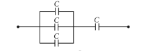
When three capacitors of equal capacities are connected in parallel and one of the same capacity is connected in series with its combination. The resultant capacity is $3.75 \mu F$. The capacity of each capacitor is
Answer
Correct option: A.
(a): The resultant capacitance
Image
$
C_{\text {resultant }}=\frac{3 C \times C}{3 C+C}=\frac{3 C^2}{4 C}=\frac{3}{4} C
$
Given : $C_{\text {resultann }}=3.75 \mu F$
$
C=\frac{3.75 \times 4}{3}=5 \mu F
$

View full question & answer
MCQ 611 Mark
The amount of work done in increasing the voltage across the plates of capacitor from $5 V$ to $10 V$ is $W$. The work done in increasing it from $10 V$ to $15 V$ will be
Answer
Correct option: D.
(d) : The amount of work done in increasing the voltage across the plates of capacitor is stored in the form of electrostatic energy.
$
\begin{aligned}
\therefore \quad W & =U_2-U_1 \\
& =\frac{1}{2} C V_2^2-\frac{1}{2} C V_1^2=\frac{1}{2} C\left(10^2-5^2\right)=\frac{75}{2} C
\end{aligned}
$. . . . . .(i)
Similarly, work done in increasing the voltage from $10 V$ to $15 V$ is
$
W^{\prime}=\frac{1}{2} C\left(15^2-10^2\right)=\frac{125}{2} C
$. . . . . .(ii)
From eqns. (i) and (ii)
$
\frac{W^{\prime}}{W}=\frac{125}{75} \text { or } W^{\prime}=1.67 W
$
View full question & answer
MCQ 621 Mark
Two identical parallel plate air capacitors are connected in series to a battery of e.m.f. $V$. If one of the capacitor is completely filled with dielectric material of constant $K$, then potential difference of the other capacitor will become
Answer
(b) : Let the capacitance of air filled parallel plate capacitor be $C$. Then capacitance of dielectric filled capacitor is $KC$.

$\therefore$ Equivalent capacitance, $C _{\text {eq }}=\frac{C \times K C}{C+K C}=\frac{K C}{(K+1)}$
Charge in the circuit, $q=C_{\text {eq }} V=\frac{K C V}{(K+1)}$
$\therefore$ Potential difference of air filled capacitor is
$
V^{\prime}=\frac{q}{C}=\frac{K V}{(K+1)}
$
View full question & answer
MCQ 631 Mark
Three parallel plate air capacitors are connected in parallel. Each capacitor has plate area $\frac{A}{3}$ and the separation between the plates is $d, 2 d$ and $3 d$ respectively. The equivalent capacity of combination is ( $\epsilon_0=$ absolute permittivity of free space)
Answer
(b) :$
\begin{gathered}
C_p=C_1+C_2+C_3=\frac{\epsilon_0 A}{3 d}+\frac{\epsilon_0 A}{3(2 d)}+\frac{\epsilon_0 A}{3(3 d)} \\
=\frac{\epsilon_0 A}{3 d}+\frac{\epsilon_0 A}{6 d}+\frac{\epsilon_0 A}{9 d}=\frac{11 \epsilon_0 A}{18 d}
\end{gathered}
$
View full question & answer
MCQ 641 Mark
A capacitor $C_1=4 \mu F$ is connected in series with another capacitor $C_2=1 \mu F$. The combination is connected across $d.c.$ source of $200 V$. The ratio of potential across $C_2$ to $C_1$ is
  • A
    $2: 1$
  • $4: 1$
  • C
    $8: 1$
  • D
    $16: 1$
Answer
Correct option: B.
$4: 1$
Given situation is shown in the figure.Here, $C_1=4 \mu F$$C_2=1 \mu F$
$V=200 V , \frac{V_2}{V_1}=?$Net capacitance of the circuit,$C=\frac{C_1 C_2}{C_1+C_2} ; $
$C=\frac{4 \times 1}{4+1}=\frac{4}{5} \mu F$
Charge flows through circuit,$q=C V=\left(\frac{4}{5} \mu F \right) \times(200 V )$
$=160 \mu C =160 \times 10^{-6} C
$Potential across $C_1, V_1=\frac{q}{C_1}=\frac{160 \times 10^{-6}}{4 \times 10^{-6}}=40 V$
Potential across $C_2, V_2=V-V_1=200-40=160 V$
$\therefore \frac{V_2}{V_1}=\frac{160}{40}=\frac{4}{1}$
View full question & answer
MCQ 651 Mark
The electric field intensity at a point near and outside the surface of a charged conductor of any shape is ' $E_1$. The electric field intensity due to uniformly charged infinite thin plane sheet is ' $E_2$ ' The relation between ' $E_1$ ' and ' $E_2$ ' is
Answer
Correct option: C.
(c) : Electric field near surface of charged conductor
$
E_1=\frac{\sigma}{\varepsilon_0}
$. . . . . .(i)
Electric field due to uniformly charged infinite thin plane sheet,
$
\begin{aligned}
& E_2=\frac{\sigma}{2 \varepsilon_0}=\frac{E_1}{2} \quad \text { [Using eqn. (i)] } \\
& \therefore \quad E_1=2 E_2
\end{aligned}
$
View full question & answer
MCQ 661 Mark
The difference in the effective capacity of two similar capacitors when joined in series and then in parallel is $6 \mu F$. The capacity of each capacitor is
Answer
Correct option: B.
(b) : Suppose capacity of each capacitor is $C$.
When two capacitors are connected in parallel their equivalent capacity is given by,
$
C_1=C+C=2 C
$
When two capacitors are connected in series their equivalent capacity is given by
$
C_2=\frac{C \times C}{C+C}=\frac{C}{2}
$
According to question, $C_1-C_2=6 \mu F$
$
\begin{aligned}
& 2 C-\frac{C}{2}=6 \mu F ; \quad \frac{3 C}{2}=6 \mu F \\
& \therefore \quad C=4 \mu F
\end{aligned}
$
View full question & answer
MCQ 671 Mark
An electron in potentiometer wire experiences a force $2.4 \times 10^{-19} N$. The length of potentiometer wire is $6 m$. The e.m.f. of the battery connected across the wire is (electronic charge $=1.6 \times 10^{-19} C$ )
Answer
Correct option: B.
(b) : Force on an electron, $F=e E$
$\therefore \quad$ Electric field,
$
E=\frac{F}{e}=\frac{2.4 \times 10^{-19} N }{1.6 \times 10^{-19} C }=\frac{3}{2} N C ^{-1}
$
Potential difference across the wire is
$
\begin{aligned}
& V=E l=\frac{3}{2} N C ^{-1} \times 6 m =9 V \\
& \therefore \quad \text { Emf of the battery }=V=9 V
\end{aligned}
$
View full question & answer
MCQ 681 Mark
In air, a charged soap bubble of radius $r$ is in equilibrium having outside and inside pressures being equal. The charge on the drop is ( $\epsilon_0=$ permittivity of free space, $T$ = surface tension of soap solution)
Answer
(d) : Excess pressure inside the soap bubble is
$
P=\frac{4 T}{r}
$
As the pressure inside and outside is the same, so pressure of the charged bubble is
$
P_{\text {electro }}=\frac{4 T}{r} ; \frac{\sigma^2}{2 \epsilon_0}=\frac{4 T}{r}
$
where $\sigma$ is the surface charge density of the bubble
$
\sigma=\sqrt{\frac{8 T \epsilon_0}{r}}
$
$\therefore \quad$ Charge on the bubble is
$
Q=4 \pi r^2 \sigma=4 \pi r^2 \sqrt{\frac{8 T \epsilon_0}{r}}
$
View full question & answer
MCQ 691 Mark
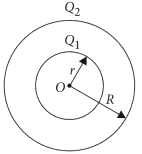
Two concentric spheres kept in air have radii $R$ and $r$. They have similar charge and equal surface charge density $\sigma$. The electric potential at their common centre is ( $\epsilon_0=$ permittivity of free space)
View full question & answer