Questions

5 Mark Question

Take a timed test

4 questions · self-marked practice — reveal the answer and mark yourself.

Question 15 Marks
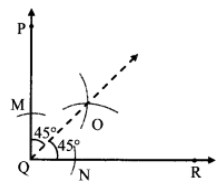
Construct an angle bisector to draw an angle of 45°.
Answer
For getting measurement of 45° (for the bisected angle), one has to make an angle of 90° (i.e. 45° × 2).

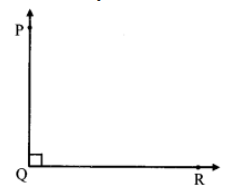
Step 1:
Draw ∠PQR of 90°.
Image

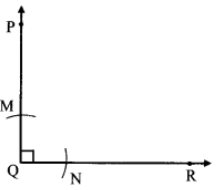
Step 2:
Cut arcs on the rays QP and QR.
Name these points as M and N respectively.
Image

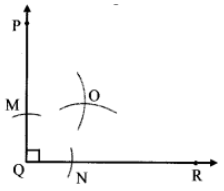
Step 3:
Place the compass point on point M and draw an arc inside the angle.
Without changing the distance of the compass, place the compass point on point N and cut the
Image

Step 4:
Draw ray QO.
Ray QO is the angle bisector of ∠PQR.
i.e. m∠PQO = m∠RQO = 45°
Image

View full question & answer
Question 25 Marks
Construct an angle bisector to obtain an angle of 30°.
Answer
In order to get a bisected angle of a given measure, the student has to draw the angle having twice the measurement of required bisected angle.
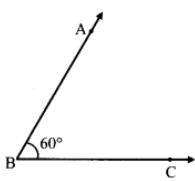
For getting measurement of 30° (for the bisected angle), one has to make an angle of 60° (i.e. 30° × 2).

Step 1:
Draw $\angle ABC$ of $60^{\circ}$.
Image

Step 2:
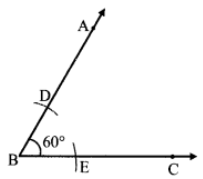
Cut arcs on the rays BA and BC. Name these points as D and E respectively.

Image

Step 3:
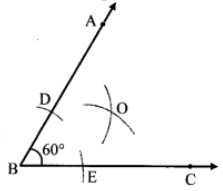
Place the compass point on point D and draw an arc inside the angle.
Without changing the distance of the compass, place the compass point on point E and cut the previous arc. Name the point of intersection as O

Image

Step 4:
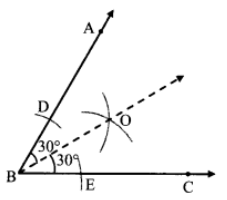
Draw ray BO.
Ray $BO$ is the angle bisector of $\angle ABC$.
i.e. $m \angle A B O=m \angle C B O=30^{\circ}$

Image

View full question & answer
Question 35 Marks
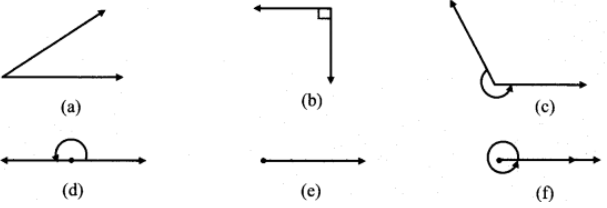
Look at the figures below and write the type of each of the angles:

Image

Answer
a. Acute angle
b. Right angle
c. Reflex angle
d. Straight angle
e. Zero angle
f. Complete angle
View full question & answer
Question 45 Marks
Measure of the angle Type of the angle
i. 180° a. Zero angle
ii. 240° b. Straight angle
iii. 360° c. Reflex angle
iv. d. Complete angle
Answer
(i – Straight Angle),
(ii – Reflex Angle),
(iii – Complete Angle),
(iv – Zero Angle).
View full question & answer