Questions

5 Mark Question

Take a timed test

10 questions · self-marked practice — reveal the answer and mark yourself.

Question 15 Marks
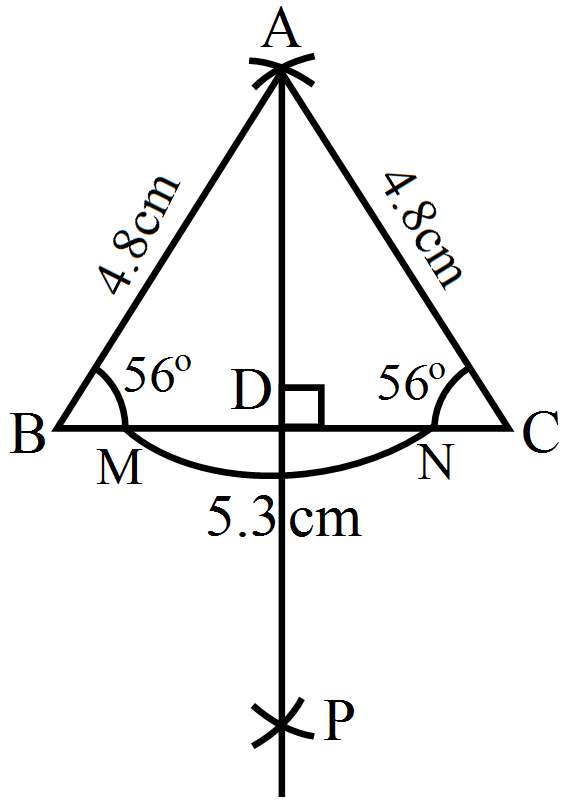
Construct a $\triangle\text{ABC}$ in which AB = AC = 4.8cm and BC = 5.3cm. Measure $\angle\text{B}$ and $\angle\text{C}$. Draw $\text{AD}\bot\text{BC}$.
Answer
Steps for construction:
Step I: Draw BC = 5.3cm
Step II: Draw an arc of radius 4.8cm from the centre, B.
Step III: Draw another arc of radius 4.8cm from the centre, C.
Step IV: Both of these arcs intersect at A.
Step V: Join AB and AC.
Step VI: With A as the centre and any radius, draw an arc cutting BC at M and N.
Step VII: With M as the centre and the radius more than half of MN, draw an arc.
Step VIII: With N as the centre and the same radius, draw another arc cutting the previously drawn arc at P.
Step IX: Join AP, cutting BC at D.Then, $\text{AD}\bot\text{BC}$
View full question & answer
Question 25 Marks
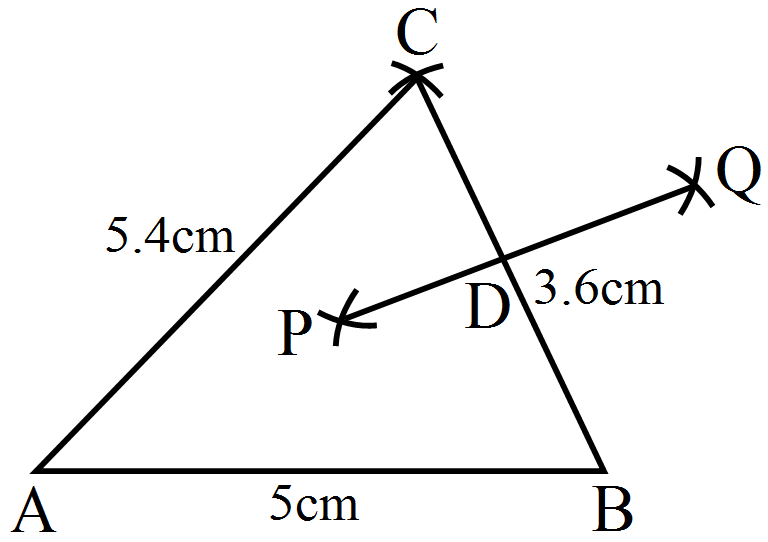
Construct a $\triangle\text{ABC}$ in which BC = 3.6cm, AB = 5cm and AC = 5.4cm. Draw the perpendicular bisector of the side BC.
Answer
Steps for construction:
Step I: Draw a line segment (AB) of length 5cm.
Step II: Draw an arc of radius 5.4cm from the centre (A).
Step III: With B as the centre, draw another arc of radius 3.6cm, cutting the previous arc at C.
Step IV: Join AC and BC.
Step V: Taking B as the centre and the radius more than half of BC, draw two arcs on both the sides of BC.
Step VI: Similarly, taking C as the centre and the same radius, draw arcs on both the sides of BC, cutting the previous arcs at P and Q.
Then, PQ is the required perpendicuar bisector of BC, meeting BC at D.
View full question & answer
Question 35 Marks
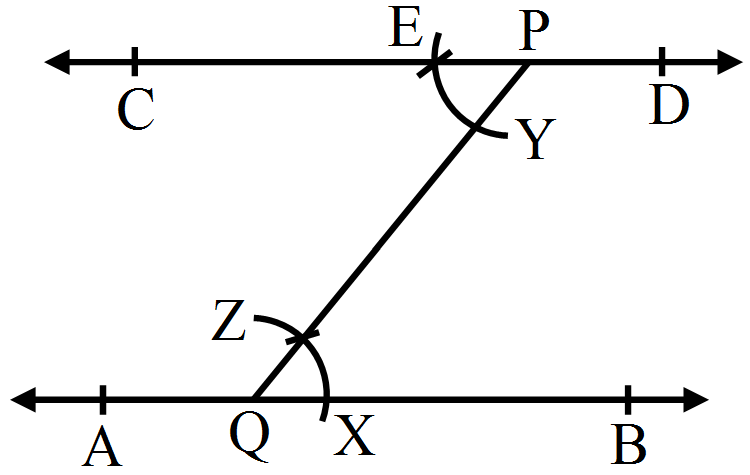
Draw a line AB and take a point P outside it. Draw a line CD parallel to AB and passing through the point P.
Answer
Steps of construction:
Step I: Draw a line AB.
Step II: Take a point Q on AB and a point P outside AB, and join PQ.
Step III: With Q as the centre an any radius, draw an arc to cut AB at X and PQ at Z.
Step IV: With P as the centre and the same radius, draw an arc cutting QP at Y.
Step V: With y as the centre and the radius equal to XZ, draw an arc to cut the pevious arc at E.
Step VI: Join PE and produce it on both the sides to get the required line.
View full question & answer
Question 45 Marks
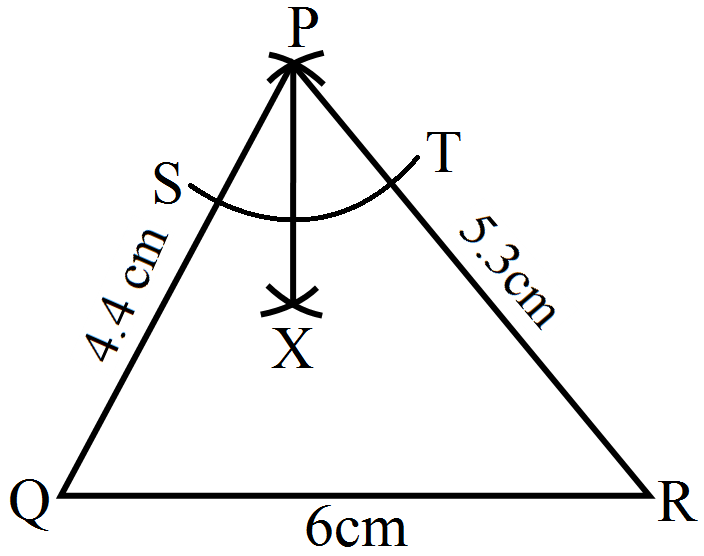
Construct a $\triangle\text{PQR}$ in which QR = 6cm, PQ = 4.4cm and PR = 5.3cm. Draw the bisector of $\angle\text{P.}$
Answer
Steps for construction:
Step I: Draw a line segment QR of length 6cm.
Step II: Draw arcs of 4.4cm and 5.3cm from Q and R, respectively. They intersect at P.
Step III: Draw an arc of any radius from the centre (P), cutting PQ and PR at S and T, respectively.
Step IV: With S as the centre and the radius more than half of ST, draw an arc.
Step V: With T as the centre and the same radius, draw another arc cutting the previously drawn arc at X.
Step VI: Join P and X.
Then, PX is the bisector of $\angle\text{P}$.
View full question & answer
Question 55 Marks
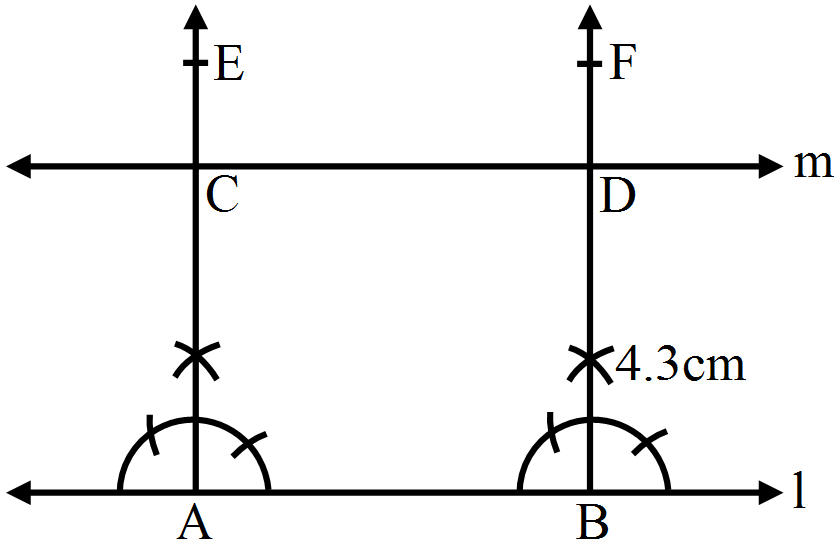
Draw a line l and draw another line m parallel to l at a distance of 4.3cm from it.
Answer
Steps for construction:
Step I: Let l be the given line.
Step II: Take any two points A and B on line l.
Step III: Construct $\angle\text{BAE}=90^\circ$ and $\angle\text{ABF}=90^\circ$.
Step IV: With A as the centre and the radius equal to 4.3cm, cut AE at C.
Step V: With B as the centre and the radius equal to 4.3cm, cut BF at D.
Step VI: Join CD and produce it on either side to get the required line m, parallel to l and at a distance of 4.3cm from it.
View full question & answer
Question 65 Marks
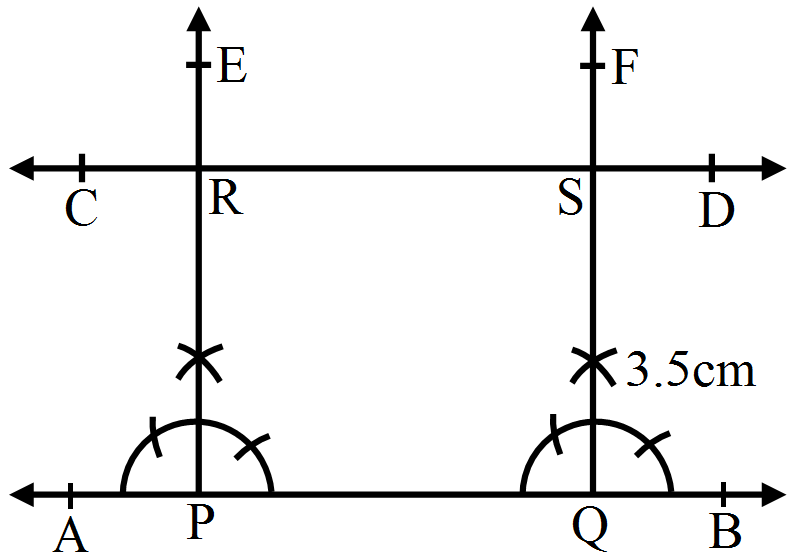
Draw a line AB and draw another line CD parallel to AB at a distance of 3.5cm from it.
Answer
Steps for construction:
Step I: Let AB be the given line.
Step II: Take any two points P and Q on AB.
Step III: Construct $\angle\text{BPE}=90^\circ$ and $\angle\text{BQF}=90^\circ$.
Step IV: With P as the centre and the radius equal to 3.5cm, cut PE at R.
Step V: With Q as the centre and the radius equal to 3.5cm, cut QF at S.
Step VI: Join RS and produce it on both the sides to get the required line, parallel to AB and at a distance of 3.5cm from it.
View full question & answer
Question 75 Marks
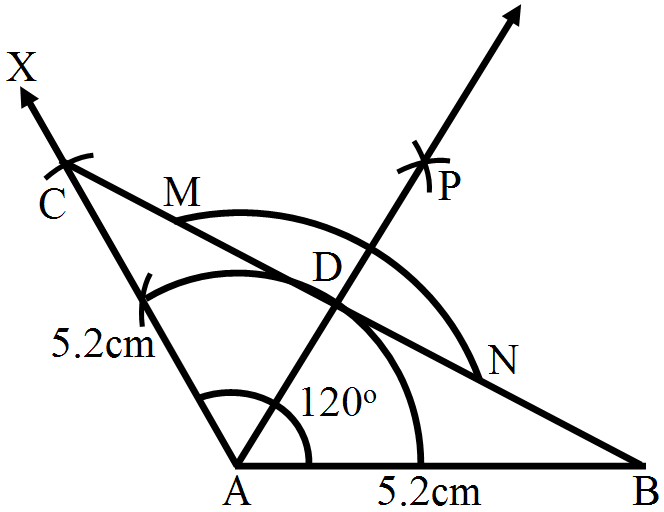
Construct a $\triangle\text{ABC}$ in which AB = AC = 5.2cm and $\angle\text{A}=120^\circ.$ Draw $\text{AD}\bot\text{BC}.$
Answer
Steps for construction: Step I: Draw AB = 5.2cm Step II: Draw $\angle\text{BAX}=120^\circ$ Step III: With A as the centre, cut the ray AX at 5.3cm at point C. Step IV: Join BC. Step V: A as the centre and any radius, draw an arc cutting BC at M and N.Step VI: With M as the centre and the radius more than half of MN, draw an arc.
Step VII: With N as the centre and the same radius as before, draw another arc cutting the previously drawn arc at P.
Step VIII: Join AP meeting BC at D.
$\therefore\text{AD}=\text{BC}$
View full question & answer
Question 85 Marks
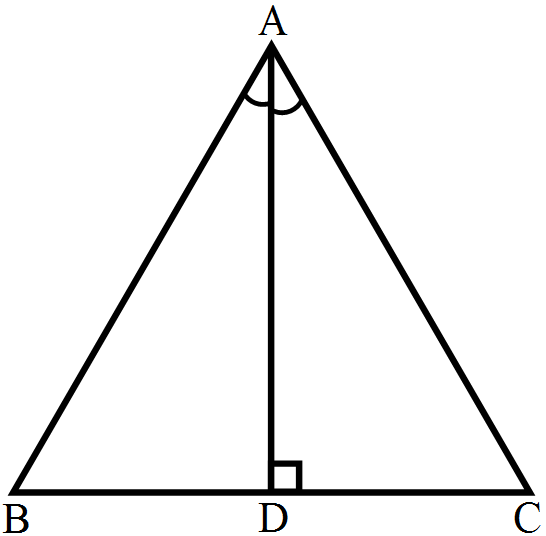
In the adjoining figure, ABC is a triangle in which AD is the bisector of $\angle\text{A}.$ If $\text{AD}\bot\text{BC}$ show that $\triangle\text{ABC}$ is isosceles.
Answer

Given:
$\angle\text{BAD}=\angle\text{DAC}\ \dots(\text{i})$
To show that $\triangle\text{ABC}$ is isoceles, we should show that $\angle\text{B}=\angle\text{C}.$
$\therefore\text{AD}\bot\text{BC},\angle\text{ADB}=\angle\text{ADC}=90^\circ$
$\angle\text{ADC}=\angle\text{ADB}$
$\angle\text{BAD}+\angle\text{ABD}=\angle\text{DAC}+\angle\text{ACD}$ (exterior angle property)
$\angle\text{DAC}+\angle\text{ABD}=\angle\text{DAC}+\angle\text{ACD}$ [from equation (i)]
$\angle\text{ABD}=\angle\text{ACD}$
This is because opposite angles of a triangle $\triangle\text{ABC}$ are equal.
Hence, ABS is an isosceles triangle.
View full question & answer
Question 95 Marks
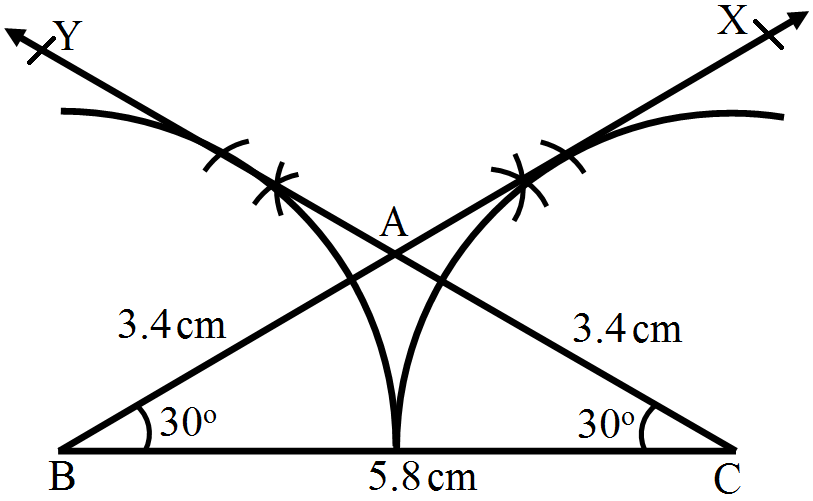
Construct a $\triangle\text{ABC}$ in which BC = 5.8cm,$\angle\text{B}=\angle\text{C}=30^\circ.$Measure AB and AC. What do you observe?
Answer
Steps for construction:
Step I: Draw BC = 5.8cm
Step II: Draw $\angle\text{BCY}=30^\circ$
Step III: Draw $\angle\text{CBX}=30^\circ$
Step IV: The ray BX an CY intersect at A. Then, ABC is the required triangle. On measuring AB and AC: AB = AC = 3.4cm.
View full question & answer
Question 105 Marks
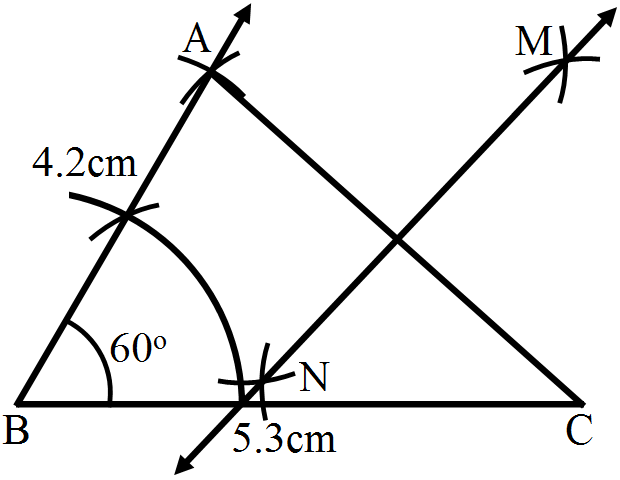
Construct a $\triangle\text{ABC}$ in which BC = 5.3cm, $\angle\text{B}=60^\circ$ and AB = 4.2cm. Also, draw the perpendicular bisector of AC.
Answer

Steps of construction:
Step 1: Draw BC = 5.3cm
Step 2: Construct $\angle\text{CBX}=60^\circ$
Step 3: With B as the centre and radius 4.2cm, cut the ray BX at point A.
Step 4: Join A and C.
Step 5: With A as the centre and radius more than half of AC, draw an arc on either side of AC.
Step 6: With C as the centre and the same radius, draw another arc cutting the previously drawn arc at M and N.
Step 7: Join M and N.
View full question & answer