Questions

5 Mark Question

🎯

Test yourself on this topic

10 questions · timed · auto-graded

Question 15 Marks
Construct a trapezium ABCD in which AB = 6cm, BC = 4cm, CD = 3.2cm, $\angle\text{B}=75^\circ$ and DC || AB.
Answer
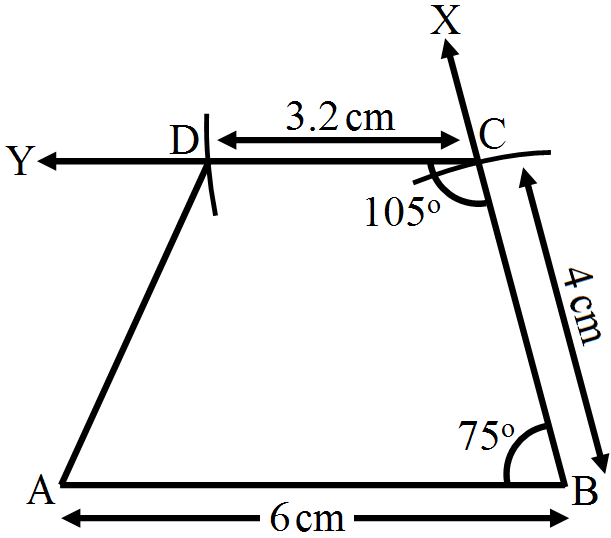
Steps of construction:
Step 1: Draw AB=6 cm.
Step 2: Make $\angle\text{ABX}=75^\circ$
Step 3: With B as the centre, draw an arc at 4cm. Name that point as C.
Step 4: AB || CD
$\therefore\angle\text{ABX}+\angle\text{BCY}=180^\circ$
$\Rightarrow\angle\text{BCY}=180^\circ-75^\circ=105^\circ$
Make $\angle\text{BCY}=105^\circ$
At C, draw an arc of length 3.2cm.
Step 5: Join A and D.
Thus, ABCD is the required trapezium.
View full question & answer
Question 25 Marks
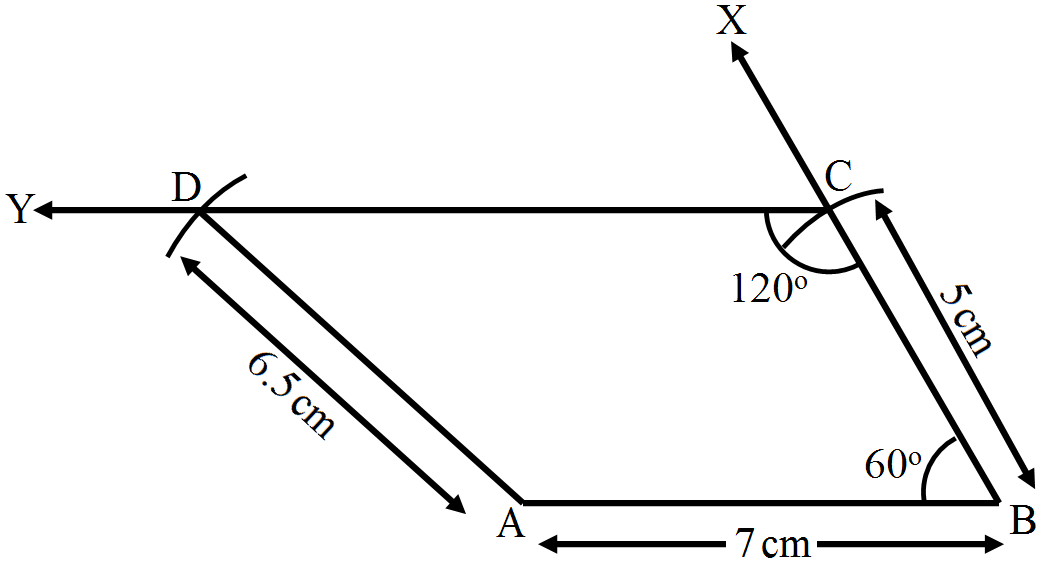
Draw a trapezium ABCD in which AB || DC, AB = 7cm, BC = 5cm, AD = 6.5cm and $\angle\text{B}=60^\circ.$
Answer

Steps of construction:
Step 1: Draw AB equal to 7cm.
Step 2: Make an angle, $\angle\text{ABX},$ equal to 60°.
Step 3: With B as the centre, draw an arc of 5cm. Name that point as C. Join B and C.
Step 4: AB || DC
$\therefore\angle\text{ABX}+\angle\text{BCY}=180^\circ$
$\Rightarrow\angle\text{BCY}=180^\circ-60^\circ=120^\circ$
Draw an angle, $\angle\text{BCY},$ equal to 120º.
Step 5: With A as the centre, draw an arc of length 6.5cm, which cuts CY. Mark that point as D.
Step 6: Join A and D.
​Thus, ABCD is the required trapezium.
View full question & answer
Question 35 Marks
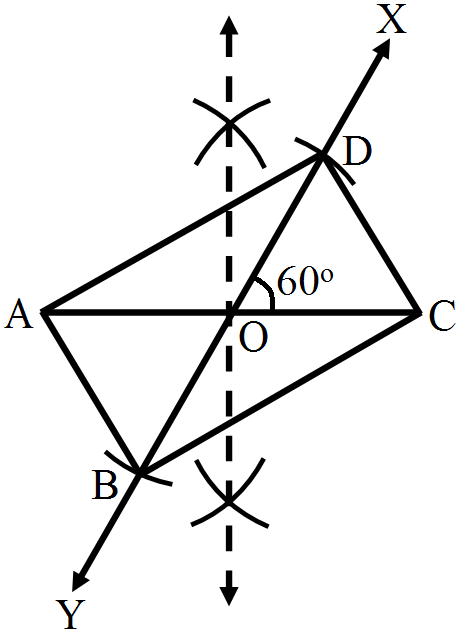
Construct a parallelogram ABCD, in which diagonal AC = 3.8cm, diagonal BD = 4.6cm and the angle between AC and BD is 60°.
Answer
We know that the diagonals of a parallelogram bisect each other.
Steps of construction:
Step 1: Draw AC = 3.8cm. Step 2: Bisect AC at O. Step 3: Make $\angle\text{COX}=60^\circ$ Produce XO to Y.Step 4:
$\text{OB}=\frac{1}{2}(4.6)\text{cm}$ $\text{OB}=2.3\text{cm}$ and $\text{OD}=\frac{1}{2}(4.6)\text{cm}$ $\text{OD}=2.3\text{cm}$ Step 5: Join AB, BC, CD and AD. ​Thus, ABCD is the required parallelogram.
View full question & answer
Question 45 Marks
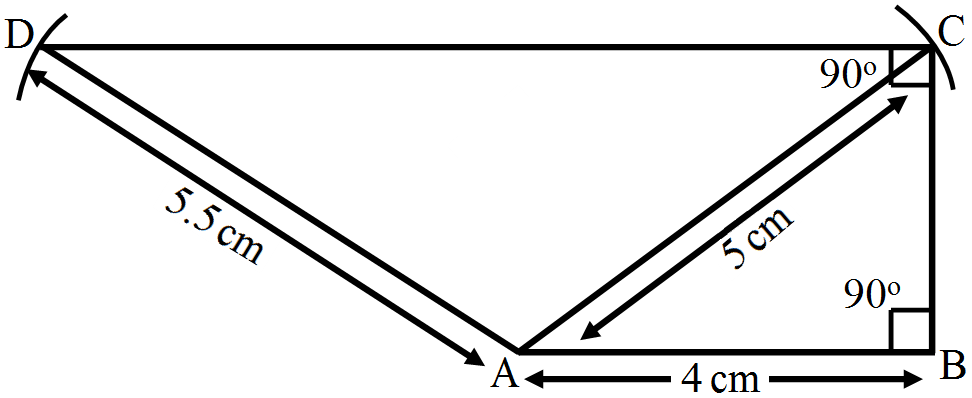
Construct a quadrilateral ABCD in which AB = 4cm, AC = 5cm, AD = 5.5cm and $\angle\text{ABC}=\angle\text{ACD}=90^\circ.$
Answer


Steps of construction:
Step 1: Draw AB = 4cm.
Step 2: Make $\angle\text{B}=90^\circ.$
Step 3:
$AC^2=AB^2+BC^2$
$5^2=4^2+BC^2$
$25-16=BC^2$
$BC=3 cm$
With B as the centre, draw an arc equal to 3cm.
Step 4: Make $\angle\text{C}=90^\circ.$
Step 5: With A as the centre and radius equal to 5.5cm, draw an arc and name that point as D.
Then, ABCD is the required quadrilateral.
View full question & answer
Question 55 Marks
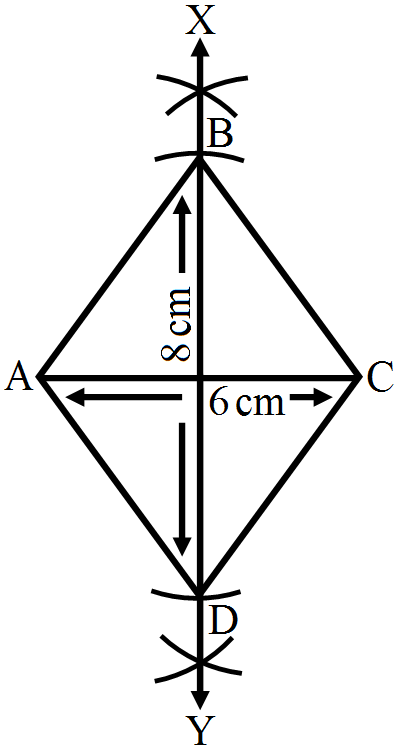
Construct a rhombus the lengths of whose diagonals are 6cm and 8cm.
Answer
We know that the diagonals of a rhombus bisect each other.
Steps of construction: Step 1: Draw AC = 6cm. Step 2: Draw a perpendicular bisector (XY) of AC, which bisects AC at O. Step 3: $\text{OB}=\frac{1}{2}(8)\text{cm}$ $\text{OB}=4\text{cm}$ and $\text{OD}=\frac{1}{2}(8)\text{cm}$ Draw an arc of length 4cm on OX and name that point as B. Draw an arc of length 4cm on OY and name that point as D. Step 4: Join AB, BC, CD and AD. ​Thus, ABCD is the required rhombus, as shown in the figure.
View full question & answer
Question 65 Marks
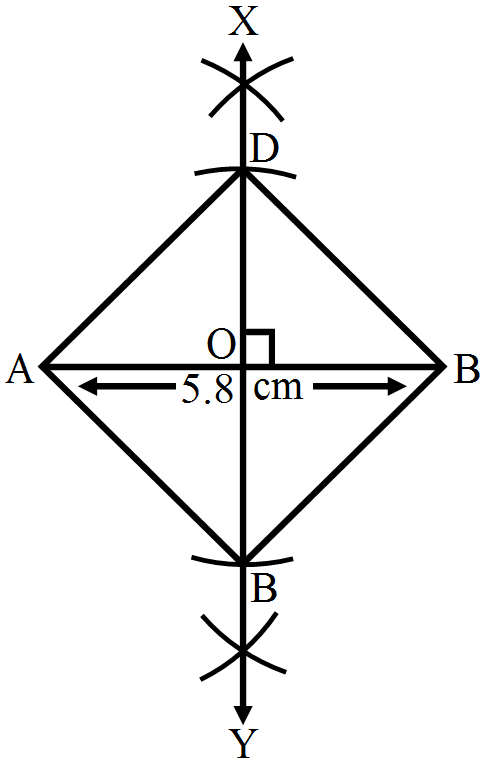
Construct a square, each of whose diagonals measures 5.8cm.
Answer
We know that the diagonals of a square bisect each other at right angles.
Steps of construction: Step 1: Draw AC = 5.8cm. Step 2: Draw the perpendicular bisector XY of AC, meeting it at O. Step 3: From O: $\text{OB}=\frac{1}{2}(5.8)\text{cm}=2.9\text{cm}$ $\text{OD}=\frac{1}{2}(5.8)\text{cm}=2.9\text{cm}$ Step 4: Join AB, BC, CD and DA. ABCD is the required square.
View full question & answer
Question 75 Marks
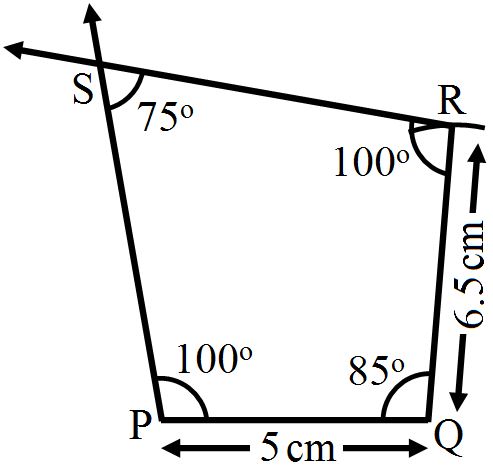
Construct a quadrilateral PQRS in which PQ = 5cm, QR = 6.5cm, $\angle\text{P}=\angle\text{R}=100^\circ$ and $\angle\text{S}=75^\circ.$
Answer

Steps of construction:
Step 1: Draw PQ = 5cm.
Step 2:
$\angle\text{P}+\angle\text{Q}+\angle\text{R}+\angle\text{S}=360^\circ$
$100^\circ+\angle\text{Q}+100^\circ+75^\circ=360^\circ$
$275^\circ+\angle\text{Q}=360^\circ$
$\angle\text{Q}=360^\circ-275^\circ$
$\angle\text{Q}=85^\circ$
Step 3: Make $\angle\text{P}=100^\circ$ and $\angle\text{Q}=85^\circ$
Step 4: With Q as the centre, draw an arc of 6.5cm.
Step 5: Make $\angle\text{R}=100^\circ$
Step 6: Join R and S.
Step 7: Measure $\angle\text{S}=75^\circ$
Then, PQRS is the required quadrilateral.
View full question & answer
Question 85 Marks
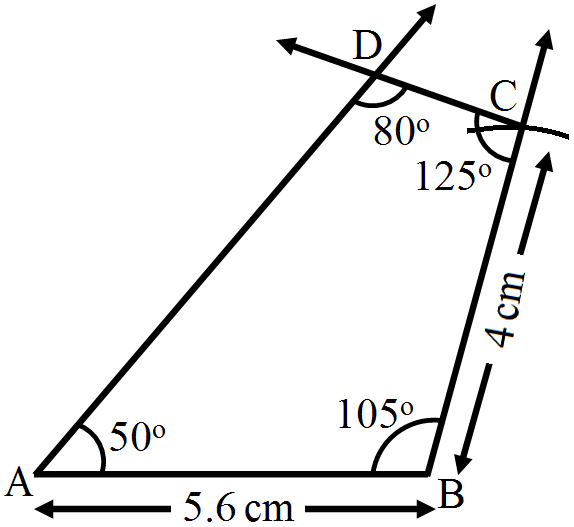
Construct a quadrilateral ABCD in which AB = 5.6cm, BC = 4cm, $\angle\text{A}=50^\circ,\angle\text{B}=80^\circ$ and $\angle\text{D}=80^\circ.$
Answer

Steps of construction:
Step 1: Draw AB = 5.6cm.
Step 2: Make $\angle\text{A}=50^\circ$ and $\angle\text{B}=105^\circ.$
Step 3: With B as the centre, draw an arc of 4cm.
Step 4: Sum of all the angles of the quadrilateral is 360º.
$\angle\text{A}+\angle\text{B}+\angle\text{C}+\angle\text{D}=360^\circ$
$50^\circ+105^\circ+\angle\text{C}+80^\circ=360^\circ$
$235^\circ+\angle\text{C}=360^\circ$
$\angle\text{C}=360^\circ-235^\circ$
$\angle\text{C}=125^\circ$
Step 5: With C as the centre, make $\angle\text{C}$ equal to $\angle125^\circ.$
Step 6: Join C and D.
Step 7: Measure $\angle\text{D}=80^\circ.$
Then, ABCD is the required quadrilateral.
View full question & answer
Question 95 Marks
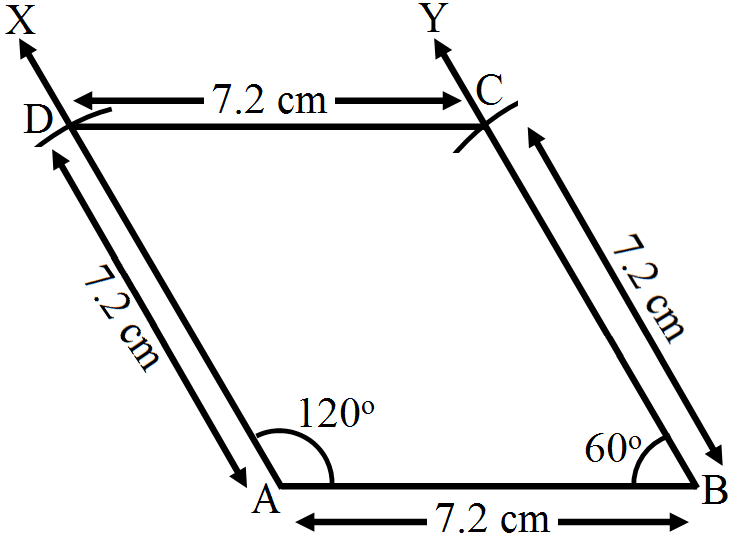
Draw a rhombus whose side is 7.2cm and one angle is 60°.
Answer

Steps of construction:
Step 1: Draw AB = 7.2cm.
Step 2: Draw
$\angle\text{ABY}=60^\circ$
$\angle\text{BAX}=120^\circ$
Sum of the adjacent angles is 180°.
$\angle\text{BAX}+\angle\text{ABY}=180^\circ$
$\Rightarrow\angle\text{BAX}=180^\circ-60^\circ=120^\circ$
Step 3:
Set off AD (7.2cm) along AX and BC (7.2cm) along BY.
Step 4: Join C and D.
Then, ABCD is the required rhombus.
View full question & answer
Question 105 Marks
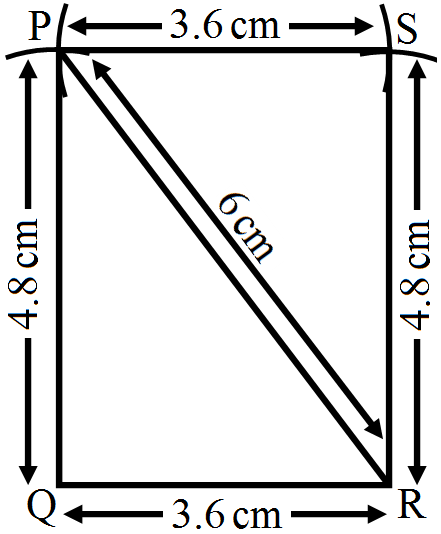
Construct a rectangle PQRS in which QR = 3.6cm and diagonal PR = 6cm. Measure the other side of the rectangle.
Answer


Steps of construction:
Step 1: Draw QR = 3.6cm.
Step 2: Make
$\angle\text{Q}=90^\circ$
$\angle\text{R}=90^\circ$
Step 3:
$PR^2=PQ^2+QR^2$
$6^2=PQ^2+3.6^2$
$PQ^2=23.04$
$PQ=4.8 cm$
Step 4: Draw an arc of length 4.8cm from point Q and name that point as P.
​Step 5: Draw an arc of length 6cm from point R, cutting the previous arc at P.
​Step 6: Join PQ.
Step 7: Draw an arc of length 4.8cm from point R.
From point P, draw an arc of length 3.6cm, cutting the previous arc. Name that point as S.
Step 8: Join P and S.
Thus, PQRS is the required rectangle. The other side is 4.8cm in length.
View full question & answer
5 Mark Question - Maths STD 8 Questions - Vidyadip