Question 14 Marks
In the given figure, ABCD and AEFG are two parallelograms. If $\angle\text{C}= 58^\circ,$ find $\angle\text{F}.$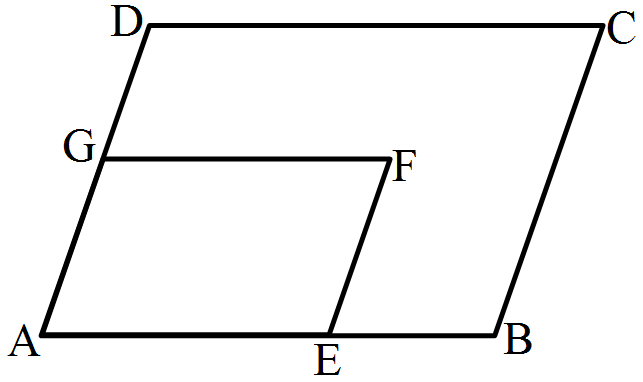
AnswerABCD and AEFG are two parallelograms as shown below: 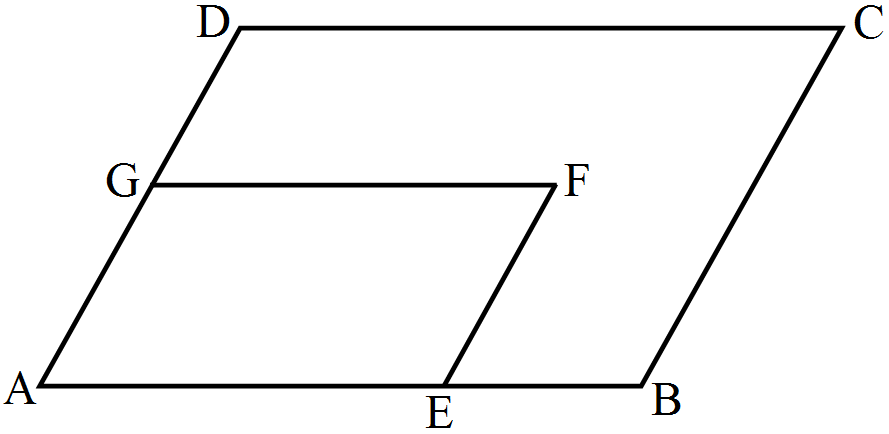 Since ABCD is a parallelogram, with $\angle\text{C}=58^\circ$ We know that the opposite angles of a parallelogram are equal. Therefore,$\angle\text{A}=\angle\text{C}$
$\angle\text{A}= 58^\circ,$
Similarly, AEFG is a parallelogram, with $\angle\text{A}= 58^\circ,$ We know that the opposite angles of a parallelogram are equal. Therefore,$\angle\text{F}=\angle\text{C}$
$\angle\text{F}= 58^\circ$
Hence, the required measure for $\angle\text{F}$ is 58º. View full question & answer→Question 24 Marks
In a $\triangle\text{ABC},$ BM and CN are perpendiculars from B and C respectively on any line passing through A. If L is the mid-point of BC, prove that ML = NL.
Answer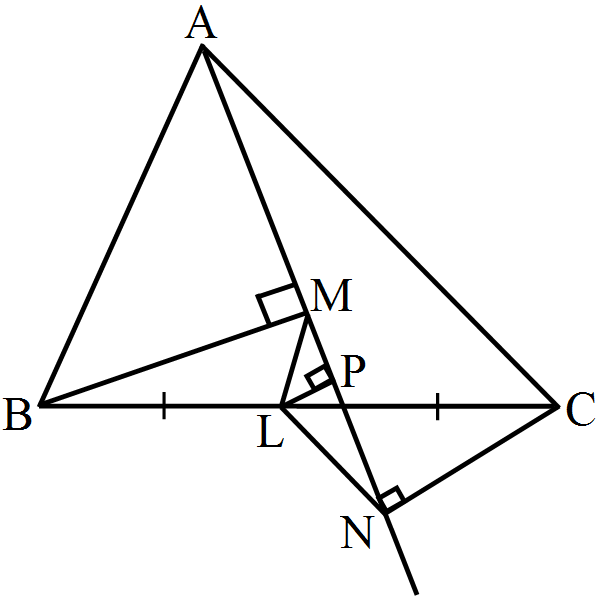 Given that, In $\triangle\text{BLM}$ and $\triangle\text{CLN}$$\angle\text{BML}=\angle\text{CNL}=90^\circ$
$\text{BL}=\text{CL}$ [L is the mid-point of BC]
$\angle\text{MLB}=\angle\text{NLC}$ [Vertically opposite angle]
$\therefore\triangle\text{BLM}=\triangle\text{CLN}$
$\therefore\text{LM}=\text{LN}$ [corresponding parts of congruent triangles] View full question & answer→Question 34 Marks
ABCD is a kite having AB = AD and BC = CD. Prove that the figure found by joining the mid points of the sides, in order, is a rectangle.
AnswerGiven, A kite ABCD having AB = AD and BC = CD. P, Q, R, S are the mid-points of sides AB, BC, CD and DA respectively. PQ, QR, RS and SP are joined. To prove: PQRS is a rectangle. 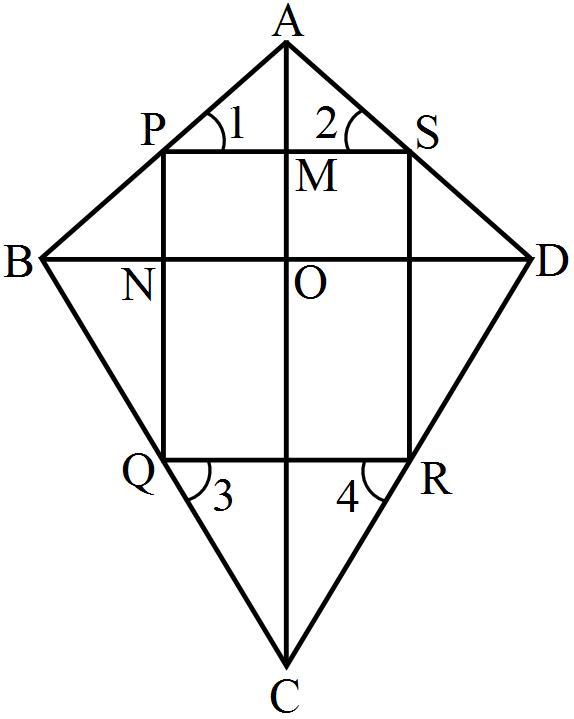 Proof: In $\triangle\text{ABC},$ P and Q are the mid-points of AB and BC respectively.$\therefore\text{PQ}||\text{AC}$ and $\text{PQ}=\frac{1}{2}\text{AC}\ ...(\text{i})$
In $\triangle\text{ADC}$ R and S are the mid-points of CD and AD respectively.$\therefore\text{RS}||\text{AC}$ and $\text{RS}=\frac{1}{2}\text{AC}\ ...(\text{ii})$
From (i) and (ii) we have PQ || RS and PQ = RS Thus, in quadrilateral PQRS, a pair of opposite sides is equal and parallel. So, PQRS is a parallelogram. Now, we shall prove that one angle of parallelogram PQRS is a right angle. Since AB = AD$\Rightarrow12\text{B}=12\text{AD}$
$\Rightarrow\text{AP}=\text{AS}\ ...(\text{iii})$ $[\therefore$ P and S are midpoints of AB and AD$]$
$\Rightarrow\angle1=\angle2\ ...(\text{iv})$
Now, in $\triangle\text{PQB}$ and $\triangle\text{SDR},$ we have PB = SD $\Big[\therefore\text{AD}=\text{AB}\Rightarrow\Big(\frac{1}{2}\Big)\text{AB}\Big]$ BQ = DR [Since PB = SD] And PQ = SR [Since, PQRS is a parallelogram] So, by SSS criterion of congruence, we have$\triangle\text{PBQ}\cong\triangle\text{SDR}$
$\Rightarrow\angle3=\angle4$ [CPCT]
Now, $\Rightarrow\angle3+\angle\text{SPQ}+\angle2=180^\circ$ And $\angle1+\angle\text{PSR}+\angle4=180^\circ$$\therefore\angle3+\angle\text{SPQ}+\angle2=\angle1+\angle\text{PSR}+\angle4$
$\Rightarrow\angle\text{SPQ}=\angle\text{PSR}$ $[\angle1=\angle2\text{and}\angle3=\angle4]$
Now, transversal PS cuts parallel lines SR and PQ at S and P respectively.$\therefore\angle\text{SPQ}+\angle\text{PSR}=180^\circ$
$\Rightarrow\angle2\text{SPQ}=180^\circ$
$\Rightarrow\angle\text{SPQ}=90^\circ$ $[\therefore\angle\text{PSR}=\angle\text{SPQ}]$
Thus, PQRS is a parallelogram such that $\angle\text{SPQ}=90^\circ.$ Hence, PQRS is a parallelogram. View full question & answer→Question 44 Marks
In a triangle, P, Q and R are the mid points of sides BC, CA and AB respectively. If AC = 21cm, BC = 29cm and AB = 30cm, find the perimeter of the quadrilateral ARPQ.
AnswerIn $\triangle\text{ABC},$ R and P are mid points of AB and BC$\text{RP}||\text{AC},\text{RP}=\Big(\frac{1}{2}\Big)\text{AC}$ [By Midpoint Theorem]
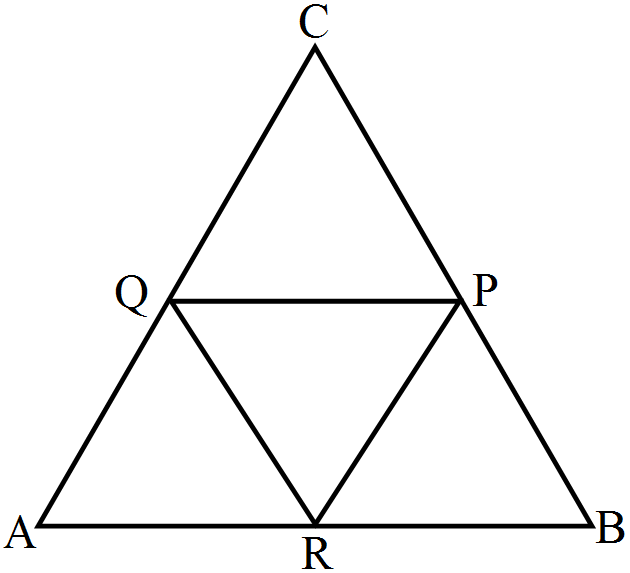 In a quadrilateral, [A pair of side is parallel and equal] RP || AQ, RP = AQ Therefore, RPQA is a parallelogram$\Rightarrow\text{AR}=\frac{1}{2}\text{AB}=\frac{1}{2}\times30=15\text{cm}$
$\text{AR}=\text{QP}=15\text{cm}$ [Opposite sides are equal]
$\Rightarrow\text{RP}=\frac{1}{2}\text{AC}=\frac{1}{2}\times21=10.5\text{cm}$
$\text{RP}=\text{AQ}=10.5\text{cm}$ [Opposite sides are equal]
Now, Perimeter of ARPQ = AR + QP + RP + AQ = 15 + 15 + 10.5 + 10.5 = 51cm View full question & answer→Question 54 Marks
If an angle of a parallelogram is two-third of its adjacent angle, find the angles of the parallelogram.
AnswerLet one of the angle of the parallelogram as x° Then the adjacent angle becomes $\frac{2}{3}\text{x}^\circ$ We know that the sum of adjacent angles of the parallelogram is supplementary. Therefore,$\text{x}+\frac{2}{3}\text{x}=180$
$\frac{5}{3}\text{x}=180$
$\text{x}=180\Big(\frac{3}{5}\Big)$
$\text{x}=108^\circ$
Thus, the angle adjacent to 108° $=\frac{2}{3}(108)^\circ$
$=72^\circ$
Since, opposite angles of a parallelogram are equal. Therefore, the four angles in sequence are 108°, 72°, 108° and 72°.
View full question & answer→Question 64 Marks
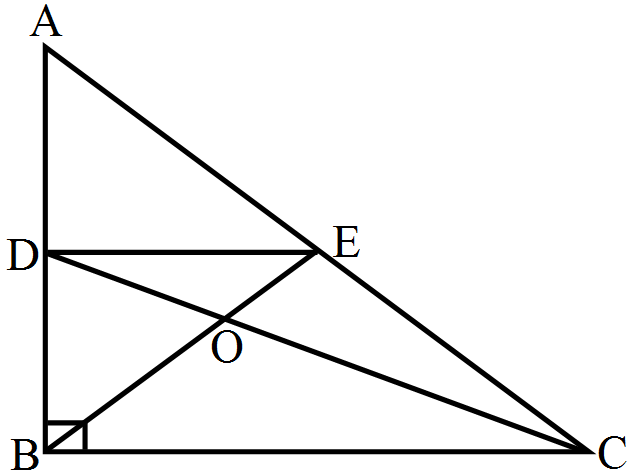
In figure, Triangle ABC is a right angled triangle at B. Given that AB = 9cm, AC = 15cm and D, E are the mid-points of the sides AB and AC respectively, calculate
- The length of BC
- The area of $\triangle\text{ADE}.$
Answer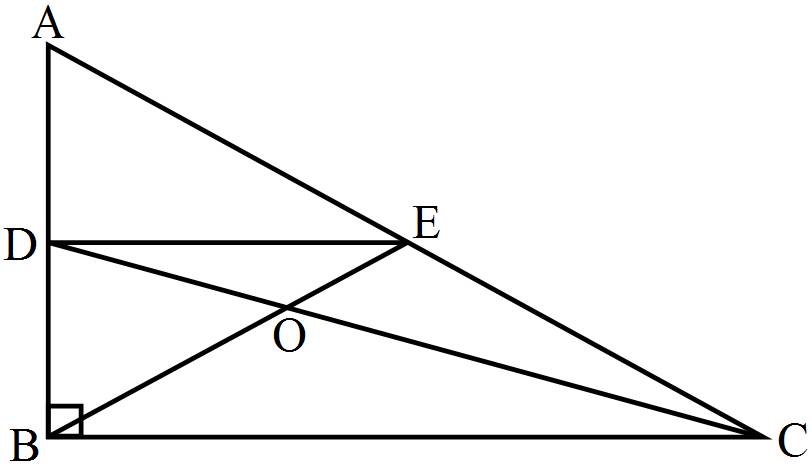
i. In $\triangle ABC , \angle B =90^{\circ}$,
By using Pythagoras theorem
$A C^2=A B^2+B C^2$
$\Rightarrow 15^2=9^2+BC^2$
$\Rightarrow BC=\sqrt{15^2-9^2}$
$\Rightarrow BC=\sqrt{225-81}$
$\Rightarrow BC=\sqrt{144}=12 cm$
ii. In $\triangle ABC$,
$D$ and $E$ are mid-points of $A B$ and $A C$
$\therefore DE \| BC ,=\frac{1}{2} BC [ By$ mid-point theorem]
$AD = DB =\frac{ AB }{2}=\frac{9}{2}=4.5 cm[\therefore D$ is the mid-point of AB $]$
Area of $\triangle ADE =\frac{1}{2} \times AD \times DE$
$=\frac{1}{2} \times 4.5 \times 6$
$=13.5 cm^2$ View full question & answer→Question 74 Marks
ABCD is a parallelogram, AD is produced to E so that DE = DC and EC produced meets AB produced in F.Prove that BF = BC.
AnswerDraw a parallelogram ABCD with AC and BD intersecting at O. Produce AD to E such that DE = DC. Join EC and produce it to meet AB produced at F. In $\triangle\text{DCE},$$\therefore\angle\text{DCE}=\angle\text{DEC}\dots(1)$ (In a triangle, equal sides have equal angles opposite to them)
AB || CD (Opposite sides of the parallelogram are parallel)$\therefore$ AF || CD (AB lies on AF)
AF || CD and EF is the transversal,$\therefore\angle\text{DCE}=\angle\text{BFC}\dots(2)$ (Pair of corresponding angles)
From (1) and (2), we get$\angle\text{DCE}=\angle\text{BFC}$
In $\triangle\text{AFE},$$\angle\text{AFE}=\angle\text{AEF}$ $(\angle\text{DEC}=\angle\text{BFC})$
$\therefore$ AE = AF (In a triangle, equal angles have equal sides opposite to them)
⇒ AD + DE = AB + BF ⇒ BC + AB = AB + BF $(\because$ AD = BC, DE = CD AND CD = AB, AB = DE$)$ ⇒ BC = BF
View full question & answer→Question 84 Marks
BM and CN are perpendiculars to a line passing through the vertex A of triangle ABC. If L is the mid-point of BC, prove that LM = LN.
AnswerTo prove LM = LN 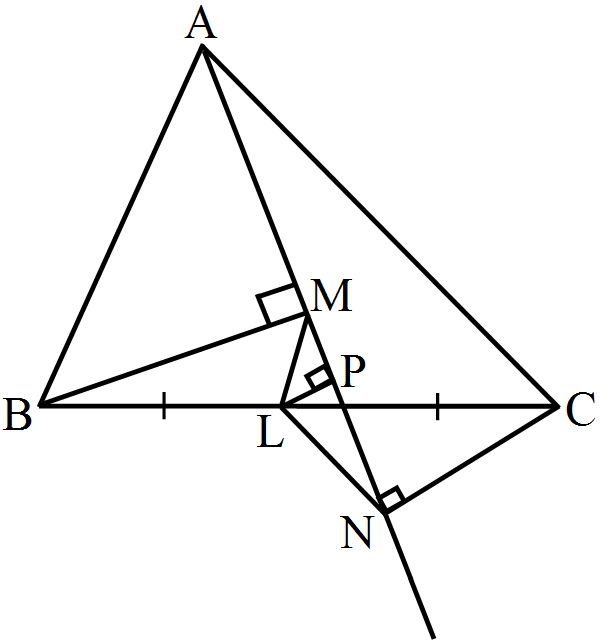 Draw LS as perpendicular to line MN. Therefore, the lines BM, LS and CN being the same perpendiculars on line MN are parallel to each other. According to intercept theorem, If there are three or more parallel lines and the intercepts made by them on a transversal are equal, then the corresponding intercepts on any other transversal are also equal. In the figure, MB, LS and NC are three parallel lines and the two transversal lines are MN and BC. We have, BL = LC [As L is the given mid-point of BC] Using the intercept theorem, we get MS = SN .....(i) Now in $\triangle\text{MLS}$ and $\triangle\text{LSN}$ MS = SN using equation ...(i)$\angle\text{LSM}=\angle\text{LSN}=90^\circ$ $[\text{LS}\bot\text{MN}]$
And SL = LS is common.$\therefore\triangle\text{MLS}\cong\triangle\text{LSN}$ [SAS Congruency Theorem]
$\therefore\text{LM}=\text{LN}$ [CPCT] View full question & answer→Question 94 Marks
In ABCD is a parallelogram in which P is the mid-points of DC and Q is a point on AC such that $\text{CQ}=\frac{1}{4}\text{AC}.$ if PQ produced meets BC at E, prove R is a mid-points of BC.
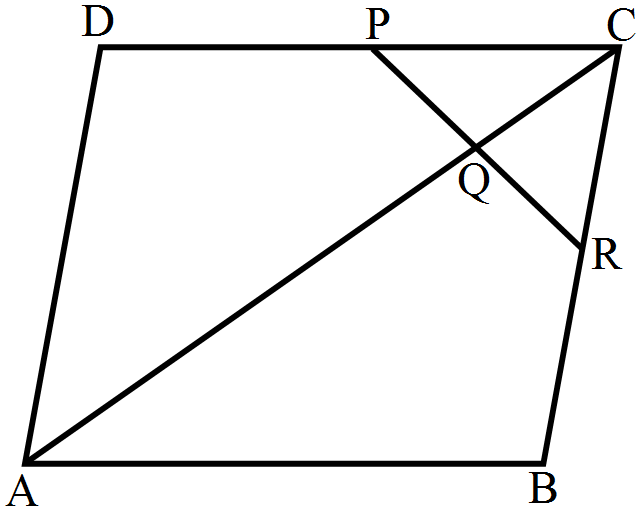
AnswerFigure is given as follows:
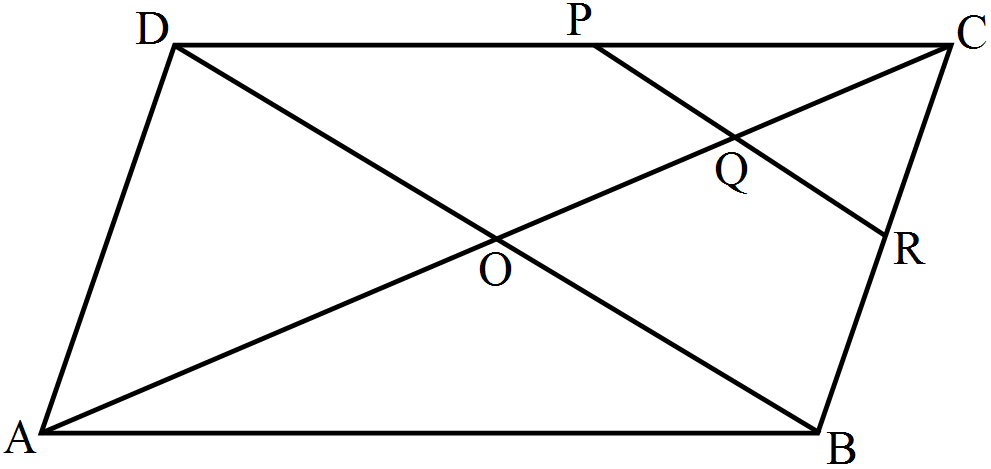
ABCD is a parallelogram, where P is the mid-points of DC and Q is a point on AC such that $\text{CQ}=\frac{1}{4}\text{AC}.$
PQ produced meets BC at R.
We need to prove that R is a mid-points of BC.
Let us join BD to meet AC At O.
It is given that ABCD is a parallelogram.
Therefore, $\text{OC}=\frac{1}{2}\text{AC}$ (Because diagonals of a parallelogram bisect each other)
Also, $\text{CQ}=\frac{1}{2}\text{AC}$
Therefore, $\text{CQ}=\frac{1}{2}\text{OC}$
In $\triangle\text{DCQ},$ p and Q are the mid-points of CD respectively.
Theorem states, the line segment joining the mid-points of any two sides of a triangle is parallel to the third side and equal to half of it.
Therefore, we get: PQ || DO
Also, in $\triangle\text{COB},$ Q is the mid-points of BC.
Hence proved. View full question & answer→Question 104 Marks
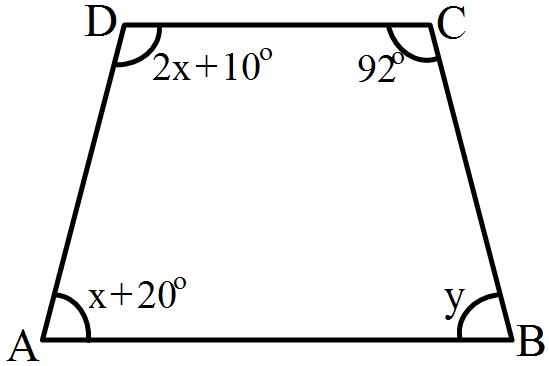
In the given figure, ABCD is a trapezium. Find the values of x and y.
AnswerThe figure is given as follows: 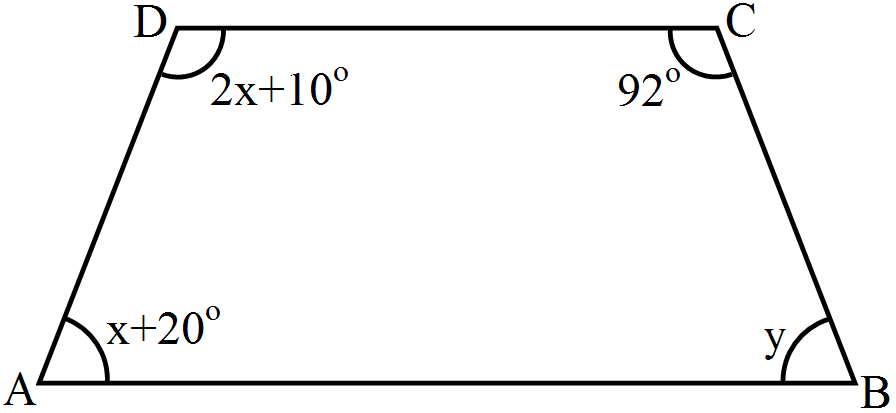 We know that ABCD is a trapezium with AB || DC Therefore,$\angle\text{A}+\angle\text{D}=180^\circ$
It is given that $\angle\text{A}=\text{x}+20^\circ$ and $\angle\text{D}=2\text{x}+10^\circ.$ (x + 20º) + (2x + 10º) = 180º 3x + 30º = 180º 3x = 180º - 30º 3x = 150º x = 50º Similarly, y + 92º = 180º y = 180º - 92º y = 88º Hence, the required values for x and y is 50º and 88º respectively. View full question & answer→Question 114 Marks
The diagonals of a rectangle ABCD meet at O, If $\angle\text{BOC}=44^\circ,$ find $\angle\text{OAD}.$
AnswerThe rectangle ABCD is given as: 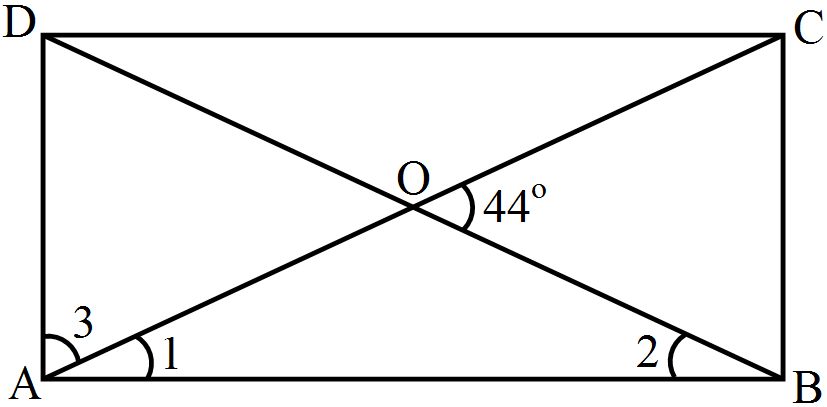 We have,$\angle\text{BOC}+\angle\text{BOA}=180^\circ$ (Linear pair)
$44^\circ+\angle\text{BOA}=180^\circ$
$\angle\text{BOA}=180^\circ-44^\circ$
$\angle\text{BOA}=136^\circ$
Since, diagonals of a rectangle are equal and they bisect each other. Therefore, in$\triangle\text{OAB},$ we have
OA = OB (Angles opposite to equal sides are equal.) Therefore,$\angle1=\angle2$
Now,in $\triangle\text{OAB},$ we have$\angle\text{BOA}+\angle1+\angle2=180^\circ$
$\angle\text{BOA}+2\angle1=180^\circ$
$2\angle1=44^\circ$
$\angle1=22^\circ$
Since, each angle of a rectangle is a right angle. Therefore,$\angle\text{BAD}=90^\circ$
$\angle1+\angle3=90^\circ$
$22^\circ+\angle3=90^\circ$
$\angle3=68^\circ$
Thus, $\angle\text{OAD}=68^\circ$ Hence, the measure of $\angle\text{OAD}$ is 68º.$\angle\text{C}+\angle\text{D}=150^\circ$
Hence, the sum of $\angle\text{C}$ and $\angle\text{D}$ is 150º. View full question & answer→Question 124 Marks
In a quadrilateral ABCD, CO and DO are the bisectors of $\angle\text{C}\ \text{and}\ \angle\text{D}$ respectively. Prove that $\angle\text{COD} = \frac{1}{2} (\angle\text{A}\ \text{and}\ \angle\text{B})$.
AnswerIn $\triangle\text{DOC}$$\angle1+\angle\text{COD}+\angle2=180^\circ$ [Angle sum property of a triangle]
$\Rightarrow\angle\text{COD}=180-(\angle1-\angle2)$
$\Rightarrow\angle\text{COD}=180-\angle\ 1+\angle2$
$\Rightarrow\angle\text{COD}=180-\Big[\frac{1}{2}\text{LC}+\frac{1}{2}\text{LD}\Big]$ $\big[\because$ OC and OD are bisectors of LC and LD respectively$\big]$
$\Rightarrow\angle\text{COD}=180-\frac{1}{2}(\text{LC+LD)}\ ...(\text{i})$
In quadrilateral ABCD$\angle\text{A}+\angle\text{B}+\angle\text{C}+\angle\text{D}=360^\circ$ [Angle sum property of quadrilateral]
$\angle\text{C}+\angle\text{D}=360^\circ-(\angle\text{A}+\angle\text{B)}\dots(\text{ii})$ Substituting (ii) in (i)$\Rightarrow\angle\text{COD}=180-\frac{1}{2}(360^\circ-(\angle\text{A}+\angle\text{B))}$
$\Rightarrow\angle\text{COD}=180-180+\frac{1}{2}(\angle\text{A}+\angle\text{B})$
$\Rightarrow\angle\text{COD}=\frac{1}{2}(\angle\text{A}+\angle\text{B})$
View full question & answer→Question 134 Marks
Two opposite angles of a parallelogram are (3x - 2)° and (50 - x)°. Find the measure of each angle of the parallelogram.
AnswerWe know that, Opposite sides of a parallelogram are equal. (3x - 2)° = (50 - x)° ⇒ 3x + x = 50 + 2 ⇒ 4x = 52° ⇒ x = 13° Therefore, (3x - 2)° = (3 × 13 - 2)° = 37° (50 - x)° = (50 - 13) = 37° Adjacent angles of a parallelogram are supplementary.$\therefore$ x + 37 = 180°
$\therefore$ x = 180° - 37° = 143°
Hence, four angles are: 37°, 143°, 37°, 143°.
View full question & answer→Question 144 Marks
In a $\triangle\text{ABC},$ E and F are the mid-points of AC and AB respectively. The altitude AP to BC intersects FE at Q. Prove that AQ = QP.
Answer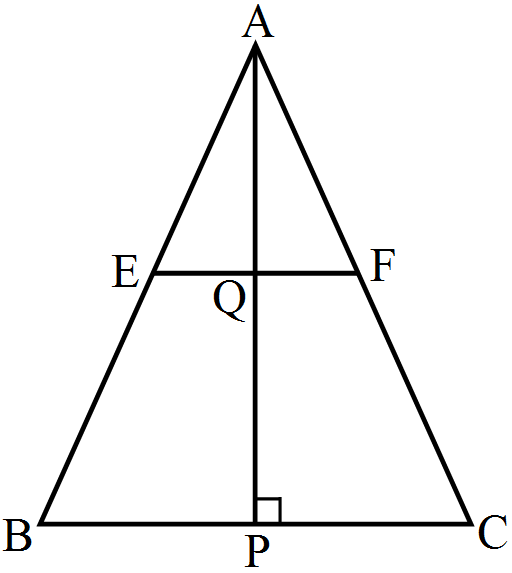 In a $\triangle\text{ABC}$
E and F are mid points of AB and AC
$\therefore\text{EF},||\text{FE},\frac{1}{2}\text{BC}=\text{FE}$ [By midpoint theorem]
In $\triangle\text{ABP}$
F is the mid-point of AB and $\text{FQ}||\text{BP}$ $[\therefore\text{EF}||\text{BP}]$
Therefore, Q is the mid-point of AP [By mid-point theorem]
Hence, AQ = QP. View full question & answer→Question 154 Marks
ABC is a triangle and through A, B, C lines are drawn parallel to BC, CA and AB respectively intersecting at P, Q and R. Prove that the perimeter of $\triangle\text{PQR}$ is double the perimeter of $\triangle\text{ABC}.$
AnswerClearly ABCQ and ARBC are parallelograms. Therefore, BC = AQ and BC = AR ⇒ AQ = AR ⇒ A is the mid-point of QR Similarly B and C are the mid points of PR and PQ respectively.$\therefore\text{AB}=\Big(\frac{1}{2}\Big)\text{PQ},$ $\text{BC}=\Big(\frac{1}{2}\Big)\text{QR},$ $\text{CA}=\Big(\frac{1}{2}\Big)\text{PR}.$
⇒ PQ = 2AB, QR = 2BC and PR = 2CA ⇒ PQ + QR + RP = 2 (AB + BC + CA) ⇒ Perimeter of $\triangle\text{PQR}=2$ $($perimeter of $\triangle\text{ABC})$
View full question & answer→Question 164 Marks
In figure, M, N and P are mid-points of AB, AC and BC respectively. If MN = 3cm, NP = 3.5cm and MP = 2.5cm, calculate BC, AB and AC.
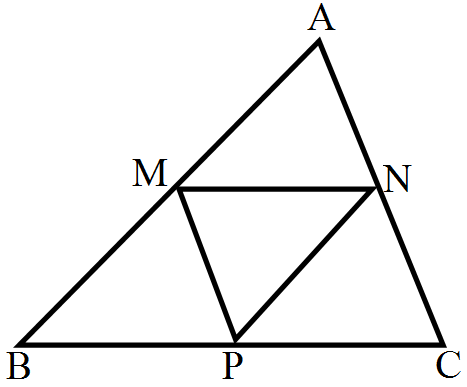
AnswerGiven MN = 3cm, NP = 3.5cm and MP = 2.5cm. To find BC, AB and AC 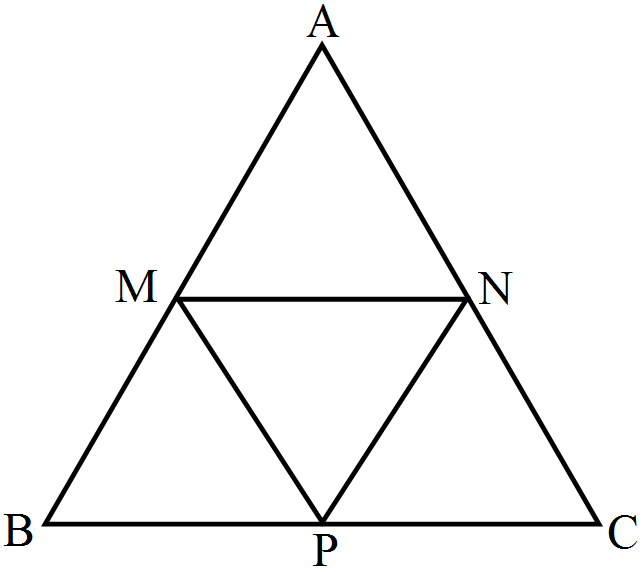 In $\triangle\text{ABC}$ M and N are mid-points of AB and AC$\therefore\text{MN}=\frac{1}{2}\text{BC},\text{MN}||\text{BC}$ [By mid-point theorem]
$\Rightarrow3=\frac{1}{2}\text{BC}$
$\Rightarrow3\times2=\text{BC}$
$\Rightarrow\text{BC}=6\text{cm}$
Similarly AC = 2MP = 2(2.5) = 5cm AB = 2 NP = 2(3.5) = 7cm View full question & answer→Question 174 Marks
If the bisectors of two adjacent angles A and B of a quadrilateral ABCD intersect at a point O such that $\angle\text{C}+\angle\text{D}=\text{k}\angle\text{AOB},$ then find the value of k.
AnswerThe quadrilateral can be drawn as follows: 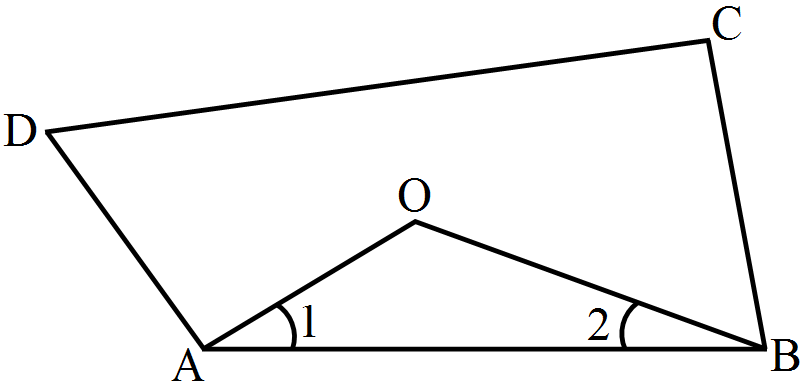 We have AO and BO as the bisectors of angles $\angle\text{A}$ and $\angle\text{B}$ respectively. In $\triangle\text{AOB},$ We have,$\angle\text{AOB}+\angle1+\angle2=180^\circ$
$\angle\text{AOB}=180^\circ-(\angle1+\angle2)$
$\angle\text{AOB}=180^\circ-\Big(\frac{1}{2}\angle\text{A}+\frac{1}{2}\angle\text{B}\Big)$
$\angle\text{AOB}=180^\circ-\frac{1}{2}\Big(\angle\text{A}+\angle\text{B}\Big)\ ...(1)$
By angle sum property of a quadrilateral, we have:$\angle\text{A}+\angle\text{B}+\angle\text{C}+\angle\text{D}=360^\circ$
$\angle\text{A}+\angle\text{B}=360^\circ-(\angle\text{C}+\angle\text{D})$
Putting in equation (1):$\angle\text{AOB}=180^\circ-\frac{1}{2}\Big[360^\circ-(\angle\text{C}+\angle\text{D})\Big]$
$\angle\text{AOB}=180^\circ-180^\circ+\frac{(\angle\text{C}+\angle\text{D})}{2}$
$\angle\text{AOB}=\frac{1}{2}(\angle\text{C}+\angle\text{D})$
$(\angle\text{C}+\angle\text{D})=2\angle\text{AOB}\ ...(2)$
On comparing equation (2) with$(\angle\text{C}+\angle\text{D})=\text{k}\angle\text{AOB}$
We get k = 2. Hence, the value for k is 2. View full question & answer→Question 184 Marks
In a $\triangle\text{ABC},$ D, E and F are, respectively the mid points of BC, CA and AB. If the lengths of sides AB, BC and CA are 7cm, 8cm and 9cm, respectively, find the perimeter of $\triangle\text{DEF}.$
AnswerGiven that, 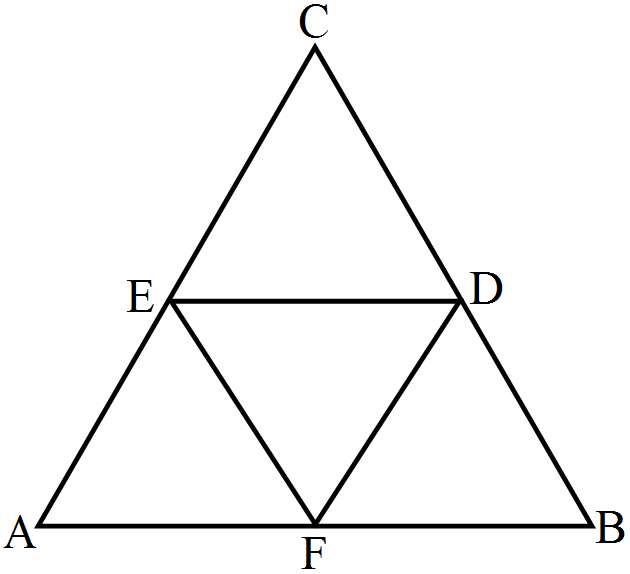 AB = 7cm, BC = 8cm, AC = 9cm In $\triangle\text{ABC},$ F and E are the mid points of AB and AC.$\therefore\text{EF}=\frac{1}{2}\text{BC}$
Similarly$\text{DF}=\frac{1}{2}\text{AC}$ and $\text{DE}=\frac{1}{2}\text{AB}$
Perimeter of $\triangle\text{DEF}=\text{DE}+\text{EF}+\text{DF}$$=\Big(\frac{1}{2}\Big)\text{AC}+\Big(\frac{1}{2}\Big)\text{BC}+\Big(\frac{1}{2}\Big)\text{AC}$
$=\frac{1}{2}\times7+=\frac{1}{2}\times8+\frac{1}{2}\times9$
$=3.5+4+4.5$
$=12\text{cm}$ View full question & answer→Question 194 Marks
In a quadrilateral ABCD, bisectors of angles A and B intersect at O such that $\angle\text{AOB}=75^\circ,$ then write the value of $\angle\text{C}+\angle\text{D}.$
AnswerThe quadrilateral can be drawn as follows: 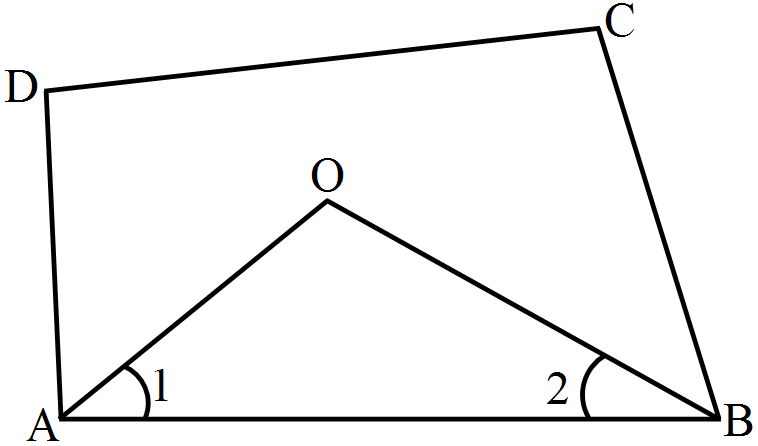 We have AO and BO as the bisectors of angles $\angle\text{A}$ and $\angle\text{B}$ respectively. In $\triangle\text{AOB},$ We have,$\angle\text{AOB}+\angle1+\angle2=180^\circ$
$\angle\text{AOB}=180^\circ-(\angle1+\angle2)$
$\angle\text{AOB}=180^\circ-\Big(\frac{1}{2}\angle\text{A}+\frac{1}{2}\angle\text{B}\Big)$
$\angle\text{AOB}=180^\circ-\frac{1}{2}\Big(\angle\text{A}+\angle\text{B}\Big)\ ...(1)$
By angle sum property of a quadrilateral, we have:$\angle\text{A}+\angle\text{B}+\angle\text{C}+\angle\text{D}=360^\circ$
$\angle\text{A}+\angle\text{B}=360^\circ-(\angle\text{C}+\angle\text{D})$
Putting in equation (1):$\angle\text{AOB}=180^\circ-\frac{1}{2}[360^\circ-(\angle\text{C}+\angle\text{D})]$
$\angle\text{AOB}=180^\circ-180^\circ+\frac{(\angle\text{C}+\angle\text{D})}{2}$
$\angle\text{AOB}=\frac{1}{2}\big(\angle\text{C}+\angle\text{D}\big)\ ...(2)$
It is given that $\angle\text{AOB}=75^\circ$ in equation (2), we get:$75^\circ=\frac{1}{2}\big(\angle\text{C}+\angle\text{D}\big)$
$\frac{1}{2}\big(\angle\text{C}+\angle\text{D}\big)=75^\circ$
$\angle\text{C}+\angle\text{D}=150^\circ$
Hence, the sum of $\angle\text{C}$ and $\angle\text{D}$ is 150º. View full question & answer→Question 204 Marks
In a parallelogram ABCD, if $\angle\text{A}=(3\text{x}-20)^\circ,\angle\text{B}=(\text{y}+15)^\circ,\angle\text{C}=(\text{x}+40)^\circ,$ then find the values of x and y.
AnswerIn parallelogram ABCD, $\angle\text{A}$ and $\angle\text{C}$ are opposite angles. We know that in a parallelogram, the opposite angles are equal. Therefore,$\angle\text{C}=\angle\text{A}$
We have $\angle\text{A}=(3\text{x}-20)^\circ$ and $\angle\text{C}=(\text{x}+40)^\circ$ Therefore, x + 40º = 3x - 20º x - 3x = -40º - 20º -2x = -60º x = 30º Therefore,$\angle\text{A}=(3\text{x}-20)^\circ$
$\angle\text{A}=[3(30)-20]^\circ$
$\angle\text{A}=70^\circ$
Similarly,$\angle\text{C}=70^\circ$
Also, $\angle\text{B}=(\text{y}+15)^\circ$ Therefore,$\angle\text{D}=\angle\text{B}$
$\angle\text{D}=(\text{y}+15)^\circ$
By angle sum property of a quadrilateral, we have:$\angle\text{A}+\angle\text{B}+\angle\text{C}+\angle\text{D}=360^\circ$
$70^\circ+(\text{y}+15)^\circ+70^\circ+(\text{y}+15)^\circ=360^\circ$
$140^\circ+2(\text{y}+15)^\circ=360^\circ$
$2(\text{y}+15)^\circ=360^\circ-140^\circ$
$2(\text{y}+15)^\circ=220^\circ$
$(\text{y}+15)^\circ=110^\circ$
$\text{y}=95^\circ$
Hence the required values for x and y are 30º and 95º respectively.
View full question & answer→Question 214 Marks
In Fig. $\text{BE}\bot\text{AC}$ AD is any line from A to BC intersecting BE in H. P, Q and R are respectively the mid-points of AH, AB and BC. prove that $\angle\text{PQR}=90^\circ.$
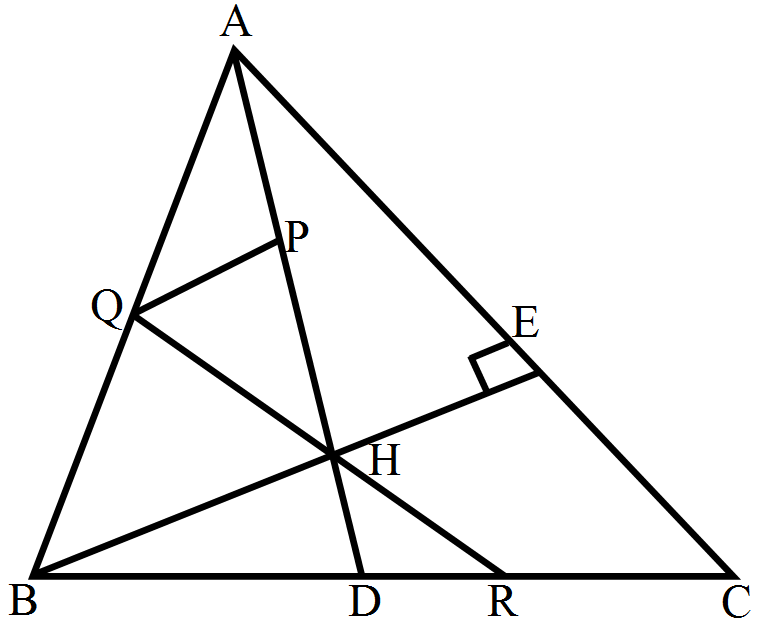
Answer$\triangle\text{ABC}$ is given with $\text{BE}\bot\text{AC}$AD is any line from A to BC intersecting BE in H.
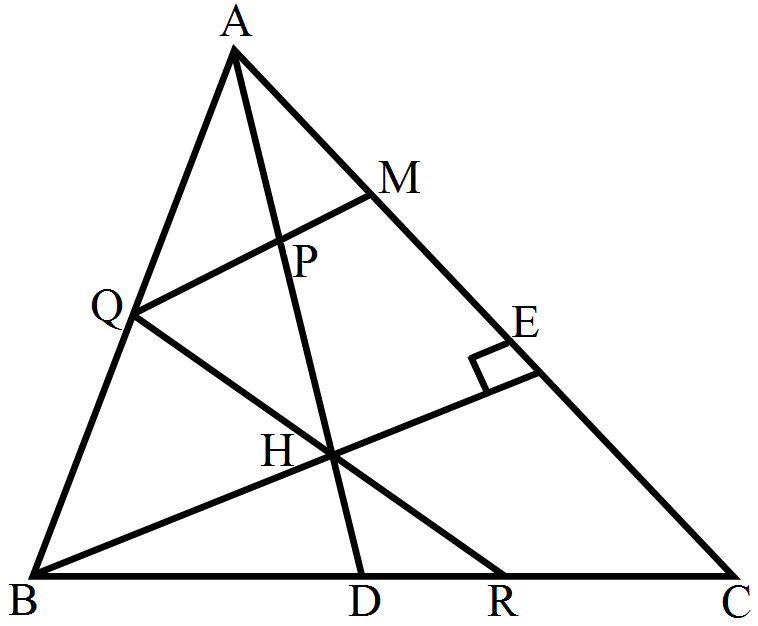
P,Q and R respectively are the mid-points of AH, AB and BC.
We need to prove that $\angle\text{PQR}=90^\circ$
Let us extend QP to meet AC at M.
In $\triangle\text{ABC},$ R and Q are the mid-points of BC and AB respectively.
Theorem states, the line segment joining the mid-points of any two sides of a triangle is parallel to the third side and equal to half of it.
Therefore, we get:
$\text{QR}||\text{AC}$
$\text{QH}||\text{ME}\ ...(\text{i})$
Similarly, in $\triangle\text{ABH},$
$\text{QP||}\text{BH}$
$\text{QM}||\text{HE}\ ...(\text{ii})$
From (i) and (ii), we get:
$\text{QM}||\text{HE}$ and $\text{QH}||\text{ME}$
We get, QHME is a parallelogram.
Also, $\text{BE}\perp\text{AC}$
Therefore, QHME is a rectangle.
Thus, $\angle\text{MQH}=90^\circ$
or,
$\angle\text{PQR}=90^\circ$
Hence proved. View full question & answer→Question 224 Marks
In the given figure, PQRS is a rhombus in which the diagonal PR is produced to T. If $\angle\text{SRT}=152^\circ, $ find x, y and z.
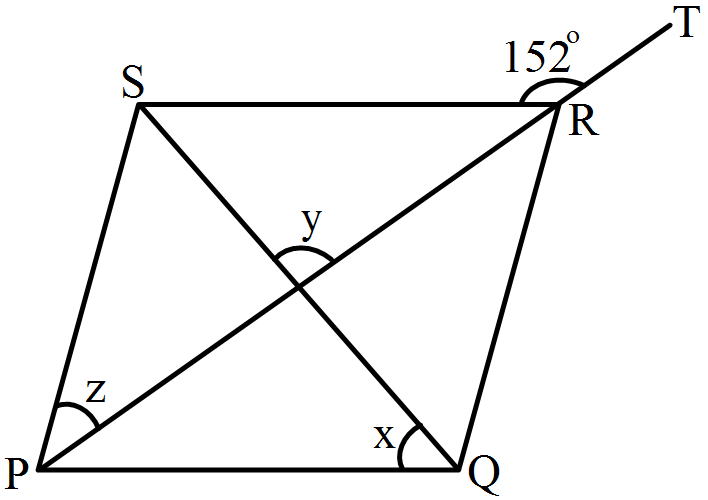
AnswerRhombus PQRS is given. 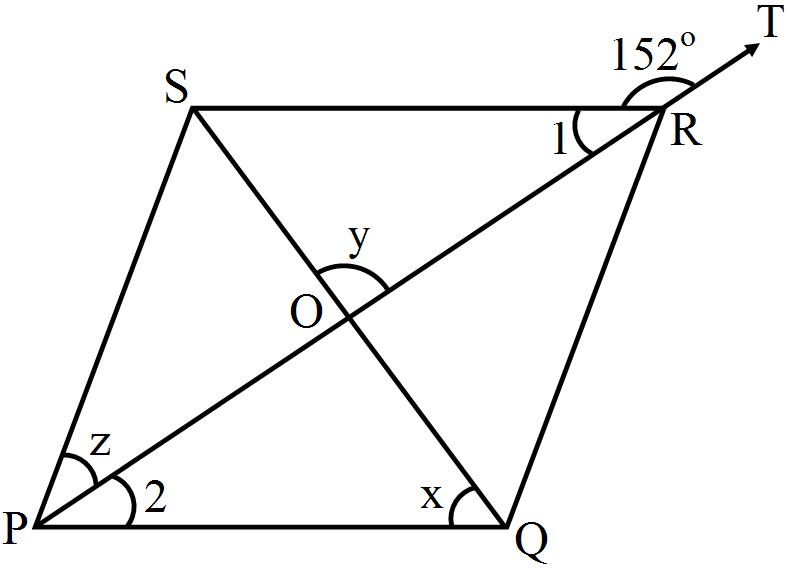 Diagonal PR is produced to T. Also, $\angle\text{SRT}=152^\circ.$ We know that in a rhombus, the diagonals bisect each other at right angle. Therefore, y = 90º Now,$\angle1+\angle\text{SRT}=180^\circ$
$\angle1+\angle152^\circ=180^\circ$
$\angle1=28^\circ$
In $\triangle\text{SOR},$ by angle sum property of a triangle, we get:$\angle1+\text{y}+\angle\text{OSR}=180^\circ$
$28^\circ+90^\circ+\angle\text{OSR}=180^\circ$
$118^\circ+\angle\text{OSR}=180^\circ$
$\angle\text{OSR}=62^\circ$
Or, $\angle\text{QSR}=62^\circ$ (Because O lies on SQ) We have, SR || PQ. Thus the alternate interior opposite angles must be equal. Therefore,$\text{x}=\angle\text{QSR}$
$\text{x}=62^\circ$
In $\triangle\text{SPR},$ We have, Since opposite sides of a rhombus are equal. Therefore, PS = SR Also, Angles opposite to equal sides are equal. Thus,$\text{z}=\angle1$
But $\angle1=28^\circ$ Thus, $\text{z}=28^\circ$ Hence the required values for x,y and z are 62º, 90º and 28º respectively. View full question & answer→Question 234 Marks
In a parallelogram ABCD, the bisector of $\angle\text{A}$ also bisects BC at X. Find AB : AD.
AnswerParallelogram ABCD is given as follows: 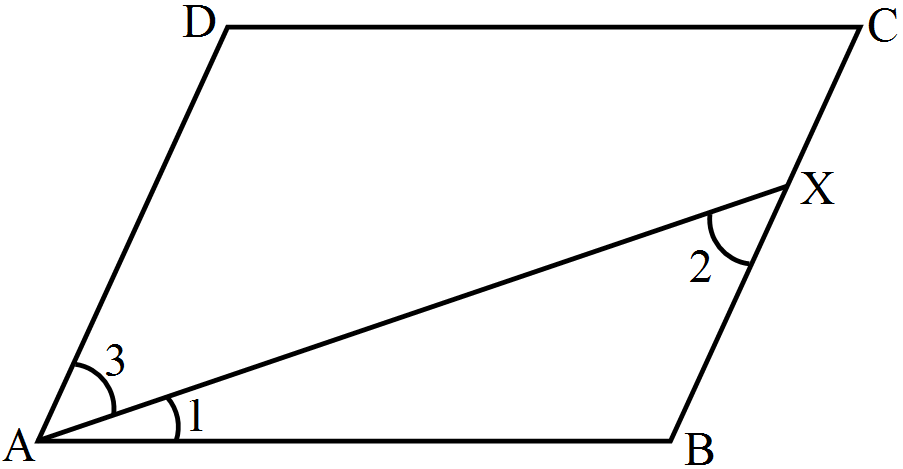 We have AX bisects $\angle\text{A}$ bisecting BC at X. That is, BX = CX We need to find AB : AD Since, AX is the bisector $\angle\text{A}$ That is,$\angle1=\frac{1}{2}\angle\text{A}\ ....(\text{i})$
Also, ABCD is a parallelogram Therefore, AD || BC and AB intersects them$\angle\text{A}+\angle\text{B}=180^\circ$
$\angle\text{B}=180^\circ-\angle\text{A}\ ....(\text{ii})$
In $\triangle\text{ABX},$ by angle sum property of a triangle:$\angle1+\angle2+\angle\text{B}=180^\circ$
From (i) and (ii), we get:$\frac{1}{2}\angle\text{A}+\angle2+180^\circ-\angle\text{A}=180^\circ$
$\angle2-\frac{1}{2}\angle\text{A}=0$
$\angle2=\frac{1}{2}\angle\text{A}\ ....(\text{iii})$
From (i) and (iii),we get:$\angle1=\angle2$
Sides opposite to equal angles are equal. Therefore, BX = AB 2BX = 2AB As X is the mid point of BC. Therefore, BC = 2AB Also, ABCD is a parallelogram, then, BC = AD AD = 2AB Thus, AB : AD = AB : 2AB AB : AD = 1 : 2 Hence the ratio of AB : AD is 1 : 2. View full question & answer→Question 244 Marks
P and Q are the point of trisection of the diagonal BD of a parallelogram ABCD. prove that CQ is parallel to AP. prove also that AC bisects PQ.
Answer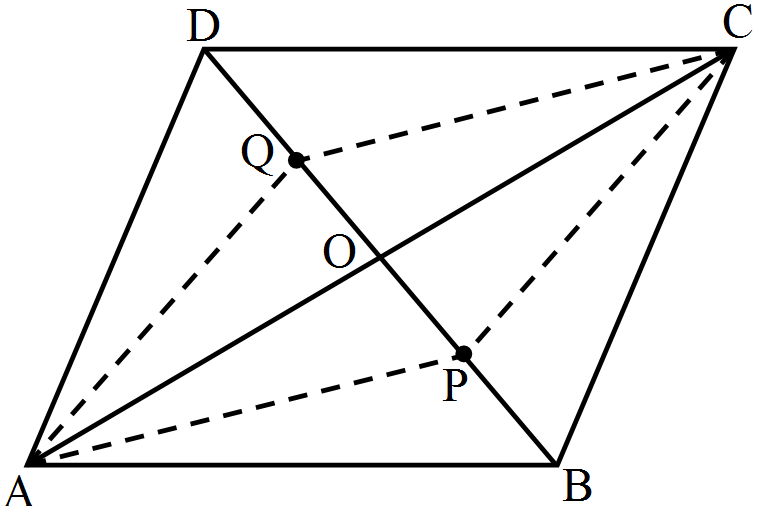 Since, digonals of a parallelogram bisect each other. Therefore, OA = OC and OB = OD. Since, P and Q are points of trisenction of BD.$\therefore$ BP = PQ = QD
NOW, OB = OD and BP =QD ⇒ OB - BP = OD - QD ⇒ OP = OQ Thus, in quadrilateral APCQ, we have OA = OC and OP = OQ ⇒ Diagonals of quadrilateral APCQ bisect each other ⇒ APCQ is a parallelogram. Hence, AP || CQ. View full question & answer→Question 254 Marks
In figure, AB = AC and CP ∥ BA and AP is the bisector of exterior $\angle\text{CAD}$ of $\triangle\text{ABC}.$ Prove that:
- $\angle\text{PAC}=\angle\text{BCA}.$
- ABCP is a parallelogram.
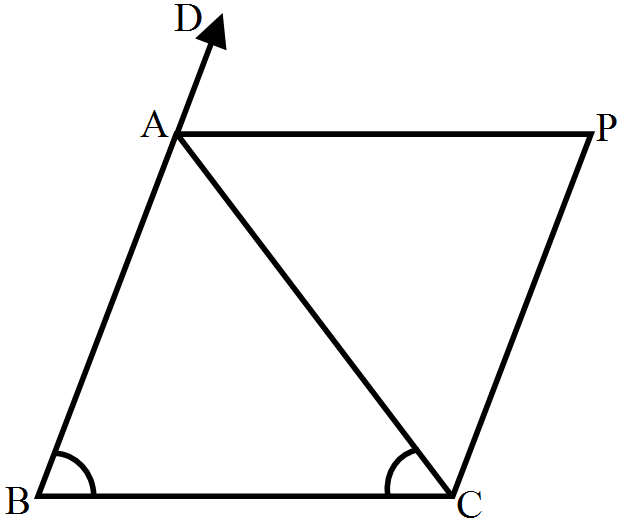
AnswerGiven:AB = AC and CD ∥ BA and AP is the bisector of exterior $\angle\text{CAD}$ of $\triangle\text{ABC}$
To prove:
- $\angle\text{PAC}=\angle\text{BCA}$
- ABCP is a parallelogram.
Proof:
- We have,
AB = AC
$\Rightarrow\angle\text{CAD}=\angle\text{ABC}$ [Opposite angles of equal sides of triangle are equal]
Now, $\angle\text{CAD}=\angle\text{ABC}+\angle\text{ACB}$
$\Rightarrow\angle\text{PAC}+\angle\text{PAD}=\angle\text{ACB}$ $[\therefore\angle\text{PAC}=\angle\text{PAD}]$
$\Rightarrow2\angle\text{PAC}=2\angle\text{ACB}$
$\Rightarrow\angle\text{PAC}=\angle\text{ACB}$
- Now,
$\angle\text{PAC}=\angle\text{BCA}$
$\Rightarrow\angle\text{AP}||\text{BC}$ and $\text{CP}||\text{BA}$ [Given]
Therefore, ABCP is a parallelogram. View full question & answer→Question 264 Marks
In Figure, ABCD is a parallelogram in which $\angle\text{A}=60^\circ$. If the bisectors of $\angle\text{A}$, and $\angle\text{B}$ meet at P, prove that AD = DP, PC = BC and DC = 2AD.
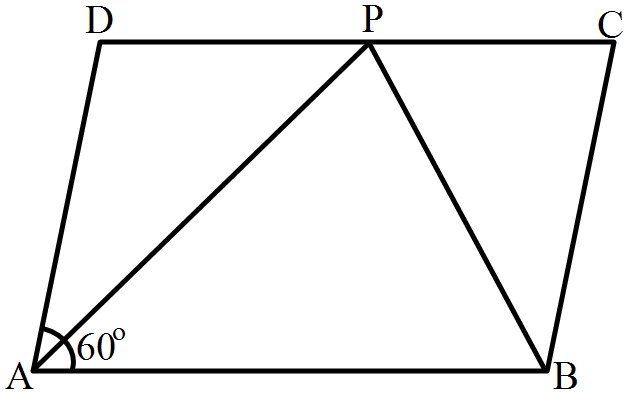
AnswerAP bisects $\angle\text{A}$ Then, $\angle\text{DAP} = \angle\text{PAB} = 30^\circ$ Adjacent angles are supplementary Then, $\angle\text{A}+\angle\text{B}=180^\circ$$\angle\text{B}+60^\circ=180^\circ$
$\angle\text{B}=180^\circ-60^\circ$
$\angle\text{B}=120^\circ$
BP bisects $\angle\text{B}$ Then, $\angle\text{PBA} = \angle\text{PBC} = 30^\circ$$\angle\text{PAB} = \angle\text{APD} = 30^\circ$ [Alternate interior angles]
Therefore, AD = DP [Sides opposite to equal angles are in equal length] Similarly,$\angle\text{PAB} = \angle\text{APD} = 60^\circ$ [Alternate interior angles]
Therefore, PC = BC DC = DP + PC DC = AD + BC [Since, DP = AD and PC = BC] DC = 2AD [Since, AD = BC, opposite sides of a parallelogram are equal]
View full question & answer→Question 274 Marks
If ABCD is a rhombus with $\angle\text{ABC}=56^\circ,$ find the measure of $\angle\text{ACD}.$
AnswerThe figure is given as follows: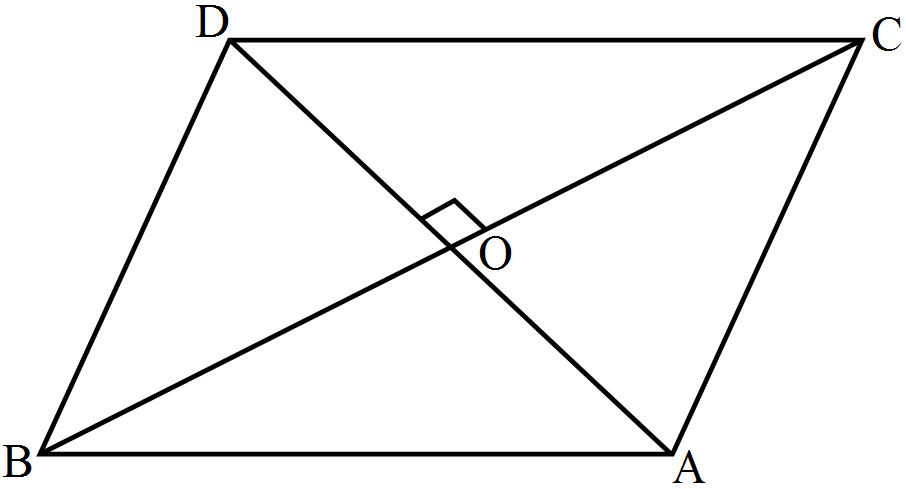
ABCD is a rhombus. Therefore, ABCD is a parallelogram. Thus,$\angle\text{ABC}=\angle\text{ADC}$
$\angle\text{ADC}=56^\circ$ $[\angle\text{ABC}=56^\circ(\text{Given})]$
$\angle\text{ODC}=28^\circ$ $\Big[\angle\text{ODC}=\frac{1}{2}\angle\text{ADC}\Big]$
Now in $\triangle\text{ODC},$ we have:$\angle\text{OCD}+\angle\text{ODC}+\angle\text{COD}=180^\circ$
$\angle\text{OCD}+28^\circ+90^\circ=180^\circ$
$\angle\text{OCD}=62^\circ$
$\angle\text{ACD}=62^\circ$
Hence the measure of $\angle\text{ACD}$ is $62^\circ.$ View full question & answer→Question 284 Marks
Let ABC be an isosceles triangle in which AB = AC. If D, E, F be the mid points of the, sides BC, CA and AB respectively, show that the segment AD and EF bisect each other at right angles.
AnswerSince D, E and F are mid-points of sides BC, CA and AB respectively.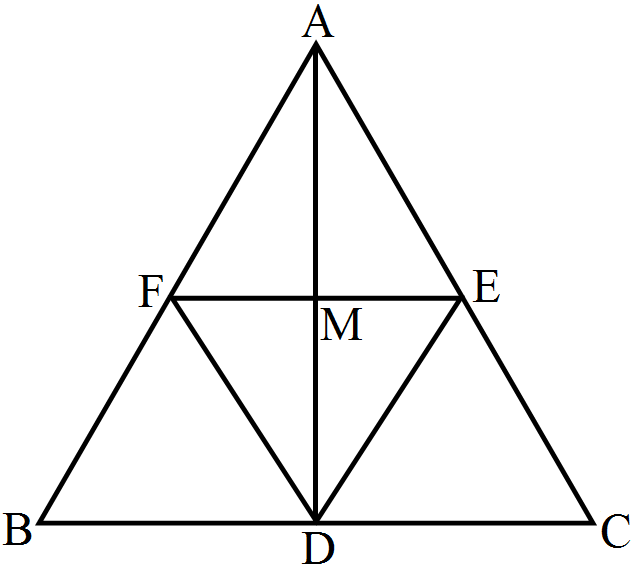 $\therefore\text{AB}||\text{DE}$ and $\text{AC}||\text{DF}$
$\therefore\text{AF}||\text{DE}$ and $\text{AE}||\text{DF}$
ABDE is a parallelogram. AF = DE and AE = DF$\Big(\frac{1}{2}\Big)\text{AB}=\text{DE}$ and $\Big(\frac{1}{2}\Big)\text{AC}=\text{DF}$
DE = DF [Since, AB = AC] AE = AF = DE = DF ABDF is a rhombus. ⇒ AD and FE bisect each other at right angle. View full question & answer→Question 294 Marks
If measures opposite angles of a parallelogram are (60 - x)° and (3x - 4)°, then find the measures of angles of the parallelogram.
AnswerLet ABCD be a parallelogram, with $\angle\text{A}=(60^\circ-\text{x})^\circ$ and $\angle\text{C}=(3\text{x}-4)^\circ.$ We know that in a parallelogram, the opposite angles are equal. Therefore,$\angle\text{A}=\angle\text{C}$
60 - x = 3x - 4 -x - 3x = -4 - 60 -4x = -64 x = 16 Thus, the given angles become$\angle\text{A}=(60^\circ-\text{x})^\circ$
$=(60-16)^\circ$
$=44^\circ$
Similarly,$\angle\text{C}=44^\circ$
Also, adjacent angles in a parallelogram form the consecutive interior angles of parallel lines, which must be supplementary. Therefore,$\angle\text{A}+\angle\text{B}=180^\circ$
$44^\circ+\angle\text{B}=180^\circ$
$\angle\text{B}=180^\circ-44^\circ$
$\angle\text{B}=136^\circ$
similarly,$\angle\text{D}=\angle\text{B}$
$\angle\text{D}=136^\circ$
Thus, the angles of a parallelogram are 44º, 136º, 44º, and 136º.
View full question & answer→Question 304 Marks
In the given figure, ABCD is a rectangle in which diagonal AC is produced to E. If $\angle\text{ECD}=146^\circ,$ find $\angle\text{AOB}.$
AnswerABCD is a rectangle With diagonal AC produced to point E. 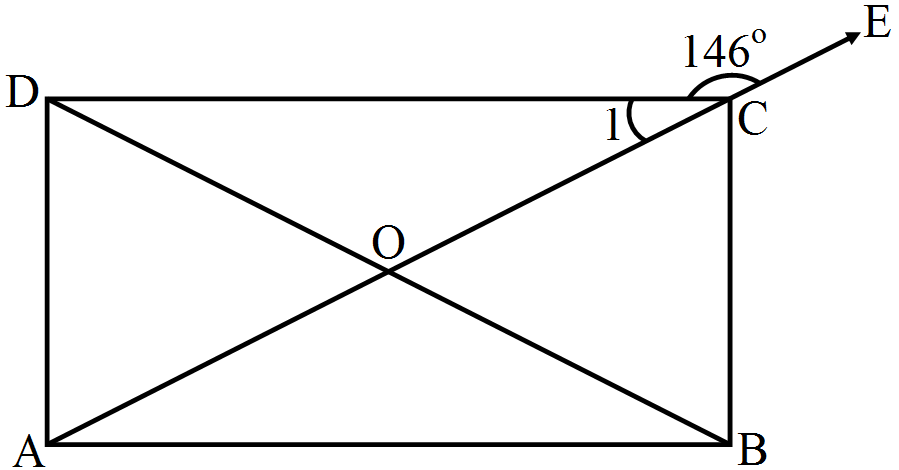 We have$\angle1+\angle\text{DCE}=180^\circ$ (Linear pair)
$\angle1+146^\circ=180^\circ$
$\angle1=34^\circ$
We know that the diagonals of a parallelogram bisect each other. Thus OC = OD Also, angles opposite to equal sides are equal. Therefore,$\angle\text{ODC}=34^\circ$
By angle sum property of a traingle$\angle\text{ODC}+\angle1+\text{COD}=180^\circ$
$34^\circ+34^\circ+\text{COD}=180^\circ$
$68^\circ+\angle\text{COD}=180^\circ$
$\angle\text{COD}=112^\circ$
Also, $\angle\text{COD}$ and $\angle\text{AOB}$ are vertically opposite angles. Therefore, $\angle\text{AOB}=112^\circ$ Hence, the required measure for $\angle\text{AOB}$ is 112º. View full question & answer→Question 314 Marks
ABCD is a parallelogram; E and f are the mid-points of AB and CD respectively. GH is any line intersecting AD, EF and BC at G, P and H respectively. Prove that GP = PH.
AnswerSince E and F are mid-points of AB and CD respectively 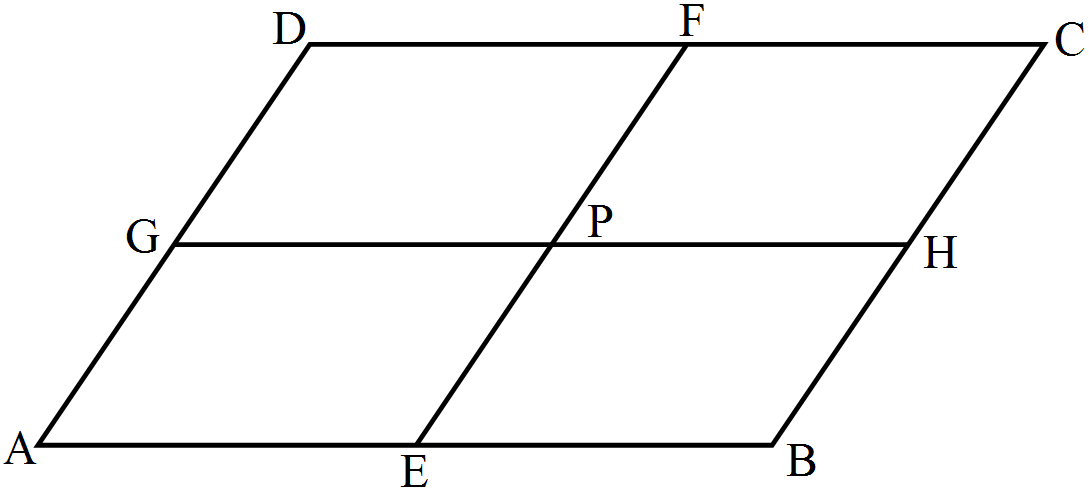 $\text{AE}=\text{BE}=\Big(\frac{1}{2}\Big)\text{AB}$
And $\text{CF}=\text{DF}=\Big(\frac{1}{2}\Big)\text{CD}$ But, AB = CD$\Big(\frac{1}{2}\Big)\text{AB}=\Big(\frac{1}{2}\Big)\text{CD}$
⇒ BE = CF Also, BE || CF $[\therefore$ AB || CD$]$ Therefore, BEFC is a parallelogram BC || EF and BE = PH ....(i) Now, BC || EF ⇒ AD || EF $[\therefore$ BC || AD as ABCD is a parallelogram$\big]$ Therefore, AEFD is a parallelogram. ⇒ AE = GP But E is the mid-point of AB. So, AE = BF Therefore, GP = PH. View full question & answer→Question 324 Marks
ABC is a Triangle. D is a point on Ab such that $\text{AD}=\frac{1}{4}\text{AD}$ and E is a point on AC such that $\text{AE}=\frac{1}{4}\text{AC.}$ prove that $\text{DE}=\frac{1}{4}\text{BC}.$
Answer$\triangle\text{ABC}$ is given with D a point on AB such that $\text{AD}=\frac{1}{4}\text{AB}.$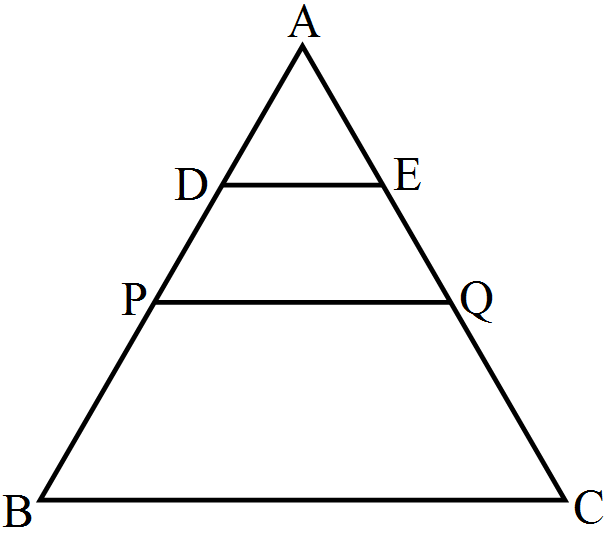
Also, E is point on AC such that $\text{AE}=\frac{1}{4}\text{AC}.$
We need to prove that $\text{DE}=\frac{1}{4}\text{BC}$
Let P and Q be the mid points of AB and AC respectively.
it is given that
$\text{AD}=\frac{1}{4}\text{AB}$ and $\text{AE}=\frac{1}{4}\text{AC}$
But, we have taken P and Q as the mid points of AB and AC respectively.
therefore, D and E are the mid-points of AP and AQ respectively.
in $\triangle\text{ABC},$ P and Q are the mid-points of AB and AC respectively.
Theorem states, the line segment joining the mid-points of any any two sides of a triangle is parallel to the third side and equal to half of it.
Therefore, we get PQ || BC and $\text{PQ}=\frac{1}{2}\text{BC}\ ...(\text{i})$
in $\triangle\text{APQ},$ D and E are the mid-point of AP and AQ respectively.
Therefore, we get DE || PQ and $\text{DE}=\frac{1}{2}\text{PQ}\ ...(\text{ii})$
From (i) and (ii), we get:
$\text{DE}=\frac{1}{4}\text{BC}$
Hence proved. View full question & answer→Question 334 Marks
ABCD is a rhombus, EABF is a straight line such that EA = AB = BF. Prove that ED and FC when produced meet at right angles.
Answer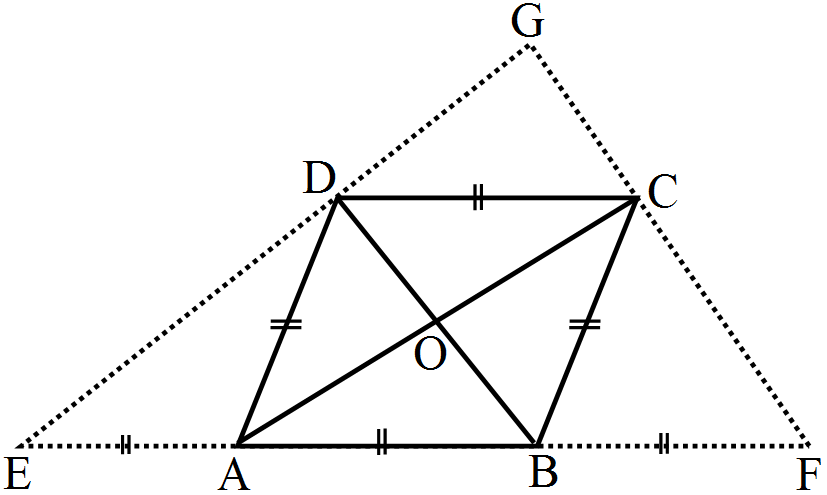 We know that the diagonals of a rhombus are perpendicular bisector of each other.$\therefore\text{OA}=\text{OC},\text{OB}=\text{OD}$
$\angle\text{AOD}=\angle\text{COD}=90^\circ$
And, $\angle\text{AOB}=\angle\text{COB}=90^\circ$ In $\triangle\text{BDE},$ A and O are mid-points of BE and BD respectively.$\therefore\text{OA}||\text{DE}$
$\Rightarrow\text{OC}||\text{DG}$
In $\triangle\text{CFA},$ B and O are mid-points AF and AC respectively$\therefore\text{OB}||\text{CF}$
$\Rightarrow\text{OD}||\text{GC}$
Thus, in quadrilateral DOCG, we have OC || DG and OD || GC DOCG is a parallelogram.$\therefore\angle\text{DGC}=\angle\text{DOC}$
$\Rightarrow\angle\text{DGC}=90^\circ$ View full question & answer→Question 344 Marks
ABCD is a square E, F, G and H are points on AB, BC, CD, and DA respectively, such that AE = BF = DH. prove that EFGH is a square.
Answer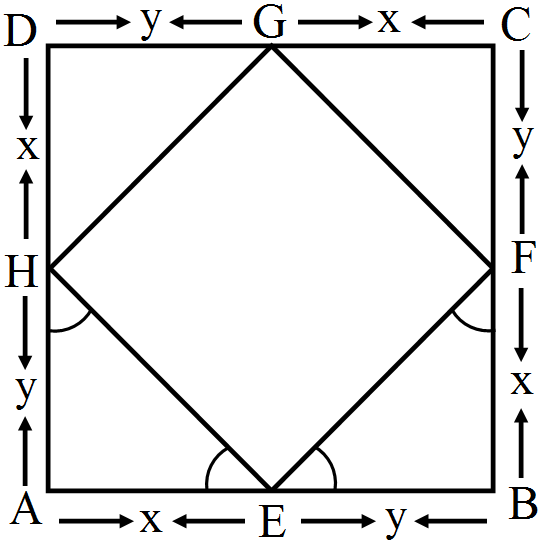 We have, AE = BF = CG = DH = X (say)$\therefore$ BE = CF = DG = AH = Y (say)
In $\triangle\text{AEH}$ and $\triangle\text{BEF},$ we have AE = BF$\angle \text{A}=\angle \text{B}$
and, AH = BE So, by SAS congruence criterion, we have$\triangle\text{AEH}\cong\triangle\text{BFE}$
$\Rightarrow\angle1=\angle2$ and $\angle3=\angle4$
But, $\angle1+\angle3=90^\circ$ and $\angle2+\angle4=90^\circ$$\Rightarrow\angle1+\angle3+\angle2+\angle4=90^\circ+90^\circ$
$\Rightarrow\angle1+\angle4+\angle1+\angle4=180^\circ$
$\Rightarrow2(\angle1+\angle4)=90^\circ$
$\Rightarrow\angle1+\angle4=90^\circ$
$\Rightarrow\text{HEF}=90^\circ$
Similarly, we have$\angle\text{F}=\angle\text{G}=\angle\text{H}=90^\circ$
Hence, EFGH is a square View full question & answer→Question 354 Marks
Show that, the line segments joining the mid-points of opposite sides of a quadrilateral bisects each other.
AnswerLet ABCD is a quadrilateral in which P, Q, R and S are mid-points of sides AB, BC, CD and DA respectively. 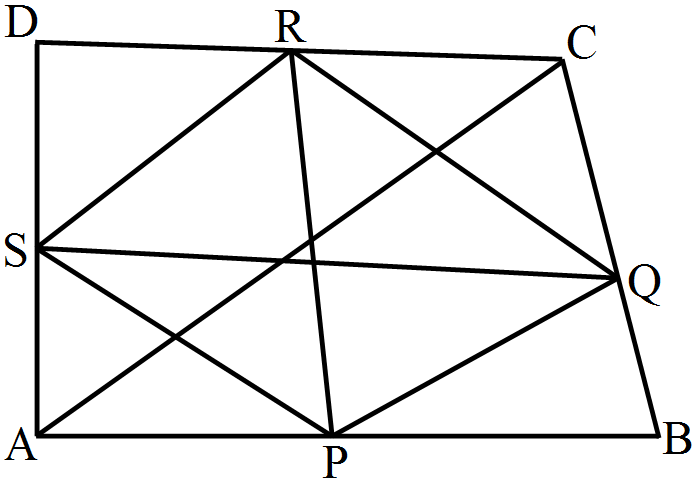 So, by using mid-point theorem we can say that$\text{SP}||\text{BD}$ and $\text{SP}=\Big(\frac{1}{2}\Big)\text{BD}\ ...(\text{i})$
Similarly in $\triangle\text{BCD}$ $\text{QR}||\text{BD}$ and $\text{QR}=\Big(\frac{1}{2}\Big)\text{BD}\ ...(\text{ii})$ From equations (i) and (ii), we have SP ∥ QR and SP = QR As in quadrilateral SPQR, one pair of opposite sides is equal and parallel to each other. So, SPQR is a parallelogram since the diagonals of a parallelogram bisect each other. Hence PR and QS bisect each other. View full question & answer→Question 364 Marks
If PQRS is a square, then write the measure of $\angle\text{SRP.}$
AnswerThe square PQRS is given as: 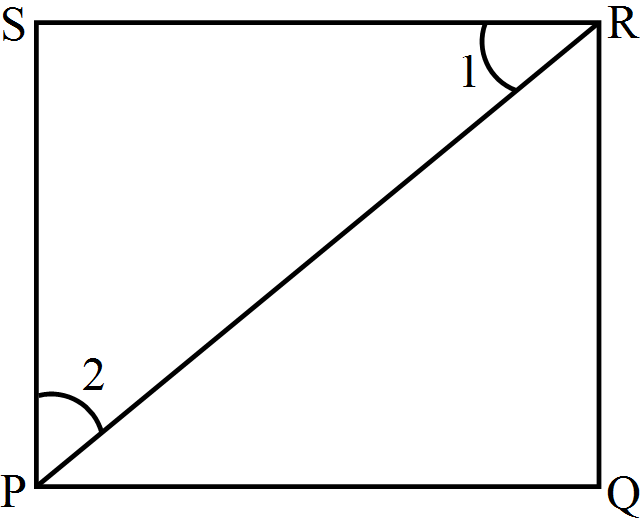 Since PQRS is a square. Therefore, PS = SR and $\angle\text{PSR}=90^\circ$ Now, in $\triangle\text{PSR},$ we have PS = SR That is, $\angle\text{1}=\angle\text{2}$ (Angles opposite to equal sides are equal) By angle sum property of a triangle.$\angle\text{PSR}+\angle\text{1}+\angle\text{2}=180^\circ$
$\angle\text{PSR}+2\angle\text{1}=180^\circ$
$90^\circ+2\angle\text{1}=180^\circ$ $(\angle\text{PSR}=90^\circ)$
$2\angle\text{1}=90^\circ$
$\angle1=45^\circ$
Hence, the measure of $\angle\text{SRP}$ is 45°. View full question & answer→Question 374 Marks
If ABCD is a rectangle with $\angle\text{BAC}=32^\circ,$ find the measure of $\angle\text{DBC}.$
AnswerFigure is given as : 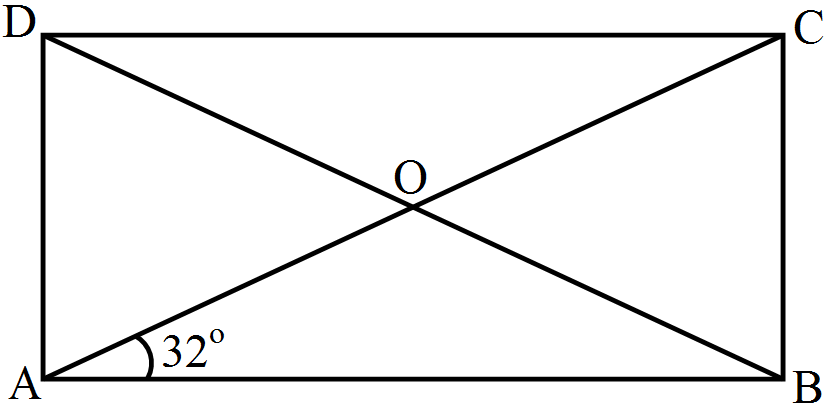 Suppose the diagonals AC and BD intersect at O. Since, diagonals of a rectangle are equal and they bisect each other. Therefore, in $\triangle\text{OAB},$ we have OA = OB Angles opposite to equal sides are equal. Therefore,$\angle\text{OAB}=\angle\text{OBA}$
$\angle\text{BAC}=\angle\text{DBA}$
But, $\angle\text{BAC}=32^\circ$$\angle\text{DBA}=32^\circ$
Now,$\angle\text{ABC}=90^\circ$
$\angle\text{DBA}+\angle\text{DBC}=90^\circ$
$32^\circ+\angle\text{DBC}=90^\circ$
$\angle\text{DBC}=58^\circ$
Hence, the measure of $\angle\text{DBC}$ is 58º. View full question & answer→