Question
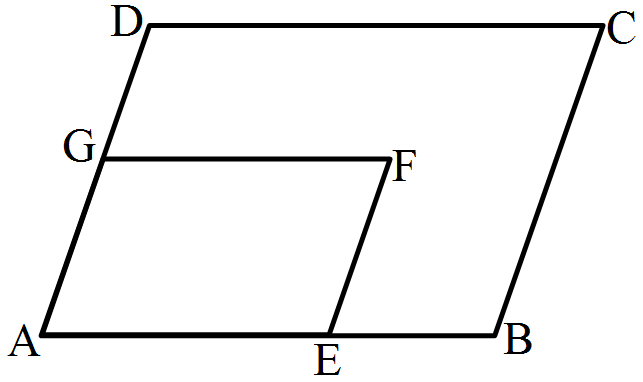
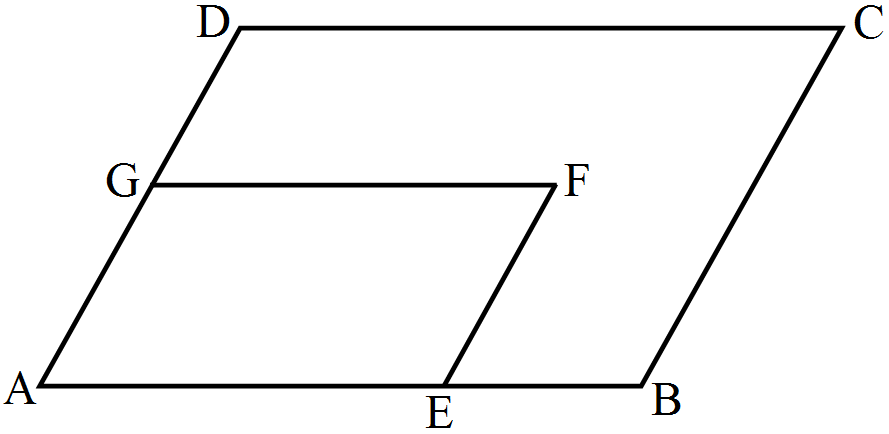
In the given figure, ABCD and AEFG are two parallelograms. If $\angle\text{C}= 58^\circ,$ find $\angle\text{F}.$
Answer

ABCD and AEFG are two parallelograms as shown below: Since ABCD is a parallelogram, with $\angle\text{C}=58^\circ$ We know that the opposite angles of a parallelogram are equal. Therefore,$\angle\text{A}=\angle\text{C}$
$\angle\text{A}= 58^\circ,$
Similarly, AEFG is a parallelogram, with $\angle\text{A}= 58^\circ,$ We know that the opposite angles of a parallelogram are equal. Therefore,$\angle\text{F}=\angle\text{C}$
$\angle\text{F}= 58^\circ$
Hence, the required measure for $\angle\text{F}$ is 58º.

Need a full question paper?

Generate a complete, print-ready paper with questions like this in minutes — across 16+ boards, with answer keys.
Start Generating Free

Similar questions

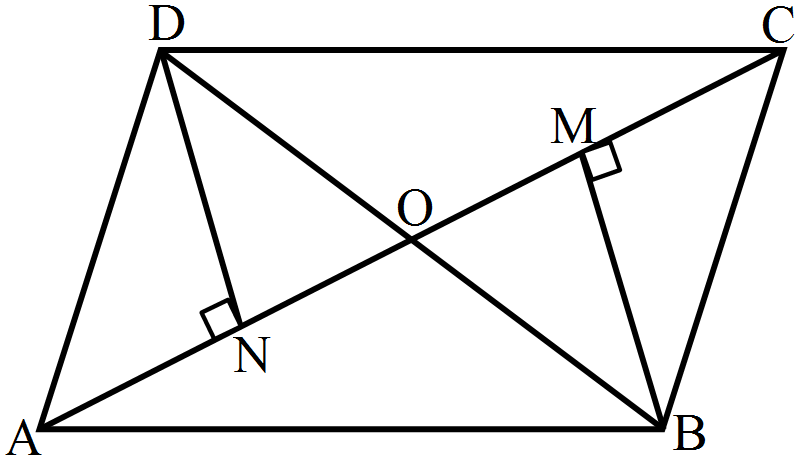
In the adjoining figure, $\text{BM}\perp\text{AC}$ and $\text{DN}\perp\text{AC}.$ If BM = DN, prove that AC bisects BD.
Find the rational roots of the polynomial $f(x) = 2x^3 + x^2 - 7x - 6$
Five coins were simultaneously tossed 1000 times and at each, toss the number of heads was observed. The number of tosses during which 0, 1, 2, 3, 4 and 5 heads were obtained are shown in the table below. Find the mean number of heads per toss.
No. of heads per toss
No. of tosses
0
38
1
144
2
342
3
287
4
164
5
25
Total
1000
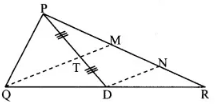
In the adjoining figure, seg $PD$ is a median of $\triangle P Q R$. Point $T$ is the midpoint of seg PD. Produced QT intersects PR at M. Show that $\frac{P M}{P R}=\frac{1}{3}$. [Hint: Draw DN $\| QM$ ]

Image

Divide the polynomial $(2y^4 - 3y^3 + 5y - 4) ÷ (y - 1)$ By synthetic division method and Linear method.
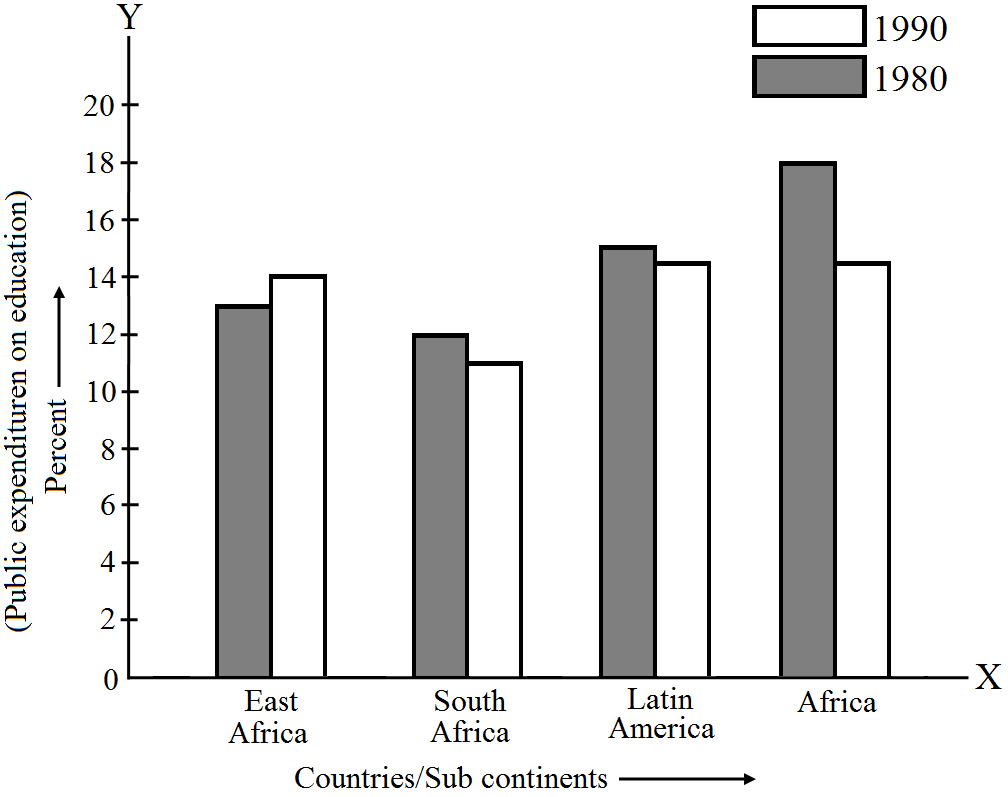
Read the bar graph given in figure and answer the following questions:
  1. What information does it give?
  2. In which part the expenditure on education is maximum in 1980?
  3. In which part the expenditure has gone up from 1980 to 1990?
  4. In which part the gap between 1980 and 1990 is maximum?
Using factor theorem, factorize the following polynomials:
$2y^3 - 5y^2 - 19y + 42$
P is a point on the bisector of an $\angle\text{ABC}.$ If the line through P parallel to AB meets BC at Q, prove that triangle BPQ is isosceles.
The mean of the following data is 20.6 Find the value of p.
x:
10
15
p
25
35
f:
3
10
25
7
5
Prove that if the two arms of an angle are perpendicular to the two arms of another angle, then the angles are either equal or supplementary.