Questions

5 Mark Question

Take a timed test

4 questions · self-marked practice — reveal the answer and mark yourself.

Question 15 Marks
Write any three rational numbers between the two numbers given below.
i. 0.3 and – 0.5
ii. – 2.3 and – 2.33
iii. 5.2 and 5.3
iv. – 4.5 and – 4.6
Answer
i. 0.3 = 0.30 and -0.5 = -0.50
We know that,
0. 30 >0.29 >….. >0.10>.. > – 0.10>…. > -0.30>…> -0.50
∴ the three rational numbers between 0.3 and -0.5 are -0.3, -0.1 and 0.1.

Alternate Method:
A rational number between two rational numbers a and b
$\begin{aligned} & =\frac{ a + b }{2} \\ \frac{0.3+(-0.5)}{2} & =\frac{0.3-0.5}{2} \\ & =\frac{-0.2}{2} \\ & =-0.1 \\ \frac{0.3+(-0.1)}{2} & =\frac{0.3-0.1}{2} \\ & =\frac{0.2}{2} \\ & =0.1 \\ \frac{-0.1+(-0.5)}{2} & =\frac{-0.1-0.5}{2} \\ & =\frac{-0.6}{2} \\ & =-0.3\end{aligned}$

∴ the three rational numbers between 0.3 and -0.5 are -0.3, -0.1 and 0.1.

ii. -2.3 = -2.300 and -2.33 = -2.330
We know that,
-2.300 > -2.301>… > -2.310>…> -2.320>…> -2.330
∴ the three rational numbers between -2.3 and -2.33 are -2.310, -2.320 and -2.325.

iii. 5.2 = 5.20 and 5.3 = 5.30
We know that,
5.20 < 5.21 < 5.22 < 5.23 < … < 5.30
∴ the three rational numbers between 5.2 and 5.3 are 5.21, 5.22 and 5.23.

iv. -4.5 = -4.50 and -4.6 = -4.60 We know that,
-4.50 > -4.51 > -4.52 >… > – 4.55 >…>- 4.60
∴ the three rational numbers between -4.5 and -4.6 are -4.51, -4.52 and -4.55.
View full question & answer
Question 25 Marks
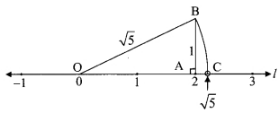
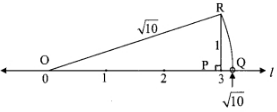
Represent the numbers √5 and √10 on a number line.
Answer
i. Draw a number line and take point $A$ at 2 .
Draw $A B$ perpendicular to the number line such that $A B=1$ unit.
In $\triangle OAB , m \angle OAB =90^{\circ}$
$\therefore(O B)^2=(O A)^2+(A B)^2 \ldots[$ [Pythagoras theorem]
$=(2)^2+(1)^2$
$\therefore( OB )^2=5$
$\therefore OB =\sqrt{ } 5$ units.... [Taking square root of both sides]
With O as centre and radius equal to OB , draw an arc to intersect the number line at C .

Image

The coordinate of the point C is $√5 $.
ii. Draw a number line and take point Pat 3 .
Draw $P R$ perpendicular to the number line such that $P R=1$ unit.
In $\triangle O P R, m \angle O P R=90^{\circ}$
$\therefore( OR )^2=( OP )^2+( PR )^2 \ldots$ [Pythagoras theorem]
$=(3)^2+(1)^2$
$\therefore( OR )^2=10$
$\therefore OR =\sqrt{ } 10$ units. $\ldots$. [Taking square root of both sides]
With O as centre and radius equal to OR , draw an arc to intersect the number line at Q .
The coordinate of the point Q is $\sqrt{ } 10$.
Image
The coordinate of the point Q is $√10 $.
View full question & answer
Question 35 Marks
Prove that 3 + √5 is an irrational number.
Answer
Let us assume that 3 + √5 is a rational number.
So, we can find co-prime integers ‘a’ and ‘b’ (b ≠ 0) such that
$
\begin{aligned}
& 3+\sqrt{5}=\frac{a}{b} \\
\therefore \quad & \sqrt{5}=\frac{a}{b}-3
\end{aligned}
$
Since, $a$ and $b$ are integers, $\frac{a}{b}-3$ is a rational
number and so √5 is a rational number.
But this contradicts the fact that √5 is an irrational number.
∴ Our assumption that 3 – √5 is a rational number is wrong.
3 + √5 is an irrational number.
View full question & answer
Question 45 Marks
Show that $4\sqrt{2}$ is an irrational number.
Answer
Let us assume that $4\sqrt{2}$ is a rational number .
So, we can find co-prime integers $‘a’$ and $‘b’ (b \neq 0)$ such that
$4 \sqrt{ } 2=\frac{a}{b}$
$\therefore \sqrt{ } 2=\frac{a}{4 b}$
Since, $a$ and $b$ are integers, $\frac{a}{4 b}$ is a rational number and so $\sqrt{ 2}$ is a rational number.
Alternate Proof:
Let us assume that $4\sqrt{2}$ is a rational number.
So, we can find co-prime integers $‘a’$ and $‘b’ (b \neq 0)$ such that
$ 4 \sqrt{2}=\frac{a}{b}$
$\therefore b(4 \sqrt{2})=a$
$\therefore 32 b^2=a^2$
$\therefore b^2=\frac{a^2}{32}$
Since, 32 divides $a^2$, so 32 divides 'a' as well.
So, we write $a=32 c$, where c is an integer.
$\therefore a ^2=(32 c )^2 \ldots$ [Squaring both the sides]
$\therefore 32 b^2=32 \times 32 c ^2 \ldots[$ [From(i) $]$
$\therefore b^2=32 c ^2$
$\therefore c^2=\frac{b^2}{32}$
Since, 32 divides $b ^2$, so 32 divides ' b '.
$\therefore 32$ divides both a and b .
a and b have at least 32 as a common factor.
But this contradicts the fact that a and b have no common factor other than 1.
$\therefore$ Our assumption that $4 \sqrt{ } 2$ is a rational number is wrong.
$\therefore 4 \sqrt{ } 2$ is an irrational number.
View full question & answer