Questions

2 Mark Question

Take a timed test

13 questions · self-marked practice — reveal the answer and mark yourself.
Question 12 Marks
Can a triangle have:
Two acute angles?
Justify your answer in case.
Answer
Yes, A triangle can have 2 acute angles. Acute angle means less the 90° angle.
View full question & answer
Question 22 Marks
Define a triangle.
Answer
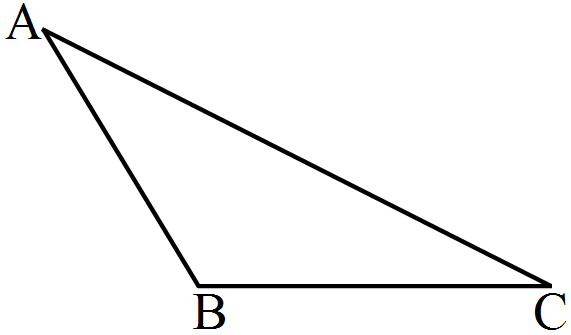
A plane figure bouded by three lines in a plane is called a triangle. The figure below represent a $\triangle\text{ABC},$ with AB, AC and BC as the three segments.
View full question & answer
Question 32 Marks
Can a triangle have:
All angles equal to 60°?
Justify your answer in case.
Answer
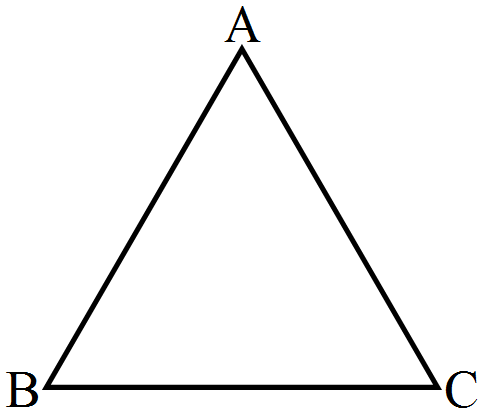
Yes, A triangle can have three angles equal to 60°. Then the sum of three angles equal to the 180°. Such triangles are called as equilateral triangle. [Since, the sum of all the internal angles of a triangle is180°].
View full question & answer
Question 42 Marks
Can a triangle have:
All angles more than 60°?
Justify your answer in case.
Answer
No, Having angles more than 60° make that sum more than 180°. This is not possible. [Since the sum of all the internal angles of a triangle is 180°]
View full question & answer
Question 52 Marks
Write the sum of the angles of an obtuse triangle.
Answer
In the given problem, $\triangle\text{ABC}$ is an obtuse triangle, with$\angle\text{B}$ as the obtuse angle. So, according to "the angle sum property of the triangle", for any kind of triangle, the sum of its angles is 180°. So,$\angle\text{A}+\angle\text{B}+\angle\text{C}=180^\circ$
Therefore, sum of the angles of an obtuse triangle is 180º.
View full question & answer
Question 62 Marks
Can a triangle have:
All angles less than 60°?
Justify your answer in case.
Answer
No, Having all angles less than 60° will make that sum less than 180° which is not possible. [Therefore, the sum of all the internal angles of a triangle is 180°]
View full question & answer
Question 72 Marks
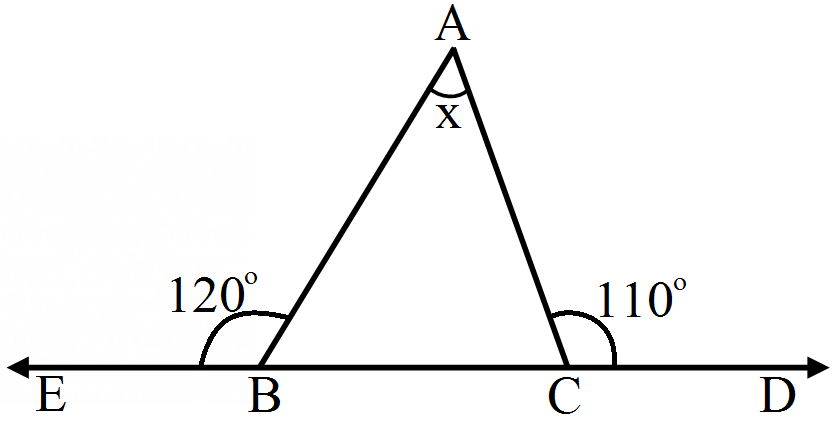
Compute the value of x in the following figures.
Answer
$\angle\text{ABC}=180^\circ-120^\circ=60^\circ$ [Linear pair]$\angle\text{ACB}=180^\circ-110^\circ=70^\circ$ [Linear pair]
$\therefore\text{e}\angle\text{BAC}=\text{x}$
$=180^\circ-\angle\text{ABC}-\angle\text{ACB}=180^\circ-60^\circ-70^\circ=50^\circ$ [Sum of all angles of a triangle]
View full question & answer
Question 82 Marks
Can a triangle have:
Two obtuse angles?
Justify your answer in case.
Answer
No, A triangle can't have 2 obtuse angles. Obtuse angle means more than 90° So that the sum of the two sides will exceed 180° which is not possible. As the sum of all three angles of a triangle is 180°.
View full question & answer
Question 92 Marks
State exterior angle theorem.
Answer
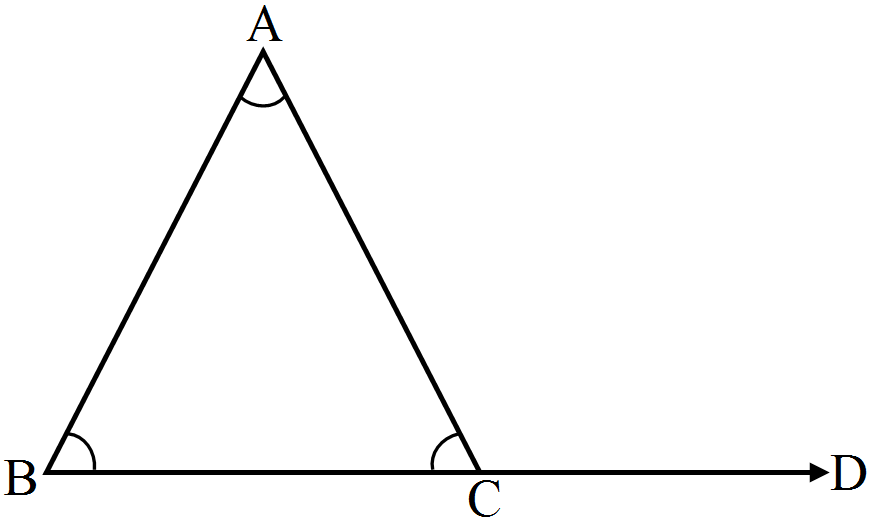
Exterior angle theorem states that, if a side of a triangle is produced, the exterior angle so formed is equal to the sum of the two interior opposite angles. Thus, in $\triangle\text{ABC}$$\angle\text{ACD}=\angle\text{A}+\angle\text{B}$
View full question & answer
Question 102 Marks
Can a triangle have:
Two right angles?
Justify your answer in case.
Answer
No, Two right angles would up to 180°. So the third angle becomes zero. This is not possible, so a triangle cannot have two right angles. [Since sum of angles in a triangle is 180°].
View full question & answer
Question 112 Marks
If each angle of a triangle is less than the sum of the other two, show that the triangle is acute angled.
Answer
Given each angle of a triangle less than the sum of the other two$\therefore\angle\text{X}+\angle\text{Y}+\angle\text{Z}$
$\Rightarrow\angle\text{X}+\angle\text{X}<\angle\text{X}+\angle\text{Y}+\angle\text{Z}$
$\Rightarrow2\angle\text{X}<180^\circ$ [Sum of all the angles of a triangle]
$\Rightarrow\angle\text{X}<90^\circ$
Similarly $\angle\text{Y}<90^\circ$ and $\angle\text{Z}<90^\circ$ Hence, the triangles are acute angled.
View full question & answer
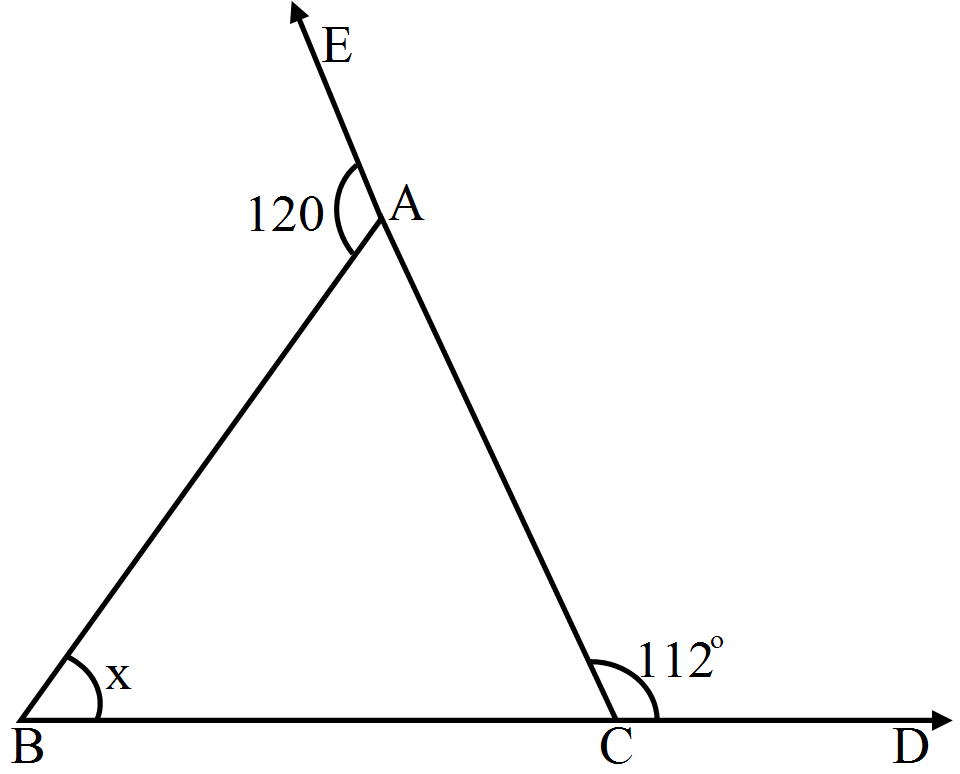
Question 122 Marks
Compute the value of x in the following figures.
Answer
$\angle\text{BAC}=180^\circ-120^\circ=60^\circ$ [Linear pair]$\angle\text{ACB}=180^\circ-112^\circ=68^\circ$ [Linear pair]
$\therefore\text{x}=180^\circ-\angle\text{BAC}-\angle\text{ACB}$
$=180^\circ-60^\circ-68^\circ=52^\circ$ [Sum of all angles of a triangle]
View full question & answer
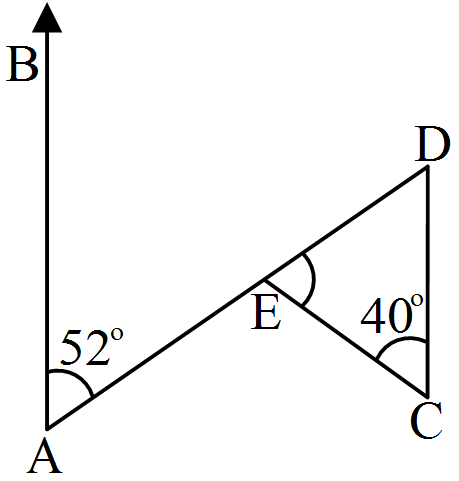
Question 132 Marks
Compute the value of x in the following figures.
Answer
$\angle\text{BAE}=\angle\text{EDC}=52^\circ$ [Alternate angles]$\therefore\angle\text{DEC}=\text{x}=180^\circ-40^\circ-\angle\text{EDC}$
$=180^\circ-40^\circ-52^\circ$
$=180^\circ-92^\circ=88^\circ$ [Sum of all angles of a triangle]
View full question & answer