Questions

2 Mark Question

Take a timed test

25 questions · self-marked practice — reveal the answer and mark yourself.
Question 12 Marks
Conduct the above discussed activity and find the height of a tall tree in your surrounding. If there is no tree in the premises, then find the height of a pole.
View full question & answer
Question 22 Marks
It is convenient to do the above experiment between 11:30 am and 1:30 pm instead of doing it in the morning at 8’O clock. Can you tell why?
Answer
At 8’O clock in the morning, the sunlight is not very bright. At the same time, the sun is on the horizon and the shadow would by very long. It would be extremely difficult to measure shadow in that case.
Between 11:30 am and 1:30 pm, the sun is overhead and it would be easier to measure the length of shadow.
View full question & answer
Question 32 Marks
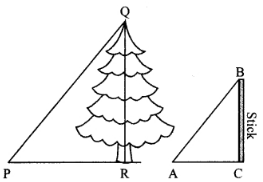
Measuring height of a tree using trigonometric ratios.

Image
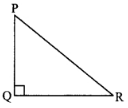
This experiment can be conducted on a clear sunny day. Look at the figure given above. Height of the tree is QR, height of the stick is BC.
Thrust a stick in the ground as shown in the figure. Measure its height and length of its shadow. Also measure the length of the shadow of the tree. Using these values, how will you determine the height of the tree?
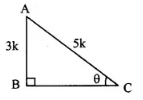
Answer
Rays of sunlight are parallel.
So, ∆PQR and ∆ABC are equiangular i.e., similar triangles.
Sides of similar triangles are proportional.
$
\therefore \frac{Q R}{B C}=\frac{P R}{A C}
$
$\therefore$ Height of the tree $( QR )=\frac{B C}{A C} \times PR$
|Substituting the values of PR, BC and AC in the above equation, we can get length of QR i.e., the height of the tree.
View full question & answer
Question 42 Marks
While solving the above illustrative example, can we take the lengths of PQ and PR as 5 and 13? If so, then what changes are needed In the writing of the solution.
Answer
Yes, we can take lengths of PQ and PR as 5 and 13.
In that case, we will have to take k = 1 and solve the problem accordingly.
View full question & answer
Question 52 Marks
While solving the above Illustrative example, why the lengths of PQ and PR are taken 5k and 13k?
Answer
$\frac{P Q}{P R}=\frac{5}{13} \ldots$ [Given]
Here, the ratio of the lengths of sides PQ and PR is 5 : 13.
The actual lengths of the sides can be any multiple of the ratio. Hence, we consider the multiple k while solving.
View full question & answer
Question 62 Marks
Find the values of : $\cos 60^{\circ} \times \cos 30^{\circ}+\sin 60^{\circ} \times \sin 30^{\circ}$
Answer
$\cos 60^{\circ} \times \cos 30^{\circ}+\sin 60^{\circ} \times \sin 30^{\circ}$
$\cos 60^{\circ}=\frac{1}{2}, \cos 30^{\circ}=\frac{\sqrt{3}}{2}, \sin 60^{\circ}=\frac{\sqrt{3}}{2}$
$\text { and } \sin 30^{\circ}=\frac{1}{2}$
$\cos 60^{\circ} \times \cos 30^{\circ}+\sin 60^{\circ} \times \sin 30^{\circ}$
$=\frac{1}{2} \times \frac{\sqrt{3}}{2}+\frac{\sqrt{3}}{2} \times \frac{1}{2}$
$=\frac{\sqrt{3}}{4}+\frac{\sqrt{3}}{4}$
$=\frac{\sqrt{3}+\sqrt{3}}{4}$
$=\frac{2 \sqrt{3}}{4}=\frac{\sqrt{3}}{2}$
$\therefore \quad \cos 60^{\circ} \times \cos 30^{\circ}+\sin 60^{\circ} \times \sin 30^{\circ}=\frac{\sqrt{3}}{2}$
View full question & answer
Question 72 Marks
Find the values of : $\cos ^2 45^{\circ}+\sin ^2 30^{\circ}$
Answer
$\cos ^2 45^{\circ}+\sin ^2 30^{\circ}$
$\cos 45^{\circ}=\frac{1}{\sqrt{2}} \text { and } \sin 30^{\circ}=\frac{1}{2}$
$\cos ^2 45^{\circ}+\sin ^2 30^{\circ}=\left(\cos 45^{\circ}\right)^2+\left(\sin 30^{\circ}\right)^2$
$=\left(\frac{1}{\sqrt{2}}\right)^2+\left(\frac{1}{2}\right)^2$
$=\frac{1}{2}+\frac{1}{4}$
$=\frac{2+1}{4}$
$\therefore \quad \cos ^2 45^{\circ}+\sin ^2 30^{\circ}=\frac{3}{4}$
View full question & answer
Question 82 Marks
Find the values of : $\frac{\tan 60^{\circ}}{\sin 60^{\circ}+\cos 60^{\circ}}$
Answer
\frac{\tan 60^{\circ}}{\sin 60^{\circ}+\cos 60^{\circ}} \\ \frac{\tan 60^{\circ}}{\sin 60^{\circ}+\cos 60^{\circ}}=\frac{\sqrt{3}}{\frac{\sqrt{3}}{2}+\frac{1}{2}} \\ =\frac{\sqrt{3}}{\frac{\sqrt{3}+1}{2}} \\ =\sqrt{3} \times \frac{2}{\sqrt{3}+1} \\ \therefore \quad \frac{\tan 60^{\circ}}{\sin 60^{\circ}+\cos 60^{\circ}}=\frac{2 \sqrt{3}}{\sqrt{3}+1} \\\end{array}$
View full question & answer
Question 92 Marks
Find the values of : $2 \sin 30^{\circ}+\cos 0^{\circ}+3 \sin 90^{\circ}$
Answer
$2 \sin 30^{\circ}+\cos 0^{\circ}+3 \sin 90^{\circ}$
$2 \sin 30^{\circ}+\cos 0^{\circ}+3 \sin 90^{\circ}=2\left(\frac{1}{2}\right)+1+3(1)$
$=1+1+3$
$\therefore 2 \sin 30^{\circ}+\cos 0^{\circ}+3 \sin 90^{\circ}=5$
View full question & answer
Question 102 Marks
Find the values of : $\frac{4}{5} \tan ^2 60^{\circ}+3 \sin ^2 60^{\circ}$
Answer
$ \frac{4}{5} \tan ^2 60^{\circ}+3 \sin ^2 60^{\circ}$
$\frac{4}{5} \tan ^2 60^{\circ}+3 \sin ^2 60^{\circ}$
$=\frac{4}{5}\left(\tan 60^{\circ}\right)^2+3\left(\sin 60^{\circ}\right)^2$
$=\frac{4}{5}(\sqrt{3})^2+3\left(\frac{\sqrt{3}}{2}\right)^2$
$=\frac{4}{5} \times 3+3 \times \frac{3}{4}$
$=\frac{12}{5}+\frac{9}{4}$
$=\frac{48+45}{20}$
$=\frac{93}{20}$
$\therefore \quad \frac{4}{5} \tan ^2 60^{\circ}+3 \sin ^2 60^{\circ}=\frac{93}{20}$
View full question & answer
Question 112 Marks
Find the values of : $5 \sin 30^{\circ}+3 \tan 45^{\circ}$
Answer
$ \sin 30^{\circ}=\frac{1}{2} \text { and } \tan 45^{\circ}=1$
$5 \sin 30^{\circ}+3 \tan 45^{\circ}=5\left(\frac{1}{2}\right)+3(1)$
$=\frac{5}{2}+3$
$=\frac{5+6}{2}$
$\therefore \quad 5 \sin 30^{\circ}+3 \tan 4 5 =\frac{11}{2}$
View full question & answer
Question 122 Marks
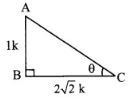
Tan θ =$\frac{1}{2√2}$.Find Sin θ= , Cos θ= ?
Answer
$\tan \theta=\frac{1}{2 \sqrt{2}}$..(i) [Given]
In right angled $\triangle A B C$,
$\angle C=\theta \text {. }$
Image
$ \tan \theta=\frac{\text { Opposite side of } \theta}{\text { Adjacent side of } \theta}$
$\therefore \quad \tan \theta=\frac{ AB }{ BC } \quad \ldots \text { (ii) }$
$\therefore \quad \frac{ AB }{ BC }=\frac{1}{2 \sqrt{2}} \quad \ldots[\text { From (i) and (ii)] }$
Let the common multiple be k.
\therefore $AB = 1k$ and $AC = 2√2 k$
Now, $AC^2 = AB^2 + BC^2$ …[Pythagoras theorem]
$= K^2 + (2√2 k )^2$
$= K^2 – 225^2$
$= 25K^2 + 8K^2$
$= 9K^2$
$\therefore AC =\sqrt{9 k^2} \ldots \text {.. [Taking square root of both sides] }$
$=3 K$
$\therefore \quad \sin \theta=\frac{\text { Opposite side of } \theta}{\text { Hypotenuse }}=\frac{ AB }{ AC }=\frac{1 k }{3 k }=\frac{1}{3}$
$\quad \cos \theta=\frac{\text { Adjacent side of } \theta}{\text { Hypotenuse }}=\frac{ BC }{ AC }=\frac{2 \sqrt{2} k }{3 k }=\frac{ 2 \sqrt{2}}{3}$
View full question & answer
Question 132 Marks
Sin θ =$\frac{3}{5}$.Find Cos θ= , Tan θ= ?
Answer
$\sin \theta=\frac{3}{5}$..(i) [Given]
In right angled $\triangle ABC$,
$\angle C=\theta \text {. }$
Image
$\sin \theta=\frac{\text { Opposite side of } \theta}{\text { Hypotenuse }}$
$\therefore \quad \sin \theta=\frac{ AB }{ AC } \quad \ldots \text { (ii) } $
$\therefore \quad \frac{ AB }{ AC }=\frac{3}{5} \quad \ldots[\text { From (i) and (ii)] }$
Let the common multiple be k.
$\therefore A B=3 k \text { and } A C=5 k$
Now, $AC ^2= AB ^2+ BC ^2 \ldots$ [Pythagoras theorem]
$\therefore(5) K^2=(3) K^2+BC^2$
$\therefore 25 K^2=9 K^2-225^2$
$\therefore BC^2=25 K^2-9 K^2$
$\therefore B C=\sqrt{16 k^2} \ldots \text { [Taking square root of both sides] }$
$=4 K$
$\cos \theta=\frac{\text { Adjacent side of } \theta}{\text { Hypotenuse }}=\frac{ BC }{ AC }=\frac{4 k }{5 k }=\frac{4}{5}$
$\tan \theta=\frac{\text { Opposite side of } \theta}{\text { Adiacent side of } \theta}=\frac{ AB }{ BC }=\frac{3 k }{4 k }=\frac{3}{4}$
View full question & answer
Question 142 Marks
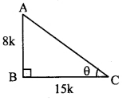
Tan θ =$\frac{8}{15}$.Find Sin θ= , Cos θ= ?
Answer
$\tan \theta=\frac{8}{15}$..(i) [Given]
In right angled $\triangle ABC$,
$\angle C=\theta \text {. }$

Image

$\begin{aligned} & \tan \theta=\frac{\text { Opposite side of } \theta}{\text { Adjacent side of } \theta} \\ \therefore \quad \tan \theta & =\frac{ AB }{ BC } \quad \ldots \text { (ii) } \\ \therefore \quad & \frac{ AB }{ BC }=\frac{8}{15} \quad \ldots[\text { From (i) and (ii)] }\end{aligned}$
Let the common multiple be k.
Let the common multiple be $k$.
$\therefore A B=8 k \text { and } B C=15 k$
Now, $A C^2=A B^2+B C^2 \ldots[$ Pythagoras theorem $]$
$=(8) K^2+(15 K)^2$
$=64 K^2-225^2$
$=289 K^2$
$\begin{aligned}
\therefore & A C=\sqrt{289 k^2} \ldots \text {.[Taking square root of both sides] } \\
= & 17 K \\
& \therefore \quad \sin \theta=\frac{\text { Opposite side of } \theta}{\text { Hypotenuse }}=\frac{ AB }{ AC }=\frac{8 k }{17 k }=\frac{8}{17} \\
& \cos \theta=\frac{\text { Adjacent side of } \theta}{\text { Hypotenuse }}=\frac{ BC }{ AC }=\frac{15 k }{17 k }=\frac{15}{17}
\end{aligned}$
View full question & answer
Question 152 Marks
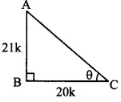
Tan θ =$\frac{21}{20}$.Find Sin θ= , Cos θ= ?
Answer
$\cos \theta=\frac{21}{\sqrt{20}}$..(i) [Given]
In right angled $\triangle ABC$,
$\angle C=\theta \text {. }$

Image

$\begin{array}{ll}
\tan \theta=\frac{\text { Opposite side of } \theta}{\text { Adjacent side of } \theta} \\
\therefore \quad \tan \theta=\frac{ AB }{ BC } \\
\therefore \quad & \frac{ AB }{ BC }=\frac{21}{20}
\end{array}$
...[From (i) and (ii)]
Let the common multiple be $k$.
$\therefore A B=21 k \text { and } B C=20 k$
Now, $A C^2=A B^2+B C^2 \ldots[$ Pythagoras theorem $]$
$=(21) K^2+(20 K)^2$
$=441 K^2-400^2$
$=841 K^2$
$\begin{aligned}
\therefore & AB =\sqrt{841 k^2} \ldots[\text { Taking square root of both sides] } \\
= & 29 K \\
& \therefore \quad \sin \theta=\frac{\text { Opposite side of } \theta}{\text { Hypotenuse }}=\frac{ AB }{ AC }=\frac{21 k }{29 k }=\frac{21}{29} \\
& \cos \theta=\frac{\text { Adjacent side of } \theta}{\text { Hypotenuse }}=\frac{ BC }{ AC }=\frac{20 k }{29 k }=\frac{ 2 0 }{ 2 9 }
\end{aligned}$
View full question & answer
Question 162 Marks
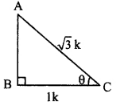
Cos θ =$\frac{1}{√3}$.Find Sin θ= , Tan θ= ?
Answer
$\cos \theta=\frac{1}{\sqrt{3}}$..(i) [Given]
In right angled $\triangle A B C$, $\angle C=\theta$.

Image

$\begin{aligned} \cos \theta & =\frac{\text { Adjacent side of } \theta}{\text { Hypotenuse }} \\ \therefore \quad \cos \theta & =\frac{ BC }{ AC } \quad \ldots \text { (ii) } \\ \therefore \quad \frac{ BC }{ AC } & =\frac{1}{\sqrt{3}} \quad \ldots[\text { From (i) and (ii)] }\end{aligned}$
Let the common multiple be $k$.
$\therefore A B=1 k \text { and } B C=\sqrt{ } 3 k$
Now, $A C^2=A B^2+B C^2 \ldots[$ Pythagoras theorem $]$
$\therefore(\sqrt{ } 3 K)^2=A B^2+K^2$
$\therefore 3 K^2=3 K^2-K^2=2 K^2$
$\therefore A B=\sqrt{2 k^2} \text {.. [Taking square root of both sides] }$
$A B=\sqrt{ } 2 K$
$\therefore \quad \sin \theta=\frac{\text { Opposite side of } \theta}{\text { Hypotenuse }}=\frac{A B}{A C}=\frac{\sqrt{2} k}{\sqrt{3} k}=\frac{\sqrt{2}}{\sqrt{3}}$
$\tan \theta=\frac{\text { Opposite side of } \theta}{\text { Adjacent side of } \theta}=\frac{A B}{B C}=\frac{\sqrt{2} k }{1 k }=\sqrt{2}$
View full question & answer
Question 172 Marks
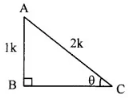
Sin θ =$\frac{1}{2}$.Find Cos θ= , Tan θ= ?
Answer
$\sin \theta=\frac{1}{2}$..(i) [Given]
In right angled $\triangle ABC$,
$\angle C=\theta \text {. }$

Image

$\begin{aligned} \sin \theta & =\frac{\text { Opposite side of } \theta}{\text { Hypotenuse }} \\ \therefore \quad \sin \theta & =\frac{ AB }{ AC } \quad \ldots \text { (ii) } \\ \therefore \quad \frac{ AB }{ AC } & =\frac{1}{2} \quad \ldots[\text { From (i) and (ii)] }\end{aligned}$
Let the common multiple be $k$.
$\therefore A B=1 k \text { and } BC=2 k$
Now, $A C^2=A B^2+B C^2 \ldots$ [Pythagoras theorem]
$\therefore 2 K^2=K^2+BC^2$
$\therefore 4 K^2=K^2+BC^2$
$\therefore B C^2=4 K^2-K^2=3 K^2$
$\therefore B C=\sqrt{3 k^2} \ldots . \text { [Taking square root of both sides] }$
$=\backslash \backslash \text { sqrt }\{3\{k\} \backslash$
$\therefore \quad \cos \theta=\frac{\text { Adjacent side of } \theta}{\text { Hypotenuse }}=\frac{B C}{A C}=\frac{\sqrt{3} k}{2 k}=\frac{\sqrt{3}}{2}$
$\quad \tan \theta=\frac{\text { Opposite side of } \theta}{\text { Adjacent side of } \theta}=\frac{A B}{B C}=\frac{1 k}{\sqrt{3} k}=\frac{1}{\sqrt{3}}$
View full question & answer
Question 182 Marks
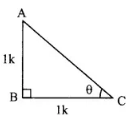
Tan θ = 1.Find Sin θ= , Cos θ= ?
Answer
$\tan \theta=1=\frac{1}{1}$..(i) [Given]
In right angled $\triangle ABC$,
$\angle C=\theta \text {. }$

Image

$\tan \theta=\frac{\text { Opposite side of } \theta}{\text { Adjacent side of } \theta}$
$\therefore \quad \tan \theta=\frac{A B}{B C}$
$\therefore \quad \frac{ AB }{ BC }=\frac{1}{1}$
Let the common multiple be k.
$\therefore AB = 1k and BC = 1k$
Now, $AC^2 = AB^2 + BC^2 …[Pythagoras theorem]$
$= K^2 + K^2$
$= 2K^2$
$\therefore AC$ = $\sqrt { 2 k }$
$ \therefore \quad \sin \theta  =\frac{\text { Opposite side of } \theta}{\text { Hypotenuse }}=\frac{ AB }{ AC }=\frac{ lk }{\sqrt{2} k }=\frac{1}{\sqrt{2}}$
$\cos \theta =\frac{\text { Adjacent side of } \theta}{\text { Hypotenuse }}=\frac{ BC }{ AC }=\frac{ lk }{\sqrt{2} k }=\frac{1}{\sqrt{2}}$
View full question & answer
Question 192 Marks
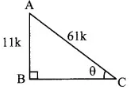
Sin θ =$\frac{11}{61}$.Find Cos θ= , Tan θ= ?
Answer
$\sin \theta=\frac{11}{61}$
(i) [Given]
In right angled ∆ABC, ∠C = θ.

Image

$\begin{array}{ll} & \sin \theta=\frac{\text { Opposite side of } \theta}{\text { Hypotenuse }} \\ \therefore \quad & \sin \theta=\frac{ AB }{ AC } \ldots \text { (ii) } \\ \therefore \quad & \frac{ AB }{ AC }=\frac{11}{61} \quad \ldots[\text { From (i) and (ii)] }\end{array}$
Let the common multiple be k.
AB = 11k and AC = 61k
Now, $AC^2 = AB^2 + BC^2 …[Pythagoras theorem]$
$\therefore (61k)^2 = (11k)^2 + BC^2$
$\therefore 3721k^2 = 121k^2 + BC^2$
$\therefore BC^2 = 3721k^2 – 121k^2 = 3600k^2$
$BC =\sqrt{3600 k^2}$.. [Taking square root of both sides]
$=60 k$
$\begin{aligned} \therefore \quad \cos \theta & =\frac{\text { Adjacent side of } \theta}{\text { Hypotenuse }}=\frac{ BC }{ AC }=\frac{60 k }{61 k }=\frac{60}{61} \\ \tan \theta & =\frac{\text { Opposite side of } \theta}{\text { Adjacent side of } \theta}=\frac{ AB }{ BC }=\frac{11 k }{60 k }=\frac{11}{60}\end{aligned}$
View full question & answer
Question 202 Marks
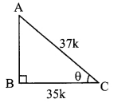
Cos θ =$\frac{35}{37}$.Find Sin θ= , Tan θ= ?
Answer
$\cos \theta=\frac{35}{37} \ldots$ (i) ) [Given] In right angled $\triangle ABC$,

Image

∠C = θ.
$\cos \theta=\frac{\text { Adjacent side of } \theta}{\text { Hypotenuse }}$
$\therefore \quad \cos \theta=\frac{ BC }{ AC }$
$\therefore \quad \frac{ BC }{ AC }=\frac{35}{37}$
Let the common multiple be k.
∴ BC = 35k and AC = 37k
Now, $AC^2 = AB^2 + BC^2 …[Pythagoras theorem]$
$\therefore (37k)^2 = AB^2+ (35k)^2$
$1369k^2 = AB^2 + 1225k^2$
$AB2 = 1369k^2 – 1225k^2$
$= 144k^2$
$AB = 144k^2$
$AB =\sqrt{2 g h K^2}$... [Taking square root of both sides]
$= 12k$
$ \therefore \quad \sin \theta  =\frac{\text { Opposite side of } \theta}{\text { Hypotenuse }}=\frac{ AB }{ AC }=\frac{12 k }{37 k }=\frac{12}{37}$
$\tan \theta  =\frac{\text { Opposite side of } \theta}{\text { Adjacent side of } \theta}=\frac{ AB }{ BC }=\frac{12 k }{35 k }=\frac{12}{35}$
View full question & answer
Question 212 Marks
In the figure gIven below, ∆PQR is a right angled triangle. Write the names of sides opposite and adjacent to ∠P and ∠R.

Image

Answer
In right angled ∆PQR,
i. side opposite to ∠P = QR
ii. side opposite to ∠R = PQ
iii. side adjacent to ∠P = PQ
iv. side adjacent to ∠R = QR
View full question & answer
Question 222 Marks
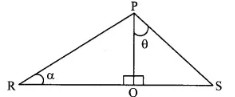
In the given figure, ∠PQR = 90°, ∠PQS = 90°, ∠PRQ = α and ∠QPS = θ. Write the following trigonometric ratios.
i. sin α, cos α , tan α
ii. sin θ, cos θ, tan θ
Image
Answer
i. In $\triangle P Q R$,
$\sin \alpha=\frac{\text { Opposite side of } \alpha}{\text { Hypotenuse }}=\frac{ P Q }{ P R }$
$\cos \alpha=\frac{\text { Adjacent side of } \alpha}{\text { Hypotenuse }}=\frac{ R Q }{ P R }$
$\tan \alpha=\frac{\text { Opposite side of } \alpha}{\text { Adjacent side of } \alpha}=\frac{ P Q }{ R Q }$
ii. In $\triangle P Q S$,
$\sin \theta=\frac{\text { Opposite side of } \theta}{\text { Hypotenuse }}=\frac{ Q S }{ P S }$
$\cos \theta=\frac{\text { Adjacent side of } \theta}{\text { Hypotenuse }}=\frac{ P Q }{ P S }$
$\tan \theta=\frac{\text { Opposite side of } \theta}{\text { Adjacent side of } \theta}=\frac{ Q S }{ P Q }$
View full question & answer
Question 232 Marks
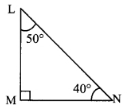
In right angled ∆LMN, ∠LMN = 90°, ∠L = 50° and ∠N = 40°. Write the following ratios.

Image
i. sin 50°
ii. cos 50°
iii. tan 40°
iv. cos 40°
Answer
i. $\quad \sin 50^{\circ}=\frac{\text { Opposite side of } 50^{\circ}}{\text { Hypotenuse }}=\frac{ M N }{ L N }$
ii. $\cos 50^{\circ}=\frac{\text { Adjacent side of } 50^{\circ}}{\text { Hypotenuse }}=\frac{ L M }{ L N }$
iii. $\tan 40^{\circ}=\frac{\text { Opposite side of } 40^{\circ}}{\text { Adjacent side of } 40^{\circ}}=\frac{ L M }{ M N }$
iv. $\cos 40^{\circ}=\frac{\text { Adjacent side of } 40^{\circ}}{\text { Hypotenuse }}=\frac{ M N }{ L N }$
View full question & answer
Question 242 Marks
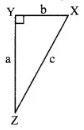
In the right angled ∆XYZ, ∠XYZ = 90° and a, b, c are the lengths of the sides as shown in the figure. Write the following ratios.

Image
i. sin x
ii. tan z
iii. cos x
iv. tan x.
Answer
i. $\quad \sin X =\frac{\text { Opposite side of } \angle X }{\text { Hypotenuse }}=\frac{ YZ }{ XZ }=\frac{\text { a }}{ c }$
ii. $\tan Z=\frac{\text { Opposite side of } \angle Z}{\text { Adjacent side of } \angle Z}=\frac{X Y}{Y Z}=\frac{b}{a}$
iii. $\cos X=\frac{\text { Adjacent side of } \angle X}{\text { Hypotenuse }}=\frac{X Y}{X Z}=\frac{b}{c}$
iv. $\tan X=\frac{\text { Opposite side of } \angle X }{\text { Adjacent side of } \angle X }=\frac{ YZ }{ XY }=\frac{\text { a }}{\text { b }}$
View full question & answer
Question 252 Marks
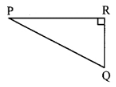
In the given figure, ∠R is the right angle of ∆PQR. Write the following ratios.

Image
i. sin P
ii. cos Q
iii. tan P
iv. tan Q

Answer
i. $\quad \sin P =\frac{\text { Opposite side of } \angle P}{\text { Hypotenuse }}=\frac{ Q R }{ P Q }$
ii. $\cos Q =\frac{\text { Adjacent side of } \angle Q }{\text { Hypotenuse }}=\frac{ Q R }{ P Q }$
iii. $\tan P =\frac{\text { Opposite side of } \angle P }{\text { Adjacent side of } \angle P }=\frac{ QR }{ PR }$
iv. $\tan Q =\frac{\text { Opposite side of } \angle Q}{\text { Adjacent side of } \angle Q}=\frac{ P R }{ Q R }$
View full question & answer