Questions

Question Answer (5 Marks)

🎯

Test yourself on this topic

27 questions · timed · auto-graded

Question 15 Marks
How will you separate a mixture of common salt, sulphur powder and sand?
Answer
At first, the mixture of common salt, sulphur powder and sand is shaken with carbon disulphide. Sulphur dissolves in carbon disulphide whereas common salt and sand remain un-dissolved. The solution is then filtered, common salt and sand mixture is obtained as residue. On evaporating the filtrate, carbon disulphide solvent is eliminated and solid sulphur remains behind. Now, the common salt and sand mixture is shaken with water. Common salt gets dissolved in water. The solution is then filtered, sand is obtained as residue. The filtrate is then evaporated to get crystals of common salt.
View full question & answer
Question 25 Marks
A mixture contains water, kerosene and sand. How will you separate this mixture?
Answer
The mixture of water, kerosene and sand is filtered with the help of filter paper first. Sand remains as residue on the filter paper while mixture of water and kerosene is obtained as filtrate .The mixture of water and kerosene is then put in separating funnel and allowed to stand for some time. The mixture separates into two layers according to the difference in the densities of water and kerosene. Water is heavier than kerosene. So, water forms lower layer while kerosene forms upper layer. On opening the stop clock of separating funnel, the lower layer of water comes out first and collected in beaker leaving behind kerosene in the separating funnel.
View full question & answer
Question 35 Marks
List five characteristics by which compounds can be distinguished from mixtures.
Answer
 
MIXTURES
 
COMPOUNDS
i
A mixture can be separated into constituents by the physical processes.
i
A compound cannot be separatwd into its constituents by the physical processes.
ii
A mixture shows the properties its contituents.
ii
The properties of a compound are entirely different from those of its constituents.
iii
Energy is usually neither given out nor absorbed in the preparation of a mixture.
iii
Energy is usually given or absorbed during the preparation of a compound.
iv
The composition of a mixture is variable.
iv
The composition of a compound is fixed.
v
A mixture does not have a fixed melting point, boiling point, etc.
v
A compound has a fixed melting boiling point etc.
View full question & answer
Question 45 Marks
Give the main differences between physical changes and chemical changes.
Answer
  PHYSICAL CHANGE   CHEMICAL CHANGE
i No, new substance is formed in a physical change. i New substance is formed in a chemical change.
ii It is a temporart change. ii A chemical change is a permanent change.
iii It is easily reversible. iii This process is usually irreversible.
iv Very little heat or light energy is usually absorbed or given out in this process. iv A lot of heat or light energy is absorbed or given out in this process.
v Mass of substance does not alter. v Mass of substance does alter in this process.
View full question & answer
Question 55 Marks
How will you separate common salt, sand and iron filings from their mixture?
Answer
Mixture of common salt, sand and iron filings can be separated by using magnet first. A horse-shoe magnet is moved on the surface of the mixture. The iron filings are attracted by the magnet, they cling to the poles of the magnet and get separated. This process is repeated a number of times till complete separation of iron filings occur leaving behind mixture of common salt and sand. The mixture of common salt and sand is then dissolved in water and then filtered with the help of filter paper. Sand remains as residue on the filter paper while common salt solution is obtained as filtrate .The filtrate is then evaporated to get crystals of common salt.
View full question & answer
Question 65 Marks
Define the following:
  1. Sol
  2. Aerosol
  3. Emulsion
  4. Foam
Given one example of each.
Answer
  1. Sol: Sol is a colloid in which tiny solid particles are dispersed in a liquid medium.
Examples are ink and soap solution.
  1. Aerosol: Aerosol is a colloid in which a solid or liquid is dispersed in a gas.
Examples are hairspray and fog.
  1. Emulsion: An emulsion is a colloid in which minute droplets of one liquid are dispersed in another liquid which is not miscible with it.
Examples are milk and butter.
  1. Foam: A foam is a colloid in which a gas is dispersed in a liquid medium.
Examples are soap bubbles and shaving cream.
View full question & answer
Question 75 Marks
Discuss the method of separating a mixture containing chalk powder, iron fillings and naphthalene.
Answer
Mixture of chalk powder, iron filings and naphthalene can be separated by using magnet and then by sublimation. A horse-shoe magnet is moved on the surface of the mixture. The iron filings are attracted by the magnet, they cling to the poles of the magnet and get separated. This process is repeated a number of times till complete separation of iron filings occur leaving behind mixture of chalk powder and naphthalene. Then, mixture of chalk powder and naphthalene is heated. Naphthalene sublimes on heating leaving behind chalk powder and can be recovered in the form of sublimate by cooling its vapours.
View full question & answer
Question 85 Marks
Draw a labelled diagram of the fractional distillation apparatus used for separating a mixture of alcohol and water.
View full question & answer
Question 95 Marks
How will you separate a mixture of mercury, oil and water?
Answer
Mercury, oil and water are immiscible liquids and have different densities. Mixture of mercury, oil and water will be put in separating funnel and allowed to stand for sometimes. The mixture separates into three layers according to the densities of mercury, oil and water. On opening the stop clock of separating funnel, the lower layer formed by mercury comes out first and collected in beaker leaving behind other two layers. Similarly, again on opening the stop clock of separating funnel, the lower layer of water comes out first and collected in beaker leaving behind oil in the funnel.
View full question & answer
Question 105 Marks
You are given a mixture of water, groundnut oil and common salt. How will you separate groundnut oil and common salt from it?
Answer
The mixture of water, groundnut oil and common salt is put in a separating funnel and allowed to stand for some time. The mixture separates into two layers according to the densities of water and groundnut oil. Water is heavier than groundnut oil. So, water forms lower layer while groundnut oil forms upper layer. On opening the stop clock of separating funnel, the lower layer of water comes out first and collected in beaker leaving behind groundnut oil in the funnel. Now, solution of water and common salt is heated. Water gets evaporated leaving behind solid common salt.
View full question & answer
Question 115 Marks
How will you separate camphor, common salt and iron nails from their mixture?
Answer
A horse-shoe magnet is moved on the surface of the mixture of camphor, common salt and iron nails. The iron nails are attracted by the magnet, they cling to the poles of the magnet and get separated. This process is repeated a number of times till complete separation of iron nails occur leaving behind mixture of camphor and common salt. Mixture of camphor and common salt is heated. Camphor sublimes on heating leaving behind common salt and can be recovered in the form of sublimate by cooling its vapours.
View full question & answer
Question 125 Marks
Describe the various steps involved in the separation of iodine, iron filings and salt from a mixture.
Answer
Mixture of iodine, iron filings and salt can be separated by using magnet and then by sublimation. A horse-shoe magnet is moved on the surface of the mixture. The iron filings are attracted by the magnet, they cling to the poles of the magnet and get separated. This process is repeated a number of times till complete separation of iron filings occur leaving behind mixture of iodine and salt. Then, mixture of iodine and salt is heated. Iodine sublimes on heating leaving behind salt and can be recovered in the form of sublimate by cooling its vapours.
View full question & answer
Question 135 Marks
How will you separate a mixture of iron filings, chalk powder an common salt?
Answer
Mixture of iron filings, chalk powder and common salt can be separated by using magnet first. A horse-shoe magnet is moved on the surface of the mixture. The iron filings are attracted by the magnet, they cling to the poles of the magnet and get separated. This process is repeated a number of times till complete separation of iron filings occur leaving behind mixture of chalk powder and common salt. The mixture of chalk powder and common salt is then dissolved in water and then filtered with the help of filter paper. Chalk powder remains as residue on the filter paper while common salt solution is obtained as filtrate .The filtrate is then evaporated to get crystals of common salt.
View full question & answer
Question 145 Marks
Differentiate between a saturated and an unsaturated solution. How will you test whether a given solution is saturated or not?
Answer
A solution in which no more solute can be dissolved at that temperature is called a saturated solution while a solution in which more quantity of solute can be dissolved without raising its temperature is called an unsaturated solution. To test the saturation or unsaturation of a solution, more solute may be added to the solution. If that solute gets dissolved in the solution then the solution will be unsaturated. To test whether a given solution is saturated or not, add some more solute to the solution and try to dissolve it by stirring. If solute does not dissolve in the given solution, then it will be a saturated solution.
View full question & answer
Question 155 Marks
Describe the method of separating a mixture containing common salt, sand and ammonium chloride.
Answer
The mixture of common salt, sand and ammonium chloride will be heated first. Ammonium chloride sublimes on heating and can be recovered in the form of sublimate by cooling its vapours leaving behind mixture of common salt and sand. Salt is soluble in water whereas sand is insoluble in water. The mixture of sand and salt is dissolved in water, then it is filtered with the help of filter paper. Sand remains as residue on the filter paper while salt solution is obtained as filtrate .The filtrate is then evaporated to get crystals of salt.
View full question & answer
Question 165 Marks
What is fractional distillation? What is the use of fractionating column in fractional distillation?
Answer
Fractional distillation is the process of separating two or more miscible liquids (liquids which mix together in all proportions and form a single layer) by distillation, the distillate being collected in fractions boiling at different temperatures. The separation of two liquids by fractional distillation depends on the difference in their boiling points. It is carried out by using a fractionating column. Fractionating column is a long vertical glass tube filled with glass beads. The glass beads provide a large surface area for hot vapours to cool and condens repeatedly. It provides different temperature zones inside it, the highest temperature being at the bottom of the column and the lowest temperature near its top. It is fitted in the neck of the distillation flask.
View full question & answer
Question 175 Marks
How would you prepare a saturated solution of sodium chloride in water at 25°C? What will happen if this solution is cooled to 10°C?
Answer
Take some water in a beaker and heat it slowly with the help of burner. Now, start adding sodium chloride salt to the hot water with a spoon and stir it with a glass rod continuously so that sodium chloride goes on dissolving in water. Take the temperature of water up to 25°C and then keeping this temperature constant, go on adding sodium chloride till no more sodium chloride dissolves in it and some undissolved crystals will be left at the bottom. The contents of the beaker are now filtered and the clear solution obtained is the saturated solution of sodium chloride at 25°C. If the temperature is lowered from 25°C to 10°C, then some of the crystals of sodium chloride will separate out from the solution in the form of solute crystals.
View full question & answer
Question 185 Marks
State the main points of difference between homogeneous and heterogeneous mixtures.
Answer
Those mixtures in which the substances are completely mixed together and are indistinguishable from one another, are called homogeneous mixtures. They have a uniform composition throughout its mass. All the homogeneous mixtures are called solutions.
Examples: Sugar solution, salt solution, copper sulphate solution, etc.
Those mixtures in which the substances remain separate and one substance is spread throughout the other substance as small particles, droplets or bubbles, are called heterogeneous mixtures. Heterogeneous mixture does not have a uniform composition throughout its mass.
Example: Starch solution, soap solution.
View full question & answer
Question 195 Marks
There are three substances X, Y and Z. The substance X does not have a fixed melting point or boiling point and it still shows the individual properties of its constituents. The substance Y is a pure substance which occurs in nature as such. The substance Y has a fixed melting point and boiling point but it cannot be broken down into simpler substances by any chemical means. The substance Z is also a pure substance whose properties are entirely different from those of its constituents. The substance Z can, however, be divided by electrolysis into two substances which belong to the same class of substances as Y.
  1. What type of substance could X be? Name one substance like X.
  2. What type of substance could Y be? Name one substance like Y.
  3. What type of substance could Z be? Name one substance like Z.
  4. Whish process involves absorption or release of an appreciable amount of energy: formation of substance X or formation of substance Z?
  5. Name the three groups into which all the substances like Y are divided on the basis of their properties.
Answer
  1. ​​Substance X does not have a fixed melting or boiling point. Moreover, it shows the properties of its constituents. So, it must be a mixture. Sugar solution in water is a substance like X.
  2. Substance Y has a fixed melting or boiling point but it cannot be split into simpler substances by chemical processes. Hence, it must be an element. Hydrogen is a substance like Y.
  3. Substance Z is also a pure substance whose properties are entirely different from those of its constituents. Hence, it must be a compound. Sugar is a substance like Z.
  4. Formation of Z(a compound) involves absorption or release of an appreciable amount of energy.
  5. The three groups are metals, non-metals and metalloids. All the substances like Y are divided into these groups on the basis of their properties.
View full question & answer
Question 205 Marks
$A, B$ and $C$ are all liquids. Liquid A has a comparatively low boiling point. On heating, liquid a vaporizes completely without leaving behind any residue. Liquid A is being used increasingly as a fuel in motor vehicles either alone or by mixing with petrol. Liquid $B$ has a very high boiling point. It also vaporizes completely on heating, without leaving any residue. Liquid $B$ is a conductor of electricity and used in making thermometers. Liquid $c$ has a moderate boiling point. On heating, liquid C vaporises leaving behind a white solid $D$ which is used in cooking vegetables. The condensation of vapours from $C$ give a liquid $E$ which turns anhydrous $CuSO _4$ to blue.
a. Which liquid could be an element? Name this element.
b. Which liquid could be a mixture? Name this mixture.
c. Which liquid could be a compound? Name this compound.
d. What could the solid $D$ be?
e. What do you think is liquid $E$ ?
Answer
a. Liquid $B$ has a very high boiling point. It also vaporises on heating. It is a conductor of electricity and is used in making thermometers. So, $B$ could be an element. Further, liquid B is mercury as mercury is a liquid metal, which expands on heating and is used extensively in thermometers.
b. Liquid $C$ has a moderate boiling point. It could be a mixture. It is a salt solution because when $C$ is heated, it vaporises and leaves behind a white solid (salt), which is used in the process of cooking.
c. Liquid $A$ is used in motor vehicles as fuel, either alone or after mixing with petrol. It could be a compound because on heating, it does not leave any residue. It is alcohol as alcohol is being used in motor vehicles nowadays.
d. Solid $D$ is sodium chloride. It is also known as common salt and is added in food.
e. Liquid $E$ is water as, on heating, liquid $C$ , which is a salt solution, leaves water vapours. On condensing these vapours, we obtain pure water. When water is mixed with anhydrous copper sulphate, we obtain a blue colour solution. This is because of the formation of hydrated copper sulphate solution.$\text{CuSO}_4+5\text{H}_2\text{O}\xrightarrow{\ \ \ \ \ \ \ \ \ \ \ \ }\text{CuSO}_4\cdot5\text{H}_2\text{O}\\ \ \ \ \ \ \ \ \ \ \ \ \ \ \ \ \ \ \ \ \ \ \ \ \ \ \ \ \ \ \ \ \ \ \ \ \ \ {^\text{hydrated copper sulphate}}$
View full question & answer
Question 215 Marks
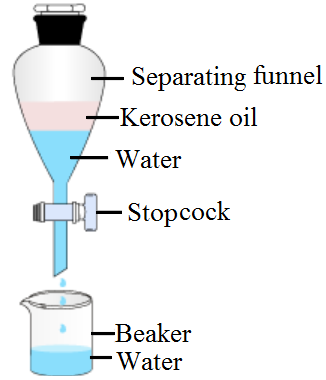
How will you separate a mixture of kerosene oil and water? Explain with the help of a labeled diagram
Answer
The mixture of water and kerosene is put in separating funnel and allowed to stand for some time. The mixture separates into two layers according to the densities of water and kerosene. Water is heavier than kerosene. So, water forms lower layer while kerosene forms upper layer. On opening the stop clock of separating funnel, the lower layer of water comes out first and collected in beaker leaving behind kerosene.

Separation of kerosene oil and water mixture by separating funnel.
View full question & answer
Question 225 Marks
Iron powder and sulphur powder were mixed together and divided into two parts A and B. When part A was heated strongly over a burner, then a substance C was formed. The part B was, however, not heated at all. When dilute hydrochloric acid was added to substance C, then gas D was evolved and when dilute hydrochloric acid was added to part B then gas E was evolved.
  1. What type of substance is B?
  2. What type of substance is C?
  3. Name the gas (i) D, and (ii) E?
  4. Write one characteristic property of gas D.
Answer
  1. Here, iron powder and sulphur powder are mixed together. B is a mixture (Fe + S).
  2. Here, iron powder and sulphur powder are mixed together and heated strongly on a burner. So, C is the compound iron sulphide(FeS).
  3.  
  1. Here, dilute HCl was added to C (iron sulphide)to obtain D, which is hydrogen sulphide gas.
$\text{FeS}+2\text{HCl}\xrightarrow{\ \ \ \ \ \ \ \ \ \ \ }\text{FeCl}_2+\text{H}_2\text{S}$
  1. When dilute HCl is added to B, Fe present in the mixture reacts with the acid to form hydrogen gas.
$\text{Fe}+\text{HCl}\xrightarrow{\ \ \ \ \ \ \ \ \ \ \ }\text{FeCl}_2+\text{H}_2$
  1. Gas D smells like rotten egg.
  2. When a burning stick is held in the gas, the gas itself catches fire with blue flame and a ‘pop’ sound. In the process, the burning stick extinguishes.
View full question & answer
Question 235 Marks
There is a large group of materials P which can be divided into three groups Q, R, and S on the basis of their properties. The substances belonging to group Q can be solids, liquids or gases. The solids belonging to group Q are usually electrical insulators. Most of the substances of group R are solids which are good conductors of electricity. The substances belonging to group S are neither insulators like Q nor good conductors like R. The properties of S are intermediate between those of Q and R.
  1. What could the group of materials P be?
  2. Name the substances Q. Give two examples of such substances.
  3. Name the substances R. Write two examples of such substances.
  4. Name the substances S. Give two examples of such substances.
  5. Out of Q, R and S, which substances are malleable and ductile?
Answer
  1. Group of materials P is element.
  2. Q is a non-metal.
Examples: Carbon(s), and bromine (l)
  1. R is a metal, as most of them are good conductors of heat and electricity.
Examples: Copper, and aluminum
  1. S is a metalloid, as they have intermediate properties of those of metals and non-metals.
Examples: Arsenic, and antimony
  1. R is a metal, therefore, it is malleable and ductile.
View full question & answer
Question 245 Marks
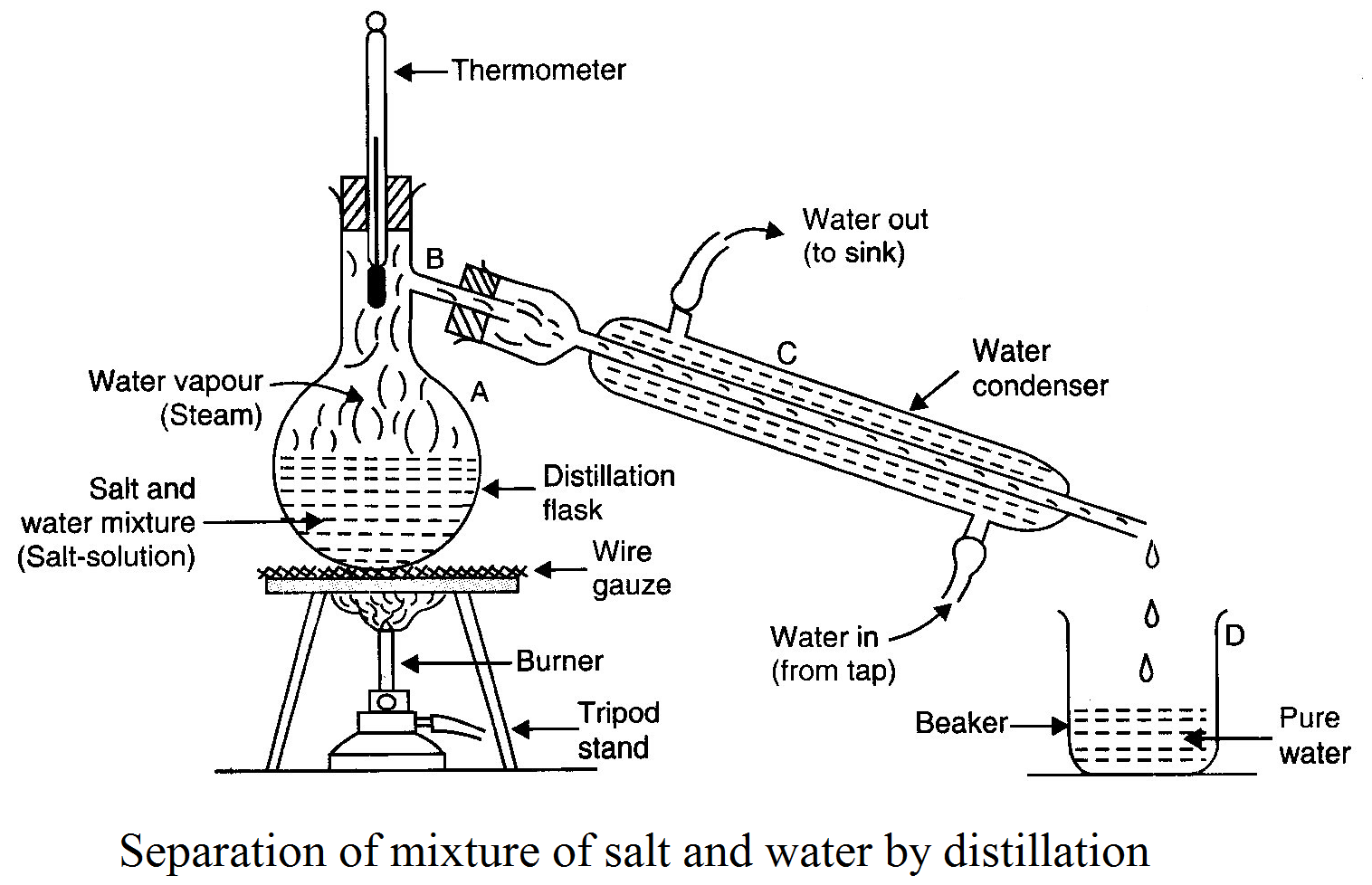
How can you obtain pure water from a salt-water mixture (or salt-solution)? Draw a meat and labelled diagram of the apparatus you would use to obtain pure water from a salt-water mixture (or salt-solution).
Answer
A mixture of common salt and water can be separated completely by the process of distillation. The distillation can be used to separate a liquid from dissolved non-volatile solids.
The salt water mixture is taken in the distillation flask A and heated. Some porcelain pieces are put in the distillation flask to avoid bumping of the solution due to uneven heating. On heating, water forms vapours which rise up and come out through the side tube B of the distillation flask, and go into water condenser C. Cold water from tap is circulated through the outer tube of condenser for cooling the vapours. The hot vapours get cooled in the condenser to form pure water (i.e. distilled water) which trickles down from the condenser and collects in the beaker D. Since the salt is non-volatile, so it remains behind in the distillation flask.
View full question & answer
Question 255 Marks
Explain how, nitrogen, oxygen and argon gases are separated form air.
Answer
Air is mixture of gases like nitrogen, oxygen, argon, carbon dioxide, helium, neon, krypton, xeon etc. The various gases of air are separated from one another by fractional distillation of liquid air. This separation is based on the fact that different gases of air have different boiling points(in liquid form).
The air is first filtered to remove dust, then water vapour and carbon dioxide are removed. Air is compressed to a high pressure and then cooled. The cooled air is then allowed to expand quickly into a chamber through a jet. This cools the air even more. This process of compression, cooling and rapid expansion of air is repeated again and again to make the air more and more cool so that it becomes liquid air. Now, the liquid air is fed into a tall fractionating column and warmed up slowly.
Liquid nitrogen has lowest boiling point of -196°C. So, on warming, it boils off first to form nitrogen gas and is collected at the upper part of the fractional distillation column. Liquid argon has a slightly higher boiling point of -186°C. So, it boils off next and collected as argon gas in the middle part of fractional distillation column. Liquid oxygen has a still higher boiling point of -183°C. So, liquid oxygen boils off last and collected as oxygen gas at the bottom of fractional distillation column.
View full question & answer
Question 265 Marks
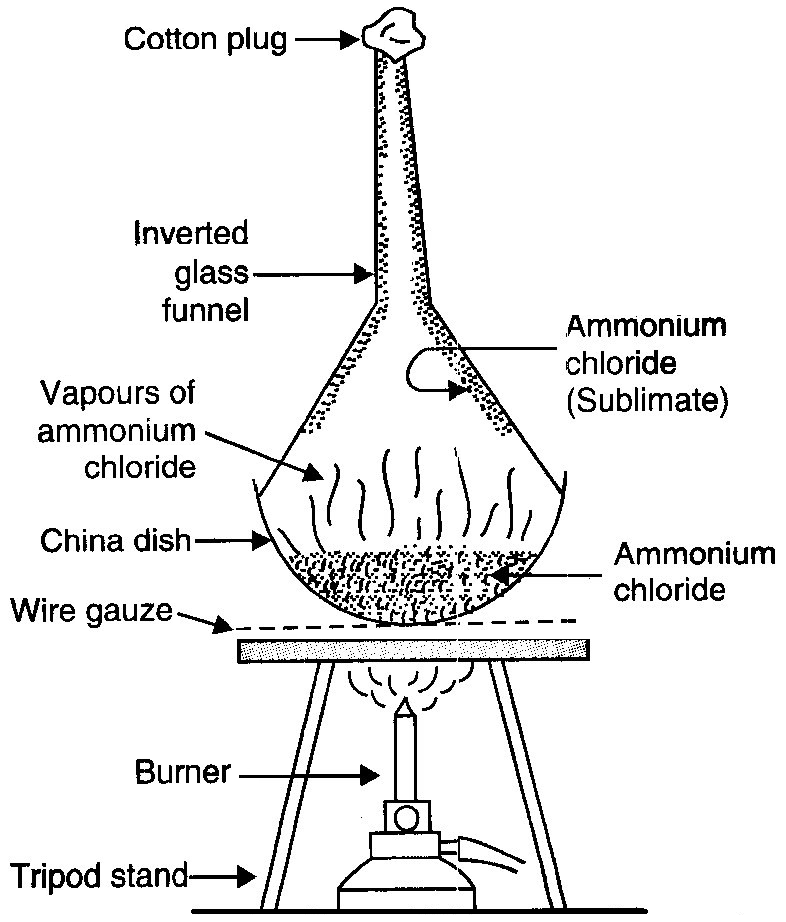
With the help of a labelled diagram, describe the method of separating ammonium chloride from a mixture of ammonium chloride and common salt. Mention the difference in the properties of ammonium chloride and sodium chloride which has made this separations possible.
Answer
The mixture of common salt and ammonium chloride is taken in a china dish and placed on a tripod stand. The china dish is covered with an inverted glass funnel. A loose cotton plug is put in the upper, open end of the funnel to prevent the ammonium chloride vapours from escaping into the atmosphere. The china dish is heated by using a burner. On heating the mixture, ammonium chloride changes into white vapours. These vapours rise up and get converted into solid ammonium chloride on coming in contact with the cold, inner walls of the funnel. In this way, pure ammonium chloride collects on the inner sides of the funnel in the form of a sublimate and can be removed. Common salt does not change into vapours on heating, so it remains behind in the china dish and can be separated out.

Ammonium chloride sublimes on heating whereas common salt does not sublime on heating. So, we can separate ammonium chloride from a mixture of common salt and ammonium chloride by the process of sublimation.
View full question & answer
Question 275 Marks
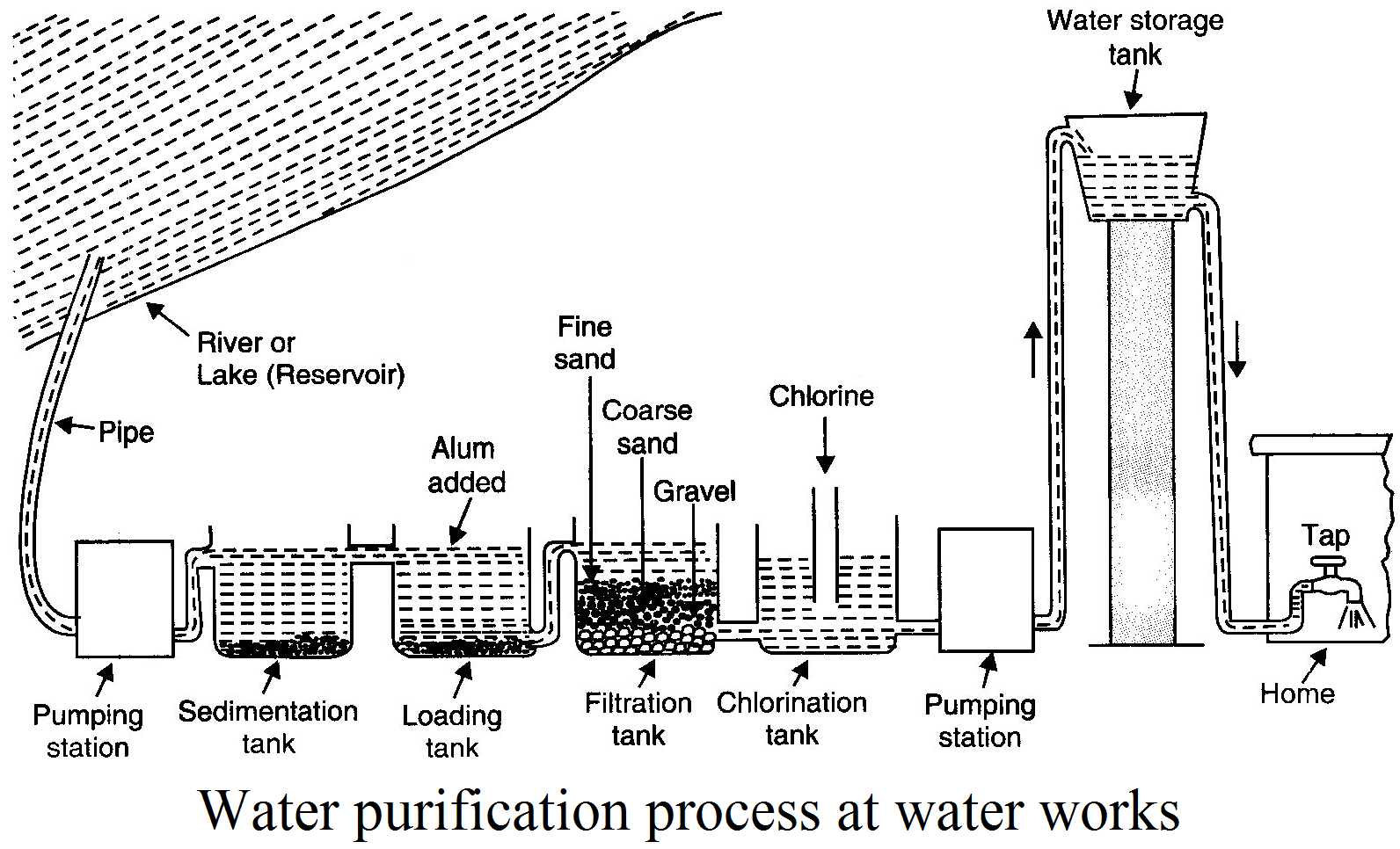
How is water purified on a large scale at water works? Explain with the help of a labelled diagram. Name the substance which is added to kill germs in the drinking water supply?
Answer
In cities, drinking water is supplied from water works where river or lake water is made free from suspended solid substances and germs. In water works, the methods like sedimentation, decantation, loading, filtration and chlorination etc. are used to remove undesirable materials from water. The source of water supply in a city is either a nearby river or lake (reservoir), from there it is pumped into 'sedimentation tank'. Here it is allowed to stand for sometime so that many of insoluble substances present in water settle down at bottom of the tank. From there, it is sent to a 'loading tank' where some alum is added to water. Here suspended clay particles in water get loaded with alum particles, become heavy and settle down at the bottom of the tank. Then, it is passed through 'filtration tank'. It has three layers: fine sand layer at top, coarse sand layer in middle and gravel as the bottom layer. These act as filters and even the small suspended particles get removed when water passes through these layers. Then, the clear water is passed into a chlorination tank. Here, chlorine is added to water to kill the germs present in it. Now, the clean and disinfected water is pumped by pumping station into high storage tanks and from there, it is supplied to homes and factories through the network of big and small pipes.
View full question & answer