Questions

[5 marks Questions]

🎯

Test yourself on this topic

13 questions · timed · auto-graded

Question 15 Marks
What is a functional group? Give examples of four different functional groups.
Answer
For the definition of functional group and example,
Functional Group Family Representation
$-\text{OH}$ Alcohols $\text{R}-\text{O}-\text{H}$
$\ \ \ \ \text{O}\\\ \ \ \ ||\\-\text{C}-\text{H}$ Aldehydes $\ \ \ \ \ \ \ \ \text{O}\\\ \ \ \ \ \ \ \ ||\\\text{R}-\text{C}-\text{H}$
$\ \ \ \ \text{O}\\\ \ \ \ ||\\-\text{C}-$ Ketones $\ \ \ \ \ \ \ \ \text{O}\\\ \ \ \ \ \ \ \ ||\\\text{R}-\text{C}-\text{R}$
$\ \ \ \ \text{O}\\\ \ \ \ ||\\-\text{C}-\text{OH}$ Carboxylic acids $\ \ \ \ \ \ \ \ \text{O}\\\ \ \ \ \ \ \ \ ||\\\text{R}-\text{C}-\text{OH}$
$-\text{N}-\text{H}\\\ \ \ \ |\\\ \ \ \text{H}$ Amines $\text{R}-\text{NH}_2$
$-\text{O}-$ Ethers $\text{R}-\text{O}-\text{R}$
$-\text{X}\ (\text{halogen})$ Haloalkanes $\text{R}-\text{X}$
$-\text{NO}_2$ Nitroalkanes $\text{R}-\text{NO}_2$
View full question & answer
Question 25 Marks
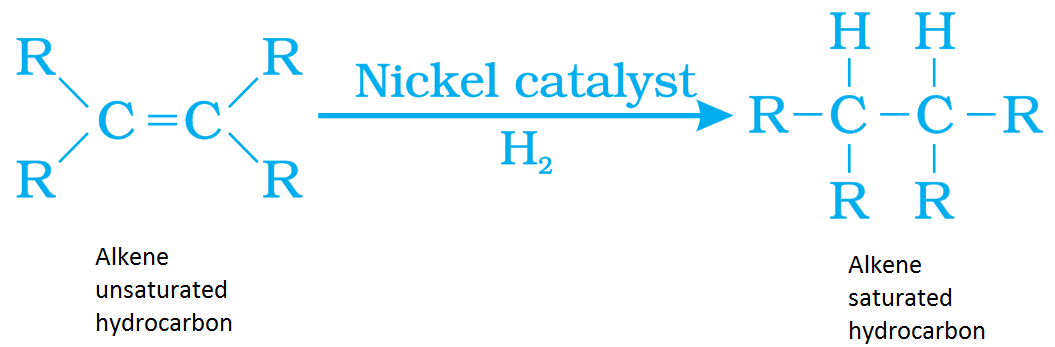
Name the reaction which is commonly used in the conversion of vegetable oils to fats. Explain the reaction involved in detail.
Answer

The reaction that is used to convert vegetable oil to fat is called as hydrogenation reaction. Vegetable oils contain unsaturated hydrocarbons which can exhibit addition reaction with hydrogen to form saturated hydrocarbons or fats. The reaction occurs in the presence of metal catalyst like finely divided nickel or palladium at 200°C and forms saturated vegetable fats.

The hydrogenation reaction is an industrial method for the manufacturing of vanaspati ghee from vegetable oil.

$\text{Vegetable oil}+\text{H}_2\xrightarrow{\ \ \text{Ni}, 473\text{K}\ \ }\text{Vanaspati ghee}$


Here, R is any alkyl group which usually contains a large number of carbon atoms in vegetable oils.
View full question & answer
Question 35 Marks
Give the structural differences between saturated and unsaturated hydrocarbons with two examples, each.
Answer
Saturated hydrocarbons or alkanes contain either C—C or C—H bonds in their molecules. These are represented by the general formula $C _n H _{2 n-2}$ For example,$\ \ \ \ \ \ \ \ \text{H}\ \ \ \ \ \text{H}\\\ \ \ \ \ \ \ \ \ |\ \ \ \ \ \ \ |\\\text{H}-\text{C}-\text{C}-\text{H}\\\ \ \ \ \ \ \ \ \ |\ \ \ \ \ \ \ |\\\ \ \ \ \ \ \ \ \text{H}\ \ \ \ \ \text{H}\\\ \ \ \ \ \ \ \ \text{Ethane}$ $\ \ \ \ \ \ \ \text{H}\ \ \ \ \ \text{H}\ \ \ \ \ \text{H}\\\ \ \ \ \ \ \ \ |\ \ \ \ \ \ \ |\ \ \ \ \ \ \ |\\\text{H}-\text{C}-\text{C}-\text{C}-\text{H}\\\ \ \ \ \ \ \ \ \ |\ \ \ \ \ \ |\ \ \ \ \ \ \ |\\\ \ \ \ \ \ \ \ \text{H}\ \ \ \ \text{H}\ \ \ \ \ \ \text{H}\\\ \ \ \ \ \ \ \ \ \ \text{Propane}$
Unsaturated hydrocarbons contain either atleast one >C = C< bond or triple —C ≡ C— bond in their molecules. These may be either alkenes or alkynes in nature. The general formula of alkenes is $C _n H _{2 n}$ while that of alkynes is $C _n H _{2 n-2}$ for example,
$\ \ \ \ \ \ \ \ \text{H}\ \ \ \ \ \text{H}\\\ \ \ \ \ \ \ \ \ |\ \ \ \ \ \ \ |\\\text{H}-\text{C}=\text{C}-\text{H}\\\ \ \ \ \text{Ethene}$ $\ \ \ \ \ \ \ \ \text{H}\\\ \ \ \ \ \ \ \ \ |\\\text{H}-\text{C}-\text{C}=\text{C}-\text{H}\\\ \ \ \ \ \ \ \ \ |\ \ \ \ \ \ \ |\ \ \ \ \ \ \ |\\\ \ \ \ \ \ \ \ \text{H}\ \ \ \ \ \text{H}\ \ \ \ \ \ \text{H}\\\ \ \ \ \ \ \ \ \text{Propene}$ $\text{H}-\text{C}\equiv\text{C}-\text{H}\\\ \ \ \ \ \ \text{Ethyne}$ $\ \ \ \ \ \ \ \ \text{H}\\\ \ \ \ \ \ \ \ \ |\\\text{H}-\text{C}-\text{C}\equiv\text{C}-\text{H}\\\ \ \ \ \ \ \ \ \ |\\\ \ \ \ \ \ \ \ \text{H}\\\ \ \ \ \text{Propyne}$
View full question & answer
Question 45 Marks
What are hydrocarbons? Give examples.
Answer
Hydrocarbons are the organic compounds containing only carbon and hydrogen atoms as their constituents. These may be alkanes, alkenes and alkynes.
Alkane: $\ \ \ \ \ \ \ \ \text{H}\\\ \ \ \ \ \ \ \ \ |\\\text{H}-\text{C}-\text{H}\\\ \ \ \ \ \ \ \ \ |\\\ \ \ \ \ \ \ \ \text{H}\\\ \ \ \text{Methane}$ $\ \ \ \ \ \ \ \ \text{H}\ \ \ \ \ \text{H}\\\ \ \ \ \ \ \ \ \ |\ \ \ \ \ \ |\\\text{H}-\text{C}-\text{C}-\text{H}\\\ \ \ \ \ \ \ \ |\ \ \ \ \ \ \ |\\\ \ \ \ \ \ \ \text{H}\ \ \ \ \ \ \text{H}\\\ \ \ \ \ \ \ \text{Ethane}$ $\ \ \ \ \ \ \ \ \text{H}\ \ \ \ \ \text{H}\ \ \ \ \ \text{H}\\\ \ \ \ \ \ \ \ \ |\ \ \ \ \ \ |\ \ \ \ \ \ \ |\\\text{H}-\text{C}-\text{C}-\text{C}-\text{H}\\\ \ \ \ \ \ \ \ |\ \ \ \ \ \ \ |\ \ \ \ \ \ \ |\\\ \ \ \ \ \ \ \text{H}\ \ \ \ \ \ \text{H}\ \ \ \ \text{H}\\\ \ \ \ \ \ \ \ \ \ \text{Propane}$
Alkyl group: $\ \ \ \ \ \ \ \ \text{H}\\\ \ \ \ \ \ \ \ \ |\\\text{H}-\text{C}-\\\ \ \ \ \ \ \ \ \ |\\\ \ \ \ \ \ \ \ \text{H}\\ \text{Methyl group}$ $\ \ \ \ \ \ \ \ \text{H}\ \ \ \ \ \text{H}\\\ \ \ \ \ \ \ \ \ |\ \ \ \ \ \ |\\\text{H}-\text{C}-\text{C}-\\\ \ \ \ \ \ \ \ |\ \ \ \ \ \ \ |\\\ \ \ \ \ \ \ \text{H}\ \ \ \ \ \ \text{H}\\\ \ \ \text{Ethyl group}$ $\ \ \ \ \ \ \ \ \text{H}\ \ \ \ \ \text{H}\ \ \ \ \ \text{H}\\\ \ \ \ \ \ \ \ \ |\ \ \ \ \ \ |\ \ \ \ \ \ \ |\\\text{H}-\text{C}-\text{C}-\text{C}-\\\ \ \ \ \ \ \ \ |\ \ \ \ \ \ \ |\ \ \ \ \ \ \ |\\\ \ \ \ \ \ \ \text{H}\ \ \ \ \ \ \text{H}\ \ \ \ \text{H}\\\ \ \ \ \ \ \text{Propyl group}$
The structures of compounds belonging to a few families are:
$\ \ \ \ \ \ \ \ \text{H}\\\ \ \ \ \ \ \ \ \ |\\\text{H}-\text{C}-\text{Cl}\\\ \ \ \ \ \ \ \ \ |\\\ \ \ \ \ \ \ \ \text{H}$ $\ \ \ \ \ \ \ \ \text{H}\ \ \ \ \ \text{H}\\\ \ \ \ \ \ \ \ \ |\ \ \ \ \ \ |\\\text{H}-\text{C}-\text{C}-\text{OH}\\\ \ \ \ \ \ \ \ |\ \ \ \ \ \ \ |\\\ \ \ \ \ \ \ \text{H}\ \ \ \ \ \ \text{H}$ $\ \ \ \ \ \ \ \ \text{H}\ \ \ \ \ \text{H}\ \ \ \ \ \text{H}\\\ \ \ \ \ \ \ \ \ |\ \ \ \ \ \ |\ \ \ \ \ \ \ |\\\text{H}-\text{C}-\text{C}-\text{C}-\text{NH}_2\\\ \ \ \ \ \ \ \ |\ \ \ \ \ \ \ |\ \ \ \ \ \ \ |\\\ \ \ \ \ \ \ \text{H}\ \ \ \ \ \ \text{H}\ \ \ \ \text{H}$
View full question & answer
Question 55 Marks

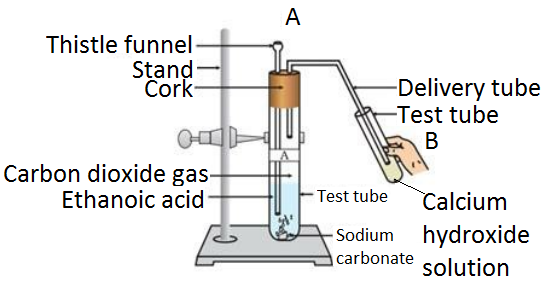
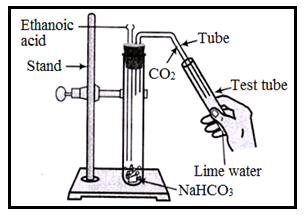
Look at Figure and answer the following questions:
  1. What change would you observe in the calcium hydroxide solution taken in tube B?
  2. Write the reaction involved in test tubes A and B respectively.
  3. If ethanol is given instead of ethanoic acid, would you expect the same change?
  4. How can a solution of lime water be prepared in the laboratory?
Answer
  1. Calcium hydroxide solution in the test tube B becomes milky.
  2. Reaction in test tube A:
$CH_3 COOH+NaHCO_3 \rightarrow CH_3 COONa+CO_2+H_2 O$
Reaction in test tube B :
$Ca(OH)_2+CO_2 \rightarrow CaCO_3+H_2 O$
  1. Ethanol does not react with sodium hydrogen carbonate. Hence, same change cannot be observed.
  2. For this, take distilled water in a beaker and mix calcium carbonate powder in it. After stirring thoroughly, wait till the mixture settles. Decant the clear liquid from the beaker. This liquid is lime water.
View full question & answer
Question 65 Marks
A compound C (molecular formula, $C _2 H _4 O _2$ ) reacts with Na-metal to form a compound R and evolves a gas which burns with a pop sound. Compound C on treatment with an alcohol A in presence of an acid forms a sweet smelling compound S (molecular formula, $C _3 H _6 O _2$ ). On addition of NaOH to C , it also gives R and water. S on treatment with NaOH solution gives back R and A.Identify $C , R , A , S$ and write down the reactions involved.
Answer
Compound C with molecular formula $C _2 H _4 O _2$ contains two oxygen atoms so it can be either ester or carboxylic acid. Since it reacts with sodium metal to form compound $R$ and evolves a gas which burns with pop sound, therefore it should be a carboxylic acid which forms sodium alkanoate and hydrogen gas with sodium metal.
$2 CH_3 COOH+2 Na \longrightarrow 2 CH_3 COONa+H_2 \uparrow$
The gas which burns with pop sound is hydrogen gas.
Reaction of ethanoic acid with alcohol in the presence of an acid (Conc. $H _2 SO _4$ ) forms sweet smelling ester. So compound S that is formed due to reaction of ethanoic acid and methanol $( A )$ is methyl ethanoate with molecular formula $C _3 H _6 O _2$ and structural formula $CH _3 COOCH _3$.
$CH_3 COOH+CH_3 OH \xrightarrow{\text { Conc. } H_2 So_4} CH_3 COOCH_3+H_2 O$
Hence compound $C =$ Ethanoic acid $\left( CH _3 COOH \right), R =$ Sodium ethanoate $\left( CH _3 COONa \right), A =$ Methanol $\left( CH _3 OH \right)$ and S $=$ Methyl merhanoate $\left( CH _3 COOCH _3\right)$
View full question & answer
Question 75 Marks
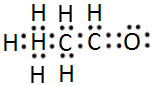
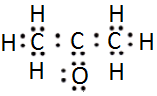
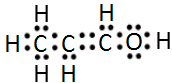
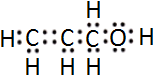
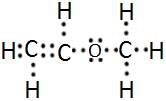
Draw the possible isomers of the compound with molecular formula $C _3 H _6 O$ and also give their electron dot structures.
Answer

Five isomers possible for the molecular formula $C_3H_6O$ are listed below.
Sr. No.
Name of isomer
(Structural formula)
Electron dot structure
1.
Propanal
$\left(CH_3 CH_2 CHO\right)$
2.
Propanone
$\left(CH_3 COCH_3\right)$
3.
Prop-1-ene-1-ol
$\left(CH_3 CH=CH-OH\right)$
4.
Prop-2-en-1-ol
$\left(CH_2=CHCH_2-OH\right)$
5.
Methoxyethene
$\left(CH_2=CH-OCH_3\right)$
View full question & answer
Question 85 Marks
An organic compound $A$ on heating with concentrated $H _2 SO _4$ forms a compound $B$ which on addition of one mole of hydrogen in presence of Ni forms a compound C . One mole of compound C on combustion forms two moles of $CO _2$ and 3 moles of $H _2 O$. Identify the compounds $A , B$ and C and write the chemical equations of the reactions involved.
Answer
Since one mole of compound C on combustion forms two moles of $CO _2$ and three moles of $H _2 O$ the compound C is a hydrocarbon with formula $C _2 H _6$. It is ethane. The compound B which forms $C _2 H _6$ upon addition of hydrogen is ethene $\left( C _2 H _4\right)$. The organic compound $A$ which forms ethene upon acidic dehydration is ethanol. The chemical chemical equations for the reactions involved are:$\text{C}_2\text{H}_5\text{OH}\xrightarrow[\ \ \ \text{heat}\ \ \ ]{\ \text{H}_2\text{SO}_4\ }\text{CH}_2=\text{CH}_2\xrightarrow[\ \ \text{heat}\ \ \ ]{\ \ \text{H}_2\text{Ni}\ \ }\text{CH}_3-\text{CH}_3\\\text{Ethanol (A)}\ \ \ \ \ \ \ \ \ \text{Ethene (B)}\ \ \ \ \ \ \ \ \ \ \ \ \ \ \ \text{Ethane (C)}$
$\text{C}_2\text{H}_6+3\text{O}_2\xrightarrow{\ \ \ \ (\text{Combustion})\ \ \ }2\text{CO}_2+3\text{H}_2\text{O}\\\ \ (\text{C)}$
View full question & answer
Question 95 Marks
How would you bring about the following conversions? Name the process and write the reaction involved.
  1. Ethanol to ethene.
  2. Propanol to propanoic acid. Write the reactions.
Answer
  1. From ethanol: This method involves the slow oxidation of a dilute solution of ethanol (10-15 per cent) by oxygen present in air in the presence of an enzyme acetobactor.
$\text{CH}_3\text{CH}_2\text{OH}+\text{O}_2\xrightarrow{\ \ \text{Acetobactor}\ \ }\text{CH}_3\text{COOH}+\text{H}_2\text{O}\\\ \ \ \ \text{Ethanol}\ \ \ \ \ (\text{Air})\ \ \ \ \ \ \ \ \ \ \ \ \ \ \ \ \ \ \ \text{Ethanoic acid}\\\ \ \ \ \ \ \ \ \ \ \ \ \ \ \ \ \ \ \ \ \ \ \ \ \ \ \ \ \ \ \ \ \ \ \ \ \ \ \ \ \ \ \ \ \ \ \ \ \ \ \ \ (\text{as vinegar})$

The acid obtained is in the form of dilute solution called vinegar.

We have also studied under ethanol that it gets oxidised to ethanoic acid in the presence of dilute solution of alkaline $KMnO _4$ or acidified $K _2 Cr _2 O _7$.
  1. From methanol: These days ethanoic acid is manufactured by the reaction between methanol and carbon monoxide in the presence of iodine-rhodium ($I_2$—Rh) catalyst mixture.
$\text{CH}_3\text{OH}+\text{CO}\xrightarrow{\ \ \text{I}_2-\text{Rh Catalyst}\ \ }\text{CH}_3\text{COOH}\\\ \ \text{Methanol}\ \ \ \ \ \ \ \ \ \ \ \ \ \ \ \ \ \ \ \ \ \ \ \ \ \ \ \ \ \ \text{Ethanoic acid}$​​​​​​​
View full question & answer
Question 105 Marks
A salt X is formed and a gas is evolved when ethanoic acid reacts with sodium hydrogencarbonate. Name the salt X and the gas evolved. Describe an activity and draw the diagram of the apparatus to prove that the evolved gas is the one which you have named. Also, write chemical equation of the reaction involved.
Answer
Ethanoic $\left( CH _3 COOH \right)$ acid reacts with sodium hydrogen carbonate $\left( NaHCO _3\right)$ to form sodium ethanoate $\left( CH _3 COONa ^{-}\right)$, water and carbon dioxide gas. Hence salt X is sodium ethanoate and the gas evolved is $CO _2$. The chemical equation of the reaction involved is:
$CH_3 COOH+NaHCO_3 \rightarrow CH_3 COONa+H_2 O+CO_2$
Activity for observing the gas evolved in above reaction:

Set up the apparatus and take sodium hydrogen carbonate in test tube. Add ethanoic acid to it and observe brisk effervescence of carbon dioxide $\left( CO _2\right)$ gas. Now pass this gas through freshly prepared lime water $\left( Ca ( OH )_2\right)$. It will turn milky due to the formation of insoluble calcium carbonate $\left( CaCO _3\right)$.
$\text{Ca(OH)}_2+\text{CO}_2\xrightarrow{\ \ \ }\text{CaCO}_3+\text{H}_2\text{O}\\\ \ \ \ \ \ \ \ \ \ \ \ \ \ \ \ \ \ \ \ \ \ \ \ \ \ \ \ \ \ \ \ \ \ \ (\text{Milky})$
View full question & answer
Question 115 Marks
A compound $X$ is formed by the reaction of a carboxylic acid $C _2 H _4 O _2$ and an alcohol in presence of a few drops of $H _2 SO _4$. The alcohol on oxidation with alkaline $KMnO _4$ followed by acidification gives the same carboxylic acid as used in this reaction. Give the names and structures of:
a. Carboxylic acid.
b. Alcohol.
c. The compound X. Also, write the reaction.
Answer
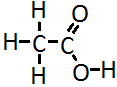
  1. Carboxylic acid with molecular formula $C _2 H _4 O _2$ is acetic acid or ethanoic acid having the structure as:

b. Given alcohol forms acetic acid on oxidation with alkaline $KMnO _4$ followed by acidification. Therefore, it must be ethanol with structure $CH _3- CH _2- OH$.
$CH _3 CH _2 OH \xrightarrow[\text { Acidification }]{\text { Alkaline } KMnO _4} CH _3 COOH$
c. Reaction of ethanoic acid with ethanol in presence of a few drops of conc. $H _2 SO _4$ is an esterification reaction that forms an ester, ethyl ethanoate $\left( CH _3 COOC _2 H _5\right)$.
$CH_3 COOH+C_2 H_5 OH \xrightarrow{\text { Conc. } H_2 SO_4} CH_3 COOC_2 H_5+H_2 O$
View full question & answer
Question 125 Marks
Esters are When ester treated with an alkali, the reaction gives ethanol and sodium ethanoate. This reaction is called saponification reaction because this reaction forms the basis of preparation of soap. This can be given by following equation.
Answer
Esters as pointed, are pleasant smelling compounds. These are therefore, commonly used as flavouring agents and also in perfumes. When an ester is reacted with water in the presence of a dilute acid like dilute HCl, acid and alcohol are formed as the product. The reaction is called ester hydrolysis.$\text{CH}_3\text{COOC}_2\text{H}_5(\text{aq})+\text{H}_2\text{O}(\text{l})\xrightarrow{\ \ \text{H}^+\ \ }\text{CH}_3\text{COOH}(\text{aq})+\text{C}_2\text{H}_5\text{OH(aq)}\\\ \ \ \text{Ethylethanoate}$
Ester hydrolysis is the reverse of esterification reaction.
When an ester is reacted with an aqueous solution of base like NaOH or KOH, the product is an alcohol and salt of the acid. For example,
$\text{CH}_3\text{COOC}_2\text{H}_5(\text{aq})+\text{NaOH}(\text{aq})\xrightarrow{\ \ \ \ }\text{CH}_3\text{COONa (aq)}+\text{C}_2\text{H}_5\text{OH}(\text{aq})\\ \ \ \text{Ethyl ethanoate}\ \ \ \ \ \ \ \ \ \ \ \ \ \ \ \ \ \ \ \ \ \ \ \ \ \ \ \ \ \ \ \text{Sod. ethanoate (salt.)}$
$\text{CH}_3\text{COOC}_2\text{H}_5(\text{aq})+\text{KOH}(\text{aq})\xrightarrow{\ \ \ \ \ \ }\text{CH}_3\text{COOK}(\text{aq})+\text{C}_2\text{H}_5\text{OH}(\text{aq})\\\ \ \ \ \ \ \ \text{Ethylethanoate}\ \ \ \ \ \ \ \ \ \ \ \ \ \ \ \ \ \ \ \ \ \ \ \ \ \ \ \text{Pot. ethanoate (salt)}$
The reaction is known as saponification reaction because it is the basis for the formation of soap.
View full question & answer
Question 135 Marks
Why detergents are better cleansing agents than soaps? Explain.
Answer

A substance capable of removing grease and dirt from any fabric or body is called detergent. The detergents are of two types Le. soapy and non-soapy detergents. The soapy detergents are soaps whereas the non-soapy detergents are synthetic detergents or simply detergents. Although both are cleansing agents, they differ in chemical composition. In the present chapter, we shall briefly discuss the composition and cleansing action of soaps and synthetic detergents.
Soaps are the sodium and potassium salts of long chain fatty acids with general formula RCOONa or RCOOK. The acids present have the formula RCOOH where R may have following values.
$C _{15} H _{31} COOH$
Palmitic acid
$\left(R=C_{15} H_{31}\right)$
$C_{17} H_{33} COOH$
Oleic acid
$\left(R=C_{17} H_{33}\right)$
$C_{17} H_{35} COOH$
$ Stearic acid$
$\left(R=C_{17} H_{35}\right)$
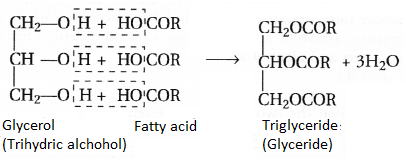
These fatty acids exist as triesters of glycerol which is a trihydric alcohol. The triesters are also called triglycerides or simply glycerides and are the constituents of edible oils and fats. These are of animal and vegetable origin e.g. castor oil, linseed oil or soyabean oil. Chemically the triglycerides are formed as a result of esterification reaction.
View full question & answer
[5 marks Questions] - Science STD 10 Questions - Vidyadip