Questions

5 Marks Questions

🎯

Test yourself on this topic

19 questions · timed · auto-graded

Question 15 Marks
What do you mean by ozone hole? What are its consequences?
Answer
  • Pathogens: Pathogens include bacteria and other microorganisms that enter water from domestic sewage and animal excreta.
    Human excreta contain bacteria such as Escherichia coli and Streptococcus faecalis , which cause gastrointestinal diseases.
  • Organic wastes: Organic wastes when added to water, as these are biodegradable, bacteria decomposes organic matter and consume dissolved oxygen in water. When the concentration of dissolved oxygen of water is below 6 ppm, the growth of fish gets inhibited. Breakdown of the organic wastes by anaerobic bacteria produces chemicals that have a foul smell and are harmful to human health.
  • Chemical pollutants: Some inorganic chemicals as an industrial wastes dissolve in water like cadmium, mercury nickel etc. These metals are dangerous to humans and other animals. These metals can damage kidneys and central nervous system, lever etc. Petroleum products pollute many sources of water.
View full question & answer
Question 25 Marks
Explain tropospheric pollution in 100 words.
Answer
Tropospheric pollution arises due to the presence of undesirable substances in the lowest layer of the atmosphere. Oxides of sulphur, nitrogen, carbon, and hydrocarbons are the major gaseous pollutants. Oxides of sulphur $\left(\mathrm{SO}_2\right.$ and $\left.\mathrm{SO}_3\right)$ and nitrogen $\left(\mathrm{NO}_2, \mathrm{NO}\right)$ are produced as a result of burning of fossil fuels (coal, automobile fuel). These oxides react with water in the presence of atmospheric oxygen to form nitric acid ( $\mathrm{HNO}_3$ ) and sulphuric acid $\left(\mathrm{H}_2 \mathrm{SO}_4\right)$, which leads to the formation of 'Acid rain'.
$2\text{SO}_{2(\text{g})}+\text{O}_{2(\text{g})}+2\text{H}_2\text{O}_{(\text{l})}\xrightarrow{\ \ \ \ \ \\ \ \ }2\text{H}_2\text{SO}_{4(\text{aq})}$
$4\text{NO}_{2(\text{g})}+\text{O}_{2(\text{g})}+2\text{H}_2\text{O}_{\text{(l)}}\xrightarrow{ \ \ \ \ \ \ \ \ \\ \\}4\text{HNO}_{3(\text{aq})}$
Acid rain causes harm to agriculture, plants, and trees. It also leads to various respiratory ailments.
Hydrocarbons are carbon and hydrogen containing compounds that burn to produce oxides of carbon. Hydrocarbons are carcinogenic and their products are also major pollutants. Carbon monoxide (CO) is poisonous in nature as it reacts with the haemoglobin of blood, which can even result in death. Though carbon dioxide ($\mathrm{CO}_2$) is not toxic in nature, yet it contributes towards global warming by trapping the reflected IR rays. This results in the heating up of the Earth’s atmosphere, thereby leading to the melting of icebergs and glaciers.
Particulates of smoke, dust, mist, and fume are harmful for human health as they are likely to block the nasal passage of a person, causing respiratory ailments. Smoke and fog combine to produce smog during a cool, humid day, thereby reducing visibility to a large extent. Photochemical smog is formed due to the presence of PAN, ozone, formaldehyde, and acrolein. It causes eye irritation, headaches, and chest pain. It also leads to the cracking of rubber and does damage to plants.
View full question & answer
Question 35 Marks
Write down the reactions involved during the formation of photochemical smog.
Answer
Photochemical smog is produced by action of sunlight on hydrocarbons and nitrogen oxides. NO is converted to $\mathrm{NO}_2$ by the effect of sunlight. This $\mathrm{NO}_2$ further absorbs sunlight and disintegrates into NO and $\mathrm{O}_2$. Thus, a chain reaction begins.
$\text{NO}_{\text{(g)}}+\frac{1}{2}\text{O}_{2(\text{g})}\xrightarrow{ \ \ \ \ \text{h}v \\ \ \ \ \\\ \ }\text{NO}_{2(\text{g})}$
$\text{NO}_2\xrightarrow{ \ \ \ \ \text{h}v \ \ \\ \ }\text{NO}_{(\text{g})}+\text{O}_{(\text{g})}$
These oxygen atoms react with $\mathrm{O}_2$ to form ozone as:
$\text{O}_{2(\text{g})}+\text{O}_{(\text{g})}\leftrightharpoons\text{O}_{3(\text{g})}$
$\text{O}_{3(\text{g})}+\text{NO}_{(\text{g})}\leftrightharpoons\text{}\text{NO}_{2(\text{g})}+\text{O}_{2(\text{g})}$
These two gases formed, react with hydrocarbons to produce other chemicals.
$3\text{CH}_4 + 2\text{O}_3 \xrightarrow{\ \ \ \ \ \ } 3\text{CH}_2 = \text{O} + 3\text{H}_2\text{O}\\\ \ \ \ \ \ \ \ \ \ \ \ \ \ \ \ \ \ \ \ \ \ \ \ \ \ \ \ \ \ \text{formaldehyde}$
Other chemicals produced are:
$\text{CH}_2 = \text{CH} - \text{CH} = \text{O}\\ \ \ \ \ \ \ \ \text{Acrolein} $
$\text{CH}_3 - \text{C} - \text{O} - \text{O} - \text{NO}_2\\ \ \ \ \ \ \ \ \ \ \ \ \ \ {||}\\ \ \ \ \ \ \ \ \ \ \ \ \ \text{O}\\\text{Peroxyacetyl nitrate (PAN)}$
View full question & answer
Question 45 Marks
What are the reactions involved for ozone layer depletion in the stratosphere?
Answer

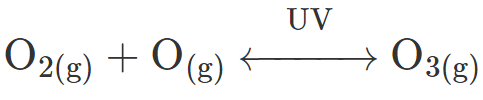
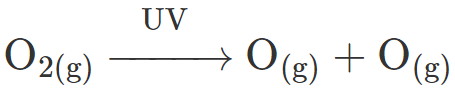
In the stratosphere, ozone is a product of the action of UV radiations on dioxygen as:
  1.  
  1.  

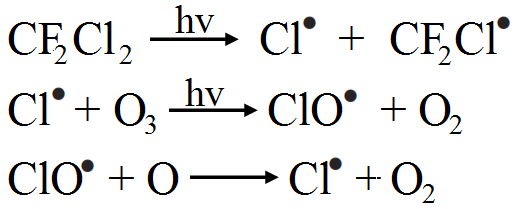
eaction (ii) indicates the dynamic equilibrium existing between the production and decomposition of ozone molecules. Any factor that disturbs the equilibrium may cause depletion of ozone layer by its decomposition. One such factor is the release of chlorofluorocarbon compounds (CFCs). These are non-reactive, non-flammable molecules that are used in refrigerators, air conditioners, plastics, and electronic industries. Once released CFCs mix with atmospheric gases and reach the stratosphere, where they are decomposed by UV radiations.
  1. $\text{CF}_2\text{Cl}_{2(\text{g})}\xrightarrow{ \ \ \ \text{UV} \ \ \ \ }\dot{\text{Cl}}_{(\text{g})}+\dot{\text{CF}}_2\text{Cl}_{\text{(g)}}$
The chlorine free radical produced in reaction (iii) reacts with ozone as:
  1. $\dot{\text{Cl}}_{(\text{g})}+\text{O}_{3(\text{g})}\xrightarrow{\ \ \\ \ \ \ \ \\ \ \ \\ \ \ \\ }\text{Cl}\dot{\text{O}}_{(\text{g})}+\text{O}_{2(\text{g})}$
The $\dot{\text{Cl}}_{(\text{g})}$ radicals further react with atomic oxygen to produce more chlorine radicals as:
  1. $\text{Cl}\dot{\text{O}}_{(\text{g})}+\text{O}_{(\text{g})}\xrightarrow{\ \ \\\ \\\ \ \ \ \ \ }\dot{\text{Cl}}_{(\text{g})}+\text{O}_{2(\text{g})}$
The regeneration of $\dot{\text{Cl}}_{(\text{g})}$ causes a continuous breakdown of ozone present in the stratosphere, damaging the ozone layer.
View full question & answer
Question 55 Marks
Do you observe any soil pollution in your neighbourhood? What efforts will you make for controlling the soil pollution?
Answer
Major sources of soil pollution are industrial wastes and agricultural pollutants such as pesticides, fertilizers, etc.
It is very important to maintain the quality and fertility of soil to ensure and sustain the growth of plants and food crops.
Insecticides like DDT are not soluble in water. For this reason, they remain in soil for a long time, contaminating the root crops. Pesticides like Aldrin and Dieldrin are non-biodegradable and highly toxic in nature. They can enter the higher trophic levels through food chains, causing metabolic and physiological disorders. The same is true for industrial wastes that comprises of several toxic metals like Pb, As, Hg, Cd, etc.
Hence, the best way to check soil pollution is to avoid direct addition of pollutants to the soil. Also, wastes should undergo proper treatment. They should be recycled and only then, allowed to be dumped.
View full question & answer
Question 65 Marks
Have you ever observed any water pollution in your area? What measures would you suggest to control it?
Answer
Water pollution arises as a result of various human activities. This includes discharges from wastewater treatment plants, run-off from agricultural fields, storm-water drainage, etc. Pollutants from these sources enter the water bodies, thereby contaminating the water and rendering it impure.
Industries and chemical factories discharge toxic, heavy metals such as Fe, Mn, Al, etc., along with organic wastes into water. Domestic sewage and animal excreta are also responsible for pathogenic contamination of water. These pollutants make water unfit for drinking.
Therefore, all industrial and chemical discharges should be made free from toxic metals before allowing them to enter a water body. The concentration of these pollutants should be checked regularly. Compost should be preferred over chemical fertilizers in gardens and agricultural fields to avoid harmful chemicals from entering ground water.
View full question & answer
Question 75 Marks
What are the harmful effects of photochemical smog and how can they be controlled?
Answer
EFFECTS OF PHOTOCHEMICAL SMOG:
Photochemical smog is oxidizing smog owing to the presence of $\mathrm{NO}_2$ and $\mathrm{O}_3$, causing corrosion of metals, stones, rubber, and painted surfaces. The other major components of photochemical smog are PAN, acrolein, and formaldehyde. Both PAN and ozone are eye irritants, while nitric oxide (formed from $\mathrm{NO}_2$ ) causes nose and throat irritation. At higher concentrations, photochemical smog causes chest pain, headaches, throat dryness, and various respiratory ailments.
CONTROL MEASURES:
Photochemical smog results from the burning of fossil fuels and automobile fuels that emit $\mathrm{NO}_2$ and hydrocarbons, which in turn form ozone, PAN, and other chemicals. The use of catalytic converters in automobiles is recommended to prevent the release of $\mathrm{NO}_2$ and hydrocarbons into the atmosphere.
Plantation of plants such as Pinus, Juniparur, Quercus, Pyrus, and Vitis is also advised as these plants have the capability to metabolize $\mathrm{NO}_2$.
View full question & answer
Question 85 Marks
Statues and monuments in India are affected by acid rain. How?
Answer
Acid rain is a byproduct of various human activities that leads to the emission of oxides of sulphur and nitrogen in the atmosphere. These oxides undergo oxidation and then react with water vapour to form acids.
$2\text{SO}_{2(\text{g})}+\text{O}_{2(\text{g})}+2\text{H}_2\text{O}_{(\text{l})}\xrightarrow{\ \ \ \ \ \ \ \ }2\text{H}_2\text{SO}_{4(\text{aq})}$
$4\text{NO}_{2(\text{g})}+\text{O}_{2(\text{g})}+2\text{H}_2\text{O}_{(\text{l})}\xrightarrow{\ \ \ \ \ \ \ \ }4\text{H}\text{NO}_{3(\text{aq})}$
Acid rain causes damage to buildings and structures made of stone and metal. In India, limestone is a major stone used in the construction of various monuments and statues, including the Taj Mahal.
Acid rain reacts with limestone as:
$\text{CaCO}_3+\text{H}_2\text{SO}_4\xrightarrow{\ \ \ \\ \ \ \ \ \ }\text{CaSO}_4+\text{H}_2\text{O}+\text{CO}_2$
This results in the loss of lustre and colour of monuments, leading to their disfiguration.
View full question & answer
Question 95 Marks
List gases which are responsible for greenhouse effect.
Answer
Gases responsible for greenhouse effect are:
$\mathrm{CO}_2, \mathrm{CH}_4, \mathrm{~N}_2 \mathrm{O}, \mathrm{H}_2 \mathrm{O}_{(\mathrm{g})}, \mathrm{CFCs}$ and $\mathrm{O}_3$. Carbon dioxide molecules trap heat as they are transparent to sunlight but not to the heat radiations. Carbon dioxide is, thus, the major contributor to global warming. Methane is produced naturally when vegetation is burnt, digested or rotted in the absence of oxygen. Large amounts of methane are released in paddy fields, coal mines from rotting garbage dumps and fossil fuels.
Chlorofluorocarbons (CFCs) are man-made industrial chemicals used in air conditioning, etc. CFCs are also damaging the ozone layer. These gases together are responsible for greenhouse effect.
View full question & answer
Question 105 Marks
What are the major causes of water pollution? Explain.
Answer
  1. The depletion of ozone layer is termed as ozone hole. It was first reported by a group of scientists working in Antarctica in 1980s.
  2. Ozone layer is responsible for prevention of infiltration of UV rays which has the potential to cause serious damage to plants, animals and human life. Due to depletion of this $\mathrm{O}_3$ layer, these harmful rays will find an easy route into the earth’s atmosphere and create problems such as mutation of cells leading to cancer of the skin or increased transpiration in plants and reduced water level in soil. Increase in UV radiations damages paints and fibers causing them to fade faster.
View full question & answer
Question 115 Marks
What is smog? How is classical smog different from photochemical smogs?
Answer
Smog is a kind of air pollution. It is the blend of smoke and fog. There are two kinds of smog:
  1. Classical smog.
  2. Photochemical smog.
The two smogs can be differentiated as follows:
  Classical smog Photochemical smog
Occurrence It occurs in a cool, humid climate. It occurs in a dry, sunny climate.
Components Smoke, fog, and sulphurdioxide. PAN, acrolein, ozone, formaldehyde, nitric oxide.
Nature It is reducing in nature. It is oxidizing in nature.
View full question & answer
Question 125 Marks
What are biodegradable and non-biodegradable pollutants?
Answer
Biodegradable pollutants:
Those pollutants which can be broken down into simpler, harmless, substances in nature in due course of time (by the action of micro-organisms like certain bacteria) are called biodegradable pollutants. Domestic wastes (garbage), urine, faecal matter, sewage, agriculture residues, paper, wood, cloth, cattle dung, animal bones, leather, wool, vegetable stuff or plants are biodegradable pollutants.
Non-biodegradable pollutants:
Those pollutants which cannot be broken down into simpler, harmless substances in nature are called non-biodegradable pollutants. DDT, plastics, polythene, bags, insecticides, pesticides, mercury, lead, and arsenic, metal articles like aluminum cans, synthetic fibres, glass objects, iron products and silver foils are non-biodegradable pollutants.
View full question & answer
Question 135 Marks
On the basis of chemical reactions involved, explain how do chlorofluorocarbons cause thinning of ozone layer in stratosphere.
Answer
Chlorofluorocarbons are stable compounds. They move to stratosphere by random diffusion. These undergo decomposition in the presence of sunlight to release Cl atoms. These Cl atoms cause catalytic chemical reactions and cause significant depletion of ozone layer as shown below:
Since the free radicals use ozone and convert it to oxygen, they cause thinning of ozone layer in stratosphere.
View full question & answer
Question 145 Marks
Ozone is a toxic gas and is a strong oxidising agent even then its presence in the stratosphere is very important. Explain what would happen if ozone from this region is completely removed?
Answer
Atmosphere is divided into certain levels like atmpsphere, troposphere, stratosphere, exosphere. The stratosphere consists of considerable amount of ozone ($\mathrm{O}_3$), Which protects us from the harmful ultravoilet (UV) radiations $(\lambda \ 255\text{nm})$ coming from the sun. These raditions cause skin cancer (melanoma) in humans. Therefore, it is important to maintain the ozone shield. The main reason of ozone layer depletion is believed to be the release of chloroflurocarbon compounds (CFCs), also known as Freon. UV raditions is alos one of the cause of cataract formation in eyes. It can cause genetic mutation and destroy crops, aquatic plants and animals are also affected by UV raditins.
View full question & answer
Question 155 Marks
Green plants use carbon dioxide for photosynthesis and return oxygen to the atmosphere, even then carbon dioxide is considered to be responsible for green house effect. Explain why?
Answer
Carbon dioxide gas is confined to troposphere only. Normally it forms about 0.003 percent by volume of the atmosphere. With the increased use of fossil fuels, a large amount of carbon dioxide gets released into the atmosphere. Excess of $\mathrm{CO}_2$ in the air is removed by green plants and this maintains an appropritae level of $\mathrm{CO}_2$ in the atmosphere. Green plants require $\mathrm{CO}_2$ for photosynthesis and they, in turn, emit oxygen, thus maintaining the delicate balance. As you know, deforestation and burning of fossil fuel increases the $\mathrm{CO}_2$ level and disturb the balance in the atmosphere. The increased amount of $\mathrm{CO}_2$ in the air is mainly responsible for global warming.
View full question & answer
Question 165 Marks
What is the significance of the terms — ‘isolated gaseous atom’ and ‘ground state’
while defining the ionization enthalpy and electron gain enthalpy?
Hint : Requirements for comparison purposes.
Answer
Significance of term ‘isolated gaseous atom’. The atoms in the gaseous state are far separated in the sense that they do not have any mutual attractive and repulsive interactions. These are therefore regarded as isolated atoms. In this state the value of ionization enthalpy and electron gain enthalpy are not influenced by the presence of the other atoms. It is not possible to express these when the atoms are in the ; liquid or solid state due to the presence of inter atomic forces.
Significance of ground state. Ground state of the atom represents the normal – energy state of an atom. It means electrons in a particular atom are in the lowest energy state and they neither lose nor gain electron. Both ionisation enthalpy and I electron gain enthalpy are generally expressed with respect to the ground state ofan atom only.
View full question & answer
Question 175 Marks
Some time ago formation of polar stratospheric clouds was reported over Antarctica. Why were these formed? What happens when such clouds break up by warmth of sunlight?
Answer
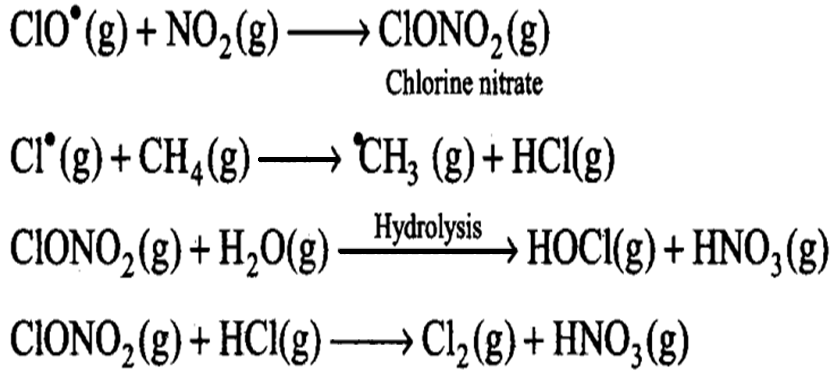
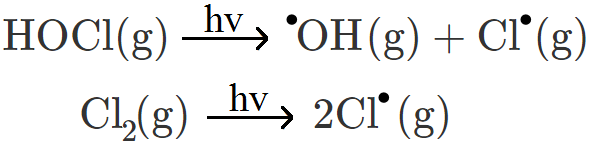
In summer season, nitrogen dioxide and methane react with chlorine monoxide and chlorine atoms forming chlorine sinks, preventing much ozone depletion, whereas in winter, special type of clouds called polar stratospheric clouds are formed over Antarctica. These polar stratospheric clouds provide surface on which chlorine nitrate gets hydrolysed to form hypochlorous acid. It also reacts with hydrogen chloride to give molecular chlorine.

When sunlight returns to the Antarctica in spring, the sun's warmth breaks up the clouds and $\mathrm{HOCl}, \mathrm{Cl}_2$ are photolysed by sunlight.

The chlorine radicals thus formed initiate the chain reaction for ozone depletion.
View full question & answer
Question 185 Marks
Account for the following:
i. Ozone layer is necessary for life.
ii. The temperature of thermosphere is $1500^{\circ} \mathrm{C}$ but a person would not feel warm in it.
iii. Increased $\mathrm{SO}_2$ concentration causes chlorosis.
iv. $\mathrm{CO}_2$ keeps the earth warm.
v. The pH of normal rain water is 5.6 .
Answer
i. Ozone absorbs about $99 \%$ of harmful UV radiations coming from the sun and thus protects human beings from adverse effect of UV radiations. Thus, its presence is necessary for life.
ii. This is because the pressure in the thermosphere is Every low.
iii. Because increased $\mathrm{SO}_2$ concentration retards the rate of formation of chloroplast.
iv. $\mathrm{CO}_2$ have tendency to absorb most of the heat radiation that are emitted by objects of the earth. Thus, it keeps the earth warm.
v. This is because of the dissolution of $\mathrm{CO}_2$ from atmosphere which furnish $\mathrm{H}^{+}$ions to the rain water.

$\text{H}_2\text{O(l)}+\text{CO}_2\text{(g)}\rightleftharpoons\text{H}_2\text{CO}_3(\text{aq})$

$\text{H}_2\text{CO}_3(\text{aq})\rightleftharpoons\text{H}^+(\text{aq})+\text{HCO}^-_3(\text{aq})$
View full question & answer
Question 195 Marks
Explain how does green house effect cause global warming.
Answer
Green chemistry is a way of thinking and is about utilizing the existing knowledge and principles of chemistry and ohter sciences to reduce the adverse impact on environment. Green chemistry is a production process that would bring about minimum pollution or deterioration to the environment.
The byproducts generated during a process, if not used gainfully, add to the environmental pollution. Such processes are not only environmental unfriendly but also cost-ineffective. The waste generation and its disposal both are economically unsound.
Utilization of existing knowledge base for reducing the chemical hazards along with the development activities is the foundation of green chemistry.
View full question & answer