Questions · Page 1 of 4

M.C.Q (1 Marks)

🎯

Test yourself on this topic

50 questions · timed · auto-graded

MCQ 11 Mark
$\Delta_\text{f}\text{U}^\ominus$ of formation of $\text{CH}_4\ (\text{g})$ at certain temperature is $-393\ \text{kJ}\ \text{mol}^{-1}.$ The value of $\Delta_\text{f}\text{H}^\ominus$ is:
  • A
    Zero
  • $<\Delta_\text{f}\text{U}^\ominus$
  • C
    $>\Delta_\text{f}\text{U}^\ominus$
  • D
    Equal to $\Delta_\text{f}\text{U}^\ominus$
Answer
Correct option: B.
$<\Delta_\text{f}\text{U}^\ominus$
$\Delta_\text{f}\text{H}^\ominus=\Delta_\text{f}\text{U}^\ominus+\Delta\text{n}_\text{g}\text{RT}$
For the reaction,
$\text{C}(\text{s})+2\text{H}_2(\text{g})\rightarrow\text{CH}_4$
$\therefore\ \Delta\text{n}_\text{g}=1-2=-1$
$\therefore\ \Delta_\text{f}\text{H}^\ominus= \Delta_\text{f}\text{U}^\ominus-1\text{RT}$
or$\ \Delta_\text{f}\text{U}^\ominus=\Delta_\text{f}\text{H}^\ominus+\text{RT}$
or$\ \Delta_\text{f}\text{H}^\ominus<\Delta_\text{f}\text{U}^\ominus$
View full question & answer
MCQ 21 Mark
Which of the following can be calculated from Born $-$ Haber cycle for $\mathrm{Al}_2 \mathrm{O}_3?$
  • A
    Lattice energy of $\mathrm{Al}_2 \mathrm{O}_3$​
  • B
    Electron affinity of $O-$ atom
  • C
    Ionisation energy of $\ce{Al}$
  • All of these
Answer
Correct option: D.
All of these
The Born $-$ Haber Cycle can be applied to determine the lattice energy of an ionic solid; ionization energy, electron affinity, dissociation energy, sublimation energy, heat of formation, and Hess's Law.
View full question & answer
MCQ 31 Mark
The internal energy of a piece of lead when beaten by a hammer will :
  • Increase
  • B
    Decrease
  • C
    Remain constant
  • D
    Sometimes increases and sometimes decreases
Answer
Correct option: A.
Increase
When beaten by a hammer the material heats up due to the impact.
As the work done by this heat is zero there is a net increase in internal energy.
View full question & answer
MCQ 41 Mark
A liquid boils at such a temperature at which the saturated vapour pressure, as compared to atmospheric pressure, is :
  • A
    One $-$ third
  • Equal
  • C
    Half
  • D
    Double
Answer
Correct option: B.
Equal
The vapor pressure at which a liquid boils is equal to the atmospheric pressure.
View full question & answer
MCQ 51 Mark
Which of the following is not a thermodynamic coordinate?
  • Gas constant $(R)$
  • B
    Pressure $(P)$
  • C
    Volume $(V)$
  • D
    Temperature $(T)$
Answer
Correct option: A.
Gas constant $(R)$
$R$ is a constant and is not a thermodynamic constant.
View full question & answer
MCQ 61 Mark
The mathematical expression of first law of thermodynamics is :
  • A
    $\Delta\text{U}=\text{q}$
  • B
    $\Delta\text{U}=\text{W}$
  • $\Delta\text{U}=\text{q}+\text{W}$
  • D
    $\Delta\text{U}=\text{W}_\text{ad}$
Answer
Correct option: C.
$\Delta\text{U}=\text{q}+\text{W}$
View full question & answer
MCQ 71 Mark
For an ideal solution containing two liquid components $A$ and $B,$ the Gibbs free energy of mixing is minimum, when the molar ratio of the liquids is :
  • $1 : 1$
  • B
    $1 : 2$
  • C
    $1 :10$
  • D
    $1 : 1000$
Answer
Correct option: A.
$1 : 1$
View full question & answer
MCQ 81 Mark
For the process to occur under adiabatic conditions, the correct condition is :
  • A
    $\Delta\text{T}=0$
  • B
    $\Delta\text{p}=0$
  • $\text{q}=0$
  • D
    $\text{w}=0$
Answer
Correct option: C.
$\text{q}=0$
View full question & answer
MCQ 91 Mark
Which specific process has negative value of specific heat?
  • Saturated vapours
  • B
    Ice
  • C
    Water
  • D
    Vapours
Answer
Correct option: A.
Saturated vapours
In case of saturated vapors, when a certain quantity of heat is removed, the temperature increases.
Hence, the specific heat is negative for saturated vapors.
View full question & answer
MCQ 101 Mark
In a thermodynamic system working subtance is ideal gas, its internal energy is in the from of :
  • Kinetic energy only
  • B
    Kinetic and potential energy
  • C
    Potential energy
  • D
    None of these
Answer
Correct option: A.
Kinetic energy only
Internal energy is associated with the atoms or molecules of the gas.
In an ideal gas the energy is in the form of Kinetic energy only.
View full question & answer
MCQ 111 Mark
For both reversible and irreversible expansion of an ideal gas, under isothermal condition,
  • $\Delta\text{U}=0,\Delta\text{S}_\text{total}\neq0$
  • B
    $\Delta\text{U}\neq0,\Delta\text{S}_\text{total}=0$
  • C
    $\Delta\text{U}=0,\Delta\text{S}_\text{total}\neq0$
  • D
    $\Delta\text{U}\neq0,\Delta\text{S}_\text{total}\neq0$
Answer
Correct option: A.
$\Delta\text{U}=0,\Delta\text{S}_\text{total}\neq0$
View full question & answer
MCQ 121 Mark
Which of the following endothermic processes are spontaneous?
  • A
    Melting of ice
  • B
    Evaporation of water
  • C
    Heat of combustion
  • Both $(a)$ and $(b)$
Answer
Correct option: D.
Both $(a)$ and $(b)$
The reaction of baking soda with other acids, like hydrochloric acid, is also endothermic.
Melting of ice and Evaporation of water is show endothermic process.
View full question & answer
MCQ 131 Mark
The internal energy of a perfect gas depends on :
  • A
    Pressure
  • Temperature
  • C
    Volume
  • D
    Specific heat
Answer
Correct option: B.
Temperature
According to the assumptions of Kinetic Theory of Gases, the molecules do not occupy any volume and attractive forces are absent between molecules of an ideal gas.
Thus, other parameters such as volume, pressure etc do not play a significant role in the internal energy of an ideal gas and is a function of temperature only.
For an ideal gas, $\ce{U = U(T)}$
where, $U$ is the internal energy of the ideal gas.
$T$ is the temperature of the ideal gas.
View full question & answer
MCQ 141 Mark
The internal energy of a compressed real gas, as compared to that of the normal gas at the same temperature, is :
  • Less
  • B
    More
  • C
    Sometimes less, sometimes more
  • D
    None of these
Answer
Correct option: A.
Less
The internal energy wil be less due to the short range repulsive forces present between the molecules of the real gas.
View full question & answer
MCQ 151 Mark
What will be the value of logarithm of equilibrium constant $\ce{K_P}$ if the standard free energy change of a reaction is $\Delta\text{G}^\circ=-115\text{kJ}$ at $298K$ will be :
  • A
    $2.303$
  • B
    $13.83$
  • C
    $2.015$
  • $20.15$
Answer
Correct option: D.
$20.15$
$\Delta\text{G}^\circ=-115\times10^3\text{J}$
$\text{T}=298\text{K, R}=8.314\text{JK}^{-1}\text{mol}^{-1}$
$-\Delta\text{G}^\circ=2.303\text{RT}\log_{10}\text{K}_\text{p}$
$-(-115\times10^3)=2.303\times8.314$
$\times298\log_{10}\text{K}_\text{p}$
$\log_{10}\text{K}_\text{p}=\frac{115000}{2.303\times8.314\times298}=20.15$
View full question & answer
MCQ 161 Mark
The standard enthalpies of formation of $\mathrm{CO}_2(\mathrm{~g}), \mathrm{H}_2 \mathrm{O}(\mathrm{l}) , (l)$ and glucose $(s)$ at $25^\circ C$ are $-400\text{ kJ/ mol}, -300\text{ kJ/ mol}$ and $-1300\text{ kJ/ mol}^{-1}$ respectively. The standard enthalpy of combustion per gram of glucose of $25^\circ C$ is:
  • A
    $+\ 2900kJ$
  • B
    $-\ 2900kJ$
  • $-\ 16.11kJ$
  • D
    $+\ 16.15kJ$
Answer
Correct option: C.
$-\ 16.11kJ$
$\text{C}_6\text{H}_{12}\text{O}_6(\text{s})+6\text{O}_2(\text{g})\overrightarrow{\ \ \ \ \ \ \ }\ 6\text{CO}_2(\text{g})+6\text{H}_2\text{O(l)}$
$[$Molar mass of$\mathrm{C}_6 \mathrm{H}_{12} \mathrm{O}_6=180 \mathrm{~g} \mathrm{~mol}^{-1}]$
$\Delta\text{H}=6\Delta\text{HgCO}_2+6\Delta\text{HgH}_2\text{O}-\Delta\text{HgC}_6\text{H}_{12}\text{O}_6$
$=6\times(-400)+6\times(-300)-(-1300\text{kJ})$
$\Delta\text{H}=-2400-1800+1300$
$=-4200+1300=-2900\text{kJ/ 180}$
$=-16.11\text{kJ/ g}$
View full question & answer
MCQ 171 Mark
The heat measured for a reaction in bomb calorimeter is :
  • A
    $\triangle G$
  • B
    $\triangle H$
  • $\triangle U$
  • D
    $P\triangle V$
Answer
Correct option: C.
$\triangle U$
A bomb calorimeter is a type of constant $-$ volume calorimeter used in measuring the heat of combustion of a particular reaction.
Hence, the heat measured for a reaction in bomb calorimeter is $\triangle U.$
View full question & answer
MCQ 181 Mark
The internal energy of a perfect gas is :
  • Completely kinetic
  • B
    Completely potential
  • C
    Sum of potential and kinetic energy of the molecules
  • D
    Difference of kinetic and potential energy of the molecules
Answer
Correct option: A.
Completely kinetic
In a perfect gas or an ideal gas, the atoms of molecules collide in a perfectly elastic manner. That is the intermolecular attractive forces are absent and thus the internal energy is completely kinetic.
View full question & answer
MCQ 191 Mark
Which of the following statements is not correct?
  • A
    For a spontaneous process, $\triangle G$ must be negative.
  • B
    Enthalpy, entropy, free energy etc. are state variables.
  • A spontaneous process is reversible in nature.
  • D
    Total of all possible kinds of energy of a system is called its internal energy.
Answer
Correct option: C.
A spontaneous process is reversible in nature.
Spontaneous processes are irreversible because they can be reversed only by taking a different path to get back to their original state. A reversible process can take the same path to return to its original state. An irreversible process must take a different path to get back to its original state.
View full question & answer
MCQ 201 Mark
The reaction $\ce{2A(g)\rightarrow A2​(g)},$ will be spontaneous :
  • A
    At high temperature
  • At low temperature
  • C
    At all temperature
  • D
    Never at any temperature
Answer
Correct option: B.
At low temperature
View full question & answer
MCQ 211 Mark
Internal energy does not include :
  • A
    Vibrational energy
  • B
    Rotational energy
  • Energy arising by gravitational pull
  • D
    Nuclear energy
Answer
Correct option: C.
Energy arising by gravitational pull
Energy arising by gravitational pull is not included in internal energy. Its external energy.
View full question & answer
MCQ 221 Mark
Maximum entropy will be in which of the following?
  • A
    Ice.
  • B
    Liquid water.
  • C
    Snow.
  • Water vapour.
Answer
Correct option: D.
Water vapour.
View full question & answer
MCQ 231 Mark
The sign of $\Delta\text{G}$ for a spontaneous and non $-$ spontaneous process respectively are :
  • A
    Positive and negative.
  • Negative and positive.
  • C
    Zero and positive.
  • D
    Positive and zero.
Answer
Correct option: B.
Negative and positive.
gives a criteria for spontaneity at constant pressure and temperature.
  1. If $\Delta\text{G}$ is negative $(< 0),$ the process is spontaneous.
  2. If $\Delta\text{G}$ is positive $(> 0),$ the process is non$-$spontaneous.
View full question & answer
MCQ 241 Mark
No work is done on the system, but $q$ amount of heat is taken out from the system and given to the surrounding. The change in internal energy of a system is :
  • $\Delta\text{U}=-\text{q}$
  • B
    $\Delta\text{U}=+\text{q}$
  • C
    $\Delta\text{U}=\text{W}_\text{ad}$
  • D
    $\Delta\text{U}=\text{q}-\text{W}$
Answer
Correct option: A.
$\Delta\text{U}=-\text{q}$
View full question & answer
MCQ 251 Mark
Which one of the following reaction has $\Delta\text{S}^\circ$ greater than zero?
  • A
    $\text{CaO}+\text{CO}_2(\text{g})\rightleftharpoons \text{CaCO}_3(\text{s})$
  • B
    $\text{NaCl(aq)}\rightleftharpoons \text{NaCl(s)}$
  • $\text{NaNO}_3(\text{s})\rightleftharpoons \text{Na}^+(\text{aq})+\text{NO}_3^-(\text{sq})$
  • D
    $\text{N}_2(\text{g})+3\text{H}_2(\text{g})\rightleftharpoons 2\text{NH}_3(\text{g})$
Answer
Correct option: C.
$\text{NaNO}_3(\text{s})\rightleftharpoons \text{Na}^+(\text{aq})+\text{NO}_3^-(\text{sq})$
Reaction has $\Delta\text{S}^\circ > 0.$ This is because, in this reaction the compound breaks up into its respective ions resulting in increase in randomness and thus entropy.
View full question & answer
MCQ 261 Mark
Thermodynamics is the branch of science concerned with $ ........ $ and $ ......... $ and their relation to energy and work :
  • Heat, temperature
  • B
    Tmperature, pressure
  • C
    Heat, volume
  • D
    Volume, pressure
Answer
Correct option: A.
Heat, temperature
Thermodynamics is the branch of physics concerned with heat and temperature and their relation to energy and work.
In thermodynamics, we study about the concepts of heat, temperature and relation between heat energy and mechanical energy.
View full question & answer
MCQ 271 Mark
What is the characteristic of a material which undergo spontaneous combustion?
  • A
    High calorific value
  • B
    High vapour pressure
  • Low ignition temperature
  • D
    All of the above
Answer
Correct option: C.
Low ignition temperature
pontaneous combustion is a byproduct of spontaneous heating, which occurs when a material increases in temperature without drawing heat from its surroundings. Such materials have a low ignition temperature. If the material reaches its ignition temperature, spontaneous ignition or combustion occurs.
Examples of materials that are prone to spontaneous combustion include oily rags, hay, and other agricultural products.
View full question & answer
MCQ 281 Mark
According to Hess's law, the heat of reaction depends upon :
  • A
    Initial condition of reactants
  • Initial and final conditions of reactants
  • C
    Intermediate path of the reaction
  • D
    End conditions of reactants
Answer
Correct option: B.
Initial and final conditions of reactants
According to Hess's law, the heat of reaction depends upon Initial and final conditions of reactants. The the heat of reaction is independant of the intermediate path of the reaction.
For example, the heat of the reaction for the reaction $\ce{A \rightarrow D}$ is equal to the sum of the heats of the reactions $\ce{A \rightarrow B, B \rightarrow C, C \rightarrow D}.$
View full question & answer
MCQ 291 Mark
Which of the following is most likely to produce a spontaneous reaction?
  • A
    Negative Enthalpy
  • B
    Negative Entropy
  • C
    Positive Entropy
  • Negative Enthalpy and positive Entropy
Answer
Correct option: D.
Negative Enthalpy and positive Entropy
Explanation: (D) Negative Enthalpy and positive Entropy
For the spontaneous reaction, the negative enthalpy and positive entropy is most likely.
As for spontaneous reaction the value of ΔG must be negative.
Hence, as per formula, ΔG = ΔH − TΔS, So, if ΔH and ΔS are negative and positive respectively then the value of the ΔG must be negative whatever the temperature.
View full question & answer
MCQ 301 Mark
When we take acetone in a test tube it feels cold. Which reaction occurs in the process?
  • Endothermic reaction
  • B
    Exothermic reaction
  • C
    Reversible process
  • D
    Adiabatic process
Answer
Correct option: A.
Endothermic reaction
Acetone is a very volatile solvent, it evaporates quickly.
The heat is absorbed from the surface.
This process is called a endothermic reaction.
View full question & answer
MCQ 311 Mark
Based on knowledge of solid compounds and bond strengths, which of the following reactions is considered non $-$ spontaneous due to the extremely high activation energy but once started becomes extremely spontaneous?
  • Dissolution of sodium hydroxide.
  • B
    Creating a dilution of hydrochloric acid.
  • C
    The burning of $\mathrm{C}_{20} \mathrm{H}_{42}$​.
  • D
    The synthesis of silver oxide.
Answer
Correct option: A.
Dissolution of sodium hydroxide.
Dissolution of $\ce{NaOH}$ required high activation energy but once started becomes extremely spontaneous.
View full question & answer
MCQ 321 Mark
The total heat content of a system is :
  • A
    Entropy
  • B
    Free energy
  • Enthalpy
  • D
    Kinetic energy
Answer
Correct option: C.
Enthalpy
Enthalpy $(H)$ is the sum of the internal energy $(U)$ and the product of pressure and volume $\ce{(PV)}$ given by the equation : $\text{H = U + PV}.$
View full question & answer
MCQ 331 Mark
Which of the following, is correct when decrease in entropy has been taken place?
  • A
    Temperature of a crystalline solid is raised from $0K$ to $115K.$
  • A liquid crystallises into a solid.
  • C
    $2\text{NaHCO}_3(\text{s})\xrightarrow{\Delta}\text{Na}_2\text{CO}_3(\text{s})+\text{CO}_2(\text{g})+\text{H}_2\text{O(g)}$
  • D
    $\ce{H_2(g) \rightarrow 2H(g)}$
Answer
Correct option: B.
A liquid crystallises into a solid.
View full question & answer
MCQ 341 Mark
For the process, $\ce{H_2O(l) \rightarrow H_2O(g) }$ at $T = 100^\circ C$ and $1$ atm, the correct choice is :
  • A
    $\Delta\text{S}_\text{System} > 0$ and $\Delta\text{S}_\text{Surr} < 0$
  • $\Delta\text{S}_\text{System} > 0,\ \Delta\text{S}_\text{Surr} > 0$
  • C
    $\Delta\text{S}_\text{System} < 0$  and $\Delta\text{S}_\text{Surr} > 0$
  • D
    $\Delta\text{S}_\text{System} < 0,\ \Delta\text{S}_\text{Surr} < 0$
Answer
Correct option: B.
$\Delta\text{S}_\text{System} > 0,\ \Delta\text{S}_\text{Surr} > 0$
Entropy of system is increasing and of surroundings decreasing.
View full question & answer
MCQ 351 Mark
The laws of thermodynamics speak about :
  • A
    Rates of chemical changes
  • Feasibility and energy transformations of a Process
  • C
    Both the rate and energy changes of a process
  • D
    Energy changes in chemical reactions only
Answer
Correct option: B.
Feasibility and energy transformations of a Process
Thermodynamics laws are about energy transformation of a process and feasibility of a process.
View full question & answer
MCQ 361 Mark
Hess's law is applicable for the determination of heat of :
  • A
    Reaction
  • B
    Transition
  • C
    Formation
  • All of the above
Answer
Correct option: D.
All of the above
Hess's law of constant heat summation deals with the enthalpy change for a chemical reaction. The chemical reaction can involve any chemical change. It may include formation or transition.
View full question & answer
MCQ 371 Mark
Enthalpy of sublimation of a substance is equal to :
  • Enthalpy of fusion $+$ enthalpy of vaporisation.
  • B
    Enthalpy of fusion.
  • C
    Enthalpy of vaporisation.
  • D
    Twice the enthalpy of vaporization.
Answer
Correct option: A.
Enthalpy of fusion $+$ enthalpy of vaporisation.
View full question & answer
MCQ 381 Mark
Thermodynamics is not concerned about $ .........$
  • A
    Energy changes involved in a chemical reaction.
  • B
    The extent to which a chemical reaction proceeds.
  • The rate at which a reaction proceeds.
  • D
    The feasibility of a chemical reaction.
Answer
Correct option: C.
The rate at which a reaction proceeds.
Thermodynamics is not concerned with rate at which a reaction proceeds. The rate of reaction is dealt by kinetics.
View full question & answer
MCQ 391 Mark
You are given a lump of an unknown metal. You perform an experiment and figure out the specific heat is close to 0.89 J/g oC. What could be the identity of the metal?
  • A
    Gold
  • B
    Silver
  • C
    Aluminum
  • None of the above
Answer
Correct option: D.
None of the above
Explanation:  (D) None of the above
Specific heat of aluminium is close to $0.89J/ g^\circ$C.
View full question & answer
MCQ 401 Mark
At the boiling point of water the saturated vapour pressure will be $($in $mm$ of $\ce{Hg}) :$
  • A
    $750$
  • $760$
  • C
    $850$
  • D
    $860$
Answer
Correct option: B.
$760$
The boiling point of water is defined as the temperature at which the partial pressures of the water and steam are equal and thus equal to $760\ mm$ of $\ce{Hg}.$
View full question & answer
MCQ 411 Mark
A quantity that cannot be directly measured is :
  • A
    Heat of formation of $\ce{H_2​O(l)}$
  • Heat of formation of $\ce{CH_4​(g)}$
  • C
    Latent heat of fusion of ice
  • D
    Heat of combustion of ethyl alcohol
Answer
Correct option: B.
Heat of formation of $\ce{CH_4​(g)}$
View full question & answer
MCQ 421 Mark
If there were no atmosphere, the average temperature on earth surface would be :
  • lower
  • B
    higher
  • C
    same
  • D
    $0^\circ C$
Answer
Correct option: A.
lower
Without atmosphere, earth will turn into a ball of ice.
It’s temperature will decrease due to absence of green house gases which trap the sun’s heat and keep the planet warm.
View full question & answer
MCQ 431 Mark
Calculate the difference between $\ce{C_P}$ and $\ce{C_V}$ for $10$ moles of an ideal gas.
  • $83.14J$
  • B
    $8.314J$
  • C
    $831.4J$
  • D
    $0.831J$
Answer
Correct option: A.
$83.14J$
View full question & answer
MCQ 441 Mark
In a cyclic process, the change in the internal energy of a system over one complete cycle :
  • A
    depends on the path
  • B
    is always negative
  • is always zero
  • D
    is always positive
Answer
Correct option: C.
is always zero
In cyclic process, the change in internal energy of a system over one complete cycle is always zero.
View full question & answer
MCQ 451 Mark
Which of the following parameters does not charaterize the thermodynamic state of matter?
  • A
    temperature
  • B
    pressure
  • work
  • D
    volume
Answer
Correct option: C.
work
From the above options Work depends on the shift from one state to another.
View full question & answer
MCQ 461 Mark
Which of the following expression is correct for a reversible process in a state of equilibrium?
  • A
    $\Delta\text{G}=-2.30\text{RT}\log\text{K}$
  • B
    $\Delta\text{G}=2.30\text{RT}\log\text{K}$
  • $\Delta\text{G}^\circ=-2.303\text{RT}\log\text{K}$
  • D
    $\Delta\text{G}^\circ=2.303\text{RT}\log\text{K}$
Answer
Correct option: C.
$\Delta\text{G}^\circ=-2.303\text{RT}\log\text{K}$
The correct expression for a reversible process in a state of equilibrium can be given as $\Delta\text{G}=\Delta\text{G}^\circ+2.303\text{RT}\log\text{Q}$
At equilibrium when $\Delta\text{G}=0$ and $Q = K$
then, $\Delta\text{G}=\Delta\text{G}^\circ+2.303\text{RT}\log\text{K}=0$
$\Delta\text{G}^\circ=-2.303\text{RT}\log\text{K}$
View full question & answer
MCQ 471 Mark
The most abundant element in the universe is thought to be :
  • Hydrogen
  • B
    Carbon
  • C
    Oxygen
  • D
    Nitrogen
Answer
Correct option: A.
Hydrogen
Hydrogen is the most abundant element in the universe followed by Helium.
View full question & answer
MCQ 481 Mark
Which of the following conditions is$/$ are applied for the measurement made in calorimeter?
  • A
    Constant volume, $\ce{q_v}$
  • B
    Constant pressure, $\ce{q_p}$
  • C
    Constant temperature, $\ce{q_T}$
  • Both $(a)$ or $(b)$
Answer
Correct option: D.
Both $(a)$ or $(b)$
In calorimetry, vessel called calorimeter is immersed in a known volume of a liquid. Measurements are made under two different conditions.
  1. At constant volume, $\ce{q_v}$
  2. At constant pressure, $\ce{q_p}$
View full question & answer
MCQ 491 Mark
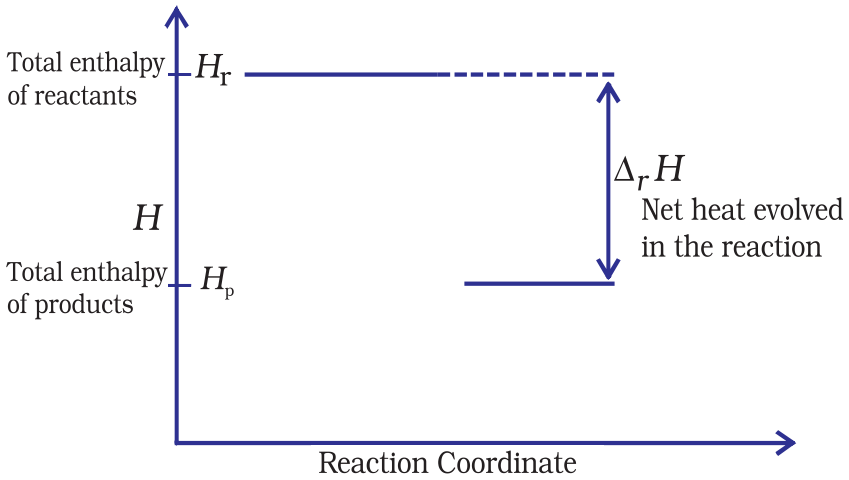
The above diagram represents :
  • Enthalpy for exothermic reactions.
  • B
    Enthalpy for endothermic reactions.
  • C
    Entropy for exothermic reactions.
  • D
    Entropy for endothermic reactions.
Answer
Correct option: A.
Enthalpy for exothermic reactions.
In an exothermic reaction, there is the decrease in enthalpy on passing from reactants to products.
View full question & answer
MCQ 501 Mark
A gas is allowed to ospand in a well insulated container against a cemstant eternal pressure of $2.5$ atm from an initial volume of $2.50L$ to a final volume of $4.50L$ The change in internal energy in Joule's will he :
  • A
    $-\ 500J$
  • $-\ 506J$
  • C
    $+\ 505J$
  • D
    $1136.25J$
Answer
Correct option: B.
$-\ 506J$
$\Delta\text{U}=\text{q}+\text{w}$
For adiabatic process $q = 0$
$\therefore\Delta\text{U}=\text{w}=-\text{P}\Delta\text{V}$
$=-2.5\text{ atm}(4.5-2.5\text{L})$
$=-2.5\times2.0\text{ atm}=-5\text{L atm}$
$\Delta\text{U}=-5\times101.3\text{J}=-506.5\text{J}$
View full question & answer