MCQ 511 Mark
If $A = \{x : x$ is a multiple of $3\}$ and $B = \{x : x$ is a multiple of $5\},$ then $A - B$ is:
- A
$\text{A}\cap\text{B}$
- ✓
$\text{A}\cap\overline{\text{B}}$
- C
$\overline{\text{A}}\cap\overline{\text{B}}$
- D
$\overline{\text{A}\cap{\text{B}}}.$
AnswerCorrect option: B. $\text{A}\cap\overline{\text{B}}$
$A = \{x : x$ is a multiple of $3\}$
$A = 3, 6, 9, 12, 15, 18, 21, 24, 27, 30, 33, 36, 39, 42, .....$
$B = \{x : x$ is a multiple of $5\}$
$B = 5, 10, 15, 20, 25, 30, 35, 40, 45, 50, ......$
Now, we have:
$A - B = 3, 6, 9, 12, 18, 21, 24, 27, 30, 33,36, 39, 42, ....$
$=\text{A}\cap\overline{\text{B}}.$
View full question & answer→MCQ 521 Mark
$A$ and $B$ are two sets having $3$ and $5$ elements respectively and having $2$ elements in common. Then the number of elements in $A \times B$ is:
AnswerTotal ordered pairs $=n(A) \times n(B) = 3 \times 5 = 15.$
View full question & answer→MCQ 531 Mark
In a class of $50$ students $35$ opted for Mathematics and $37$ opted for Biology How may have opted for only Mathematics? $($Assume that each student has to opt for at least one of the subjects$)$
AnswerHere $\ce{n(M ∪ B) = 50, n(M) = 35, n(B)} = 37$
$\therefore \ce{n(M ∩ B) = n(M) + n(B) -n(M ∪ B)}$
$= 35 + 37 - 50$
$= 22$
$\Rightarrow 22$ student have opted for both Mathematics and Biology.
Now the number of students who have opted for Mathematics only
$= \ce{n(M) -n(M ∩ B)}$
$= 35 - 22$
$= 13$
View full question & answer→MCQ 541 Mark
The symmetric difference of $A = \{1, 2, 3\}$ and $B = \{3, 4, 5\}$ is:
- A
$\{1, 2\}$
- ✓
$\{1, 2, 4, 5\}$
- C
$\{4, 3\}$
- D
$\{2, 5, 1, 4, 3\}.$
AnswerCorrect option: B. $\{1, 2, 4, 5\}$
Here,
$\text{A} = \{1, 2, 3\}$ and
$\text{B} = \{3, 4, 5\}$
The symmetric difference of $A$ and $B$ is given by:-
$\text{(A} - \text{B)}\cup\text{(B} -\text{A)}$
Now, are have:
$\text{(A} - \text{B)}= \{1, 2\}$
$\text{(B} - \text{A)}=\{4, 5\}$
$\text{(A}-\text{B)}\cup\text{(B}-\text{A)}=\{1, 2, 4, 5\}.$
View full question & answer→MCQ 551 Mark
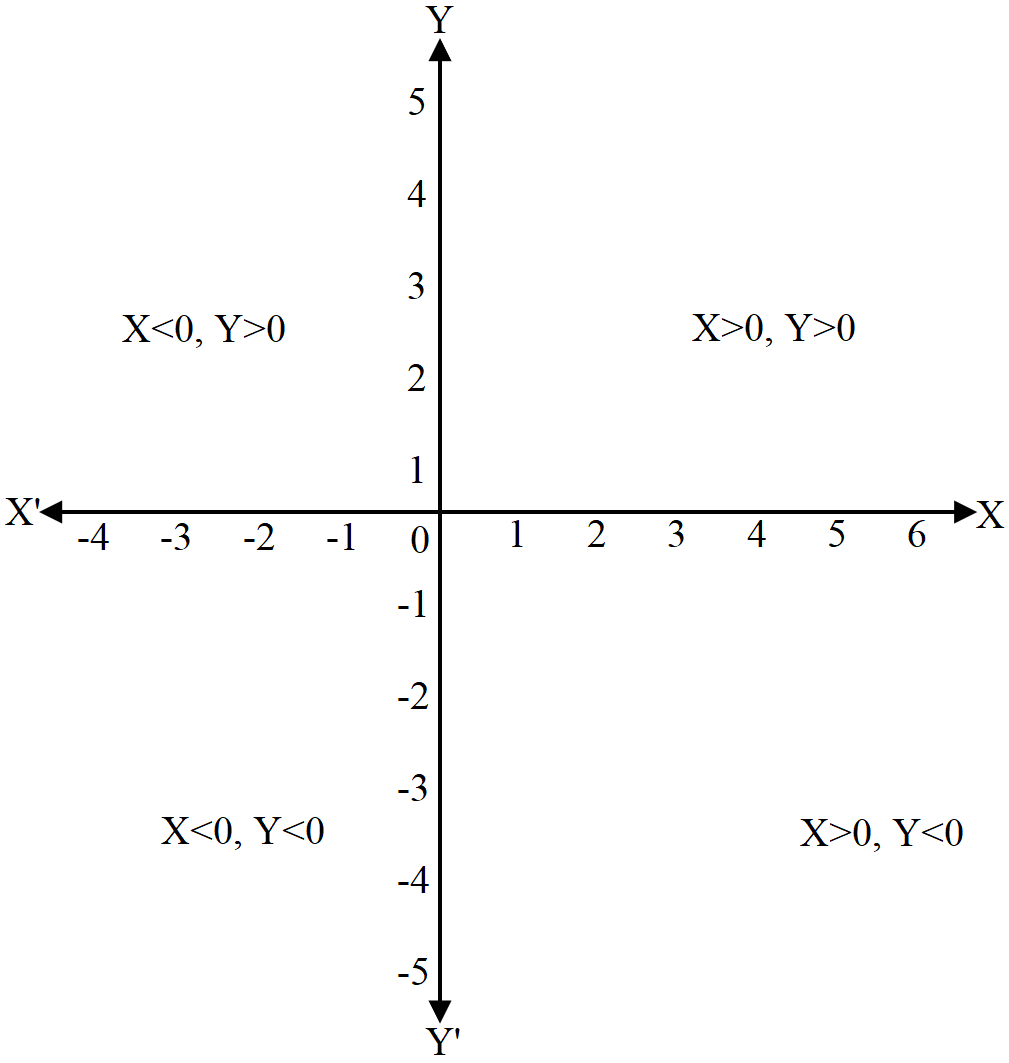
AnswerIn the second quadrant,
View full question & answer→MCQ 561 Mark
Let $F_1$ be the set of all parallelograms, $F_2$ the set of all rectangles, $F_3$ the set of all rhombuses, $F_4$ the set of all squares and $F_5$the set of trapeziums in a plane. Then $F_1$ may be equal to:
- A
$\text{F}_2\cap\text{F}_3$
- B
$\text{F}_3\cap\text{F}_4$
- C
$\text{F}_2\cup\text{F}_3$
- ✓
$\text{F}_2\cup\text{F}_3\cup\text{F}_4\cup\text{F}_1.$
AnswerCorrect option: D. $\text{F}_2\cup\text{F}_3\cup\text{F}_4\cup\text{F}_1.$
We know that every rectangle, rhombus and square in a plane is a parallelogram but every trapezium is not a parallelogram.
So, $F_1$ is either of $F_1$ or $F_2$ or $F_3$ or $F_4$.
$\therefore\text{F}_1=\text{F}_1\cup\text{F}_2\cup\text{F}_3\cup\text{F}_4$
Hence, the correct answer is option $(d).$
View full question & answer→MCQ 571 Mark
Given $A = \{a, b, c, d, e, f, g, h\}$ and $B = \{a, e, i, o, u\}$ then $B - A$ is equal to:
- ✓
$\{i, o, u\}$
- B
$\{a, b, c\}$
- C
$\{c, d, e\}$
- D
$\{a, i, z\}$
AnswerCorrect option: A. $\{i, o, u\}$
The sets $A = \{a, b, c, d, e, f, g, h\}$ and $B = \{a, e, i, o, u\},$ in order to find the difference between the two sets as $B−A,$ we begin by writing all the elements of $B$ and then take away every element of $A$ which is also the element of $B.$
Since $B$ share the elements a, e with $A,$
so $B - A = \{i, o, u\}.$
View full question & answer→MCQ 581 Mark
If $n(A)$ denotes the number of elements in set $A$ and if $\ce{n(A) = 4,n(B)} = 5$ and $\ce{n(A ∩ B)} = 3$ then $\ce{n[(A \times B) ∩ (B \times A)]}=$
AnswerFor $\ce{(A \times B) ∩ (B \times A)}$ we have to do the mapping of $\ce{A \times B}$ or $\ce{B \times A}$ between common elements.
no. of ways of mapping will be $3 \times 3 = 9$
$\ce{n[(A \times B) ∩ (B \times A)]} = 9$
View full question & answer→MCQ 591 Mark
If out of $150$ students who read at least one newspaper The Times of India, The Hindustan Times and The Hindu. There are $65$ who read The Times of India, $41$ who read The Hindu and $50$ who read The Hindustan Times.What is the maximum possible number of students who read all the three newspaper?
Answer$a + b + c = 150$
$a + 2b + 3c = 156$
Hence $b + 2c = 6$
To maximise $c$ we take minimum value of $b$ that is $0.$
Hence $c = 3$
View full question & answer→MCQ 601 Mark
Let $\ce{n(A) = 28, n(A ∩ B) = 8, n(A ∪ B)} = 52,$ then $\ce{n(A ∩ B′)} =.$
AnswerGiven $\ce{n(A) = 28, n(A ∩ B)} = 8.$
We have $\ce{A ∩ B′ = A − A ∩ B.}$
This give $\ce{n(A ∩ B′) = n(A) − n(A ∩ B)}$
or, $\ce{n(A ∩ B′)} = 28 − 8 = 20.$
View full question & answer→MCQ 611 Mark
In set$-$builder method the null set is represented by:
AnswerCorrect option: C. $\{\text{x : x} \not=\text{x}\}$
View full question & answer→MCQ 621 Mark
$n$ a class of $55$ students, the number of students studying different subjects are $23$ in Mathematics and $24$ in Physics, $19$ in Chemistry, $12$ in Mathematics and Physics, $9$ in Mathematics and Chemistry, $7$ in Physics and Chemistry and $4$ in all the three subjects, The number of students who have taken exactly one subject is:
View full question & answer→MCQ 631 Mark
In an examination, $34\%$ of the candidates fail in Arithmetic and $42\%$ in English.If $20\%$ fail in Arithmetic and English, the percentage of those passing in both subjects is:
Answer$\ce{n(A)} = 34$
$\ce{n(B)} = 42$
$\ce{n(A∩B)} = 20$
$\ce{n(A∪B) = n(A) + n(B) − n(A∩B)} = 34 + 42 − 20 = 56$
$\ce{n(A∪B)′ = 100 − n(A∪B)} = 100 − 56 = 44$
View full question & answer→MCQ 641 Mark
The sets $Sx$ are defined to be ($x, x + 1, x + 2, x + 3, x + 4)$ where $x = 1, 2, 3,.....80.$ How many of these sets contain $6$ or its multiple?
AnswerSince $5$ consecutive no. are chosen only one set in $6$ consecutive sets will not have a multiple of $6$.
So till $78$ sets there are
$78-\frac{78}{6}=78-13=65$ sets containing $6$ or multiples of $6.$
$S_{79}$ does not contain any multiple of $6$
Hence $S_{80}$ must contain a multiple of $6.$
Answer $= 66$ sets
View full question & answer→MCQ 651 Mark
If $A = \{x, y\}$ then the power set of $A$ is:
- A
$\{xx, yy\}$
- B
$\{f, x, y\}$
- C
$\{f, \{x\},\{2y\}\}$
- ✓
$\{f, \{x\},\{y\},\{x, y\}\}$
AnswerCorrect option: D. $\{f, \{x\},\{y\},\{x, y\}\}$
View full question & answer→MCQ 661 Mark
The symmetric difference of $A$ and $B$ is not equal to:
- A
$\text{(A} - \text{B)}\cap\text{(B} -\text{A)}$
- ✓
$\text{(A} - \text{B)}\cup\text{(B}- \text{A)}$
- C
$\text{(A}\cup\text{B)}-\text{(B}\cap\text{A)}$
- D
$\{\text{(A}\cup\text{B)}-\text{A\}}\cup\{\text{(A}\cup\text{B)} - \text{B}\}.$
AnswerCorrect option: B. $\text{(A} - \text{B)}\cup\text{(B}- \text{A)}$
The symmetric difference of $A$ and $B$ is given by$:-$
$\text{(A} - \text{B)}\cup\text{(B}- \text{A)}.$
View full question & answer→MCQ 671 Mark
If $A = \{1, 2, 3, 4, 5, 6\}, B = \{2, 4, 6, 8\},$ then $A - B$ will be:
- A
$\{1, 3, 5, 8\}$
- ✓
$\{1, 3, 5\}$
- C
$\{1, 2, 3, 4, 5, 6, 8\}$
- D
$ \{\}$
AnswerCorrect option: B. $\{1, 3, 5\}$
Given, $A = \{1, 2, 3, 4, 5, 6\}$ and $B = \{2, 4, 6, 8\}$
$A - B$ means $A$ contains the element which is not present in $B.$
Thus, $A − B = \{1, 3, 5\}$
View full question & answer→MCQ 681 Mark
For any two sets $A$ and $\text{B, A - B}\cup\text{B}=\text{A}=$
- A
$\text{(A - B)}\cup\text{A}$
- B
$\text{(B - A)}\cup\text{B}$
- ✓
$\text{(A}\cup\text{B)}-\text{(A}\cap\text{B)}$
- D
$\text{(A}\cup\text{B)}\cap\text{(A}\cap\text{B)}.$
AnswerCorrect option: C. $\text{(A}\cup\text{B)}-\text{(A}\cap\text{B)}$
$\text{(A}-\text{B)}\cup\text{(B}-\text{A)}=\text{(A}\cap\text{B}')\cup\text{(B}\cap\text{A}')$
$=[\text{A}\cup\text{(B}\cup\text{A}')]\cap[\text{B}'\cup\text{(B}\cap\text{A}')] [$Using distribution law$]$
$=[\text{(A}\cup\text{B})\cap\text{(A}\cup\text{A}')]\cap[\text{(B}'\cup\text{B})\cap\text{(B}'\cup\text{A}')]$ $[$Using distribution law$]$
$=[\text{(A}\cup\text{B)}\cup\text{(U)}]\cap[\text{(U)}\cap\text{(B}'\cup\text{A}')]$
$[\text{A}\cup\text{A'= U = B}'\cup\text{B}]$
$=[\text{A}\cup\text{B}]\cap[\text{B}'\cup\text{A}']$ $\begin{bmatrix}\text{(A}\cup\text{B)}\cap\text{(U)}=\text{(A}\cup\text{B)}\\\text{ and (U)}\cap\text{(B}'\cup\text{A)}'=\text{(B}'\cup\text{A}')]\end{bmatrix}$
$=[\text{A}\cup\text{B}]\cap[\text{(A}\cap\text{B)}']$ $[\text{(A}\cap\text{B)}'=\text{B}'\cup\text{A}']$
$=[\text{A}\cup\text{B}]\cap[\text{(A}\cup\text{B)}-\text{(A}\cap\text{B)}]$
$=[\text{(A}\cup\text{B)}-\text{(A}\cap\text{B)}].$
View full question & answer→MCQ 691 Mark
In a community of $175$ persons, $40$ read the Times, $50$ read the Samachar and $100$ do not read any. How many persons read both the papers?
AnswerSince $100$ do not read any
$\ce{n(T ∪ S)} = 175 − 100 = 75$
$y$ set theory
$\ce{n(T ∩ S) = n(T) + n(S) − n(T ∪ S)}$
$= 40 + 50 − 75$
$= 15$
View full question & answer→MCQ 701 Mark
- A
$X < 0, Y > 0$
- B
$X < 0, Y < 0$
- C
$X > 0, Y < 0$
- ✓
$X > 0, Y > 0$
AnswerCorrect option: D. $X > 0, Y > 0$
View full question & answer→MCQ 711 Mark
If $A ⊂ B,$ then $A ∩ B$ is:
- A
$\text{B}$
- B
$\frac{A}{B}$
- ✓
$\text{A}$
- D
$\frac{B}{A}$
AnswerCorrect option: C. $\text{A}$
We are given that $A$ is the subset of $B$
$\Rightarrow$ Every element of $A$ is an element of $B.$
Therefore, the intersection elements of sets $A$ and $B$ are $A ∩ B = A.$
View full question & answer→MCQ 721 Mark
For any two sets $A$ and $B, \text{A}\cap\text{(A}\cup\text{B)}'$ is equal to:
- A
$\text{A}$
- B
$\text{B}$
- ✓
$\phi$
- D
$\text{A}\cap\text{B}.$
AnswerCorrect option: C. $\phi$
$\text{A}\cap\text{(A}\cup\text{B)}'$
$=\text{A}\cap\text{(A}'\cup\text{B}') ($De Morgen Law$)$
$=\text{(A}\cap\text{A}')\cap\text{B}'$
$=\phi\cap\text{B}'$
$=\phi$
Hence, the correct answer is option $(c).$
View full question & answer→MCQ 731 Mark
Choose the correct answers from the given four option:
Let $S =$ set of points inside the square, $T =$ the set of points inside the triangle and $C =$ the set of points inside the circle. If the triangle and circle intersect each other and are contained in a square. Then
- A
$\text{S}\cap\text{T}\cap\text{C}=\phi$
- B
$\text{S}\cup\text{T}\cup\text{C}=\text{C}$
- ✓
$\text{S}\cup\text{T}\cup\text{C}=\text{S}$
- D
$\text{S}\cup\text{T} = \text{S}\cap\text{C}$
AnswerCorrect option: C. $\text{S}\cup\text{T}\cup\text{C}=\text{S}$
The given conditions of the question may be represented by the following Venn diagram. From the given Venn diagram, we conclude thta
$\text{S}\cup\text{T}\cup\text{C}=\text{S}$
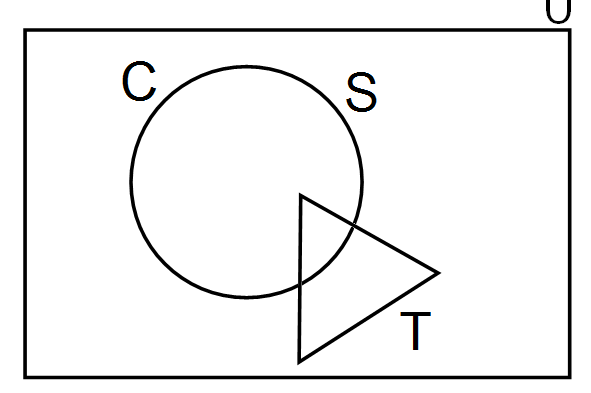
Hence, the correct option is $(c).$ View full question & answer→MCQ 741 Mark
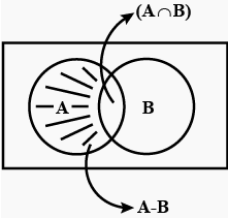
Find the equivalent set for $A − B.$
AnswerCorrect option: C. $\text{A}-(\text{A}\cap\text{B})$
Hence By this graph we see that $\text{A}-\text{B}=\text{A}-(\text{A}\cap\text{B})$
View full question & answer→MCQ 751 Mark
All the students of a batch opted Psychology, Business, or both. $73\%$ of the students opted Psychology and $62\%$ opted Business. If there are $220$ students, how many of them opted for both Psychology and business?
AnswerBy set theory
$\ce{n(P ∩ B) = n(P) + n(B) − n(P ∪ B)}$
$= 0.73 + 0.62 − 1.00$
$= 0.35$
$35\%$ of $220$
$= 77$
View full question & answer→MCQ 761 Mark
If $Y ∪ \{1, 2\} =\{1, 2, 3, 5, 9\},$ then:
- ✓
The smallest set of $Y$ is $\{3, 5, 9\}$
- B
The smallest set of $Y$ is $\{2, 3, 5, 9\}$
- C
The largest set of $Y$ is $\{1, 2, 3, 5, 9\}$
- D
Both $A$ and $C$
AnswerCorrect option: A. The smallest set of $Y$ is $\{3, 5, 9\}$
Since the set of the right hand side has $5$ elements,
$\therefore$ smallest set of $Y$ has three elements and largest set of
$Y$ has five elements,
$\therefore$ smallest set of $Y$ is $\{3, 5, 9\}$
and largest set of $Y$ is $\{1, 2, 3, 4, 9\}$
View full question & answer→MCQ 771 Mark
Which of the following has only one subset?
- A
$\{0,1\}$
- B
$\{1\}$
- C
$\{0\}$
- ✓
$\{\}$
AnswerCorrect option: D. $\{\}$
Empty set is the subset of itself.
View full question & answer→MCQ 781 Mark
Let $S = \{2, 4, 6, 8,......20\}.$ What is the maximum number of subsets does $S$ have?
AnswerCorrect option: D. $1024$
Given, $S = 2, 4, 6, 8....., 20.$
There are a total of $10$ elements.
Therefore we have $210 = 1024$ subsets.
View full question & answer→MCQ 791 Mark
Choose the correct answers from the given four option:
Let $R$ be set of points inside a rectangle of sides $a$ and $b (a, b > 1)$ with two sides along the positive direction of $x-$axis and $y-$axis. Then
- A
$R = \{(x, y) : 0 ≤ x ≤ a, 0 ≤ y ≤ b\}.$
- B
$R = \{(x, y) : 0 ≤ x < a, 0 ≤ y ≤ b\}.$
- C
$R = \{(x, y) : 0 ≤ x ≤ a, 0 < y < b\}.$
- ✓
$R = \{(x, y) : 0 < x < a, 0 < y < b\}.$
AnswerCorrect option: D. $R = \{(x, y) : 0 < x < a, 0 < y < b\}.$
Since, $R$ be the set of points inside the rectangle.
$\therefore R = \{(x, y) : 0 < x < a, 0 < y < b\}.$
View full question & answer→MCQ 801 Mark
In an examination $70\%$ students passed both in Mathematics and Physics $85\%$ passed in Mathematics and $80\%$ passed in Physics If $30$ students have failed in both the subjects then the total number of students who appeared in the examination is equal to:
AnswerStudent passed in atleast one subject
$= \ce{n (P ∪ M) = n(P) + n(M) -n (P ∪ M)}$
$= 80 + 85 - 70$
$= 95$
$\therefore 5\%$ student failed in both the subjects
$\Rightarrow 5\%$ of total students $= 30$
$\Rightarrow$ Total students $=\frac{30\times100}{5}=600$
View full question & answer→MCQ 811 Mark
If $A, B$ and $C$ are any three sets, then $\text{A}\times (\text{B}\cup\text{C})$ is equal to.
- ✓
$(\text{A}\times\text{B}) \cup (\text{A}\times\text{C})$
- B
$(\text{A}\cup\text{B}) \times (\text{A}\cup\text{C})$
- C
$(\text{A}\times\text{B}) \cap (\text{A}\times\text{C})$
- D
$\text{None of these}$
AnswerCorrect option: A. $(\text{A}\times\text{B}) \cup (\text{A}\times\text{C})$
Given $A, B$ and $C$ are any three sets.
Now, $\text{A}\times(\text{B }\cup \text{C})=(\text{A}\times\text{B}) \cup (\text{A}\times\text{C})$
View full question & answer→MCQ 821 Mark
If $A = \{1, 2, 3, 4, 5\},$ then the number of proper subsets of $A$ is:
View full question & answer→MCQ 831 Mark
If $\ce{n(A) = 115, n(B) = 326, n(A - B) = 47}$ then $\ce{n(A ∪ B)}$ is equal to:
Answer$\ce{n(A)} = 115, n(B) = 326$
$\ce{n(A - B)} = 47$
$\ce{n(A) = n(A - B) + n(A ∩ B)}$
$\ce{n(A ∩ B) = n(A) -n(A - B)}$
$\therefore \ce{n(A ∩ B)} = 115 - 47 = 68$
$\therefore \ce{n(A ∪ B) = n(A) + n(B) -n(A ∩ B)}$
$\Rightarrow \ce{n(A ∪ B)} = 115 + 326 - 68$
$\Rightarrow \ce{n A ∪ B)} = 373$
View full question & answer→MCQ 841 Mark
For two sets $\text{A}\cap\text{B = A}$ iff:
AnswerCorrect option: A. $\text{B}\subseteq\text{A}$
The union of two sets is a set of all those elements that belong to $A$ or to $B$ or to both $A$ and $B.$
If $\text{A}\cup\text{B = A},$ then $\text{B}\subseteq\text{A}.$
View full question & answer→MCQ 851 Mark
The relation $S = \{(3, 3), (4, 4)\}$ on the set $A = \{3, 4, 5\}$ is $............$
- ✓
Not reflexive but symmetric and transitive.
- B
- C
- D
AnswerCorrect option: A. Not reflexive but symmetric and transitive.
View full question & answer→MCQ 861 Mark
For any two sets $A$ and $\ce{B, A−(A−B)}$ equals:
- A
$B$
- B
$A − B$
- ✓
$A ∩ B$
- D
$A^C ∩ B^C$
AnswerCorrect option: C. $A ∩ B$
Now, $\ce{A − (A − B) = A − (A ∩ B^C)}$
$= \ce{A ∩ (A ∩ B^C)^C}$
$= \ce{A ∩(A^C∪ B)}$
$= \ce{(A ∩ A^C) ∪ (A ∩ B)}$
$= \ce{A ∩ B}$
View full question & answer→MCQ 871 Mark
Which of the following two sets are equal?
- A
$A = \{1, 2\}$ and $B = \{1\}$
- B
$A = \{1, 2\}$ and $B = \{1, 2, 3\}$
- ✓
$A = \{1, 2, 3\}$ and $B = \{2, 1, 3\}$
- D
$A = \{1, 2, 4\}$ and $B = \{1, 2, 3\}$
AnswerCorrect option: C. $A = \{1, 2, 3\}$ and $B = \{2, 1, 3\}$
Two sets are equal if and only if they have the same elements.
So, $A =\{1, 2, 3\}$ and $B = \{2, 1, 3\}$ are equal sets.
View full question & answer→MCQ 881 Mark
Choose the correct answers from the given four option:
If $X = \{8n - 7n - 1 | n \in N\}$ and $Y = \{49n - 49 | n \in N\}.$ Then
- ✓
$\text{X} \subset \text{Y}$
- B
$\text{Y} \subset \text{X}$
- C
$\text{X} = \text{Y}$
- D
$\text{X} \cap \text{Y} = \phi$
AnswerCorrect option: A. $\text{X} \subset \text{Y}$
$X = \{8n - 7n - 1| n \in N\} = \{0, 49, 490, .....\}$
$Y = \{49n - 49 | n \in N\} = \{0, 49, 147, ....., 490, .....\}$
Clearlut, every element of $X$ is in $Y$ but every element of $Y$ is not in $X.$
$\therefore \text{X}\subset\text{Y}$
View full question & answer→MCQ 891 Mark
If $\ce{n(A) = 65, n(B)} = 32$ and $\ce{n(A ∩ B)} = 14,$ then $\ce{n(A \triangle B)}$ equals:
Answer$ \text{n}(\text{A}\triangle\text{B})= \text{n(A - B)} +\text{ n(B - A)}$
$\therefore(\text{A}\triangle\text{B})=\text{ (A - B)} ∪ \text{(B - A)}$
$\Rightarrow (\text{A}\triangle\text{B}) = \text{n(A)} \text{ -n(A ∩ B)} +\text{ n(B)} − \text{n(A ∩ B)}$
$\Rightarrow (\text{A}\triangle\text{B})=\text{ n(A)} +\text{ n(B)} \text{ -2n} (A∩B)$
$= 65 + 32 - 2 \times 14$
$= 69$
View full question & answer→MCQ 901 Mark
Choose the correct answers from the given four option: Let $F_1$ be the set of parallelograms, $F_2$ the set of rectangles, $F_3$ the set of rhombuses, $ {F}_4$ the set of squares and ${F}_5$ the set of trapeziums in a plane. Then ${F}_1$ may be equal to,
- A
$\text{F}_2\cap\text{F}_3$
- B
$\text{F}_3\cap\text{F}_4$
- C
$\text{F}_2\cup\text{F}_5$
- ✓
$\text{F}_2\cup\text{F}_3\cup\text{F}_4\cup\text{F}_1$
AnswerCorrect option: D. $\text{F}_2\cup\text{F}_3\cup\text{F}_4\cup\text{F}_1$
Every rectangel, rhombus, square in a plane is a parallelogram but every trapezium is not a parallelogram.
$\text{F}_1=\text{F}_2\cup\text{F}_3\cup\text{F}_4\cup\text{F}_1$
View full question & answer→MCQ 911 Mark
If $A = \{1, 2, 4\}, B = \{2, 4, 5\}$ and $C = \{2, 5\},$ then $\ce{(A − B) \times (B − C)} =$
- A
$\{(1, 2), (1, 5), (2, 5)\}$
- B
$\{\{1, 4\}\}$
- ✓
$(1, 4)$
- D
$\{(1, 2)\}$
AnswerCorrect option: C. $(1, 4)$
$A = {1, 2, 4}$ and $B = {2, 4, 5}$
$A − B = {1, 2, 4} − {2, 4, 5} = {1}$
$B={2,4,5}$ and $C = {2, 5}$
$B − C = {2, 4, 5} − {2, 5} = {4}$
$\ce{(A − B) \times (B − C)} = {1} \times {4} = (1, 4)$
View full question & answer→MCQ 921 Mark
The total number of subsets of $\{1, 2, 6, 7\}$ are?
AnswerWe have to find the total number of subsets of $\{1, 2, 6, 7\}.$
We know that, for a set containing $n$ elements, the total number of subsets is $2n.$
Consider $\{1, 2, 6, 7\},$ wich has $4$ elements.
$\therefore$ here $n = 4$
Hence total number of subsets is $24 = 16.$
Thus the total number of subsets of $\{1, 2, 6, 7\}$ is $16.$
View full question & answer→MCQ 931 Mark
$A - B$ is read as?
AnswerCorrect option: A. Difference of $A$ and $B$ of $B$ and $A$
View full question & answer→MCQ 941 Mark
In a class, $20$ opted for Physics, $17$ for Maths, $5$ for both and $10$ for other subjects. The class contains how many students?
AnswerBy set theory
$\ce{n(P ∪ M) = n(P) + n(M) − n(P ∩ M)}$
$= 20 + 17 − 5$
$= 32$
So total no. of students
$= 32 + 10$
$= 42$
$32$ opted for at least one subject from Physics and maths while $10$ opted for other.
View full question & answer→MCQ 951 Mark
IF $A = [5, 6, 7]$ and $B = [7, 8, 9]$ then $\text{A }\cup \text{ B}$ is equal to.
- ✓
$[5, 6, 7, 8, 9]$
- B
$[5, 6, 7]$
- C
$[7, 8, 9]$
- D
AnswerCorrect option: A. $[5, 6, 7, 8, 9]$
Given $A = [5, 6, 7]$ and $B = [7, 8, 9]$
then $\text{A }\cup \text{ B} = [5, 6, 7, 8, 9]$
View full question & answer→MCQ 961 Mark
Let $A, B$ are two sets such that $n(A) = 4$ and $n(B) = 6.$ Then the least possible number of elements in the power set of $\ce{(A ∪ B)}$ is:
AnswerCorrect option: D. $1024$
Given,
$n(A) = 4, n(B) = 6$
Then the least number of possible elements in
$\ce{n(A \cup B)=2^{n(A)} \cdot 2^{n(B)}}=2^4 \cdot 2^6=2^{10}=1024$
View full question & answer→MCQ 971 Mark
If $A = \{1, 2, 3, 4\}, B = \{2, 3, 5, 6\}$ and $C = \{3, 4, 6,7\},$ then.
- A
$\text{A } – (\text{B} \cap \text{C}) = ({1, 3, 4})$
- ✓
$\text{A } – (\text{B} \cap \text{C}) = ({1, 2, 4})$
- C
$\text{A } – (\text{B} \cup \text{C}) = ({2, 3})$
- D
$\text{A } – (\text{B} \cup \text{C}) = (\text{f})$
AnswerCorrect option: B. $\text{A } – (\text{B} \cap \text{C}) = ({1, 2, 4})$
View full question & answer→MCQ 981 Mark
Let $S = \{1, 2, 3,.....40\}$ and let $A$ be a subset of $S$ such that no two elements in $A$ have their sum divisible by $5$ What is the maximum number of elements possible in $A?$
AnswerThere are $20$ maximum number of elements possible in $A.$
$A = (1, 2, 5, 6, 7, 11, 12, 15, 16, 17 ,21, 22, 25, 26, 27, 31, 32, 35, 36, 37).$
View full question & answer→MCQ 991 Mark
Two finite sets have $m$ and $n$ elements. The number of subsets of the first set is $112$ more than that of the second. The values of $m$ and $n$ are respectively:
- A
$4, 7$
- ✓
$7, 4$
- C
$4, 4$
- D
$7, 7.$
AnswerCorrect option: B. $7, 4$
We know that if a set $X$ contains $k$ elements, then the number of subsets of $X$ are $2^k$.
It is given that the number of subsets of a set containing $m$ elements is $112$ more than the number of subsets of set containing $n$ elements.
$\therefore 2^\text{m}-2^\text{n}=112$
$\Rightarrow2^\text{n}(2^\text{m - n}-1)=2\times2\times2\times2\times7$
$\Rightarrow2^\text{n}(2^{\text{m}-\text{n}}-1)=2^4(2^3-1)$
$\Rightarrow\text{n}=4$ and $\text{m}-\text{n}=3$
$\therefore\text{ m}-4=3$
$\Rightarrow\text{m}=7$
Thus, the values of $m$ and $n$ are $7$ and $4,$ respectively.
Hence, the correct answer is option $(b).$
View full question & answer→MCQ 1001 Mark
In a party, $70$ guests were to be served tea or coffee after dinner. There were $52$ guests who preferred tea while $37$ preferred coffee. Each of the guests liked one or the other beverage. How many guests liked both tea and coffee?
AnswerBy set theory
$\ce{n(T ∩ C) = n(T) + n(C) − n(T ∪ C)}$
$= 52 + 37 − 70$
$= 19$
View full question & answer→