Question 12 Marks
A steel cable with a radius of 1.5cm supports a chairlift at a ski area. If the maximum stress is not to exceed $108N m^{-2}$, what is the maximum load the cable can support?
Answer
View full question & answer→Radius of the steel cable, r = 1.5cm = 0.015m Maximum allowable stress = $10^8N m^{-2}$ Maximum stress = Maximum force/Area of cross-section $\therefore$ Maximum force = Maximum stress × Area of cross-section$= 10^8 ×\pi(0.015)^2
= 7.065 \times 10^4N$ Hence, the cable can support the maximum load of $7.065 \times 10^4N$.
= 7.065 \times 10^4N$ Hence, the cable can support the maximum load of $7.065 \times 10^4N$.
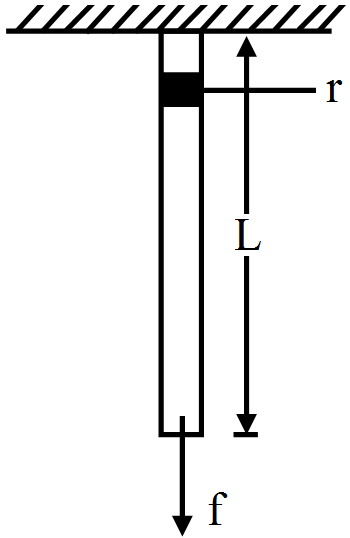 Now Young's modulus(Y) $=\frac{\text{f}}{\text{A}}\times\frac{\text{L}}{\text{l}}$ For frist wire, $\text{Y}=\frac{\text{f}}{\pi\text{r}^2}\times\frac{\text{L}}{\text{l}}\ ...(\text{i)}$ For second wire. $\text{Y}=\frac{2\text{f}}{\pi(2\text{r})^2}\times\frac{2\text{L}}{\text{l}'}$ $=\frac{\text{f}}{\pi\text{r}^2}\times\frac{\text{L}}{\text{l}'}$ For Eqs. (i) and (ii), $\frac{\text{f}}{\pi\text{r}^2}\times\frac{\text{L}}{\text{l}}=\frac{\text{f}}{\pi\text{r}^2}\times\frac{\text{L}}{\text{l}'}$ $\therefore\text{l}=\text{l}'$ $[\because$ both wires are of same material, hence, Young's modulus will be same$].$
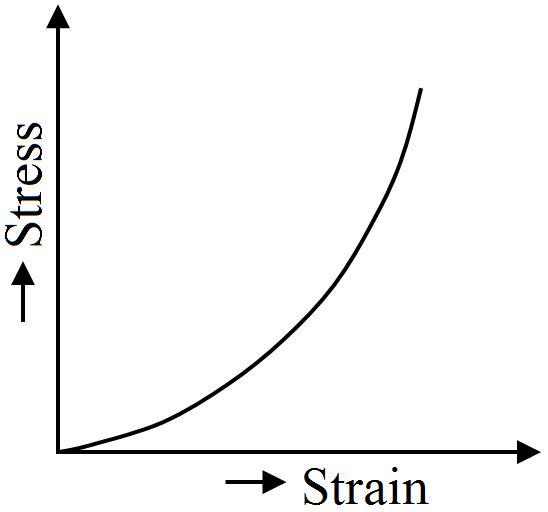 Although elastic region is very large but the material does not obey Hooke's law over most of the region. Moreover, there is no well defined plastic region.