Question 15 Marks
The Marina trench is located in the Pacific Ocean, and at one place it is nearly eleven km beneath the surface of water. The water pressure at the bottom of the trench is about $1.1 \times 10^8$ Pa. A steel ball of initial volume $0.32m^3$ is dropped into the ocean and falls to the bottom of the trench. What is the change in the volume of the ball when it reaches to the bottom?
AnswerWater pressure at the bottom, $p = 1.1 \times 10^8$ Pa Initial volume of the steel ball, $V = 0.32m^3$ Bulk modulus of steel, $B = 1.6 \times 10^{11}Nm^{–2}$ The ball falls at the bottom of the Pacific Ocean, which is 11km beneath the surface. Let the change in the volume of the ball on reaching the bottom of the trench be $\Delta\text{V}.$ Bulk modulus, $\text{B}= \frac{\text{p}}{\big(\frac{\Delta\text{V}}{\text{V}}\big)}$$\Delta\text{V} = \frac{\text{B}}{\text{pV}}$
$= 1.1 \times 10^8 \times 0.32/(1.6 \times 10^{11} ) = 2.2 \times 10^{-4}m^3$ Therefore, the change in volume of the ball on reaching the bottom of the trench is $2.2 \times 10^{–4}m^3$.
View full question & answer→Question 25 Marks
A $14.5kg$ mass, fastened to the end of a steel wire of unstretched length $1.0m$, is whirled in a vertical circle with an angular velocity of $2rev/s$ at the bottom of the circle. The cross-sectional area of the wire is $0.065cm^2$. Calculate the elongation of the wire when the mass is at the lowest point of its path.
AnswerMass, m = 14.5kg Length of the steel wire, l = 1.0m Angular velocity, $\omega= 2\text{ rev/s} = 2 × 2\pi\text{ rad/s} = 12.56rad/s$ Cross-sectional area of the wire, $a = 0.065cm^2 = 0.065 \times 10^{-4}m^2$ Let $\Delta\text{l}$ be the elongation of the wire when the mass is at the lowest point of its path. When the mass is placed at the position of the vertical circle, the total force on the mass is:$\text{F}=\text{mg}+\text{ml}\omega^2$
$= 14.5 \times 9.8 + 14.5 \times 1 \times (12.56)^2 = 2429.53N$ Young's modulus $=\frac{\text{Stress}}{\text{Strain}}$ $\text{Y}=\frac{\frac{\text{F}}{\text{A}}}{\frac{\Delta\text{l}}{\text{l}}}=\frac{\text{F}}{\text{A}}\frac{\text{l}}{\Delta\text{l}}$ $\therefore\ \Delta\text{l}=\frac{\text{Fl}}{\text{AY}}$ Young’s modulus for steel $= 2 \times 10^{11}$ Pa $\Delta\text{l}=\frac{2429.53\times1}{0.065\times10^{-4}\times2\times10^{11}}$ $\Rightarrow\ \Delta\text{l}=1.87\times10^{-3}\text{m}$ Hence, the elongation of the wire is $1.87 \times 10^{-3}m$.
View full question & answer→Question 35 Marks
Compute the bulk modulus of water from the following data: Initial volume = $100.0$ litre, Pressure increase = 100.0 atm ($1\ atm = 1.013 × 10⁵ Pa$), Final volume = $100.5$ litre. Compare the bulk modulus of water with that of air (at constant temperature). Explain in simple terms why the ratio is so large.
AnswerInitial volume, $V_1 = 100.0l = 100.0 \times 10^{–3}m^3$ Final volume, $V_2 = 100.5l = 100.5 \times 10^{–3}m^3$ Increase in volume, $\Delta\text{V} = \text{V}_2 – \text{V}_1$ = $0.5 \times 10^{–3}m^3$ Increase in pressure, $\Delta\text{p} = 100.0 \text{ atm}$ =$100 \times 1.013 \times 10^5$ Pa Bulk modulus $=\frac{\Delta\text{P}}{\frac{\Delta\text{V}}{\text{V}_1}}=\frac{\Delta\text{p}\times\text{V}_1}{\Delta\text{V}}$
$=\frac{100\times1.013\times10^5\times100\times10^{-3}}{0.5\times10^{-3}}$
$=2.026\times10^9\text{ Pa}$ Bulk modulus of air = $1.0 \times 10^5$ Pa $\therefore\ \frac{\text{Bulk modulus of water}}{\text{Bulk modulus of air}}=\frac{2.026\times10^{9}}{1.0\times10^5}=2.026\times10^4$This ratio is very high because air is more compressible than water.
View full question & answer→Question 45 Marks
The edge of an aluminium cube is $10cm$ long. One face of the cube is firmly fixed to a vertical wall. A mass of $100kg$ is then attached to the opposite face of the cube. The shear modulus of aluminium is $25G$ Pa. What is the vertical deflection of this face?
AnswerEdge of the aluminium cube, $\mathrm{L}=10 \mathrm{~cm}=0.1 \mathrm{~m}$ The mass attached to the cube, $\mathrm{m}=100 \mathrm{~kg}$ Shear modulus $(\eta)$ of aluminium $=25 \mathrm{GPa}=25 \times 10^9$ Pa Shear modulus, $\eta=$ Shear stress $/$ Shear strain $=(\mathrm{F} / \mathrm{A}) /(\mathrm{L} / \Delta \mathrm{L})$ Where, $\mathrm{F}=$ Applied force $=\mathrm{mg}=100 \times 9.8=980 \mathrm{NA}=$ Area of one of the faces of the cube $=0.1 \times 0.1=0.01 \mathrm{~m}^2 \Delta \mathrm{~L}=$ Vertical deflection of the cube
$\therefore \Delta \mathrm{L}=\frac{\mathrm{FL}}{\mathrm{A} \eta}=980 \times 0.1 /\left[10^{-2} \times\left(25 \times 10^9\right)\right]=3.92 \times 10^{-7} \mathrm{~m}$ The vertical deflection of this face of the cube is $3.92 \times$ $10^{-7} \mathrm{~m}$
View full question & answer→Question 55 Marks
A mild steel wire of length $1.0m$ and cross-sectional area $0.50 \times 10^{-2}cm^2$ is stretched, well within its elastic limit, horizontally between two pillars. A mass of $100g$ is suspended from the mid-point of the wire. Calculate the depression at the midpoint.
AnswerLength of the steel wire = 1.0m Area of cross-section, $A = 0.50 \times 10^{-2}cm^2 = 0.50 \times 10^{-6}m^2$^ A mass 100g is suspended from its maidpoint m = 100g = 0.1kg Hence, the wire dips, as shwn in the given figure
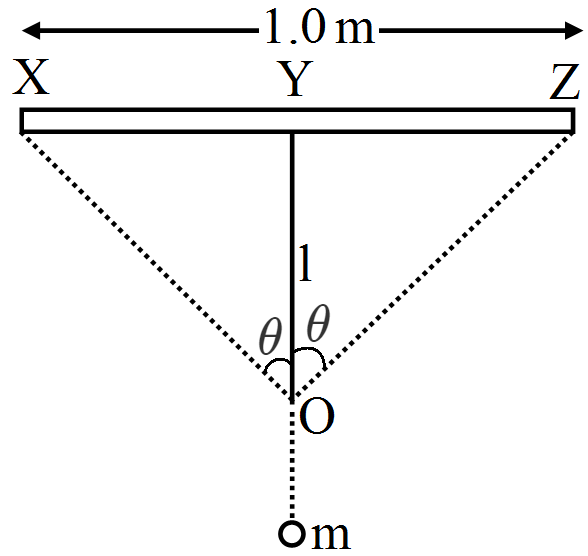
Original length = XZ Depression = l The length after mass m, is attached to the wire = XO + OZ Increase in the length of the wire: \triangle l = (XO + OZ) – XZ Where,$\text{XO}=\text{OZ}=\big[(0.5)^2+\text{l}^2\big]^\frac{1}{2}$
$\therefore\ \Delta\text{l}=2\big[(0.5)^2+(\text{l})^2\big]^\frac{1}{2}-1.0$
$=2\times0.5\bigg[1+\Big(\frac{\text{l}}{0.5}\Big)^2\bigg]^\frac{1}{2}-1.0$
Expanding and neglecting higher terms, we get: $\Delta\text{l}=\frac{\text{l}^2}{0.5}$
$\text{Strain}=\frac{\text{Increase in length}}{\text{Original length}}$ Let T be the tension in the wire. $\therefore\ \text{mg}=2\text{T}\cos\theta$ Using the figure, it can be written as: $\cos\theta=\frac{\text{l}}{\big((0.5)^2+\text{l}^2\big)\frac{1}{2}}$$=\frac{\text{l}}{(0.5)\Big(1+\big(\frac{\text{l}}{0.5}\big)^2\Big)^\frac{1}{2}}$
Expanding the expression and eliminating the higher terms:
$\cos\theta=\frac{\text{l}}{(0.5)\Big(1+\frac{\text{l}^2}{2(0.5)^2}\Big)}$
$\Big(1+\frac{\text{l}^2}{0.5}\Big)\simeq1$ for small l $\therefore\ \cos\theta=\frac{\text{l}}{0.5}$$\therefore\ \text{T}=\frac{\text{mg}}{2\big(\frac{\text{l}}{0.5}\big)}=\frac{\text{mg}\times0.5}{2\text{l}}=\frac{\text{mg}}{4\text{l}}$
$\text{Stress}=\frac{\text{Tension}}{\text{Area}}=\frac{\text{mg}}{4\text{l}\times\text{A}}$
Young's modulus $=\frac{\text{Stress}}{\text{Strain}}$
$\text{Y}=\frac{\text{mg}\times0.5}{4\text{l}\times\text{A}\times\text{l}^2}$
$\text{l}=\sqrt[3]{\frac{\text{mg}\times0.5}{4\text{YA}}}$ Young's modulus of steel, $\text{Y}=2\times10^{11}\text{ Pa}$
$\therefore\ \text{l}=\sqrt{\frac{0.1\times9.8\times0.5}{4\times2\times10^{11}\times0.50\times10^{-6}}}$ = 0.0106m Hence, the depression at the midpoint is 0.0106m. View full question & answer→Question 65 Marks
A rod of length $1.05m$ having negligible mass is supported at its ends by two wires of steel (wire A) and aluminium (wire B) of equal lengths as shown in Fig. The cross-sectional areas of wires A and B are $1.0mm^2$ and $2.0mm^2$, respectively. At what point along the rod should a mass m be suspended in order to produce (a) equal stresses and (b) equal strains in both steel and aluminium wires.
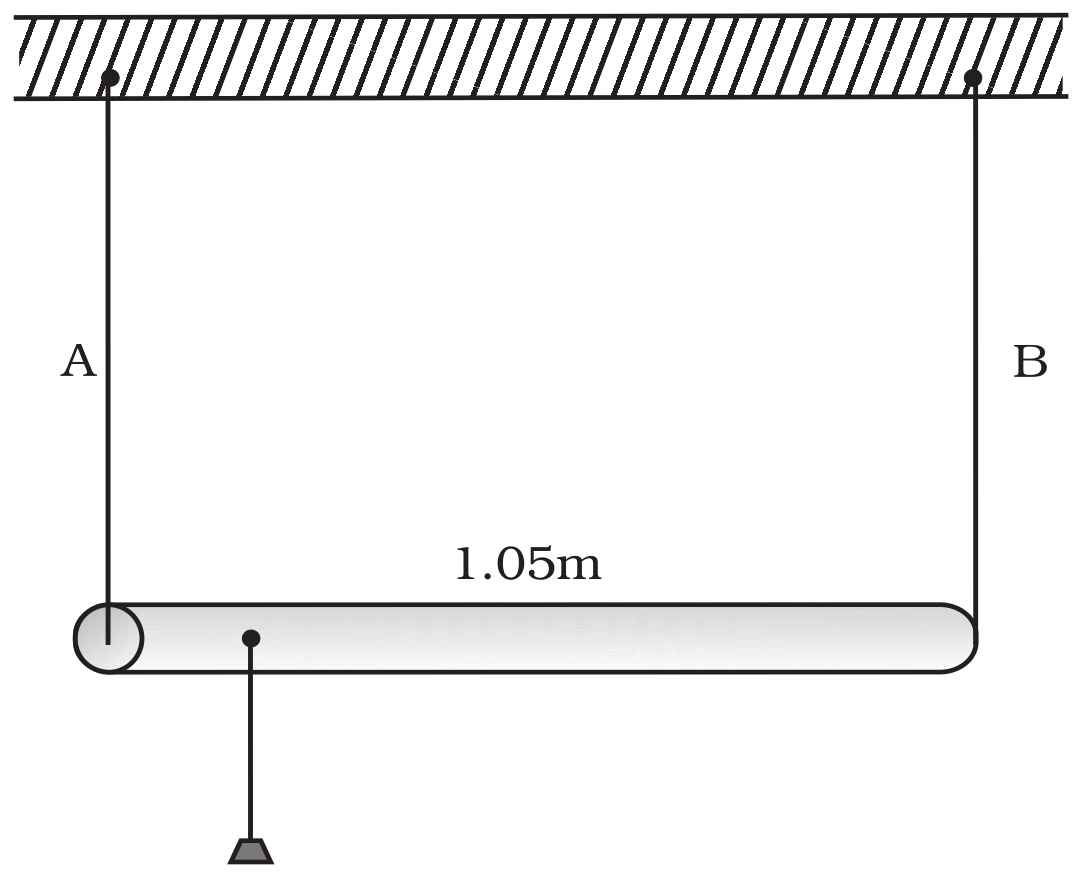
Answer
- 0.7m from the steel-wire end
Let a small mass m be suspended to the rod at a distance y from the end where wire A is attached.
Stress in wire $=\frac{\text{Force}}{\text{Area}}=\frac{\text{F}}{\text{a}}$
If the two wires have equal stresses, then:
$\frac{\text{F}_1}{\text{a}_1}=\frac{\text{F}_2}{\text{a}_2}$
Where
$F_1$ = Force exerted on the steel wire
$F_2$ = Force exerted on the aluminum wire
$\frac{\text{F}_1}{\text{F}_2}=\frac{\text{a}_1}{\text{a}_2}=\frac{1}{2}\ ....(1)$
The situation is shown in the following figure.
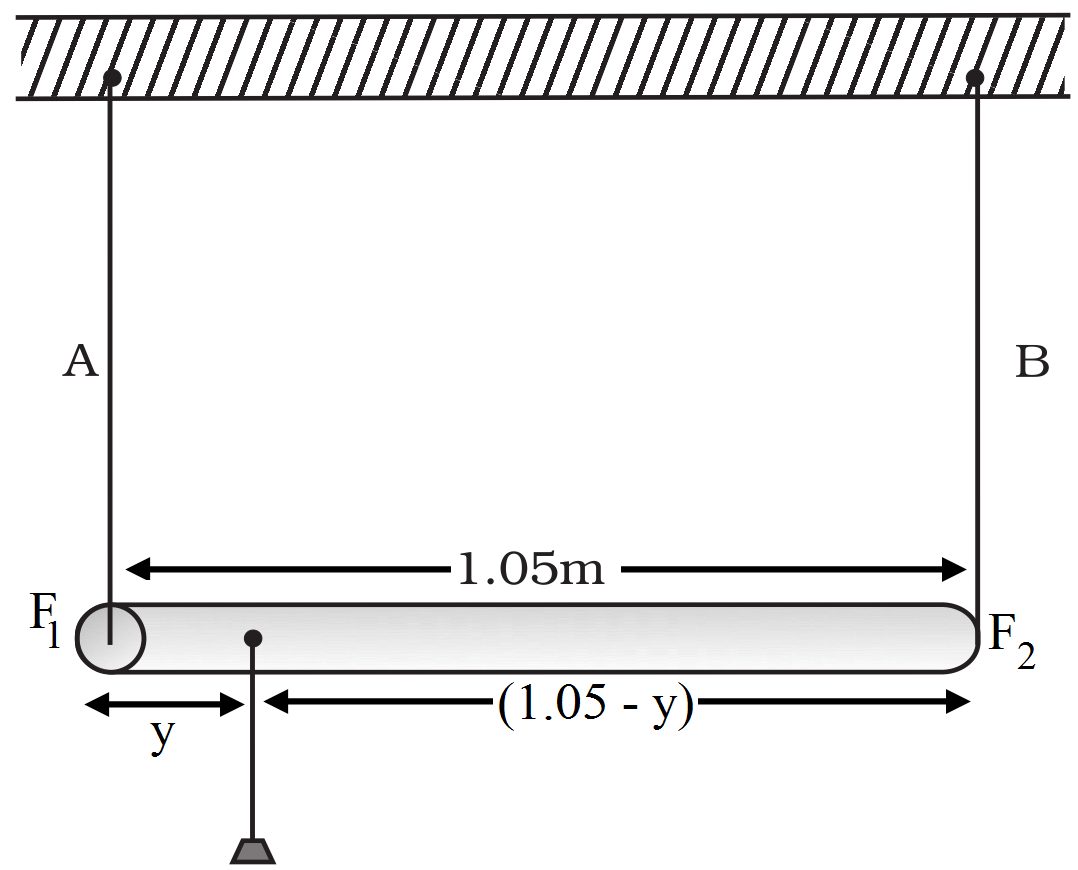
Taking torque about the point of suspension, we have:
$\text{F}_1\text{y}=\text{F}_2(1.05-\text{y})$
$\frac{\text{F}_1}{\text{F}_2}=\frac{1.05-\text{y}}{\text{y}}\ .....(2)$
Using equations (1) and (2), we can write:
$\frac{1.05-\text{y}}{\text{y}}=\frac{1}{5}$
$2(1.05 - y) = y$
$2.1 - 2y = y$
$3y = 2.1$
$\therefore$ y = 0.7m
In order to produce an equal stress in the two wires, the mass should be suspended at a distance of 0.7m from the end where wire A is attached.
- 0.432m from the steel-wire end
Cross-sectional area of wire A, $a_1 = 1.0mm^2= 1.0 \times 10^{–6}m^2$
Cross-sectional area of wire B, $a_2 = 2.0mm^2= 2.0 \times 10^{–6}m^2$
Young’s modulus for steel, $Y_1 = 2 \times 10^{11}Nm^{–2}$
Young’s modulus for aluminium, $Y_2 = 7.0 \times 10^{10}Nm^{–2}$
Young’s modulus $=\frac{\text{Stress}}{\text{Strain}}$
$\text{Strain}=\frac{\text{Stress}}{\text{Young's modulus}}=\frac{\text{a}}{\text{Y}}$
$\frac{\frac{\text{F}_1}{\text{a}_1}}{\text{Y}_1}=\frac{\frac{\text{F}_2}{\text{a}_2}}{\text{Y}_2}$
$\frac{\text{F}_1}{\text{F}_2}=\frac{\text{a}_1}{\text{a}_2}\frac{\text{Y}_1}{\text{Y}_2}=\frac{1}{2}\times\frac{2\times10^{11}}{7\times10^{10}}=\frac{10}{7}\ .....(3)$
Taking torque about the point where mass m, is suspended at a distance $y_1$ from the side where wire A attached, we get:
$F_1y_1 = F_2(1.05 - y_1)$
$\frac{\text{F}_1}{\text{F}_2}=\frac{1.05-\text{y}_1}{\text{y}_1}\ .....(4)$
Using equations (3) and (4), we get:
$\frac{(1.05-\text{y}_1)}{\text{y}_1}=\frac{10}{7}$
$7(1.05 - y_1) = 10y_1$
$17y_1 = 7.35$
$\therefore y_1 = 0.432$
In order to produce an equal strain in the two wires, the mass should be suspended at a distance of $0.432m$ from the end where wire A is attached. View full question & answer→Question 75 Marks
Two wires of diameter $0.25cm$, one made of steel and the other made of brass are loaded as shown in Fig. The unloaded length of steel wire is $1.5m$ and that of brass wire is $1.0m$. Compute the elongations of the steel and the brass wires.
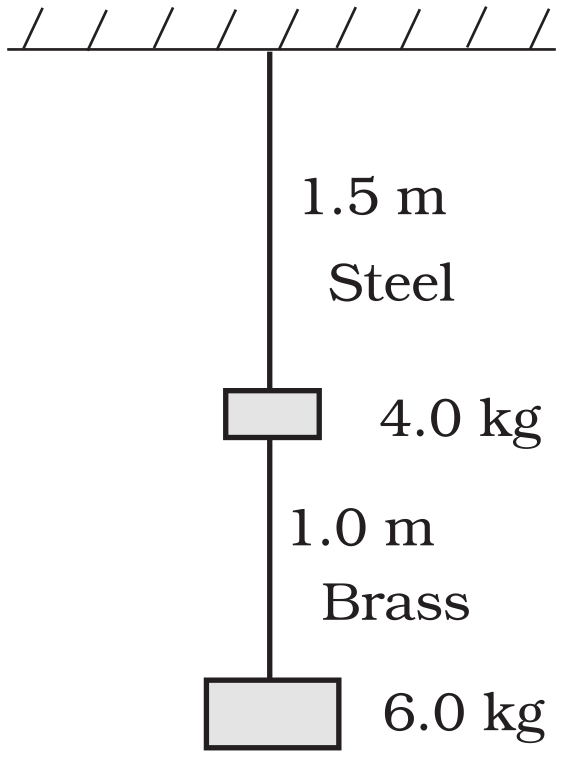
AnswerElongation of the steel wire $=1.49 \times 10^{-4} \mathrm{~m}$ Elongation of the brass wire $=1.3 \times 10^{-4} \mathrm{~m}$ Diameter of the wires, $\mathrm{d}=$ 0.25 m Hence, the radius of the wires, $\mathrm{r}=\mathrm{d} / 2=0.125 \mathrm{~cm}$ Length of the steel wire, $\mathrm{L}_1=1.5 \mathrm{~m}$ Length of the brass wire, $\mathrm{L}_2=1.0 \mathrm{~m}$ Total force exerted on the steel wire: $F_1=(4+6) \mathrm{g}=10 \times 9.8=98 \mathrm{~N}$ Young's modulus for steel:
$\mathrm{Y}_1=\frac{\left(\frac{\mathrm{F}_1}{\Lambda_1}\right)}{\left(\frac{\Delta \mathrm{L}_1}{\mathrm{~L}_1}\right)}$ Where, $\Delta \mathrm{L}_1=$ Change in the length of the steel wire $\mathrm{A}_1=$ Area of cross-section of the steel wire $=\pi r_1^2$ Young's modulus of steel, $\mathrm{Y}_1=2.0 \times 10^{11} \mathrm{~Pa} \therefore \Delta \mathrm{~L}_1=\frac{\mathrm{F}_1 \times \mathrm{L}_1}{\mathrm{~A}_1 \times \mathrm{Y}_1}=\frac{\mathrm{F}_1 \times \mathrm{L}_1}{\pi \mathrm{r}_1^2 \times \mathrm{Y}_1}$
$=\frac{98 \times 1.5}{\pi\left(0.125 \times 10^{-2}\right)^2 \times 2 \times 10^{11}}=1.49 \times 10^{-4} \mathrm{~m}$ Total force on the brass wire: $\mathrm{F}_2=6 \times 9.8=58.8 \mathrm{~N}$ Young's modulus for brass: $\mathrm{Y}_2=\frac{\left(\frac{\mathrm{P}_2}{\Lambda_2}\right)}{\left(\frac{\Delta \mathrm{L}_2}{\mathrm{~L}_2}\right)}$ Where, $\Delta \mathrm{L}_2=$ Change in length $\mathrm{A}_2=$ Area of cross-section of the wire $\therefore \Delta \mathrm{L}_2=\frac{\mathrm{F}_2 \times \mathrm{L}_2}{\mathrm{~A}_2 \times \mathrm{Y}_2}=\frac{\mathrm{F}_2 \times \mathrm{L}_2}{\pi \mathrm{I}_2^2 \times \mathrm{Y}_2}=\frac{58.8 \times 1.0}{\pi \times\left(0.125 \times 10^{-2}\right)^2 \times\left(0.91 \times 10^{1 \mathrm{I}}\right)}=1.3 \times 10^{-4} \mathrm{~m}$ Elongation of the steel wire $=1.49 \times$
$10^{-4} \mathrm{~m}$ Elongation of the brass wire $=1.3 \times 10^{-4} \mathrm{~m}$
View full question & answer→Question 85 Marks
What is the density of water at a depth where pressure is $80.0$ atm, given that its density at the surface is $1.03 \times 103kg m^{-3}$?
AnswerLet the given depth be h. Pressure at the given depth, $p = 80.0 atm = 80 \times 1.01 \times 10^5Pa$ Density of water at the surface, $\rho_1 = 1.03 \times 10^3kg m^{–3}$ Let $\rho_2$ be the density of water at the depth h. Let $V_1$ be the volume of water of mass m at the surface. Let $V_2$ be the volume of water of mass m at the depth h. Let $\Delta\text{V}$ be the change in volume.$\Delta\text{V} = \text{V}_1 – \text{V}_2$
$=\text{m}\Big[\Big(\frac{1}{\rho_1}\Big)-\Big(\frac{1}{\rho_2}\Big)\Big]$
$\therefore$ Volumetric strain $=\frac{\Delta\text{V}}{\text{V}_1}$$=\text{m}\Big[\Big(\frac{1}{\rho_1}\Big)-\Big(\frac{1}{\rho_2}\Big)\Big]\times\Big(\frac{\rho_1}{\text{m}}\Big)$
$\frac{\Delta\text{V}}{\text{V}_1}= 1 – \Big(\frac{\rho_1}{\rho_2}\Big)\ ......(1)$
Bulk modulus, $\mathrm{B}=\mathrm{pV} / \Delta \mathrm{V} \Delta \mathrm{V} / \mathrm{V}_1=\mathrm{p} / \mathrm{B}$ Compressibility of water $=(1 / \mathrm{B})=45.8 \times 10^{-11} \mathrm{~Pa}^{-1} \therefore \Delta \mathrm{~V} / \mathrm{V}_1=80 \times 1.013 \times$ $10^5 \times 45.8 \times 10^{-11}=3.71 \times 10^{-3} \ldots \ldots . .(2)$ For equations (1) and (2), we get: $1-\left(\frac{\rho_1}{\rho_2}\right)=3.71 \times 10^{-3} \rho_2=1.03 \times 10^3 /[1- \left.\left(3.71 \times 10^{-3}\right)\right]=1.034 \times 10^3 \mathrm{~kg} \mathrm{~m}^{-3}$ Therefore, the density of water at the given depth $(\mathrm{h})$ is $1.034 \times 10^3 \mathrm{~kg} \mathrm{~m}^{-3}$.
View full question & answer→Question 95 Marks
A rigid bar of mass $15kg$ is supported symmetrically by three wires each $2.0m$ long. Those at each end are of copper and the middle one is of iron. Determine the ratios of their diameters if each is to have the same tension.
AnswerTension force acting on each wire is the same. Hence, the extension is the same for each wire. Since, the wires are of the same length, the strain will also be same. Young's modulus is given by, $\text{Y}=\frac{\text{Stress}}{\text{Strain}}=\frac{\frac{\text{F}}{\text{A}}}{\text{Strain}}=\frac{\frac{4\text{F}}{\pi\text{d}^2}}{\text{Strain}}\ ....(1)$ where, F = Tension force A = Area of cross-section d = Diameter of the wire From equation (1), we have $\text{Y}\propto\Big(\frac{1}{\text{d}^2}\Big)$ Young's modulus for iron, $Y_1 = 190 \times 10^9Pa$ Diameter of the iron wire = $d_1$ Young's modulus for copper, $Y_2 = 120 \times 10^9Pa$ Diameter of the copper wire = $d_2$ Therefore, Ratio of their diameters is given by, $\frac{\text{d}_1}{\text{d}_2}=\sqrt{\frac{\text{Y}_1}{\text{Y}_2}}=\sqrt{\frac{190\times10^9}{120\times10^9}}=\sqrt{\frac{19}{12}}$
View full question & answer→Question 105 Marks
Two cylinders A and B of radii r and 2r are soldered co-axially. The free end of A is clamped and the free end of B is twisted by an angle $\phi.$ Find twist at the junction taking the material of two cylinders to be same and of equal length.
AnswerLet $\tau$ be the torque applied at the free end and $\phi'$ be the angle of twist at the junction. Then, $\tau=\frac{\pi\eta\text{r}^4\phi'}{2\text{l}}=\frac{\pi\eta(2\text{r})^4(\phi-\phi')}{2\text{l}}$ or $\phi'=\frac{16\phi}{17}$
View full question & answer→Question 115 Marks
Identical springs of steel and copper are equally stretched. On which, more work will have to be done?
AnswerKey concept: Work Done in stretching a Wire or Spring. In stretching a wire work is done against internal restoring forces. This work is stored in the wire as elastic potential energy or strain energy. If a force F acts along the length L of the wire of cross - section A and stretches it by x, then $\text{Y}=\frac{\text{stress}}{\text{strain}}=\frac{\text{F/A}}{\text{x/L}}=\frac{\text{FL}}{\text{Ax}}\Rightarrow\text{F}=\frac{\text{YA}}{\text{L}}\text{x}$ So the work done for an additional small increase dx in length, $\text{dW}=\text{Fdx}=\frac{\text{YA}}{\text{L}}\text{x}.\text{dx}$ Hence the total work done in increasing the length by I, $\text{w}=\int^1_0\text{dw}=\int^1_0\text{fdx}=\int^1_0\frac{\text{YA}}{\text{L}}\text{ xdx}=\frac{1}{2}\frac{\text{YA}}{\text{L}}\text{ l}^2$ This work done is stored in the wire. According to this problem work done in stretching a wire is given by $\text{W}=\frac{\text{YAl}^2}{2\text{L}}$ As springs of steel and copper are equally stretched. Therefore, for same force (F), $\text{W}\propto\Delta\text{l}\ ...(\text{i})$ As both springs are identical, so A and L are same. $\Delta\text{l}\propto\frac{\text{l}}{\text{Y}}\ ...(\text{ii})$ From eqs. (i) and (ii), we get $\text{W}\propto\frac{\text{l}}{\text{Y}}$ $\therefore \frac{\text{W}_\text{steel}}{\text{W}_\text{copper}}=\frac{\text{Y}_\text{copper}}{\text{Y}_\text{steel}}<(\text{As, Y}_\text{steel}>\text{Y}_\text{copper})$ $\Rightarrow\text{W}_\text{steel}>\text{W}_\text{copper}$Hence, more work will be done in case of spring made of copper.
View full question & answer→Question 125 Marks
The Marina trench is located in the Pacific Ocean, and at one place it is nearly eleven km beneath the surface of water. The water pressure at the bottom of the trench is about $1.1 \times 10^8 Pa$. A steel ball of initial volume $0.32m^3$ is dropped into the ocean and falls to the bottom of the trench. What is the change in the volume of the ball when it reaches to the bottom?
AnswerWater pressure at the bottom, $p = 1.1 \times 10^8$ Pa Initial volume of the steel ball, $V = 0.32m^3$ Bulk modulus of steel, $B = 1.6 \times 10^{11}Nm^{–2}$^ The ball falls at the bottom of the Pacific Ocean, which is 11km beneath the surface. Let the change in the volume of the ball on reaching the bottom of the trench be $\Delta\text{V}.$ Bulk modulus, $\text{B}= \frac{\text{p}}{\big(\frac{\Delta\text{V}}{\text{V}}\big)}$$\Delta\text{V} = \frac{\text{B}}{\text{pV}}$
$= 1.1 \times 10^8 \times 0.32/(1.6 \times 10^{11} ) = 2.2 \times 10^{-4}m^3$
Therefore, the change in volume of the ball on reaching the bottom of the trench is $2.2 \times 10^{–4}m^3$.
View full question & answer→Question 135 Marks
A $14.5kg$ mass, fastened to the end of a steel wire of unstretched length $1.0m$, is whirled in a vertical circle with an angular velocity of $2rev/s$ at the bottom of the circle. The cross-sectional area of the wire is $0.065cm^2$. Calculate the elongation of the wire when the mass is at the lowest point of its path.
AnswerMass, m = 14.5kg Length of the steel wire, l = 1.0m Angular velocity, $\omega= 2\text{ rev/s} = 2 × 2\pi\text{ rad/s}$ = 12.56rad/s Cross-sectional area of the wire, $a = 0.065cm^2 = 0.065 \times 10^{-4}m^2$ Let $\Delta\text{l}$ be the elongation of the wire when the mass is at the lowest point of its path. When the mass is placed at the position of the vertical circle, the total force on the mass is:$\text{F}=\text{mg}+\text{ml}\omega^2$
$= 14.5 \times 9.8 + 14.5 \times 1 \times (12.56)^2 = 2429.53N$ Young's modulus $=\frac{\text{Stress}}{\text{Strain}}$ $\text{Y}=\frac{\frac{\text{F}}{\text{A}}}{\frac{\Delta\text{l}}{\text{l}}}=\frac{\text{F}}{\text{A}}\frac{\text{l}}{\Delta\text{l}}$
$\therefore\ \Delta\text{l}=\frac{\text{Fl}}{\text{AY}}$ Young’s modulus for steel = $2 \times 10^{11}$ Pa $\Delta\text{l}=\frac{2429.53\times1}{0.065\times10^{-4}\times2\times10^{11}}$ $\Rightarrow\ \Delta\text{l}=1.87\times10^{-3}\text{m}$ Hence, the elongation of the wire is $1.87 \times 10^{-3}m$.
View full question & answer→Question 145 Marks
A truck is pulling a car out of a ditch by means of a steel cable that is $9.1m$ long and has a radius of $5mm$. When the car just begins to move, the tension in the cable is $800N$. How much has the cable stretched? (Young’s modulus for steel is $2 \times 10^{11}N m^{–2}.)$
AnswerLength of cable,$L = 9.1m r = 5mm = 5 \times 10^{-3}m$, $\text{A}=\pi\text{r}^2$ Tension in cable = $F = 800N Y = 2 \times 10^{11}N m^{-2}$ $\Delta\text{L}=\frac{\text{FL}}{\text{AY}}=\frac{800\times9.10}{3.14\times10^{-3}\times10^{-3}\times5\times5\times2\times10^{11}}$ $\Delta\text{L}=\frac{800\times910\times10^{-11+6}}{314\times5\times5\times2}$ $=\frac{728}{157}\times10^{-5\text{m}}=4.64\times10^{-5}\text{m}$ $\Delta\text{L}=4.64\times10^{-5}\text{m}.$
View full question & answer→Question 155 Marks
Compute the bulk modulus of water from the following data: Initial volume = 100.0 litre, Pressure increase = 100.0 atm ($1 atm = 1.013 × 10⁵ Pa$), Final volume = 100.5 litre. Compare the bulk modulus of water with that of air (at constant temperature). Explain in simple terms why the ratio is so large.
AnswerInitial volume, $V_1 = 100.0l = 100.0 \times 10^{–3}m^3$ Final volume, $V_2 = 100.5l = 100.5 \times 10^{–3}m^3$ Increase in volume, $\Delta\text{V} = \text{V}_2 – \text{V}_1 = 0.5 \times 10^{–3}m^3$ Increase in pressure, $\Delta\text{p} = 100.0 \text{ atm} = 100 \times 1.013 \times 10^5$ Pa Bulk modulus $=\frac{\Delta\text{P}}{\frac{\Delta\text{V}}{\text{V}_1}}=\frac{\Delta\text{p}\times\text{V}_1}{\Delta\text{V}}$
$=\frac{100\times1.013\times10^5\times100\times10^{-3}}{0.5\times10^{-3}}$
$=2.026\times10^9\text{ Pa}$ Bulk modulus of air = $1.0 \times 10^5$ Pa
$\therefore\ \frac{\text{Bulk modulus of water}}{\text{Bulk modulus of air}}=\frac{2.026\times10^{9}}{1.0\times10^5}=2.026\times10^4$This ratio is very high because air is more compressible than water.
View full question & answer→Question 165 Marks
A steel rod $\left(Y=2.0 \times 10^{11} \mathrm{~N} \mathrm{~m}^{-2}\right.$, and $\left.\alpha=10^{-50} \mathrm{C}^{-1}\right)$ of length 1 m and area of cross-section 1 cm 2 is heated from $0^{\circ} \mathrm{C}$ to $200^{\circ} \mathrm{C}$, without being allowed to extend or bend. What is the tension produced in the rod?
Answer$\therefore\text{L}_\text{t}=\text{L}_0(1+\alpha\Delta\text{t})$ $\text{L}_\text{t}-\text{L}_0=\text{L}_0\alpha.\Delta\text{t}$ $\Delta\text{L}=1\times10^{-5}\times200=2\times10^{-3}$ $\text{Y}=\frac{\text{FL}_0}{\text{A}\Delta\text{L}}\ \ \ \text{L}_0=1\text{m}$ $\therefore\text{F}=\frac{\text{YA}\Delta\text{L}}{\text{L}_0}\ \ \ \text{A}=1\text{cm}^2=10^{-4}\text{ m}^2$ $\text{Y}=2\times10^{11}\text{Nm}^{-2}$ $\Delta\text{L}=2\times10^{-3}\text{m}$ $\text{F}=\frac{2\times10^{11}\times10^{-4}\times2\times10^{-3}}{1}$ $=4\times10^{11-7}=4\times10^4\text{N}.$
View full question & answer→Question 175 Marks
The edge of an aluminium cube is $10cm$ long. One face of the cube is firmly fixed to a vertical wall. A mass of $100kg$ is then attached to the opposite face of the cube. The shear modulus of aluminium is $25G$ Pa. What is the vertical deflection of this face?
AnswerEdge of the aluminium cube, $\mathrm{L}=10 \mathrm{~cm}=0.1 \mathrm{~m}$ The mass attached to the cube, $\mathrm{m}=100 \mathrm{~kg}$ Shear modulus $(\eta)$ of aluminium $=25 \mathrm{GPa}=25 \times 10^9$ Pa Shear modulus, $\eta=$ Shear stress $/$ Shear strain $=(\mathrm{F} / \mathrm{A}) /(\mathrm{L} / \Delta \mathrm{L})$ Where, $\mathrm{F}=$ Applied force $=\mathrm{mg}=100 \times 9.8=980 \mathrm{NA}=$ Area of one of the faces of the cube $=0.1 \times 0.1=0.01 \mathrm{~m}^2 \Delta \mathrm{~L}=$ Vertical deflection of the cube $\therefore \Delta \mathrm{L}=\frac{\mathrm{FL}}{\mathrm{A} \eta}=980 \times 0.1 /\left[10^{-2} \times\left(25 \times 10^9\right)\right]=3.92 \times 10^{-7} \mathrm{~m}$ The vertical deflection of this face of the cube is $3.92 \times$ $10^{-7} \mathrm{~m}$
View full question & answer→Question 185 Marks
When a load on a wire is increased from 3kg wt to 5kg wt., the elongation increases from 0.61mm to 1.02mm. How much work is done during the extension of the wire?
Answer$\text{W}_1=\frac{1}{2}.\text{F}\times\text{l}$ $=\frac{1}{2}\times3\times9.8\times0.61\times10^{-3}\text{J}$ $\text{W}_2=\frac{1}{2}.\text{F}\times\text{l}$ $=\frac{1}{2}\times5\times9.8\times1.02\times10^{-3}\text{J}$ $\therefore$ Net work done during the extensions, $\text{W}=\text{W}_2-\text{W}_1$ $=\Big(\frac{1}{2}\times5\times9.8\times1.02\times10^{-3}\Big)$ $-\Big(\frac{1}{2}\times3\times9.8\times0.61\times10^{-3}\Big)$ $=\frac{1}{2}\times9.8\times10^{-3}[5 \times1.02-3\times0.61]$ $=\frac{1}{2}\times9.8\times10^{-3}[5.10-1.83]$ $=\frac{1}{2}\times9.8\times10^{-3}\times3.27=16.023\times10^{-3}\text{J}$
View full question & answer→Question 195 Marks
Why a hollow shaft is stronger than a solid shaft made from the same and equal amounts of material?
AnswerThe torque required to produce a unit twist in a solid shaft of radius r is given by, $\tau=\frac{\pi\eta\text{r}^4}{2\text{l}},\ ...(1)$ where $\eta$ is the modulus of rigidity of the material and l is the length of the shaft. The torque required to produce a unit twist in a hollow shaft of inner and outer radii $r_i$ and $r_0$ is given by, $\tau=\frac{\pi\eta\big(\text{r}^4_0-\text{r}^4_\text{i}\big)}{2\text{l}}=\frac{\pi\eta\big(\text{r}^2_0-\text{r}^2_\text{i}\big)\big(\text{r}^2_0+\text{r}^2_\text{i}\big)}{2\text{l}}$ Dividing (2) by (1) we get, $\frac{\tau'}{\tau}=\frac{\big(\text{r}^2_0-\text{r}^2_\text{i}\big)\big(\text{r}^2_0+\text{r}^2_\text{i}\big)}{\text{r}^4}$ Since the two shafts are made of the same material and the amounts of material are equal, $\therefore\pi\text{r}^2\text{l}=\pi\big(\text{r}^2_0-\text{r}^2_\text{i}\big)\text{l}\ \text{or}\ \text{r}^2=\text{r}^2_0-\text{r}^2_\text{i}$ From (3), $\frac{\tau'}{\tau}=\frac{\text{r}^2_0+\text{r}^2_\text{i}}{\text{r}^2}\ \text{or} \frac{\tau'}{\tau}>1\ \text{or}\ \tau'>\tau$ The torque required to twist a hollow shaft is clearly more than the torque required to twist a solid shaft. Thus, hollow shaft is stronger than a solid shaft.
View full question & answer→Question 205 Marks
An equilateral triangle ABC is formed by two Cu rods AB and BC and one Al rod. It is heated in such a way that temperature of each rod increases by $\Delta\text{T}$. Find change in the angle ABC. $[$Coeff. of linear expansion for 1 Cu is $\alpha_1$ Coeff. of linear expansion for 2Al is $\alpha_2]$
AnswerBy trigonometry $\cos\theta=\frac{\text{l}_1^2+\text{l}_3^2-\text{l}_2^2}{2\text{l}_1\text{l}_3}$ $2\text{l}_1\text{l}_3\cos\theta=\text{l}_1^2+\text{l}_3^2-\text{l}_2^2$ 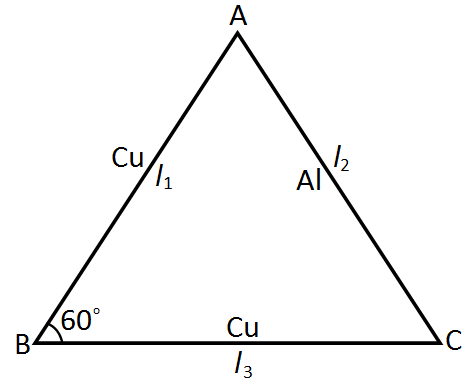 Differentiating both sides $2\big[\text{d}(\text{l}_1\text{l}_3)\cdot\cos\theta+\text{l}_1\text{l}_3\text{d}(\cos\theta)\big]=2\text{l}_1\text{dl}_1+2\text{l}_3\text{dl}_3-2\text{l}_2\text{dl}_2$ $2\big[(\text{l}_1\text{dl}_3+\text{l}_3\text{dl}_1)\cos\theta-\text{l}_1\text{l}_3\sin\theta\text{ d}\theta\big]=2(\text{l}_1\text{dl}_1+\text{l}_3\text{dl}_3-\text{l}_2\text{dl}_2)$ $(\text{l}_1\text{dl}_3+\text{l}_3\text{dl}_1)\cos\theta-1_1\text{l}_3\sin\theta\text{ d}\theta=1_1\text{dl}_1+\text{l}_3\text{dl}_3-\text{l}_2\text{dl}_2\ \ \ (\text{i})$ $\text{L}_\text{t}=\text{L}_0(1+\alpha\Delta\text{t})$ $\text{L}_\text{t}-\text{L}_0(\text{L}_0\alpha\Delta\text{t})$ $\Delta\text{L}=\text{L}\alpha.\Delta\text{t})$ $\text{dl}_1=\text{l}_1\alpha_1\Delta\text{t}_2\text{ dl}_3=\text{l}_2\alpha_1\Delta\text{t}$ and $\text{dl}_2=\text{l}_2\alpha_2\Delta\text{t}$ $\text{l}_1=\text{l}_2=\text{l}_3=\text{l}$ $\therefore\text{dl}_1=\text{l}\alpha_1\Delta\text{t}_2\text{ dl}_3=\text{l}\alpha_1\Delta\text{t}$ $\text{}$and $\text{dl}_2=\text{l}\alpha_2\Delta\text{t}$ Substitute their value in (i) $\cos\theta(\text{l}^2.\alpha_1\Delta\text{t}+\text{l}^2\alpha\Delta\text{t})-\text{l}^2\sin\theta\text{ d}\theta=\text{l}^2\alpha_1\Delta\text{t}+\text{l}^2\alpha_1\Delta\text{t}-\text{l}^2\alpha_2\Delta\text{t}$ $2\text{l}^2\alpha_1\Delta\text{t}\cos\theta-\text{ l}^2[\sin\theta.\text{d}\theta]=\text{l}^2[\alpha_1+\alpha_1-\alpha_2]\Delta\text{t}$ $\text{l}^2[2\alpha_1\Delta\text{t}\cos60^0-\sin60^0\text{d}\theta]=\text{l}^2[2\alpha_1-\alpha_2]\Delta\text{t}$ $2\alpha_1\Delta\text{t}\times\frac{1}{2}-2\alpha_1\Delta\text{t}+\alpha_2\Delta\text{t}=\frac{\sqrt{3}}{2}\text{d}\theta$ $\frac{\sqrt{3}}{2}\text{d}\theta=[\alpha_1-2\alpha_1+\alpha_2]\Delta\text{t}$ $\text{d}\theta=\frac{2(\alpha_2-\alpha_1)\Delta\text{t}}{\sqrt{3}}$ $[\therefore\Delta\text{t}=\Delta\text{T (given)}]$ $\text{d}\theta=\frac{2(\alpha_2-\alpha_1)\Delta\text{T}}{\sqrt{3}}$
 View full question & answer→Question 215 Marks
The Stress-Strain graph for a metal wire is shown in the figure upto the point E. The wire returns to its original state O along the curve EPO when it is gradually unloaded. Point B corresponds to the fracture of the wire:
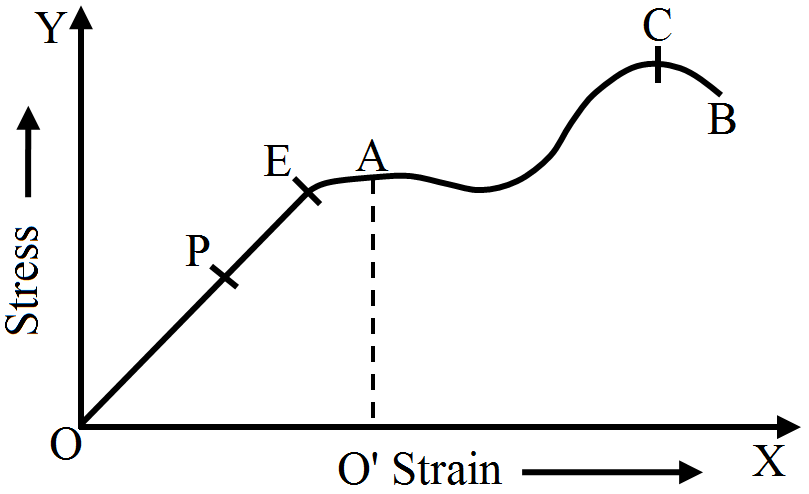
- Upto what point of the curve is Hooke's law obeyed?
- Which point on the curve corresponds to the elastic limit or yield point of the wire?
- Indicate the elastic and plastic regions of the Stress-Strain graph.
- Describe what happens when the wire is loaded upto a stress corresponding to the point A on the graph, and then unloaded gradually. In particular, explain, the dotted curve.
- What is peculiar about the portion of the Stress-Strain graph from C to B? Upto what stress can the wire be subjected without causing fracture?
Answer
- Upto the point P. It has to be slightly below E.
- Point E.
- Elastic region: O to E.
Plastic region: E to B.
- Strain increases in proportion to the load upto P. But beyond P, it increases by an increasingly greater amount for a given increase in the load. Beyond the elastic limit E, it does not retrace the curve backward. The wire is unloaded but returns to 'O' along the dotted line 'AO'. Point 'O' corresponding to zero load which implies a permanent strain in wire.
- From C to B, strain increases even if the wire is being unloaded and at B it fractures. Stress upto that corresponding to C can be applied without causing fracture.
View full question & answer→Question 225 Marks
A wire of length I and area of cross-section A is stretched by the application of a force. If the Young's modulus is Y, what is the work done per unit volume?
AnswerThe wire has length l, area of cross-section A made of material constant Y. Let a force F be applied and at any instance, x be the extension associated (x < L), where L is the maximum extension. At this instant, F, $=\frac{\text{AY}.\text{x}}{\text{l}}$ Since force is a variable with r, Work done to stretch is, $\text{W}=\int\limits^\text{L}_\text{0}\text{Fdx}=\frac{1}{2}\frac{\text{AY}}{\text{l}}.\text{L}^2$ $\text{W}=\frac{1}{2}(\text{Al})\Big(\frac{\text{Y.L}}{\text{l}}\Big)\Big(\frac{\text{L}}{\text{l}}\Big)$ $=\frac{1}{2}\text{Volume}\times\text{Stress}\times\text{Strain}$ $\therefore$ Work done per unit volume $=\frac{1}{2}\text{Stress}\times\text{Stain}$
View full question & answer→Question 235 Marks
A rubber string 10 m long is suspended from a rigid support at its one end. Calculate the extension in the string due to its own weight. The density of rubber is $1.5 \times 10^3 \mathrm{~kg} / \mathrm{m}$ and Young's modulus for the rubber is $5 \times 100 \mathrm{~N} / \mathrm{m}^2$. The breaking stress for a metal is $7.8 \times 10^9 \mathrm{~N} / \mathrm{m}^2$. Calculate the maximum length of the wire made of this metal with may be suspended without breaking. The density of metal $=7.8 \times 10^3 \mathrm{~kg} / \mathrm{m}^3$.
Answer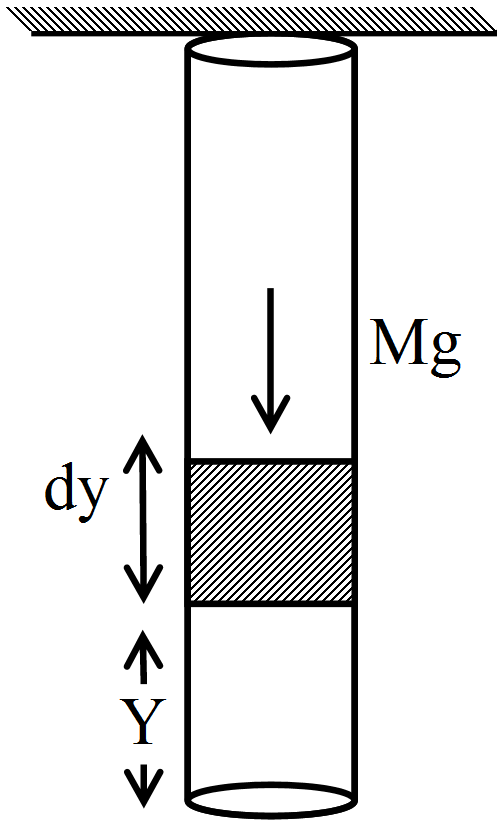
$\text{l}=10\text{m}.\rho=1.5\times10^3\text{kg/m}^3$ $\text{Y}=5\times10^6\text{N/m}^2$ We know, $\text{Y}=\frac{\text{F}.\text{l}}{\text{A}.\Delta\text{l}}$ Eficient force = Mg Consider a small length dy at a distance y from free end. The length above this, (l - y) will experience a force of $\text{F}_{\text{dx}}=\frac{\text{M}}{\text{l}}(\text{dy}).\text{gdy}$ View full question & answer→Question 245 Marks
Two long metallic strips are joined together by two rivets each of radius $0.1cm$ (see Fig.).
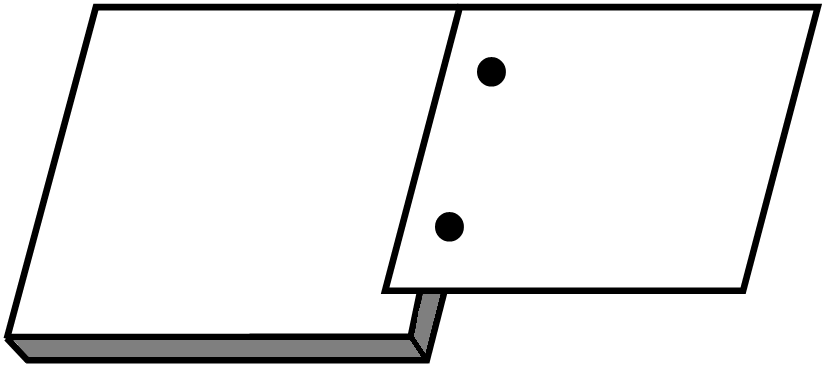
Each rivet can withstand a maximum shearing stress of $3.0 \times 10^8Nm^{-2}$. Calculate the maximum tangential force a strip can exert. AnswerLet F be the tensile force applied. Since, each rivet shares the stretching force equally, so the shearing force on each rivet $=\frac{\text{F}}{2}.$ If A is the area of each rivet, then shearing stress on each rivet $=\frac{\text{F}}{2\text{A}}.$
Now, maxirnum shearing stress on each, strip = $3.0 \times 10^8Nm^{-2}$ i.e., $\frac{\text{F}_\text{max}}{2\text{A}}=3.0\times10^8\text{Nm}^{-2}$ where, $F_{max}$ is maxinum tangential force. or $\text{F}_\text{max}=3.0\times10^8\times2\text{A}=6.0\times10^8\times\pi\text{r}^2$
$\therefore\text{r}=0.1\text{cm}\Rightarrow0.1\times10^{-2}$ $\text{r}=1\times10^{-3}\text{m}$
$\Rightarrow\text{F}_\text{max}=6.0\times10^8\times\frac{22}{7}\times(1\times10^{-3})=1885\text{N}$
View full question & answer→Question 255 Marks
A 5cm cube has its upper face displaced by 0.2cm by a tangential force of 8N. Calculate the shearing strain, shearing stress and modulus of rigidity of the material of cube.
Answer$\text{L}=5\text{cm}=5\times10^{-2}\text{m}$ $\Delta\text{L}=0.2\text{cm}=0.2\times10^{-2}\text{m};\text{F}=8\text{N}$ Shearing strain $=\frac{\Delta\text{L}}{\text{L}}=\frac{0.2}{5}=0.04$ Shearing stress $=\frac{\text{F}}{\text{L}\times\text{L}}=\frac{8}{\big(5\times10^{-2}\big)^2}$ $=3200\text{N}/\text{m}^2$ Modulus of rigidity, $\eta=\frac{\text{Shearing Stress}}{\text{Shearing Strain}}$ $=\frac{3200}{0.04}=80000\text{N}/\text{m}^2$ $=8\times10^{4}\text{N}/\text{m}^2$
View full question & answer→Question 265 Marks
A spring balance reads 10kg when a bucket of water is suspended from it. What is the reading on the spring balance when:
- An ice cube of mass 1.5kg is put into the bucket?
- An iron piece of mass 7.8kg suspended by another string is immersed with half its volume inside the water in the bucket (Relative density of iron = 7.8)?
Answer
- The rading of the spring balance = 10kg + 1.5kg = 11.5kg.
- Mass of the iron piece m = 7.8kg
$\therefore$ Volume of the iron piece $=\frac{7.8}{7.8\times10^3}=10^3\text{m}^3$
Volume of the water immersed $=\frac{10^3}{2}\text{m}^3$
$\therefore$ Mass of the water displaced $=\frac{10^3}{2}\times10^{-3}=0.5\text{kg}$
$\therefore$ Reading ofthe spring balance $=(10+0.5)\text{kg}=10.5\text{kg}.$ View full question & answer→Question 275 Marks
A cable is replaced by another cable of the same length and material but twice the diameter. How will this affect the elongation under a given load?
AnswerLet Y be the Young's modulus of the material of the wire, L the length and D the diameter. Let the wire be loaded with a mass M kg. If $\Delta\text{l}$ is the elongation, we can write, $\Delta\text{l}=\frac{\text{MgL}}{\pi\Big(\frac{\text{D}}{2}\Big)^2\text{Y}}=\frac{4\text{MgL}}{\pi\text{D}^2\text{Y}}$ When the diameter is doubled for the same length (l) and mass (m), the elongation is given by: $\Delta\text{l}_1=\frac{\text{MgL}}{\pi\Big(\frac{2\text{D}}{2}\Big)^2\text{Y}}=\frac{\text{MgL}}{\pi\text{D}^2\text{Y}}$ $\therefore\frac{\Delta\text{l}_1}{\Delta\text{l}}=\frac{\text{MgL}}{\pi\text{D}^2\text{Y}}\times\frac{\pi\text{D}^2\text{Y}}{4\text{MgL}}=\frac{1}{4}$ or $\Delta\text{l}_1=\frac{1}{4}\Delta\text{l}$ Therefore, the elongation is one fourth the elongation with the diameter D of the wire.
View full question & answer→Question 285 Marks
10kg mass is attached to one end of a copper wire $3m$ long and $1mm$ in diameter. Calculate the lateral compression produced in it (Poisson's ratio is $0.25$ and Young's modulus of the material of the wire is $12.5 \times 10^{10}N/ m^2$).
AnswerLet Dl be the increase in length of the wire, $\therefore\text{Y}=\frac{\frac{\text{F}}{\text{A}}}{\frac{\Delta\text{l}}{\text{l}}}$
$\text{Y}=\frac{\text{F}.\text{l}}{\text{A.}\Delta\text{l}}$
$\text{Y}=\frac{\text{F}.\text{l}}{\pi\text{r}^2.\Delta\text{l}}$
$\therefore\Delta\text{l}=\frac{\text{F}.\text{l}}{\pi\text{r}^2.\text{Y}}=\frac{10\times9.8\times3}{3.14\times(0.5\times10^{-3})\times12.5\times10^{10}}$
$=0.2993\times10^{-2}\text{m}$ Now the Poisson's ratio $\sigma=-\frac{\Delta\text{D}}{\text{D}}\times\frac{\text{l}}{\Delta\text{l}}$
$\therefore\Delta\text{D}=\frac{\sigma.\text{D}.\Delta\text{l}}{\text{l}}=\frac{-0.2993\times10^{-3}\times0.25}{3}$
$=-2.5\times10^{-7}=-0.25\times10^{-6}=-0.25\mu\text{m}$ Here the lateral compression $=0.25\mu\text{m}$ (approx).
View full question & answer→Question 295 Marks
A rubber string 10 m long is suspended from a rigid support at its one end. Calculate the extension in the string due to its own weight. The density of rubber is $1.5 \times 10^3 \mathrm{~kg} / \mathrm{m}^3$ and Young's modulus for the rubber is $5 \times 10^6 \mathrm{~N} / \mathrm{m}^2$. The breaking stress for a metal is $7.8 \times 10^9 \mathrm{~N} / \mathrm{m}^2$. Calculate the maximum length of the wire made of this metal which may be suspended without breaking. The density of metal $=7.8 \times 10^3 \mathrm{~kg} / \mathrm{m}^3$.
Answer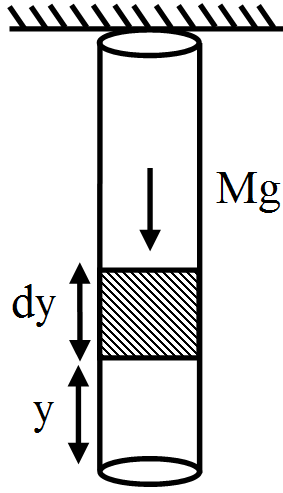
$\text{l}=10\text{m},\rho=15\times10^3\text{kg}\ \text{m}^3$
$\text{Y}=5\times10^6\text{N}\text{m}^2$ We know, $\text{Y}=\frac{\text{F.l}}{\text{A}\Delta\text{l}}$ Efficient force = Mg Consider a small length dy at a distance y from free end. The length above this, (l - y) wil experience a force of, $\text{F}_\text{dy}=\frac{\text{M}}{\text{l}}(\text{dy}).\text{gdy}$
$\therefore$ Extension dI $=\frac{\text{F}.\text{l}}{\text{AY}}$
$\Rightarrow\text{dl}=\frac{(\text{l}-\text{y})}{\text{AY}}.\frac{\text{M}}{\text{l}}\text{gdy}$
$=\frac{\text{Mg}}{\text{lAY}}(\text{l}-\text{y})\text{dy}$ Net extension due to its own weight} $=\int\text{dl}$
$=\frac{\text{Mg}}{\text{AYl}}\int(\text{l}-\text{y})$
$=\frac{\text{Mg}}{\text{lAY}}\Big[\text{ly}-\frac{\text{y}^2}{2}\Big]^\text{l}_0=\frac{\text{Mgl}}{2\text{AY}}$ Net extension $=\frac{\text{Mgl}}{2}=\frac{\text{Mgl}^2}{2\text{YV}}=\frac{\rho\text{gl}^2}{2\text{Y}}$ Extcnrion of rubbcer string, $=\frac{1.5\times10^3\times10\times10^2}{2\times5\times10^6}=0.15\text{m}$ Breaking stress for a metal = $7.8 \times 10^9N/ m^2$ Density = $7.8 \times 10^3kg/ m^3$. Stress $=\frac{\text{Force}}{\text{Area}}=\frac{\text{Mg}}{\text{A}}=\frac{\text{Mgl}}{\text{Al}}=\frac{\text{Mgl}}{\text{Volume}}\rho\text{gl}$ If $\rho\text{gl}>$ Breaking stress, the wire will break.
$\therefore\text{l}\leq\frac{7.8\times10^9}{\rho\text{g}},\text{l}\leq\frac{7.8\times10^9}{7.8\times10^3\times10}$ i.e., $\text{l}\leq10^5\text{m}$ Maximum length of wire = $10^5m$. View full question & answer→Question 305 Marks
A slightly tapering wire of length I and end radii a and b on both sides is subjected to the stretching forces F on both sides as shown in figure. If Y is the Young's modulus of the wire, calculate the extension produced in the wire.
Answer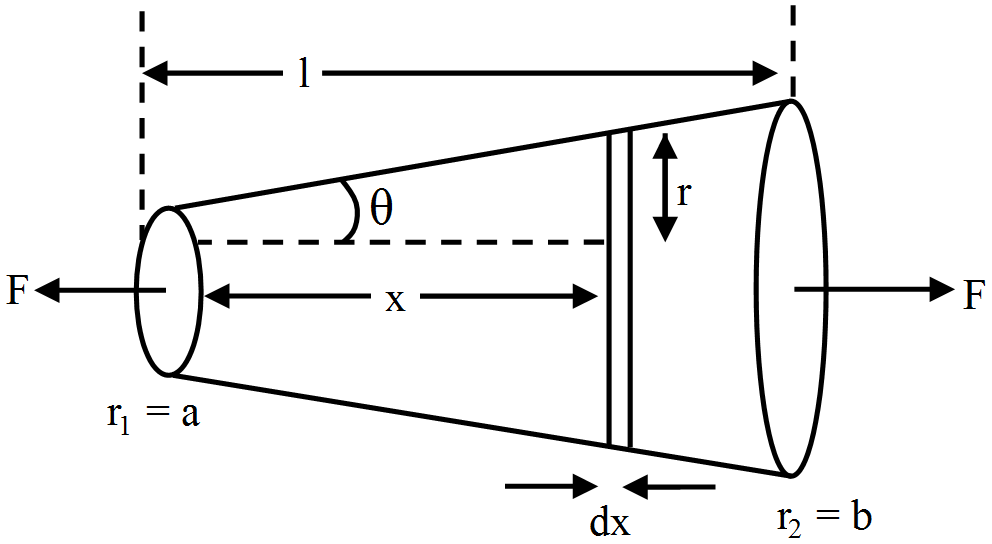 Consider an element of length d at a distance r from the end where the radius is a. The change in length
on this portion is: $\text{dl}=\frac{\text{Fdx}}{\text{AY}}$ where $\text{A}=\pi\text{r}^2\ \text{with }\text{r}=\text{a}+\text{x},\tan\theta$ $\therefore$ Net change in length l, $\int\text{dl}=\frac{\text{F}}{\pi\text{Y}}\int\limits^{\text{l}}_{0}\frac{\text{dx}}{(\text{a}+\text{x},\tan\theta)^2}$ Let $(\text{a}+\text{x},\tan\theta)\ \text{be}\ \text{Z}.\text{i}.\text{e}.,\text{Z}=(\text{a}+\text{x},\tan\theta)$ Then $\text{dZ}=0+\tan\theta\text{ dx}$ So, $\text{l}=\frac{\text{F}}{\pi\text{Y}}\int\limits^\text{l}_0{}\frac{\text{dZ}}{\tan\theta.\text{Z}^2}=\frac{\text{F}}{\pi\text{Y}\tan\theta}\int\limits^{\text{l}}_{0}\text{Z}^{-2}\text{dZ}$ $=\frac{\text{F}}{\pi\text{Y}\tan\theta}\Big|\frac{\text{Z}^{-1}}{-1}\Big| ^\text{l}_0$ $\text{l}=\frac{-\text{F}}{\pi\text{Y}\tan\theta}\Big|\frac{1}{(\text{a}+\text{x}\tan\theta)}\Big|^\text{l}_0$ $=\frac{\text{F}}{\pi\text{Y}\tan\theta}\Big(\frac{1}{\text{a}}-\frac{1}{\text{b}}\Big)$ $=\frac{\text{F}}{\pi\text{Y}\tan\theta}\frac{\text{l}\tan\theta}{\text{ab}}=\frac{\text{Fl}}{\pi\text{Y}\text{ab}}$ View full question & answer→Question 315 Marks
In nature, the failure of structural members usually result from large torque because of twisting or bending rather than due to tensile or compressive strains. This process of structural breakdown is called buckling and in cases of tall cylindrical structures like trees, the torque is caused by its own weight bending the structure. Thus the vertical through the centre of gravity does not fall within the base. The elastic torque caused because of this bending about the central axis of the tree is given by $\frac{\text{Y}\pi\text{r}^4}{4\text{R}}.$ Y is the Young’s modulus, r is the radius of the trunk and R is the radius of curvature of the bent surface along the height of the tree containing the centre of gravity (the neutral surface). Estimate the critical height of a tree for a given radius of the trunk.
AnswerBy Pythagoras theorem: in right angled $\triangle\text{ABC}$ where point C is just outside the base of Trunk i.e. point C is at D $\text{R}^2=(\text{R}-\text{d})^2+\Big(\frac{\text{h}}{2}\Big)^2$ $\text{R}^2=\text{R}^2+\text{d}^2-2\text{Rd}+\frac{\text{h}^2}{4}$ $\therefore\text{d}<<<\text{R}$ $(\therefore d^2$ can be neglected$)$ $2\text{Rd}=\frac{\text{h}^2}{4}\text{ or }\text{d}=\frac{\text{h}^2}{8\text{R}} \ \ \ (\text{I})$ Let weight of Trunk per unit volume = $W_0$ The weight of trunk = Volume \times $W_0 =(\pi\text{r}^2\text{h})\text{W}_0$ Torque by bending the trunk = Force × $\bot$dist. $\tau=\pi\text{r}^2\text{hW}_0\times\text{d}$ $\tau=\frac{\pi\text{r}^4\text{Y}}{4\text{R}}\text{(given)}$ $\therefore\pi\text{r}^2\text{hW}_0\times\frac{\text{h}^2}{8\text{R}}=\frac{\pi\text{r}^4\text{Y}}{4\text{R}}$ $\text{h}^3=\frac{\pi\text{r}^4\text{Y}\times8\text{R}}{4\text{R}\pi\text{r}^2\text{W}_0}=\frac{2\text{r}^2\text{Y}}{\text{W}_0}$ $\text{h}=\Big[\frac{2\text{Y}}{\text{W}_0}\Big]^{\frac{1}{3}}\text{r}^{\frac{2}{3}}$ Hence, h is the critical height given in this expression.
View full question & answer→Question 325 Marks
Consider a long steel bar under a tensile stress due to forces F acting at the edges along the length of the bar. Consider a plane making an angle $\Delta$ with the length. What are the tensile and shearing stresses on this plane?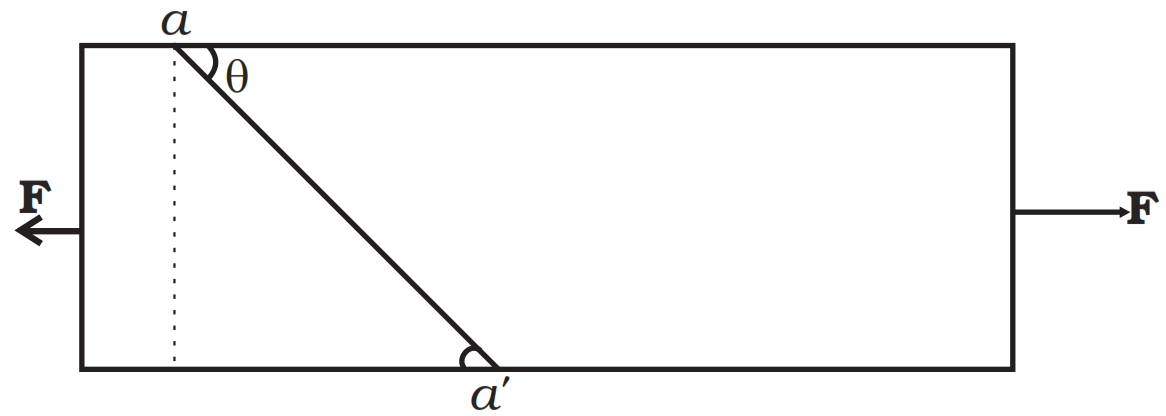
- For what angle is the tensile stress a maximum?
- For what angle is the shearing stress a maximum?
AnswerAccording to the problem force F is applied along horizontal, so we resolve it in two perpendicular components - one is parallel to the inclined plane and other one is perpendicular to the inclined plane as shown in the diagram. Now, we can easily calculate the tensile and shearing stress. Here, $\text{F}_\bot=\text{F}\sin\theta,\text{F}_\parallel=\text{F}\cos\theta$ Let the cross - sectional area of the bar be A. Consider the equilibrium of the plane aa'. Here, $\text{F}_\bot$ produces tensile stress and $\text{F}_\parallel$ produces shear stress, on the plane aa'. Let the area of the face aa' be A, then $\therefore\ \sin\theta=\frac{\text{A}}{\text{A}'}\Rightarrow\text{A}'=\frac{\text{A}}{\sin\theta}$ Tensile stress on the plane aa' $\text{aa}'=\frac{\text{F}_\bot}{\text{A}'}=\frac{\text{F}\sin\theta}{\text{A}/\sin\theta}=\frac{\text{F}}{\text{A}}\sin^2\theta$ Shearing stress on the plane aa', Shearing stress $=\frac{\text{Parallel force}}{\text{Area}}$ $=\frac{\text{F}_\parallel}{\text{A}'}=\frac{\text{F}\cos\theta}{\text{A}/\sin\theta}=\frac{\text{F}\sin\theta\cos\theta}{\text{A}}=\frac{\text{F}(2\sin\theta\cos\theta)}{2\text{A}}$ $=\frac{\text{F}\sin2\theta}{2\text{A}}$
- For tensile stress to be maximum,
$\sin^2\theta=0\Rightarrow\sin\theta=0\Rightarrow\theta=\frac{\pi}{2}\text{ or }\theta=90^0$
- For shearing stress to be maximum,
$\sin2\theta=1\Rightarrow2\theta=\frac{\pi}{2}\Rightarrow\theta=\frac{\pi}{4}\text{ or }\theta=45^0$ View full question & answer→Question 335 Marks
Calculate the percentage increase in length of a wire of diameter 2.5mm stretched by a force of 100kg weight. Young's modulus of elasticity of wire is $12.5 \times 10^{11} dyne/ sq. cm$.
AnswerHere, $2\text{r}=2.5\text{mm}=0.25\text{cm}$ or $\text{r}=0.125\text{cm}$ $\therefore\text{a}=\pi\text{r}^2$ $=\frac{22}{7}\times(0.125)^2\text{sq}.\text{cm}$ $\text{F}=100\text{kg}=100\times1000\text{g}$ $\text{F}=10\times1000\times980\text{dyne}$ $\text{Y}=12.5\times10^{11}\text{dyne}/\text{ sq}.\text{cm}$ As $\text{Y}=\frac{\text{F}\times\text{l}}{\text{a}\times\Delta\text{l}}\therefore\frac{\Delta\text{l}}{\text{l}}=\frac{\text{F}}{\text{aY}}$ Hence, % increase in length, $=\frac{\Delta\text{l}}{\text{l}}\times100=\frac{\text{F}}{\text{aY}}\times100$ $=\frac{(100\times1000\times890)\times7\times100}{22\times(0.125)^2\times12.5\times10^{11}}$ $=0.1812\%$
View full question & answer→Question 345 Marks
A cube of aluminium of each side $4cm$ is subjected to a tangential (shearing) force. The top face of the cube is sheared through $0.012cm$ with respect to the bottom face. Find:
- Shearing strain,
- Shearing stress;
- The shearing force.
Given: $\eta=2008\times10^{11}\text{dyne},\text{cm}^{-2}.$ Answer$\text{l}=4\text{cm},\Delta\text{l}=0.012\text{cm},$ $\eta=2.08\times10^{11}\text{dyne}/\text{cm}^{-2}$
- Shearing strain $\theta=\frac{\Delta\text{l}}{\text{l}}=\frac{0.012}{4\text{cm}}=0.003$
- Area of top face = $l^2 = 4cm \times 4cm = 16cm^2$
Modulus of rigidity,
$\eta=\frac{\text{Shearing Stress}}{\text{Shearing Strain}}$
or Shearing Stress,
$=\eta\times\text{Shearing Strain}$
$=2.08\times10^{11}\times0.003\text{dyne}/\text{cm}^{-2}$
$=6.24\times10^8\text{dyne}/\text{cm}^{-2}$
- Shearing force = Area × Shearing Stress,
$= 16 \times 6.24 \times 10^8dyne,$
$= 9.984 \times 10^9dyne.$ View full question & answer→Question 355 Marks
A rigid bar of mass $15kg$ is supported symmetrically by three wires each $2.0m$ long. Those at each end are of copper and the middle one is of iron. Determine the ratios of their diameters if each is to have the same tension.
AnswerTension force acting on each wire is the same. Hence, the extension is the same for each wire. Since, the wires are of the same length, the strain will also be same. Young's modulus is given by, $\text{Y}=\frac{\text{Stress}}{\text{Strain}}=\frac{\frac{\text{F}}{\text{A}}}{\text{Strain}}=\frac{\frac{4\text{F}}{\pi\text{d}^2}}{\text{Strain}}\ ....(1)$ where, F = Tension force A = Area of cross-section d = Diameter of the wire From equation (1), we have $\text{Y}\propto\Big(\frac{1}{\text{d}^2}\Big)$ Young's modulus for iron, $Y_1 = 190 \times 10^9Pa$ Diameter of the iron wire = $d_1$ Young's modulus for copper, $Y_2 = 120 \times 10^9Pa$ Diameter of the copper wire = $d_2$
Therefore, Ratio of their diameters is given by, $\frac{\text{d}_1}{\text{d}_2}=\sqrt{\frac{\text{Y}_1}{\text{Y}_2}}=\sqrt{\frac{190\times10^9}{120\times10^9}}=\sqrt{\frac{19}{12}}$
View full question & answer→Question 365 Marks
A 45 kg boy whose leg bones are $5 \mathrm{~cm}^2$ in area and 50 cm long falls through a height of 2 m without breaking his leg bones. If the bones can withstand a stress of $0.9 \times 10^8 \mathrm{~N} / \mathrm{m}^2$, calculate the Young's modulus for the material of the bone. Use, $g=10 \mathrm{~ms}^{-2}$.
Answer$m = 45kg ; h = 2m L = 0.50m ; A = 5 \times 10^{-4}m^2$ Loss in gravitational energy = Gain in elastic energy in both leg bones, So, $\text{mgh}=2\times\Big[\frac{1}{2}\times\text{Stress}\times\text{Strain}\times\text{Volume}\Big]$ Here, $\text{Volume}=\text{AL}=5\times10^{-4}\times0.50$
$=2.5\times10^{-4}\text{m}$
$\therefore45\times10\times2=2\times\Big[\frac{1}{2}\times0.9\times10^8\times\text{Strain}\times2.5\times10^{-4}\Big]$ or $\text{Y}=\frac{\text{Stress}}{\text{Strain}}$
$=\frac{0.9\times10^8}{0.04}$
$=2.25\times10^9\text{Nm}^{-2}$
View full question & answer→Question 375 Marks
- Prove that the work done in stretching a wire per unit volume is $\frac{1}{2}\times\text{tension}\times\text{extension.}$
- Prove that the work done per unit volume in stretching a wire for every type of strain $=\frac{1}{2}\times\text{stress}\times\text{strain}.$
Answer
- $\frac{\text{Work done}}{\text{Volume}}=\frac{1}{2}\frac{\text{F}}{\text{L}}.\frac{\Delta\text{l}}{\text{l}}$
$\therefore\text{Work done}=\frac{1}{2}\text{F}\times\text{A}\frac{\Delta\text{l}}{\text{l}}$
$=\frac{1}{2}\text{Tension}\times\text{extension}$
- The wire has length l, area of cross-section A made of material constant Y. Let a force F be applied and at any instance, x be the extension associated (x < L), where L is the maximum extension. At this instant,
$\text{F}=\frac{\text{AY}.\text{x}}{\text{l}}$
Since force is a variable with x,
Work done to stretch is,
$\text{W}=\int\limits^\text{L}_{0}\text{Fdx}$
$\text{W}=\frac{1}{2}\frac{\text{AY}}{\text{l}}.\text{L}^2$
$\text{W}=\frac{1}{2}(\text{Al})\Big(\frac{\text{Y.L}}{\text{l}}\Big)\Big(\frac{\text{L}}{\text{l}}\Big)$
$=\frac{1}{2}\times\text{Volume}\times\text{Stress}\times\text{Strain}$ View full question & answer→Question 385 Marks
Four identical cylindrical columns of steel support a big structure of mass $50,000kg$. The inner and outer radii of each column are $30cm$ and $40cm$ respectively. Assume the load distribution to be uniform, calculate the compressional strain of each column. The Young's modulus of steel is $2.0 \times 10^{11}Pa$.
AnswerHere, $m = 50,000kg ; r_1 = 0.30m$ and $r_2 = 0.40m ; Y = 2.0 \times 10^{11}Pa$, Area of cross section of each column, $\text{a}=\pi\Big(\text{r}^2_2-\text{r}^2_1\Big)$
$=\pi\big[(0.4)^2-(0.3)^2\big]$
$=\pi\times0.07\text{m}^2$ Whole weight of the structure = m = 50000 \times 9.8N This weight is equally shared by four columns. $\therefore$ Compressional force on one coulmn, $\text{F}=\frac{50000\times9.8}{4}\text{N}$ Now $\text{Y}=\frac{\frac{\text{F}}{\text{a}}}{\text{Compressional Strain}}$
$\therefore$ Compressional strain $=\frac{\text{F}}{\text{aY}}$
$=\frac{50000\times\frac{9.8}{4}}{(\pi\times0.07)\times2.0\times10^{11}}$
$=2.785\times10^{-6}$
View full question & answer→Question 395 Marks
A boy's catapult is made of a rubber cord 42cm long and 6mm in diameter. The boy stretches the cord by 20cm. Find the Young's modulus of the rubber if a stone weighing 0.02kg when catapulted flies with a velocity of $20ms^{-1}$. Disregard the change in the cross-section of the cord in stretching.
AnswerDue to extension produced in the cord, energy is stored in it which is converted into kinetic energy when the stone flies away. Assuming that there is no loss of energy in this process, the kinetic energy of the stone is given by, $\text{W}=\frac{1}{2}\text{m}\upsilon^2=4\text{J}$ This must be equal to the work done in stretching the cord. Using the equation. $\text{W}=\frac{1}{2}\text{F}\Delta\text{l}=4\text{J}$ Where F is the stretching force. Since, $\Delta\text{l}=20\text{cm}=0.2\text{m}$ $\text{F}=\frac{4\times2}{0.2}=40\text{N}$ Stress $=\frac{\text{F}}{\text{A}}=\frac{40}{\pi\text{r}^2}$ Now, $\text{r}=3\text{mm}=3\times10^{-3}\text{m}$ Hence, $\text{Stress}=\frac{40}{\pi(3\times10^{-3})^2}=1.415\times10^6\text{Nm}^{-2}$ But, $\text{Strain}=\frac{20}{42}=0.47\%$ Young's modulus = Y $=\frac{1.415\times10^6}{0.476}=2.97\times10^6\text{Nm}^{-2}.$
View full question & answer→Question 405 Marks
Describe stress-strain relationship for a loaded steel wire and hence explain the terms : Elastic limit, yield point, tensile strength.
AnswerIn figure. 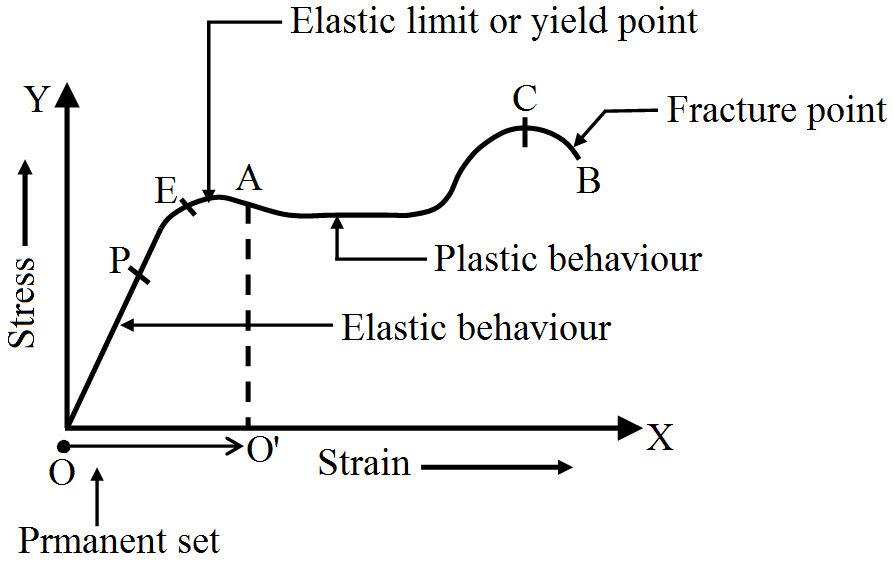 Elastic region : O to E. Plastic region : E to B. Upto the point E, the steel wire will regain its status immediately on the removal of stress and the ratio of $\frac{\text{Stress}}{\text{Strain}}$ will be a constant.
- Strain increases in proportion to the load upto P. But beyond P, it increases by an increasingly greater amount for a given increase in the load. Beyond the elastic limit E, it does not retrace the curve backward. The wire is unloaded but returns to 'O' along the dotted line 'AO'. Point 'O' corresponding to zero load which implies a permanent strain in wire.
- From C to B, strain increases even if the wire is being unloaded and at B it fractures. Stress upto that corresponding to C can be applied without causing fracture.
View full question & answer→Question 415 Marks
A steel wire of length 2l and cross-sectional area A is stretched within elastic limit as shown in figure. Calculate the strain and stress in the wire.
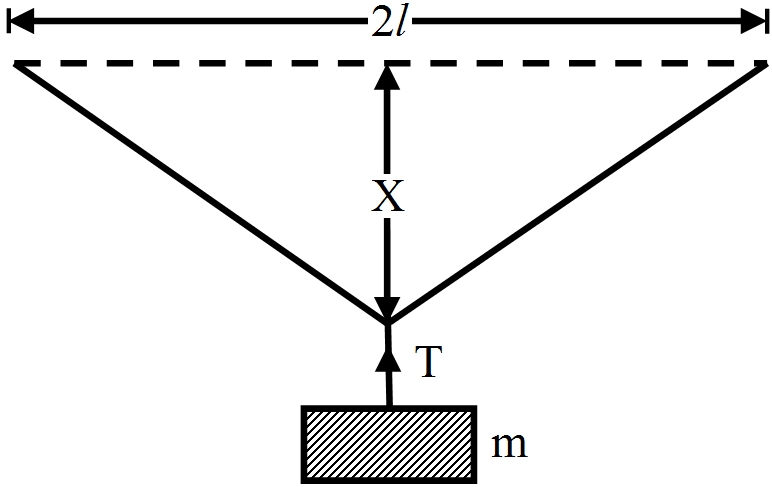
AnswerTotal length L = 2l. Increase in length of the wire, when it is stretched from its mid-point. 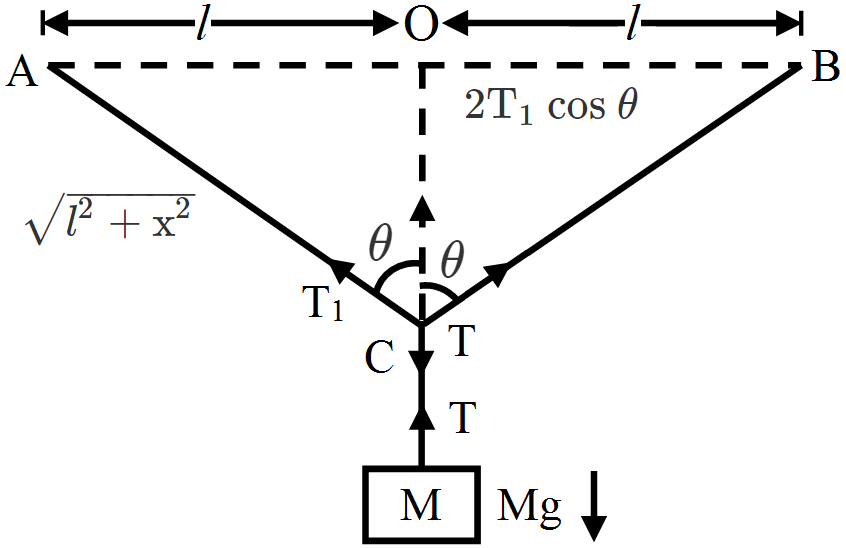 From Pythagoras theoream, $\text{BC}^2=\text{l}^2+\text{x}^2$ $\text{BC}=\sqrt{\text{l}^2+\text{x}^2}$ Similarly, $\text{AC}=\sqrt{\text{l}^2+\text{x}^2}$
 View full question & answer→Question 425 Marks
A wire of length L and radius r is clamped rigidly at one end. When the other end of the wire is pulled by a force f, its length increases by l. Another wire of the same material of length 2L and radius 2r, is pulled by a force 2f. Find the increase in length of this wire.
AnswerWe have to apply Hooke’s law to compare the extension in each wire. According to the diagram which shows the situation. Now, Young’s modulus $\text{(Y)}=\frac{\text{f}}{\text{A}}\times\frac{\text{L}}{\text{l}}$ First case, length of wire = L, radius of wire = r Force applied = f, increase in length = l $\text{Y}_1=\frac{\frac{\text{f}}{\pi\text{r}^2}}{\frac{\text{l}}{\text{L}}}=\frac{\text{fL}}{\pi\text{r}^2\text{l}}\ \ ...\text{(i)}$ In second case, lengthof wire = 2L, radius of wire = 2r, force applied = 2f, increase in length = x (say) $\text{Y}_2=\frac{\frac{\text{2f}}{\pi\text{(2r})^2}}{\frac{\text{x}}{\text{L}}}=\frac{\text{fL}}{\pi\text{r}^2\text{x}}\ \ ...\text{(ii)}$ 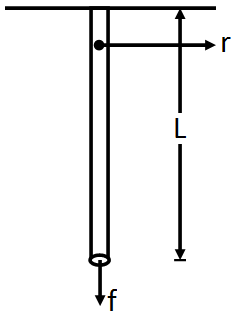 Both the wires are of same material, so Young's modulus will be same. From Eqs. (i) and (ii), $\frac{\text{f}}{\pi\text{r}^2}\times\frac{\text{L}}{\text{l}}=\frac{\text{f}}{\pi\text{r}^2}\times\frac{\text{L}}{\text{x}}$ Hence, x = l.
 View full question & answer→Question 435 Marks
One end of a nylon rope of length $4.5m$ and diameter $12mm$ is fixed to a free limb. A monkey, weighing $100N$, jumps to catch the free end and stays there. Find the alongation of the rope and the corresponding change in the diameter. Given Young's modulus of Nylone $- 4.8 \times 10^{11}N/ m^2$ and Poision's ratio of nylon = $0.2$.
AnswerHere $\text{l}=4.5\text{m}$ $\text{r}=6\text{mm}=6\times10^{-3}\text{m}$ $\text{mg}=100\text{N}$
$\therefore\text{Y}=\frac{\text{mgl}}{\pi\text{r}^2\times\Delta\text{l}}$ $\Delta\text{l}=\frac{\text{mgl}}{\pi\text{r}^2\times\text{Y}}=\frac{100\times4.5}{3.14\times(6\times10^{-3})\times4.8\times10^{11}}$ $=8.2\times10^{-6}\text{m}$
Now, $\Delta\text{D}=\frac{\sigma\text{D}.\Delta\text{l}}{\text{l}}=\frac{-0.2\times6\times10^{-3}\times8.2\times10^{-6}}{4.5}$ $=-2.18\times10^{-9}=2.18\times10^{-9}\text{m}$
Hence, the elongation in rope is $8.2 \times 10^{-6}m$ and the change in the diameter is $2.18 \times 10^{-9}m$.
View full question & answer→Question 445 Marks
Determine the poission's ratio of the material of wire whose volume remains constant under an external normal stress.
AnswerLet volume of the wire before the expansion, $\text{V}_1=\pi\text{r}^2\text{l}$ Volume of the wire after expansion, $\text{V}_2=\pi(\text{r}-\Delta\text{r})^2\times(\text{l}+\Delta\text{l})$ But volume remains same during the expansion, $\therefore\pi\text{r}^2\text{l}=\pi(\text{r}-\Delta\text{r})^2\times(\text{l}+\Delta\text{l})$ $\text{r}^2\text{l}=(\text{r}^2+\Delta\text{r}^2-2\text{r}\times\Delta\text{r})\times(\text{l}\times\Delta\text{l})$ $=\text{r}^2(\text{l}+\Delta\text{l})+\Delta\text{r}^2(\text{l}+\Delta\text{l})\\-2\text{r}\times\Delta\text{r}(\text{l}+\Delta\text{l})$ $=\text{r}^2\text{l}+\text{r}^2\times\Delta\text{l}+\Delta\text{r}^2\text{l}+\Delta\text{r}^2\\\times\Delta\text{l}-2\text{r}\Delta\text{rl}-2\text{r}\Delta\text{r}\times\Delta\text{l}$ $\Rightarrow2\text{r}\Delta\text{rl}=\text{r}^2\Delta\text{l}$ $[$Rejecting the higher power of $\Delta\text{r}$ and $\Delta\text{r}\times\Delta\text{l}]$ $\Rightarrow\frac{\text{r}.\Delta\text{r}.\text{l}}{\text{r}^2.\Delta\text{l}}=\frac{1}{2}\Rightarrow\frac{\frac{\Delta\text{r}}{\text{r}}}{\frac{\Delta\text{r}}{\text{l}}=\frac{1}{2}}$ $\sigma=\frac{1}{2}=0.5$ Therefore, iI the volume of the wire does not change, the value of the poission ratio $\sigma$ is maximum equal to 0.5.
View full question & answer→Question 455 Marks
For two different type of rubber stress - strain curves are shown:
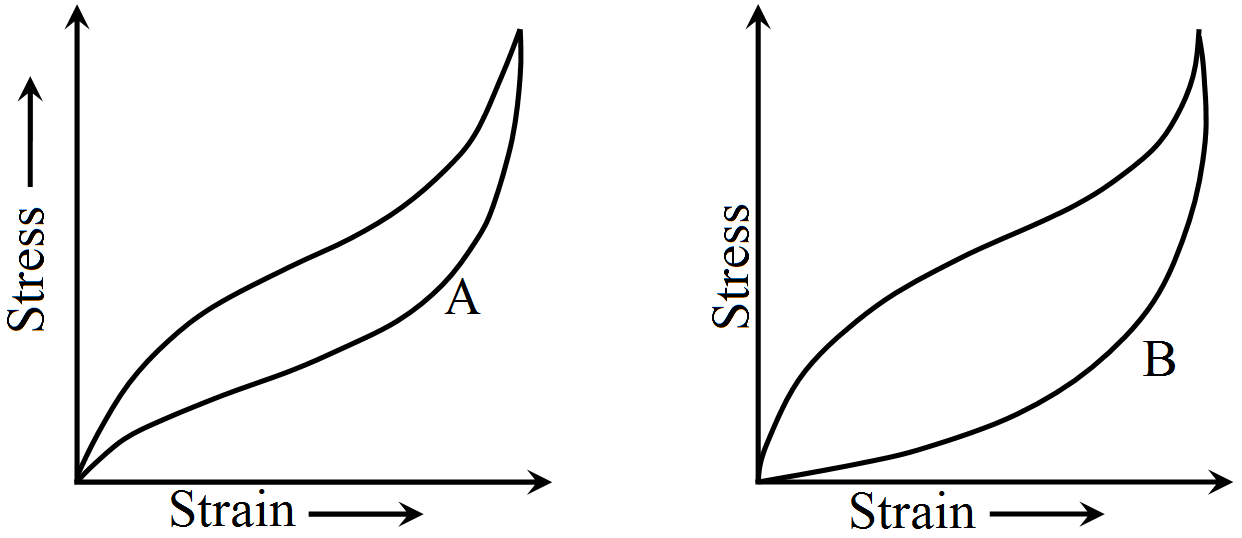
- To make a shock absorber which rubber will you prefer and why?
- To make car tyre which of the two rubber would you prefer and why?
AnswerThe area of hysteresis loop is proportional to the energy dissipated by the material as heat when material undergoes loading and unloading.
- B material having larger loop area would absorb more energy when subjected to vibration/ shock.
- A material is preferred for car type because, the energy dissipation must be minimised to avoid excessing heating of the car type.
View full question & answer→Question 465 Marks
A metal bar of length L and area of cross-section A, is rigidly clamped between two walls. The Young's modulus of its material is Y and the coefficient of linear expansion is $\alpha.$ The bar is heated so that its temperature is increased from 0 to $\theta^\circ\text{C}.$ Find the force exerted at the ends of the bar.
Answer$\text{Y}=\frac{\text{F}\times\text{L}}{\text{A}\times\Delta\text{L}}\ \text{or}\ \text{F}=\text{YA}\frac{\Delta\text{L}}{\text{L}}$ Also $\Delta\text{L}=\text{L}\alpha$ $(\theta=$ increase in temperature$)$ $\therefore\text{F}=\frac{\text{YAL}\alpha\theta}{\text{L}}=\text{YA}\alpha\theta$
View full question & answer→Question 475 Marks
An elastic spring of force constant K is compressed by an amount x. Show that its potential energy is $\frac{1}{2}\text{Kr}^2.$
AnswerFrom Hook's law, when spring is compressed or elongated, it tends to recover its original length. Restoring force $\propto$ Strech or compression, $-\text{F}\propto\text{x}$ or F = -kx K = constant of the spring, Let the body be displaced further through an infinitesimally small distance dx, against the restoring force. $\therefore$ Small amount of work done in increasing the length of the spring by dx is dW = -F, dx = Kx, dx ...(i) Total work done in giving displacement x to the body can be obtained by (i) from x = 0 to x = x, $\text{i}.\text{e}.,\text{W}=\int\limits_{\text{x}=0}^{\text{x}=\text{x}} \text{Kx}.\text{dx}$ $=\text{K}\Big[\frac{\text{x}^2}{2}\Big]^{\text{x}=\text{x}}_{\text{x}=0}$ $\Rightarrow\text{W}=\text{K}\Big[\frac{\text{x}^2}{2}-0\Big]$ $\Rightarrow\text{W}=\frac{1}{2}\text{Kx}^2$
View full question & answer→Question 485 Marks
A stone of mass m is tied to an elastic string of negligble mass and spring constant k. The unstretched length of the string is L and has negligible mass. The other end of the string is fixed to a nail at a point P. Initially the stone is at the same level as the point P. The stone is dropped vertically from point P.
- Find the distance y from the top when the mass comes to rest for an instant, for the first time.
- What is the maximum velocity attained by the stone in this drop?
- What shall be the nature of the motion after the stone has reached its lowest point?
AnswerA stone is tied at P with string of length L. String is fixed with nail at ‘O’. Stone is lifted upto height L, so that string is stretched as shown in given fig. When stone fall under gravity. It tries to follow path PP’ but due to elastic string it will go a part of circular path P to Q. This is like a centrifugal force that stretches the string outward and increases its length $(\Delta\text{L}).$ So the change in Potential energy of stone at Q’ and p converts into mechanical energy in string of spring constant K. So P.E of stone = mechanical Energy of string. $\text{mgy}=\frac{1}{2}\text{K}(\text{y}-\text{L})^2$ $\text{mgy}=\frac{1}{2}\text{K}(\text{y}^2+\text{L}^2-2\text{yL})$ $2\text{mgy}=\text{K}[\text{y}^2+\text{L}^2-2\text{yL}]$ $2\text{mgy}=\text{K}\text{y}^2-2\text{K}\text{y}\text{L}+\text{KL}^2$ or $\text{K}\text{y}^2-2\text{K}\text{y}\text{L}-2\text{mgy}+\text{KL}^2=0$ $\text{K}\text{y}^2-2(\text{K}\text{L}+\text{mg})\text{y}+\text{KL}^2=0$
- Solving this equation by quadratic formula we get,
$\text{D}=\text{b}^2-4\text{ac}\ \ (\text{a}=\text{K}\text{ b}=-2(\text{KL+mg})\text{ c=KL}^2)$
$\text{D}=\big[-2(\text{KL+mg})\big]^2-4\text{(K)}\text{(KL)}^2$
$\text{D}=+4\big[(\text{KL})^2+\text{(mg)}^2+2\text{(KL)(mg)}\big]-4\text{K}^2\text{L}^2$
$\text{D}=4\big[\text{K}^2\text{L}^2+\text{m}^2\text{g}^2+2\text{KLmg}\big]-4\text{K}^2\text{L}^2$
$=4\text{K}^2\text{L}^2+4\text{m}^2\text{g}^2+8\text{KLmg}-4\text{K}^2\text{L}^2$
$\sqrt{\text{D}}=\sqrt{4\text{m}\text{g}[\text{m}\text{g}+2\text{KL}]}=2\sqrt{\text{m}\text{g}(\text{m}\text{g}+2\text{KL})}$
$\therefore\text{y}\frac{-\text{d}\pm\sqrt{\text{D}}}{2\text{a}}=\frac{+2\big(\text{KL}+\text{mg}\big)\pm2\sqrt{\text{mg(2}\text{KL}+\text{mg)}}}{2\text{K}}$
$\text{y}=\frac{2\big[\big(\text{KL}+\text{mg}\big)\big]\pm\sqrt{\text{mg(2}\text{KL}+\text{mg)}}}{2\text{K}}$
$\text{y}=\frac{\big(\text{KL}+\text{mg}\big)\pm\sqrt{\text{mg}(2\text{KL}+\text{mg})}}{\text{K}}$
- At maximum velocity as its lowest point acceleration is zero.
$\therefore\ \text{F}=0$
So, the spring or string force Kx is blanced by gravitational force mg. so, these two forces will be equal and opposite.
$\therefore\ \text{mg}=\text{kx}\ ...(\text{i})$ where x is extension in string
Let v be the maximum velocity of stone at bottom of journey.
By law of conservation of energy,
KE of stone + PE gain by string = P.E. lost stone from p tp Q'
$\frac{1}{2}\text{mv}^2+\frac{1}{2}\text{Kx}^2=\text{mg}(\text{L}+\text{x})$
$\text{mv}^2+\text{Kx}^2=2\text{mg}(\text{L}+\text{x})$
$\text{mv}^2=2\text{mgL}+2\text{mgx}-\text{Kx}^2$
$\text{mg}=\text{Kx}\ (\text{from i})$
$\text{x}=\frac{\text{mg}}{\text{K}}$
$\therefore\ \text{mv}^2=2\text{mgL}+2\text{mg}\cdot\frac{\text{mg}}{\text{k}}-\text{K}\frac{\text{m}^2\text{g}^2}{\text{K}^2}$
$=2\text{mgL}+\frac{2\text{m}^2\text{g}^2}{\text{K}}-\frac{\text{m}^2\text{g}^2}{\text{K}}$
$\text{mv}^2=\text{m}\Big[\text{2gL}+\frac{\text{mg}^2}{\text{K}}\Big]$
$\therefore\ \text{v}=\Big[2\text{gL}+\frac{\text{mg}^2}{\text{K}}\Big]^{\frac{1}{2}}$
- At lowest point from figuare in part (a)
$\text{F}=\text{mg}\downarrow-\text{K}(\text{y}-\text{L})\uparrow\ (\text{by string})$
$\therefore\ \text{m}\frac{\text{d}^2\text{z}}{\text{dt}^2}=\text{mg}-\text{K}(\text{y}-\text{L})$
$\frac{\text{d}^2\text{z}}{\text{dt}^2}-\text{g}+\frac{\text{K}}{\text{m}}(\text{y}-\text{L})=0$
$\frac{\text{d}^2\text{y}}{\text{dt}^2}+\frac{\text{K}}{\text{m}}\Big[(\text{y}-\text{L})-\frac{\text{mg}}{\text{K}}\Big]$
make a transformation of variables:
$\text{z}=\Big[(\text{y}-\text{L)}-\frac{\text{mg}}{\text{K}}\Big]$
then $\frac{\text{d}^2\text{z}}{\text{dt}}^2+\frac{\text{k}}{\text{m}}\text{z}=0$
it is differential equation of second order which represents S.H.M.
$\therefore\frac{\text{d}^2\text{z}}{\text{dt}^2}+\omega^2\text{z}=0$
Where w is angular frequency so $\omega=\sqrt{\frac{\text{K}}{\text{m}}}$
Solution of above differential equation is of type
$\text{z}=\text{A}\cos(\omega\text{t}+\theta)$
Where $\omega=\sqrt{\frac{\text{K}}{\text{m}}}\text{ and }\theta$ is phase difference.
$\text{z}=\Big(\text{L}+\frac{\text{m}}{\text{K}}\text{g}\Big)+\text{A}'\cos(\omega\text{t+}\theta)$
So the stone performs SHM with angular frequency $\omega$ about the point at y = 0
$|\text{z}_0|=\Big|-\Big(\text{L}+\frac{\text{mg}}{\text{K}}\Big)\Big|\ \ \ [\text{from (i)}]$
$\therefore\text{z}_0=\Big(\text{L}\frac{\text{mg}}{\text{K}}\Big)$ View full question & answer→Question 495 Marks
A load of 31.4 kg is suspended from a wire of radius $10^{-3} \mathrm{~m}$ and density $9 \times 10^3 \mathrm{~kg} / \mathrm{m}^3$. Calculate the change in temperature of the wire if $75 \%$ of the work done is converted into heat. The Young's modulus and the specific heat capacity of the material of the wire are $9.8 \times 10^{10} \mathrm{~N} / \mathrm{m}^2$ and $490 \mathrm{~J} / \mathrm{kg} / \mathrm{k}$ respectively.
AnswerVolume of wire $\text{V}=\pi\text{r}^2\text{l}$ $\therefore\text{Density}=\frac{\text{Mass}}{\text{V}}$ $9\times10^3=\frac{31.4}{\pi\text{r}^2\times\text{L}}$ $\therefore\text{L}=\frac{31.4}{\pi^2\times9\times10^3}$ $\text{L}=\frac{31.4}{3.14\times10^{-6}\times9\times10^3}$ $\therefore\text{L}=\frac{10}{9}\times10^3\text{m}=\frac{10^4}{9}\text{m}$ Now, $\text{Y}=\frac{\text{mg.L}}{\pi\text{r}^2\text{l}}$ $\therefore\text{l}=\frac{\text{mg.L}}{\pi\text{r}^2.\text{Y}}=\frac{31.4\times9.8\times10^4}{3.14\times10^{-6}\times9\times9.8\times10^{10}}=\frac{10}{9}\text{m}$ Now the work done, $=\frac{1}{2}\text{F}.\text{l}=\frac{1}{2}\times3.14\times9.8\times\frac{10}{9}$ 75% of the work done is converted into heat energy. $\therefore$ Heat erergy $=\frac{1}{2}\times31.4\times9.8\times\frac{10}{9}\times\frac{75}{100}$ But heat erergy = mass × S.P heat × temp difference, $=31.4\times490\times\text{t}$ $\therefore31.4\times490\times\text{t}$ $=\frac{1}{2}\times31.4\times9.8\times\frac{10}{9}\times\frac{75}{100}$ $\therefore\text{t}=\frac{\frac{1}{2}\times31.4\times9.8\times\frac{10}{9}\times\frac{75}{100}}{31.4\times490}$ $\text{t}=\frac{1}{120}\text{K}\ \text{or }0.0083^\circ\text{C}.$
View full question & answer→Question 505 Marks
Two wires, one of steel and the other of aluminium, each $2 m$ long and of diameter $2.0 mm$ , are joined end to end to form a composite wire of length $4.0 m$ . What tension in the wire will produce a total extension of $0.90 mm$ ? Y for steel $=2 \times 10^{11} \mathrm{Nm}^{-2} ; Y$ for aluminium $=7 \times 10^{11} \mathrm{Nm}^{-2}$
AnswerY for steel, $Y_1 = 2 \times 10^{11}Nm^{-2} Y$ for aluminium, $Y_2 = 7Y \times 10^{11}Nm^{-2}$ Length of each wire, $L = 2m; d = 2.0mm$
$\therefore$ Radius, $r = 1mm = 10^{-3}m$ Area of cross-section, $\text{A}=\pi\text{r}^2=\pi(10^{-3})^2=\pi\times10^{-6}\text{m}^2$ Total extension $\big(\Delta\text{l}_1+\Delta\text{l}_2\big)=9\times10^{-4}\text{m}$ We know, $\text{Y}=\frac{\text{FL}}{\text{A}\Delta\text{l}}$
$\therefore\big(\Delta\text{l}_2+\Delta\text{l}_2\big)=\frac{\text{FL}}{\text{A}}\Big(\frac{1}{\text{Y}_1}+\frac{1}{\text{Y}_2}\Big)$ or $9\times10^{-4}=\frac{\text{F}\times2}{\pi\times10^{-6}}\Big(\frac{1}{2\times10^{11}}+\frac{1}{7\times10^{11}}\Big)$ or $\text{F}=\frac{9\times10^{-4}\times3.14\times10^{-6}\times14\times10^{11}}{2\times9}$
$=219.8\text{N}$
View full question & answer→