Questions · Page 2 of 2

5 Marks Questions

Question 515 Marks
A cricket ball is thrown at a speed of 28m/ s in a direction 30° above the horizontal. Calculate:
  1. The maximum height.
  2. The time taken by the ball to return to the same level.
  3. The horizontal distance from the point of projection to the point where the ball returns to the same level.
Answer
Here, $\text{u}=28\text{ m/s},\theta=30^\circ$
  1. Maximum height:
$\text{h}=\frac{\text{u}^2\sin^2\theta}{2\text{g}}=\frac{(28)^2(\sin30^\circ)^2}{2\times9.8}$
$=10.0\text{m}$
  1. Time of flight:
$\text{T}=\frac{2\text{u}\sin\theta}{\text{g}}=\frac{2\times28\times\sin30^\circ}{9.8}$
$=2.9\text{ sec}$
  1. Horizontal range:
$\text{R}=\frac{\text{u}^2\sin2\theta}{\text{g}}$
$=(28)^2\times\frac{\sin(2\times30^\circ)}{9.8}=69.28\text{m}$
View full question & answer
Question 525 Marks
A man whirls a stone round his head on the end of a string $4m$ long. Can the string be in a horizontal plane? If the stone has a mass of $0.4kg$, and the string will break if the tension in it exceed $8N$, what is the smallest angle the string can make with the horizontal ? What is the speed of the stone? (take $g = 10ms^{-2}$)
Answer
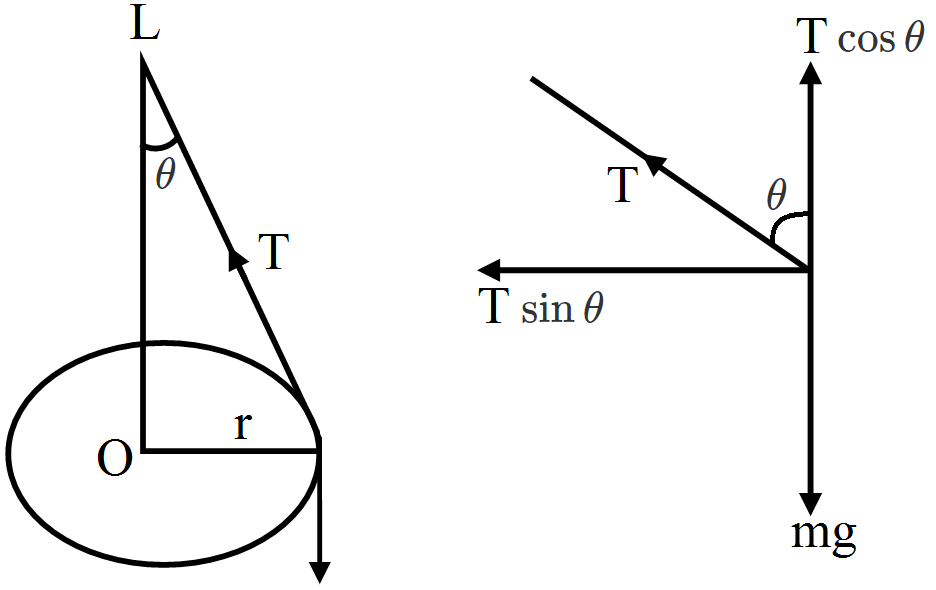
At equilibrium, $\text{T}\cos\theta=\text{mg};$
$\text{T}\sin\theta=\frac{\text{mv}^2}{\text{r}}=\frac{\text{mv}^2}{\text{l}\sin\theta}$
$[\because\ \text{r}=\text{l}\sin\theta]$ As, $\text{T}\cos\theta=\text{mg};$ or $\text{T}=\frac{\text{mg}}{\cos\theta}$ In case the string becomes horizontal, $\theta=90^\circ,$
$\therefore\ \text{T}=\frac{\text{mg}}{\cos90^\circ}=\infty$ Thus, for making the string horizontal, the tension must be infinite which is impossible. Therefore, the string cannot be in horizontal plane.

The value of maximum angle $\theta$ is given by the breaking tension of the string, such that, $\text{T}\cos\theta=\text{mg};\ \text{T}_{(\text{max})}=8\text{N}$
$\therefore\ \cos\theta=\frac{\text{mg}}{\text{T}_{(\text{max})}}=\frac{0.4\times10}{8}=\frac{1}{2}$or, $\theta=60^\circ$
$\therefore$ Angle with the horizontal,
$=90^\circ-60^\circ=30^\circ$ Also, $\text{T}\sin\theta=\frac{\text{mv}^2}{\text{l}\sin\theta}$ or, $8\times\sin60^\circ=\frac{0.4\times\text{v}^2}{4\times\sin60^\circ}$ or, $\text{v}=\sqrt{80}\sin60^\circ\cong7.7\text{ms}^{-1}$
View full question & answer
Question 535 Marks
Rain is falling vertically with a speed of $10\sqrt{3}\text{ms}^{-1}.$ A man riding on a bicycle is moving with a speed of $10ms^{-1}$ in north to south direction. What is the direction in which he should hold his umbrella?
Answer
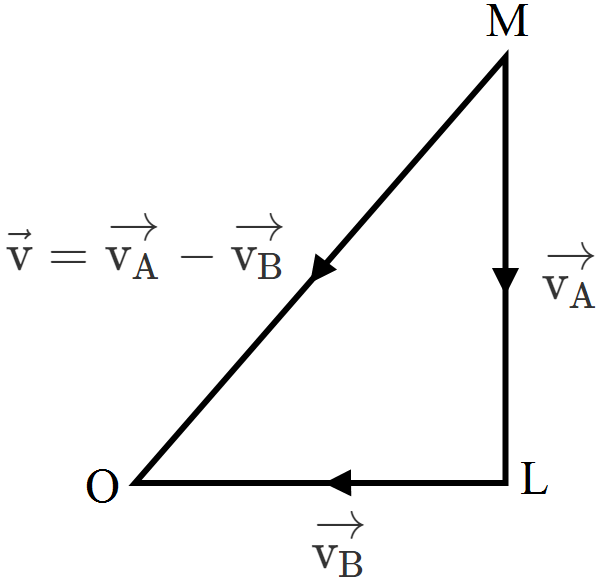
Let the velocity of rain be, $\vec{\text{v}_\text{A}}=(10\sqrt{3})\text{ms}^{-1},$ vertically downwards. Velocity of the man on the bicycle, $\vec{\text{v}_\text{B}}=10\text{ ms}^{-1},$ north to south. Relative velocity of rain w.r.t. man, $\vec{\text{v}}=\vec{\text{v}_\text{A}}-\vec{\text{v}_\text{B}}$ From $\triangle\text{OLM},\ \vec{\text{ML}}=\vec{\text{v}_\text{A}}=(10\sqrt{3})\text{ms}^{-1}$ $\vec{\text{LO}}=-\vec{\text{v}_\text{B}}=-10\text{ms}^{-1}$ $\vec{\text{v}}=\vec{\text{v}_\text{A}}+(-\vec{\text{v}_\text{B}})=\vec{\text{MO}}$

Using trigonometric considerations,
$\tan\theta=\frac{10\sqrt{3}}{10}=\sqrt{3}=\tan60^\circ$
$\therefore\ \theta=60^\circ$ Thus, in order to guard himself, the man should keep his umbrella along OM., i.e., at 60° to the horizontal.
View full question & answer
Question 545 Marks
A quarterback, standing on his opponents 35-yard line, throws a football directly down field, releasing the ball at a height of 2.00m above the ground with an initial velocity of 20.0m/ s, directed 30.0° above the horizontal.
  1. How long does it take for the ball to cross the goal line, 32.0m from the point of release?
  2. The ball is thrown too hard and so passes over the head of the intended receiver at the goal line. What is the ball's height above the ground as it crosses the goal line?
Answer
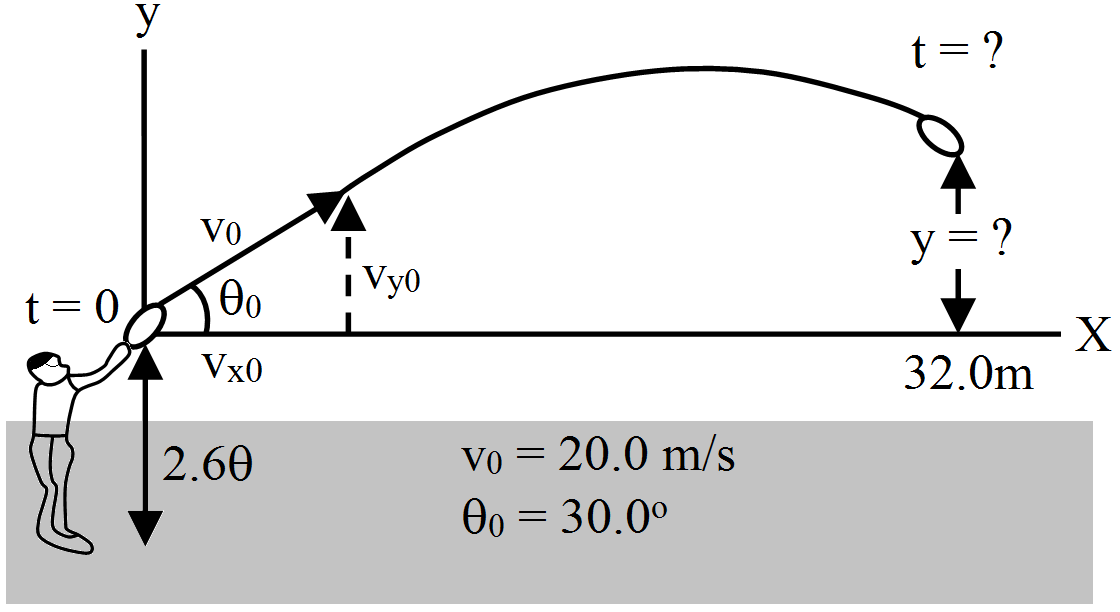
To better visualise the solution described here, we first sketch the trajectory as shown in figue.
  1. The problem here is to find t when x = 32.0m. We can use $(\text{x}=\text{v}_{\text{x}_0}\text{t}),$ if we first find $\text{v}_{\text{x}_0}.$ From figure, we see that $\text{v}_{\text{x}_0}=\text{v}_0\cos\theta_0=(20.0\text{m/s})(\cos30.0^\circ)$
= 17.3m/ s
Using the relation and solve for t.
$\text{x}=\text{v}_{\text{x}_0}\text{t}$
$\text{t}=\frac{\text{x}}{\text{v}_{\text{x}_0}}=\frac{32.0\text{m}}{17.3\text{m/s}}=1.85\text{s}$
  1. We want to find y when x = 32.0m, or since we have already found the time in part (a), we can state this, find y when t = 1.85s. Using the relation,
$\text{y}=\text{v}_{\text{y}_0}\text{t}-\frac{1}{2}\text{gt}^2$
where, $\text{v}_{\text{y}_0}=\text{v}_0\sin\theta_0$
$=(20.0\text{m/s})(\sin30.0^\circ)=10.0\text{m/s}$
Thus, $\text{y}=(10.0\text{m/s})(1.85\text{s})-\frac{1}{2}(9.80\text{m/s}^2)(1.85\text{s})^2$
= 1.73m
Since, y = 0 is 2.00m above the ground, this means the ball is 3.73m above the ground as it crosses the goal line too much high to be caught at that point.
View full question & answer
Question 555 Marks
Write the expression for the magnitude and direction of the resultant of two vectors inclined at an angle $\theta.$ Discuss special cases when value of $\theta$ is (i) 0°, (ii) 180° and (iii) 90°.
Answer
Let two vectors $\vec{\text{A}}$ and $\vec{\text{B}}$ be acting simultaneously at a particle, inclined at an angle $\theta$ from one another. The magnitude of resultant vector $\vec{\text{R}}$ is given by, $\text{R}=\sqrt{\text{A}^2+\text{B}^2+2\text{AB}\cos\theta}$ If the resultant vector subtends an angle $\beta$ from the direction of $\vec{\text{A}},$ then$\tan\beta=\frac{\text{B}\sin\theta}{\text{A}+\text{B}\cos\theta}$
There are three special cases which are as follows:
  1. If $\theta=0^\circ$ i.e., vectors $\vec{\text{A}}$ and $\vec{\text{B}}$ are acting in same direction, then $\cos\theta=\cos0^\circ=1$ and $\sin\theta=\sin0^\circ=0.$ Hence,
$\text{R}=\sqrt{\text{A}^2+\text{B}^2+2\text{AB}(1)}=\text{A}+\text{B}$
and $\tan\beta=\frac{\text{B}\times(0)}{\text{A}+\text{B}(1)}=0$ or $\beta=\tan^{-1}(0)=0^\circ$
Thus the magnitude of resultant vector is equal to the sum of the magnitudes of $\vec{\text{A}}$ and $\vec{\text{B}}$ and the resultant vector acts in the direction of $\vec{\text{A}}$ or $\vec{\text{B}}.$
  1. If $\theta=180^\circ$ i.e., vectors $\vec{\text{A}}$ and $\vec{\text{B}}$ are acting in mutually opposite direction, then $\cos\theta=\cos180^\circ=-1$ and $\sin\theta=\sin180^\circ=0.$
$\therefore\ \text{R}=\sqrt{\text{A}^2+\text{B}^2+2\text{AB}(-1)}$
$=\sqrt{\text{A}^2+\text{B}^2-2\text{AB}}=(\text{A}-\text{B})$
and $\tan\beta=\frac{\text{B}\times(0)}{\text{A}+\text{B}(-1)}=0$ or $\beta=\tan^{-1}(0)=0^\circ\text{ or }180^\circ.$
Hence the magnitude of resultant vector is equal to the difference of the magnitudes of $\vec{\text{A}}$ and $\vec{\text{B}}$ and the resultant vector acts in the direction of bigger of two vectors $\vec{\text{A}}$ and $\vec{\text{B}}.$
  1. If $\theta=90^\circ$ i.e., vectors $\vec{\text{A}}$ and $\vec{\text{B}}$ are acting in mutually perpendicular directions, then $\cos\theta=\cos90^\circ=0$ and $\sin\theta=\sin90^\circ=1.$
​​​​​​​$\therefore\ \text{R}=\sqrt{\text{A}^2+\text{B}^2+2\text{AB}(0)}=\sqrt{\text{A}^2+\text{B}^2}$
and $\tan\beta=\frac{\text{B}\times(1)}{\text{A}+\text{B}(0)}=\frac{\text{B}}{\text{A}}$
Thus, the magnitude of resultant vector is $\text{R}=\sqrt{\text{A}^2+\text{B}^2}$ and it subtends an angle $\beta$ from $\vec{\text{A}}$ such that $\tan\beta=\frac{\text{B}}{\text{A}}.$
View full question & answer
Question 565 Marks
A body is projected at an angle o upward with the horizontal:
  1. Obtain the condition for maximum horizontal range.
  2. Prove that horizontal range of projectile is same when fired at an angle $\theta$ and $(90^\circ-\theta)$ with the horizontal.
  3. Obtain an expression for velocity of projectile at any instant t.
Answer
  1. Horizontal range: It is distance covered by the object with uniform velocity u cos 0 in the time equal to total time of flight T.

$\therefore\ \text{R}=\text{u}\cos\theta\times\text{T}$
$=\text{u}\cos\theta\times\frac{2\text{u}\sin\theta}{\text{g}}$
$=\frac{\text{u}^2}{\text{g}}2\sin\theta\cos\theta$
$\text{R}=\frac{\text{u}^2\sin2\theta}{\text{g}}$
Horizontal range will be maximum if
$\sin2\theta=\text{maximum}=1=\sin90^\circ$
$2\theta=90^\circ$ or $\theta=45^\circ$
$\therefore$ Maximum horizontal range,
$\text{R}_\text{m}=\frac{\text{u}^2}{\text{g}}\sin2\times45^\circ=\frac{\text{u}^2}{\text{g}}$
$\text{R}_\text{max}=\frac{\text{u}^2}{\text{g}}$
  1. When an object is projected with velocity u making an angle $\theta$ with horizontal direction
$\text{R}_1=\frac{\text{u}^2\sin2\theta}{\text{g}}\dots(\text{i})$
When an object is projected with u making an angle $(90^\circ-\theta).$
$\text{R}_2=\frac{\text{u}^2\sin2(90^\circ-\theta)}{\text{g}}$
$=\frac{\text{u}^2}{\text{g}}\sin(180^\circ-2\theta)$
$=\frac{\text{u}^2}{\text{g}}\sin2\theta\dots(\text{ii})$
From (i) and (ii), $R_1 = R_2$
$\therefore$ The horizontal range is same for two complementary angles.
  1. Velocity at any time t,
$\text{v}=\sqrt{\text{u}^2+\text{g}^2\text{t}^2-2\text{ugt}+\sin(90^\circ-\theta)}$
$\Rightarrow\ \text{v}=\sqrt{\text{u}^2+\text{g}^2\text{t}^2-2\text{ugt}\cos\theta}$​​​​​​​
View full question & answer
Question 575 Marks
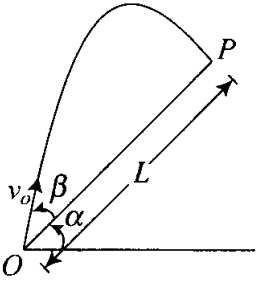
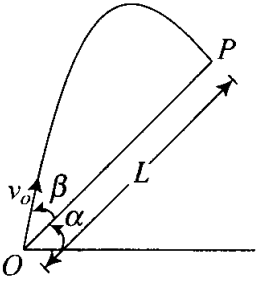
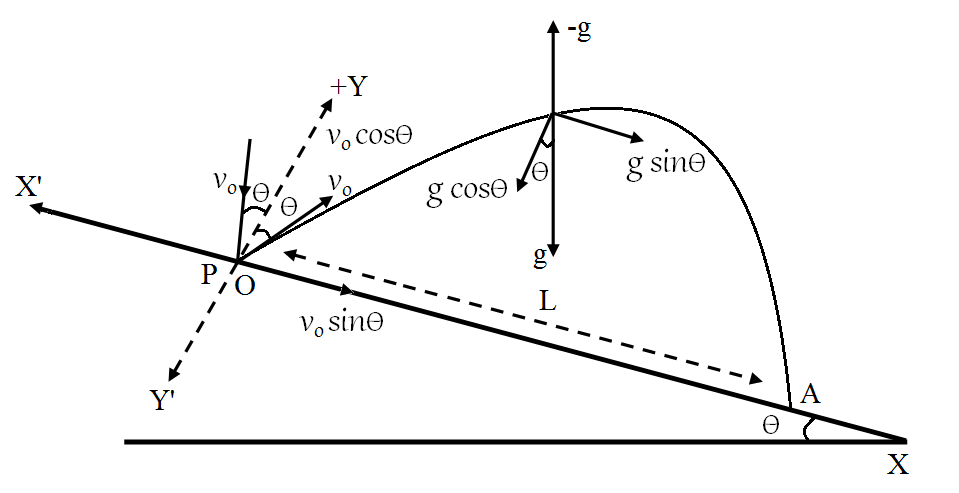
A particle is projected in air at an angle $\beta$ to a surface which itself is inclined at an angle $\alpha$ to the horizontal (Fig.).
  1. β at which range will be maximum.
(Hint: This problem can be solved in two different ways:
  1. Point P at which particle hits the plane can be seen as intersection of its trajectory (parobola) and straight line. Remember particle is projected at an angle $(\alpha+\beta)$ w.r.t. horizontal.
  2. We can take x-direction along the plane and y-direction perpendicular to the plane. In that case resolve g (acceleration due to gravity) in two differrent components, $g_x$ along the plane and $g_y$ perpendicular to the plane. Now the problem can be solved as two independent motions in x and y directions respectively with time as a common parameter.)
Answer
Consider new cartesian coordinates in which X-axis is along inclined plane OP and OY axis perpendicular to it as shown in the figure. Consider the motion of the projectile from OAP. $\text{a}_\text{y}=-\text{g}\cos\alpha$
$\text{a}_\text{x}=\text{g}\sin\alpha$

​​​​​​​ For L will be maximum pr maximum range along with new OX axis. From above relation of L, it will be maximum when $\sin\beta\cos(\alpha+\beta)$ is maximum as $\alpha$ is a constant angle of inclination of the plane. So $\cos^2\alpha$ is constant. Consider $\text{Z}=\sin\beta\cos(\alpha+\beta)$
$=\sin\beta[\cos\alpha\cos\beta-\sin\alpha\sin\beta]$
$=\frac{1}{2}[\cos\alpha \ 2\sin\beta\cos\beta-\sin\alpha \ 2\sin^2\beta]$
$=\frac{1}{2}[\cos\alpha \ \sin2\beta-\sin\alpha+(1-\cos \ 2\beta)]$
$=\frac{1}{2}[\cos\alpha \ \sin2\beta-\sin\alpha+\sin\alpha\cos \ 2\beta]$
$=\frac{1}{2}[\cos\alpha \ \sin2\beta+\sin\alpha\cos \ 2\beta-\sin\alpha]$
$\text{Z}=\frac{1}{2}[\sin(2\beta+\alpha-\sin\alpha)]$ For Z maximum $\sin(2\beta+\alpha)=1$
$\sin(2\beta+\alpha)=\sin90^\circ$
$2\beta+\alpha=90^\circ$
$2\beta=90^\circ-\alpha$
$\Rightarrow\beta=\frac{90^\circ}{2}-\frac{\alpha}{2}=45^\circ-\frac{\alpha}{2}$
$\therefore\beta=\frac{\pi}{4}-\frac{\alpha}{2}$ radian.
View full question & answer
Question 585 Marks
Define angular velocity and angular acceleration. The total speed $V_1$ of a projectile at its greatest height is $\sqrt{\frac{6}{7}}$ of its speed $V_2$ when it is at half its greatest height. Show that the angle of projection is $30°$.
Answer
Angular Velocity: Angular velocity of an object in circular motion is defined as the time rate of change of is angular displacement. It is denoted by $\omega$ and is measured in radians per second $(rad.s^{-1})$.$\omega=\frac{\text{angular displacement}}{\text{Time}}=\frac{\theta}{\text{t}}=\frac{\text{d}\theta}{\text{dt}}$
Angular Acceleration: Angular acceleration of an object in circular motion is defined as the time rate of change of its angular velocity. It is denoted by 'a’ and measured in rad $s^{-2}$.
$\alpha=\frac{\text{angular velocity change}}{\text{time taken}}=\frac{\text{d}\omega}{\text{dt}}$
Numerical: Velocity at highest point $=\text{u}\cos\theta=\text{V}_1\ (\text{given})$
$\text{h}_\text{max}=\frac{\text{u}^2\sin^2\theta}{2\text{g}}$
Vertical velocity at $\frac{\text{h}_\text{max}}{2}=\text{V}_{2\text{y}}=\sqrt{\text{u}^2\sin^2\theta-2\text{g}\frac{\text{h}_\text{max}}{2}}$
$\text{V}_{2\text{y}}=\sqrt{\text{u}^2\sin^2\theta\Big(1-\frac{1}{2}\Big)}=\frac{\text{u}\sin\theta}{\sqrt{2}}$
$\text{V}_{2\text{x}}=\text{u}\cos\theta$
$\text{V}_2=\sqrt{\text{V}^2_{2\text{x}}+\text{V}^2_{2\text{y}}}$
$=\sqrt{\text{u}^2\cos^2\theta+\frac{\text{u}^2\sin^2\theta}{2}}$
Given, $\text{V}_1=\sqrt{\frac{6}{7}}\text{V}_2$
$\therefore\ \frac{\text{u}\cos\theta}{\text{u}\sqrt{\cos^2\theta+\frac{\sin^2\theta}{2}}}=\sqrt{\frac{6}{7}}$
Squaring both the sides
$\frac{\cos^2\theta}{\cos^2\theta+\frac{\sin^2\theta}{2}}=\frac{6}{7}$
$\frac{1}{1+\frac{\tan^2\theta}{2}}=\frac{6}{7}$
$1+\frac{\tan^2\theta}{2}=\frac{7}{6}\Rightarrow\ \frac{\tan^2\theta}{2}=\frac{7}{6}-1=\frac{1}{6}$
$\tan\theta=\sqrt{\frac{2}{6}}=\frac{1}{\sqrt{3}}$
$\therefore\ \theta=\tan^{-1}\Big(\frac{1}{\sqrt{3}}\Big)=30^\circ.$
View full question & answer
Question 595 Marks
A hunter aims his gun and fires a bullet directly at a monkey in a tree. At the instant, the bullet leaves the barrel of the gun, the monkey drops. Will the bullet hit the monkey? Substantiate your answer with proper reasoning.
Answer


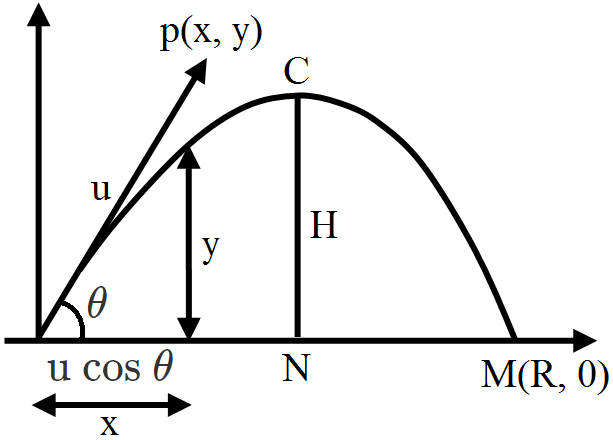
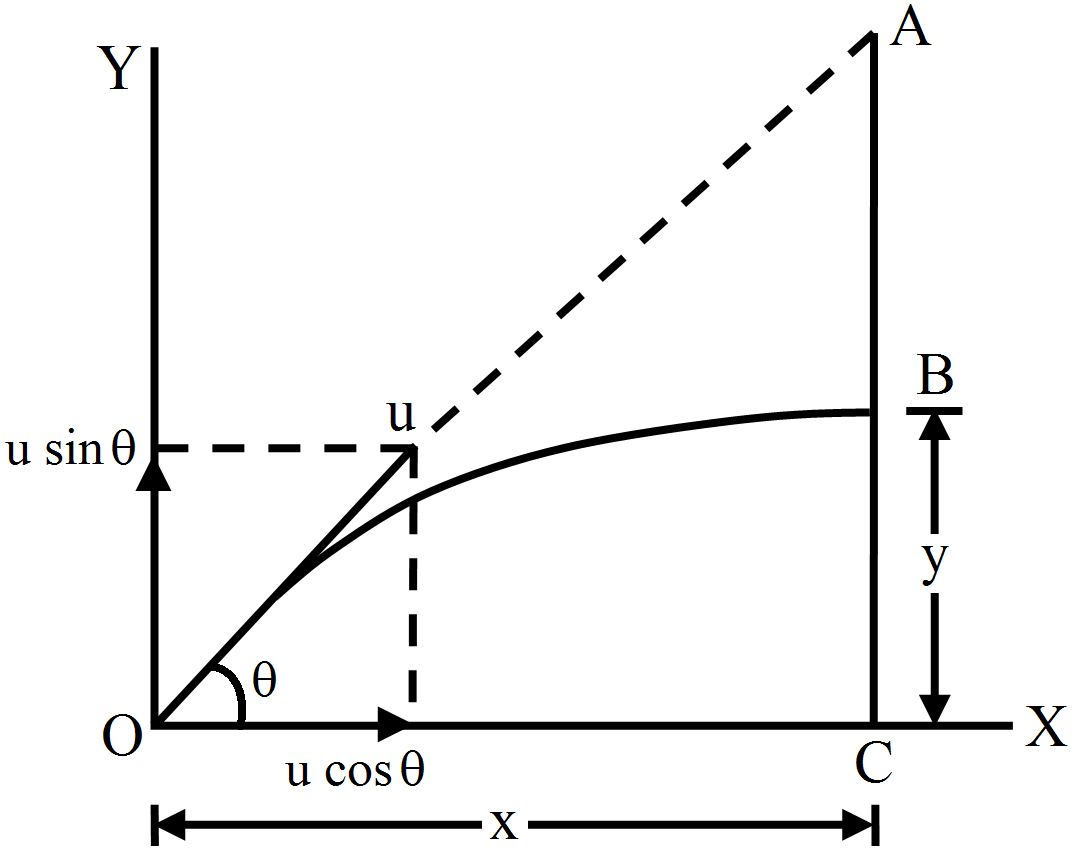
Let the monkey stationed at A, be fired with a gun from O with a velocity u at an angle $\theta$ with the horizontal direction OX.
Draw AC, perpendicular to OX. Let the bullet cross the vertical line AC at B after time t and coordinates of B(x, y) be w.r.t. origin O as showa in figure.
$\therefore\ \text{t}=\frac{\text{OC}}{\text{u}\cos\theta}=\frac{\text{x}}{\text{u}\cos\theta}\dots(\text{i})$ [where, OC = x]
In $\triangle\text{OAC},\text{AC}=\text{OC}$
$\tan\theta=\text{x}\tan\theta\dots(\text{ii})$
Clearly, CB = y = the vertical distance travelled by the bullet in time t.
Taking motion of the bullet from O to B along y-axis, we have
$y_0 = 0, y = y, \text{u}_\text{y}=\text{u}\sin\theta, a_y = -g, t = t$
As, $\text{y}=\text{y}_0+\text{u}_\text{y}\text{t}+\frac{1}{2}\text{a}_\text{y}\text{t}^2$
$\therefore\ \text{y}=0+\text{u}\sin\theta\text{t}+\frac{1}{2}(-\text{g})\text{t}^2$
$=\text{u}\sin\theta\text{t}-\frac{1}{2}\text{gt}^2\dots(\text{iii})$
$\therefore\ \text{AB}=\text{AC}-\text{BC}=\text{x}\tan\theta-\text{y}$
$=\text{x}\tan\theta-\Big(\text{u}\sin\theta\text{t}-\frac{1}{2}\text{gt}^2\Big)$
$=\text{x}\tan\theta-\Big(\text{u}\sin\theta\times\frac{\text{x}}{\text{u}\cos\theta}-\frac{1}{2}\text{gt}^2\Big)$ [from eq. (i)]
$\text{AB}=\text{x}\tan\theta-\text{x}\tan\theta+\frac{1}{2}\text{gt}^2=\frac{1}{2}\text{gt}^2$
It means the bullet will pass through the poirt B on vertical line AC at a vertical distance $\frac{1}{2}\text{gt}^2$ below point A.
The distance through which the monkey falls vertically in time $\text{t}=\frac{1}{2}\text{gt}^2=\text{AB}.$ It means the bullet and monkey will pass through the point B simultaneously.
Therefore, the bullet will hit the monkey.
View full question & answer
Question 605 Marks
Prove that the path of one projectile as seen from another projectile is a straight line.
Answer
The coordinates of one projectile as seen from another projectile are: $\text{X}=\text{x}_1-\text{x}_2=(\text{u}_1\cos\theta_1-\text{u}_2\cos\theta_2)\text{t}$ $\text{Y}=\text{y}_1-\text{y}_2$ $=(\text{u}_1\sin\theta_1)\text{t}-\frac{1}{2}\text{gt}^2-(\text{u}_2\sin\theta_2)\text{t}+\frac{1}{2}\text{gt}^2$$=(\text{u}_1\sin\theta_1-\text{u}_2\sin\theta_2)\text{t}$
$\therefore\ \frac{\text{Y}}{\text{X}}=\frac{(\text{u}_1\sin\theta_1-\text{u}_2\sin\theta_2)\text{t}}{(\text{u}_1\cos\theta_1-\text{u}_2\cos\theta_2)\text{t}}$
$=\frac{\text{u}_1\sin\theta_1-\text{u}_2\sin\theta_2}{\text{u}_1\cos\theta_1-\text{u}_2\cos\theta_2}=\text{m}$ (constant)
or, $\text{Y}=\text{mX}$
This equation represents straight line. Hence proved.
View full question & answer
Question 615 Marks
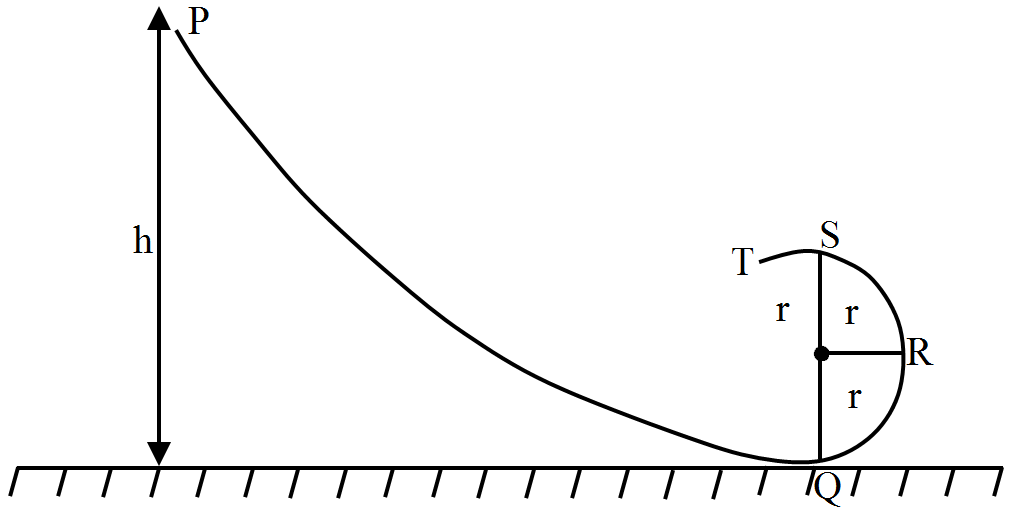
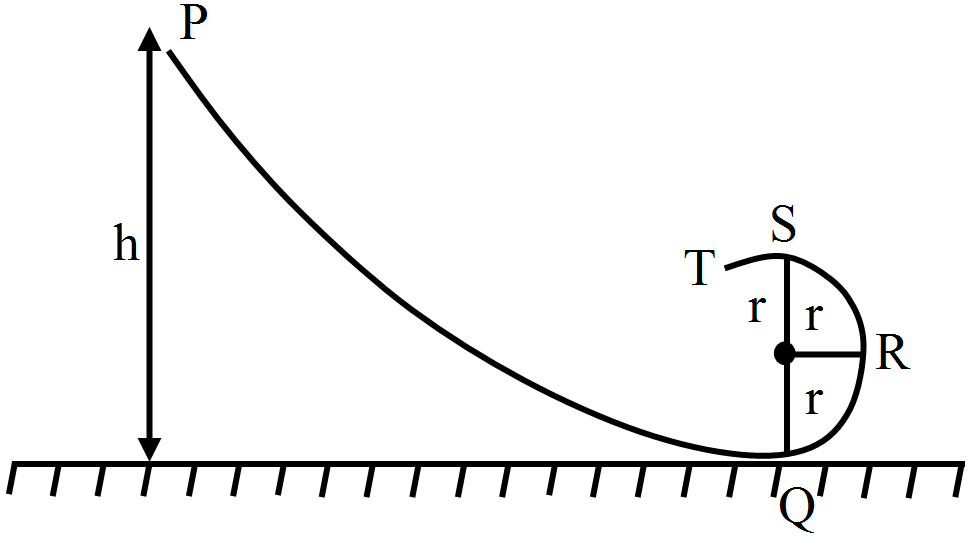
Given in figure PQRST is a channel in the vertical plane, part QRST being circular arc of radius r. A ball is released from P, and slides without friction and without rolling. Show that it will complete the loop path if h is greater than $\frac{5\text{r}}{2}.$
Answer
When the ball (of mass m) reaches Q, its P.E. (mgh) changes into kinetic energy, such that $\text{mgh}=\frac{1}{2}\text{mv}_1^2\dots(\text{i})$ where $v_1$ is the velocity obtained by the ball on reaching Q. The ball again rises to S, Such that $\text{mg}(\text{h}-2\text{r})=\frac{1}{2}\text{mv}_2^2\dots(\text{ii})$ where $v_2$ is the velocity obtained by the ball on reaching S. In order to complete the circular path, the centrifugal force acting upward at S should be greater than or equal to weight mg acting downwards.
​​​​​​​
$\therefore\ \frac{\text{mv}^2_2}{\text{r}}\geq\text{mg}$ or $\text{v}_2^2\geq\text{rg}$
from (ii) $\text{v}_2^2=\frac{2\text{mg}(\text{h}-2\text{r})}{\text{m}}=2\text{g}(\text{h}-2\text{r})$
$\therefore\ 2\text{g}(\text{h}-2\text{r})\geq\text{rg}$ or $\text{h}\geq\frac{5\text{r}}{2}$
View full question & answer
Question 625 Marks
Mathematically describe the motion of a particle along a plane (or along a two-dimensional plane).
Answer
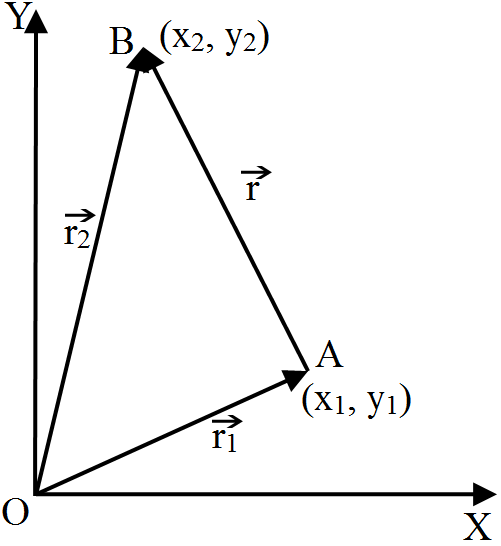
Consider motion of a particle in x-y plane. Displacement: Let the particle be at position A having position vector $\vec{\text{r}}_1$ at time $t_1$ where $\vec{\text{r}}_1=(\text{x}_1\hat{\text{i}}+\text{y}_1\hat{\text{j}}).$ At time $t_2$, the object reaches point B having Position vector $\vec{\text{r}}_2$ where $\vec{\text{r}}_2=(\text{x}_2\hat{\text{i}}+\text{y}_2\hat{\text{j}}).$ $\therefore$ Displacement of the particle during the time $(t_2 - t_1​​​​​​​)$ will be$\vec{\text{r}}\ \text{ or }\ \vec{\text{r}}_{12}=\vec{\text{r}}_2-\vec{\text{r}}_1=(\text{x}_2-\text{x}_1)\hat{\text{i}}+(\text{y}_2-\text{y}_1)\hat{\text{j}},$
where, $|\vec{\text{r}}|=\sqrt{(\text{x}_2-\text{x}_1)^2+(\text{y}_2-\text{y}_1)^2}$
Velocity. If motion be uniform then unilorm velocity may be defined as the displacemmt covered per unit time i.e., $\text{Velocity }\vec{\text{v}}=\frac{\Delta\vec{\text{r}}}{\Delta\text{t}}=\frac{\vec{\text{r}}_2-\vec{\text{r}}_1}{\text{t}_2-\text{t}_1}$ $=\frac{(\text{x}_2-\text{x}_1)}{(\text{t}_2-\text{t}_1)}\hat{\text{i}}+\frac{(\text{y}_2-\text{y}_1)}{(\text{t}_2-\text{t}_1)}\hat{\text{j}}=\text{v}_\text{x}\hat{\text{i}}+\text{v}_\text{y}\hat{\text{j}}$ where $\text{v}_\text{x}=\frac{\text{x}_2-\text{x}_1}{\text{t}_2-\text{t}_1},\text{v}_\text{y}=\frac{\text{y}_2-\text{y}_1}{\text{t}_2-\text{t}_1}$ and $|\vec{\text{v}}|=\sqrt{\text{v}^2_\text{x}+\text{v}^2_\text{y}}$

Accelerataion: If velocity of particle is variable then time rate of change of velocity is the acceleration $\vec{\text{a}}.$ If $\vec{\text{v}}_1$ and $\vec{\text{v}}_2$ be the velocities of the particle at times $t_1$ and $t_2$​​​​​​​ respectively and acceleration be uniform, then
$\vec{\text{a}}=\frac{\Delta\vec{\text{v}}}{\Delta\text{t}}=\frac{\vec{\text{v}}_2-\vec{\text{v}}_1}{\text{t}_2-\text{t}_1}$ $=\frac{(\text{v}_{2\text{x}}\hat{\text{i}}+\text{v}_{2\text{y}}\hat{\text{j}})-(\text{v}_{1\text{x}}\hat{\text{i}}+\text{v}_{1\text{y}}\hat{\text{j}})}{(\text{t}_2-\text{t}_1)}$ $=\frac{(\text{v}_{2\text{x}}-\text{v}_{1\text{x}})}{(\text{t}_2-\text{t}_1)}\hat{\text{i}}+\frac{(\text{v}_{2\text{y}}-\text{v}_{1\text{y}})}{(\text{t}_2-\text{t}_1)}\hat{\text{j}}$ $=\text{a}_\text{x}\hat{\text{i}}+\text{a}_\text{y}\hat{\text{j}}$ where $\text{a}_\text{x}=\frac{\text{v}_{2\text{x}}-\text{v}_{1\text{x}}}{\text{t}_2-\text{t}_1},\ \text{a}_\text{y}=\frac{\text{v}_{2\text{y}}-\text{v}_{1\text{y}}}{\text{t}_2-\text{t}_1}$ and $|\vec{\text{a}}|=\sqrt{\text{a}_\text{x}^2+\text{a}^2_\text{y}}.$
View full question & answer
Question 635 Marks
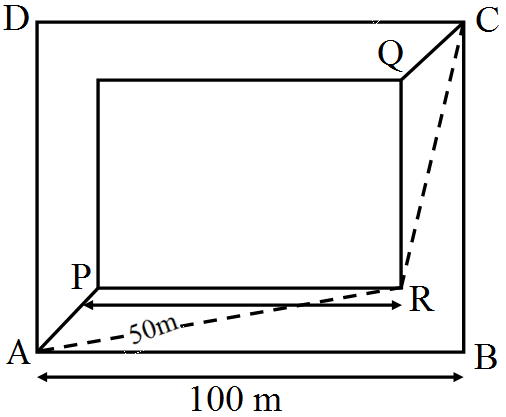
A man wants to reach from A to the opposite corner of the square C Fig. The sides of the square are 100m. A central square of 50m × 50m is filled with sand. Outside this square, he can walk at a speed 1m/ s. In the central square, he can walk only at a speed of $\upsilon\text{m/ s}(\upsilon<1)$. What is smallest value of v for which he can reach faster via a straight path through the sand than any path in the square outside the sand?
Answer
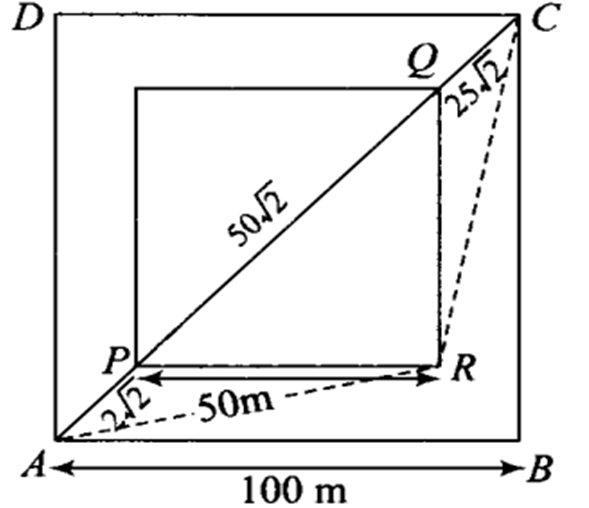
As shown in the adjacent diagram.The man walk throught the sand on the path APQC via straight line, so, time taken by him to go from A to C is
$\text{T}_\text{sand}=\frac{\text{AP+QC}}{1}+\frac{\text{PQ}}{\text{v}}$
$=\frac{25\sqrt{2}+25\sqrt{2}}{1}+\frac{50\sqrt{2}}{\text{v}}$
$=50\sqrt{2}+\frac{50\sqrt{2}}{\text{v}}$
$=50\sqrt{2}\Big(\frac{1}{\text{v}}+1\Big)$
Clearly from figure the shortest path outside the sand will be ARC. Time taken to go from A to C via this path is
$\text{T}_\text{outside}=\frac{\text{AR+RC}}{1}\text{s}$
Clearly, $\text{AR}=\sqrt{75^2+25^2}$$=\sqrt{75\times75\times+25\times25}$
$=5\times5\sqrt{9+1}$ $=25\sqrt{10}\text{m}$
$\text{RC}=\text{AR}=\sqrt{75^2+25^2}$ $=25\sqrt{10}\text{m}$
$\Rightarrow\text{T}_\text{outside}2\text{AR}=2\times25\sqrt{10}\text{s}$ $=50\sqrt{10}\text{s}$
For $\text{T}_\text{sand}<\text{T}_\text{outside}$
$\Rightarrow50\sqrt{2}\Big(\frac{1}{\text{v}}+1\Big)<2\times25\sqrt{10}$
$\Rightarrow\frac{2\sqrt{2}}{2}\Big(\frac{1}{\text{v}}+1\Big)\sqrt{10}$
$\Rightarrow\frac{1}{\text{v}}+<\frac{2\sqrt{10}}{2\sqrt{2}}$ $=\frac{\sqrt{5}}{2}\times2=\sqrt{5}$
$\frac{1}{\text{v}}<\frac{\sqrt{5}}{2}\times2-1\Rightarrow\frac{1}{\text{v}}<\sqrt{5}-1$
$\Rightarrow\text{v}>\frac{1}{\sqrt{5}-1}\approx0.81\text{m/ s}\Rightarrow\text{v}>0.81\text{m/ s}$
View full question & answer
Question 645 Marks
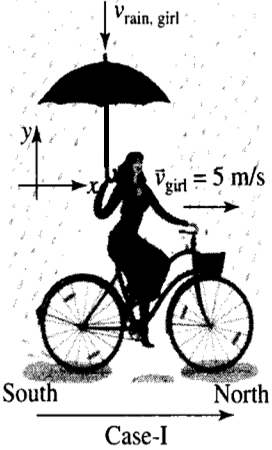
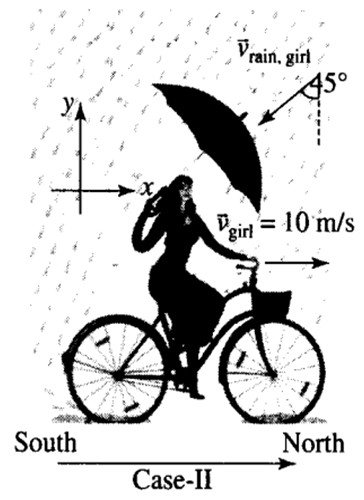
A girl riding a bicycle with a speed of $5m/ s$ towards north direction, observes rain falling vertically down. If she increases her speed to $10m/ s$, rain appears to meet her at $45°$ to the vertical. What is the speed of the rain? In what direction does rain fall as observed by a ground based observer?
(Hint: Assume north to be $\hat{\text{i}}$ direction and vertically downward to be $-\hat{\text{j}}$. Let the rain velocity $\text{v}_\text{r}$ be $\text{a}\hat{\text{i}}+\text{b}\hat{\text{j}}.$ The velocity of rain as observed by the girl is always $V_r-V_{girl}$. Draw the vector diagram/s for the information given and find a and b. You may draw all vectors in the reference frame of ground based observer)
Answer
$\text{V}_{\text{rg}}$ is the velocity of rain appears to the girl. We must draw all vectors in the reference frame of ground-based observer.

Assume north to be $\hat{\text{i}}$ direction and vertically downward to be$(-\hat{\text{j}})$.Let the rain velocity
$\text{v}_\text{r}=\text{a}\hat{\text{i}}+\text{b}\hat{\text{j}}$Case I: According to the problem, velocity of
$\text{girl}=\text{v}_\text{g}=({5\text{m/ s}})\hat{\text{i}}$Let $\text{v}_\text{rg}=$ velocity of rain w.r.t girl
$=\text{v}_\text{r}-\text{v}_\text{g}=(\text{a}\hat{\text{i}}+\text{b}\hat{\text{j}})-5\hat{\text{i}}=(\text{a}-5)\hat{\text{i}}+\text{b}\hat{\text{j}}$ According to question, rain appears to fall vertically downward. Hence,$\text{a}-5=0\Rightarrow\text{a}=5$Case II: Now velocity of the girl after increasing her speed,
$\text{v}_\text{g}=(10\text{m/ s})\hat{\text{i}}$

$\therefore \ \text{v}_\text{rg}=\text{v}_\text{r}-\text{v}_\text{g}$ $=(\text{a}\hat{\text{i}}+\text{b}\hat{\text{j}})-10\hat{\text{i}}=(\text{a}-10)\hat{\text{i}}+\text{b}\hat{\text{j}}$According to questions rain appears to fall at 45° to the vertical, hence
$\tan45^\circ=\frac{\text{b}}{\text{a}-10}=1$ $\Rightarrow \ \ \text{b}=\text{a}-10=5-10=-5$Hence, velocity of rain $=\text{a}\hat{\text{i}}+\text{b}\hat{\text{j}}$
$\Rightarrow \ \ \text{v}_\text{r}=5\hat{\text{i}}-5\hat{\text{j}}$
Speed of rain $=|\text{v}_\text{r}|=\sqrt{(5)^2+(-5)^2}=\sqrt{50}=5\sqrt{2}\text{m/s}$
View full question & answer
Question 655 Marks
In a harbour, wind is blowing at the speed of $72km/h$ and the flag on the mast of a boat anchored in the harbour flutters along the N-E direction. If the boat starts moving at a speed of $51km/h$ to the north, what is the direction of the flag on the mast of the boat?
Answer
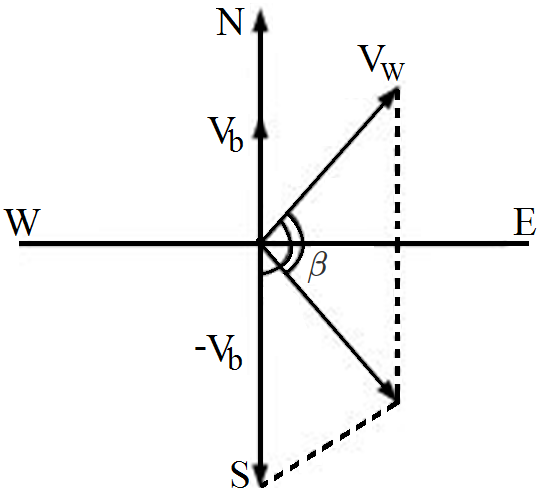
Velocity of the boat, $v_b = 51km/h$ Velocity of the wind, $v_w = 72km/h$ The flag is fluttering in the north-east direction. It shows that the wind is blowing toward the north-east direction. When the ship begins sailing toward the north, the flag will move along the direction of the relative velocity $(v_{wb})$ of the wind with respect to the boat.

 The angle between $v_w$ and $(-v_b) = 90^\circ + 45^\circ \tan\beta=\frac{51\sin(90+45)}{72+51\cos(90+45)}$
$=\frac{51\sin45}{72+51(-\cos45)}=\frac{51\times\frac{1}{\sqrt{2}}}{72-51\times\frac{1}{\sqrt{2}}}$
$=\frac{51}{72\sqrt{2}-51}=\frac{51}{72\times1.414-51}=\frac{51}{50.800}$
$\therefore\beta=\tan^{-1}(1.0038)=45.11^\circ$ Angle with respect to the east direction = $45.11^\circ – 45^\circ = 0.11^\circ$
Hence, the flag will flutter almost due east.
View full question & answer
Question 665 Marks
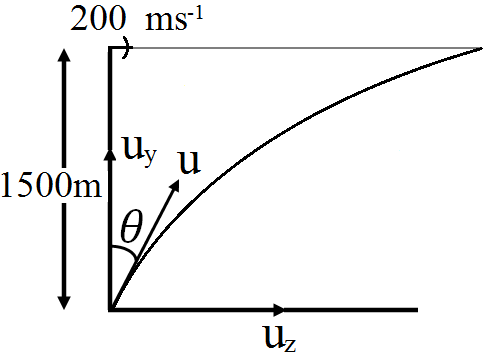
A fighter plane flying horizontally at an altitude of $1.5km$ with speed $720km/h$ passes directly overhead an anti-aircraft gun. At what angle from the vertical should the gun be fired for the shell with muzzle speed $600ms^{-1}$ to hit the plane? At what minimum altitude should the pilot fly the plane to avoid being hit? (Take $g = 10ms^{-2}$).
Answer
Height of the fighter plane = 1.5km = 1500m Speed of the fighter plane, v = 720km/h = 200m/s Let $\theta$ be the angle with the vertical so that the shell hits the plane. The situation is shown in the given figure.

Muzzle velocity of the gun, u = 600m/s Time taken by the shell to hit the plane = t Horizontal distance travelled by the shell = $u_xt$ Distance travelled by the plane = vt The shell hits the plane. Hence, these two distances must be equal. $\text{u}_\text{x}\text{t}=\text{vt}$
$\text{u}\sin\theta=\text{v}$
$\sin\theta=\frac{\text{v}}{\text{u}}$
$=\frac{200}{600}=\frac{1}{3}=0.33$
$\theta=\sin^{-1}(0.33)=19.5^\circ$
In order to avoid being hit by the shell, the pilot must fly the plane at an altitude (H) higher than the maximum height achieved by the shell.
​​​​​​​$\therefore\text{H}=\frac{\text{u}^2\sin^2(90-\theta)}{2\text{g}}$
$=\frac{(600)^2\cos^2\theta}{2\text{g}}$
$=\frac{3,60,000\times\cos^219.5}{2\times10}$
$=16,006.482\text{m}$
$=16\text{km}$
View full question & answer
Question 675 Marks
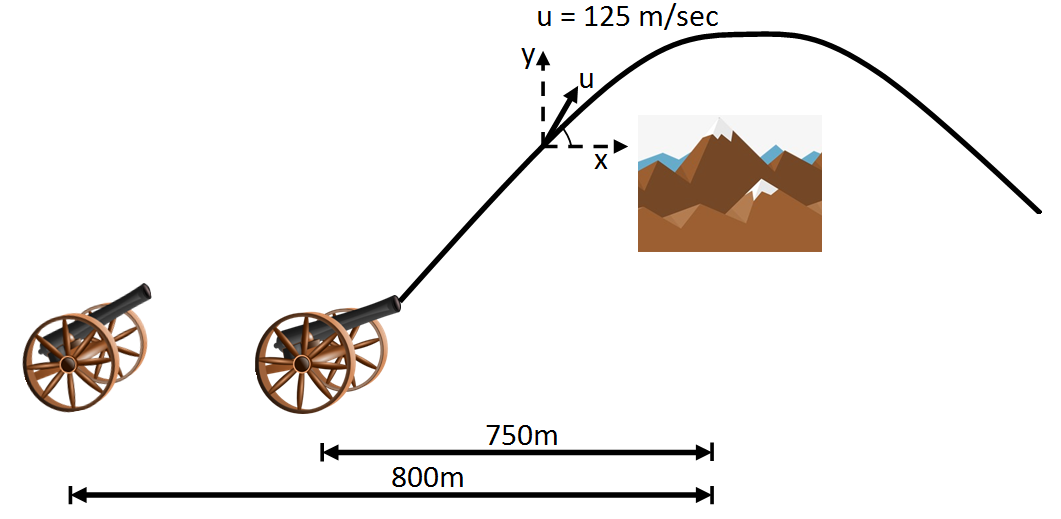
A hill is 500m high. Supplies are to be sent across the hill using a canon that can hurl packets at a speed of 125m/ s over the hill. The canon is located at a distance of 800m from the foot of hill and can be moved on the ground at a speed of 2m/ s; so that its distance from the hill can be adjusted. What is the shortest time in which a packet can reach on the ground across the hill? Take $g =10m/ s^2$.
Answer


Speed of packets = 125m/ s
Height of hill = 500m
To cross the hill by packet the vertical components of the speed of packet ($125m s^{-1}$) must be minimised so that it can attain a height of 500m and the distance between Hill and Cannon must be half the range of packet.
$\text{v}^2=\text{u}^2+2\text{gh}$
$0=\text{u}^2_\text{y}-2\text{gh}$
$\text{u}_\text{y}=\sqrt{2\text{gh}}=\sqrt{2\times10\times500}$
$=\sqrt{10000}$
$\text{u}_\text{y}=100\text{m/s}$
$\text{u}^2=\text{u}^2_\text{x}+\text{u}^2_\text{y}$
$(125)^2=\text{u}^2_\text{x}+100^2$
$\Rightarrow\ \text{u}^2_\text{x}=125^2-100^2$
$\text{u}^2_\text{x}=(125-100)(125+100)$
$=25\times225$
$\text{u}_\text{x}=5\times15$
$\Rightarrow\ \text{u}_\text{x}=75\text{m/s}$
Vertical motion of packet
$\text{v}_\text{y}=\text{u}_\text{y}+\text{gt}$
$0=100-10\text{t}$
$\therefore\ \text{Total time of }\frac{1}2\text{ flight}=10\text{sec}$ [Total time to reach the top of hill]
So the cannon must be at $\frac{1}2$ the range = horizontal distance in 10sec
$=\text{u}_\text{x}\times10=75\times10\text{m}=750$
Hence, the distance between hill and cannon = 750m
So the distance to which cannon must move toward the hill = 800 - 750 = 50m
Time taken to move cannon in 50m $=\frac{\text{distance}}{\text{speed}}=\frac{50}{2}=25\text{sec}$
Hence, the total time taken by packet from 800m away from hill to reach other side
= 25s + 10s + 10s = 45 seconds.
View full question & answer
Question 685 Marks
A cyclist is riding with a speed of $27km/h$. As he approaches a circular turn on the road of radius 80m, he applies brakes and reduces his speed at the constant rate of $0.50m/s$ every second. What is the magnitude and direction of the net acceleration of the cyclist on the circular turn?
Answer
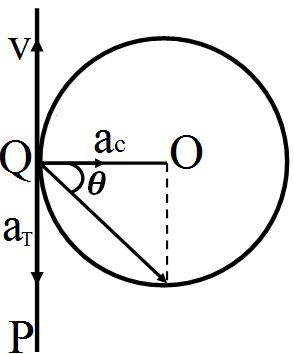
$0.86m/s^2; 54.46^\circ$  with the direction of velocity Speed of the cyclist, v = 27km/h = 7.5m/s Radius of the circular turn, r = 80m Centripetal acceleration is given as: $\text{a}_\text{c}=\frac{\text{v}^2}{\text{r}}$ $=\frac{7.5^2}{80}=0.7\text{ms}^{-2}$ The situation is shown in the given figure:

Suppose the cyclist begins cycling from point P and moves toward point Q. At point Q, he applies the breaks and decelerates the speed of the bicycle by $0.5m/s^2$. This acceleration is along the tangent at Q and opposite to the direction of motion of the cyclist. Since the angle between $a_c$ and $a_T$ is $90^0$, the resultant acceleration a is given by: $\text{a}=\Big(\text{a}_\text{c}^2+\text{a}_\text{T}^2\Big)^{1/2}$ $=\Big((0.7)^2+(0.5)^2\Big)^{1/2}$ $=(0.74)^{1/2}$ $\tan\theta=\frac{\text{a}_\text{c}}{\text{a}_\text{T}}$ where $\theta$ is the angle of the resultant with the direction of velocity. $\tan\theta=\frac{0.7}{0.5}=1.4$ $\theta=\tan^{-1}(1.4)=54.56^\circ$
View full question & answer
Question 695 Marks
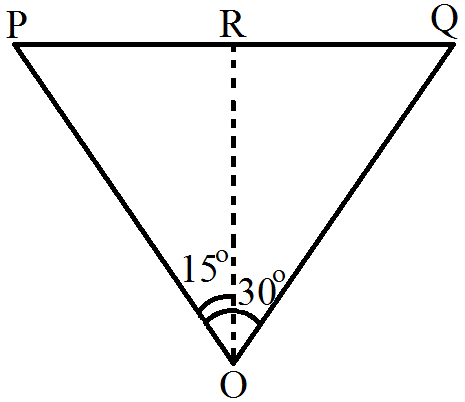
An aircraft is flying at a height of 3400m above the ground. If the angle subtended at a ground observation point by the aircraft positions 10.0s apart is 30°, what is the speed of the aircraft?
Answer
The positions of the observer and the aircraft are shown in the given figure. Height of the aircraft from ground, OR = 3400m Angle subtended between the positions, $\angle\text{POQ}=30^\circ$ Time = 10s In $\triangle\text{PRO}:$ $\tan15^\circ=\frac{\text{PR}}{\text{OR}}$ $\text{PR}=\text{OR}\tan15^\circ$ $=34000\times\tan15^\circ$ $\triangle\text{PRO}$ is similar to $\triangle\text{RQO.}$ $\therefore\text{PR}=\text{RQ}$ $\text{PQ} = \text{PR} + \text{RQ}$ $=2\text{PR}=2\times3400\tan15^\circ$ $=6800\times0.268=1822.4\text{m}$ $\therefore$ Speed of the aircraft $=\frac{1822.4}{10}=182.24\text{m/s}$
View full question & answer
Question 705 Marks
The position of a particle is given by $\text{r}=3.0\text{t}\hat{\text{i}}-2.0\text{t}^2\hat{\text{j}}+4.0\hat{\text{k }}\text{m}$ Where t is in seconds and the coefficients have the proper units for r to be in metres. (a) Find the v and a of the particle? (b) What is the magnitude and direction of velocity of the particle at t = 2.0s?
Answer
  1. $\vec{\nu}(\text{t})=(3.0\hat{\text{i}}-4.0\text{t}\hat{\text{J}});\text{a}=-4.0\hat{\text{j}}$
The position of the particle is given by:
$\vec{\text{r}}=3.0\text{t}\hat{\text{i}}-2.0\text{t}^2\hat{\text{J}}+4.0\hat{\text{k}}$
Velocity $\vec{\nu},$ of the particle given as:
$\vec{\nu}=\frac{\text{d}\vec{\text{r}}}{\text{dt}}=\frac{\text{d}}{\text{dt}}(3.0\text{t}\hat{\text{i}}-2.0\text{t}^2\hat{\text{J}}+4.0\hat{\text{k}})$
$\therefore\vec{\nu}=3.0\hat{\text{i}}-4.0\text{t}\hat{\text{J}}$
Acceleration, $\vec{\text{a}},$ of the particle is given as:
$\vec{\text{a}}=\frac{\text{d}\vec{\nu}}{\text{dt}}=\frac{\text{d}}{\text{dt}}(3.0\hat{\text{i}}-4.0\text{t}\hat{\text{J}})$
$\therefore\vec{\text{a}}=-4.0\hat{\text{J}}$
  1. 8.54m/s, 69.45° below the x - axis
We have velocity vector, $\vec{\nu}=3.0\hat{\text{i}}-4.0\text{t}\hat{\text{J}}$
$\text{At t}=2.0\text{s}:$
$\vec{\nu}=3.0\hat{\text{i}}-8.0\hat{\text{J}}$
The magnitude of veocity is given by:
$|\vec{\nu}|\sqrt{3^2+(-8)^2}=\sqrt{73}=8.54\text{m/s}$
Direction, $\theta=\tan^{-1}\Big(\frac{\nu_\text{y}}{\nu_\text{x}}\Big)$
$=\tan^{-1}\Big(\frac{-8}{3}\Big)=-\tan^{-1}(2.667)$
$=-69.45^\circ$
The negative sing indicates that the direction of velocity is below the x - axis.
View full question & answer
Question 715 Marks
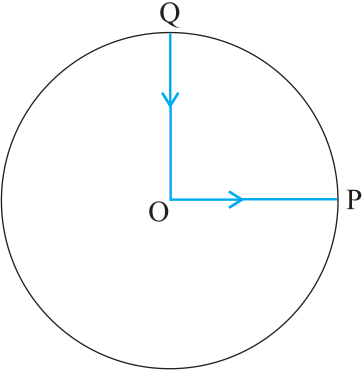
A cyclist starts from the centre O of a circular park of radius 1km, reaches the edge P of the park, then cycles along the circumference, and returns to the centre along QO as shown in Fig. If the round trip takes 10 min, what is the (a) net displacement, (b) average velocity, and (c) average speed of the cyclist?
Answer
  1. Displacement is given by the minimum distance between the initial and final positions of a body. In the given case, the cyclist comes to the starting point after cycling for 10 minutes. Hence, his net displacement is zero.
  2. Average velocity is given by the relation:
$\text{Average velocity}=\frac{\text{Net Displacement}}{\text{Total time}}$
Since the net displacement of the cyclist is zero, his average velocity will also be zero.
  1. Average speed of the cyclist is given by the relation:
$\text{Average speed}=\frac{\text{Total path length}}{\text{Total time}}$
Total path length = OP + PQ + QO
$=1+\frac{1(2\pi\times1)}{4}+1$
$=2+\frac{\pi}{2}$
= 3.570km
Time taken = 10 min $=\frac{10}{60}=\frac{1}{6}\text{h}$
$\therefore$ Average speed = $\frac{3.570}{\frac{1}{6}}=21.42\text{km/h}$
View full question & answer
Question 725 Marks
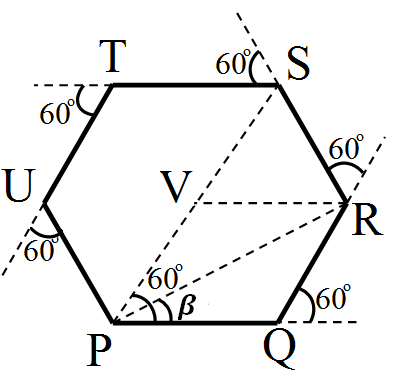
On an open ground, a motorist follows a track that turns to his left by an angle of 600 after every 500m. Starting from a given turn, specify the displacement of the motorist at the third, sixth and eighth turn. Compare the magnitude of the displacement with the total path length covered by the motorist in each case.
Answer
The path followed by the motorist is a regular hexagon with side 500 m, as shown in the given figure Let the motorist start from point P. The motorist takes the third turn at S. $\therefore$ Magnitude of displacement = PS = PV + VS = 500 + 500 = 1000m Total path length = PQ + QR + RS = 500 + 500 + 500 = 1500m The motorist takes the sixth turn at point P, which is the starting point. $\therefore$ Magnitude of displacement = 0 Total path length = PQ + QR + RS + ST + TU + UP = 500 + 500 + 500 + 500 + 500 + 500 = 3000m The motorist takes the eight turn at point R $\therefore$ Magnitude of displacement = PR $=\sqrt{\text{PQ}^2+\text{QR}^2+2(\text{PQ}).(\text{QR})\cos60^\circ}$ $=\sqrt{500^2+500^2+(2\times500\times\cos60^\circ)}$ $\sqrt{2,50,000+2,50,000+\Big(5,00,000\times\frac{1}{2}\Big)}$ $=866.03\text{m}$ $\beta=\tan^{-1}\Big(\frac{500\sin60^\circ}{500+500\cos60^\circ}\Big)=30^\circ$ Therefore, the magnitude of displacement is 866.03m at an angle of 30° with PR. Total path length = Circumference of the hexagon + PQ + QR = 6 × 500 + 500 + 500 = 4000m The magnitude of displacement and the total path length corresponding to the required turns is shown in the given table:
Turn
Magnitude of displacement (m)
Total path length (m)
Third
1000
1500
Sixth
0
3000
Eighth
866.03; 30°
4000
View full question & answer
Question 735 Marks
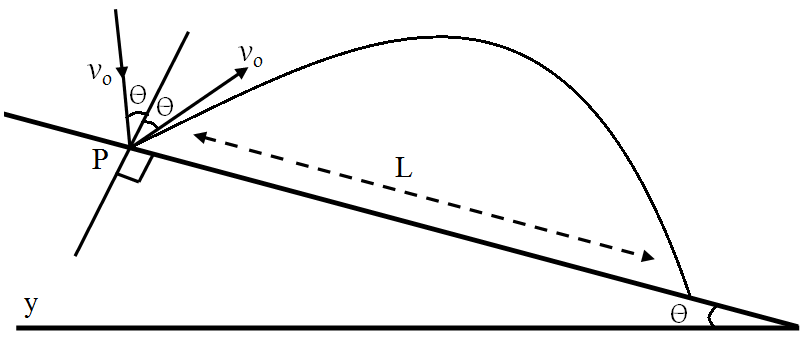
A particle falling vertically from a height hits a plane surface inclined to horizontal at an angle $\theta$ with speed $\text{v}_0$ and rebounds elastically. Find the distance along the plane where if will hit second time.
(Hint:
  1. After rebound, particle still has speed Vo to start.
  2. Work out angle particle speed has with horizontal after it rebounds.
  3. Rest is similar to if particle is projected up the incline.
Answer
Particle rebounces from P so it will be an elastic collision. As it strikes plane inclined at $\text{v}_0$ speed so speed of particle after rebounces will be $\text{v}_0$ Again consider the new axia X'OX and YOY' axis at P as origin 'O'. The componenets of g and $\text{v}_0$ in new OX and OY axis are:
$\text{v}_\text{x}=\text{v}_0\sin\theta\text{ and v}_\text{y}=\text{v}_0\cos\theta$ $\text{g}_\text{x}=\text{g}\cos\theta,\text{g}_\text{y}=\text{g}\sin\theta$ acting vertically downwords Consider the motion of particle from O to A in new YOY' axis. $\text{s}_\text{y}=\text{u}_\text{y}\text{t}+\frac{1}{2}\text{a}_\text{y}\text{t}^2$ $\text{s}_\text{y}=0\ \text{v}_\text{y}=\text{v}_0\cos\theta\ \text{a}_\text{y}=-\text{g}\sin\theta $ (upward) $\therefore\text{t=T}$ (time of flight) $0=\text{T}\Big[\text{v}_0\cos\theta-\frac{1}{2}\text{g}\text{ sin}\theta\text{ T}\Big]$ This means either $\text{T}=0\text{ or v}_0\cos\theta-\frac{\text{g}\cos\theta(\text{T})}{2}=0$T cannot be zero $\Rightarrow\text{T}=\frac{2\text{v}_0\cos\theta}{\text{g}\cos\theta}$
$\text{T}=\frac{2\text{v}_0}{\text{g}}$
Now consider the motion along OX axis. $\text{S}_\text{x}=\text{L, u}_\text{x}=\upsilon_0\sin\theta,\text{a}_\text{x}=\text{g}\sin\theta,\text{t}=\text{T}=\frac{2\upsilon_0}{\text{g}}$ $\text{S}_\text{x}=\text{u}_\text{x}\text{t}+\frac{1}{2}\text{a}_\text{x}\text{t}^2$ $\text{L}=\Big[\frac{2\text{v}_\text{0}}{\text{g}}\Big]\text{v}_0\sin\theta+\frac{1}{2}\text{g}\sin\theta\Big[\frac{2\text{v}_0}{\text{g}}\Big]^2$ $\text{L}=\frac{2\text{v}^2_0}{\text{g}}\sin\theta+\frac{1}{2}\text{g}\sin\theta.\frac{4\text{v}^2_0}{\text{g}^2}$ $=\frac{2\text{v}^2_0}{\text{g}}[\sin\theta+\sin\theta]=\frac{2\text{v}^2_0}{\text{g}}2\sin\theta$ $\Rightarrow\text{L}=\frac{4\text{v}^2_0}{\text{g}}\sin\theta.$
View full question & answer
Question 745 Marks
$\hat{\text{i}}$ and $\hat{\text{j}}$ are unit vectors along x- and y- axis respectively. What is the magnitude and direction of the vectors $\hat{\text{i}}+\hat{\text{j}},$ and $\hat{\text{i}}-\hat{\text{j}}$? What are the components of a vector $\text{A}=2\hat{\text{i}}+3\hat{\text{j}}$ along the directions of $\hat{\text{i}}+\hat{\text{j}}$ and $\hat{\text{i}}-\hat{\text{j}}$? [You may use graphical method]
Answer
Consider a vector $\vec{\text{P}}$ given as,$\text{P}=\hat{\text{i}}+\hat{\text{j}}$
$\text{P}_\text{x}\hat{\text{i}}+\text{P}_\text{y}\hat{\text{j}}=\hat{\text{i}}+\hat{\text{j}}$
On comparing the components on both sides, we get,
$\text{P}_\text{x}=\text{P}_\text{y}=1$
$|\vec{\text{P}}|=\sqrt{\text{P}_\text{x}^2+\text{P}_\text{y}^2}=\sqrt{(1)^2+(1)^2}=\sqrt{2}\ ...(\text{i})$
Hence, the magnitude of the vector $\hat{\text{i}}+\hat{\text{j}}\ \text{is}\ \sqrt{2}$
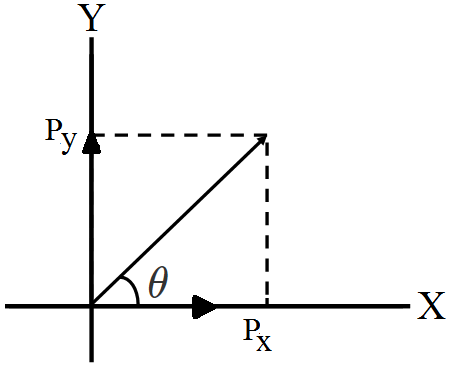
Let $\theta$ be the angle made by he vector $\vec{\text{P}},$ With
The x-axis, as shows in the following figure.

$\therefore\tan\theta=\Big(\frac{\text{P}_\text{y}}{\text{P}_\text{x}}\Big)$
$\Rightarrow\theta=\tan^{-1}\Big(\frac{1}{1}\Big)=45^\circ\ ...(\text{ii})$
Hence, vector $\hat{\text{i}}+\hat{\text{j}}$ makes an angle of 45° with the x-axis.
Let,
$\text{i.e.,}\text{Q}_\text{x}\ \hat{\text{i}}-\text{Q}_\text{y}\hat{\text{j}}=\hat{\text{i}}-\hat{\text{j}}$
$\text{Q}_\text{x}=\text{Q}_\text{y}=1$
$|\text{Q}|=\sqrt{\text{Q}_\text{x}^2+\text{Q}_\text{y}^2}=\sqrt{2}\ ...(\text{iii})$
Hence, the magnitude of the vector $\hat{\text{i}}-\hat{\text{j}}\ \text{is}\ \sqrt{2}.$
View full question & answer
Question 755 Marks
A particle starts from the origin at t = 0s with a velocity of $10.0\hat{\text{j}}\text{m/s}$ and moves in the x - y plane with a constant acceleration of $(8.0\hat{\text{i}}+2.0\hat{\text{j}})\text{ms}^{-2}.$ (a) At what time is the x- coordinate of the particle 16m? What is the y-coordinate of the particle at that time? (b) What is the speed of the particle at the time?
Answer
Velocity of the particle, $\vec{\nu}=10.0\hat{\text{j}}\text{m/s}$ Acceleration of the particle, $\vec{\text{a}}=(8.0\hat{\text{i}}+2.0\hat{\text{j}})$ Also, But, $\vec{\text{a}}=\frac{\text{d}\vec{\nu}}{\text{dt}}=8.0\hat{\text{i}}+2.0\vec{\text{j}}$ $\text{d}\vec{\nu}=(8.0\hat{\text{i}}+2.0\hat{\text{j}})\text{dt}$ Integrating both sides: $\vec{\nu}(\text{t})=8.0\text{t}\hat{\text{i}}+2.0\text{t}\hat{\text{j}}+\vec{u}$ Where, $\vec{u}$ = Velocity vector of the particle at t = 0 $\vec{\nu}$ = Velocity vector of the particle at time t Integrating the equations with the conditions: at t = 0, r = 0, and at t = t, r = r $\vec{\text{r}}=\vec{u}\text{t}+\frac{1}{2}8.0\text{t}^2\hat{\text{i}}+\frac{1}{2}\times2.0\text{t}^2\hat{\text{j}}$ $=\vec{u}\text{t}+4.0\text{t}^2\hat{\text{i}}+\text{t}^2\hat{\text{j}}$ $=(10.0\hat{\text{j}})\text{t}+4.0\text{t}^2\hat{\text{i}}+\text{t}^2\hat{\text{j}}$ $\text{x}\hat{\text{i}}+\text{y}\hat{\text{j}}=4.0\text{t}^2\hat{\text{i}}+(10\text{t}+\text{t}^2)\hat{\text{j}}$ We observe that the motion of the particle is in x - y plane, So, on equating the coefficients of $\hat{\text{i}}$ and $\hat{\text{j}}$ we get, $\text{x}=4\text{t}^2$ $\text{t}=\Big(\frac{\text{x}}{4}\Big)^{1/2}$ and $\text{y} = 10\text{t} + \text{t}^2$
  1. When y = 16m:
$\text{t}=\Big(\frac{16}{4}\Big)^{1/2}=2\text{s}$
$\therefore\text{y}=10\times2+(2)^2=24\text{m}$
  1. Velocity of the particle is given by:
$\vec{\nu}(\text{t})=8.0\text{t}\hat{\text{i}}+2.0\text{t}\hat{\text{j}}+\vec{u}$
$\text{At t}=2\text{s}$
$\vec{\nu}(2)=8.0\times2\hat{\text{i}}+2.0\times2\hat{\text{j}}+10\hat{\text{j}}$
$=16\hat{\text{i}}=14\hat{\text{j}}$
$\therefore$ Speed of the particle,
$\text{V}=\sqrt{(16)^2+(14)^2}$
$=\sqrt{256+196}=\sqrt{452}$
$=21.26\text{m/s}$
View full question & answer
Question 765 Marks
Find the magnitude and direction of the resultant of two vectors $A$ and $B$ in terms of their magnitudes and angle $\theta $ between them.
Image
Answer
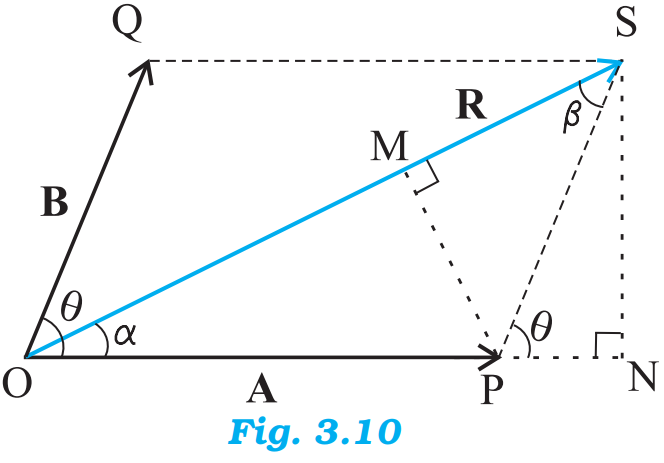
Let $O P$ and $O Q$ represent the two vectors $A$ and $B$ making an angle $\theta ($Fig. $3.10)$. Then, using the parallelogram method of vector addition, $OS$ represents the resultant vector $R$ :
$R = A + B$
$S N$ is normal to $O P$ and $P M$ is normal to $O S$.
From the geometry of the figure,
but
$O S^2=O N^2+S N^2$
$O N=O P+P N=A+B \cos \theta$
$S N=B \sin \theta$
$O S^2=(A+B \cos \theta)^2+(B \sin \theta)^2$
or,
$R^2=A^2+B^2+2 A B \cos \theta$
$R=\sqrt{A^2+B^2+2 A B \cos \theta} \text{(3.24a)}$
In $\Delta OSN , SN = OS \sin \alpha=R \sin \alpha$, and
in $\triangle PSN , SN =P S \sin \theta=B \sin \theta$
Therefore, $R \sin \alpha=B \sin \theta$
or, $\frac{R}{\sin \theta}=\frac{B}{\sin \alpha} \text{(3.24b)}$
Similarly,
$PM =A \sin \alpha=B \sin \beta$
$\text { or, } \frac{A}{\sin \beta}=\frac{B}{\sin \alpha} \text{(3.24c)}$
Combining Eqs. $(3.24b)$ and $(3.24c)$, we get
$\frac{R}{\sin \theta}=\frac{A}{\sin \beta}=\frac{ B }{\sin \alpha} \text{(3.24d)}$
Using Eq. $(3.24d)$, we get:
$\sin \alpha=\frac{B}{R} \sin \theta \text{(3.24e)}$
where $R$ is given by Eq. $(3.24a).$
or, $\tan \alpha=\frac{ S N}{O P+P N}=\frac{B \sin \theta}{A+B \cos \theta} \text{(3.24f)}$
Equation $(3.24a)$ gives the magnitude of the resultant and Eqs. $(3.24e)$ and $(3.24f)$ its direction. Equation $(3.24a)$ is known as the Law of cosines and Eq. $(3.24d)$ as the Law of sines.
View full question & answer
5 Marks Questions - Page 2 - Physics STD 11 Science Questions - Vidyadip