Question 515 Marks
A spring balance has a scale that reads from $0$ to $50kg$. The length of the scale is $20cm$. A body suspended from this balance, when displaced and released, oscillates with a period of 0.6s. What is the weight of the body?
AnswerMaximum mass that the scale can read, M = 50kg Maximum displacement of the spring = Length of the scale, l = 20cm = 0.2mTime period, T = 0.6s
Maximum force exerted on the spring, F = Mg
Where, g = acceleration due to gravity = $9.8m/s^2$
F = 50 × 9.8 = 490
$\therefore$ Spring constant, $\text{k}=\frac{\text{F}}{\text{l}}=\frac{490}{0.2}=2450\text{ Nm}^{-1}$
Mass m, is suspended from the balance. Time period, $\text{T}=2\pi\sqrt{\frac{\text{m}}{\text{k}}}$$\therefore\ \text{m}=\Big(\frac{\text{T}}{2\pi}\Big)^2\times\text{k}=\Big(\frac{0.6}{2\times3.14}\Big)^2\times2450$
= 22.36kg$\therefore$ Weight of the body = mg = 22.36 × 9.8 = 219.167N
Hence, the weight of the body is about 219N.
View full question & answer→Question 525 Marks
A body of mass m falls from a height h on to the pan of a spring balance. The masses of the pan and spring are negligible. The spring constant of the spring is k. Having stuck to the pan the body starts performing harmonic oscillations in the vertical direction. Find the amplitude and energy of oscillation.
AnswerSuppose by falling down through a height h, the mass m compresses the spring balance by a length x. This P.E. lost by the mass = mg (h + x) This is stored up as energy of the spring by compression$=\frac{1}{2}\text{kx}^2$
$\therefore\text{mg}(\text{h}+\text{x})=\frac{1}{2}\text{kx}^2$
$=\frac{1}{2}\text{kx}^2-\text{mgx}-\text{mgh}=0$
Solving this quadratic equation, we get$\text{x}=\frac{\sqrt{\Big(\frac{2\text{mg}}{\text{k}}\Big)^2+\Big(\frac{8\text{mgh}}{\text{k}}\Big)}}{2}$
$=\frac{\text{mg}}{\text{k}}\pm\frac{\text{mg}}{\text{k}}\sqrt{1+\frac{2\text{kh}}{\text{mg}}}$
In the equilibrium position, the spring will be compressed through the distance mg/k and hence the amplitude oscillation is $\text{A}=\frac{\text{mg}}{\text{k}}\sqrt{1+\frac{2\text{kh}}{2\text{k}}}$
Energy of oscillation $=\frac{1}{2}\text{kA}^2$$=\frac{1}{2}\text{k}\Big(\frac{\text{mg}}{\text{k}}\Big)^2\Big(1+\frac{2\text{kh}}{\text{mg}}\Big)$
$=\text{mgh}+\frac{\text{(mg)}^2}{2\text{k}}$
View full question & answer→Question 535 Marks
- Derive expression for kinetic energy and potential energies of simple harmonic oscillator. Hence show that the total energy is conserved.
- What is the length of a simple pendulum which ticks in one second?
Answer
- P.E. with a S.H.M. $=\frac{1}{2}\text{kx}^2=\frac{1}{2}\text{m}\omega^2\text{x}^2$
K.E. with a S.H.M $=\frac{1}{2}\text{mv}^2=\frac{1}{2}\text{m}$
$\big[\omega\sqrt{\text{A}^2-\text{x}^2}\big]^2=\frac{1}{2}\text{m}\omega^2(\text{A}^2-\text{x}^2)$
where z is mass, A is amplitude, x is any position and $\omega$ is the angular frequency,
$\therefore\text{Total energy}=\frac{1}{2}\text{m}\omega^2\text{x}^2+\frac{1}{2}\text{m}\omega^2(\text{A}^2-\text{x}^2)$
$=\frac{1}{2}\text{m}\omega^2\text{A}^2$
- T = 1sec, l = ?
$\text{T}=2\pi\sqrt{\frac{\text{l}}{\text{g}}}$
$\text{l}=2\times3.14\sqrt{\frac{\text{l}}{9.8}}$
$\sqrt{\frac{\text{l}}{9.8}}=\frac{1}{6.28}$
Squaring both sides and solving,
$\text{l}=0.25\text{m}=25\text{cm}$ View full question & answer→Question 545 Marks
A block is resting on a piston which is moving vertically with a simple harmonic motion of period 1sec. At what amplitude of motion will the block and the piston seperate? What is the maximum velocity of the piston at this amplitude?
AnswerWe know that $\text{y}=\text{a}\sin\omega\text{t}$$\therefore$ Velocity of the block $=\frac{\text{dy}}{\text{dt}}=\text{a}\omega\cos\omega\text{t}$
Acceleration of the block $=\frac{\text{d}^2\text{y}}{\text{dt}^2}=\omega^2\sin\omega\text{t}$
$=-\omega\text{y}$
For maximum acceleration y = a$\therefore\Big(\frac{\text{d}^2\text{y}}{\text{dt}^2}\Big)_\text{max}$
$=-\omega\text{a}$
The block will be separated form the piston when$\omega^2\text{a}=\text{g}$
$=\text{a}=\frac{\text{g}}{\omega}$
$=\Big(\therefore\frac{2\pi}{\text{T}}\Big)$
$=\text{a}=\frac{\text{gT}^2}{4\pi^2}$ According to the given problem T = 1sec.$\therefore\text{a}=\frac{\text{g}}{4\pi^2}$
$=\frac{9.8}{4\times(3.14)^2}$
$=0.248\text{m/ sec}^2$
At this amplitude, the maximum velocity of the block will be$\omega\text{a}=\frac{2\pi}{\text{T}}$
$\frac{2\times3.14\times.0.248}{1}$
$=1.56\text{m/ sec}$
View full question & answer→Question 555 Marks
A SHM is expressed by the equation $\text{x}=\text{A}\cos(\omega\text{t}+\phi)$ and the phase angle $\phi=0$ . Draw graphs to show variation of displacement, velocity and acceleration for one complete cycle in SHM.
AnswerLet $\text{x}=\text{A}\cos(\omega\text{t}+\phi)$ and if phase $\phi$ is zero, then $\text{x}=\text{A}\cos\omega\text{t}+\phi$$\therefore\text{v}=\frac{\text{dx}}{\text{dt}}$ $=-\text{A}\omega\sin\omega\text{t}$
$\text{a}\frac{\text{dv}}{\text{dt}}=-\text{A}\omega^2\cos\omega\text{t}$
$=-\omega\text{x}$
Thus, values of x ,v and a at different times, over one complete oscillation cycle are:
| $\text{time}$ |
$0$ |
$\frac{\text{T}}{4}$ |
$\frac{\text{T}}{2}$ |
$\frac{3\text{T}}{4}$ |
$\text{T}$ |
| $\omega\text{t}$ |
$0$ |
$\frac{\pi}{2}$ |
$\pi$ |
$\frac{3\pi}{2}$ |
$2\pi$ |
| $\text{x}$ |
$\text{A}$ |
$0$ |
$-\text{A}$ |
$0$ |
$\text{A}$ |
| $\text{v}$ |
$0$ |
$-\text{A}\omega$ |
$0$ |
$+\text{A}\omega$ |
$0$ |
| $\text{a}$ |
$-\text{A}\omega^2$ |
$0$ |
$\text{A}\omega^2$ |
$0$ |
$-\text{A}\omega^2$ |
With the given data we plot x-t.v-t and a-t graphs. The grapha have beem shown in Fig. (a), (b) and (c).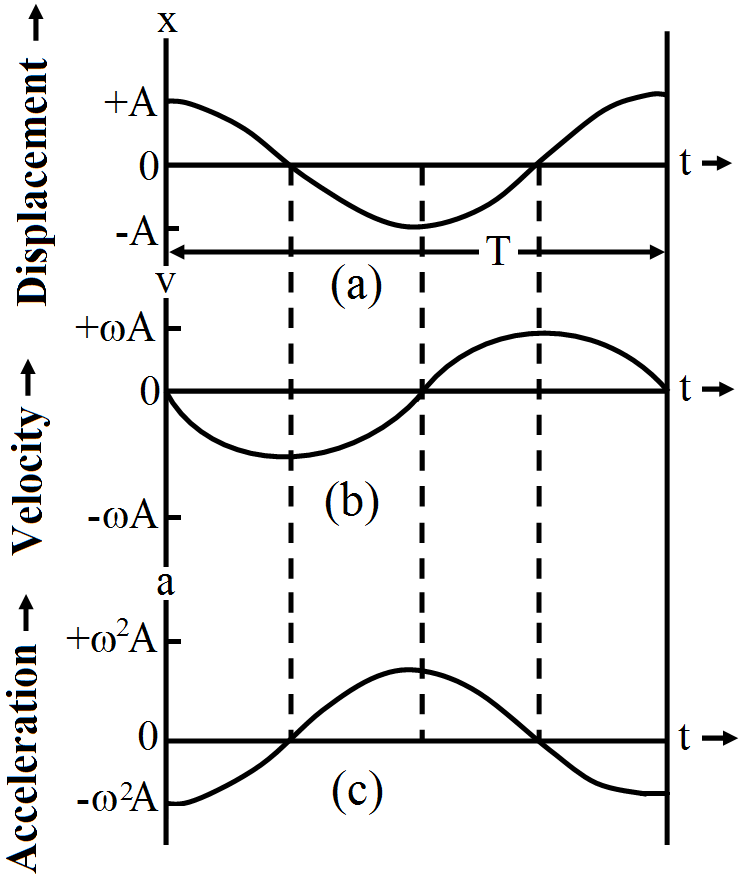
View full question & answer→Question 565 Marks
A particle of mass m is executing simple harmonic oscillations of amplitude A. At $\text{x}=\frac{\text{A}}{2}$ what fraction of its energy is potential? What fraction is kinetic?
AnswerWe know that total energy of a harmonic oscillator $\text{E}=\frac{1}{2}\text{m}\omega^2\text{A}^2$
At $\text{x}=\frac{\text{A}}{2}$, the potential energy of oscillator,$\text{U}=\frac{1}{2}\text{m}\omega^2\text{x}^2$
$\frac{1}{2}\text{m}\omega^2.\big(\frac{\text{A}}{2}\big)^2$
$=\frac{1}{8}\text{m}\omega^2\text{A}^2$
$\therefore\frac{\text{U}}{\text{E}}=\frac{\frac{1}{8}\text{m}\omega^2\text{A}^2}{\frac{1}{2}\text{m}\omega^2\text{A}^2}$
$=\frac{1}{4}=\frac{1}{4}\times100\%$
$=25\%$
$\text{x}=\frac{\text{A}}{2}$ the Kinetic energy
$\text{K}=\frac{1}{2}\text{m}\omega^2(\text{A}^2-\text{x}^2)$
$=\frac{1}{2}\text{m}\omega^2\bigg[\text{A}^2-\big(\frac{\text{A}}{2}\big)^2\bigg]$
$=\frac{3}{8}\text{m}\omega^2\text{A}^2$
$\therefore\frac{\text{K}}{\text{E}}=\frac{\frac{3}{8}\text{m}\omega^2\text{A}^2}{\frac{1}{2}\text{m}\omega^2\text{A}^2}$
$=\frac{3}{4}=\frac{3}{4}\times100\%$
$=75\%$
View full question & answer→Question 575 Marks
The displacement x (in cm) of an oscillating particle varies with time t (in seconds) according to the equation. $\text{x}=2\cos(0.5\pi\text{t}+\frac{\pi}{3})$ Find
- Amplitude of oscillation.
- The time period of oscillation.
- The maximum velocity of the particle.
- The maximum acceleration of the particle.
AnswerThe displacement of the particle is given by $\text{x}=2\cos(0.5\pi\text{t}+\frac{\pi}{3})\text{cm}$ To find the amplitude and time period of the oscillation, we compare this equation with $\text{x}=\text{A}\cos(\omega\text{t}+\delta)$
- Amplitude A = 2cm
- Angular frequency $\omega=0.5\pi\text{ rad}\text{ s}^{-1}$
$\text{T}=\frac{2\pi}{\omega}=\frac{2\pi}{0.5\pi}=4\text{s}$
- Maximum acceleration $\text{a}_\text{max}=|\text{A}\omega|$
$=2\times0.5\pi=\pi\text{cm}\text{s}^{-1}=3.142\text{cms}^{-1}$
- Maximum acceleration $\text{a}_\text{max}=|-\omega^2\text{A}|$
$=\omega^2\text{A}=(0.5\pi)^2\times2$
$=\frac{\pi}{2}\text{cms}^{-2}=4.935\text{cms}^{-2}$ View full question & answer→Question 585 Marks
A simple pendulum with a brass bob has a time period T. The bob is now immersed in a non-viscous liquid and oscillated. If the density of the liquid is $\frac{1}{9}$ that of brass, find the time of the same pendulum.
AnswerLet V be the volume and $\rho$ be the density of the brass bob. Mass of the bob $\text{m}=\text{V}\rho$ and weight of bob $=\text{V}\rho\text{g}.$ Buoyancy force of liquid on bob $=\text{V}\Big(\frac{\rho}{9}\Big)\text{g}=\frac{\text{V}\rho\text{g}}{9}.$ So, the effective weight of bob in liquid $=\text{V}\rho\text{g}-\frac{\text{V}\rho\text{g}}{9}=\frac{8\text{V}\rho\text{g}}{9},$$\therefore\text{Acceleration g}'=\frac{\frac{8\text{V}\rho\text{g}}{9}}{\text{m}}$
$=\frac{\frac{8\text{V}\rho\text{g}}{9}}{\text{V}\rho}=\frac{8\text{g}}{9}$
Time period of the bob$-2\pi\sqrt{\frac{\text{l}}{\text{g}}}=2\pi\sqrt{\frac{\text{l}}{\big(\frac{8\text{g}}{9}\big)}}$
$=2\pi\sqrt{\frac{\text{l}}{\text{g}}}\times\frac{3}{\sqrt{8}}=\frac{3\text{T}}{\sqrt{8}}$ $\Big(\because\text{T}=2\pi\sqrt{\frac{\text{l}}{\text{g}}}\Big)$
View full question & answer→Question 595 Marks
Find the expression for time period of motion of a body suspended by two springs connected in parallel and series.
AnswerConsider a body of mass M suspended by two springs connected in parallel as shown in Fig. (a) Let $k_1$ and $k_2$ be the spring constants of two springs respectively. Let the body be pulled down so that each spring is stretched through a distance y. Restoring forces $F_1$ and $F_2$ will be developed in the springs $S_1$ and $S_2$ respectively. According to Hooke's law, $F, = -k_2y$ And $F_2 = -k_2y$ Since both the forces acting in the same direction, therefore, total restoring force acting on the body is given by $F = F_1 + F_2 = -k_1y - k_2y = -(k_1 + k_2)y$
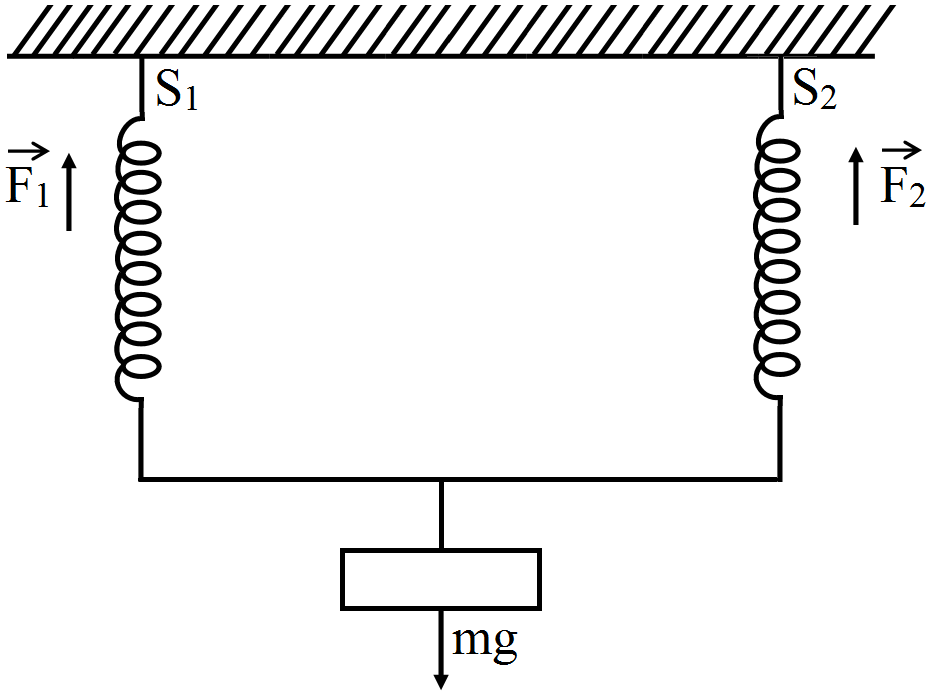
$\therefore$ Acceleration produced in the body is given by
$\text{a}=\frac{\text{F}}{\text{M}}=-\frac{(\text{k}_1+\text{k}_2)\text{y}}{\text{M}}\cdots\text{(i)}$
Since $\frac{(\text{k}_1+\text{k}_2)}{\text{M}}$ is constant $\therefore\text{a}\propto-\text{y}$ Hence motion of the body is SHM. time period of boby is given by$\text{T}=2\pi\sqrt{\frac{\text{y}}{\text{|a|}}}$
$=2\pi\sqrt{\frac{\text{M}}{\text{k}_1+\text{k}_2}}\cdots\text{(ii)}$
If $\text{k}_1=\text{k}_2=\text{k}$ Then $\text{T}=2\pi\sqrt{\frac{\text{M}}{2\text{k}}}$ For series: Consider a body of mass M suspended by two springs $S_1$ and $S_2$ which are connected in series as shown in Fig. (b). Let k, and k, be the spring constants of springs $S_1$ and $S_2$ respectively. Suppose at any instant, the displacement of the body from equilibrium position is y in the downward direction. If $y_1$ and $y_2$ be the extension produced in the springs $S_1$ and $S_2$ respectively, then
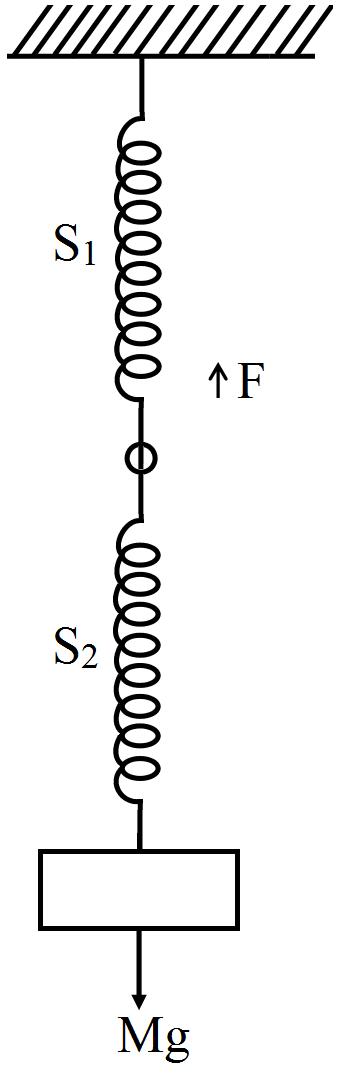
$y = y_1 + y_2 ...(i)$ Restoring forces developed in S1 and S2 are given by $F_1 = -k_1 + y_1 ...(ii) F_2 = -k_2 + y_2 ...(iii)$ Multiplying eqn. (ii) by $k_2$ and eqn. (iii) by $k_1$ and adding we get$\therefore k_2F_1 + k_1F_2 = -k_1k_2(y_1 + y_2) = -k_1k_2y$
[From eqn.(i)] Since both the spring are connected in series, so $F_1 = F_2 = F \therefore F(k_1 + k_2) = -k_1k_2y$
$\text{F}=-\frac{\text{k}_1\text{k}_2}{(\text{k}_1+\text{k}_2)\text{y}}$
If a be the acceleration produced in the the body of mass M, then$\text{a}=\frac{\text{F}}{\text{M}}=-\frac{\text{k}_1\text{k}_2\text{y}}{(\text{k}_1+\text{k}_2)\text{M}}\cdots\text{(iv)}$
Time period of the body is given by $\text{T}=2\pi\sqrt{\frac{\text{y}}{\text{|a|}}}$
$=2\pi\sqrt{\frac{(\text{k}_1+\text{k}_2)\text{M}}{\text{k}_1\text{k}_2}}$
[From eqn.(iv)]$\text{T}=2\pi\sqrt{\Big(\frac{1}{\text{k}_1}+\frac{1}{\text{k}_2}\Big)}\text{M}$ View full question & answer→Question 605 Marks
A particle is executing S.H.M. If $v_1$ and $v_2$ are the speeds of the particle at distance $x_1$ and $x_2$ from the equilibrium position, show that the frequency of oscillations is
$\text{f}=\frac{1}{2\pi}\bigg(\frac{\text{v}^2_1-\text{v}^2_2}{\text{x}^2_2-\text{x}^2_1}\bigg)^{\frac{1}{2}}$
AnswerThe displacement ofa particle executing S.H.M. is given by$\text{x = a}\cos\omega\text{t}$
$=\frac{\text{dx}}{\text{dt}}=\omega\text{a}\sin\omega\text{t}$
$\therefore\text{Velocity, v}=\frac{\text{dx}}{\text{dt}}$ or $\text{v}^2=\text{a}^2\omega^2\sin^2\omega\text{t}$
$=\text{a}^2\omega^2(1-\cos^2\omega\text{t})$
$=\omega^2(\text{a}^2-\text{x}^2)$
Hence, $\text{v}^2_1=\omega^2(\text{a}^2-\text{x}^2_1)$ And $\text{v}^2_2=\omega^2(\text{a}^2-\text{x}^2_2)$ Subtracting the two.$\text{v}^2_1-\text{v}^2_2=\omega^2\Big(\text{x}^2_2-\text{x}^2_1\Big)$
$\omega^2=\frac{\text{v}^2_1-\text{v}^2_2}{\text{x}^2_2-\text{x}^2_1}$
$\omega=\Big(\frac{\text{v}^2_1-\text{v}^2_2}{\text{x}^2_2-\text{x}^2_1}\Big)^{\frac{1}2{}}$
But $\omega=2\pi\text{f}$$\therefore\text{f}=\frac{1}{2\pi}\Big(\frac{\text{v}^2_1-\text{v}^2_2}{\text{x}^2_2-\text{x}^2_1}\Big)^{\frac{1}{2}}$
View full question & answer→Question 615 Marks
An 8kg body performs S.H.M. of amplitude 30cm. The restoring force is 60N when the displacement is 30cm. Find (a) time period (b) the acceleration, P.E. and K.E., when displacement is 12cm.
AnswerHere, m = 8kg; a = 30cm = 0.30m; F = 60N; y = 0.30m F = -ky$\text{k}=-\frac{\text{F}}{\text{y}}=-\frac{60}{0.30}=-200\text{Nm}^{-1}$
As $\omega=\sqrt{\frac{\text{k}}{\text{m}}}=\sqrt{\frac{200}{8}}=5\text{s}^{-1}$ Time period, $\text{T}=\frac{2\pi}{\omega}=\frac{2\times22}{7\times5}=\frac{44}{35}=1.256\text{s}$ Here, y = 12cm = 0.12m$\therefore\text{Acceleration}$
$\text{A}=\omega^2\text{y}=(5)^2\times0.12=3.0\text{ms}^{-2}$
$\text{P.E.}=\frac{1}{2}\text{ky}^2=1.44\text{J}$
$\text{K.E.}=\frac{1}2{}\text{k}(\text{a}^2-\text{y}^2)=7.56\text{J}$
View full question & answer→Question 625 Marks
A transverse harmonic wave travelling on a string is described by $\text{y(x, t})=3.0\sin\Big[(36\text{t}+0.018\text{x})+\frac{\pi}{4}\Big]$ where x and y are in cm and t in s. The positive direction of x is from left to right.
- What are the speed and direction of propagation of the wave?
- What are its amplitude and frequency?
- What is the initial phase at the origin?
- What is the least distance between two successive crests in the wave?
AnswerGiven: $\text{y(x, t})=3.0\sin\Big[(36\text{t}+0.018\text{x})+\frac{\pi}{4}\Big]$ Comparing with a plane progressive wave going from right to left$\text{y(x, t})=\text{r}\sin\Big[\frac{2\pi}{\lambda}(\omega\text{t}+\text{kx})+\phi_1\Big]$
- Speed $=\text{v}=\frac{\omega}{\text{k}}=\frac{36}{0.018}$
$=2000\text{cm/s}$
wave travelling from right to left, i.e. travels along the negative r-axis.
- Amplitude, $\text{r}=3.0\text{cm}$
$\Rightarrow\text{k}=\frac{2\pi}{\lambda}=\frac{2\pi}{\lambda}=0.018$
$\Rightarrow\lambda=\frac{2\pi}{0.018}\approx349\text{cm}$
and $\text{v}=\frac{\text{v}}{\lambda}=\frac{2000\text{cm/s}}{349\text{cm}}=5.73\text{s}^{-1}$
- $\phi_0=\frac{\pi}{4}$
Least distance between successive crest
$-\lambda-\frac{2\pi}{\text{k}}=\frac{2\pi}{0.018}-3.5\text{m}$ View full question & answer→Question 635 Marks
A body is dropped in a hole drilled across a diameter of the earth. Show that it executes S.H.M. Assume the earth to be homogeneous sphere of radius R.
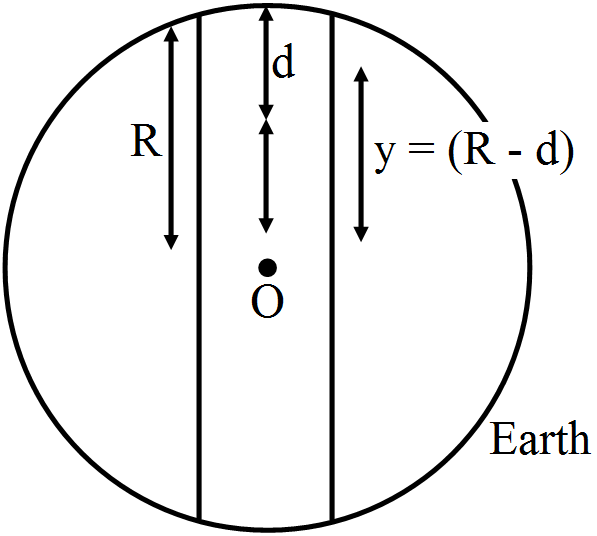
AnswerWhen the body is dropped into the straight hole, and it falls through the depth d, the value of acceleration due of gravity at the point P is given by 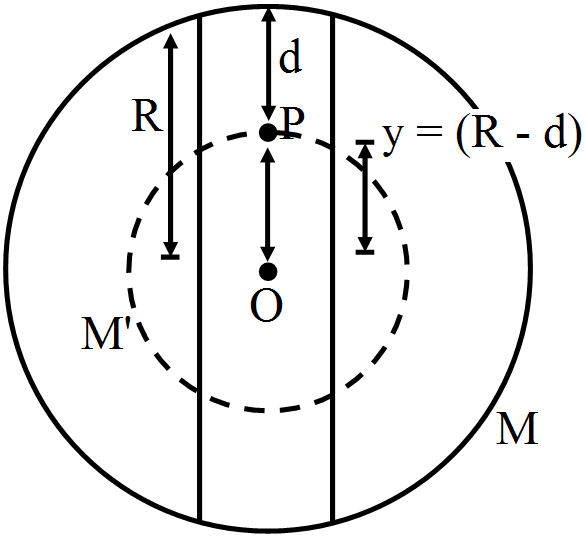 $\text{g}'=\frac{\text{GM}'}{(\text{R}-\text{d})^2}$
where M' = mass of the earth of radius (R - d)$\text{M}'=\frac{4}{3}\pi(\text{R}-\text{d})^3\times\rho$
Here $\rho$ = Average density of the earth, R = radius of the earth$\therefore\text{g}'=\frac{4\pi\text{G(R}-\text{d})\rho}{3}$
Thus, $\text{g}'\propto(\text{R}-\text{d})$ i.e. the acceleration (in magnitude) of the body is proportional to the displacement from the centre of the earth O. Thus, the motion is S.H.M. View full question & answer→Question 645 Marks
A spring having with a spring constant $1200N m^{-1}$ is mounted on a horizontal table as shown in Fig. A mass of $3kg$ is attached to the free end of the spring. The mass is then pulled sideways to a distance of $2.0cm$ and released. 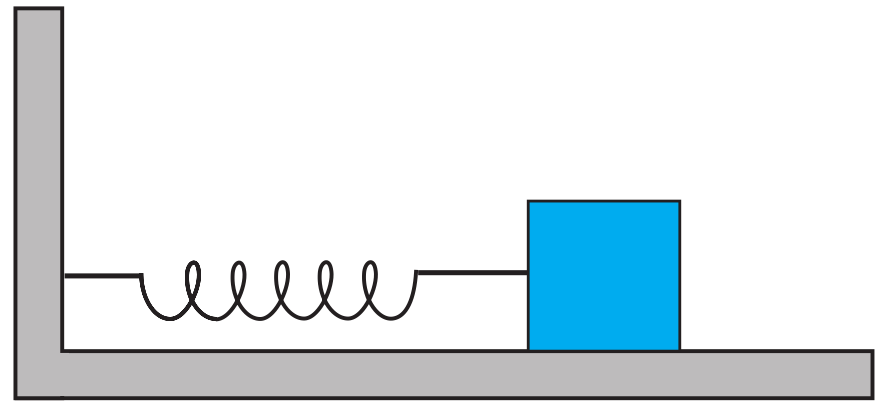
Determine (i) the frequency of oscillations, (ii) maximum acceleration of the mass, and (iii) the maximum speed of the mass. AnswerSpring constant, $k = 1200N m^{-1}$
Mass, m = 3kg
Displacement, A = 2.0cm = 0.02cm
- Frequency of oscillation v, is given by the relation:
$\upsilon=\frac{1}{\text{T}}=\frac{1}{2\pi}\sqrt{\frac{\text{k}}{\text{m}}}$
where, T is time period
$\therefore\ \upsilon=\frac{1}{2\times3.14}\sqrt{\frac{1200}{3}}$
= 3.18m/s
Hence, the frequency of oscillations is 3.18 cycles per second.
- Maximum acceleration (a) is given by the relation:
$\text{a}=\omega^2\text{A}$
where,
$\omega=$ Angular frequency $=\sqrt{\frac{\text{k}}{\text{m}}}$
A = maximum displacement
$\therefore\ \text{a}=\frac{\text{k}}{\text{m}}\text{A}=\frac{1200\times0.02}{3}=8\text{ ms}^{-2}$
Hence, the maximum acceleration of the mass is $8.0m/s^2$.
Maximum velocity, $\text{v}_\text{max}=\text{A}\omega$
$=\text{A}\sqrt{\frac{\text{k}}{\text{m}}}=0.02\times\sqrt{\frac{1200}{3}}=0.4\text{ m/s}$
Hence, the maximum velocity of the mass is 0.4m/s. View full question & answer→Question 655 Marks
Show that for a particle in linear S.H.M., the average K.E. over a period of oscillation equals the average P.E. over the same period.
AnswerConsider a particle of mass m executing S.H.M. along a straight path with O as mean position. Let r be the amplitude of oscillation of the particle and $\omega$ be its angular frequency of vibration. Let at an instant the displacement of the particle from the mean position be y. Then $\text{y = r}\sin\omega\text{t}$$\therefore$ Velocity, $\text{v}=\frac{\text{dy}}{\text{dt}}=\text{r}\omega\cos\omega\text{t}$
and acceleration,$\text{A}=\frac{\text{dv}}{\text{dt}}=-\omega^2\text{r}\sin\omega\text{t}=-\omega^2\text{y}$
P.E. of the particle for displacement y is$\text{E}_{\text{p}}=\int\limits^{\text{y}}_0\text{m}\omega^2\text{ydy}$
$=\frac{1}{2}\text{m}\omega^2\text{y}^2=\frac{1}{2}\text{m}\omega^2\text{y}^2\sin^2\omega\text{t}$
$\therefore$ Average potential energy over the period of oscillation is
$\text{E}_{\text{P}_{\text{av}}}=\frac{1}{\text{T}}\int\limits^{\text{T}}_0\frac{1}{2}\text{m}^2\text{r}^2\omega^2\sin^2\omega\text{t dt}$
$=\frac{1}{2\text{T}}\text{m}\omega^2\text{r}^2\Big(\frac{\text{T}}{2}\Big)=\frac{1}{4}\text{m}\omega^2\text{r}^2 \ ...(\text{i})$
$\bigg[\because\int\limits^{\text{T}}_0\sin^2\omega\text{t dt}=\frac{\text{T}}{2}\bigg]$
K.E. of the particle $=\frac{1}{2}\text{mv}^2=\frac{1}{2}\text{mr}^2\omega^2\cos^2\omega\text{t}.$ Average kinetic energy over the period of oscillation$\text{E}_{\text{kav}}=\frac{1}{\text{T}}\int\limits^{\text{T}}_0\frac{1}{2}\text{mr}^2\omega^2\cos^2\omega\text{t dt}$
$=\frac{1}{2\text{T}}\text{m}\omega^2\text{r}^2\Big(\frac{\text{T}}{2}\Big)=\frac{1}{4}\text{m}\omega^2\text{r}^2\ ...(\text{ii})$
$\bigg[\because\int\limits^{\text{T}}_0\cos^2\omega\text{t dt}=\frac{\text{T}}{2}\bigg]$
From (i) and (ii),$\text{E}_{\text{P}_{\text{av}}}=\text{E}_{\text{K}_{\text{av}}}$
View full question & answer→Question 665 Marks
A body weighing $10g$ has a velocity of $6cm/s^{-1}$ after one second of its starting from mean position. If the time period is $6s$, then find the kinetic energy, potential energy and the total energy.
AnswerHere m = 10g T = 6s$\omega=\frac{2\pi}{\text{T}} $
$=\frac{2\pi}{6}$
$=\frac{\pi}{3}\text{ rads}^{-1}$
When $\text{t}=1\text{s}$ $\text{v}=6\text{cms}^{-1}$$\text{v}=\text{A}\omega\cos\omega\text{t}$
$6=\text{A}\times\frac{\pi}{3}\cos\frac{\pi}{3}\times\cos60^\circ$
$=\text{A}\times\frac{\pi}{3}\times\frac{1}{2}=\frac{\pi\text{A}}{6}$
$=\text{A}=\frac{36}{\pi}\text{cm}$
Total energy $\text{E}=\frac{1}{2}\text{m}\text{A}^2\omega^2$Kinetic energy $=\frac{1}{2}\text{mv}^2$
$=\frac{1}{2}\times10\times6^2$
$=180\text{erg}$
$\therefore$ $\text{Potential}=\text{Total energy} - \text{Kinetic energy}$
$=720-180$
$=540\text{erg}$
View full question & answer→Question 675 Marks
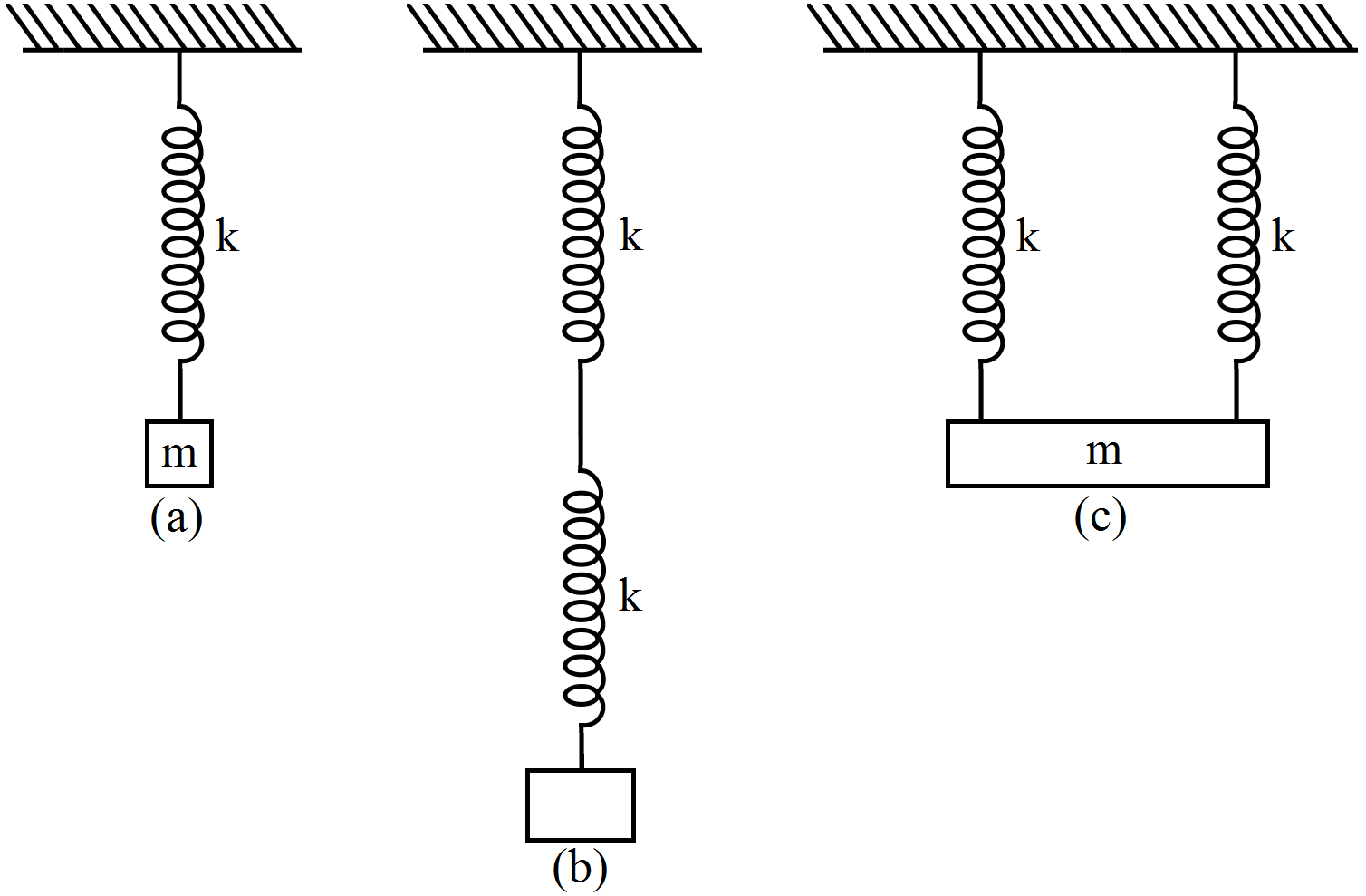
What do you understand by undamped and damped simple harmonic oscillations? Show that the time periods for vertical harmonic oscillations of the three systems shown in Figs. (a), (b)
(c) Are in the ratio of $1:\sqrt{2}:\frac{1}{\sqrt{2}}$. All spring are identical each having a force constant K.
AnswerUndamped Simple Harmonic oscillations: When a simple harmonic system oscillates with a constant amplitude which does not change with time, its oscillations are called undamped simple harmonic oscillations.
Damped Simple Harmonic oecillations: When a simple harmonic system orillates with a decreasing amplitude with time, its oscillations are called damped simple harmonic orillations.
Let us suppose that an extension x is produced in the spring when a force mg is applied to it. The equilibrium position in case
- Is given by F = mg = kx ...(1)
The time period in this case is given by
$\text{T}_\text{a}=2\pi\sqrt{\frac{\text{mass}}{\text{spring constant}}}$
$=2\pi\sqrt{\frac{\text{m}}{\text{k}}} ...(2)$
- In this case, the length of the spring is doubled. Hence a given force mg will double the extension. Let x' be the extension produced and $\text{k}_\text{eff}$ be the force constant of the combination. Thus, F = mg
$=\text{k}_\text{eff}\text{x}'=2\text{k}_\text{eff}$
$(\because\text{x}'=2\text{x})\ ...(3)$
Comparing (1) and (3) we get
$\text{F}=\text{kx}=2\text{k}_\text{eff}\text{x}$
$=\text{k}_\text{eff}=\frac{\text{k}}{2}$
Thus the time period in this case is given by
$\text{T}_\text{b}=2\pi\sqrt{\frac{\text{m}}{\text{k}_\text{eff}}}$
$=2\pi\sqrt{\frac{2\text{m}}{\text{k}}}$
$\sqrt{2}\text{T}_\text{a}\ ...(4)$
- In this case, the extension x" produced in each spring by a force mg is half that produced in case (a), i.e.,
$\text{x}''=\frac{\text{x}}{2}$
If $k_{eff}$ is the force cosntant of the combination in this case, we have
$\text{F}=\text{mg}=\text{k}_\text{eff}$
$=\text{x}''=\frac{\text{k}_\text{eff}}{2}\text{x}$
Comparing (5) with (1) we have
$\text{k}_\text{eff}=2\text{k}$
Hence, $\text{T}_\text{e}=2\pi\sqrt{\frac{\text{m}}{\text{k}_\text{eff}}}$
$=2\pi\sqrt{\frac{\text{m}}{2\text{k}}}$
$=\frac{\text{T}_\text{a}}{\sqrt{2}}\ ...(6)$
From (2), (4) and (6) we have
$=\text{T}_\text{a}:\text{T}_\text{b}:\text{T}_\text{c}$
$=1:\sqrt{2}:\frac{1}{\sqrt{2}}$. View full question & answer→Question 685 Marks
Define simple harmonic motion (SHM). Two masses m, and m, are suspended together by a massless spring of spring constant k (see Fig.a). When the masses are in equilibrium, $m_1$ is removed without disturbing the system. Find the angular frequency and amplitude oscillation of $m_2$
AnswerFor definition, see text. Let $x_1$ be the extension produced in the spring when it is loaded with mass $m_2$ alone and $x_2$ be the further extension when mass $m_1$ is added to mass $m_2$ so that $x = x_1 + x_2$ is the total extension produced by $m_1 + m_2$ (see Fig.b). Thus we have,
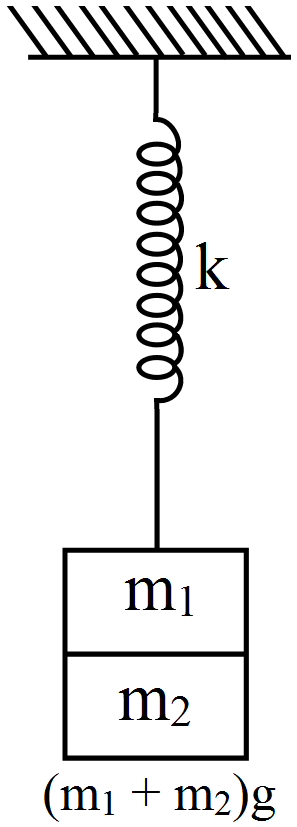
For equilibrium state of $m_2 m_2g = kx_1 ...(1)$ For equilibrium state of $(m_1 + m_2) (m_1 + m_2)g = k(x) = k(x_1 + x_2) ...(2)$ When the mass $m_1$ is removed the mass $m_2$ will move upwards under the unbalanced force = $m_1g$. Hence
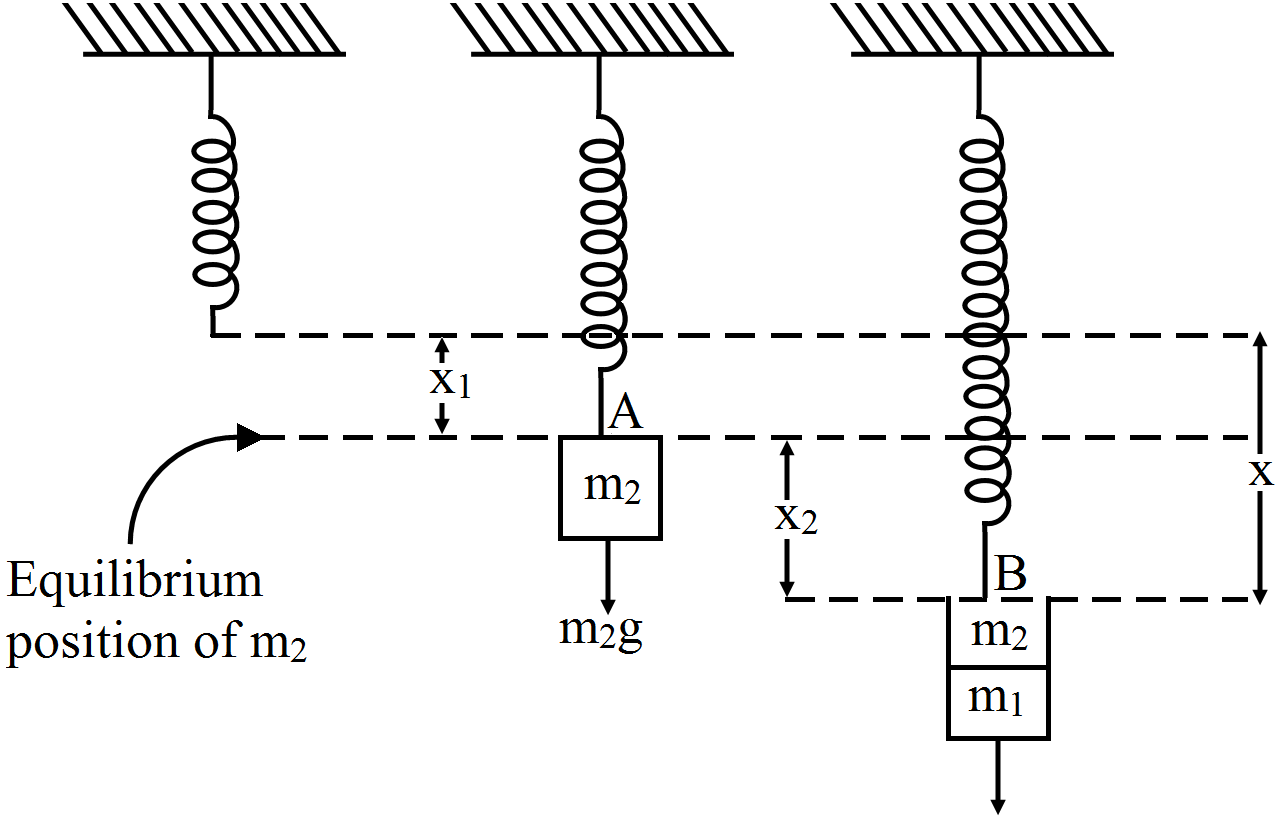
Restoring force (F) on $m_2 = -m_1g$ Substracting (1) and (2) we have $m_1g = kx_2 ...(3)$ Hence, Restoring force on $m_2 = -kx_2$
$\therefore$ Accleration of $\text{m}_2=\frac{\text{F}}{\text{m}_2}$
$=-\frac{\text{k}}{\text{m}_2}\text{x}_2$
i.e., Accelaration $\propto-$ Displacement Angular frequency is $\omega=\sqrt{\frac{\text{k}}{\text{m}_2}}$$\therefore$ Frequency of oscillation is $\text{n}=\frac{\omega}{2\pi}=\frac{1}{2\pi}\sqrt{\frac{\text{k}}{\text{m}_2}}$
It is clear that A is the equilibrium postion of $m_2$ and B its maximum displacement position. Hence $AB = x_2$ is the amplitude of oscillation of $m_2$ which from Eq. (3) is given by Amplitude $=\text{x}_2=\frac{\text{m}_1\text{g}}{\text{g}}$ View full question & answer→Question 695 Marks
An 8kg body performs S.H.M. of amplitude 30cm. The restoring force is 60N when the displacement is 30cm. Find (a) time period (b) the acceleration, P.E. and K.E., when displacement is 12cm.
AnswerHere, m = 8kg; a = 30cm = 0.30m;$\text{F}=60\text{N};\text{y}=0.30\text{m}$
$\text{F}=-\text{ky}$
$\text{k}=-\frac{\text{F}}{\text{y}}=-\frac{60}{0.30}=-200\text{Nm}^{-1}$
As $\omega=\sqrt{\frac{\text{k}}{\text{m}}}=\sqrt{\frac{200}{8}}=5\text{s}^{-1}$ Time period, $\text{T}=\frac{2\pi}{\omega}=\frac{2\times22}{7\times5}=\frac{44}{35}=1.256\text{s}$ Here, $\text{y}=12\text{cm}=0.12\text{m}$$\therefore\text{Acceleration,}\text{ A}=\omega^2\text{y}=(5)^2\times0.12=3.0\text{ms}^{-2}$
$\text{P.E.}=\frac{1}{2}\text{ky}^2=1.44\text{J}$
$\text{K.E.}=\frac{1}{2}\text{k(a}^2-\text{y}^2)=7.56\text{J}$
View full question & answer→Question 705 Marks
Figure (a) shows a spring of force constant k clamped rigidly at one end and a mass m attached to its free end. A force F applied at the free end stretches the spring. Figure (b) shows the same spring with both ends free and attached to a mass m at either end. Each end of the spring in Fig. (b) is stretched by the same force F.
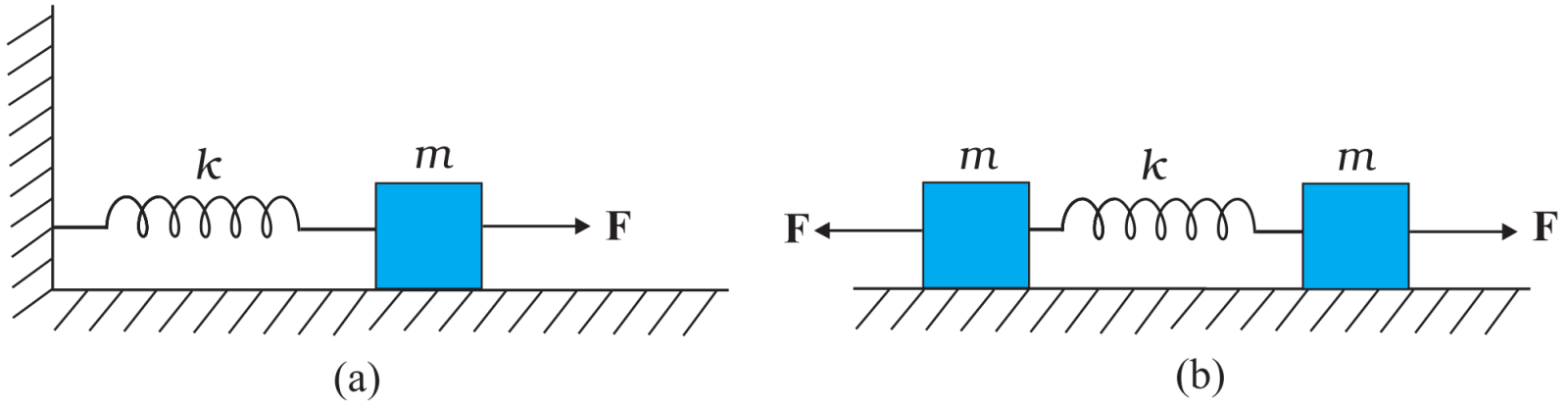
If the mass in Fig. (a) and the two masses in Fig. (b) are released, what is the period of oscillation in each case?
AnswerIn Fig. (a) if x is the extension in the spring, when mass m is returning to its mean position after being released free, then restoring force on the mass iss F = -kx, i.e., $\text{F}\propto\text{x}$ As, this F is directed towards mean position of the mass, hence the mass attached to the spring will execute SHM. Spring factor = spring constant = k inertia factor = mass of the given mass = m As time period,$\text{T}=2\pi\sqrt{\frac{\text{inertia factor}}{\text{spring factor}}}$
$\therefore\ \text{T}=2\pi\sqrt{\frac{\text{m}}{\text{k}}}$
In Fig. (b), we have a two body system of spring constant k and reduced mass, $\mu=\frac{\text{m}\times\text{m}}{\text{m+m}}=\frac{\text{m}}{2}$ Inertia factor = m/2 Spring factor = k$\therefore$ Time period, $\text{T}=2\pi\sqrt{\frac{\frac{\text{m}}{2}}{\text{k}}}=2\pi\sqrt{\frac{\text{m}}{2\text{k}}}$
View full question & answer→Question 715 Marks
Find the expression for kinetic energy, potential energy and total energy of a particle executing SHM.
AnswerLet at any instant, the displacement of a particle executing SHM is y, mass of the particle 'm'. We know displacement, $\text{y}=\text{a}\sin\omega\text{t}$ Velocity, $\text{v}=\frac{\text{dy}}{\text{dt}}=\frac{\text{d}}{\text{dt}}\text{a}\sin\omega\text{t}$$\text{v}=\text{a}\omega\cos\omega\text{t}$
Kinetic energy $=\frac{1}{2}\text{m}\text{v}^2$$\text{E}_\text{k}=\frac{1}{2}\text{m}(\text{a}\omega\cos\omega\text{t})^2$
$=\frac{1}{2}\text{ma}^2\omega^2\cos^2\omega\text{t}$
$=\frac{1}{2}\text{ma}^2\omega^2(1-\sin^2\omega\text{t})$
$=\frac{1}{2}\text{ma}^2\omega^2(1-\frac{\text{y}^2}{\text{a}^2})$
$=[\because\text{y}=\text{a}\sin\omega\text{t}]$
$=\frac{1}{2}\text{m}\omega^2(\text{a}^2-\text{y}^2)$
For Potential Energy: As velocity $\text{v}=\text{a}\omega\cos\omega\text{t}$ Acceleration $\frac{\text{d}}{\text{dt}}\text{(v)}=(\text{a}\omega\cos\omega\text{t})$$=-\text{a}\omega^2\sin\omega\text{t}$
$=-\omega^2\sin\omega\text{t}$
$=-\omega^2(\text{a}\sin\omega\text{t})$
$=-\omega^2\text{y}$
Restoring force at any instant, $\text{F}=-\text{w}^2\text{y}.\text{m}$$=-\text{m}\omega^2\text{y}$
The negative sign indicates that the restoring force is always directed towards the mean position. In order to maintain the particle at displacement y, a force $\text{m}\omega^2\text{y}$acting away from the mean position has to be applied on the particle. Let dW be the work done by the applied force to displace a given particle through a distance dy away from the mean position. Then, $\text{dW}=\text{m}\omega^2\text{y}\text{dy}$. Let W be the total work done in increasing the displacement from O to y. Thus $\text{W}=\int_\limits{0}^{\text{y}}\text{m}\omega^2\text{ydy}$$=\text{m}\omega\int_\limits{0}^{\text{y}}\text{ydy}$
$\text{W}=\text{m}\omega^2\bigg[\frac{\text{y}^2}{2}\bigg]^4_0$
$=\text{m}\omega^2\Big(\frac{\text{y}^2}{2}-0\Big)$
$=\frac{1}{2}\text{m}\omega^2\text{y}^2$
$=\frac{1}{2}\text{m}\omega^2\text{y}^2$
This work done is stored in the particle as potential $\therefore\text{E}_\text{p}=\frac{1}{2}\text{m}\omega^2\text{y}^2$
Total energy, $\text{E}=\text{E}_\text{k}+\text{E}_\text{p}$$\Rightarrow\text{E}=\frac{1}{2}\text{m}\omega^2(\text{a}^2-\text{y}^2)+\frac{1}{2}\text{mv}^2\text{y}^2$
$\text{E}=\frac{1}{2}\text{m}\omega^2\text{a}^2-\frac{1}{2}\text{m}\omega^2\text{y}^2+\frac{1}{2}\text{m}\omega^2\text{y}^2$
$\text{E}=\frac{1}{2}\text{m}\omega^2\text{a}^2$
View full question & answer→Question 725 Marks
What is simple pendulum? Show that the motion of the pendulum is S.H.M. and hence deduce an expression for the time period of pendulum. Also define second's pendulum.
AnswerIn simple pendulum a heavy point mass body i.e., bob suspended by a weightless inextensible and perfectly flexible string from a rigid support about which it is free to oscillate. m = mass of bob l = length of pendulum 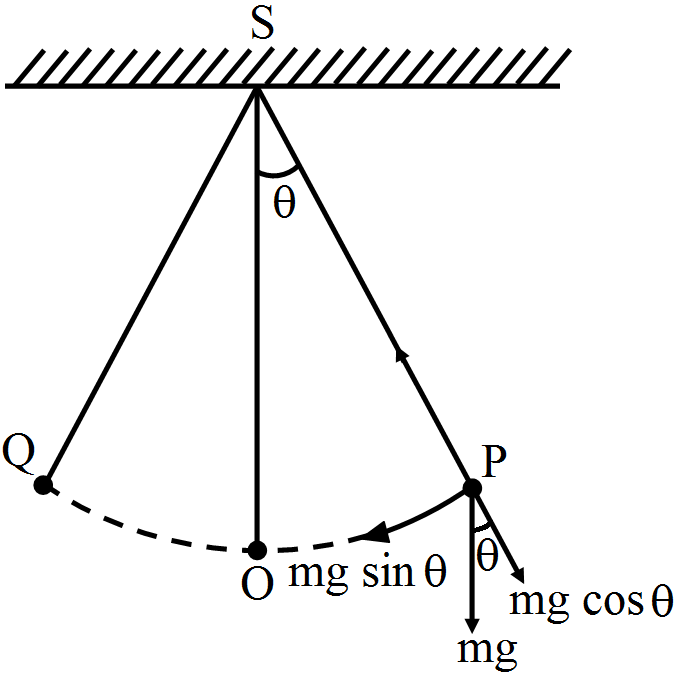 When bob is displaced to point P through small angle $\theta.$ Various forces acting on the bob is:
- Weight mg of the bob acting vertically downward.
- Tension T in string along PS.
Resolving mg into two components:
- $\text{mg}\cos\theta$ opposite to tension T.
- $\text{mg}\sin\theta$ directed towards O.
If the string remains taut$\text{T}=\text{mg}\cos\theta$
The force $\text{mg}\sin\theta$ tends to bring back the bob to its mean position O.$\therefore$ Restoring force acting on bob is
$\text{F}=-\text{mg}\sin\theta$
-ve sign shows force is directed towards mean position. If $\theta$ is small, then$\sin\theta=\theta=(\text{arc)OP}/\text{l}=\text{x}/\text{l}$
$\text{F}=-\text{mg}\theta=-\text{mg} \ ...(\text{i})$
$\text{F}\propto$ displacement (x) and F is directed towards mean position O.
In S.H.M, Restoring force$\text{F}=-\text{kx} \ ...(\text{ii})$
Comparing (i) and (ii)$\text{k}=\frac{\text{mg}}{\text{x}}$
inertia factor = mass of bob = m$\text{T}=2\pi\sqrt{\frac{\text{inertia factor}}{\text{spring factor}}}$
$=2\pi\sqrt{\frac{\text{m}}{\text{mg/l}}}=2\pi\sqrt{\frac{\text{l}}{\text{g}}}$
Simple pendulum whose time period of vibrations is two seconds is called a second's pendulum. View full question & answer→Question 735 Marks
- Define SHM. What are its characteristics? At what distance from the mean position in SHM of amplitude r the energy is half kinetic and half potential?
- A spring having a force constant K is divided into three equal parts. What would be force constant for each individual parts?
Answer
- Simple harmonic motion is the projection of uniform circular motion on a diameter of a circle of reference.
Characteristics of SHM:
- Displacement: The displacement of a particle executing SHM at an instant is defined as the distance of a particle from the mean position at that instant.
- Amplitude: The maximum displacement on either side of the mean position is called the amplitude of the motion.
- Velocity: The velocity of the particle executing SHM at any instant, is defined as the time rate of change of its displacement at that instant.
- Acceleration: The acceleration of the particle executing SHM at any instant is defined as the time rate of change of its velocity at that instant.
P.E. with a S.H.M. $=\frac{1}{2}\text{Kx}^2=\frac{1}{3}\text{m}\omega^2\text{x}^2$
K.E. of the particle with a S.H.M. at any instant
$=\frac{1}{2}\text{mv}^2$
$=\frac{1}{2}\text{m}\big[\omega\sqrt{\text{r}^2-\text{x}^2}\big]^2$
$=\frac{1}{2}\text{m}\omega^2(\text{r}^2-\text{x}^2)$
Where z is mass, r is amplitude, x is any position and $\omega$ is the angular frequency.
$\text{P.E. = K.E.}$
$\frac{1}{2}\text{m}\omega^2\text{x}^2=\frac{1}{2}\text{m}\omega^2(\text{r}^2-\text{x}^2)$
$\text{x}=\pm\frac{\text{r}}{\sqrt{2}}$
- We know that force constaot ofa spring,
$\text{K}=\frac{\text{F}}{\text{y}}$
When the spring is cut into tfuee equal parts then the displacement for the same force will be reduced to $\frac{\text{y}}{3}$
$\therefore\text{K}'=\frac{\text{F}}{\text{y}^3}=\frac{\text{F}}{\text{y}}$
$\Rightarrow\text{K}'=3\text{K}$ View full question & answer→Question 745 Marks
A circular disc of mass $10kg$ is suspended by a wire attached to its centre. The wire is twisted by rotating the disc and released. The period of torsional oscillations is found to be $1.5s$. The radius of the disc is $15cm$. Determine the torsional spring constant of the wire. (Torsional spring constant $\alpha$ is defined by the relation $\text{J}=-\alpha\theta,$ where J is the restoring couple and $\theta$ the angle of twist).
AnswerMass of the circular disc, m = 10kg Radius of the disc, r = 15cm = 0.15m The torsional oscillations of the disc has a time period, T = 1.5s The moment of inertia of the disc is:$\text{l}=\frac{1}{2}\text{mr}^2$
$=\frac{1}{2}\times(10)\times(0.15)^2$
$= 0.1125kg m^2$ Time period, $\text{T}=2\pi\sqrt{\frac{\text{l}}{\alpha}}$$\alpha$ is the torsional constant.
$\alpha=\frac{4\pi^2\text{l}}{\text{T}^2}$
$=\frac{4\times(\pi)^2\times0.1125}{(1.5)^2}$
= 1.972Nm/rad Hence, the torsional spring constant of the wire is $1.972Nm\ rad^{-1}$.
View full question & answer→Question 755 Marks
A tunnel is dug through the centre of the Earth. Show that a body of mass ‘m’ when dropped from rest from one end of the tunnel will execute simple harmonic motion.
AnswerAs the acceleration due to gravity of earth inside the earth is g'$\text{g}'=\text{g}\Big(1-\frac{\text{d}}{\text{R}}\Big)=\text{g}\Big[\frac{\text{R}-\text{d}}{\text{R}}\Big]$
R - d = y$\therefore\text{g}'=\text{g}\frac{\text{y}}{\text{R}}$
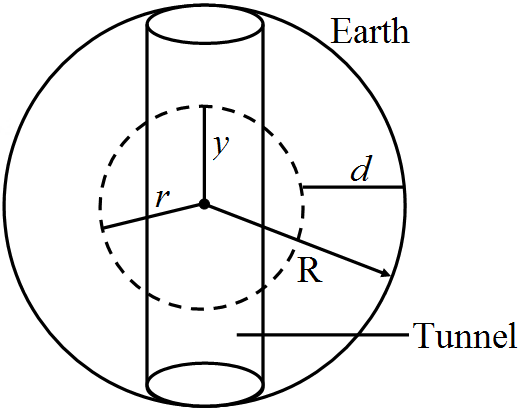 Force on both at depth is$\text{F}=-\text{mg}'=-\text{mg}\frac{\text{y}}{\text{R}}$
$\text{F}\propto(-\text{y})$
So motion of body in tunnel is SHM. for a period we can write ma = - mg'$\text{a}=\frac{-\text{g}}{\text{R}}\text{y}$
$-\omega^2\text{y}=\frac{-\text{g}}{\text{R}}\text{y}(\because\text{a}=-\omega^2\text{y})$
$\frac{2\pi}{\text{T}}=\sqrt{\frac{\text{g}}{\text{R}}}\ \text{or}\ \text{T}=2\pi\sqrt{\frac{\text{R}}{\text{G}}}$ View full question & answer→Question 765 Marks
You are riding in an automobile of mass $3000\ kg$. Assuming that you are examining the oscillation characteristics of its suspension system. The suspension sags $15\ cm$ when the entire automobile is placed on it. Also, the amplitude of oscillation decreases by $50\%$ during one complete oscillation. Estimate the values of $(a)$ the spring constant $k$ and $(b)$ the damping constant b for the spring and shock absorber system of one wheel, assuming that each wheel supports $750\ kg.$
Answer
- Mass of the automobile, $m = 3000\ kg$
Displacement in the suspension system, $x = 15\ cm = 0.15\ m$
There are 4 springs in parallel to the support of the mass of the automobile.
The equation for the restoring force for the system:
$F = –4kx = mg$
Where, k is the spring constant of the suspension system
Time period, $\text{T}=2\pi\sqrt{\frac{\text{m}}{4\text{k}}}$
and $k = mg/4x = 3000 \times 10/4 \times 0.15 = 5000 = 5 \times 10^4Nm$
Spring Constant, $k = 5 \times 10^4Nm$
- Each wheel supports a mass, $M = 3000/4 = 750\ kg$
For damping factor $b,$ the equation for displacement is written as
$x = x_0e^{-bt/2M}$
The amplitude of oscilliation decreases by $50\%.$
$\therefore x = x_0/2$
$x_0/2 = x_0e^{-bt/2M}$
$log_e2 = bt/2M$
$\therefore b = 2M \log_e2/t$
where,
Time period, $\text{t}=2\pi\sqrt{\frac{\text{m}}{4\text{k}}}=2\pi\sqrt{\frac{3000}{4\times5\times10^4}}=0.7691\text{ s}$
$\therefore\ \text{b}=\frac{2\times750\times0.693}{0.7691}=1351.58\text{ kg/s}$
View full question & answer→Question 775 Marks
A cylindrical piece of cork of density of base area A and height h floats in a liquid of density $\rho_1.$ The cork is depressed slightly and then released. Show that the cork oscillates up and down simple harmonically with a period $\text{T}=2\pi\sqrt{\frac{\text{h}\rho}{\rho_1\text{g}}}$ where $\rho$ is the density of cork. (Ignore damping due to viscosity of the liquid).
AnswerBase area of the cork = A Height of the cork = h Density of the liquid = $\rho_1$ Density of the cork = $\rho$ In equilibrium: Weight of the cork = Weight of the liquid displaced by the floating cork Let the cork be depressed slightly by x. As a result, some extra water of a certain volume is displaced. Hence, an extra up-thrust acts upward and provides the restoring force to the cork. Up-thrust = Restoring force, F = Weight of the extra water displaced F = –(Volume × Density × g) Volume = Area × Distance through which the cork is depressed Volume = Ax$\therefore\ \text{F}=-\text{Ax}\rho_1\text{g}\ .....(\text{i})$
Accroding to the force law: F = kx k = F/x where, k is constant$\text{k}=\frac{\text{F}}{\text{x}}=-\text{A}\rho_1\text{g}\ .....(\text{ii})$
The time period of the oscillations of the cork:$\text{T}=2\pi\sqrt{\frac{\text{m}}{\text{k}}}\ .....(\text{iii})$
where, m = Mass of the cork = Volume of the cork × Density = Base area of the cork × Height of the cork × Density of the cork$=\text{Ah}\rho$
Hence, the expression for the time period becomes:$\text{T}=2\pi\sqrt{\frac{\text{Ah}\rho}{\text{A}\rho_1\text{g}}}=2\pi\sqrt{\frac{\text{h}\rho}{\rho_1\text{g}}}$
View full question & answer→Question 785 Marks
Draw a graph to show the variation of P.E., K.E. and total energy of a simple harmonic oscillator with displacement.
AnswerThe potential energy (PE) of a simple harmonic oscillator is
$\text{PE}=\frac{1}{2}\ \text{kx}^2=\frac{1}{2}\text{m}\omega^2\text{x}^2$
When, PE is plotted against displacement x, we will obtain a parabola.
When x = 0, PE = 0.
When $\text{x}=\pm\text{A},\text{PE}=\text{maximum}$
$=\frac{1}{2}\text{m}\omega^2\text{A}^2$
The kinetic energy (KE) of a simple harmonic oscillator $\text{KE}=\frac{1}{2}\text{mv}^2$
But velocity of oscillator $\text{v}=\omega\sqrt{\text{A}^2-\text{x}^2}$
$\Rightarrow\text{KE}=\frac{1}{2}\text{m}[\omega\sqrt{\text{A}^2-\text{x}^2]^2}$
Or $\text{KE}=\frac{1}{2}\text{m}\omega^2(\text{A}^2-\text{x}^2)$
This is also parabola, if we plot KE against displacement x.
I.e, $\text{KE}=0\ \text{at}\ \text{x}=\pm\text{A}$
and $\text{KE}=\frac{1}{2}\text{m}\omega^2\text{A}^2\ \text{at}\text{x}=0$
Now, total energy of the simple harmonic oscillator = PE + KE [using Eqs. (i) and (ii)]
$=\frac{1}{2}\text{m}\omega^2\text{x}^2+\frac{1}{2}\text{m}\omega^2(\text{A}^2-\text{x}^2)$
$=\frac{1}{2}\text{m}\omega^2\text{x}^2+\frac{1}{2}\text{m}\omega^2\text{A}^2-\frac{1}{2}\text{m}\omega^2\text{x}^2$
$\text{TE}=\frac{1}{2}\text{m}\omega^2\text{A}^2=\text{constant}$
which is a constant and independent of x.
Plotting under the above guidlines KE, PE and TE verus displacement x-fraph as follows:
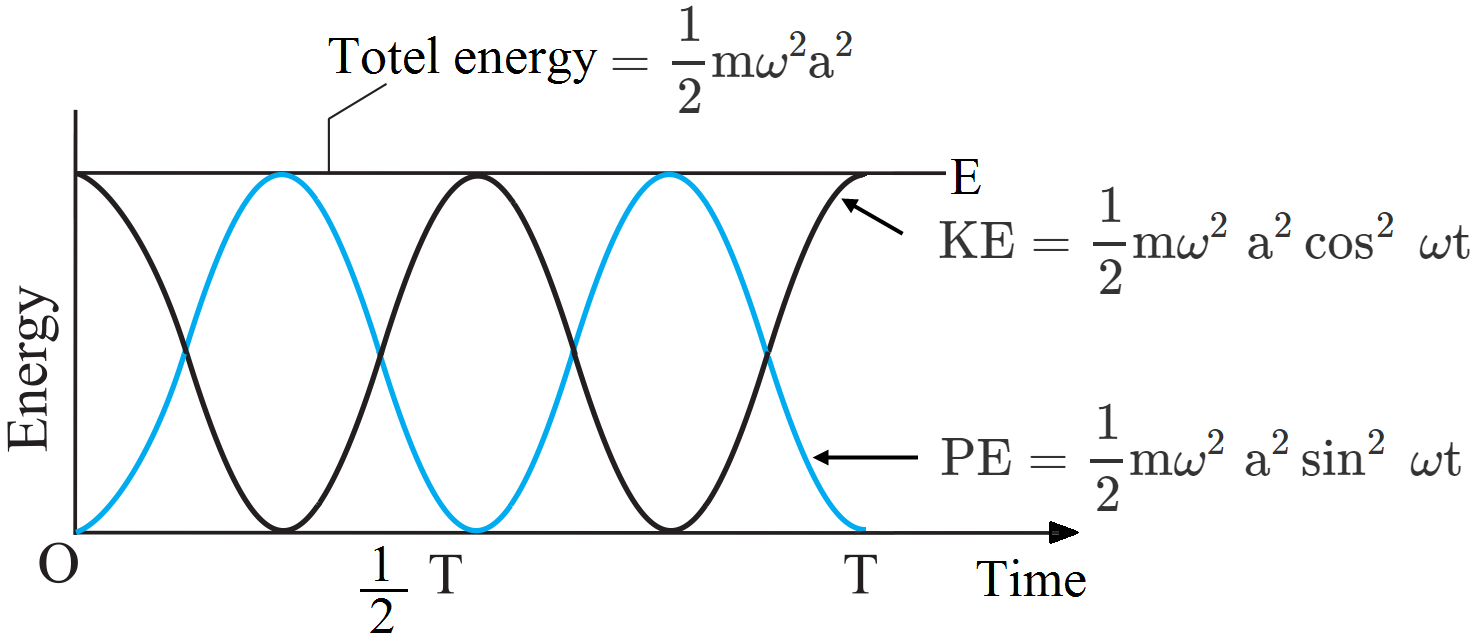
Important point: From the graph we note that potential energy or kinetic energy completes two vibrations in a time during which S.H.M. completes one vibration. Thus the frequency of potential energy or kinetic energy is double than that of S.H.M. View full question & answer→Question 795 Marks
If the earth were a homogeneous sphere and a straight hole bored in it through its centre, show that if a body were dropped into the hole it would execute a simple harmonic motion. Also find its time period.
AnswerLet a body of mass m be dropped in straight hole in the earth of mass M below and radius R. The body will be attracted towards the centre of the earth with a force given by,$\text{F}=\frac{\text{GMm}}{\text{R}^2},$ But $\text{F = mg}$
$\therefore\text{mg}=\frac{\text{GMm}}{\text{R}^2}$
$\text{g}=\frac{\text{Gm}}{\text{R}^2}=\text{G}\frac{4}{3}\frac{\pi\text{R}^3\rho}{\text{R}^2}$
$\Rightarrow\text{g}=\frac{4\pi\text{GR}\rho}{3},$
where $\rho$ is mean density of the earth. When the body is dropped into the straight hole, and it falls through the depth d, the value of acceleration due of gravity at the point P is given by,$\text{g}'=\frac{\text{Gm}'}{(\text{R}-\text{d})^2},$
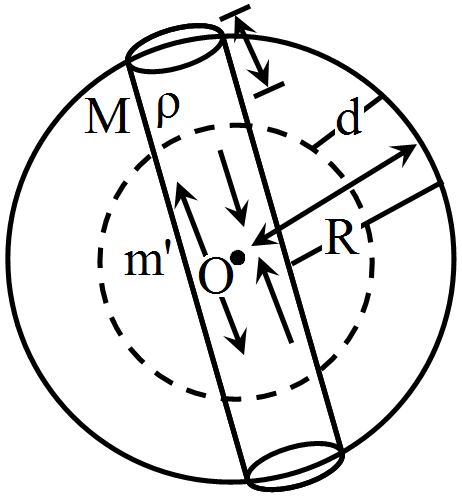 where m' is the mass of th€ sphere of radius (R - d).$\therefore\text{g}'=\frac{4\pi\text{G(R}-\text{d})\rho}{3}$
Thus, $\frac{\text{g}'}{\text{g}}=\frac{(\text{R}-\text{d})}{\text{R}}$$\text{g}'=\frac{\text{g}}{\text{R}}(\text{R}-\text{d})$
$\text{g}'\propto(\text{R}-\text{d})$
i.e., the acceleration (in magnitude) of the body is proportional to the displacement from the centre of the earth O. Thus, the motion is S.H.M. Time period, $\text{T}=2\pi\sqrt{\frac{\text{Displacement}}{\text{Acceleration}}}$$=2\pi\sqrt{\frac{\text{R}-\text{d}}{\Big(\frac{\text{R}-\text{d}}{\text{R}}\Big)}\text{g}}=2\pi\sqrt{\frac{\text{R}}{\text{g}}}$ View full question & answer→Question 805 Marks
An air chamber of volume V has a neck area of cross section a into which a ball of mass m just fits and can move up and down without any friction (Fig.). Show that when the ball is pressed down a little and released , it executes SHM. Obtain an expression for the time period of oscillations assuming pressure-volume variations of air to be isothermal [see Fig.].
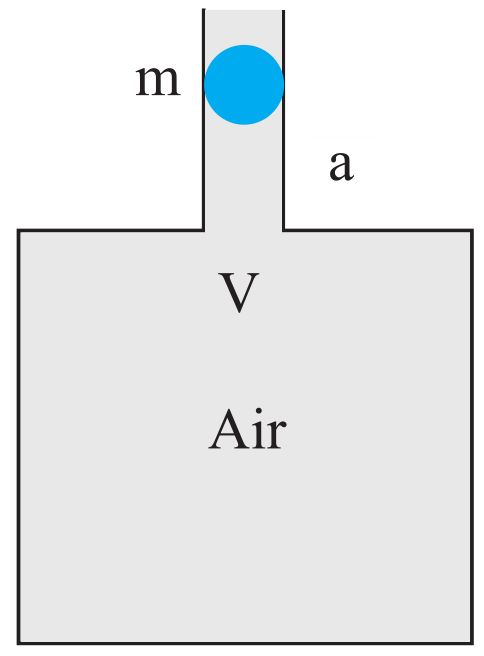
AnswerVolume of the air chamber = V Area of cross-section of the neck = a Mass of the ball = m The pressure inside the chamber is equal to the atmospheric pressure. Let the ball be depressed by x units. As a result of this depression, there would be a decrease in the volume and an increase in the pressure inside the chamber Decrease in the volume of the air chamber, ΔV = ax Volumetric strain = Change in volume/Original volume ⇒ ΔV/V = ax/V Bulk Modulus of air B = Stress/Strain = -p/ax/V In this case, stress is the increase in pressure. The negative sign indicates that pressure increases with a decrease in volume.$\text{p}=\frac{-\text{Bax}}{\text{V}}$
The restoring force acting on the ball,$\text{F}=\text{p}\times\text{a}$
$=\frac{-\text{Bax}}{\text{V}}.\text{a}$
$=\frac{-\text{Ba}^2\text{x}}{\text{V}}\ ....(\text{i})$
In simple harmonic motion, the equation for restoring force is:F = -kx ....(ii)
Where, k is the spring constant Comparing equations (i) and (ii), we get:$\text{k}=\frac{\text{Ba}^2}{\text{V}}$
Time period,$\text{T}=2\pi\sqrt{\frac{\text{m}}{\text{k}}}$
$=2\pi\sqrt{\frac{\text{Vm}}{\text{Ba}^2}}$
View full question & answer→Question 815 Marks
One end of a U-tube containing mercury is connected to a suction pump and the other end to atmosphere. A small pressure difference is maintained between the two columns. Show that, when the suction pump is removed, the column of mercury in the U-tube executes simple harmonic motion.
AnswerArea of cross-section of the U-tube = A Density of the mercury column = $\rho$ Acceleration due to gravity = g Restoring force, F = Weight of the mercury column of a certain height F = –(Volume × Density × g)$\text{F}=-(\text{A}\times2\text{h}\times\rho\times\text{g})=-2\text{A}\rho\text{gh}$
= -k × Displacement in one of the arms (h)
Where, 2h is the height of the mercury column in the two arms k is a constant, given by $\text{k}=-\frac{\text{F}}{\text{h}}=2\text{A}\rho\text{g}$ Time period, $\text{T}=2\pi\sqrt{\frac{\text{m}}{\text{k}}}=2\pi\sqrt{\frac{\text{m}}{2\text{A}\rho\text{g}}}$ Where, m is the mass of the mercury column Let l be the length of the total mercury in the U-tube. Mass of mercury, m = Volume of mercury × Density of mercury$=\text{Al}\rho$
$\therefore\ \text{T}=2\pi\sqrt{\frac{\text{Al}\rho}{2\text{A}\rho\text{g}}}=2\pi\sqrt{\frac{\text{l}}{2}}\text{g}$
Hence, the mercury column executes simple harmonic motion with time period $2\pi\sqrt{\frac{\text{l}}{2\text{g}}}$
View full question & answer→Question 825 Marks
Find the time period of mass M when displaced from its equilibrium positon and then released for the system shown in figure.
AnswerKey concept: For observing oscillation, we have to displace the block slightly beyond equilibrium position and find the acceleration due to the restoring force. Let in the equilibrium position, the spring has extended by an amount $x_0$. Tension in the spring = $kx_0$ For equilibrium of the mass M, $Mg = 2kx_0$
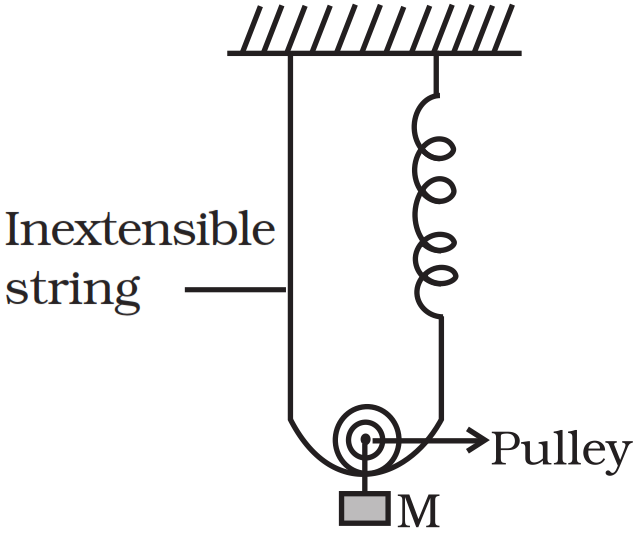
Let the mass be pulled through a distance y and then released. But, string is inextensible, hence the spring alone will contribute the total extension $y + y = 2y$, to lower the mass down by y from initial equilibrium mean position $x_0$. So, net extension in the spring $(x_0 + 2y)$. From F.B.D of the block,
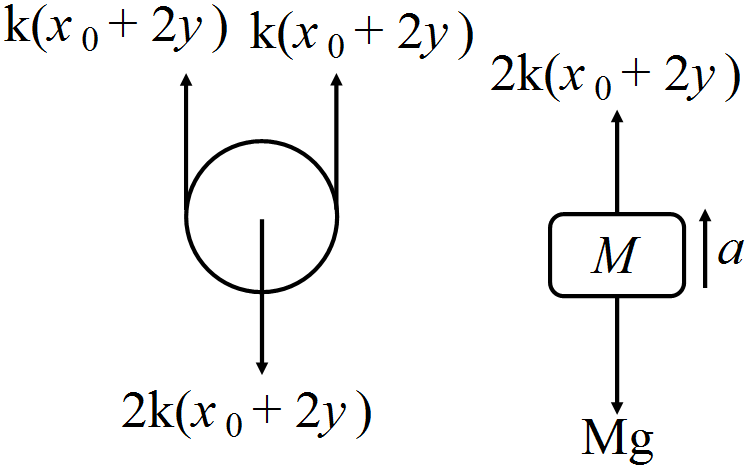
$2\text{K}(\text{x}_0+2\text{y})-\text{Mg}=\text{Ma}$
$2\text{Kx}_0+4\text{ky}-\text{Mg}=\text{Ma}\Rightarrow\text{Ma}=4\text{ky}$
$\overline{\text{a}}=-\Big(\frac{4\text{k}}{\text{M}}\Big)\overline{\text{y}}$
k and M being constant.$\therefore\text{a}\propto-\text{x}.$ Hence, motion is SHM.
Comparing the above acceleration expression with standard SHM equation.$\text{a}=-\omega^2\text{x},$ we get
$\omega^2=\frac{4\text{k}}{\text{M}}\Rightarrow\omega=\sqrt{\frac{4\text{k}}{\text{M}}}$ View full question & answer→Question 835 Marks
In Fig. 14.9, what will be the sign of the velocity of the point, which is the projection of the velocity of the P′ reference particle P .P is moving in a circle of radius R in anticlockwise direction.
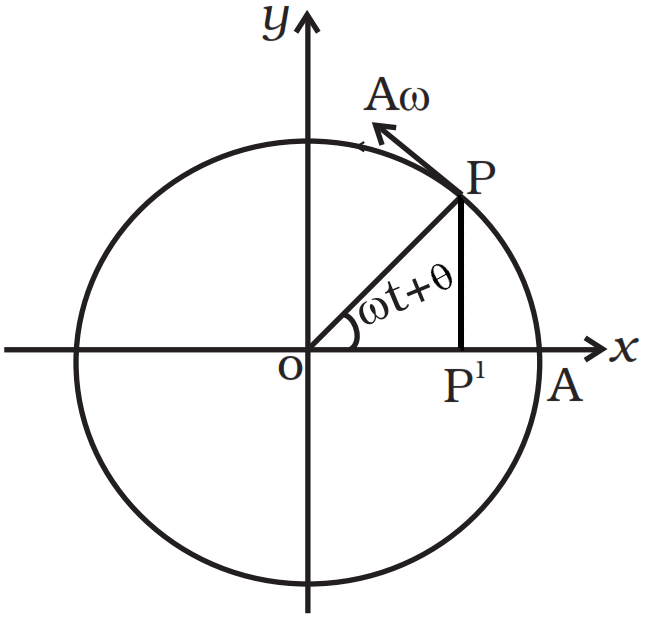
AnswerP' is foot perpendicular of velocity vector of particle p at any time t.
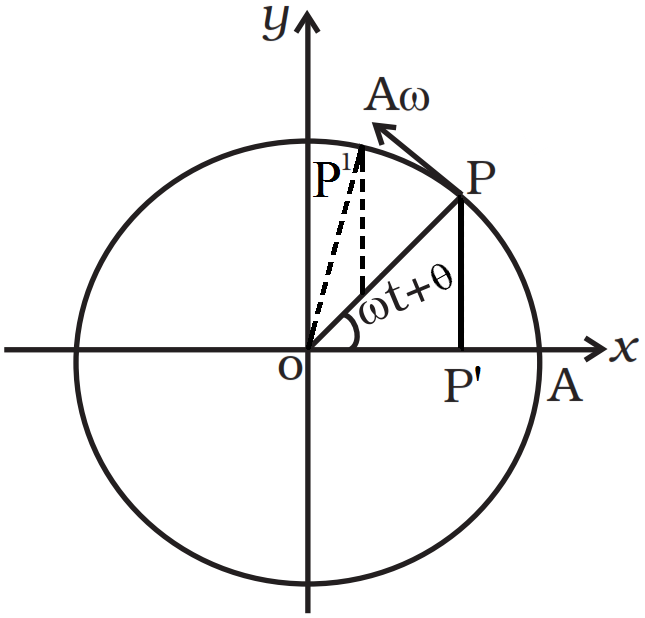
Now particle moves from $p$ to $p_1$ then its foot shifts from p' to Q i.e, towards negatives axis.
Hence the sign of $\theta$ motion of P' is negative. View full question & answer→Question 845 Marks
A body describes simple harmonic motion with an amplitude of 5cm and a period of 0.2s. Find the acceleration and velocity of the body when the displacement is (a) 5cm (b) 3cm (c) 0cm.
AnswerAmplitude, A = 5cm = 0.05m Time period, T = 0.2s For displacement, x = 5cm = 0.05m Acceleration is given by:$\text{a}=-\omega^2\text{x}$
$=-\Big(\frac{2\pi}{\text{T}}\Big)^2\text{x}$
$=-\Big(\frac{2\pi}{0.2}\Big)^2\times0.05$
$=-5\pi^2\text{ m/s}^2$
Velocity is given by:$\text{v}=\omega\sqrt{\text{A}^2-\text{x}^2}$
$=\frac{2\pi}{\text{T}}\sqrt{(0.05)^2-(0.05)^2}$
= 0When the displacement of the body is 5cm, its acceleration is $-5\pi^2\text{ m/s}^2$ and velocity is 0.
For displacement, x = 3cm = 0.03m
$\text{a}=-\omega^2\text{x}$
$=-\Big(\frac{2\pi}{\text{T}}\Big)^2\text{x}$
$=-\Big(\frac{2\pi}{0.2}\Big)^20.03$
$=-3\pi^2\text{ m/s}^2$
Velocity is given by:$\text{v}=\omega\sqrt{\text{A}^2-\text{x}^2}$
$=\frac{2\pi}{\text{T}}\sqrt{\text{A}^2-\text{x}^2}$
$=\frac{2\pi}{\text{T}}\sqrt{(0.05)^2-(0.03)^2}$
$=\frac{2\pi}{0.2}\times0.04$
$=0.4\pi\text{ m/s}$
When the displacement of the body is 3cm, its acceleration is $-3\pi\text{ m/s}^2$ and velocity is $0.4\pi\text{ m/s}.$ For displacement, x = 0 Acceleration is given by:$\text{a}=-\omega^2\text{x}=0$
Velocity is given by:$\text{v}=\omega\sqrt{\text{A}^2-\text{x}^2}$
$=\frac{2\pi}{\text{T}}\sqrt{\text{A}^2-\text{x}^2}$
$=\frac{2\pi}{0.2}\sqrt{(0.05)^2-0}$
$=0.5\pi\text{ m/s}$
When the displacement of the body is 0, its acceleration is 0 and velocity is $0.5\pi\text{ m/s}.$
View full question & answer→Question 855 Marks
Show that for a particle in linear SHM the average kinetic energy over a period of oscillation equals the average potential energy over the same period.
AnswerThe equation of displacement of a particle executing SHM at an instant t is given as:$\text{x}=\text{A}\sin\omega\text{t}$
where,
A = Amplitude of oscillation
$\omega=$ Angular frequency $=\sqrt{\frac{\text{k}}{\text{M}}}$
The velocity of the particle is: v = dx/dt $=\text{A}\omega\cos\omega\text{t}$
The kinetic energy of the particle is:
$\text{E}_\text{k}=\frac{1}{2}\text{Mv}^2=\frac{1}{2}\text{MA}^2\omega^2\cos^2\omega\text{t}$
The portential energy of the particle is:
$\text{E}_\text{p}=\frac{1}{2}\text{kx}^2=\frac{1}{2}\text{M}^2\omega^2\text{A}^2\sin^2\omega\text{t}$
For time period T, the average kinetic energy over a single cycle is given as:
$(\text{E}_\text{k})_\text{Avg}=\frac{1}{\text{T}}\int\limits_{0}^{\text{T}}\text{E}_\text{k}\text{dt}$
$=\frac{1}{\text{T}}\int\limits_{0}^{\text{T}}\frac{1}{2}\text{MA}^2\omega^2\cos^2\omega\text{t dt}$
$=\frac{1}{2\text{T}}\text{MA}^2\omega^2\int\limits_{0}^{\text{T}}\frac{(1+\cos2\omega\text{t})}{2}\text{dt}$
$=\frac{1}{4\text{T}}\text{MA}^2\omega^2\Big[\text{t}+\frac{\sin2\omega\text{t}}{2\omega}\Big]^{\text{T}}_{0}$
$=\frac{1}{4\text{T}}\text{MA}^2\omega^2(\text{T})$
$=\frac{1}{4}\text{MA}^2\omega^2\ ......(\text{i})$
And, average potential energy over one cycle is given as:
$(\text{E}_\text{p})_\text{Avg}=\frac{1}{\text{T}}\int\limits^{\text{T}}_{0}\text{E}_\text{p}\text{dt}$
$=\frac{1}{\text{T}}\int\limits_{0}^{\text{T}}\frac{1}{2}\text{MA}^2\omega^2\sin^2\omega\text{t dt}$
$=\frac{1}{2\text{T}}\text{MA}^2\omega^2\int\limits_{0}^{\text{T}}\frac{(1-\cos2\omega\text{t})}{2}\text{dt}$
$=\frac{1}{4\text{T}}\text{MA}^2\omega^2\Big[\text{t}-\frac{\sin2\omega\text{t}}{2\omega}\Big]^{\text{T}}_{0}$
$=\frac{1}{4\text{T}}\text{MA}^2\omega^2(\text{T})$
$=\frac{1}{4}\text{MA}^2\omega^2\ ......(\text{ii})$
It can be inferred from equations (i) and (ii) that the average kinetic energy for a given time period is equal to the average potential energy for the same time period.
View full question & answer→Question 865 Marks
One end of a V-tube containing mercury is connected to a suction pump and the other end to atmosphere. The two arms of the tube are inclined to horizontal at an angle of 45 PHA° each. A small pressure difference is created between two columns when the suction pump is removed. Will the column of mercury in V-tube execute simple harmonic motion? Neglect capillary and viscous forces.Find the time period of oscillation.
AnswerLet the liquid column in both columns are at heights initial. Now due to pressure difference the liquid columns in A arm pressed by and in arm B lifts by (so difference in vertical height between two levels = Consider an element of liquid of height (in tube). 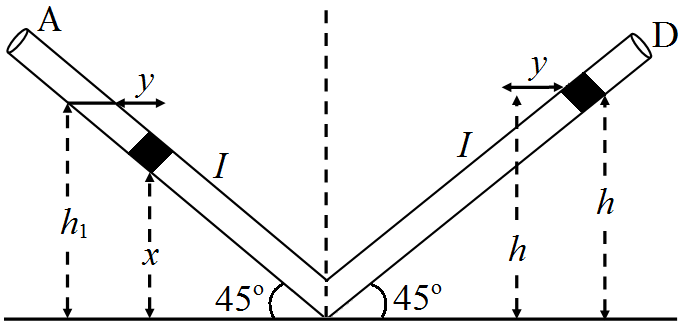 Then iy's mass $\text{dm}=\text{A}.\text{dx}\rho.$A = area of cross section of tube. P.E. of the left dm element column = (dm)g h P.E. of dm element in left column $\text{A}\rho\text{g x dx}$ Total P.E. in left column $=\int_{0}^{\text{h}}\text{A}\rho\text{gx dx}=\text{A}\rho\text{g}\Big[\frac{\text{x}^2}{2}\Big]^\text{h}_0$$=\text{A}\rho\text{g}\frac{\text{h}_1^2}{2}$
from figure $\sin45^\circ=\frac{\text{h}_1}{\text{l}}$$\text{h}_1=\text{h}_2=\text{l}\sin45^\circ=\frac{\text{l}}{\sqrt{2}}$
$\therefore\text{h}_1^2=\text{h}_2^2=\frac{\text{l}^2}{2}$
$\therefore$ P.E. in left column $=\text{A}\rho\text{g}\frac{\text{l}^2}{4}$
Similarly P.E. in right column $=\text{A}\rho\text{g}\frac{\text{l}^2}{4}$$\therefore$ total potential energy $=\text{A}\rho\text{g}\ \frac{\text{l}^2}{4}+\text{A}\rho\text{g}\frac{\text{l}^2}{4}=\frac{\text{A}\rho\text{gl}^2}{2}$
Due to pressure difference, let element moves towards right side y is unit. Then the liquid column is left arm = (l - y) And the liquid column is right arm = (l + y) P.E. of liquid column in left arm $=\text{A}\rho\text{g}(\text{l}-\text{y})^2\sin^245^\circ$ P.E. of liquid column in right arm $=\text{A}\rho\text{g}(\text{l}+\text{y})^2\sin45^\circ$ $\therefore$ Total P.E. due liquid column $=\text{A}\rho\text{g}\Big(\frac{1}{\sqrt{2}}\Big)^2[(\text{l}-\text{y})^2+(\text{l}+\text{y})^2]$ Final P.E. due to different in liquid columns$=\frac{\text{A}\rho\text{g}}{2}[\text{l}^2+\text{y}^2-2\text{ly}+\text{l}^2+\text{y}^2+2\text{ly}]$
Final P.E. $=\frac{\text{A}\rho\text{g}}{2}(2\text{l}^2+2\text{y}^2)$ Change P.E. = final P.E. - Initial P.E.$=\frac{\text{A}\rho\text{g}}{2}(2\text{l}^2+2\text{y}^2)-\frac{\text{A}\rho\text{gl}^2}{2}$
$=\frac{\text{A}\rho\text{g}}{2}\ [2\text{l}^2+2\text{y}^2-\text{l}^2]$
Change in P.E. $=\frac{\text{A}\rho\text{g}}{2}\ (\text{l}^2+2\text{y}^2)$ If change in velocity (v) of total liquid column$\Delta\text{KE}=\frac{1}{2}\text{mv}^2$
$\text{m}=(A.2\text{l})\rho$
$\Delta\text{kE}=\frac{1}{2}\ (\text{A}2\ \text{l}\rho)\text{v}^2=\text{A}\rho\text{lv}^2$
$\therefore$ Change in total energy $=\frac{\text{A}\rho\text{g}}{2}(\text{l}^2+2\text{y}^2)+-\text{A}\rho\text{lv}^2$
Total change in energy $\Delta\text{PE}+\Delta\text{KE}=0$$\therefore\frac{\text{A}\rho\text{g}}{2}\ [\text{l}^2+2\text{y}^2]+\text{A}\rho\text{lv}^2=0$
$\frac{\text{A}\rho}{2}[\text{g}(\text{l}^2+2\text{y}^2)+2\text{lv}^2]=0$
$\frac{\text{A}\rho}{2}\neq0$
$\therefore\text{g}(\text{l}^2+2\text{y}^2)+2\text{lv}^2=0$
Differentiating W.R.T, $\text{g}\Big[0+2\times2\text{y}\ \frac{\text{dy}}{\text{dt}}\Big]+2\text{l}.2\text{v}.\frac{\text{dv}}{\text{dt}}=0$$4\text{gy}\ \frac{\text{dy}}{\text{dt}}+4\text{vl}\ \frac{\text{d}^2\text{y}}{\text{dt}^2}=0$ $\Big[\because\text{A}=\frac{\text{dv}}{\text{dt}}=\frac{\text{d}^2\text{y}}{\text{dt}^2}\Big]$
$4\text{gy}.\text{v}+4\text{vl}\frac{\text{d}^2\text{y}}{\text{dt}^2}=0\Rightarrow4\text{v}\Big[\text{gy}+\text{l}.\frac{\text{d}^2\text{y}}{\text{dt}^2}\Big]=0$
$\frac{\text{d}^2\text{y}}{\text{dt}^2}+\frac{\text{g}}{\text{l}}\ \text{y}=0\ \because4\text{v}\neq0$
It is the equation of SHM oscillator and standard equation of SHM is $\frac{\text{d}^2\text{y}}{\text{dt}^2}+\omega^2\text{y}=0$$\frac{2\pi}{\text{T}}=\sqrt{\frac{\text{g}}{\text{l}}}\Rightarrow\text{T}=2\pi\sqrt{\frac{\text{l}}{\text{g}}}$ View full question & answer→Question 875 Marks
A cylindrical log of wood of height h and area of cross-section A floats in water. It is pressed and then released. Show that the log would execute S.H.M. with a time period.$\text{T}=2\pi\sqrt{\frac{\text{m}}{\text{A}\rho\text{g}}}$
where m is mass of the body and ρ is density of the liquid.
Answerwhen log is pressed downward into the liquid then and upward Buoyant force (B.F.) action it which oves the block upward and due to inertia it moves upward from its mean position due to inertia and then again come down due to gravity. So net restoring force on block = Buoyant force – mg 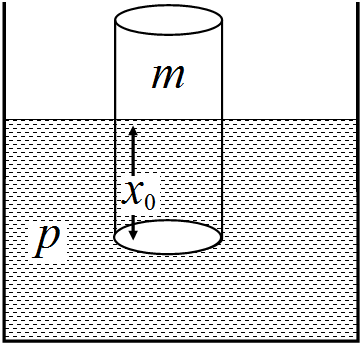 V = volume of liquid displaced by blocks Let when floats then $\text{mg}=\text{B.f}\ \text{or}\ \text{mg}=\text{V}\rho\text{g}$ A = area of cross section x = Height of blocks liquid Let x height again dip in liquid when pressed into water total height of block in water$=(\text{x}+\text{x}_0)$
So net restoring force $[\text{A}(\text{x}+\text{x}_0)]\rho\text{g}-\text{mg}$$\text{F}_\text{restoring}=\text{A}\text{x}_0\rho\text{g}+\text{Ax}\rho\text{g}-\text{A}\text{x}_0\rho\text{g}$
$\text{F}_\text{Restoring}=-\text{Ax}\rho\text{g}$
(as Buoyant force is upward and x is downward)$\text{F}_\text{restoring}\propto-\text{x}$
So motion is SHM here k $\text{A}\rho\text{g}$$\text{a}=-\omega^2\text{x}\omega^2=\frac{\text{k}}{\text{m}}\Rightarrow\text{T}=2\pi\sqrt{\frac{\text{m}}{\text{k}}}$
$\text{F}_\text{restoring}=-\text{A}\rho\text{gx}$
$\text{ma}=-\text{A}\rho\text{gx}$
$\text{a}=\frac{-\text{A}\rho\text{gx}}{\text{m}}\Rightarrow-\omega^2\text{x}=\frac{-\text{A}\rho\text{gx}}{\text{m}}$
$\omega^2=\frac{\text{A}\rho\text{g}}{\text{m}}$
$\text{k}=\text{A}\rho\text{g}$
$\Big(\frac{2\pi}{\text{T}}\Big)^2=\frac{\text{A}\rho\text{g}}{\text{m}}\Rightarrow\frac{\text{T}}{2\pi}=\sqrt{\frac{\text{m}}{\text{A}\rho\text{g}}}\Rightarrow\text{T}=2\pi\sqrt{\frac{\text{m}}{\text{A}\rho\text{g}}}$ View full question & answer→Question 885 Marks
A simple pendulum of time period $1s$ and length l is hung from a fixed support at O, such that the bob is at adistance H vertically above A on the ground The amplitude is $\theta$ The string snaps at $\theta=\frac{\theta_0}{2}$ Find the time taken by the bob to hit the ground. Also find distance from A where bob hits the ground. Assume θ to be small so that $\sin\theta_0\ \text{and}\ \cos\theta_0=1.$
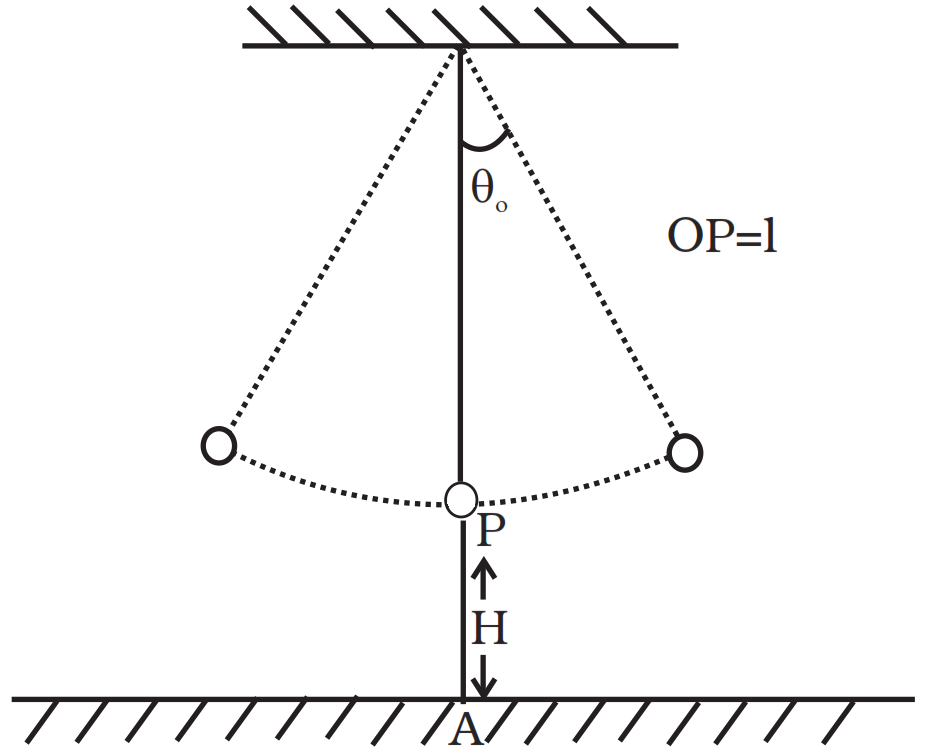
AnswerConsider the diagram at $\text{t}=0,\theta=\frac{\theta}{2}$At $\text{t}=\text{t}_1\ \ \ \ \ \theta=\frac{\theta_0}{2}$
$\theta=\theta_0\cos\omega\text{t}$
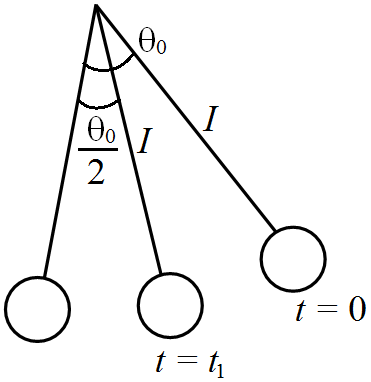
$\text{t}=\text{t}_1,\theta=\frac{\theta_0}{2}$
$\therefore\frac{\theta_0}{2}=\theta_0\cos\frac{2\pi}{\text{T}}\text{t}_1$
$\text{T}=1\text{Sec}(\text{given})$
$\therefore\cos2\pi\text{t}_1=\frac{1}{2}=\cos\frac{\pi}{3}$
$2\pi\text{t}_1=\frac{\pi}{3}\ \text{or}\ \text{t}_1=\frac{1}{6}$
$\theta=\theta_0\cos2\pi\text{r}$
$\frac{\text{d}\theta}{\text{dt}}=-\theta_02\pi\sin2\pi\text{t}$
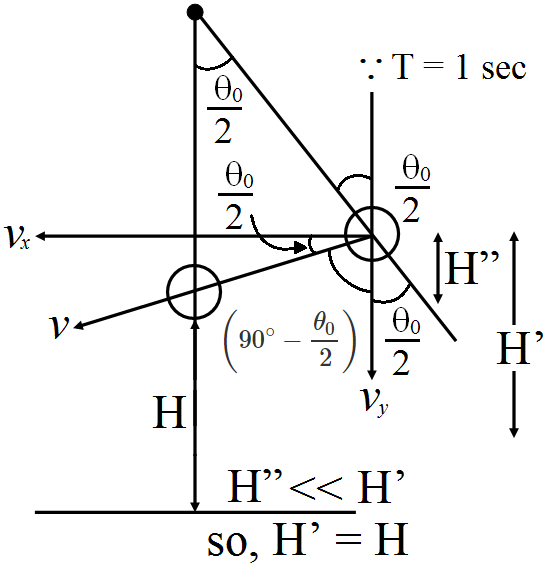
At $\text{t}=\frac{1}{6}\text{i.e,}\ \text{at}\ \theta=\frac{\theta_0}{2}$
$\frac{\text{d}\theta}{\text{dt}}=-\theta_02\pi\sin2\pi\frac{1}{6}$
$\frac{\text{d}\theta}{\text{dt}}=-\theta_02\pi\sin\frac{\pi}{3}$
$=-\theta_02\pi\frac{\sqrt{3}}{2}$
$\frac{\text{d}\theta}{\text{dt}}=-\theta_0\pi\sqrt{3}$
$\omega=-\theta_0\pi\sqrt{3}\Big(\because\frac{\text{d}\theta}{\text{dt}}=\omega\Big)$
$\frac{\text{v}}{\text{t}}=-\theta_0\pi\sqrt{3}$
$\text{v}=-\sqrt{3}\pi\theta_0\text{l}$
(-) ve shows that bob’s motion is towards left.
$\text{v}_\text{x}=\text{v}\cos\frac{\theta_0}{2}=-\sqrt{3\pi}\theta_0\text{l}\cos\frac{\theta_0}{2}$
$\text{v}_\text{y}=\text{v}\sin\frac{\theta_0}{2}=-\sqrt{3}\pi\theta_0\text{l}\sin\frac{\theta_0}{2}$
Let vertical distance covered by is H’ (downward)
$\text{s}=\text{ut}+\frac{1}{2}\text{gt}^2$
$\text{H}'=\text{v}_\text{y}\text{t}+\frac{1}{2}\text{gt}^2$
$\frac{1}{2}\text{gt}^2+\sqrt{3}\pi\theta_0\text{l}\sin\frac{\theta_0}{2}\times\text{t}-\text{H}'=0$
$\sin\frac{\theta_0}{2}=\frac{\theta_2}{2}$ (given)
$\therefore\frac{1}{2}\text{gt}^2+\sqrt{3}\pi\theta_0\text{l}\frac{\theta_0}{2}\text{t}-\text{H}=0$
By Quadratic formula $\text{t}=\frac{-\text{B}\pm\sqrt{\text{B}^2-4\text{Ac}}}{2\text{A}}$
$\text{t}=\frac{(-\sqrt{3}\pi\theta_0^2\text{l})/4\pm\sqrt{(3\pi^2\theta^4_0\text{l}^2)/4+4\frac{1}{2}\text{gH}}}{\text{2g/2}}$
As $\theta_0$ is very small so by neglecting $\theta^4_0$ and $\theta^2_0$
$\text{t}=\frac{+\sqrt{2\text{gH}'}}{\text{g}}\text{H}'=\text{H}+\text{H}''$
$\therefore\text{t}=\sqrt{\frac{2\text{H}}{\text{g}}}\text{H}''<<\text{H}$ as $\frac{\theta_0}{2}$ is very small
$\therefore\text{H}=\text{H}'$
Distance covered in horizontal = $v_xt$
$\text{x}=\sqrt{3}\pi\theta_0\text{l}\cos\frac{\theta_0}{2}\sqrt{\frac{2\text{H}}{\text{g}}}$
$\therefore\text{x}=\sqrt{3}\pi\theta_0\text{l}\sqrt{\frac{2\text{H}}{\text{g}}}\cos\frac{\theta_0}{2}=1$
$\text{x}=\theta_0\text{l}\pi\sqrt{\frac{6\text{H}}{\text{g}}}$
At the time snapping, the bob was at distance $\text{l}\sin\frac{\theta_0}{2}=\text{l}\frac{\theta_0}{2}$ from A
Thus the distance of bob From A where it meet the ground is
$=\frac{\text{l}\theta_0}{2}-\text{x}=\frac{\text{l}\theta_0}{2}-\theta_0\text{l}\pi\sqrt{\frac{6\text{H}}{\text{g}}}$
$=\theta_0\text{l}\Big[\frac{1}{2}-\pi\sqrt{\frac{6\text{H}}{\text{g}}}\Big]$ View full question & answer→Question 895 Marks
A person normally weighing $50kg$ stands on a massless platform which oscillates up and down harmonically at a frequency of $2.0s^{–1}$ and an amplitude $5.0cm$. A weighing machine on the platform gives the persons weight against time.
- Will there be any change in weight of the body, during the oscillation?
- If answer to part (a) is yes, what will be the maximum and minimum reading in the machine and at which position?
AnswerWeight in weight machine will be due to the normal reaction (N) by platform. Consider the top position of platform, two forces due to weight of person and oscillator acts both downward.
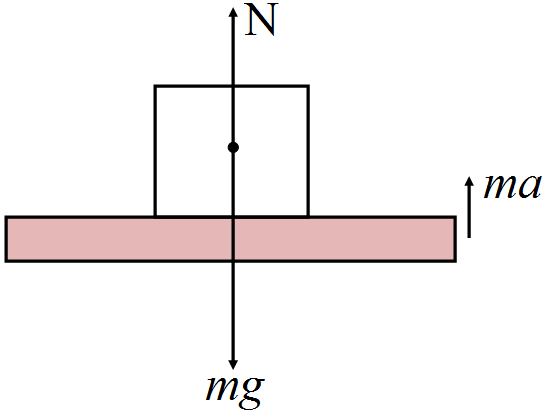
So motion is downward. Let with acceleration a then ma = mg - N ...(i) When platform lifts form its lowest position to upward ma = N - mg ...(ii)$\text{a}\omega^2\text{A}$ acceleration of oscillator
- Form (i) equation
$\text{N}=\text{mg}-\text{m}\omega^2\text{A}$
Where A is amplitude, $\omega$ angular frequency, m mass of oscillator.
$\omega=2\pi\text{v}=2\pi\times2=4\pi\ \text{rad}/\text{sec}.$
$\text{A}=5\text{cm}=5\times10^{-2}\text{m}_2\text{m}=50\text{kg}$
$\text{N}=50\times9.8-50\times4\pi\times4\pi\times5\times10^{-2}$
$=50[9.8-16\pi^2\times5\times10^{-2}$
$=50[9.8-80\times3.14\times3.14\times10^{-2}]$
$\text{N}=50[9.8-7.89]=50\times1.91=95.50\text{N}$
So minimum weight is 95.50N.
- form (ii) N – mg = ma
For upward motion form lowest point of oscillator.
$\text{N}=\text{mg}+\text{ma}=\text{m}(\text{a}+\text{g})$
$=\text{m}[9.81+\omega^2\text{A}]\text{a}=\omega^2\text{A}$
$=50[9.81+16\pi^2\times5\times10^{-2}$
$=50[9.81+7.89]=50[17.70]$
$\text{N}=885.00\text{N}$
- Hence, there is a change in weight of the body during oscillation.
- The maximum weight is 885N, when platform moves from lowest to up direction.
And the minimum is 95.5N, when platform moves from highest point to downward direction. View full question & answer→Question 905 Marks
A body of mass m is attached to one end of a massless spring which is suspended vertically from a fixed point. The mass is held in hand so that the spring is neither stretched nor compressed. Suddenly the support of the hand is removed. The lowest position attained by the mass during oscillation is 4cm below the point, where it was held in hand.
- What is the amplitude of oscillation?
- Find the frequency of oscillation?
AnswerWhen mass m is held in support by hand the extension in spring will be zero as no deforming force acts on spring. Let the mass reaches at its new position unit displacement from previous. Then P.E. of spring or mass = gravitational P.E. lost by man. 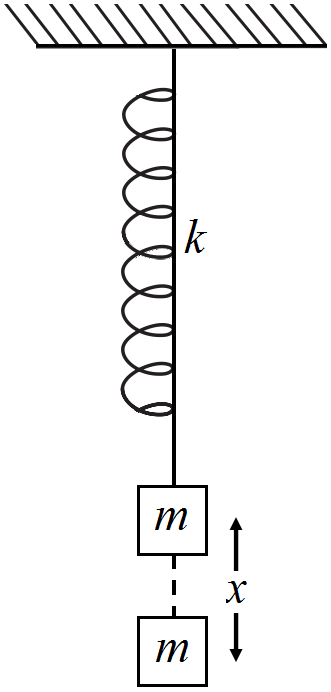 P.E = mg x But P.E. due to spring is $\frac{1}{2}\text{kx}^2\text{k}=\omega^2\text{A}$$\therefore\frac{1}{2}\text{kx}^2=\text{mg x}$
Mean position of spring by block will be when let extension is then$\text{F}=-\text{kx}_0$
$\text{F}=\text{mg}\therefore\text{mg}=+\text{kx}_0\ \text{or}\ \text{x}_0=\frac{\text{mg}}{\text{k}}\ ...(\text{ii})$
From (i) and (ii)$\text{x}=2\Big(\frac{\text{mg}}{\text{k}}\Big)=2\text{x}_0$
$\text{x}=4\text{cm}\therefore4=2\text{x}_0$
$\text{x}_0=2\text{cm}$
The amplitude of oscillator is the maximum distance from mean position.$\text{x}-\text{x}_0=4-2=2\text{cm}$
Time Period $\text{T}=2\pi\sqrt{\frac{\text{m}}{\text{k}}}$ which does not depend on amplitude.$\frac{2\text{mg}}{\text{k}}=\text{x}$ from (1)
$\frac{\text{m}}{\text{k}}=\frac{\text{x}}{2\text{g}}=\frac{4\times10^{-2}}{2\times9.8}\ \text{or}\ \frac{\text{k}}{\text{m}}=\frac{2\times9.8}{4\times10^{-2}}$
$\text{v}=\frac{1}{2\pi}\sqrt{\frac{\text{k}}{\text{m}}}=\frac{1}{2\times3.14}\sqrt{\frac{2\times9.8}{4\times10^{-2}}}=\frac{4.9\times10^{-2}}{6.28}$
$\text{v}=\frac{10\times2.21}{6.28}=3.52\text{Hz}.$
Oscillator will not rise above the positive from where it was released because total extension in spring is 4cm when released and amplitude is 2cm. So it oscillates below the released position. View full question & answer→Question 915 Marks
A block whose mass is $1 \ kg$ is fastened to a spring. The spring has a spring constant of $50 N m ^{-1}$. The block is pulled to a distance $x=10 \ cm$ from its equilibrium position at $x=0$ on a frictionless surface from rest at $t=0$. Calculate the kinetic, potential and total energies of the block when it is $5 \ cm$ away from the mean position.
AnswerThe block executes $\text{SHM}$, its angular frequency, as given by $Eq. (13.14b),$ is
$\omega =\sqrt{\frac{k}{m}}$
$ =\sqrt{\frac{50 N m ^{-1}}{1 \ kg }}$
$ =7.07 rad s ^{-1}$
Its displacement at any time $t$ is then given by,
$x(t)=0.1 \cos (7.07 t)$
Therefore, when the particle is $5 \ cm$ away from the mean position, we have
$0.05=0.1 \cos (7.07 t)$
Or $\cos (7.07 t)=0.5$ and hence
$\sin (7.07 t)=\frac{\sqrt{3}}{2}=0.866$
Then, the velocity of the block at $x=5 \ cm$ is
$=0.1 \times 7.07 0.866 m s ^{-1}$
$=0.61 m s ^{-1}$
Hence the $K.E.$ of the block,
$=\frac{1}{2} m v^2$
$=1 / 2\left[1 \ kg \times\left(0.6123 m s ^{-1}\right)^2\right]$
$=0.19 J$
The $P.E.$ of the block,
$=\frac{1}{2} k x^2$
$=1 / 2\left(50 N m ^{-1} \times 0.05 m \times 0.05 m \right)$
$=0.0625 J$
The total energy of the block at $x=5 \ cm$,
$=\text { K.E. + P.E. }$
$=0.25 J$
we also know that at maximum displacement, $K.E.$ is zero and hence the total energy of the system is equal to the $P.E.$ Therefore, the total energy of the system,
$=1 / 2\left(50 N m ^{-1} \times 0.1 m \times 0.1 m \right)$
$ =0.25 J$
which is same as the sum of the two energies at a displacement of $5 \ cm$. This is in conformity with the principle of conservation of energy.
View full question & answer→Question 925 Marks
Two identical springs of spring constant k are attached to a block of mass m and to fixed supports as shown in Fig. 13.14. Show that when the mass is displaced from its equilibrium position on either side, it executes a simple harmonic motion. Find the period of oscillations.
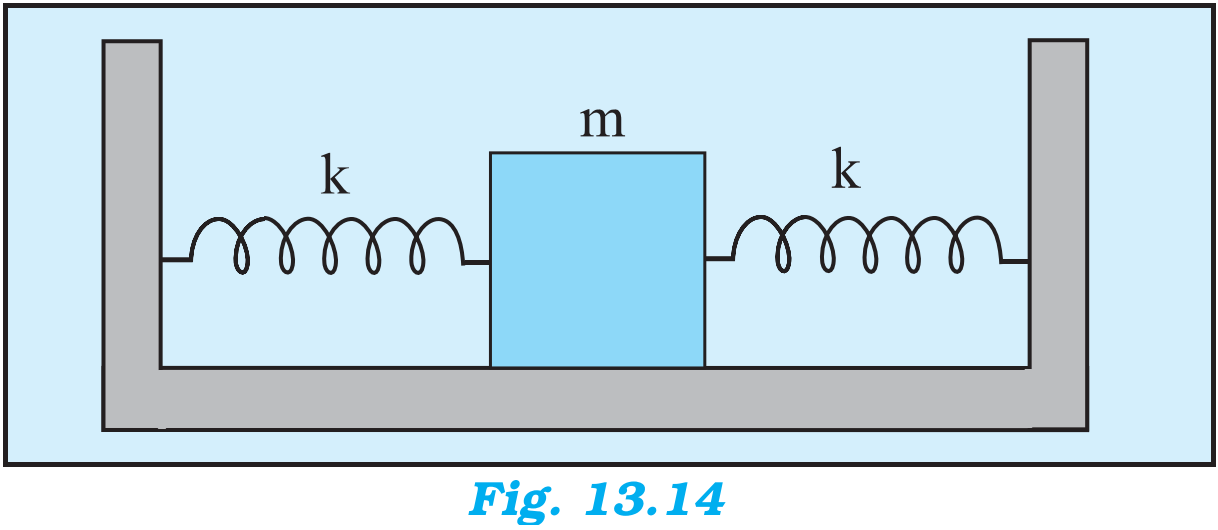
AnswerLet the mass be displaced by a small distance x to the right side of the equilibrium position, as shown in Fig. 13.15. Under this situation the spring on the left side gets
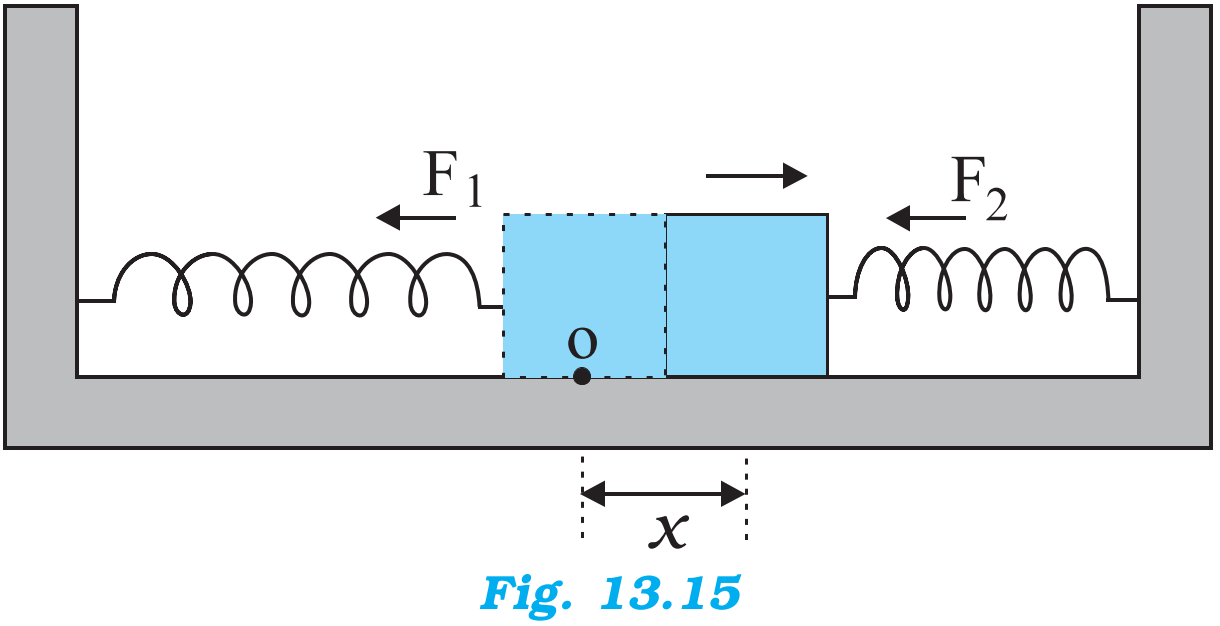
elongated by a length equal to $x$ and that on the right side gets compressed by the same length. The forces acting on the mass are then,
$
\begin{array}{r}
F_1=-k x \text { (force exerted by the spring on } \\
\text { the left side, trying to pull the } \\
\text { mass towards the mean } \\
\text { position) } \\
F_2=-k x \text { (force exerted by the spring on } \\
\text { the right side, trying to push the } \\
\text { mass towards the mean } \\
\text { position) }
\end{array}
$
The net force, $F$, acting on the mass is then given by,
$
F=-2 k x
$
Hence the force acting on the mass is proportional to the displacement and is directed towards the mean position; therefore, the motion executed by the mass is simple harmonic. The time period of oscillations is,
$
T=2 \pi \sqrt{\frac{m}{2 k}}
$ View full question & answer→Question 935 Marks
The figure given below depicts two circular motions. The radius of the circle, the period of revolution, the initial position and the sense of revolution are indicated in the figures. Obtain the simple harmonic motions of the x-projection of the radius vector of the rotating particle P in each case.
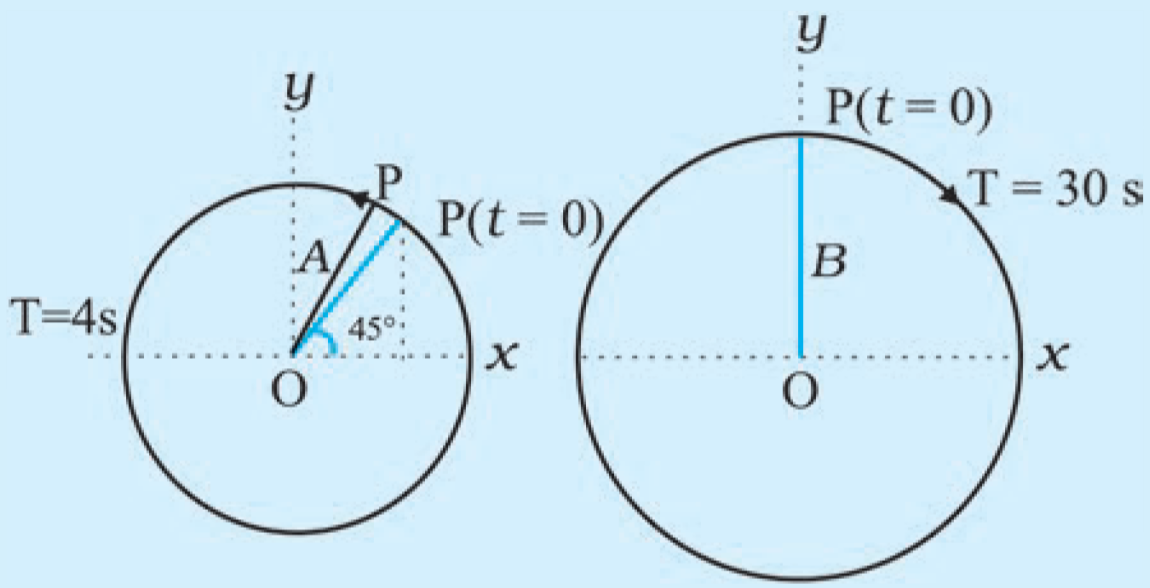
Answer(a) At $t=0$, OP makes an angle of $45^{\circ}=\pi / 4 rad$ with the (positive direction of) $x$-axis. After time $t$, it covers an angle $\frac{2 \pi}{T} t$ in the anticlockwise sense, and makes an angle of $\frac{2 \pi}{T} t+\frac{\pi}{4}$ with the $x$-axis.
The projection of OP on the $x$-axis at time $t$ is given by,
$
x(t)=A \cos \left(\frac{2 \pi}{T} t+\frac{\pi}{4}\right)
$
For $T=4 s$,
$
x(t)=A \cos \left(\frac{2 \pi}{4} t+\frac{\pi}{4}\right)
$
which is a SHM of amplitude $A$, period $4 s$, and an initial phase $*=\frac{\pi}{4}$.
(b) In this case at $t=0$, OP makes an angle of $90^{\circ}=\frac{\pi}{2}$ with the $x$-axis. After a time $t$, it covers an angle of $\frac{2 \pi}{T} t$ in the clockwise sense and makes an angle of $\left(\frac{\pi}{2}-\frac{2 \pi}{T} t\right)$ with the $x$-axis. The projection of OP on the $x$-axis at time $t$ is given by
$
\begin{array}{r}
x(t)=B \cos \left(\frac{\pi}{2}-\frac{2 \pi}{T} t\right) \\
=B \sin \left(\frac{2 \pi}{T} t\right)
\end{array}
$
For $T=30 s$,
$
x(t)=B \sin \left(\frac{\pi}{15} t\right)
$
Writing this as $x(t)=B \cos \left(\frac{\pi}{15} t-\frac{\pi}{2}\right)$, and comparing with Eq. (13.4). We find that this represents a SHM of amplitude $B$, period $30 s$, and an initial phase of $-\frac{\pi}{2}$.
View full question & answer→Question 945 Marks
Which of the following functions of time represent (a) periodic and (b) non-periodic motion? Give the period for each case of periodic motion [ $\omega$ is any positive constant].
(i) $\sin \omega t+\cos \omega t$
(ii) $\sin \omega t+\cos 2 \omega t+\sin 4 \omega t$
(iii) $e ^{-\omega t}$
(iv) $\log (\omega t)$
Answer(i) $\sin \omega t+\cos \omega t$ is a periodic function, it can also be written as $\sqrt{2} \sin (\omega t+\pi / 4)$.
Now $\sqrt{2} \sin (\omega t+\pi / 4)=\sqrt{2} \sin (\omega t+\pi / 4+2 \pi)$ $=\sqrt{2} \sin [\omega(t+2 \pi / \omega)+\pi / 4]$
The periodic time of the function is $2 \pi / \omega$.
(ii) This is an example of a periodic motion. It can be noted that each term represents a periodic function with a different angular frequency. Since period is the least interval of time after which a function repeats its value, $\sin \omega t$ has a period $T_0=2 \pi / \omega ; \cos 2 \omega t$ has a period $\pi / \omega=T_o / 2$; and $\sin 4 \omega t$ has a period $2 \pi / 4 \omega=T_o / 4$. The period of the first term is a multiple of the periods of the last two terms. Therefore, the smallest interval of time after which the sum of the three terms repeats is $T_0$, and thus, the sum is a periodic function with a period $2 \pi / \omega$.
(iii) The function $e^{-\omega t}$ is not periodic, it decreases monotonically with increasing time and tends to zero as $t \rightarrow \infty$ and thus, never repeats its value.
(iv) The function $\log (\omega t)$ increases monotonically with time $t$. It, therefore, never repeats its value and is a nonperiodic function. It may be noted that as $t \rightarrow \infty, \log (\omega t)$ diverges to $\infty$. It, therefore, cannot represent any kind of physical displacement.
View full question & answer→