MCQ 11 Mark
The angular velocity of the engine (and hence of the wheel) of a scooter is proportional to the petrol input per second. The scooter is moving on a frictionless road with uniform velocity. If the petrol input is increased by 10%, the linear velocity of the scooter is increased by:
AnswerOn a frictionless road, we have:
Angular velocity of the engine = 0
Therefore, increase in petrol input will not affect the angular velocity and hence the linear velocity of the scooter will remain the same.
View full question & answer→MCQ 21 Mark
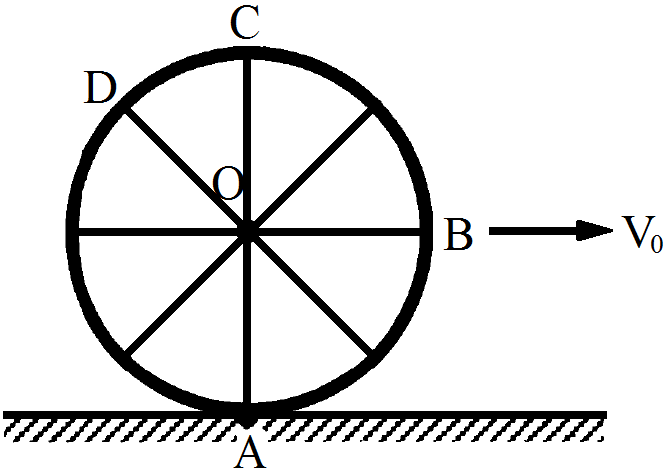
Consider a wheel of a bicycle rolling on a level road at a linear speed $v_0:$
- A
The speed of the particle $A$ is zero.
- B
The speed of $B$ is greater than the speed of $O.$
- C
The speed of $C$ is $2v_0:$
- ✓
AnswerFor pure rolling, $\omega\text{r}=\text{v}_0$
Velocity of the particle at $A, B, C$ and $D$ will be resultant of $v_0:$ and $\omega\text{r}.$
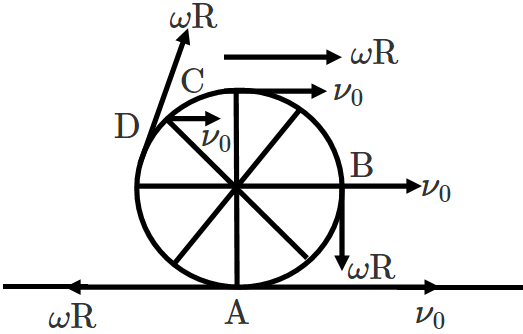
At point $B,$
$\text{v}_{\text{net}}=\sqrt{\text{v}_0^2+(\omega\text{r})^2}$
$\text{v}_{\text{net}}=\sqrt{\text{v}_0^2+\text{v}_0^2}$
$\text{v}_{\text{net}}=\sqrt{2}\text{v}_0$
At Point $C,$
$\text{v}_{\text{net}}=\text{v}_0+(\omega\text{r})$
$\text{v}_{\text{net}}=2\text{v}_0$
At Point $A,$
$\text{v}_{\text{net}}=\text{v}_0-(\omega\text{r})$
$\text{v}_{\text{net}}=0$
At point $O,$
$\text{r}=0$
$\Rightarrow\text{v}_{\text{net}}=\text{v}_0$ View full question & answer→MCQ 31 Mark
A body is uniformly rotating about an axis fixed in an inertial frame of reference. Let $\overrightarrow{\text{A}}$ be a unit vector along the axis of rotation and $\overrightarrow{\text{B}}$ be the unit vector along the resultant force on a particle P of the body away from the axis. The value of $\overrightarrow{\text{A}}.\overrightarrow{\text{B}}$ is:
AnswerThe unit vector along the axis of rotation and the unit vector along the resultant force on the particle are perpendicular to each other in a uniform rotation. Therefore, we have:
$\overrightarrow{\text{A}}.\overrightarrow{\text{B}}=0$
View full question & answer→MCQ 41 Mark
A particle moves on a straight line with a uniform velocity. Its angular momentum:
- A
About any given point remains constant.
- B
Is zero about a point on the straight line.
- C
Is not zero about a point away from the straight line.
- ✓
AnswerAngular momentum $=\text{m}\Big(\overrightarrow{\text{r}}\times\overrightarrow{\text{v}}\Big)$
If the point is on the straight line, $\overrightarrow{\text{r}}$ and $\overrightarrow{\text{v}}$ will have the same direction and their cross product will be zero. Hence, angular momentum is zero.
If the point is not on the straight line, $\overrightarrow{\text{r}}$ and $\overrightarrow{\text{v}}$ will not have the same direction and their cross product will not be zero. Hence, angular momentum is non$-$zero.
No external torque is applied on the body; therefore, its angular momentum about any given point remains constant.
View full question & answer→MCQ 51 Mark
A body having its centre of mass at the origin has three of its particles at $(a, 0,0),(0, a, 0),(0,0, a)$. The moments of inertia of the body about the $X$ and $Y$ axes are $0.20 \mathrm{~kg}-\mathrm{m}^2$ each. The moment of inertia about the $Z-$axis:
- A
Is $0.20 \mathrm{~kg}-\mathrm{m}^2$
- B
Is $0.40 \mathrm{~kg}-\mathrm{m}^2$
- C
Is $0.20 \sqrt{2} \mathrm{~kg}-\mathrm{m}^2$
- ✓
Cannot be deduced with this information.
AnswerCorrect option: D. Cannot be deduced with this information.
$I_x=m_2 a^2+m_3 a^2=0.20 \ldots \text { (i) }$
$I_y=m_1 a^2+m_3 a^2=0.20 \ldots \text { (ii) }$
$I_z=m_1 a^2+m_2 a^2 \ldots \text { (iii) }$
We have three equations and four variables.
So, $\mathrm{I}_{\mathrm{z}}$ cannot be deduced with the given information.
View full question & answer→MCQ 61 Mark
A body is rotating nonuniformity about a vertical axis fixed in an inertial frame. The resultant force on a particle of the body not on the axis is:
- A
- ✓
Horizontal and skew with the axis.
- C
Horizontal and intersecting the axis.
- D
AnswerCorrect option: B. Horizontal and skew with the axis.
The resultant force on a particle of the body rotating non-uniformly is always horizontal and skew with the rotation axis because net torque on the body is non-zero.
View full question & answer→MCQ 71 Mark
A body is in pure rotation. The linear speed $\nu$ of a particle, the distance r of the particle from the axis and the angular velocity $\omega$ of the body are related as $\omega=\frac{\text{v}}{\text{r}}$ Thus:
AnswerCorrect option: D. $\omega$ is independent of r.
In a pure rotation, angular velocity of all the particles remains same and does not depend on the position of the particle from the axis of rotation.
View full question & answer→MCQ 81 Mark
One end of a uniform rod of mass m and length (l) is clamped. The rod lies on a smooth horizontal surface and rotates on it about the clamped end at a uniform angular velocity $\omega.$ The force exerted by the clamp on the rod has a horizontal component:
AnswerCorrect option: D. $\frac{1}{2}\text{m}\omega^2\text{l}$
Consider a small portion of rod at a distance x from the clamped end (as shown in fig.) with width dxand mass dm.
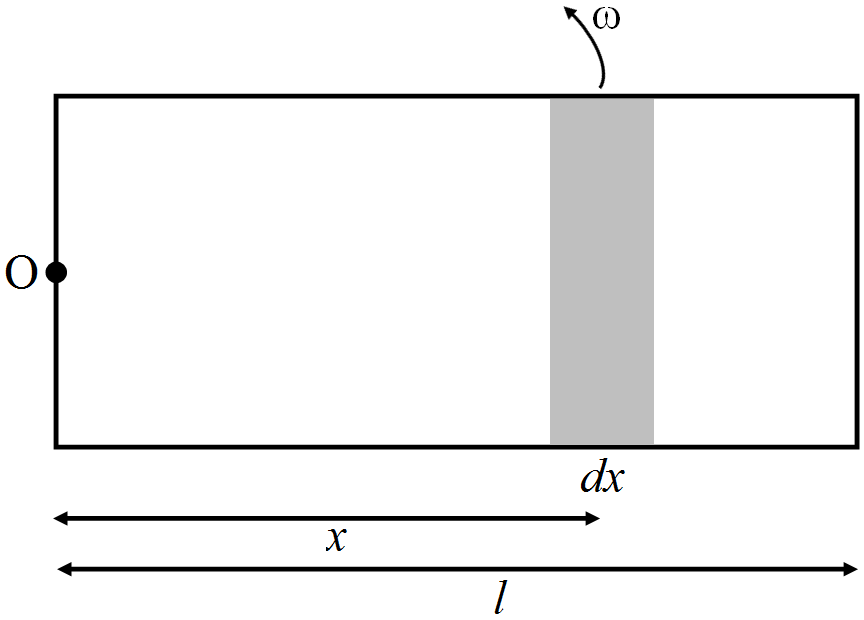
Centripetal force on this portion $=\omega^2\text{xdm}$
$\text{dm}=\Big(\frac{\text{m}}{1}\Big)\text{dx}$
Force on the whole rod $=\text{F}=\int_\limits0^\text{l}\omega^2\text{x}\frac{\text{m}}{\text{l}}\text{dx}$
$\therefore\text{F}=\frac{1}{2}\text{m}\omega^2\text{l}$ View full question & answer→MCQ 91 Mark
Let $\overrightarrow{\text{A}}$ be a unit vector along the axis of rotation of a purely rotating body and $\overrightarrow{\text{B}}$ be a unit vector along the velocity of a particle P of the body away from the axis. The value of $\overrightarrow{\text{A}}.\overrightarrow{\text{B}}$ is:
AnswerFor a purely rotating body, the axis of rotation is always perpendicular to the velocity of the particle. Therefore, we have:
$\overrightarrow{\text{A}}.\overrightarrow{\text{B}}=0$
View full question & answer→MCQ 101 Mark
Consider the following two equations:
$A. \text{L}=\text{I}\omega$
$B. \frac{\text{dL}}{\text{dt}}=\Gamma$
In noninertial frames:
- A
Both $A$ and $B$ are true.
- ✓
$A$ is true but $B$ is false.
- C
$B$ is true but $A$ is false.
- D
Both $A$ and $B$ are false.
AnswerCorrect option: B. $A$ is true but $B$ is false.
In non$-$inertial frames, $\frac{\text{dL}}{\text{dt}}=\Gamma_{\text{Total}}$
Here, $\Gamma_{\text{Total}}$ is the total torque on the system due to all the external forces acting on the system.
So, equation $(B)$ is not true as in non$-$inertial frames, pseudo force must be applied to study the motion of the object.
View full question & answer→MCQ 111 Mark
The density of a rod gradually decreases from one end to the other. It is pivoted at an end so that it can move about a vertical axis through the pivot. A horizontal force F is applied on the free end in a direction perpendicular to the rod. The quantities, that do not depend on which end of the rod is pivoted, are:
- A
- B
Angular velocity when the rod completes one rotation.
- C
Angular momentum when the rod completes one rotation.
- ✓
Torque of the applied force.
AnswerCorrect option: D. Torque of the applied force.
The torque of the applied force does not depend on the density of a rod. It depend on the distance between the pivot and the point where F is applied. So, it does not depend on which end of the rod is pivoted.
View full question & answer→MCQ 121 Mark
A circular disc A of radius r is made from an iron plate of thickness $(t)$ and another circular disc $B$ of radius $4r$ is made from an iron plate of thickness $\frac{\text{t}}{4}.$ The relation between the moments of inertia $I_A$ and $I_B$ is:
- A
$I_A>I_B$
- B
$I_A=I_B$
- ✓
$I_A < I_B$
- D
Depends on the actual values of t and r.
AnswerCorrect option: C. $I_A < I_B$
Moment of inertia of circular disc of radius r:
$\text{l}=\frac{1}{2}\text{mr}^2$
Mass $=$ Volume $\times $ Density
Volume of disc $=\pi\text{r}^2\text{t}$
Here, tis the thickness of the disc.
As density is same for both the rods, we have:
Moment of inertia, $I \propto$ thickness $ \times ($radius$)^4$
$\frac{\text{I}_{\text{A}}}{\text{I}_{\text{B}}}=\frac{\text{t}.(\text{r})^4}{\frac{\text{t}}{4}(\text{4r})^4}<1$
$\Rightarrow\frac{\text{I}_{\text{A}}}{\text{I}_{\text{B}}}<1$
$\Rightarrow\text{I}_{\text{A}}<\text{I}_{\text{B}}$
View full question & answer→MCQ 131 Mark
A sphere cannot roll on:
- A smooth horizontal surface.
- A smooth inclined surface.
- A rough horizontal surface.
- A rough inclined surface.
- A
Only $A$
- B
Only $B$
- ✓
$A$ and $B$
- D
AnswerCorrect option: C. $A$ and $B$
A sphere cannot roll on a smooth inclined surface and on a smooth horizontal surface because there is no backward force $($force of friction$)$ to prevent its slipping.

View full question & answer→MCQ 141 Mark
A hollow sphere and a solid sphere having same mass and same radii are rolled down a rough inclined plane:
- A
The hollow sphere reaches the bottom first.
- ✓
The solid sphere reaches the bottom with greater speed.
- C
The solid sphere reaches the bottom with greater kinetic energy.
- D
The two spheres will reach the bottom with same linear momentum.
AnswerCorrect option: B. The solid sphere reaches the bottom with greater speed.
Acceleration of a sphere on the incline plane is given by:
$\text{a}=\frac{\text{g}\sin\theta}{1+\frac{\text{I}_{\text{COM}}}{\text{mr}^2}}$
$I_{COM}$ for a solid sphere $=\frac{2}{5}\text{mr}^2$
So, $\text{a}=\frac{\text{g}\sin\theta}{1+\frac{2\text{mr}^2}{5\text{mr}^2}}=\frac{5}{7}\text{g}\sin\theta$
$I_{COM}$ for a hollow sphere $=\frac{2}{3}\text{mr}^2$
So, $\text{a}'=\frac{\text{g}\sin\theta}{1+\frac{2\text{mr}^2}{3\text{mr}^2}}=\frac{3}{5}\text{g}\sin\theta$
The acceleration of the solid sphere is greater; therefore, it will reach the bottom with greater speed.
View full question & answer→MCQ 151 Mark
Equal torques act on the discs $A$ and $B$ of the previous problem, initially both being at rest. At a later instant, the linear speeds of a point on the rim of $A$ and another point on the rim of $B$ are $v_A$ and $v_B$ respectively. We have:
- A
$v_A>v_B$
- B
$v_A=v_B$
- ✓
$v_A$
- D
The relation depends on the actual magnitude of the torques.
Answer$\tau=\text{I}\alpha ($Magnitude$)$
For equal torque, we have:
$\text{I}_{\text{A}\propto\text{A}}=\text{I}_{\text{B}\propto\text{B}}$
$\text{I}_{\text{A}}<\text{I}_{\text{B}}$
$\Rightarrow\alpha_{\text{A}}>\alpha_{\text{B}}\ \dots(\text{i})$
Now, $\omega=\alpha\text{t}$
Or, $\frac{\text{v}}{\text{r}}=\alpha\text{t}$
$\text{v}_{\text{A}}>\text{v}_{\text{B}} [$Using $(i)]$
View full question & answer→MCQ 161 Mark
The axis of rotation of a purely rotating body:
- Must pass through the centre of mass.
- May pass through the centre of mass.
- Must pass through a particle of the body.
- May pass through a particle of the body.
- A
$A$ and $B$
- ✓
$B$ and $D$
- C
$A$ and $D$
- D
$A$ and $C$
AnswerCorrect option: B. $B$ and $D$
It is not necessary that the axis of rotation of a purely rotating body should pass through the centre of mass or through a particle of the body. It can also lie outside the body.
View full question & answer→MCQ 171 Mark
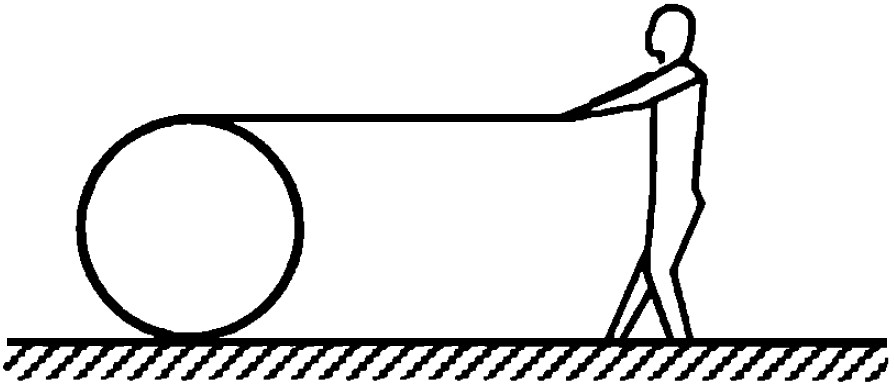
A string of negligible thickness is wrapped several times around a cylinder kept on a rough horizontal surface. A man standing at a distance $1$ from the cylinder holds one end of the string and pulls the cylinder towards him. There is no slipping anywhere. The length of the string passed through the hand of the man while the cylinder reaches his hands is:
AnswerFor pure rolling, $\omega\text{r}=\text{v}_0$
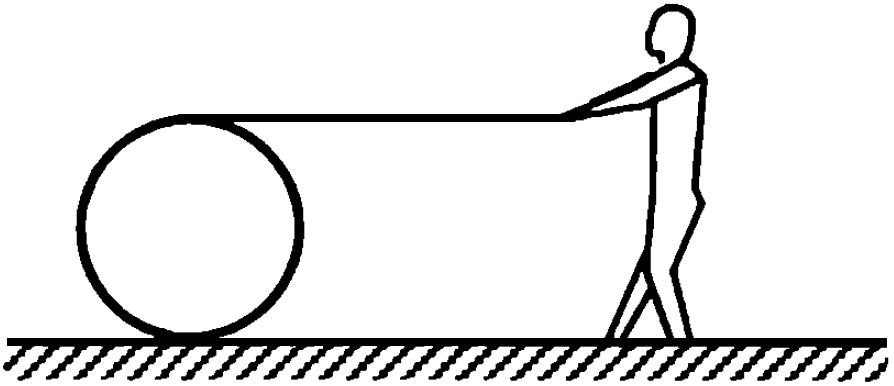
As shown in the figure, the velocity of the string will be resultant of $v_0$ and $\omega\text{r}.$
$\text{v}_{\text{net}}=\text{v}_0+(\omega\text{r})$
$\text{v}_{\text{net}}=2\text{v}_0$
Let:
Linear distance travelled by the cylinder in time $(\text{t}),\ \text{v}_0\text{t}=\text{l}$
$\therefore$ Linear distance travelled by the string in same time, $2\text{v}_0\text{t}=\text{2l}$ View full question & answer→MCQ 181 Mark
If there is no external force acting on a nonrigid body, which of the following quantities must remain constant?
- Angular momentum.
- Linear momentum.
- Kinetic energy.
- Moment of inertia.
- A
$A$ and $B$
- ✓
$A$ and $C$
- C
$B$ and $D$
- D
$C$ and $D$
AnswerCorrect option: B. $A$ and $C$
$\overrightarrow{\text{F}}_{\text{ext}}=0$
$\Rightarrow\overrightarrow{\tau}_{\text{ext}}=0$
That is, the change in linear momentum and angular momentum is zero. This is because:
$\frac{\text{d}\overrightarrow{\text{P}}}{\text{dt}}=\overrightarrow{\text{F}}_{\text{ext}}$
And $\frac{\text{d}\overrightarrow{\text{L}}}{\text{dt}}=\overrightarrow{\tau}_{\text{ext}}$
View full question & answer→MCQ 191 Mark
In the previous question, the smallest kinetic energy at the bottom of the incline will be achieved by:
- A
- ✓
- C
- D
All will achieve same kinetic energy.
AnswerTorque is same for all the bodies; therefore, the angular momentum will be conserved. Now, total kinetic energy $=\frac{1}{2}\text{mv}^2+\frac{\text{L}^2}{\text{2I}}$
So, the body with greater value of moment of inertia will have smallest kinetic energy at the bottom of the incline.
Order of the moment of inertia of the bodies: hollow sphere > disc > solid sphere
Hence, the hollow sphere will have the smallest kinetic energy at the bottom.
View full question & answer→MCQ 201 Mark
A body is rotating uniformly about a vertical axis fixed in an inertial frame. The resultant force on a particle of the body not on the axis is:
- A
- B
Horizontal and skew with the axis.
- ✓
Horizontal and intersecting the axis.
- D
AnswerCorrect option: C. Horizontal and intersecting the axis.
Because resultant force on a particle of the body rotating uniformly is always perpendicular to the rotation axis and pass through it.
View full question & answer→MCQ 211 Mark
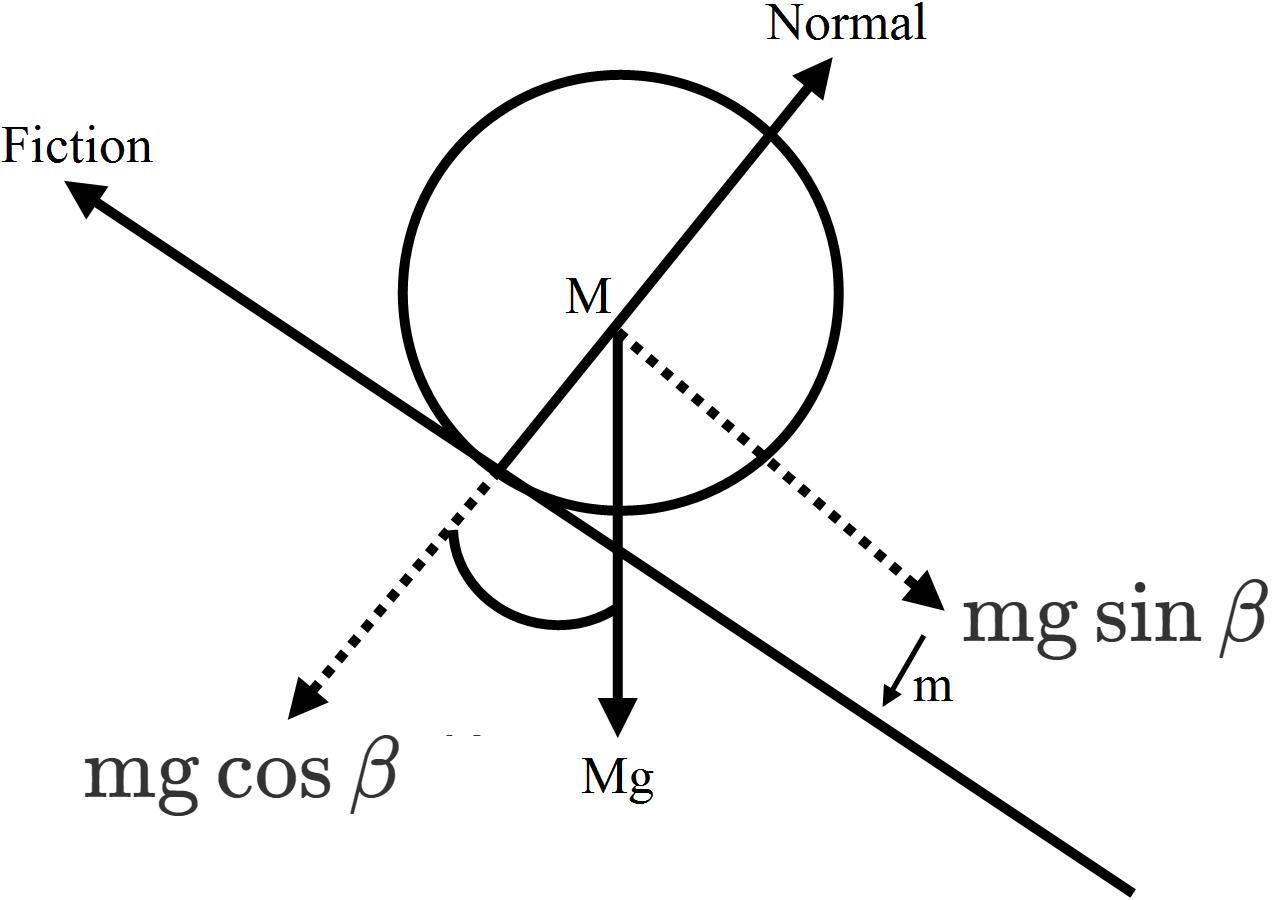
A wheel of radius 20cm is pushed to move it on a rough horizontal surface. It is found to move through a distance of 60cm on they road during the time it completes one revolution about the centre. Assume that the linear and the angular accelerations are uniform. The frictional force acting on the wheel by the surface is:
- ✓
Along the velocity of the wheel.
- B
Opposite to the velocity of the wheel.
- C
Perpendicular to the velocity of the wheel.
- D
AnswerCorrect option: A. Along the velocity of the wheel.
As the distance covered in one revolution about the centre is less than the perimeter of the wheel, it means that the direction of torque due to frictional force opposes the motion of wheel, i.e., the frictional force acting on the wheel by the surface is along the velocity of the wheel.
View full question & answer→MCQ 221 Mark
A solid sphere, a hollow sphere and a disc, all having same mass and radius, are placed at the top of a smooth incline and released. Least time will be taken in reaching the bottom by:
AnswerThe incline is smooth; therefore, all bodies will slip on the incline. Also, as the mass of bodies is same, they will reach the bottom in equal time.
View full question & answer→MCQ 231 Mark
Let $I_A$ and $I_B$ be moments of inertia of a body about two axes $A$ and $B$ respectively. The axis $A$ passes through the centre of mass of the body but $B$ does not:
- A
$\mathrm{I}_{\mathrm{A}}<\mathrm{I}_{\mathrm{B}}$.
- B
If $\mathrm{I}_{\mathrm{A}}<\mathrm{I}_B$, the axes are parallel.
- ✓
If the axes are parallel, $\mathrm{I}_{\mathrm{A}}<\mathrm{I}_{\mathrm{B}}$.
- D
If the axes are not parallel $\mathrm{I}_{\mathrm{A}}>\mathrm{I}_{\mathrm{B}}$.
AnswerCorrect option: C. If the axes are parallel, $\mathrm{I}_{\mathrm{A}}<\mathrm{I}_{\mathrm{B}}$.
If axes $A$ and $B$ are parallel, we get:
$I_B = I_A + mr^2$
Here,$r$ is the distance between two axes and mis the mass of the body.
$\therefore I_A < I_B$
View full question & answer→MCQ 241 Mark
Two uniform solid spheres having unequal masses and unequal radii are released from rest from the same height on a rough incline. If the spheres roll without slipping:
- A
The heavier sphere reaches the bottom first.
- B
The bigger sphere reaches the bottom first.
- ✓
The two spheres reach the bottom together.
- D
The information given is not sufficient to tell which sphere will reach the bottom first.
AnswerCorrect option: C. The two spheres reach the bottom together.
Acceleration of a sphere on the incline plane is given by:
$\text{a}=\frac{\text{g}\sin\theta}{1+\frac{\text{I}_{\text{COM}}}{\text{mr}^2}}$
$\mathrm{I}_{\mathrm{COM}}$ for a solid sphere $=\frac{2}{5}\text{mr}^2$
So, $\text{a}=\frac{\text{g}\sin\theta}{1+\frac{2\text{mr}^2}{5\text{mr}^2}}=\frac{5}{7}\text{g}\sin\theta$
a is independent of mass and radii; therefore, the two spheres reach the bottom together.
View full question & answer→MCQ 251 Mark
A closed cylindrical tube containing some water (not filling the entire tube) lies in a horizontal plane. If the tube is rotated about a perpendicular bisector, the moment of inertia of water about the axis:
- ✓
- B
- C
- D
Increases if the rotation is clockwise and decreases if it is anticlockwise.
AnswerMoment of inertia of a mass is directly proportional to the square of the distance of mass from the axis of rotation.
Therefore, we have:
$\text{I}\propto\text{r}^2$
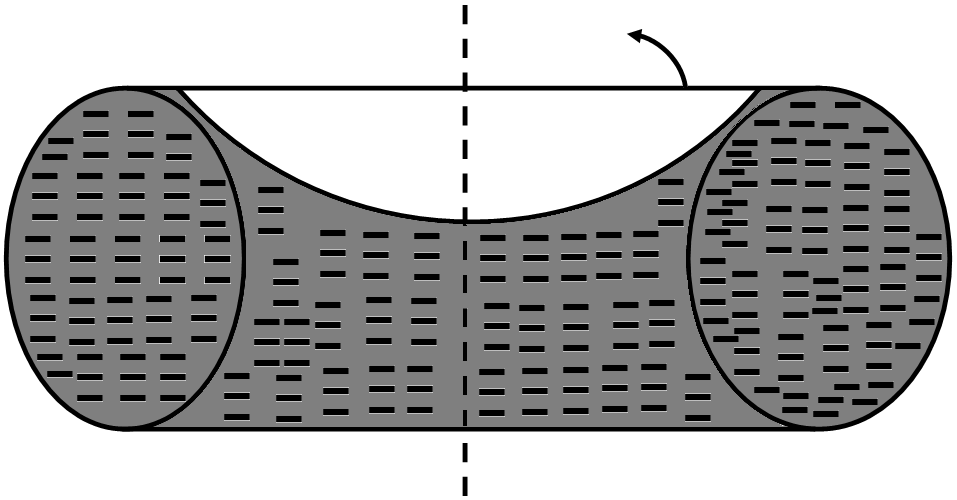
As the tube is rotated, water is collected at the end of tube because of centrifugal force and distance from the rotation axis increases. Hence, moment of inertia increases. View full question & answer→MCQ 261 Mark
A sphere is rolled on a rough horizontal surface. It gradually slows down and stops. The force of friction tries to:
- Decrease the linear velocity.
- Increase the angular velocity.
- Increase the linear momentum.
- Decrease the angular velocity.
- ✓
$A$ and $B$
- B
Only $B$
- C
$B$ and $C$
- D
$A$ and $D$
AnswerCorrect option: A. $A$ and $B$
If a sphere is rolled on a rough horizontal surface, the force of friction tries to oppose the linear motion and favours the angular motion.
View full question & answer→MCQ 271 Mark
Let $\vec{\text{F}}$ be a force acting on a particle having position vector $\vec{\text{r}}.$ Let $\vec{\tau}$ be the torque of this force about the origin, then:
- ✓
$\vec{\text{r}}.\vec{\text{F}}=0$ and $\vec{\text{F}}.\vec{\tau}=0$
- B
$\vec{\text{r}}.\vec{\tau}=0$ but $\vec{\text{F}}.\vec{\tau}\neq0$
- C
$\vec{\text{r}}.\vec{\tau}\neq0$ but $\vec{\text{F}}.\vec{\tau}=0$
- D
$\vec{\text{r}}.\vec{\tau}\neq0$ and $\vec{\text{F}}.\vec{\tau}\neq0$
AnswerCorrect option: A. $\vec{\text{r}}.\vec{\text{F}}=0$ and $\vec{\text{F}}.\vec{\tau}=0$
$\vec{\tau}=\vec{\text{r}}\times\vec{\text{F}}$
Thus, $\vec{\tau}$ is perpendicular to $\vec{\text{r}}$ and $\vec{\text{F}}$
Therefore, we have:
$\vec{\text{r}}.\vec{\tau}=0$ and $\vec{\text{F}}.\vec{\tau}=0$
View full question & answer→MCQ 281 Mark
A person sitting firmly over a rotating stool has his arms stretched. If he folds his arms, his angular momentum about the axis of rotation:
AnswerRate of change of angular momentum of the body is directly proportional to the net external torque acting on the body.
No external torque is applied on the person or on the table; therefore, the angular momentum will be conserved.
View full question & answer→MCQ 291 Mark
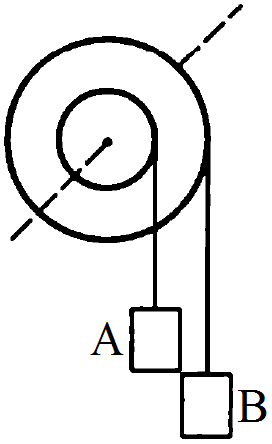
Figure shows a small wheel fixed coaxially on a bigger one of double the radius. The system rotates about the common axis. The strings supporting $A$ and $B$ do not slip on the wheels. If $x$ and $y$ be the distance travelled by $A$ and $B$ in the same time interval, then:
- A
$x = 2y$
- B
$x = y$
- ✓
$y = 2x$
- D
AnswerCorrect option: C. $y = 2x$
It is given that angular velocity is same for both the wheels
Therefore, we have:
$\text{V}_{\text{A}}=\omega\text{R}$
$\text{V}_{\text{B}}=\omega2\text{R}$
$\text{x}=\text{V}_{\text{A}}\text{t}=\omega\text{Rt}\ \dots(\text{i})$
$\text{y}=\text{V}_{\text{B}}=\omega(\text{2R})\text{t}\ \dots(\text{ii})$
From equations $(i)$ and $(ii)$, we get
$\text{y}=\text{2x}$
View full question & answer→MCQ 301 Mark
A sphere can roll on a surface inclined at an angle $\theta$ if the friction coefficient is more than $\frac{2}{7}\text{g}\tan \theta.$ Suppose the friction coefficient is $\frac{1}{7}\text{g}\tan \theta.$ If a sphere is released from rest on the incline:
- A
- B
It will make pure translational motion.
- ✓
It will translate and rotate about the centre.
- D
The angular momentum of the sphere about its centre will remain constant.
AnswerCorrect option: C. It will translate and rotate about the centre.
The given coefficient of friction $\Big(\frac{1}{7}\text{g}\tan\theta\Big)$ is less than the coefficient friction $\Big(\frac{2}{7}\text{g}\tan\theta\Big)$ required for perfect rolling of the sphere on the inclined plane. Therefore, sphere may slip while rolling and it will translate and rotate about the centre.
View full question & answer→MCQ 311 Mark
A particle moves with a constant velocity parallel to the X-axis. Its angular momentum with respect to the origin:
AnswerFor angular momentum. we have:
$\overrightarrow{\text{L}}=\text{m}\Big(\overrightarrow{\text{r}}\times\overrightarrow{\text{v}}\Big)$
$\overrightarrow{\text{v}}=\text{v}\hat{\text{i}}$ and $\overrightarrow{\text{r}}=\text{x}\hat{\text{i}}+\text{y}\hat{\text{j}}$
So, $\overrightarrow{\text{L}}=-\text{mvy}\hat{\text{k}}$
m, v and y are constant; therefore, angular momentum remains constant.
View full question & answer→MCQ 321 Mark
Let $\mathrm{l}_1$ and $\mathrm{l}_2$ be the moments of inertia of two bodies of identical geometrical shape, the first made of aluminium and the second of iron.
- ✓
$I_1$
- B
$\mathrm{I}_1=\mathrm{I}_2$
- C
$\mathrm{I}_1<\mathrm{I}_2$
- D
Relation between $\mathrm{I}_1$ and $\mathrm{I}_2$ depends on the actual shapes of the bodies.
AnswerIn the given case, we have:
$\text{MOI} \propto$ Density
The density of Iron Is more; therefore, $\mathrm{I}_2$ will be greater.
View full question & answer→MCQ 331 Mark
A sphere is rotating about a diameter:
- A
The particles on the surface of the sphere do not have any linear acceleration.
- ✓
The particles on the diameter mentioned above do not have any linear acceleration.
- C
Different particles on the surface have different angular speeds.
- D
All the particles on the surface have same linear speed.
AnswerCorrect option: B. The particles on the diameter mentioned above do not have any linear acceleration.
Linear acceleration of a rotating particle is given as:
$\overrightarrow{\text{a}}=\overrightarrow{\text{r}}\times\overrightarrow{\alpha}$
(b) The sphere is rotating about a diameter; therefore, the position vector of the particles on the diameter is zero. Thus, linear acceleration of the particle is zero.
(c) and (d): All the particles of the body have the same angular velocity. All the particle on the surface have different linear speeds that depend on the position of the particle from the axis of rotation.
View full question & answer→MCQ 341 Mark
A solid sphere, a hollow sphere and a disc, all having same mass and radius, are placed at the top of an incline and released. The friction coefficients between the objects and the incline are same and not sufficient to allow pure rolling. Least time will be taken in reaching the bottom by:
AnswerLet $\theta$ be the inclination angle.
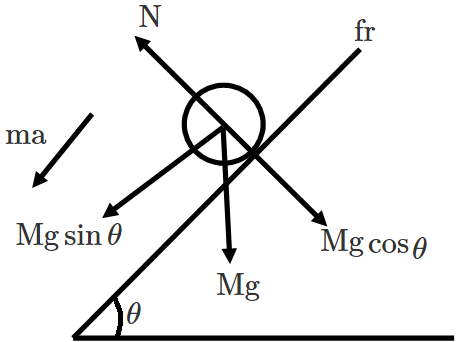
From the free body diagram, we have:
$\text{N}=\text{mg}\cos\theta\ \dots(\text{i})$
$\text{ma}=\text{mg}\sin\theta-\text{f}_{\text{r}}\ \dots(\text{ii})$
Putting $\text{f}_{\text{r}}=\mu\text{N}$ in (ii) we get,
$\text{a}=\text{g}(\sin\theta-\mu\cos\theta)$
The friction coefficients between the objects and the incline are same and not sufficient to allow pure rolling; therefore, all the bodies come down with the same acceleration. View full question & answer→MCQ 351 Mark
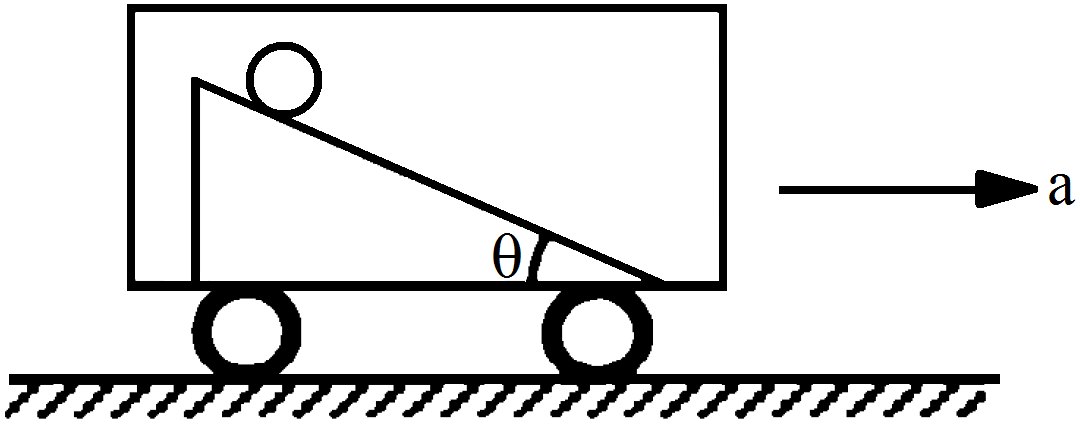
Figure shows a smooth inclined plane fixed in a car accelerating on a horizontal road. The angle of incline 0 is related to the acceleration a of the car as a = g tan°. If the sphere is set in pure rolling on the incline:
- ✓
It will continue pure rolling.
- B
It will slip down the plane.
- C
Its linear velocity will increase.
- D
Its linear velocity will slowly decrease.
AnswerCorrect option: A. It will continue pure rolling.
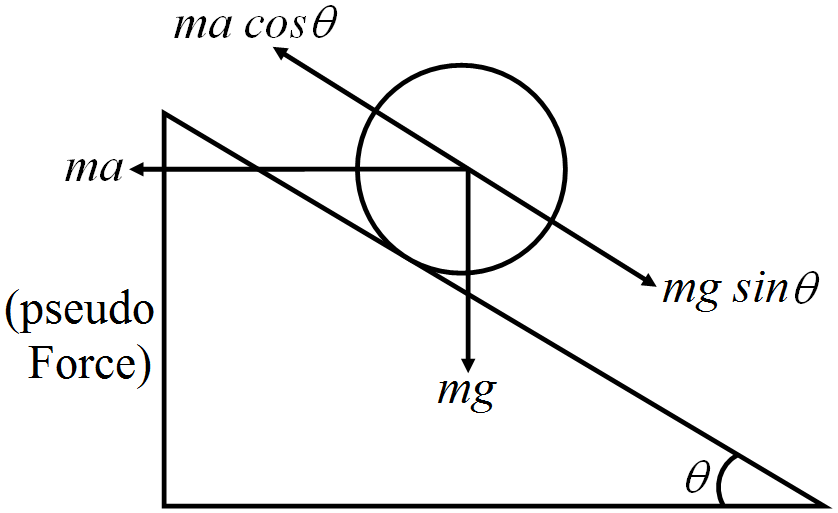
From the free body diagram of sphere, we have:
Net force on the sphere along the incline,
$\text{F}_{\text{net}}=\text{mg}\sin\theta-\text{ma}\cos\theta\ \dots(\text{i})$
On putting $\text{a}=\text{g}\tan\theta$ in equation (i), we get:
$\text{F}_{\text{net}}=0$
Therefore, if the sphere is set in pure rolling on the incline, it will continue pure rolling. View full question & answer→MCQ 361 Mark
A cubical block of mass M and edge a slides down a rough inclined plane of inclination $\theta$ with a uniform velocity. The torque of the normal force on the block about its centre has a magnitude:
AnswerCorrect option: D. $\frac{1}{2}\text{Mga}\sin\theta$
Let N be the normal reaction on the block.
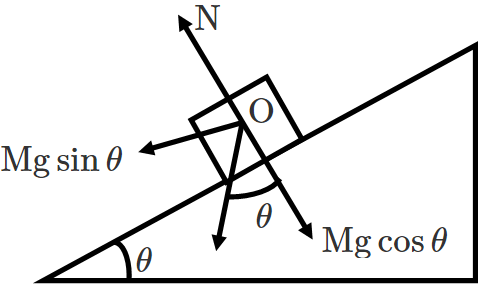
From the free body diagram of the block. it is clear that the forces N and $\text{mg}\cos\theta$ pass through the same line. Therefore, there will be no torque due to N and $\text{mg}\cos\theta.$ The only torque will be produced by $\text{mg}\sin\theta.$
$\therefore\vec{\tau}=\vec{\text{F}}\times\vec{\text{r}}$
Since a is the edge of the cube, $\text{r}=\frac{\text{a}}{2}.$
Thus, we have:
$\tau=\text{mg}\sin\theta\times\frac{\text{a}}2{}$
$=\frac{1}{2}\text{mga}\sin\theta$ View full question & answer→MCQ 371 Mark
In rear-wheel drive cars, the engine rotates the rear wheels and the front wheels rotate only because the car moves. If such a car accelerates on a horizontal road, the friction:
- On the rear wheels is in the forward direction.
- On the front wheels is in the backward direction.
- On the rear wheels has larger magnitude than the friction on the front wheels.
- On the car is in the backward direction.
- A
Only $a$
- B
$a$ and $b$
- C
$a$ and $c$
- ✓
$a,b$ and $c$
AnswerCorrect option: D. $a,b$ and $c$
- On the rear wheels, friction force is in the forward direction because it favours the motion and accelerates the car in forward direction.
- Because of the movement of the car in forward direction, front wheels push the road in forward direction and in reaction, the road applies friction force in the backward direction.
- As the car is moving in forward direction, the rear wheels have larger magnitude of friction force $($in forward direction$)$ than on the front wheels.
View full question & answer→MCQ 381 Mark
A thin circular ring of mass M and radius r is rotating about its axis with an angular speed $\omega.$ Two particles having mass m each are now attached at diametrically opposite points. The angular speed of the ring will become:
- A
$\frac{\omega\text{M}}{\text{M}+\text{m}}$
- ✓
$\frac{\omega\text{M}}{\text{M}+\text{2m}}$
- C
$\frac{\omega(\text{M}-\text{2m})}{\text{M}+\text{2m}}$
- D
$\frac{\omega(\text{M}+\text{2m})}{\text{M}}$
AnswerCorrect option: B. $\frac{\omega\text{M}}{\text{M}+\text{2m}}$
No external torque is applied on the ring; therefore, the angular momentum will be conserved.
$\text{I}\omega=\text{I}'\omega'$
$\Rightarrow\omega'=\frac{\text{I}\omega}{\Gamma}\ \dots(\text{i})$
$\text{I}=\text{Mr}^2$
$\text{I}'=\text{Mr}^2+\text{2mr}^2$
On putting these values in equation (i), we get:
$\omega'=\frac{\omega\text{M}}{\text{M}+\text{2m}}$
View full question & answer→MCQ 391 Mark
The centre of a wheel rolling on a plane surface moves with a speed $\text{v}_0$. A particle on the rim of the wheel at the same level as the centre will be moving at speed:
- A
$\text{Zero.}$
- B
$\text{v}_0$
- ✓
$\sqrt2\text{v}_0$
- D
$2\text{v}_0$
AnswerCorrect option: C. $\sqrt2\text{v}_0$
For pure rolling, $\omega\text{r}=\text{v}_0$
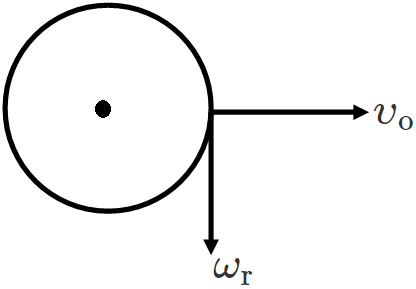
As shown in the figure, the velocity of the particle will be the resultant of $\text{v}_0$ and $\omega\text{r}.$ Therefore, we have:
$\text{v}_{\text{net}}=\sqrt{\text{v}_0^2+(\omega\text{r})^2}$
$\text{v}_{\text{net}}=\sqrt{\text{v}_0^2+\text{v}_0^2}$
$\text{v}_{\text{net}}=\sqrt2\text{v}_0$ View full question & answer→MCQ 401 Mark
A uniform rod is kept vertically on a horizontal smooth surface at a point O. If it is rotated slightly and released, it falls down on the horizontal surface. The lower end will remain:
- A
- B
At a distance less than $\frac{\text{l}}2{}$ from O.
- ✓
At a distance $\frac{\text{l}}2{}$ from O.
- D
At a distance larger than $\frac{\text{l}}2{}$ from O.
AnswerCorrect option: C. At a distance $\frac{\text{l}}2{}$ from O.
It is given that there is no force along x-axis.
COM of rod will remain and will not shift along x-axis (horizontal direction).
Force gravity is acting along y-axis (vertical direction). So, COM will shift along the y-axis by $\frac{\text{l}}2{}$ distance and COM of horizontal rod is at a distance $\frac{\text{l}}2{}$ from one end.
Therefore, lower end of the rod will remain at a distance $\frac{\text{l}}2{}$ from O.
View full question & answer→MCQ 411 Mark
The moment of inertia of a uniform semicircular wire of mass M and radius r about a line perpendicular to the plane of the wire through the centre is:
- ✓
$\text{Mr}^2$
- B
$\frac{1}{2}\text{Mr}^2$
- C
$\frac{1}4{}\text{Mr}^2$
- D
$\frac{2}{5}\text{Mr}^2$
AnswerCorrect option: A. $\text{Mr}^2$
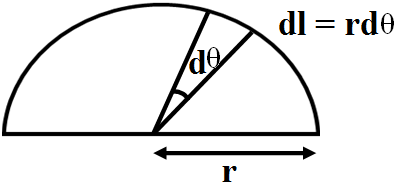
Consider an element of length, $\text{dl}=\text{rd}\theta$
$\text{dm}=\frac{\text{M}}{\pi\text{r}}\text{dl}=\frac{\text{M}}{\pi\text{r}}\text{r}\text{d}\theta$
MOI of semicircular wire $=\int_0^{\pi}\text{r}^2\text{dm}$
$\text{I}=\int_{\pi}^0\text{r}^2\frac{\text{m}}{\pi\text{r}}\text{r}\text{d}\theta$
$\Rightarrow\text{I}=\text{mr}^2$
View full question & answer→