Questions · Page 2 of 2

M.C.Q (1 Marks)

MCQ 511 Mark
For isothermal expansion of an ideal gas:
  • A
    $\Delta\text{U}=+\text{ve}$
  • B
    $\Delta\text{Q}=+\text{ve}$
  • C
    $\Delta\text{W}=+\text{ve}$
  • Both $(b)$ and $(c).$
Answer
Correct option: D.
Both $(b)$ and $(c).$
For isothermal expansion,
$\Delta\text{U}=0$
$\Rightarrow\Delta\text{U}=\Delta\text{W}$
Here, $\Delta\text{W}\rightarrow+\text{ve}$
$\Rightarrow\Delta\text{Q}\rightarrow+\text{ve}$
View full question & answer
MCQ 521 Mark
Mechanical equivalent of heat is equal to the amount of:
  • A
    Work done to produce $1 \text{cal}$ heat.
  • B
    A conversion factor between calorie and joule.
  • Both $(a)$ and $(b).$
  • D
    Neither $(a)$ nor $(b).$
Answer
Correct option: C.
Both $(a)$ and $(b).$
View full question & answer
MCQ 531 Mark
Efficiency $(\eta)$ of the heat engine in thermodynamics can be defined as:
  • A
    $\eta=\frac{\text{W}}{\text{Q}_2}$
  • B
    $\eta=1-\frac{\text{Q}_1}{\text{Q}_2}$
  • $\eta=\frac{\text{W}}{\text{Q}_1}$
  • D
    None of these.
Answer
Correct option: C.
$\eta=\frac{\text{W}}{\text{Q}_1}$
For heat engine, $Q_1 = W + Q_2$
$\Rightarrow W = Q_1 - Q_2$
$Q_2$ is heat rejected to the environment.
So, $\eta=\frac{\text{Q}_1-\text{Q}_2}{\text{Q}_1}=\frac{\text{W}}{\text{Q}_1}$
View full question & answer
MCQ 541 Mark
For Carnot engine, which process should be chosen to take the working substance from $T_1$ to $T_2$ or vice$-$versa?
  • A
    Isochoric.
  • B
    Isothermal.
  • Adiabatic.
  • D
    Isobaric.
Answer
Correct option: C.
Adiabatic.
View full question & answer
MCQ 551 Mark
For a gas, $\gamma=1.4.$ Then Atomicity, $C_P$ and $C_V$ of the gas are:
  • A
    Monoatomic, $\frac52\text{R},\frac32\text{R}$
  • B
    Monoatomic, $\frac72\text{R},\frac52\text{R}$
  • Diatomic, $\frac{7}{2}\text{R},\frac52\text{R}$
  • D
    Triatomic, $\frac72\text{R},\frac52\text{R}$
Answer
Correct option: C.
Diatomic, $\frac{7}{2}\text{R},\frac52\text{R}$
From $\gamma=\Big(1+\frac2{\text{n}}\Big)=1.4$
We get $n = 5,$ which is the number of degrees of freedom of a diatomic gas.
$\text{C}_\text{v}=\frac{\text{n}}{2}\text{R}=\frac{5}{2}\text{R}$
$\text{C}_\text{P}=\Big(\frac{\text{n}}{2}+1\Big)\text{R}=\frac{7}{2}\text{R}$
View full question & answer
MCQ 561 Mark
Efficiency of engine is $\eta_1$ at $T_1 = 200^\circ C$ and $T_2 = 0^\circ C$ and $\eta_2$ at $T_1 = 0^\circ C$ and $T_2 = 200^\circ K.$ Find the ratio of $\frac{\eta_1}{\eta_2}.$
  • A
    $1.00$
  • B
    $0.721$
  • $0.577$
  • D
    $0.34$
Answer
Correct option: C.
$0.577$
$\eta_1=1-\frac{273+0}{200+273}=\frac{200}{473}$
$\eta_2=1-\frac{-200+273}{0+27 3}=\frac{200}{273}$
$\frac{\eta_1}{\eta_2\text{}}=\frac{200}{473}\times\frac{273 }{200}=\frac{273}{473}=0.577$
View full question & answer
MCQ 571 Mark
Choose the correct option:
  • A
    Zeroth law gives the concept of temperature.
  • B
    Temperature measures the 'hotness' of the body.
  • C
    Heat flows from higher temperature to lower temperature until thermal equilibrium is attained.
  • All of the above.
Answer
Correct option: D.
All of the above.

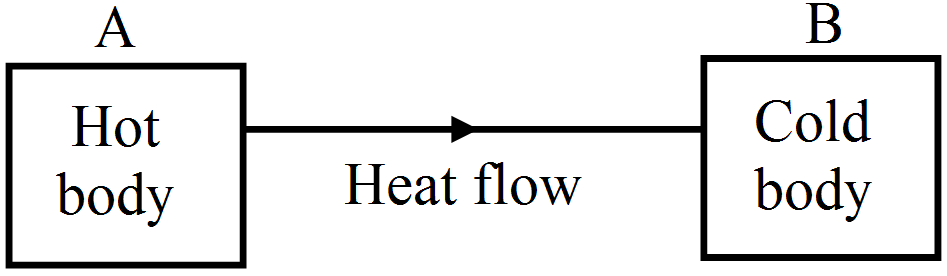
Heat flows from body $A$ to body $B$ because temperature of body $A$ is higher. At thermal equilibrium, $\text{T}_\text{A}'=\text{T}_\text{B}'$
$A$ in equilibrium with $C$ $A$ in equilibrium with $B$
$B$ in equilibrium with $C$
View full question & answer
MCQ 581 Mark
For a gas, $y = 1.4$ then atomicity, $C_p$ and $C_v$ of the gas are:
  • A
    Monoatomic $\frac52\text{R},\frac32\text{R}$
  • B
    Monoatomic $\frac72\text{R},\frac52\text{R}$
  • Diatomic $\frac72\text{R},\frac52\text{R}$
  • D
    Triatomic $\frac72\text{R},\frac52\text{R}$
Answer
Correct option: C.
Diatomic $\frac72\text{R},\frac52\text{R}$
View full question & answer
MCQ 591 Mark
If $150J$ of heat is added to a system and the work done by the system is $110J,$ then change in internal energy will be:
  • $40J.$
  • B
    $110J.$
  • C
    $150J.$
  • D
    $260J.$
Answer
Correct option: A.
$40J.$
View full question & answer
MCQ 601 Mark
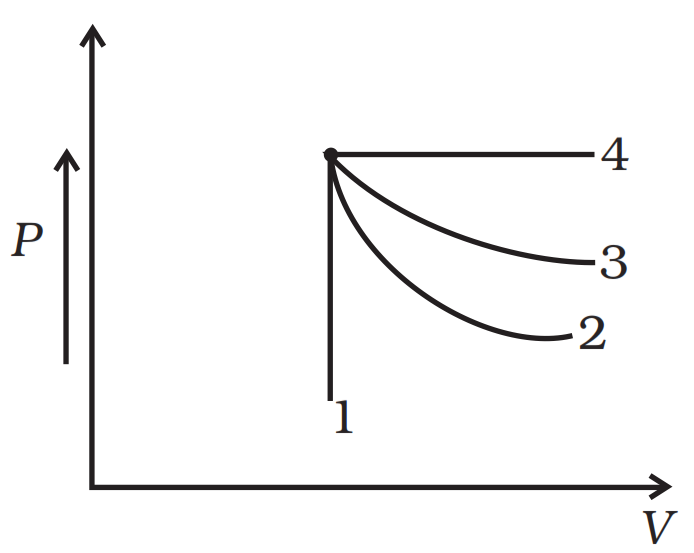
An ideal gas undergoes four different processes from thesame initial state $($Fig.$)$. Four processes are adiabatic, isothermal, isobaric and isochoric. Out of $1, 2, 3$ and $4$ whichone is adiabatic.
  • A
    $4$
  • B
    $3$
  • $2$
  • D
    $1$
Answer
Correct option: C.
$2$
$4$ is isobaric process, $1$ is isochoric. out of $3$ and $2, 3$ has the smaller slope $($magnitude$)$ hence is isothermal. Remaining process $2$ is adiabatic.
View full question & answer
MCQ 611 Mark
A mixture of gases undergoing explosive chemical reaction:
  • A
    Is not in equilibrium state during explosion.
  • B
    May have variable temperature and pressure values during explosion.
  • C
    Finally the gas will attained equilibrium state with its surroundings.
  • All of the above.
Answer
Correct option: D.
All of the above.
View full question & answer
MCQ 621 Mark
The efficiency of a Carnot's engine working between steam point and ice point is:
  • $26.81\%$
  • B
    $29\%$
  • C
    $30\%$
  • D
    $10\%$
Answer
Correct option: A.
$26.81\%$
$T_1 = (100 + 273) = 373K$
$T_2 = (0 + 273) = 273K$
Efficiency $(\eta)=1-\frac{\text{T}_2}{\text{T}_1}$
$=1-\frac{273}{373}=\frac{100}{373}$
$\%\eta=\frac{100}{373}\times100$
$=26.81\%$
View full question & answer
MCQ 631 Mark
The given quantity of an ideal gas is at pressure $P$ and absolute Temperature $T.$ The isothermal bulk Modulus of the gas is:
  • A
    $\frac{2}{4}\text{R}$
  • $\text{P}$
  • C
    $\frac32\text{P}$
  • D
    $2\text{P}$
Answer
Correct option: B.
$\text{P}$
View full question & answer
MCQ 641 Mark
A given quantity of an ideal gas is at pressure $P$ and absolute temperature $T.$ The isothermal bulk modulus of the gas is:
  • A
    $\frac23\text{P}$
  • $\text{P}$
  • C
    $\frac23\text{P}$
  • D
    $\text{2P}$
Answer
Correct option: B.
$\text{P}$
$K_i = P =$ the pressure exerted by the gas.
View full question & answer
MCQ 651 Mark
Three copper blocks of masses $M_1, M_2$ and $M_3\ kg$ respectively are brought into thermal contact till they reach equilibrium. Before contact, they were at $T_1, T_2, T_3 (T_1 > T_2 > T_3).$ Assuming there is no heat loss to the surroundings, the equilibrium temprature $T$ is $(s$ is specific heat of copper$)$
  • A
    $\text{T}=\frac{\text{T}_{1}+\text{T}_{2}+\text{T}_{3}}{3}$
  • $\text{T}=\frac{\text{M}_{1}\text{T}_{1}+\text{M}_{2}\text{T}_{2}+\text{M}_{3}\text{T}_{3}}{\text{M}_{1}+\text{M}_{2}+\text{M}_{3}}$
  • C
    $\text{T}=\frac{\text{M}_{1}\text{T}_{1}+\text{M}_{2}\text{T}_{2}+\text{M}_{3}\text{T}_{3}}{3(\text{M}_{1}+\text{M}_{2}+\text{M}_{3})}$
  • D
    $\text{T}=\frac{\text{M}_{1}\text{T}_{1}\text{S}+\text{M}_{2}\text{T}_{2}\text{S}+\text{M}_{3}\text{T}_{3}\text{S}}{\text{M}_{1}+\text{M}_{2}+\text{M}_{3}}$
Answer
Correct option: B.
$\text{T}=\frac{\text{M}_{1}\text{T}_{1}+\text{M}_{2}\text{T}_{2}+\text{M}_{3}\text{T}_{3}}{\text{M}_{1}+\text{M}_{2}+\text{M}_{3}}$
Let the equilibrium tempreature of the system $= T$
Let $\text{T}_{1}\text{T}_{2}<\text{T}<\text{T}_{3}$
As there is no loss to the surrounding.
Heat lost by $\text{M}_{3}=$ Heat gain by $\text{M}_{1}+$ Heat gain by $\text{M}_{2}$
$\text{M}_{3}\text{s}(\text{T}_{3}-\text{T})=\text{M}_{1}\text{s}(\text{T}-\text{T}_{1})+\text{M}_{2}\text{s}(\text{T}-\text{T}_{2})$
$\text{M}_{3}\text{s}\text{T}_{3}-\text{M}_{3}\text{s}\text{T}=\text{M}_{1}\text{s}\text{T}=\text{M}_{1}\text{s}\text{T}-\text{M}_{1}\text{s}\text{T}_{1}+\text{M}_{2}\text{s}\text{T}-\text{M}_{2}\text{s}\text{T}_{2}$
$\text{T}(\text{M}_{3}+\text{M}_{1}+\text{M}_{2})=[\text{M}_{3}\text{T}_{3}+\text{M}_{1}\text{T}_{1}+\text{M}_{2}\text{T}_{2}]$
$\text{T}=\frac{\text{M}_{1}\text{T}_{1}+\text{M}_{2}\text{T}_{2}+\text{M}_{3}\text{T}_{3}}{\text{M}_{1}+\text{M}_{2}+\text{M}_{3}}$
Hence verifies option $(b).$
View full question & answer
MCQ 661 Mark
According to first law of thermodynamics,
  • A
    Heat neither enters nor leaves the system.
  • B
    Heat is constant in isothermal system.
  • Energy is conserved.
  • D
    None of these.
Answer
Correct option: C.
Energy is conserved.
First law of ther modynamics is the principle of conservation of energy.
View full question & answer
MCQ 671 Mark
An engine has an efficiency of $\frac16$ when the temperature of sink is reduced by $62^\circ C,$ its efficiency is doubled, temperature of the source is:
  • A
    $37^\circ C.$
  • B
    $62^\circ C.$
  • $99^\circ C.$
  • D
    $124^\circ C.$
Answer
Correct option: C.
$99^\circ C.$
View full question & answer
MCQ 681 Mark
The internal energy of an ideal gas depends on:
  • A
    Pressure.
  • B
    Volume.
  • Temperature.
  • D
    Size of molecules.
Answer
Correct option: C.
Temperature.
View full question & answer
MCQ 691 Mark
$(\Delta\text{Q}-\Delta\text{W})$ is:
  • A
    Path dependent.
  • B
    Path independent.
  • C
    Equal to $\Delta\text{U}.$
  • Both $(b)$ and $(c).$
Answer
Correct option: D.
Both $(b)$ and $(c).$
View full question & answer
M.C.Q (1 Marks) - Page 2 - Physics STD 11 Science Questions - Vidyadip