MCQ 1511 Mark
A girl weighing $50\ kg$ makes a high jump of $1.2m.$ What is her kinetic energy at the highest point? $(g = 10\ ms^{-2}$)
Answermass of girl $M = 50\ kg$
$h = 1. 2m$
A girl is jumping vertically upward, when it will reach at maximum Hight its velocity will become zero
i.e $in_f\ K.$
And $=\frac{1}{2}\text{min}^2=\frac{1}{2}\text{m}\times0=0$
View full question & answer→MCQ 1521 Mark
A rain drop of mass $\big(\frac{1}{10}\big)$ gram falls vertically at constant speed under the influence of the forces of gravity and viscous drag. In falling through $100m,$ the work done by gravity is:
- A
$0.98J$
- ✓
$0.098J$
- C
$9.8J$
- D
$98J$
AnswerCorrect option: B. $0.098J$
work done $= mgh$
$m =$ mass of drop $= 0.1g = 0.00001\ kg$
$g = 9.8m/ s$
$h = 100m$
work done $= 0.00001 \times 9.8 \times 10$
$= 0.098 J$
View full question & answer→MCQ 1531 Mark
A bullet of mass m fired at $30^\circ$ to the horizontal leaves the barrel of the gun with a velocity $v.$ The bullet hits a soft target at a height h above the ground while it is moving downward and emerges out with half the kinetic energy it had before hitting the target. Which of the following statements are correct in respect of bullet after it emerges out of the target?
- A
The velocity of the bullet will be more than half of its earlier velocity.
- B
The bullet will continue to move along the same parabolic path.
- C
The internal energy of the particles of the target will increase.The internal energy of the particles of the target will increase.
- ✓
Answer
$-$Let $\ce{KE_2, KE_1}$ are the kinetic energy of bullet before and after hitting and targrt,
$1\text{KE}_2=\frac{1}{2}\text{KE}_1$
$\frac{1}{2}\text{mv}^2_2=\frac{1}{2}\cdot\frac{1}{2}\text{mv}^2_1$
$\text{v}^2_2=\frac{1}{2}\text{v}^2_1=\Big(\frac{\text{v}_1}{\sqrt{2}}\Big)^2$
$=\Big(\frac{\text{v}_1\sqrt{2}}{2}\Big)^2=(0.707\text{v}_1)^2$
$-v_2= 0.707v_1$. Hence, the velocity of bullet after target is not reduce to half. If rejects option $(a).$
$-v_2= 0.707v_1$. So velocity of bullet after target is more than half of its earlier velocity verifies option $(b).$
$-$Bullet has horizontal velocity so its path will be parabolic but with new parabola as both components vx and vy changes after emerging out from target. So rejects the option $(c).$
$-$As above discussed path of bullet after target will be of new parabola, verifies the option $(c).$
$-$As bullet has horizontal and vertical components so has new parabola of range smaller than previous. So rejects the option $(c).$
$-$As some parts of kinetic energy of bullet converted into heat so internal energy target increased. Verifies option $(c).$
View full question & answer→MCQ 1541 Mark
In daily life, intake of a human adult is $10^7J,$ then average human consumption in a day is:
- ✓
$2400\ kcal.$
- B
$1000\ kcal.$
- C
$1200\ kcal.$
- D
$700\ kcal.$
AnswerCorrect option: A. $2400\ kcal.$
View full question & answer→MCQ 1551 Mark
A certain force acting on a body of mass $2\ kg$ increase its velocity from $6\ m/ s$ to $15\ m/ s$ in $2s.$ The work done by the force during this interval is ?
- A
$27J$
- B
$3J$
- C
$94.5J$
- ✓
$189J$
AnswerCorrect option: D. $189J$
$v = u + at$
$15 = 6 + a(2)$
$a = 4.5\ m/ s^2$
$s = ut + 0.5at^2$
$= 6(2) + 0.5(4.5)(4)$
$= 21m$
$W = mas = 2(4.5)(21) = 189J$
View full question & answer→MCQ 1561 Mark
Two masses of $1gm$ and of $4gm$ are moving with equal linear momenta. The ratio of their kinetic energies is:
- ✓
$4 : 1$
- B
$\sqrt{2}:1$
- C
$1 : 2$
- D
$1 : 16$
AnswerCorrect option: A. $4 : 1$
View full question & answer→MCQ 1571 Mark
A car of mass $400\ kg$ travelling at $72\ \ce{kmph}$ crashes a truck of mass $4000\ kg$ and travelling at $9\ \ce{kmph}$ in the same direction. The car bounces back with a speed of $18\ \ce{kmph.}$ The speed of the truck after the impact is
- A
$9\ \ce{kmph}$
- ✓
$18\ \ce{kmph}$
- C
$27\ \ce{kmph}$
- D
$36\ \ce{kmph}$
AnswerCorrect option: B. $18\ \ce{kmph}$
$\ce{m_{car}u_{car} + m_{truck}u_{truck}}$
$\ce{= m_{car}+v_{car} + m_{truck}v_{truck}}$
$= 400 \times 72 + 4000 \times 9$
$= −18 \times 400 + 4000 \times v$
$v = 18\ \ce{kmph}$
View full question & answer→MCQ 1581 Mark
The spring of the winding knob of a watch has:
- A
- B
- ✓
- D
Kinetic or potential energy.
AnswerWe know that total energy is kinetic energy plus potential energy.
Now, kinetic energy is,
And $=\frac{1}{2}\text{Min}^2$
Which depends on velocity.
In watch there is no displacement in the knob, hence velocity is zero.
So there is no kinetic energy.
Only potential energy is there.
View full question & answer→MCQ 1591 Mark
What will be the potential energy of a body of mass $5\ kg$ kept at a height of $10m ?$
- A
$50J$
- B
$0.5J$
- ✓
$500J$
- D
$25J$
AnswerCorrect option: C. $500J$
Potential energy is energy stored in an object.
This energy has the potential to do work.
Gravity gives potential energy to an object.
This potential energy is a result of gravity pulling downwards.
The gravitational constant, $g,$ is the acceleration of an object due to gravity.
This acceleration is about $10$ meters per second on earth.
The formula for potential energy due to gravity is $\ce{PE = mgh.}$
As the object gets closer to the ground, its potential energy decreases while its kinetic energy increases.
View full question & answer→MCQ 1601 Mark
Potential energy of a person is minimum when:
- A
- B
Person is sitting on a chair.
- C
Person is sitting on the ground.
- ✓
Person is lying on the ground.
AnswerCorrect option: D. Person is lying on the ground.
Potential energy of a body is defined as energy of a body due to its position in gravitational field.
In general, Potential energy $= M \times g \times h$
where: $h$ is the height above ground.
If the person will be lying on ground then it will have minimum height above the ground therefore potential energy of the person will also be minimum.
View full question & answer→MCQ 1611 Mark
A particle is tied to one end of a light inextensible string and is moved in a vertical circle, the other end of the string is fixed at the centre. Then for a complete motion in a circle, which is correct.
$($air resistance is negligible$).$
- A
Acceleration of the particle is directed towards the centre.
- ✓
Total mechanical energy of the particle and earth remains constant.
- C
Tension in the string remains constant.
- D
Acceleration of the particle remains constant.
AnswerCorrect option: B. Total mechanical energy of the particle and earth remains constant.
At any time force acting on particle vary and hence acceleration $($net$)$ will have different direction at different times.
Tension also changes and its minimum at top point. Magnitude of acceleration also varies.
Considering earth and particle as a system and no external force on system is acting, total mechanical energy will be conserved.
View full question & answer→MCQ 1621 Mark
The form of energy present in a wound spring is:
AnswerPotential energy is stored in a wound spring. Potential energy is a type of mechanical energy. Hence, energy present in a wound spring is mechanical energy.
View full question & answer→MCQ 1631 Mark
The power $(P)$ of an engine lifting a mass of $100\ kg$ upto a height of $10m$ in $1 \ce{min}$ is:
- A
$162.3W$
- ✓
$163.3W$
- C
$164.3W$
- D
$165W$
AnswerCorrect option: B. $163.3W$
$\text{power}=\frac{\text{Work}}{\text{Time}}=\frac{\text{mgh}}{\text{t}}$
Here, $m = 100\ kg, h = 10m$
and $t = 1 \ce{min} = 60s$
$\therefore\text{p}=\frac{100\times9.8\times10}{60}=163.3\text{W}$
View full question & answer→MCQ 1641 Mark
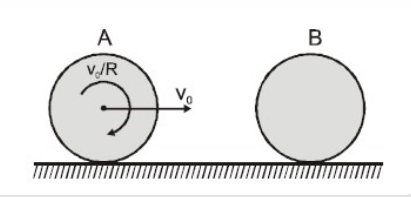
A hollow smooth uniform sphere $A$ of mass $m$ rolls without sliding on a smooth horizontal surface. It collides elastically and head$-$on with another stationary smooth hollow sphere $B$ of the same mass $mm$ and same radius. The ratio of the kinetic energy of $B$ to that of $A$ just after the collision is:
- ✓
$1 : 1$
- B
$2 : 3$
- C
$3 : 2$
- D
AnswerCorrect option: A. $1 : 1$
The sphere is rolling on a smooth surface
i.e., no energy is lost to friction and the kinetic energy of sphere $A$ is transferred to the sphere $B$ without any loss as the collision is head$-$on and elastic.
Thus, the kinetic energy of sphere $A$ and sphere $B$ are equal their ratio will be $1 : 1$
View full question & answer→MCQ 1651 Mark
Work done by gravitational force in one revolution of the earth around the sun on its elliptical path is zero because:
- A
Force is always perpendicular to displacement.
- ✓
- C
Displacement is positive.
- D
Displacement is negative.
View full question & answer→MCQ 1661 Mark
- ✓
Potential energy possessed by stored water is converted into electricity.
- B
Kinetic energy possessed by stored water is converted into potential energy.
- C
Water is heated to produce electricity.
- D
Water is converted into steam to produce electricity.
AnswerCorrect option: A. Potential energy possessed by stored water is converted into electricity.
Hydro power plant uses the potential energy stored in water. When water flows down the dam, potential energy is converted into kinetic energy which is used to rotate the turbine which produce electricity.
View full question & answer→MCQ 1671 Mark
A heavy stone is thrown from a cliff of height $h$ with a speed $v.$ The stone will hit the ground with maximum speed if it is thrown:
- A
- B
- C
- ✓
The speed does not depend on the initial direction.
AnswerCorrect option: D. The speed does not depend on the initial direction.
View full question & answer→MCQ 1681 Mark
A body of mass $0.5\ kg$ travels in a straight line with velocity $v = a x^{3/2}$ where ${a}=5 {~m}^{-1 / 2}{~s}^{-1}$. The work done by the net force during its displacement from $x = 0$ to $x = 2m$ is:
- A
$1.5J$
- ✓
$50J$
- C
$10J$
- D
$100J$
AnswerKey concept: When a variable force acts on a particle while it moves from point $A$ to $B,$ say along the path shown in the figure, work done by the force on the particle is given by
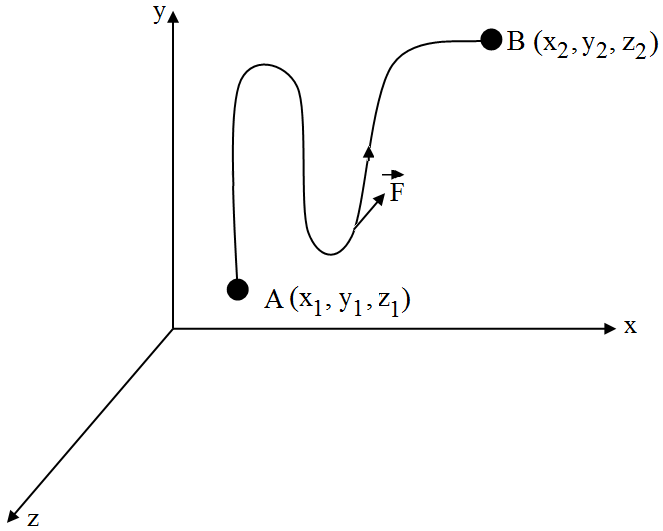
On the particle is given by
$\text{W}=\int\limits^{\text{B}}_\text{A}\vec{\text{F}}\cdot\vec{\text{ds}}\ ...(\text{i})$
Hence, $\int\limits^{\text{B}}_\text{A}\vec{\text{F}}\cdot\vec{\text{ds}}$ is to be integrated along the path the particle follows.
The vector integral is equivalent to
$\text{W}=\int\limits^{\text{x}_2}_{\text{x}_1}\text{f}_\text{x}\text{dx}+\int\limits^{\text{y}_2}_{\text{y}_1}\text{f}_\text{y}\text{dy}+\int\limits^{\text{z}_2}_{\text{z}_1}\text{f}_\text{z}\text{dz}$
According to the problem, velocity $={ax}^{3 / 2}$, mass $=0.5{~kg},{a}=5{~m}^{-1} / 2{~s}^{-1}$
We have to find work done $(W)$ by net force.
We know that,
Acceleration, $\text{a}_0=\frac{\text{dv}}{\text{dt}}=\text{v}\frac{\text{dv}}{\text{dx}}$
$=\text{ax}^{\frac{3}{2}}\frac{\text{d}}{\text{dx}}\Big(\text{ax}^{\frac{3}{2}}\Big)$
$=\text{ax}^{\frac{3}{2}}\times\text{a}\times\frac{3}{2}\times\text{x}^{\frac{1}{2}}=\frac{3}{2}\text{a}^2\text{x}^2$
Net Force $=\text{ma}_0=\text{m}\Big(\frac{3}{2}\text{a}^2\text{x}^2\Big)$
And work done due to variable force,
Work done $=\int\limits^{\text{x}=2}_{\text{x}=0}\text{F dx}=\int\limits^2_0\frac{3}{2}\text{ma}^2\text{x}^2\text{ dx}$
$=\frac{3}{2}\text{ma}^2\times\Big(\frac{\text{x}^3}{3}\Big)^2_0$
$=\frac{1}{2}\text{ma}^2\times8$
$=\frac{1}{2}\times(0.5)\times(25)\times8$
$=50\text{J}$ View full question & answer→MCQ 1691 Mark
Asha lifts a doll from the floor and places it on a table. If the weight of the doll is known, what else does one need to know in order to calculate the work Asha has done on the doll?
- A
- ✓
- C
The power she could deliver.
- D
Cost of the doll or the table.
AnswerWork done, $W =$ force $\times$ displacement $= \ce{mg \times h = mgh}$
This is the potential energy.
If weight $(mg)$ is known, then we need to know the height $(h)$ of the table.
View full question & answer→MCQ 1701 Mark
A man squatting on the ground gets straight up and stand. The force of reaction of ground on the man during the process is:
- A
Constant and equal to $mg$ in magnitude.
- B
Constant and greater than $mg$ in magnitude.
- C
Variable but always greater than $mg.$
- ✓
At first greater than $mg,$ and later becomes equal to $mg.$
AnswerCorrect option: D. At first greater than $mg,$ and later becomes equal to $mg.$
In the process of squatting on the ground he gets straight up and stand.
Then he is tilted somewhat, the man exerts a variable force on the ground to balance his weight,
hence he also has to balance frictional force besides his, weight in this case.
$N =$ Normal reaction force $=$ friction $+\ mg \Rightarrow N > mg$
Once the man gets straight up that variable force $= 0$
Normal reaction force $= mg$
View full question & answer→MCQ 1711 Mark
The potential energy, i.e., $U(x)$ can be assumed zero when:
- A
$x = 0.$
- B
Gravitational force is constant.
- C
Infinite distance from the gravitational source.
- ✓
View full question & answer→MCQ 1721 Mark
A pump is used to lift $500\ kg$ of water from a depth of $80m$ in $10s .$
$($Take $g = 10\ m s^{-2})$. Calculate the work done by the pump.
- A
$16 \times 10^5J$
- ✓
$4 \times 10^5J$
- C
$4 \times 10^8J$
- D
$2 \times 10^5J$
AnswerCorrect option: B. $4 \times 10^5J$
Mass of water lifted, $m = 500\ kg$
Displacement, $d = 80m$
Time taken, $t = 10s$
Force, $F = m \times g$
$F = 500 \times 10$
$F = 5000N$
Work done, $In = F \times d$
$In = 5000 \times 80$
$In = 4 \times 10^5 J.$
View full question & answer→MCQ 1731 Mark
A wound watch spring has $...........$ energy.
AnswerThe energy possessed by a body due to its change in position or shape is called the potential energy. A wound watch has potential energy.
View full question & answer→MCQ 1741 Mark
A student sitting at the top of a tree has $............$ than the student who is sitting on the ground.
- A
- ✓
- C
- D
More gravitational energy.
AnswerPotential energy $= \ce{mgh}$
$m \rightarrow$ mass
$g \rightarrow$ accelerationduetogravity
$h \rightarrow$ heightfromground
$P.E.$ is directly proportional to the height from the ground.
Hence a student sitting at the top of a tree has more potential energy than the student who is sitting on the ground.
View full question & answer→MCQ 1751 Mark
The height attained by a ball after $3$ rebounds on falling from a height of $h$ on floor having coefficient of restitution $e$ is:
- A
$e^3h$.
- B
$e^4h$.
- C
$e^5h$.
- ✓
$e^6h$.
AnswerCorrect option: D. $e^6h$.
View full question & answer→MCQ 1761 Mark
A heavy steel ball of mass greater than 1kg moving with a speed of 2m/ s collides head on with a stationary ping pong ball of mass less than 0.1 g. The collision is elastic. After the collision the ping pong ball moves approximately with a speed.
Answerb. 4m/ s
Explanation:
Since the body is much heavy these won't be much change in velocity & e = 1
$\text{i.e.,}\frac{\text{v-2}}{\text{0-2}}=-1$
⇒ v = 4m/ s
View full question & answer→MCQ 1771 Mark
A heavy stone is thrown force a cliff of height h in a given direction. The speed with which it hits the ground?
- A
Must be larger than the speed of projection.
- B
Must be independent of the speed of projection.
- C
Must depend on the speed of projection.
- ✓
AnswerExplanation:
The speed with which it hits the ground must depend upon the speed of projection and shall always be larger than the speed of projection, because potential energy of the body shall be converted into kinetic energy.
View full question & answer→MCQ 1781 Mark
When an arrow is released from a bow, potential energy changes into kinetic energy.
AnswerWhen an arrow is drawn back by a bow, the work done by us in stretching the bowstring gets stored at potential energy in the bow.
This potential energy of bow is transformed into kinetic energy when the bowstring is released and this gives kinetic energy to the arrow.
View full question & answer→MCQ 1791 Mark
Two bodies of masses $m,$ and $m,$ have same momentum. The ratio of their $KE$ is:
- A
$\sqrt{\frac{\text{m}_2}{\text{m}_1}}$
- B
$\sqrt{\frac{\text{m}_1}{\text{m}_2}}$
- C
$\frac{\text{m}_1}{\text{m}_2}$
- ✓
$\frac{\text{m}_2}{\text{m}_1}$
AnswerCorrect option: D. $\frac{\text{m}_2}{\text{m}_1}$
View full question & answer→MCQ 1801 Mark
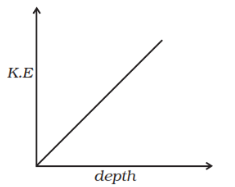
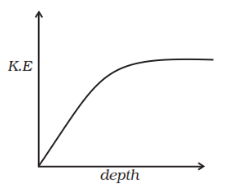
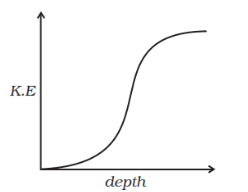
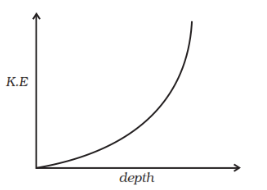
Which of the diagrams in correctly shows the change in kinetic energy of an iron sphere falling freely in a lake having sufficient depth to impart it a terminal velocity?
AnswerConstant after some depth. This constant velocity is called terminal velocity, hence KE become constant beyond this depth, which is best represented by (b).
View full question & answer→MCQ 1811 Mark
A body of mass $2\ Kg$ moving $($initially$)$ with $10\ m/ s$ is acting upon by a resultant constar which is opposite to its initial velocity. Its speed decreases to $4\ m/ s$ in $1s.$ Then the force:
View full question & answer→MCQ 1821 Mark
- ✓
Energy possessed by a body by the virtue of its motion.
- B
Energy possessed by a body by the virtue of its shape.
- C
Energy possessed by a body by the virtue of its size.
- D
AnswerCorrect option: A. Energy possessed by a body by the virtue of its motion.
The energy which a body possesses by virtue of being in motion is called as kinetic energy.
If we want to stop a moving body then we must do some work on the body to stop it which means that a moving body possesses energy because of motion.
If an object of mass $m$ moving with the velocity $v$, The kinetic energy is defined as,
$\text{K.E}=\frac{1}{2}\text{mv}^2$
View full question & answer→MCQ 1831 Mark
In an inelastic collision:
- A
Conservation of momentum is not followed.
- B
Conservation of mechanical energy is not followed.
- ✓
Conservation of mechanical energy is followed.
- D
AnswerCorrect option: C. Conservation of mechanical energy is followed.
View full question & answer→MCQ 1841 Mark
A heavy stone is thrown from a cliff of height $h$ with a speed $\nu.$ The stone will hit the ground with maximum speed if it is thrown:
- A
- B
- C
- ✓
The speed does not depend on the initial direction.
AnswerCorrect option: D. The speed does not depend on the initial direction.
As the stone falls under the gravitational force, which is a conservative force, the total energy of the stone remains the same at every point during its motion.
From the conservation of energy, we have:
Initial energy of the stone $=$ final energy of the stone
i.e., $(\text { K.E. })_i+(\text { P.E. })_{\mathrm{i}}=(\text { K.E. })_{\mathrm{f}}+(\text { P.E. })_{\mathrm{f}}$
$=\frac{1}{2}\text{mv}^2+\text{mgh}=\frac{1}{2}\text{m}(\text{v}_\text{max})^2$
$\Rightarrow\text{v}_\text{max}=\sqrt{\text{v}^2+2\text{gh}}$
From the above expression, we can say that the maximum speed With which stone hits the ground does not depend on the initial direction.
View full question & answer→MCQ 1851 Mark
The negative of the work done by the conservative internal forces on a system equals the change in:
AnswerThe negative of the work done by the conservative internal forces on a system is equal to the changes in potential energy.
i.e. $\text{W}=-\triangle\text{ P.E.}$
View full question & answer→MCQ 1861 Mark
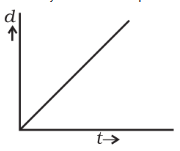
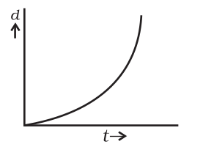
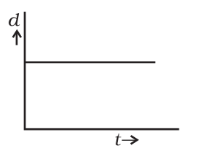
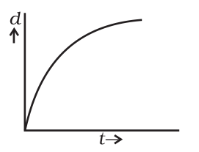
A body is moving unidirectionally under the influence of a source of constant power supplying energy. Which of the diagrams shown in correctly shows the displacement-time curve for its motion?
AnswerFor constant power
Displacement $\propto\text{t}^{\frac{3}{2}}$
Because, $\text{P}=\frac{\vec{\text{F}}\cdot\vec{\text{ds}}}{\text{dt}}=\vec{\text{F}}\cdot\vec{\text{v}}=\text{constant}$
$(\because$ P = constant according to the problem$)$
Now, will by dimensional analysis
[F][v] = constant
$\Rightarrow [MLT^{-2}][LT^{-1}]$ = constant
$\Rightarrow L^2T^{-3}$ = constant $(\because$ mass is constant$)$
$\Rightarrow\text{L}\propto\text{T}^{\frac{3}{2}}$
$\Rightarrow\text{ Displacement (d)}\propto\text{t}^{\frac{3}{2}}$
View full question & answer→MCQ 1871 Mark
A particle of mass $m$ is attached to a light string of length $l,$ the other end of which is fixed. Initially the string is kept horizontal and the particle is given an upward velocity $v.$ The particle is just able to complete a circle.
AnswerCorrect option: C. The kinetic energy of the ball in initial position was $\frac{1}{2}\text{m}\nu^2=\text{mgl}.$
The string becomes slack when the particle reaches its highest point. This is because at the highest point, the tension in the string is minimum. At this point, potential energy of the particle is maximum, while its kinetic energy is minimum. From the law of conservation of energy, we can see that the particle again passes through the initial position where its potential energy is minimum and its kinetic energy is maximum.
View full question & answer→MCQ 1881 Mark
The earth, moving around the sun in a circular orbit, is acted upon by a force and hence work done on the earth by the force is:
MCQ 1891 Mark
The force required to stretch a spring varies with the distance as shown in the figure. If the experiment is performed with the above spring of half the length, the line Then will:
- ✓
Shift towards $F−$axis
- B
Shift towards $X−$axis
- C
- D
AnswerCorrect option: A. Shift towards $F−$axis
When the length of the spring is halved, its spring constant will become double.
Slope of the force displacement graph gives the spring constant $(k)$ of spring.
If $k$ becomes double then slope of the graph increases,
i.e. Graph shifts towards force$-$axis.
View full question & answer→MCQ 1901 Mark
When the speed of a body is doubled, its kinetic energy becomes:
AnswerThe kinetic energy of a body is given by:
$\text{K}=\frac{1}{2}\text{min}^2$
Hence, Kinetic energy depends on the velocity as:
$\text{KE}\propto\text{in}^2$
View full question & answer→MCQ 1911 Mark
Which of the following physical quantities is different from others?
AnswerKinetic energy is the energy possessed by the body by virtue of its motion and potential energy is the energy possessed by the virtue of its position and shape. Energy is required to do work.
Hence work, kinetic energy, potential energy all can be measured using same unit, i.e joule.
So, force is the physical quantity here which is different from others as given by product of mass and acceleration. $S.I$ unit of force is $N ($newton$).$
View full question & answer→MCQ 1921 Mark
A ball tied to a string is swung in a vertical circle. Which of the following remains constant?
- A
- B
- C
- ✓
Earth's pull on the ball.
AnswerCorrect option: D. Earth's pull on the ball.
Earth's pull on the ball remains constant $(W = mg).$
Tension in the string changes along the vertical circular path.
Speed of the ball changes as sum of kinetic energy and potential energy remains constant during motion.
Speed changes, hence, centripetal force changes.
View full question & answer→MCQ 1931 Mark
Kinetic energy of a body depends on its:
Answer$\ce{uh}=\frac{1}{2}\text{min}^2$
So the kinetic energy of a body depends upon its mass and velocity.
View full question & answer→MCQ 1941 Mark
An object of mass $10\ kg$ is moving with velocity of $10\ ms^{-1}$. A force of $50N$ acted upon it for $2s.$ Percentage increase in its $KE$ is:
- A
$25\%$
- B
$50\%$
- C
$75\%$
- ✓
$300\%$
AnswerCorrect option: D. $300\%$
Initial velocity $= 10\ ms^{-1}$
Final velocity $=\frac{50}{10}\times2+10=20\ \text{ms}^{-1}$
$\Big(\text{Acceleration}=\frac{50}{10}=5\ \text{m/ s}^2\Big)$
Initial $\text{KE}=\frac{1}{2}\times10\times10\times10=5\times10^2\text{J}$
Final $\text{KE}=\frac{1}{2}\times10\times20\times20=20\times10^2\text{J}$
$\%$ increase $=\frac{(20-5)\times10^2}{5\times10^2}\times100=300\%$
View full question & answer→MCQ 1951 Mark
A bomb of mass $1\ kg$ is thrown vertically upwards with a speed of $100\ m/s.$ After $5$ seconds, it explodes into two fragments. One fragment of mass $400\ gm$ is found to go down with a speed of $25\ m/s.$ What will happen to second fragment just after explosion? $(g = 10\ m/s^2).$
- ✓
It will go upwards with speed $100\ m/s.$
- B
It will go upwards with speed $40\ m/s.$
- C
It will go upwards with speed $60\ m/s.$
- D
It will go downwards with speed $40\ m/s.$
AnswerCorrect option: A. It will go upwards with speed $100\ m/s.$
From $v = u + at = 100 – 10 \times 5 = 50\ m/s$
This is the velocity at the time of explosion.
According to principle of conservation of linear momentum,
$1\times50=\frac{400}{1000}\times(-25)+\frac{600}{1000}\times\text{v}$
$(50+10)=0.6\text{v}$
$\text{v}=\frac{60}{0.6}=100\ \text{m/s}$
The second fragment will go upwards with a speed of $100\ m/s.$
View full question & answer→MCQ 1961 Mark
A boy of mass $40\ kg$ runs up a flight of $50$ steps, each $10\ cm$ high in $14s.$ So, work done by the boy is:
- ✓
$1960J$
- B
$19.6J$
- C
$980J$
- D
$9.8J$
AnswerCorrect option: A. $1960J$
Mass of the boy, $m = 40\ kg$
Number of steps $= 50$
Height of each step $= 10\ cm$
Force on the boy due to gravity, $F = mg = 40 \times 9. 8 N = 392N$
While climbing up the steps, the boy does work against gravity.
Displacement in the vertical direction, $s = (50 \times 10)cm = 500\ cm = 5m$
Displacement is in the direction of force applied by the boy against gravity.
So, work done, In $= F \times s = 392 \times 5J = 1960J$
View full question & answer→MCQ 1971 Mark
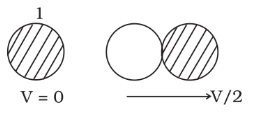
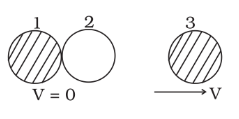
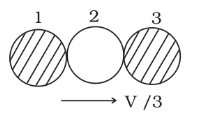
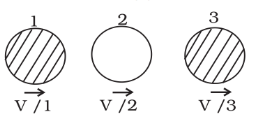
Two identical ball bearings in contact with each other and resting on a frictionless table are hit head-on by another ball bearing of the same mass moving initially with a speed V as shown in:
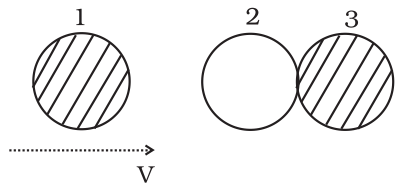
If the collision is elastic, which of the following is a possible result after collision?
AnswerKey concept: In a collision if the motion of colliding particles before and after the collision is along the same line, the collision is said to be head on or one dimensional.
When two bodies of equal masses collides elastically, their velocities are interchanged. Kinetic energy and linear momentum remains conserved Total kinetic energy of the system before collision
$=\frac{1}{2}\text{mv}^2+0=\frac{1}{2}\text{mv}^2$
In (a), kinetic energy of the system after collision,
$\text{K}_1=\frac{1}{2}(2\text{m})\Big(\frac{\text{v}}{2}\Big)^2=\frac{1}{4}\text{mv}^2$
Hence this option is incorrect.
In (b), kinetic energy of the system after collision,
$\text{K}_2=\frac{1}{2}(\text{m})(\text{v})^2=\frac{1}{2}\text{mv}^2$
Hence this option will be correct.
In (c), kinetic energy of the system after collision,
$\text{K}_3=\frac{1}{2}(3\text{m})\Big(\frac{\text{v}}{3}\Big)^2=\frac{1}{6}\text{mv}^2$
Hence this option is incorrect.
In (d), kinetic energy of the system after collision,
$\text{K}_4=\frac{1}{2}\text{mv}^2+\frac{1}{2}\text{m}\Big(\frac{\text{v}}{2}\Big)^2+\frac{1}{2}\text{m}\Big(\frac{\text{v}}{3}\Big)^2=\frac{49}{72}\text{mv}^2$
We see that kinetic energy is conserves only in (b).
View full question & answer→MCQ 1981 Mark
Complete the following sentence: The kinetic energy of a body is the energy by virtue of its$............$
AnswerThe kinetic energy of a body is the energy by virtue of its motion.
This is the definition of kinetic energy.
If it has motion then it will have velocity,
hence kinetic energy exists.
$\text{K.E}=\frac{1}{2}\text{mv}^2$
View full question & answer→MCQ 1991 Mark
A cricket ball of mass $150g$ moving with a speed of $126\ km/ h$ hits at the middle of the bat, held firmly at its position by the batsman. The ball moves straight back to the bowler after hitting the bat. Assuming that collision between ball and bat is completely elastic and the two remain in contact for $0.001s,$ the force that the batsman had to apply to hold the bat firmly at its place would be:
- A
$10.5N$
- B
$21N$
- ✓
$1.05 \times 10^4$
- D
$N$
AnswerCorrect option: C. $1.05 \times 10^4$
We know that force $\text{F}=\frac{\Delta\text{p}}{\Delta\text{t}}$ and $\frac{\Delta\text{p}}{\Delta\text{t}}=\frac{\text{m}[(-\text{v})-\text{u}]}{\text{t}}=\frac{-2\text{mv}}{\text{t}}$
And the magnitude of force will be, $\text{F}=\frac{2\text{mv}}{\text{t}}$
According to the problem, $\text{m}=150\text{g}=\frac{150}{1000}\text{kg}=\frac{3}{20}\text{kg}$
$\Delta\text{t}=\text{time of contact}=0.001\text{s}$
$\text{u}=126\text{km/ h}=\frac{126\times1000}{60\times60}\text{m/ s}=35\text{}\text{m s}$
$\text{v}=-126\text{km/ h}=-35\text{m/ s}$
Change in momentum of the ball
$\Delta\text{P}=\text{m(v}-\text{u})$
$=\frac{3}{20}(-70)=-\frac{21}{2}$
We know that force
$\text{F}=\frac{\Delta\text{P}}{\Delta\text{t}}$
$=\frac{\frac{-21}{2}}{0.001}\text{N}$
$=-1.05\times10^4\text{N}$
Here, $-ve$ sign shows that force will be opposite to the direction of movement of the ball before hitting.
So the force that the batsman had to apply to hold the bat firmly at its place would be $F = 1.05 \times 10^4$N K
View full question & answer→MCQ 2001 Mark
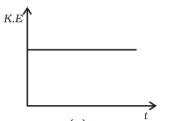
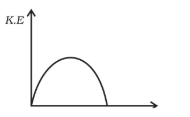
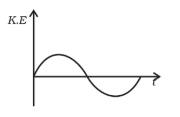
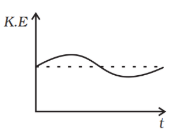
Which of the diagrams shown in most closely shows the variation in kinetic energy of the earth as it moves once around the sun in its elliptical orbit?
AnswerAs the earth moves once around the sun in its elliptical orbit, when the earth is closest to the sun, speed of the earth is maximum, hence KE is maximum. When the earth is farthest from the sun speed is minimum hence KE is minimum but never zero and negative.
This variation of KE vs t is correctly represented by option (d).
View full question & answer→