MCQ 1011 Mark
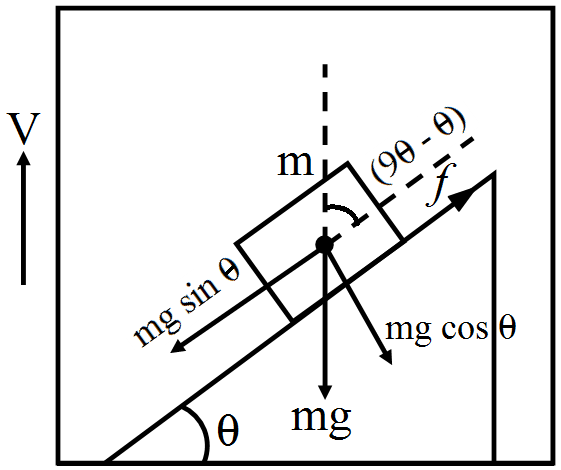
A small block of mass $m$ is kept on a rough inclined surface of inclination $\theta$ fixed in an elevator. The elevator goes up with a uniform velocity $v$ and the block does not slide on the wedge. The work done by the force of friction on the block in time $t$ will be:
AnswerCorrect option: C. $\text{mgvt}\sin^2\theta$
Distance $(d)$ travelled by the elevator in time $t = vt$
The block is not sliding on the wedge.
Then friction force $(\text{f})=\text{mg}\sin\theta$
Work done by the friction force on the block in time $t$ is given by,
$\text{W}=\text{Fd}\cos(90-\theta)$
$\Rightarrow\text{W}=\text{mg}\sin\theta\times\text{d}\times\cos(90-\theta)$
$\Rightarrow\text{W}=\text{mgd}\sin^2\theta$
$\therefore\ \text{W}=\text{mg}\nu\text{t}\sin^2\theta$
View full question & answer→MCQ 1021 Mark
A man raises a box of mass $50\ kg$ to a height of $2m$ in $2\ \text{min}$ , while another man raises the same box to the same height in $5$ minthes. What is the ratio of work done by them?
- ✓
$1 : 1$
- B
$2 : 1$
- C
$1 : 2$
- D
$4 : 1$
AnswerCorrect option: A. $1 : 1$
Work $= Fs \cos\theta$
Where, $F$ is the force applied, $s$ is the displacement, and $I$ is the angle between the force applied and displacement.
Hence, work done is independent of time taken.
In the given cases, $I = 0^{\circ}$ as the force applied are in the same direction.
Also, $F = mg$
So $\ce{In = Fs = mgs}$
In both the cases, mass and displacement are the same.
$In = 50 \times 10 \times 2 = 1000 D$
View full question & answer→MCQ 1031 Mark
- ✓
The initial kinetic energy is equal to the final kinetic energy.
- B
The final kinetic energy is less than the initial kinetic energy.
- C
The kinetic energy remains constant.
- D
The kinetic energy first increases then decreases.
AnswerCorrect option: A. The initial kinetic energy is equal to the final kinetic energy.
As no energy is lost into heat in an elastic collision,
the initial kinetic energy is equal to the final kinetic energy.
View full question & answer→MCQ 1041 Mark
A particle is pushed by forces $2\hat{\text{i}}+3\hat{\text{j}}-2\hat{\text{k}}$ and $5\hat{\text{i}}+\hat{\text{j}}-2\hat{\text{k}}$ simultaneously and it is displaced from point $\hat{\text{i}}+\hat{\text{j}}+\hat{\text{k}}$ to point $2\hat{\text{i}}-\hat{\text{j}}-2\hat{\text{k}}$. The work done is:
- A
$7$ units.
- ✓
$-7$ units.
- C
$10$ units.
- D
$-10$ units.
AnswerCorrect option: B. $-7$ units.
Net force, $=2\hat{\text{i}}+3\hat{\text{j}}-2\hat{\text{k}+}5\hat{\text{i}}-\hat{\text{j}}-3\hat{\text{k}}$
$=7\hat{\text{i}}+2\hat{\text{j}}-5\hat{\text{k}}$
Diolacement, $\text{d}=2\hat{\text{i}}-\hat{\text{j}}+3\hat{\text{k}-}\hat{\text{i}}-\hat{\text{j}}-\hat{\text{k}}$
$=\hat{\text{i}}-2\hat{\text{j}}+2\hat{\text{k}}$
Work done $=\text{F}.\text{d}=(7\hat{\text{i}}+2\hat{\text{j}}-5\hat{\text{k}}).(\hat{\text{i}}-2\hat{\text{j}}+2\hat{\text{k}})$
$=7-4-10$
$=-7\text{ units}$.
View full question & answer→MCQ 1051 Mark
Two blocks $M_1$ and $M_2$ having equal mass are free to move on a horizontal frictionless surface. $M_2$ is attached to a massless spring as shown in. Iniially $M_2$ is at rest and $M_1$ is moving toward $M_2$ with speed v and collides head$-$on with $M_2$.
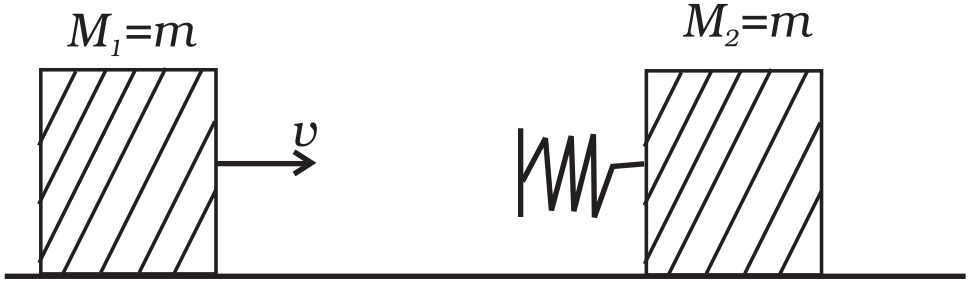
- A
While spring is fully compressed all the $KE$ of $M_1$ is stored as $PE$ of spring.
- B
While spring is fully compressed the system momentum is not conserved, though final momentum is equal to initial momentum.
- ✓
If spring is massless, the final state of the $M_1$ is state of rest.
- D
If the surface on which blocks are moving has friction, then collision cannot be elastic.
AnswerCorrect option: C. If spring is massless, the final state of the $M_1$ is state of rest.
If there is not specified we always consider the collision elastic. When two bodies of equal masse collides elastically, their velocities are interchanged in these types of collision.
Kinetic energy and linear momentum remain conserved. According to the above diagram when $m_1$ comes in contact with the spring, $m_1$ is retarded by the spring force and $m_2$ is accelerated by the spring force.
- The spring will continue $*$to compress until the two blocks acquire common velocity. So some of kinetic energy of block $M_X$ store into $P.E$ and some part of it stores into $K.E$ of block $M_2$. So option $(a)$ is incorrect.
- As surfaces are frictionalless momentum of the system will be conserved. So option $(b)$ is also incorrect.
- The two bodies of equal mass exchange their velocities in a head on elastic collision between them. So, if spring is massless, the final state of the $M_1$ is state of rest.
- Since there is a loss of $K.E$ when the blocks collides on the rough surface. Hence, the collision is inelastic.
View full question & answer→MCQ 1061 Mark
In which case, work done will be zero:
AnswerWork done by weight$-$lifter is zero because there is no displacement.
In a locomotive, work done is zero because force and displacement are mutually perpendicular to each other.
While a person holding a suitcase, work done is zero because there is no displacement.
View full question & answer→MCQ 1071 Mark
A massive ball moving with a speed in collide with a tiny ball having a very small mass, immediately after the impact the second ball will move at speed approximately equal to:
- A
$\infty$
- B
$\frac{\text{in}}{2}$
- C
$in$
- ✓
$2in$
AnswerIn an elastic collision where the projectile is much more massive than the target, the velocity of the target particle after the collision will be about twice that of the projectile and the projectile velocity will be essentially unchanged.
View full question & answer→MCQ 1081 Mark
Which of the following statements is incorrect?
- ✓
Kinetic energy may be zero, positive or negative.
- B
Power, energy and work are all scalars.
- C
Potential energy may be zero, positive or negative.
- D
Ballistic pendulum is a device for measuring the speed of bullets.
AnswerCorrect option: A. Kinetic energy may be zero, positive or negative.
The kinetic energy of a body of mass $mm$ which is moving with velocity $v$ is $\text{K}=\frac{1}{2}\text{min}^2$
Mass is always positive and if the velocity is either positive or negative, the kinetic energy is always positive due to the square of velocity.
View full question & answer→MCQ 1091 Mark
$...........$ of a two particle system depends only on the separation between the two particles. The most appropriate choice for the blank space in the above sentence is:
AnswerThe potential energy of a two particle system depends only on the separation between the particles.
View full question & answer→MCQ 1101 Mark
A particle is acted by a constant power. Then, which of the following physical quantity remains constant?
- A
- B
Rate of change of acceleration.
- C
- ✓
Rate of change of kinetic energy.
AnswerCorrect option: D. Rate of change of kinetic energy.
By definition, $\text{p}\frac{\text{dW}}{\text{dt}}$
$\because$ Work done $=$ Kinetic energy
$\Rightarrow\text{p}=\frac{\text{dW}}{\text{dt}}$
$=\frac{\text{d(KE)}}{\text{dt}}=\text{constant}$
View full question & answer→MCQ 1111 Mark
A mass of $0.5\ kg$ moving with a speed of $1.5\ ms^{-1}$ on a horizontal smooth surface, collides with a nearly weightless spring of spring constant $k = 50\ N/ m^{-1}$
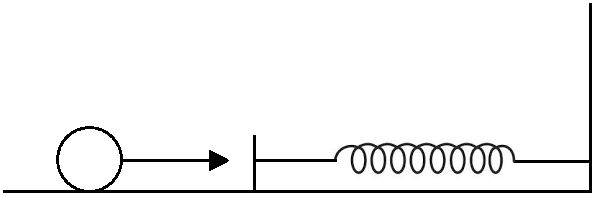
The maximum compression of the spring would be: - ✓
$0.15m$
- B
$0.12m$
- C
$1.5m$
- D
$0.5m$
AnswerCorrect option: A. $0.15m$
View full question & answer→MCQ 1121 Mark
A body of mass $2\ kg$ makes an elastic collision with another body at rest and comes to rest. The mass of the second body which collides with the first body is:
- ✓
$2\ kg$
- B
$1. 2\ kg$
- C
$3\ kg$
- D
$1\ kg$
AnswerCorrect option: A. $2\ kg$
View full question & answer→MCQ 1131 Mark
Which one of the following energies cannot be possessed by a body at rest?
AnswerKinetic energy is possessed by a body by virtue of its state of motion.
So, a body at rest cannot possess kinetic energy.
A body at rest will possess potential energy.
Thermal and magnetic energies are irrespective of state of rest or of motion of a body.
View full question & answer→MCQ 1141 Mark
Which one of the following possesses potential energy?
- A
Moving vehicle on the road.
- B
- C
- ✓
AnswerMoving vehicle on the road possesses kinetic energy.
A running athlete possesses kinetic energy.
Stone on the road possesses kinetic energy.
A stretched rubber band possesses potential energy.
View full question & answer→MCQ 1151 Mark
A ball is projected upwards. As it rises, there is increase in its:
AnswerWhen a ball is projected upwards it's height increases.
As height increases, $v$ velocity decreases $($Kinetic Energy Decreases$)$
so Potential energy increases.
Potential Energy $= mgh$
View full question & answer→MCQ 1161 Mark
One end of a light spring of spring constant $k$ is fixed to a wall and the other end is tied to a block placed on a smooth horizontal surface. In a displacement, the work done by the spring is $\frac{1}{2}\text{kx}^2.$ The possible cases are:
- A
At spring was initially compressed by a distance x and was finally in its natural length.
- B
It was initially stretched by a distance x and and finally was in its natural length.
- ✓
$A$ and $B$
- D
It was initially in its natural length and finally in a stretched position.
AnswerCorrect option: C. $A$ and $B$
For an elastic spring, the work done is equal to the negative of the change in its potential energy.When the spring was initially compressed or stretched by a distance $x$, its potential energy is given by,
$(\text{P.E.})_\text{i}=\frac{1}{2}\text{kx}^2$
When it finally comes to its natural length, its potential energy is given by,
$(\text{P.E.})_\text{f}=0$
$\therefore$ Work done $=-[(\text{P.E.})_\text{f}-(\text{P.E.})_\text{i}]$
$=-\Big[0-\frac{1}{2}\text{kx}^2\Big]$
$=\frac{1}{2}\text{kx}^2$
View full question & answer→MCQ 1171 Mark
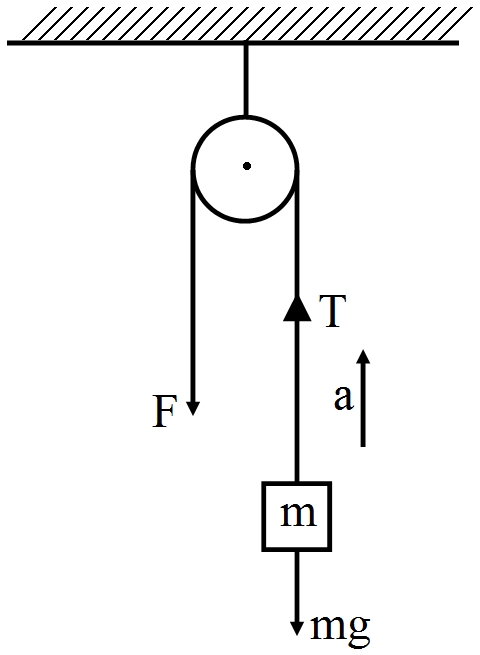
A block of mass $M$ is hanging over a smooth and light pulley through a light string. $T$ he other end of the string is pulled by a constant force $F.$ The kinetic energy of the block increases by $20J$ in $1s.$
- A
The tension in the string is $Mg.$
- ✓
The tension in the string is $F.$
- C
The work one by the tension on the block is $20J$ in the above $1s.$
- D
The work done by the force of gravity is $-20J$ in the above $1s.$
AnswerCorrect option: B. The tension in the string is $F.$
Tension in the string is equal to $F,$ as tension on both sides of a frictionless and massless pulley is the same.
i.e., $\ce{T - Mg = Ma}$
$\Rightarrow \ce{T = Mg + Ma}$
So, the tension in the string cannot be equal to $Mg.$
The change in kinetic energy of the block is equal to the work done by gravity.
Hence, the work done by gravity is $20J$ in $1s,$ while the the work done by the tension force is zero.
View full question & answer→MCQ 1181 Mark
A particle of mass my moves with velocity $v_1$ collides with another particle at rest of equal mass. The velocity of second particle after the elastic collision is:
AnswerGiven, mass $m_1= m_2=m$
and velocity, $v = v_1$
For elastic collision, $\text{v}_2=\Big(\frac{\text{m}_2-\text{m}_1}{\text{m}_1+\text{m}_2}\Big)\text{v}_2+\frac{2\text{m}_1\text{v}_1}{\text{m}_1+\text{m}_2}$
After putting given values, we will get
$\text{v}_2+\frac{2\text{m}_1\text{v}_1}{2\text{m}_1}$
$\Rightarrow\text{v}_1=\text{v}_2$
View full question & answer→MCQ 1191 Mark
Work done by a body against friction always results in:
- ✓
- B
Loss in potential energy.
- C
- D
Gain in potential energy.
View full question & answer→MCQ 1201 Mark
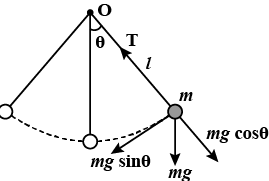
Let $\theta$ denote the angular displacement of a simple pendulum oscillating in a vertical plane. If the mass of the bob is $m,$ then tension in the string is $mg \cos\theta$
AnswerFor simple pendulum
$\frac{\text{min}}{\text{r}}=\text{T}-\text{mg}\cos\varnothing$
But when $F = I,$
i.e., the bob is at extreme position.
its velocity is zero, hence the equation becomes:
$\text{T−mg}\cos\theta =0$
$\Rightarrow\text{T−mg}\cos\theta =0$
View full question & answer→MCQ 1211 Mark
In a head-on elastic collision of two bodies of equal masses:
- A
The velocities are interchanged.
- B
The speeds are interchanged.
- C
The momenta are interchanged.
- ✓
Answerd. All of the above.
Explanation:
If u and v are the velocities before collision and u' and v' are the velocities after collision, then we have
$\text{u}'=\frac{(\text{m}-\text{m})\text{u}}{\text{m}+\text{m}}+\frac{2\text{m}}{\text{m}+\text{m}}=0+\text{v}=\text{v}$ and $\text{v}'=\frac{2\text{m}\text{u}}{(\text{m}+\text{m})}+\frac{(\text{m}-\text{m})\text{v}}{(\text{m}+\text{m})}=\text{u}+0=\text{u}$
So the velocities and speeds are interchanged. Hence (a) and (b) are true.
Since the velocities are interchanged and masses are equal hence the momenta are also interchanged. Hence (c) is true.
If u > v then after the collision the speeds of bodies are interchanged. Now the faster body slows down and the slower body speeds up. Hence (d) is true.
View full question & answer→MCQ 1221 Mark
Fast neutrons can easily be slowed down by
- A
- ✓
Passing them through water.
- C
Elastic collision with heavy nuclei.
- D
Applying a strong electric field.
AnswerCorrect option: B. Passing them through water.
Water is rich in hydrogen $($proton$)$. On collision, velocities of neutron and proton are interchanged. Fast neutrons come to rest and protons move with velocity of neutrons.
View full question & answer→MCQ 1231 Mark
The power of a windmill having blade area equal to $A$ and wind velocity equal to $v$ is $(\rho$ is density of air$):$
- ✓
$\frac{\text{A}\rho\text{v}^3}{2}$
- B
$\frac{\text{A}\rho\text{v}^2}{2}$
- C
$\frac{\text{A}\rho\text{v}}{2}$
- D
$\text{A}\rho\text{v}^3$
AnswerCorrect option: A. $\frac{\text{A}\rho\text{v}^3}{2}$
View full question & answer→MCQ 1241 Mark
Energy possessed by a body by virtue of its motion is:
AnswerKinetic energy is defined as the energy possessed by a body by virtue of its motion. and it is equal to $K.$ And, $\text{uh}=\frac{1}{2}\text{min}^2$
Where m and in are mass and Velocity of moving body.
View full question & answer→MCQ 1251 Mark
A mass attached to a string that is itself attached to the ceiling swings back and forth. If the bob is observed to be moving upward at a given instance, as shown to the right, which arrow best depicts the direction of the net force acting on the bob at that instant:
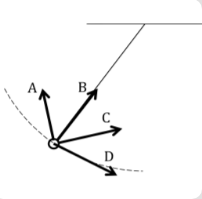
AnswerTwo forces act on the bob. $(i)$ is the tension in the string and the $(ii)\ mg \sin I,$ which will be tangential to the path.
The resultant of both the forces will be along vector $C$
View full question & answer→MCQ 1261 Mark
The moon revolves around the earth because the earth exerts a radial force on the moon. Does the earth perform work on the moon?
AnswerNo, the earth does not perform any work on the moon.
Work done$(W)$ is defined as the scalar product of force$(F)$ and displacement$(s).$
So, $W = F \times s = Fs\cos I$ where is the angle between force and displacement vector.
The radial force exerted on the moon by earth i.e attractive force due to gravity acts in direction perpendicular to which the moon suffers the displacement during rotation.
So, $I = 90$ hence $\cos I = 0$
So, $W = |F|| s| \times 0 = 0$
View full question & answer→MCQ 1271 Mark
An overhead tank having some water possesses $..........$ energy.
AnswerWe know that Potential energy is the energy possessed by a body by the virtue of its position.
$\therefore$ An overhead tank having some water possesses Potential energy, as it is at a height.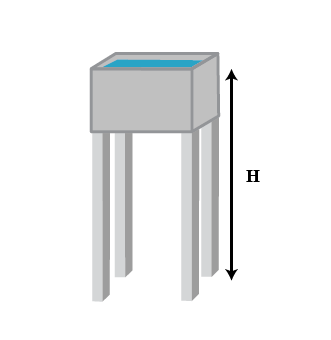
View full question & answer→MCQ 1281 Mark
Water stored in a dam possesses:
AnswerThe potential energy possessed by the object is the energy present in it by virtue of its position or configuration. Water stored in a dam, when allowed to flow, has kinetic energy which was earlier stored as potential energy.
View full question & answer→MCQ 1291 Mark
A particle is acted upon by a force $F$ which varies with position $x$ as shown in the figure. If the particle at $x = 0$ has the kinetic energy of $25J,$ then the kinetic energy of the particle at $x = 16m$ is?
- ✓
$45J$
- B
$30J$
- C
$70J$
- D
$135J$
View full question & answer→MCQ 1301 Mark
A coconut fruit hanging high in a palm tree has $.........$ owing to its location.
AnswerThe potential energy possessed by the object is the energy present in it by virtue of its position or configuration. So, the hanging coconut has potential energy due to its location $($height$).$
View full question & answer→MCQ 1311 Mark
A man, of mass $m,$ standing at the bottom of the staircase, of height $L$ climbs it and stands at its top.
AnswerCorrect option: D. $B$ and $C$
$-$Work done by gravitational force on man is $\ce{(-mgL)}$ as gravitational force is downward and displacement $L$ is upward.
The Work done by man to lift him up by muscular force will be $\ce{(+mgL)}$ as force applied by muscles is in the direction of displacement.
So net work done $= \ce{-mgL + mgL = 0}$.
$-$As there is no displacement point where the reaction acts
so, Work Done by reaction torce is zero.
As the velocity of person atmost zero at top.
So $KE = 0.$
Hence, Work Done by reaction force is zero.
View full question & answer→MCQ 1321 Mark
If the external forces acting on a system have zero resultant, the centre of mass:
AnswerExplanation:
When external forces acting on a system have zero resultant, the centre of mass may move with a constant velocity i.e. it must not accelerate.
View full question & answer→MCQ 1331 Mark
You lift a suitcase from the floor and keep it on a table. The work done by you on the suitcase does not depend on:
- A
The path taken by the suitcase.
- B
The time taken by you in doing so.
- C
- ✓
AnswerWork done by us on the suitcase is equal to the change in potential energy of the suitcase.
i.e., $\ce{W = mgh}$
Here, $mg$ is the weight of the suitcase and $h$ is height of the table.
Hence, work done by the conservative $($gravitational$)$ force does not depend on the path.
View full question & answer→MCQ 1341 Mark
A ball hits a floor and rebounds after an inelastic collision. In this case:
- A
The total energy of the ball and the earth remains the same.
- B
The total momentum of the ball and the earth is conserved.
- C
The momentum of the ball just after the collision is same as that just before the collision.
- ✓
AnswerExplanation:
As the collision is inelastic, body losses some energy, so that KE of ball does not remain the same. However, total energy and total momentum of ball and earth remain the same.
View full question & answer→MCQ 1351 Mark
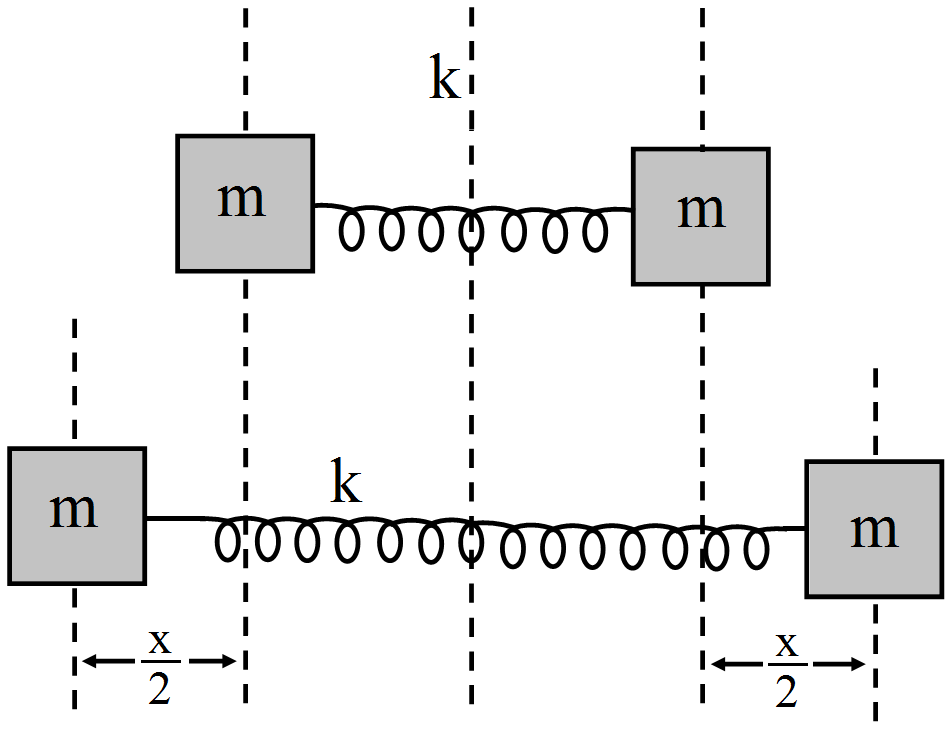
Two equal masses are attached to the two ends of a spring of spring constant $k.$ The masses are pulled out symmetrically to stretch the spring by a length $x$ over its natural length. The work done by the spring on each mass is:
AnswerCorrect option: D. $-\frac{1}{4}\text{kx}^2$
The work done by the spring on both the masses is equal to the negative of the increase in the elastic potential energy of the spring.
The elastic potential energy of the spring is given by $\text{E}_\text{p}=\frac{1}{2}\text{kx}^2.$
Work done by the spring on both the masses $=-\frac{1}{2}\text{kx}^2$
$\therefore$ Work done by the spring on each mass $=\frac{1}{2}\Big(-\frac{1}{2}\text{kx}^2\Big)$
$=-\frac{1}{4}\text{kx}^2$
View full question & answer→MCQ 1361 Mark
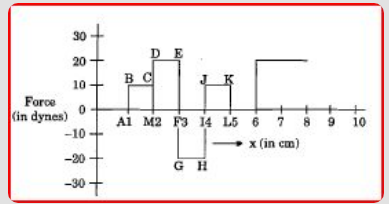
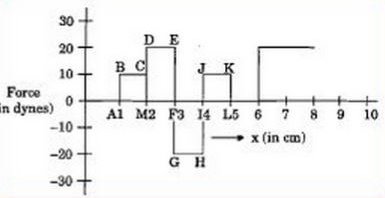
The relationship between force and position is shown in the figure $($in one dimensional case$)$. Work done by the force in displacing a body from
$X = 1\ cm$ to $X = 5\ cm$ is:
- A
$700$ ergs
- B
$70$ ergs
- ✓
$60$ ergs
- D
$20$ ergs
AnswerCorrect option: C. $60$ ergs
Work is area under the curve.
So $\ce{In = In_1 + In_2 + In_3 + In_4}$
$\ce{In_1}=$ arandaundandr $\ce{A_1BCM_2 In_2=}$ arandaundandr $\ce{M_2DEF_3}$
$\ce{In_3} =$ arandaundandr $\ce{F_3GHI_4 In_4=}$ arandaundandr $\ce{I_4JKL_5}$
$\ce{In_1}= 10 \times 1 = 10$ ergs
$\ce{In_2} = 20 \times 1 = 20$ ergs
$\ce{In_3}= −20 \times 1 = −20$ ergs
$\ce{In_4} = 10 \times 1 = 10$ ergs
$\ce{In = In_1 + In_2+ In_3 + In_4} = 10 + 20 − 20 + 10 = 20$ ergs
View full question & answer→MCQ 1371 Mark
When an aeroplane takes off from the ground:
- A
Kinetic energy increases and Potential energy decreases
- B
Potential energy increases and Kinetic energy remains constant
- C
Both Kinetic energy and Potential energy remain constant
- ✓
Both Kinetic energy and Potential energy increase
AnswerCorrect option: D. Both Kinetic energy and Potential energy increase
Kinetic energy is due to the motion of the object and potential energy is due to relative elevation.
So as the plane takes off height increases and also its speed increase,
so both kinetic and potential energy increases.
Kinetic energy$=\frac{1}{2}\text{min}^2$
Potential energy $= \ce{mgH}$
View full question & answer→MCQ 1381 Mark
Identify the wrong statement:
- ✓
A body can have momentum without energy.
- B
A body can have energy without momentum.
- C
The momentum is conserved in an elastic collision.
- D
Kinetic energy is not conserved in an inelastic collision.
AnswerCorrect option: A. A body can have momentum without energy.
View full question & answer→MCQ 1391 Mark
A force $\text{F}=5\hat{\text{i}}+6\hat{\text{j}}-4\hat{\text{k}}$ acting on a body produces a displacement $\text{s}=6\hat{\text{i}}+5\hat{\text{k}}$ The work done by the force is:
- A
$18$ units.
- B
$15$ units.
- C
$12$ units.
- ✓
$10$ units.
AnswerCorrect option: D. $10$ units.
View full question & answer→MCQ 1401 Mark
A bicyclist comes to a skidding stop in $10m.$ During this process, the force on the bicycle due to the road is $200N$ and is directly opposed to the motion. The work done by the cycle on the road is:
- A
$+2000J$
- B
$-200J$
- ✓
- D
$-20,000J$
AnswerAs the friction is present in fhis problem,
so mechanical energy is not conserved.
So energy will be lost due to dissipation by friction
Here, work is done by the frictional force on the cycle and is equal to $200 \times 10 = -2000J$
As the road does not move at all, therefore, work done by the cycle on the road is zero.
Important point.
We should be aware that here the energy of bicyclist is lost during the motion, but it is lost due to friction in the form of heat.
View full question & answer→MCQ 1411 Mark
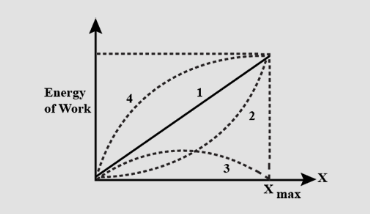
During the displacement, which of the curves shown in the graph best represents the work done on the spring block system by the applied force ?
MCQ 1421 Mark
Energy equals of a mass of one microgram in kilo joules is:
- ✓
$9 \times 10^{10}kJ$
- B
$10 \times 10^3kJ$
- C
$8 \times 10^2kJ$
- D
$7 \times 10^4kJ$
AnswerCorrect option: A. $9 \times 10^{10}kJ$
We will use Energy mass equivalence
$E = mc^2$
$E = 10^{-6}kg \times (3 \times 10^8)^2m/ s^2$
$E = 9 \times 10^{10}J$
View full question & answer→MCQ 1431 Mark
In head on elastic collision of two bodies of equal masses:
$A.$The speeds are interchanged.
$B.$The velocities are interchanged.
$C.$ The faster body slows down and the slower body speeds up.
$D.$ The momenta are interchanged.
- A
Only $A$
- B
$B$ and $C$
- C
Only $C$
- ✓
AnswerWhen $m_1 = m_2$ the statements are true.
View full question & answer→MCQ 1441 Mark
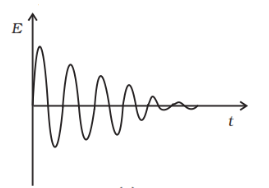
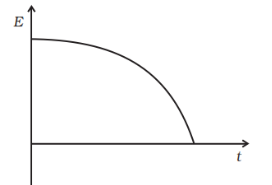
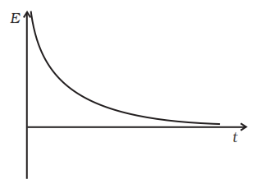
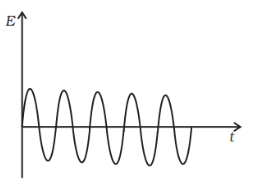
Which of the diagrams shown in represents variation of total mechanical energy of a pendulum oscillating in air as function of time?
AnswerWhen a pendulum oscillates in air, its total mechanical energy decreases continuously in overcoming resistance due to air. Therefore, total mechanical energy of the pendulum decreases exponentially with time. The variation of E v/st is correctly represented by curve (c) in which the relation between energy and time is shown.
View full question & answer→MCQ 1451 Mark
A force of $10N$ is applied on an object of mass $2\ kg$ placed on a rough surface having coefficient of friction equal to $0.2.$ Work done by applied force in $4s$ is:
- A
$120J.$
- ✓
$240J.$
- C
$250J.$
- D
$100J.$
AnswerCorrect option: B. $240J.$
View full question & answer→MCQ 1461 Mark
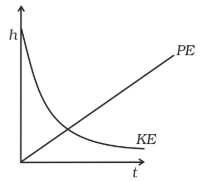
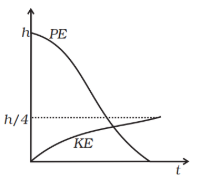
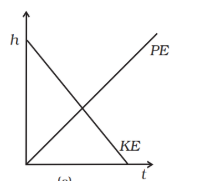
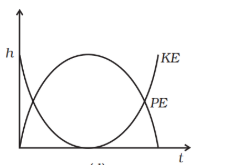
A raindrop falling from a height h above ground, attains a near terminal velocity when it has fallen through a height (3/4)h. Which of the diagrams shown in correctly shows the change in kinetic and potential energy of the drop during its fall up to the ground?
AnswerAt height h from ground raindrop have maximum potential energy. And kinetic velocity will be zero (at the instant when it dropped its velocity will be zero), then as the rain drop falls its PE starts decreasing and kinetic energy start increasing.
The total mechanical energy will remain conserved if we neglect the air resistance. If there is some air resistance, there is some force called upthrust (in fluids) which opposes its motion. It depends upon velocity of object as the velocity increases, upthrust also increases. Hence during fall of raindrop first its velocity increases and then become constant after some time. This constant velocity is called terminal velocity, hence KE also become constant. PE decreases continuously as the drop is falling continuously. The variation in PE and KE is best represented by (b).
View full question & answer→MCQ 1471 Mark
How much amount of energy is liberated to convert $1\ kg$ of coal into energy?
- ✓
$9 \times 10^{16}$J.
- B
$9 \times 10^{15}$J.
- C
$3 \times 10^{14}$J.
- D
$4 \times 10^6$J.
AnswerCorrect option: A. $9 \times 10^{16}$J.
View full question & answer→MCQ 1481 Mark
A heavy stone is thrown in from a cliff of height h in a given direction. The speed with which it hits the ground:
- A
Must depend on the speed of projection.
- B
Must be larger than the speed of projectio.
- ✓
$A$ and $B$
- D
May be smaller than the speed of projection.
AnswerCorrect option: C. $A$ and $B$
Consider that the stone is projected with initial speed $v.$
As the stone is falls under the gravitational force,
which is a conservative force,
the total energy of the stone remains the same at every point during its motion.
From the conservation of energy, we have:
Initial energy of the stone $=$ final energy of the stone
i.e., $\ce{(K.E.)_i + (P.E.)_i= (K.E.)_f+ (P.E.)_f}$
$=\frac{1}{2}\text{mv}_\text{r}^2+\text{mgh}=\frac{1}{2}\text{m}(\text{v}_\text{max})^2$
$\Rightarrow\text{v}_\text{max}=\sqrt{\text{v}^2+2\text{gh}}$ From the above expression,
we can say that the maximum speed with which the stone hits the ground depends on the speed of projection and greater than it.
View full question & answer→MCQ 1491 Mark
A particle of mass $m_1$ moving with a velocity of $5\ m/ s$ collides head on with a stationary particle of mass $m_2$. After collision both the particle move with a common velocity of $4\ m/ s,$ then the value $m_1 / m_2\ Z$ is:
- ✓
$4 : 1$
- B
$2 : 1$
- C
$1 : 8$
- D
$1 : 2$
AnswerCorrect option: A. $4 : 1$
Conservation of Momentum principle, Initial momentum is $\ce{M_i=5 m_1}$
Final momentum is $\ce{M_f=4\left(m_1 + m_2\right)}$
By the above stated principle $\ce{M_i=M_f=5 m_1=4\left(m_1 + m_2\right)}$
$\Rightarrow \ce{m_1=4 m_2}$
$\therefore$ $\ce{m_1: m_2=4: 1}$
View full question & answer→MCQ 1501 Mark
The work done by the external forces on a system equals the change in:
AnswerWhen work is done by an external forces on a system, the total energy of the system will change.
View full question & answer→